Motion-Preserving Wrist Arthrodesis | SLAC/SNAC Wrist | Capitate-Lunate-Hamate-Triquetrum Fusion | Radiolunate Joint Preserved | Dorsal Approach | Fixation Options
- Four-corner fusion (4CF) treats SLAC and SNAC wrist arthritis by excising the scaphoid and fusing the capitate, lunate, hamate, and triquetrum, preserving radiolunate and midcarpal motion
- The radiolunate joint must be preserved - if it is arthritic (stage III SLAC), four-corner fusion is contraindicated and total wrist arthrodesis or PRC should be considered
- SLAC wrist is the most common pattern of post-traumatic wrist arthritis, accounting for approximately 55-60% of cases, and follows a predictable pattern of joint degeneration described by Watson and Ballet
- Nonunion is the most significant complication - rates vary from 3-30% depending on fixation method, with circular plates historically associated with higher nonunion rates than K-wires
- Compared with proximal row carpectomy (PRC), four-corner fusion retains the native lunocapitate articulation and may provide better grip strength, but at the cost of a more complex procedure and higher complication rate
- “Always begin with the Watson and Ballet SLAC classification - examiners want to see you understand which stages are suitable for 4CF (stages I and II) versus which are not (stage III with radiolunate involvement)
- “The key decision point is the status of the radiolunate joint - if the lunate fossa of the radius and the proximal lunate are both preserved, 4CF is an option; if not, choose PRC (if capitate head is intact) or total wrist arthrodesis
- “Dorsal impingement is a common cause of persistent pain after 4CF - caused by the fused carpal mass impinging on the dorsal rim of the radius in extension; adequate scaphoid excision and dorsal lunate rim trimming reduce this risk
- “The radial styloid must be resected (styloidectomy) to prevent impingement on the fused carpus during radial deviation
Scaphoid Excision and Four-Corner Fusion
Overview and Indications
What the operation is. Scaphoid excision and four-corner fusion (4CF) is a motion-preserving limited wrist arthrodesis for advanced carpal collapse after scapholunate ligament insufficiency (SLAC wrist) or scaphoid nonunion (SNAC wrist). The scaphoid is excised and the capitate, lunate, hamate and triquetrum are fused into a single bony mass that articulates with the radius through the preserved radiolunate joint. Removing the scaphoid takes away the pain source; fusing the four corners stabilises what is left.
Where the idea came from. Watson and Ballet (1984) observed that wrist arthritis follows predictable patterns, and that in SLAC wrist the radiolunate joint is preserved until very late: the lunate fossa of the radius and the proximal pole of the lunate stay healthy while the scaphoid and its surrounding articulations degenerate. Excise the arthritic scaphoid, stabilise the remaining carpus, and pain is relieved while a functional arc of motion is kept. SLAC is the most common pattern of post-traumatic wrist arthritis, approximately 55-60% of cases.
The SLAC stages. The arthritis progresses proximally along the scaphoid, and the stage decides the operation:
- Stage I - the radial styloid-scaphoid (styloscaphoid) articulation, the earliest change; radial styloid beaking on radiographs
- Stage II - the entire scaphoid facet of the radius (radioscaphoid joint); the scaphocapitate joint may also be involved
- Stage III - the radiolunate joint; end-stage, and a contraindication to four-corner fusion
The capitolunate joint is preserved until late in SLAC, which is why a midcarpal fusion works: load transfers through an intact lunocapitate articulation.
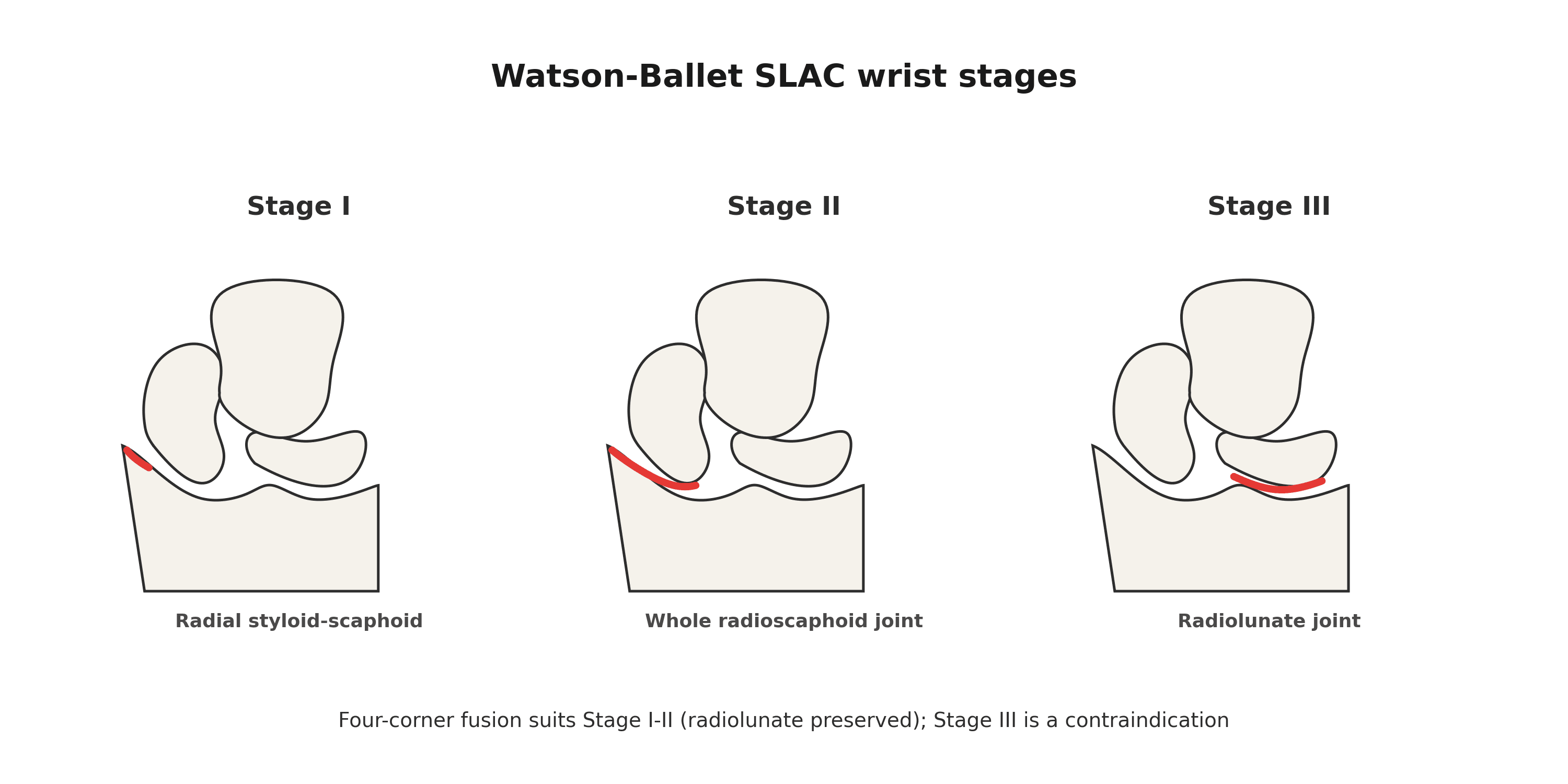
SNAC staging, and why it differs. SNAC has its own three-stage pattern analogous to SLAC but driven by a scaphoid-waist nonunion rather than scapholunate failure:
- SNAC I - arthritis between the radial styloid and the distal scaphoid fragment
- SNAC II - arthritis extends to the scaphocapitate joint
- SNAC III - arthritis involves the capitolunate (periscaphoid midcarpal) joint
Because the fracture is at the waist, the proximal scaphoid fragment stays congruent in the scaphoid fossa, so the proximal-pole radioscaphoid articulation and the radiolunate joint are spared longer than in SLAC. A SNAC wrist can therefore still have a usable radiocarpal joint when the midcarpal joint is destroyed. As in SLAC, the radiolunate joint must be preserved for four-corner fusion to be appropriate; if it is involved, choose PRC or total wrist fusion.
Indications.
- SLAC wrist stages I and II from chronic scapholunate ligament insufficiency, with preserved radiolunate joint and intact lunocapitate cartilage - the most common indication
- SNAC wrist with arthritis confined to the scaphoid articulations and preserved radiolunate joint
- Chronic scapholunate instability with secondary degenerative changes, unsuitable for ligament reconstruction
- Scaphoid nonunion with secondary arthritis and a viable proximal pole that is unsalvageable
- A patient who desires motion preservation and understands the expected functional outcomes
- A patient willing to comply with prolonged immobilisation and rehabilitation (6-12 weeks protected mobilisation)
Relative indications. Late-stage Kienbock disease with carpal collapse where radiolunate preservation is possible, and Preiser disease (avascular necrosis of the scaphoid) with secondary arthritis.
Contraindications. The radiolunate joint decides it. If that joint is arthritic (SLAC stage III), fusing the four corners does not remove the pain source and the operation will not relieve pain however well the fusion heals; such a patient needs PRC, if the capitate head cartilage is intact, or total wrist arthrodesis. The rest of the list:
- Inflammatory arthritis (rheumatoid, psoriatic)
- Capitate head cartilage loss, which reduces the point of 4CF over PRC
- Active infection
- Severe osteoporosis (poor fixation)
- Unwillingness to comply with immobilisation
- Pre-existing CRPS
Choosing between 4CF, PRC and total wrist arthrodesis. The decision runs on two joints, the radiolunate and the capitate head, and on what the patient asks of the wrist.
- Best option
- Scaphoid excision and four-corner fusion
- Reasoning
- Preserves radiolunate motion; retains native lunocapitate joint for better load transfer; grip strength advantage over PRC in some studies
- Best option
- Proximal row carpectomy (PRC)
- Reasoning
- Removes the arthritic proximal row entirely; capitate articulates with lunate fossa of radius; simpler procedure, faster recovery, lower complication rate
- Best option
- Total wrist arthrodesis
- Reasoning
- Eliminates all wrist motion but provides reliable pain relief and stability; gold standard for end-stage arthritis; most reliable for heavy labourers
- Best option
- Scaphoid excision and four-corner fusion
- Reasoning
- In SNAC, the radioscaphoid joint may be preserved (unlike SLAC); the midcarpal joint around the scaphoid is destroyed; 4CF addresses the pathology while preserving radiocarpal joints
Wrist denervation as an alternative. Total or partial wrist denervation answers "what else could you offer?". It relieves pain by interrupting the joint's afferent innervation without altering bone, cartilage or motion: the classic Wilhelm procedure divides up to ten articular nerve branches, but the practical, commonly performed version is a combined anterior and posterior interosseous neurectomy (AIN + PIN) through one or two small incisions. Its appeal is that it preserves the entire range of motion and grip, is low-morbidity and burns no bridges, since 4CF, PRC or fusion all remain possible later.
It suits a patient with painful SLAC/SNAC arthritis who wants to keep maximal motion, a poor candidate for major reconstruction, or as an adjunct. It does not address the underlying mechanical collapse, and pain relief is variable and may diminish over time; a diagnostic local-anaesthetic block of the AIN and PIN that abolishes the pain helps predict who will benefit.
Relevant Anatomy and Biomechanical Principles
Two rows. The wrist functions as two carpal rows. The proximal row (scaphoid, lunate, triquetrum) is an intercalated segment with no direct tendon insertions, moving passively in response to forces transmitted through the distal row; the distal row (trapezium, trapezoid, capitate, hamate) is rigidly interconnected and moves as a unit.
The scaphoid link. The scaphoid is the mechanical keystone bridging the two rows, and it is what prevents the lunate from extending into a DISI position. When the scapholunate ligament ruptures or the scaphoid fractures and does not unite, the link is lost: the scaphoid flexes and collapses into a vertical position, the lunate extends into dorsiflexed intercalated segment instability (DISI), the capitate migrates proximally and the carpus collapses in a predictable pattern.
Why the radiolunate joint survives. The degeneration in SLAC follows the loss of scaphoid support: the flexed scaphoid raises contact pressures at the styloscaphoid and radioscaphoid joints, and arthritis follows. The lunate fossa of the radius is a concave, spherical articulation matched to the proximal convexity of the lunate, with a large contact area and low contact pressure, and the lunate stays congruent within it even as it extends into DISI. After 4CF that joint becomes the sole remaining articulation between forearm and carpus, and the fused capitate-lunate-hamate-triquetrum mass transmits load through the lunate into the fossa.
The four corners.
- Capitate - the largest carpal bone, centred in the distal row; its proximal pole articulates with the lunate, and the capitolunate interface must fuse for the procedure to succeed
- Lunate - the keystone of the proximal row; its proximal surface articulates with the radius (preserved) and its distal surface with the capitate (must fuse)
- Hamate - articulates with the triquetrum and the capitate; including it gives lateral stability and more surface area for fusion
- Triquetrum - articulates with the lunate and hamate; some surgeons leave it out (three-corner fusion), but including it adds stability and does not significantly reduce motion
What the wrist is left with. Fusing the midcarpal joint removes midcarpal motion, so only radiolunate motion remains and the fused mass pivots on the radiolunate joint as a single block: a stable but mobile wrist.
- Flexion-extension arc approximately 50-60% of normal (approximately 40-60 degrees in total)
- Radioulnar deviation approximately 50% of normal
- Grip strength typically approximately 65-80% of the contralateral side
Retaining the native lunocapitate joint is the argument that 4CF may give better grip than PRC. The comparative evidence on this page is mixed: the Wyrick series found grip better after PRC, and the Mulford systematic review found it similar between the two (see Evidence Base).
Internervous Plane and Surgical Interval
Incision. A longitudinal dorsal skin incision centred over Lister tubercle, extending approximately 6-8 cm from the distal radius to the midcarpal region. Lister tubercle is the key landmark on the dorsal radius, sitting between the second and third compartments.
Interval. The approach is developed between the third (extensor pollicis longus) and fourth (extensor digitorum communis / extensor indicis proprius) dorsal compartments. EPL is identified at its oblique course around Lister tubercle, where it must be protected, and retracted radially; the EDC and EIP tendons are retracted ulnarly. Extensor carpi radialis brevis and longus lie deep to the second compartment on the radial side and may be retracted radially.
PIN neurectomy. The terminal branch of the posterior interosseous nerve is found on the floor of the fourth compartment and is sacrificed routinely as part of the operation, giving a partial wrist denervation that contributes to pain relief. A segment of approximately 1-2 cm is resected to prevent neuroma formation at the resection site. The motor branch to the extensor muscles leaves proximally and is not at risk.
Capsule. The dorsal wrist capsule is incised longitudinally and the capsular flaps elevated to expose the carpus from the distal radius to the midcarpal row. The dorsal radiocarpal and dorsal intercarpal ligaments are divided for access; some surgeons attempt repair at closure.
Reaching the radial styloid. The incision can be extended radially to reach the styloid for styloidectomy, or a separate radial incision used to avoid extensive dorsal dissection.
Patient Positioning and Setup
Position and anaesthesia. Supine with the arm extended on a hand table, a padded tourniquet on the upper arm, and the limb draped free so the wrist can be flexed, extended and rotated. General or regional anaesthesia (axillary or supraclavicular brachial plexus block); a block gives excellent post-operative analgesia and allows the fingers to move early.
Tourniquet. Exsanguinate and inflate to approximately 250 mmHg. Release it before closure to assess haemostasis, particularly around the dorsal radial artery branches.
Fluoroscopy. Essential. The image intensifier is positioned for PA, lateral and oblique views, which confirm that the scaphoid excision is complete, the lunate is reduced (DISI corrected), the hardware sits where intended and the styloidectomy is adequate.
Instruments and graft. A standard hand surgery tray, osteotomes, rongeurs, K-wires (0.045 and 0.062 inch) and the chosen fixation device: circular plate set, headless compression screws, or K-wires alone. Cancellous autograft comes from the distal radius, through the same dorsal incision or a separate radial styloid window, or from the excised scaphoid, whose healthy portions make excellent local autograft; some surgeons use bone substitute or allograft.
Surgical Technique
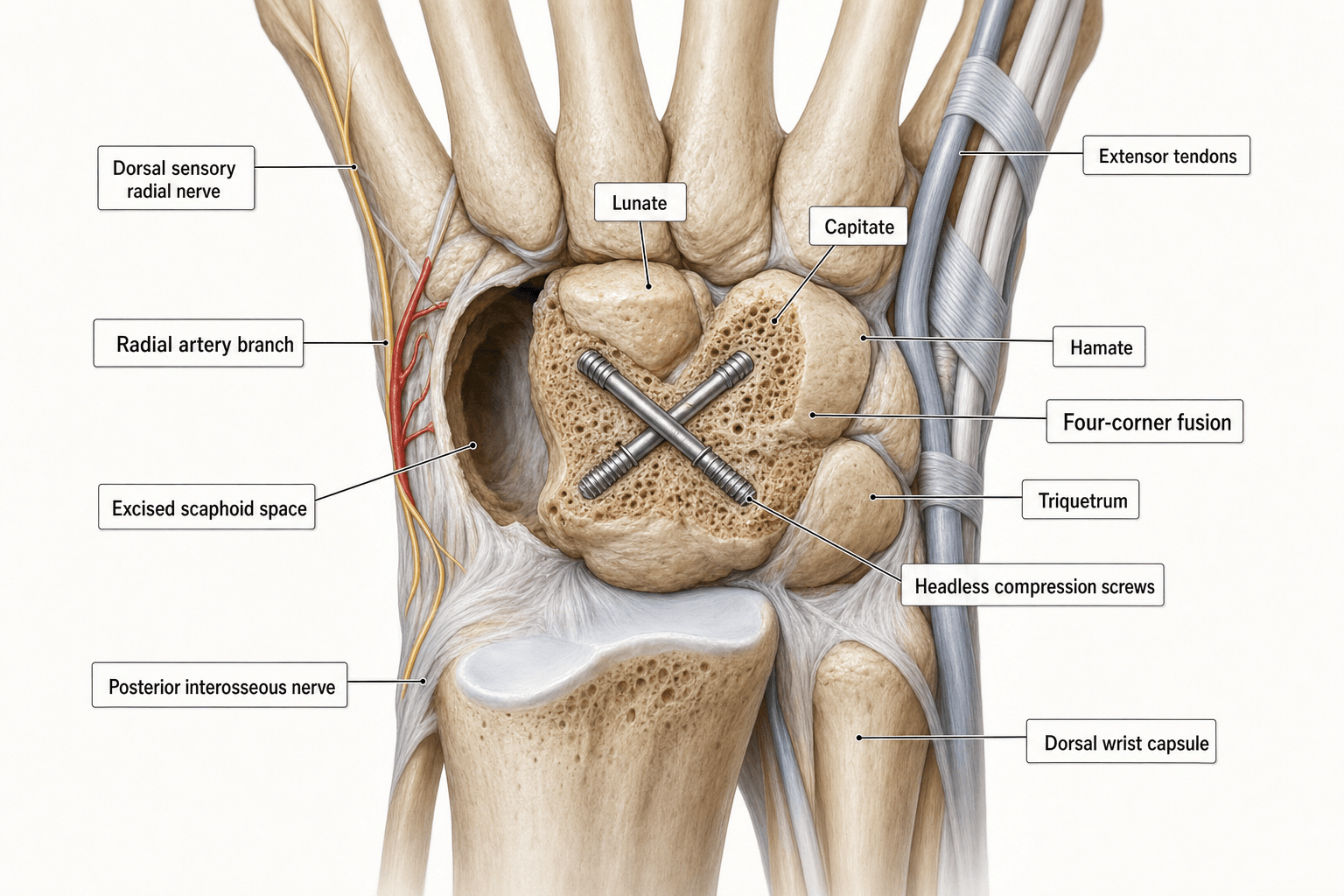
Exposure. The dorsal approach above: third and fourth compartments opened, EPL and EDC retracted, the PIN segment excised, and the capsule opened longitudinally.
Scaphoid excision. The scaphoid is identified and taken out progressively with osteotomes, rongeurs and a curette, and the excised bone is saved for local autograft. Excision must be complete, since any residual fragment can cause persistent impingement and pain; confirm it fluoroscopically in more than one view. The scaphoid fossa of the radius is inspected to confirm it is free of significant arthritis.
Radial styloidectomy. Approximately 3-5 mm of the radial styloid is resected with an oscillating saw or osteotome so that the fused carpus does not impinge on it in radial deviation. Protect the volar radiocarpal ligaments, particularly the radioscaphocapitate ligament: too much styloidectomy destabilises the carpus.
Lunate reduction. The lunate is brought out of its extended DISI position into neutral or slight flexion and held there with a 0.045 inch K-wire into the radius before any definitive fixation goes in.
A lunate left in DISI leaves the fused carpal mass impinging on the dorsal rim of the radius in extension: dorsal impingement, a severely limited arc, and a stiff, painful wrist despite a successful fusion. Failure to correct the DISI is a common technical error.
Fusion site preparation. Articular cartilage is denuded from the lunocapitate, lunotriquetral, capitohamate and triquetrohamate joints with curettes, rongeurs and a burr, down to bleeding cancellous bone, and the subchondral bone is perforated to promote bleeding and fusion. Cancellous autograft is packed into the interfaces; graft from the excised scaphoid is usually sufficient, supplemented with distal radius autograft if bone quality is poor or the scaphoid was sclerotic. Trimming the dorsal rims of the lunate and capitate reduces the risk of dorsal impingement against the radius.
Before closure. Fluoroscopy in PA, lateral and oblique views confirms complete scaphoid excision, adequate styloidectomy, neutral lunate alignment and the position of the fixation. The capsule is closed where possible and the extensor retinaculum repaired.
Fixation. Three options.
The gold standard, with the highest published union rates. Multiple 0.045-0.062 inch K-wires are driven across the fusion mass, typically one from capitate to lunate, one from hamate to lunate, one from triquetrum to lunate and one from capitate to hamate. The pins are cut flush or buried subcutaneously, and the temporary lunate-to-radius wire is retained for 4-6 weeks. The price is protected immobilisation for 6-8 weeks.
Structures at Risk and Complications
Four-corner fusion has a significant complication profile: overall complication rates of approximately 10-30% in published series, with reoperation in approximately 10-20%.
Nonunion. The most significant complication and the commonest reason for reoperation, and its rate depends on the fixation: approximately 3-5% with K-wires, approximately 5-10% with headless compression screws, and up to 15-30% with circular plates in some series, attributed to the plate preventing compression across the fusion surfaces. Not every series finds that gap: Erne's comparison of K-wires, locking plates and retrograde headless screws found nonunion low and not significantly different between groups (see Evidence Base). The other risk factors are inadequate cartilage denudation, poor bone grafting, smoking and insufficient fixation. It presents as persistent wrist pain and may need revision fusion or conversion to total wrist arthrodesis.
Dorsal impingement. The fused carpal mass, or prominent hardware on top of it, meets the dorsal rim of the radius in wrist extension. It causes pain at terminal extension and is a common cause of persistent post-operative symptoms; prevention is adequate dorsal rim trimming, a lunate reduced out of DISI, and low-profile fixation.
Hardware. Prominent dorsal hardware, especially a circular plate, irritates the extensor tendons, causes tenosynovitis and rarely ruptures a tendon; EPL rupture has been reported with prominent hardware. Circular plates are removed in approximately 10-30% of cases. K-wires may back out or cause pin-tract infection, and dorsal dissection with hardware can leave adhesions that limit finger and wrist extension.
Progressive radiolunate arthritis. The radiolunate joint is preserved at surgery, but it degenerates radiographically in most patients over the long term, and by far more than is often quoted. In the originating institution's minimum-10-year review (mean 18 years) 73% showed minimal-to-moderate radiolunate joint destruction and 27% severe, radiographic change in essentially everyone. The reassuring half is what matters clinically: function was preserved regardless, with a mean QuickDASH of 7.8 and only one patient scoring above 16. So expect the radiograph to deteriorate, counsel the patient that it usually does not track with symptoms, and do not revise a comfortable, functioning wrist on the strength of the film alone; only a minority ultimately require conversion to total wrist arthrodesis. Read that series with its main limitation in view: only 15 of 489 wrists were available for follow-up, a heavily selected 3%.
Other complications.
- Radial styloid impingement - an inadequate styloidectomy leaves the styloid meeting the fused carpus in radial deviation; pain on radial deviation, and possibly a revision styloidectomy
- CRPS - approximately 2-5%; early finger mobilisation, adequate analgesia and early hand therapy are preventive
- Infection - superficial wound infection in approximately 1-3%; deep infection requiring implant removal is rare
- Residual stiffness - the expected arc is the 40-60 degrees described above, and a patient who expects full motion will be disappointed, which is why pre-operative counselling is essential
- Nerve irritation - the PIN branch or the superficial radial nerve branches, from the dorsal dissection or from hardware prominence; the dorsal approach puts the superficial radial nerve branches at risk, and a neuroma causes dorsal wrist and hand dysaesthesia
PINCHComplications of Four-Corner Fusion - PINCH
Hook:After 4CF, watch for PINCH complications: Pseudarthrosis, Impingement, Nerve irritation, CRPS/stiffness, Hardware problems
Guidelines, Registries and Global Practice
There is no single universal guideline for four-corner fusion; practice follows evidence-based principles of carpal arthritis staging and motion-preserving surgery. Several international hand surgery societies have published consensus statements and recommendations:
- ASSH (American Society for Surgery of the Hand): four-corner fusion and PRC are both recognised as motion-preserving options for SLAC/SNAC wrist stages I-II. The choice depends on the condition of the radiolunate and capitate head cartilage, patient demands, and surgeon experience.
- BSSH (British Society for Surgery of the Hand): guidelines support limited wrist arthrodesis as a motion-preserving alternative to total wrist fusion in appropriately selected patients with SLAC/SNAC arthritis. Patient counselling about expected motion and grip strength outcomes is emphasised.
- FESSH (Federation of European Societies for Surgery of the Hand): European practice generally favours four-corner fusion over PRC for patients with high functional demands, reflecting a preference for retaining the lunocapitate articulation. However, the evidence does not strongly favour one over the other.
- Large institutional series from the Mayo Clinic, Virginia Hand Center, and European centres confirm approximately 85-95% union rates with K-wire fixation and approximately 70-80% union rates with circular plates.
- Conversion to total wrist arthrodesis after failed 4CF is commonly quoted at around 10-15% at 10 years. Do not present this as equivalent to PRC without qualifying it. In the direct comparative series cited above, 3 of 17 four-corner fusions failed and were converted to total wrist fusion with a further 2 awaiting conversion, against no failures at all in the proximal row carpectomy group - which is why those authors made PRC their procedure of choice except where capitolunate arthritis forbids it. The systematic review makes the same asymmetry in gentler terms: PRC lacks the complications specific to 4CF (nonunion, hardware problems, dorsal impingement), while its own trade-off is a significantly higher rate of subsequent radiographic osteoarthritis - most of it asymptomatic at review. The honest summary is that the two procedures fail in different ways, not at identical rates.
- Patient satisfaction scores are generally high (approximately 75-90% satisfied or very satisfied) in patients who achieve union.
- European hand surgeons have historically been more aggressive in performing limited wrist fusions compared with North American surgeons, who have tended toward PRC as the simpler first-line option for SLAC/SNAC wrist. This gap is narrowing as evidence accumulates.
- Japanese hand surgery literature has contributed significantly to understanding carpal kinematics after limited fusion, with several biomechanical studies from Japanese centres.
- In low- and middle-income settings, both PRC and K-wire four-corner fusion are valued as reliable, low-cost procedures that avoid the need for expensive implants.
- The trend away from circular plates toward K-wires or headless compression screws is now widespread in high-volume hand surgery centres globally, driven by the higher complication rates of dorsal plating.
- The choice between 4CF and PRC remains one of the most debated topics in hand surgery. Neither procedure has been shown to be clearly superior in high-quality randomised trials.
- PRC is simpler, faster, has a lower complication rate, and provides slightly better motion. 4CF may provide marginally better grip strength by retaining the native lunocapitate joint.
- Most surgeons now select based on: (1) radiolunate joint status (if arthritic, PRC or TWA), (2) capitate head cartilage (if arthritic, 4CF rather than PRC), (3) patient demands and expectations, and (4) surgeon experience and comfort with each technique.
Clinical Decision Scenarios
Practise clinical reasoning and management decisions out loud
“A 52-year-old right-hand-dominant mechanic presents with progressive right wrist pain and stiffness over 3 years. He recalls a fall on the outstretched hand approximately 10 years ago that was treated in a splint for 2 weeks. PA and lateral wrist radiographs show a dorsiflexed lunate (DISI), narrowing of the radioscaphoid joint with osteophytes, and a preserved radiolunate joint. The scaphoid appears shortened. Discuss your management.”
“A 45-year-old woman underwent scaphoid excision and four-corner fusion with a circular plate 14 months ago for SLAC II wrist. She reports persistent dorsal wrist pain, worse with extension, and has limited wrist extension to 20 degrees. Radiographs show a fused carpal mass with the circular plate prominent dorsally, and the lunate appears slightly extended. There is no lucency at the fusion interfaces. How would you manage her?”
One-liner
- Motion-preserving limited wrist arthrodesis for SLAC/SNAC arthritis: excise the scaphoid, fuse capitate-lunate-hamate-triquetrum, preserve the radiolunate joint
- Based on Watson and Ballet SLAC classification; appropriate for stages I and II with preserved radiolunate joint
SLAC staging
- Stage I: styloscaphoid arthritis (radial styloid-scaphoid)
- Stage II: entire radioscaphoid arthritis
- Stage III: radiolunate arthritis (contraindication for 4CF)
- Radiolunate preservation is the prerequisite for 4CF
Indications
- Failed scapholunate ligament (SLAC)
- Os scaphoideum nonunion (SNAC)
- Uninvolved radiolunate joint (mandatory)
- Retained motion desired by patient
Contraindications
- Radiolunate arthritis (SLAC III)
- Inflammatory arthritis (RA, psoriatic)
- Capitate head cartilage loss
- Active infection, severe osteoporosis
Fixation options
- K-wires: gold standard, lowest nonunion rate (3-5%), requires 6-8 weeks immobilisation
- Circular plate: higher nonunion rate (up to 15-30%), dorsal impingement risk
- Headless compression screws: emerging, low profile, promising early results
Surgical steps
- Dorsal approach between 3rd and 4th compartments
- PIN neurectomy (partial denervation)
- Complete scaphoid excision
- Radial styloidectomy (3-5 mm)
- Reduce lunate from DISI to neutral
- Denude four-corner joints, bone graft, fix
Complications (PINCH)
- Pseudarthrosis / nonunion (most significant)
- Impingement (dorsal, from plate or residual DISI)
- Nerve irritation (PIN branch, superficial radial)
- CRPS / stiffness
- Hardware problems (plate prominence, tendon irritation)
4CF vs PRC
- 4CF: better grip strength, retains lunocapitate joint, higher complication rate, more complex surgery
- PRC: simpler, faster recovery, better motion, lower complication rate, slightly less grip strength
- Choice: check radiolunate joint and capitate head cartilage; individualise based on patient demands
Outcomes
- Flexion-extension arc approximately 40-60 degrees (50-60% of normal)
- Grip strength approximately 65-80% of contralateral
- Union rate approximately 85-95% with K-wires
- Conversion to TWA approximately 10-15% at 10 years
- Patient satisfaction approximately 75-90% when union achieved
Evidence Base
Watson and Ballet - The SLAC Wrist: Scapholunate Advanced Collapse Pattern of Degenerative Arthritis
- In a review of 4,000 wrist radiographs, Watson and Ballet identified 210 cases of degenerative wrist arthritis after excluding other arthritides. The most common pattern (57%) was arthritis between the scaphoid, lunate, and radius - the SLAC pattern; 27% occurred at the scaphoid-trapezium-trapezoid (STT) joint; a combination pattern was seen in 15%. Twenty operations were performed on 19 SLAC patients, with 18 of 19 reporting less pain postoperatively and none requiring pain medication. Flexion-extension and radial-ulnar deviation arcs improved considerably after surgery.
Wyrick, Stern and Kiefhaber - Motion-Preserving Procedures in the Treatment of Scapholunate Advanced Collapse Wrist: Proximal Row Carpectomy Versus Four-Corner Arthrodesis
- In a retrospective comparison of 17 four-corner arthrodesis patients (mean 27-month follow-up) and 10 patients with 11 proximal row carpectomies (mean 37-month follow-up) for SLAC wrist, PRC achieved a greater total arc of motion (115 degrees = 64% of opposite wrist) than 4CF (95 degrees = 47% of opposite wrist). Grip strength was also better after PRC (94% of opposite wrist) than after 4CF (74%). Three of 17 4CF wrists failed and were converted to total wrist fusion, with two more awaiting arthrodesis; there were no failures in the PRC group.
Erne, Broer, Weiss, Loew, Cerny, Schmauss and Ehrl - Four-Corner Fusion: Comparing Outcomes of Conventional K-Wire, Locking Plate, and Retrograde Headless Compression Screw Fixations
- Retrospective comparison of 64 four-corner fusions over 5 years: 21 K-wires, 26 locking plates, and 17 retrograde headless compression screws. All three groups showed significant improvements in grip strength, pain at rest and with activity, wrist range of motion, and DASH scores. Overall complication and nonunion rates were low and not significantly different between groups. However, the headless compression screw group had significantly better postoperative pain with activity, dorsal flexion, and DASH scores than the K-wire group.
Mulford, Ceulemans, Nam and Axelrod - Proximal Row Carpectomy vs Four Corner Fusion for Scapholunate (SLAC) or Scaphoid Nonunion Advanced Collapse (SNAC) Wrists: A Systematic Review of Outcomes
- A systematic review collated 52 articles examining outcomes for SLAC or SNAC wrists treated with PRC or 4CF. Both procedures improved pain and subjective outcomes in appropriately staged patients. PRC may provide better postoperative range of movement and lacks the 4CF-specific complications of nonunion, hardware problems, and dorsal impingement. However, the risk of subsequent osteoarthritis was significantly higher after PRC (although the majority were asymptomatic at the time of review). Grip strength, pain relief, and subjective outcomes were similar in both groups.
Traverso, Wong, Wollstein, Carlson, Ashmead and Watson - Ten-Year Minimum Follow-Up of 4-Corner Fusion for SLAC and SNAC Wrist
- Of 489 wrists that underwent 4CF for SLAC between 1982 and 2003 at the originators' institution, 15 wrists in 12 patients were available for 10-year minimum follow-up (mean 18 years). Mean flexion-extension arc was 68.6 degrees and radial-ulnar deviation arc 32.9 degrees. Mean QuickDASH was 7.8 (only 1 score above 16). 73% of radiographs showed minimal to moderate joint destruction and 27% severe. Patient satisfaction was high and functional impairment was low despite radiographic radiolunate changes in most patients.