AIN Palsy | FPL/FDP Index/PQ Weakness | No OK Sign | Median Nerve Branch
- AIN is pure motor branch of median nerve, no sensory fibres
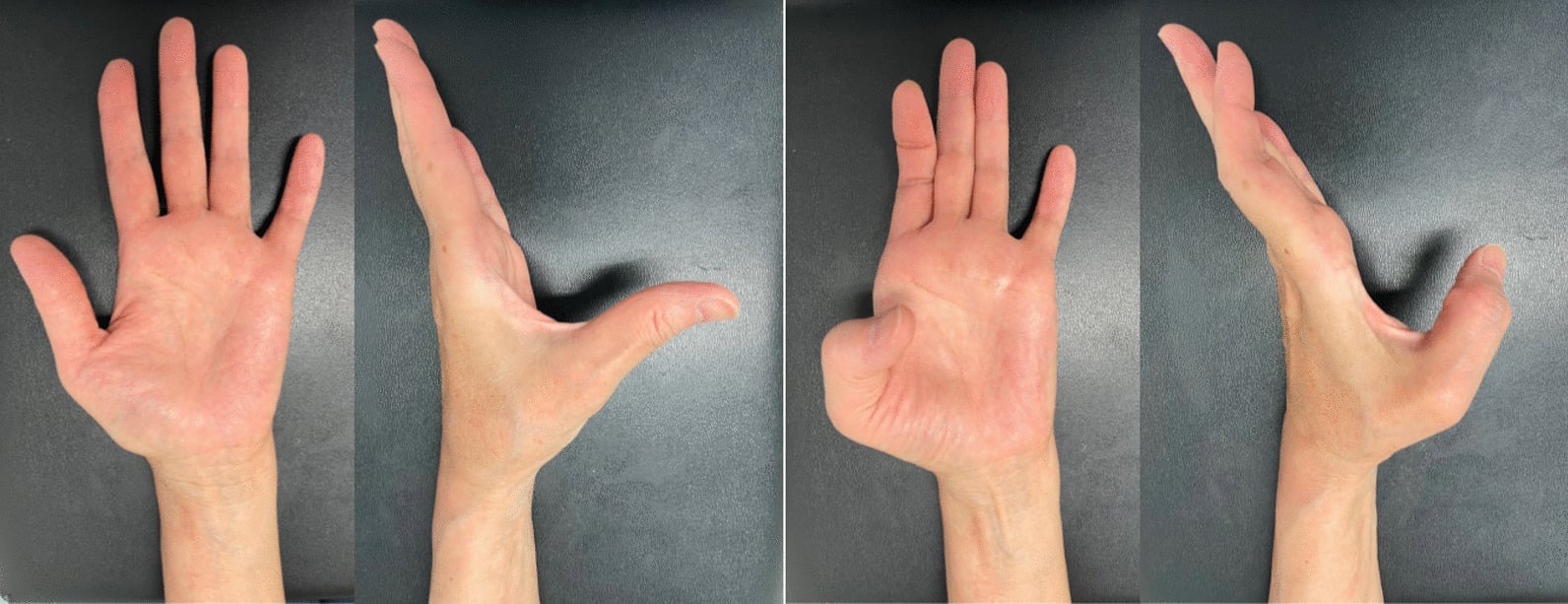
- Classic sign: inability to make OK sign due to weak FPL and FDP index
- Pronator quadratus weakness tested by resisted pronation with elbow flexed
- Most cases are neuritis (observation first), surgery for compression or no recovery
- Differentiate from Parsonage-Turner by absence of pain and other nerve involvement
- “AIN palsy = weak pinch, normal sensation in median distribution
- “OK sign tests both FPL (IP thumb) and FDP index (DIP index)
- “Parsonage-Turner often has preceding severe shoulder pain
- “Surgical decompression considered after 4-6 months without recovery in a compressive or post-traumatic palsy; neuritis is observed for 12-18 months
Overview and Epidemiology
Scope note. This page covers the AIN syndrome as a clinical entity — presentation, differential diagnosis (including Parsonage-Turner), and management. For the nerve's detailed surgical anatomy, anatomical variants and relations, see anterior interosseous nerve anatomy.
The nerve. The anterior interosseous nerve is the pure motor terminal branch of the median nerve. It leaves the median nerve 5-8 cm distal to the lateral epicondyle, passes between the heads of pronator teres and under the arch of flexor digitorum superficialis, and supplies flexor pollicis longus, the radial half of flexor digitorum profundus (index and middle fingers) and pronator quadratus. It carries no cutaneous sensory fibres, which is why the palsy produces no numbness.
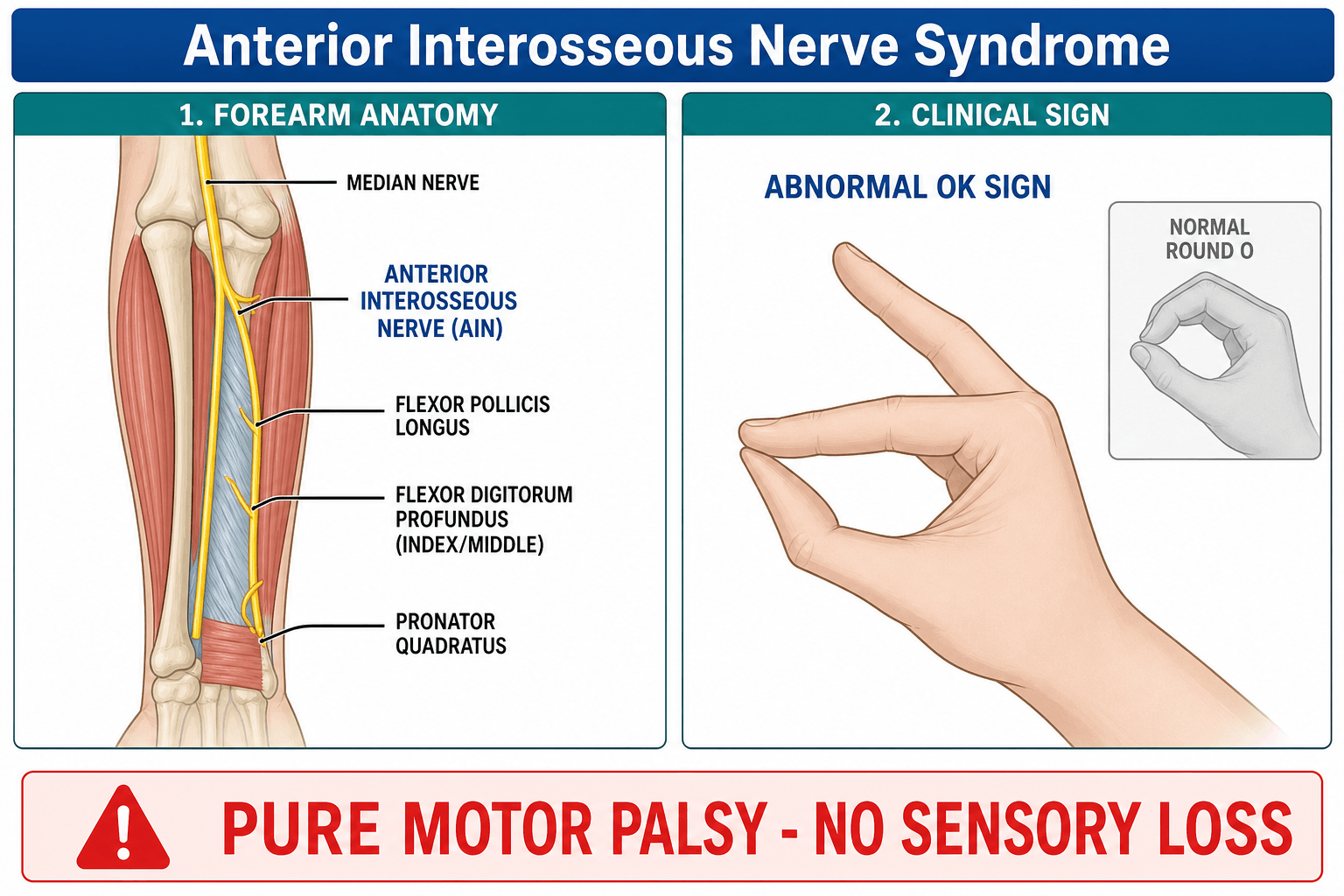
Why it matters. The deficit is a weak pinch, which costs the patient fine motor and occupational tasks. Because there is no sensory loss the diagnosis is frequently missed or delayed, and that same normal sensation is what separates the condition from carpal tunnel syndrome and pronator syndrome. Recognising it prevents unnecessary median nerve exploration at the wrist and frames the real decision, observation versus surgery: the majority resolve with observation alone, and the surgeon is balancing the chance of spontaneous recovery against denervation atrophy.
Pathophysiology
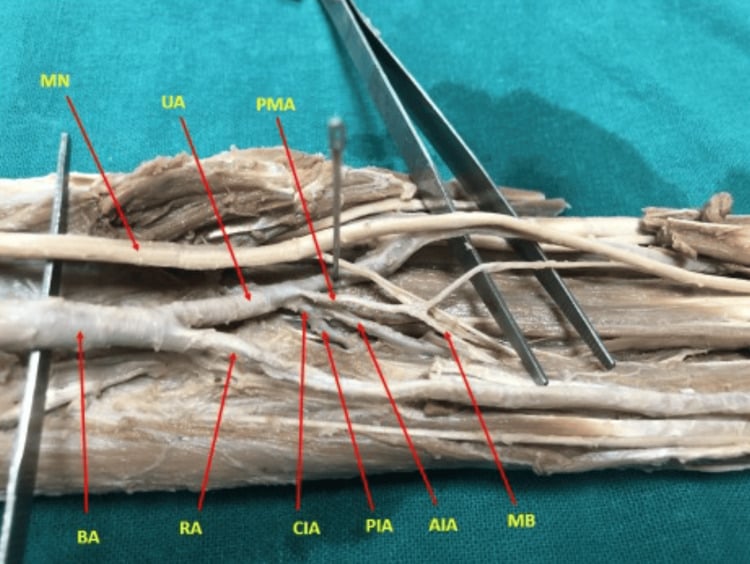
The deep course. The AIN runs with the volar interosseous artery on the interosseous membrane, deep between the flexor pollicis longus and flexor digitorum profundus that it supplies, while the median nerve lies more superficially. Its whole course lies under muscle, which is why compression here produces motor loss with no skin sensory change.
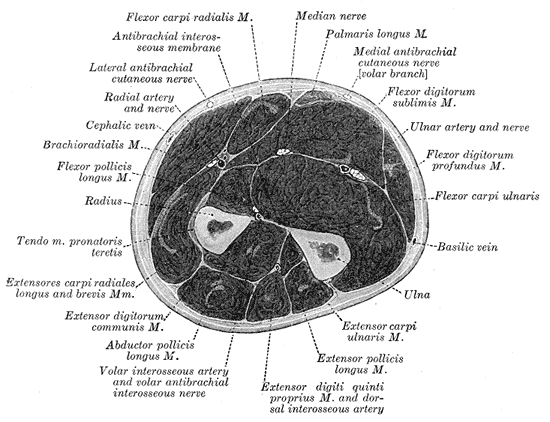
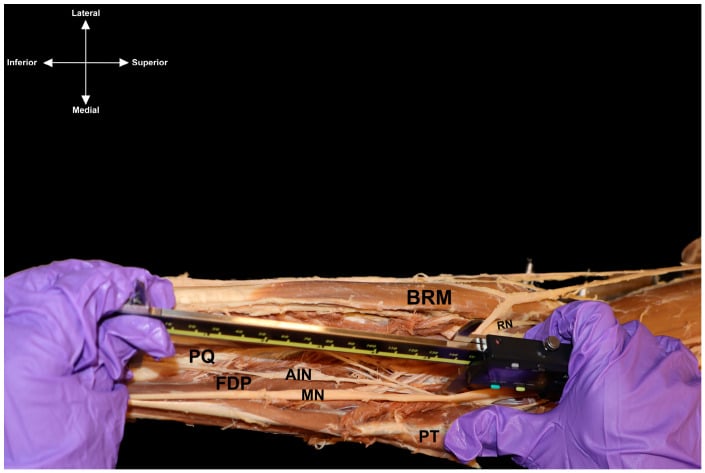
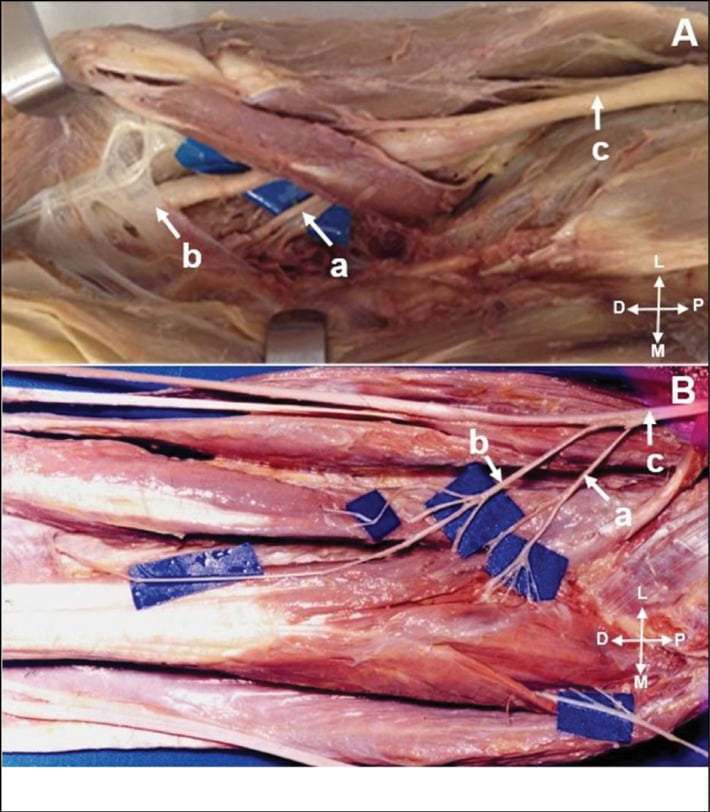
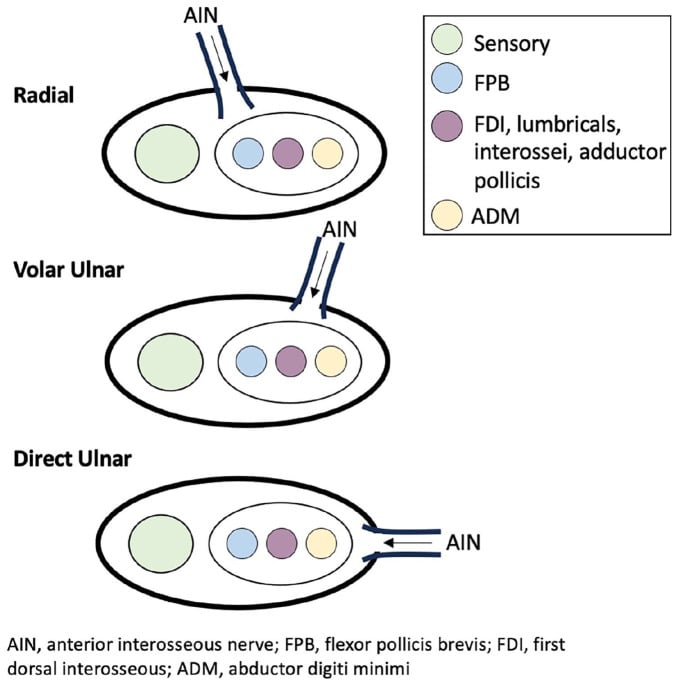
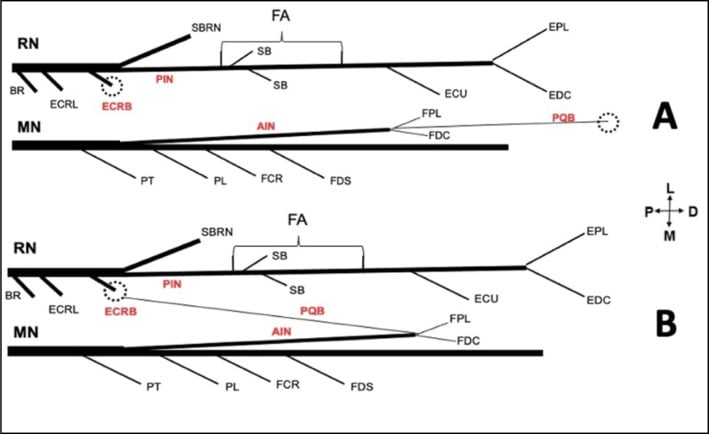
Branch order. The AIN typically arises beneath pronator teres, passes between its heads, then divides distal to the FDS arcade into two FDP branches, one or two FPL branches and a terminal pronator quadratus branch. A lesion proximal to that division takes all three muscles; a distal one may spare FDP. Some nerves ramify proximal to the FDS arcade, and in a minority two separate AIN branches leave the median nerve; partial palsies affecting only FPL or only the index FDP follow this branching rather than a partial compression.
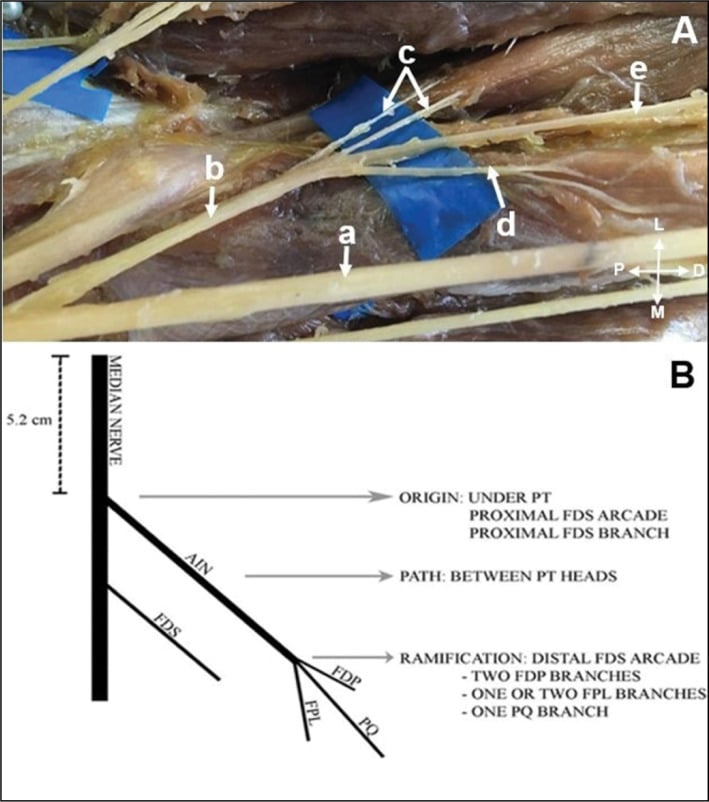
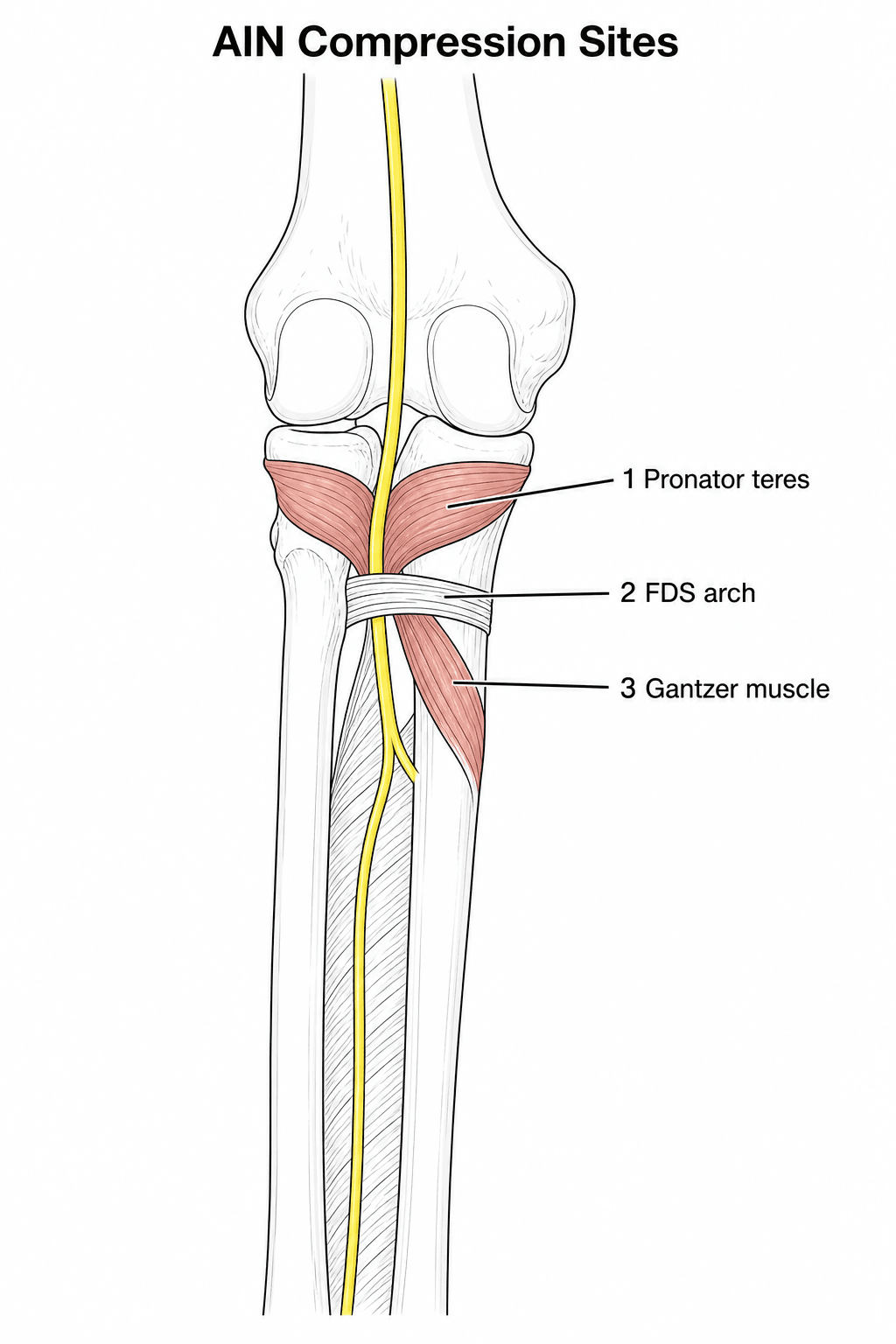
Where it is compressed. The nerve can be compressed at multiple points along its course. Unlike carpal tunnel syndrome, the compression is usually focal, and the nerve distal to the lesion remains normal. The most common sites:
- the fibrous arch of pronator teres, between its two heads (the most frequent site)
- the proximal edge of the flexor digitorum superficialis arch
- an accessory head of flexor pollicis longus (Gantzer muscle)
- rarely, the ligament of Struthers or a thrombosed radial artery
Mechanisms. The recognised causes:
- Neuritis, the most common: post-viral or idiopathic, a self-limiting axonal degeneration
- Compression by anatomical fibrous bands or muscle variants
- Trauma: supracondylar fracture, forearm fracture, iatrogenic injury
- Inflammatory, as part of a brachial plexitis (Parsonage-Turner)
Classification and Types
Identifying the underlying mechanism guides the duration of observation versus the timing of exploration.
- Mechanism
- Post-viral or inflammatory
- Key Features
- Often painless or mild ache, isolated AIN
- Recovery Potential
- Excellent, spontaneous
- Mechanism
- Brachial plexitis variant
- Key Features
- Severe preceding shoulder pain, multiple nerves
- Recovery Potential
- Good but slower, 6-18 months
- Mechanism
- Fibrous bands, Gantzer muscle
- Key Features
- Insidious or post-traumatic, no pain
- Recovery Potential
- Variable, may need decompression
- Mechanism
- Fracture, laceration, iatrogenic
- Key Features
- Clear history, often complete lesion
- Recovery Potential
- Depends on nerve continuity
Clinical Assessment
History. Ask about onset, acute after a viral illness or insidious with compression, and about pain: severe shoulder pain suggests Parsonage-Turner, a mild forearm ache suggests compression. The rest of the history:
- Function: difficulty with pinch, buttoning, writing, using scissors
- Trauma: a previous supracondylar or forearm fracture
- Systemic: recent vaccination, infection or inflammatory condition
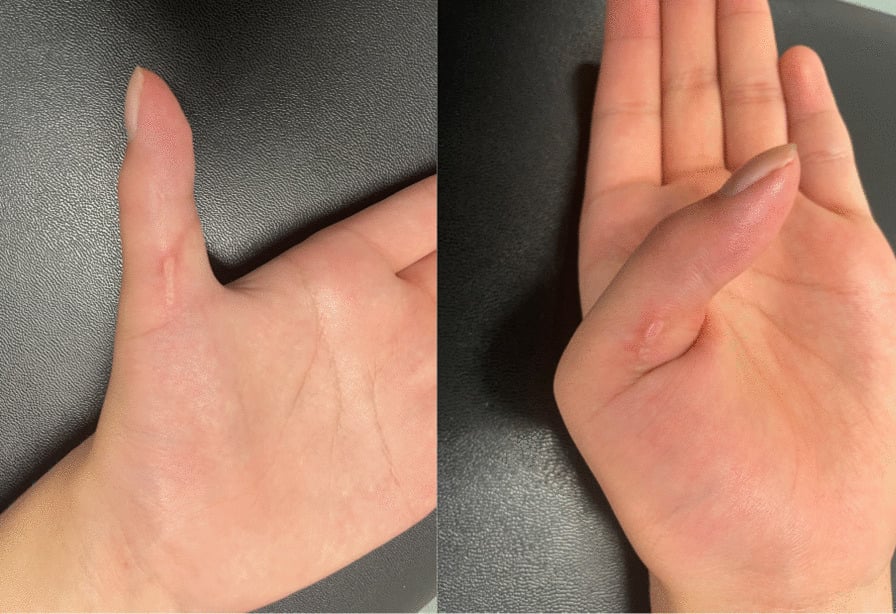
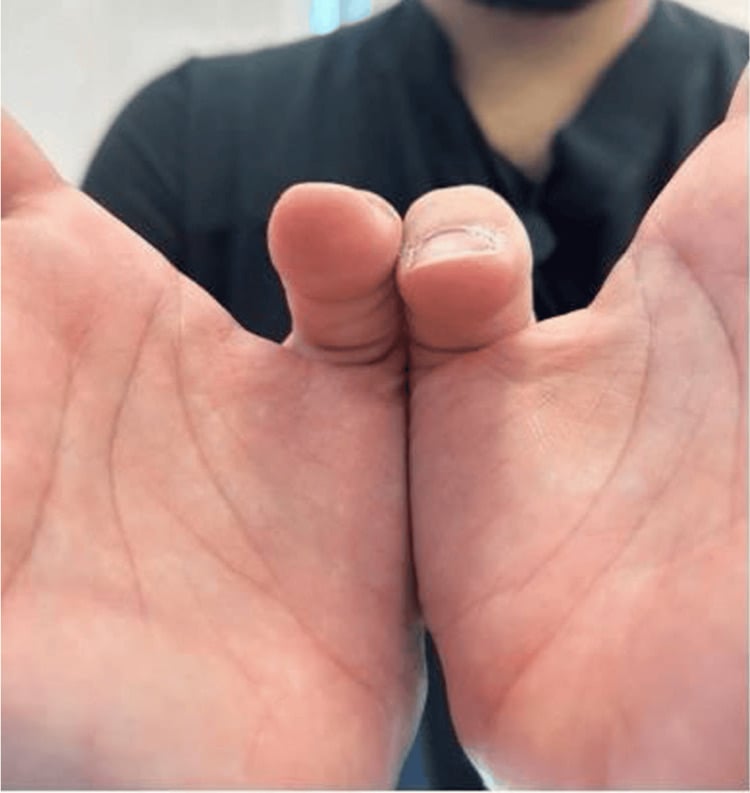
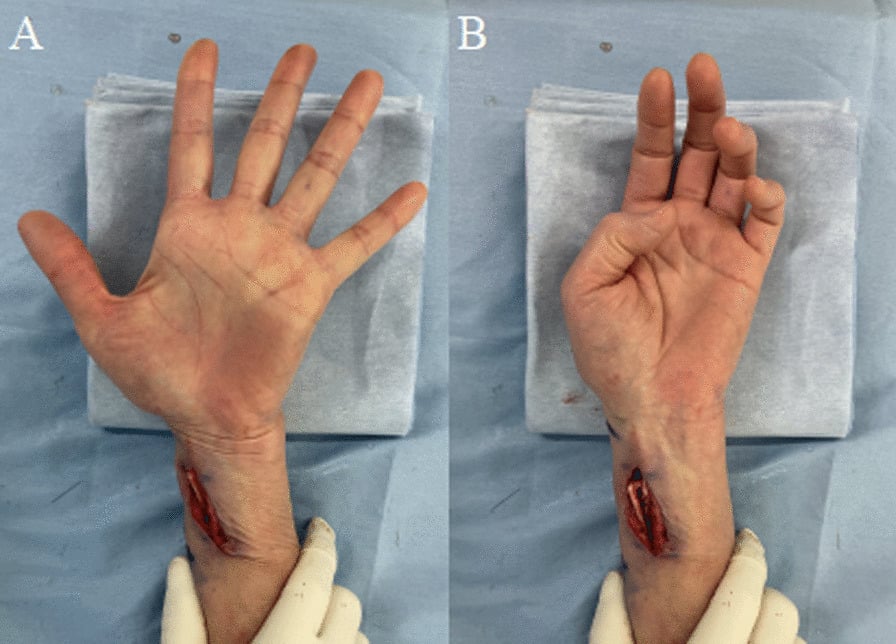
The OK sign. With the forearm supinated, ask the patient to touch the tip of the thumb to the tip of the index finger to form a perfect O, then apply gentle resistance to the thumb IP and index DIP while watching the posture. FPL flexes the thumb IP joint and FDP index flexes the index DIP joint, and both are needed for a true tip-to-tip circle; when either or both are weak the patient substitutes a key pinch, thumb pad against the radial side of the index, and the circle goes flat. A positive test is inability to maintain tip-to-tip contact, with the thumb IP and index DIP remaining extended or hyperextended, and it confirms combined FPL and FDP index weakness. Isolated FPL weakness may still allow a partial circle with index compensation. With sensation intact, the flat OK sign is pathognomonic.
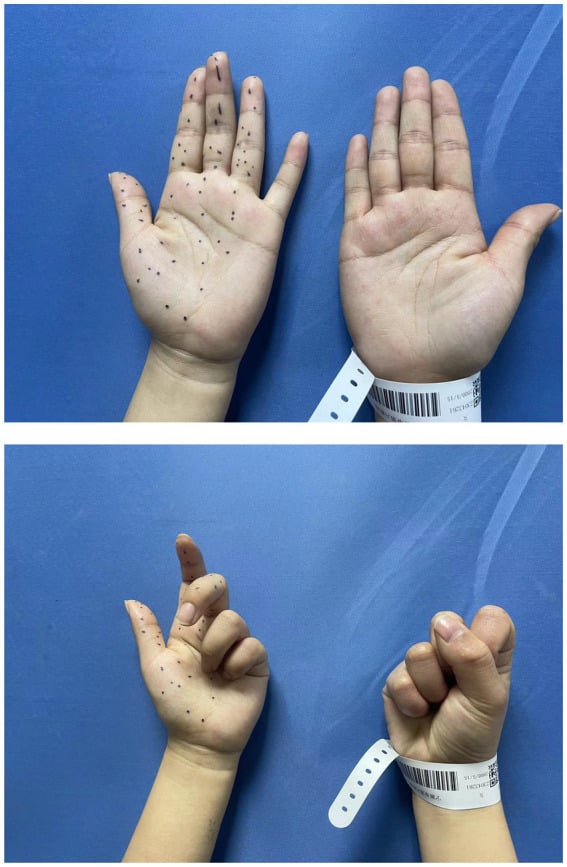
Muscle by muscle. Grade each muscle against the other side, then confirm that sensation and the other nerves are intact:
- FPL: thumb IP flexion against resistance, graded 0-5 and compared with the other side; weakness is positive
- FDP index: DIP flexion of the index alone, compared with the middle finger, which should be normal
- Pronator quadratus: resisted pronation with the elbow flexed to 90 degrees, which isolates it from pronator teres; weakness indicates AIN
- Sensation: light touch and two-point discrimination are normal in the median distribution; any sensory deficit there suggests a more proximal median neuropathy or separate pathology
- Other nerves: screen radial, ulnar and the remaining median-innervated muscles (PT, FCR, FDS) to exclude a plexitis
AIN Syndrome versus Pronator Syndrome
The two median-nerve entrapments of the proximal forearm are constantly confused and are a favourite exam pairing. The discriminator is sensory involvement and the muscles affected.
- AIN syndrome
- AIN (pure motor terminal branch)
- Pronator syndrome
- Main median nerve trunk in the forearm
- AIN syndrome
- NORMAL (no cutaneous fibres)
- Pronator syndrome
- Altered — palmar cutaneous branch (thenar/palm) and median digital territory
- AIN syndrome
- FPL, FDP index, pronator quadratus (OK-sign failure)
- Pronator syndrome
- May involve all median muscles incl. FCR, FDS, thenar; AIN muscles variably
- AIN syndrome
- Minimal or none
- Pronator syndrome
- Aching volar forearm pain, worse with activity
- AIN syndrome
- OK sign, resisted pronation (PQ)
- Pronator syndrome
- Pain/paraesthesiae on resisted pronation (PT), resisted long-finger FDS, or resisted elbow flexion-supination (lacertus)
- AIN syndrome
- Absent
- Pronator syndrome
- Usually absent (helps separate from carpal tunnel, which is nocturnal)
Why the sensation differs. Pronator syndrome has sensory symptoms and forearm pain because the whole median trunk is involved, including the palmar cutaneous branch, which arises proximal to the carpal tunnel. That branch is also what separates pronator syndrome from carpal tunnel syndrome: it runs superficial to the flexor retinaculum, so it is spared in carpal tunnel, and pronator syndrome lacks the night symptoms that carpal tunnel produces.
AIN syndrome = pure motor, normal sensation. Pronator syndrome = motor plus sensory. If a "weak pinch" patient has any median sensory change, the lesion is the main median trunk (pronator syndrome or more proximal), not the AIN.
Investigations
The diagnosis is clinical. Motor testing of FPL, FDP index and PQ plus intact median sensation is sufficient in most cases, and no imaging is required initially. Do not order an MRI of the forearm as the first test: imaging and electrophysiology are reserved for atypical features, failure to recover, or when surgery is being considered.
Nerve conduction and EMG. When the picture is atypical, neurophysiology confirms axonal loss, excludes a more proximal median lesion and maps involvement of other nerves in Parsonage-Turner. Expect reduced compound muscle action potential amplitudes from FPL and PQ, normal sensory studies, and fibrillation potentials in the affected muscles after 3 weeks. Perform it at 3-4 weeks from onset for maximal sensitivity; an early study (less than 3 weeks) may be falsely negative.
Ultrasound or MRI. When compression is suspected, imaging can show fibrous bands, a Gantzer muscle, nerve swelling or a space-occupying lesion. The findings are nerve enlargement proximal to the compression site and loss of the fascicular pattern. A normal study does not exclude neuritis or subtle compression.
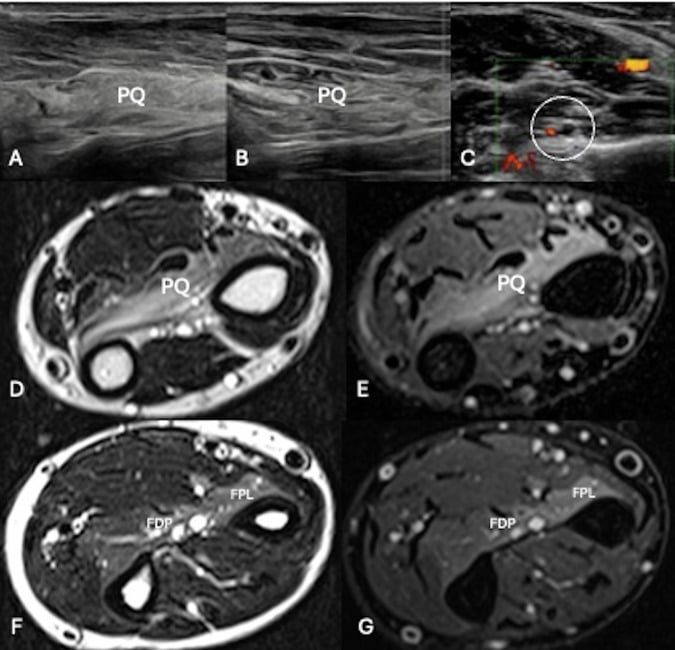
Radiographs. With a history of trauma, take AP and lateral views of the elbow and forearm and look for supracondylar fracture callus, forearm fracture malunion or anomalous bone.
Hourglass Fascicular Constriction and Neuralgic Amyotrophy
A major shift in understanding is that many spontaneous "AIN palsies" are not extrinsic compressions at all, but intrinsic fascicular lesions within the neuralgic amyotrophy (Parsonage-Turner) spectrum.
What imaging shows. High-resolution ultrasound and MRI increasingly demonstrate one or more hourglass-like constrictions, sometimes frank fascicular torsion, of the AIN fascicles, often located proximal to the elbow within the median nerve itself rather than a discrete band at a classic compression site. The Maldonado-type re-analysis (see Evidence Base) found that presumed "isolated AIN" lesions frequently show more diffuse, proximal median-nerve fascicular involvement on careful EDX/MRI review, with no radiological sign of compression, supporting an inflammatory rather than entrapment mechanism in many cases.
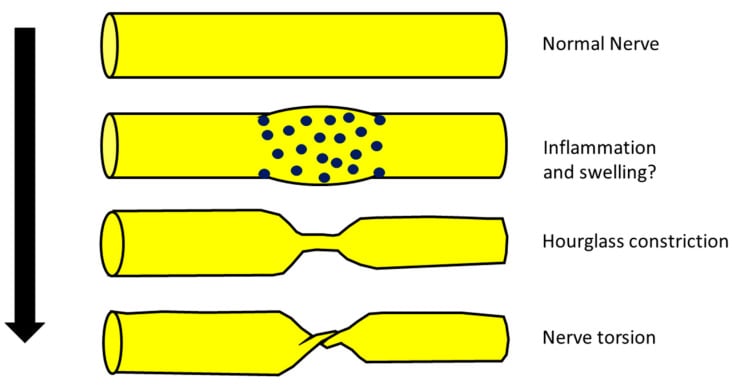
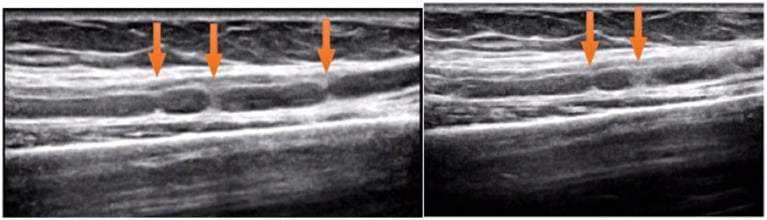
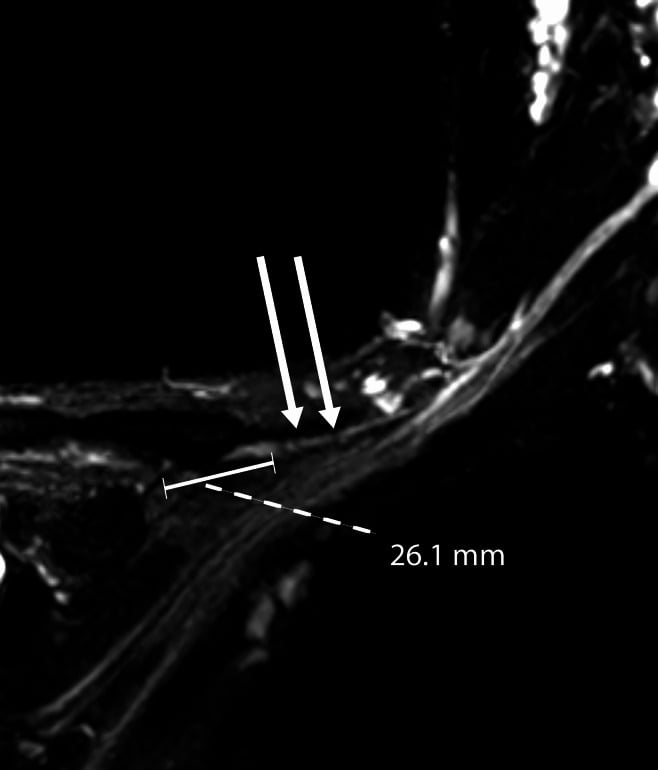
Why it matters surgically. If exploration for a presumed entrapment finds a normal nerve at the classic compression sites, the lesion may be an intrinsic constriction more proximally, and a simple decompression will not help. For a demonstrated hourglass constriction that fails to recover, the described options are interfascicular neurolysis, or resection of the constricted segment with nerve grafting or fascicular transfer, fundamentally different from a release. This is the AIN analogue of the same phenomenon seen in PIN palsy, and it explains why the results of simply decompressing spontaneous cases are unpredictable.
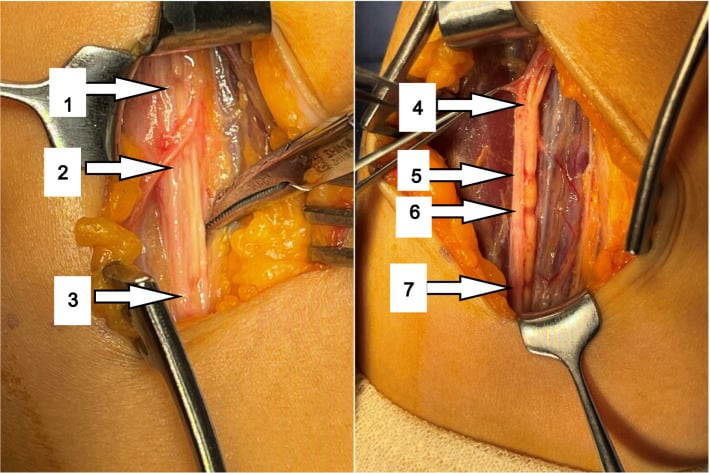
Image the whole nerve, not just the forearm: the lesion behind a spontaneous palsy may sit within the median nerve proximal to the elbow.
Management Algorithm
The goal. Observation is first line for most cases: allow spontaneous axonal regeneration while monitoring for recovery.
Observation Protocol
Confirm an isolated AIN motor deficit, document baseline strength grades and counsel on the natural history.
Repeat the OK sign and the FPL, FDP index and PQ grading, and photograph the pinch posture for comparison. Any improvement means observation continues.
Baseline EMG if not already performed, repeated at 3-4 months to assess reinnervation. Nascent motor units indicate ongoing recovery.
There is no single timer; the threshold depends on why the nerve failed. Partial recovery that is still progressing means keep observing, whatever the clock says.
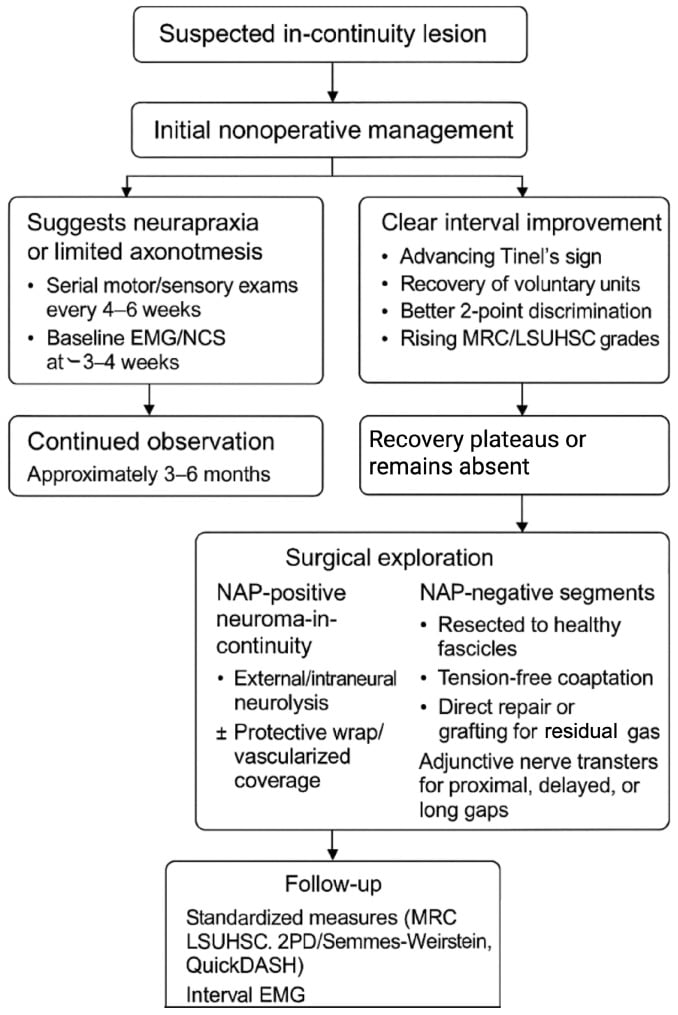
There is no single observation period. Several different thresholds circulate for this condition and all of them are defensible for the group they came from, which is exactly why quoting one flat number is the commonest error. The variable is why the nerve failed, and secondarily whether the deficit is complete or partial.
- Observe for
- 12-18 months
- Reasoning
- This is the neuralgic amyotrophy spectrum. Decompression is rarely helpful because there is no extrinsic compressor to release, and useful recovery continues out to 18 months
- Observe for
- About 12 weeks before considering exploration of a completely paralysed muscle-tendon unit
- Reasoning
- Paresis usually improves spontaneously; a single unit with complete paralysis that has not moved by 3 months is the subgroup Hill identified as worth exploring
- Observe for
- 4-6 months
- Reasoning
- There is a structural cause to remove and nothing is gained by waiting; late decompression does worse
- Observe for
- Keep observing
- Reasoning
- Ongoing reinnervation overrides the calendar - operating interrupts a recovery already under way
Most spontaneous recoveries occur between 3 and 9 months, and the decision to explore is individualised on age, occupation, EMG evidence of denervation versus reinnervation, and patient preference. The trap is applying the compressive 4-6 month threshold to a neuritis, which is the larger group: an operation at 4 months finds a normal nerve and changes nothing. Establish the aetiology first, then choose the clock.
Complications
- Incidence
- 10-20 percent if no recovery by 12 months
- Risk Factors
- Delayed diagnosis, age greater than 50, complete lesion
- Management
- Tendon transfer if no recovery: BR or ring FDS to FPL for the thumb, plus side-to-side FDP tenodesis for the index
- Incidence
- 30-40 percent of operated cases
- Risk Factors
- Greater than 12 months delay, severe axonal loss
- Management
- Realistic pre-op counselling essential
- Incidence
- Common if sensory symptoms attributed incorrectly
- Risk Factors
- Failure to test OK sign and PQ
- Management
- Re-explore median nerve at elbow level
- Incidence
- 5-10 percent of transfers
- Risk Factors
- Adhesions, over-tensioning, donor weakness
- Management
- Revision surgery or therapy
The most common error is a carpal tunnel decompression in a patient with an isolated AIN palsy. These patients have normal sensation and normal thenar bulk, so always perform the OK sign test and PQ testing before listing any patient for carpal tunnel surgery. A normal sensory study in the presence of a motor deficit should raise suspicion of AIN pathology.
Outcomes and Prognosis
- Observation Success
- 80-90 percent full or near-full recovery
- Surgical Success
- Rarely required
- Long-term Function
- Excellent pinch strength
- Observation Success
- 70-85 percent useful recovery by 18 months
- Surgical Success
- Not indicated
- Long-term Function
- Mild residual weakness common
- Observation Success
- Variable without surgery
- Surgical Success
- 70-80 percent improvement
- Long-term Function
- Good if less than 9 months delay
- Observation Success
- Poor spontaneous recovery
- Surgical Success
- 40-60 percent improvement
- Long-term Function
- Often residual lag, consider transfer
Prognostic factors. The best prognosis belongs to the young patient with a partial lesion, early improvement within 3 months, and an idiopathic neuritis. The poor prognostic markers are age over 50, a complete lesion at presentation, more than 12 months of delay to surgery, and Parsonage-Turner with widespread involvement.
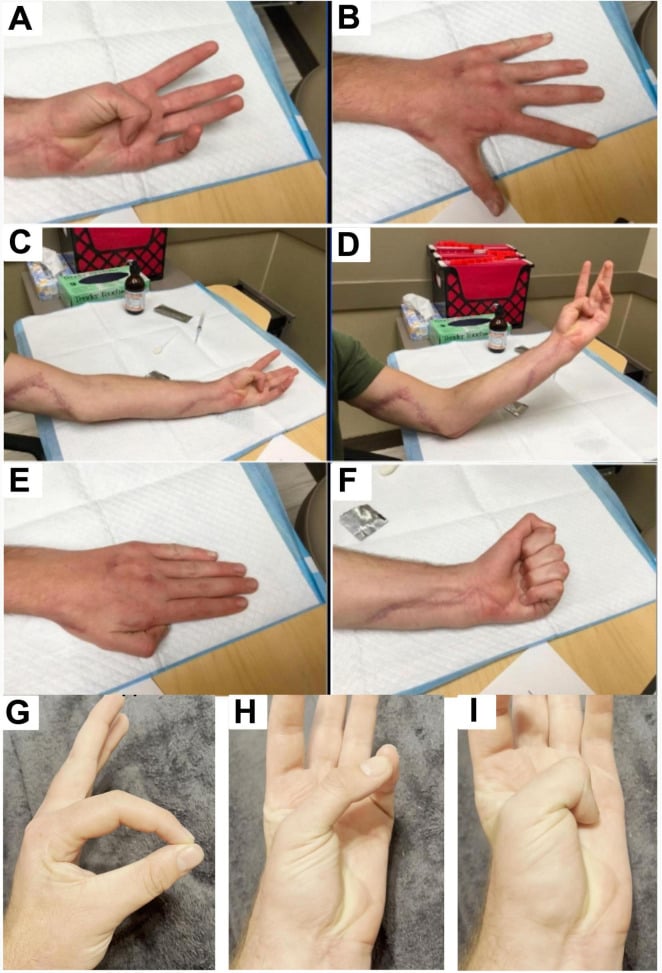
When the nerve does not recover. Tendon transfer restores the missing action. The result is judged on function rather than electrodiagnostic improvement, and a durable result depends as much on the postoperative regime as on the operation: protected motion first, with unrestricted loading only once the tendon junction has healed.
Guidelines, Registries & Global Practice
- AIN palsy is uncommon but frequently under-diagnosed worldwide because of the pure motor presentation
- Neuritis predominates in all regions, often post-viral
- Compressive cases are reported more in high-resource centres with access to EMG and ultrasound
- Parsonage-Turner incidence appears similar across populations
- High-resource: Early EMG, serial ultrasound, hand therapy monitoring, microsurgical decompression available
- Limited-resource: Clinical diagnosis alone, prolonged observation, limited access to nerve surgery
- Universal principle: Outcome depends on accurate diagnosis (OK sign + PQ test) and patience with observation
- Surgery: Concentrated in specialist hand units globally, results better with shorter delay
- Diagnosis emphasis
- OK sign + PQ testing, normal sensation
- Observation duration
- 3-6 months minimum, up to 12 months for neuritis
- Surgery indications
- No recovery + compressive features on imaging/EMG
- Diagnosis emphasis
- Clinical diagnosis, EMG for confirmation and prognosis
- Observation duration
- At least 6 months, longer if EMG shows reinnervation
- Surgery indications
- Plateau at 6-9 months in clear entrapment
- Diagnosis emphasis
- High index of suspicion, exclude Parsonage-Turner
- Observation duration
- Individualised, 4-12 months typical
- Surgery indications
- Failed observation, patient preference, occupation
- Diagnosis emphasis
- Consider in all median nerve injuries around elbow
- Observation duration
- Not specifically addressed
- Surgery indications
- Exploration in open injuries or fracture-related
There is no dedicated registry for AIN syndrome. Evidence is limited to retrospective case series and anatomic studies. The consistent message across guidelines is that the majority of cases are neuritis and recover spontaneously. Surgery is reserved for clear compressive pathology or failure to progress after adequate observation. Documentation of the OK sign test and serial motor grades is essential worldwide.
Controversies & Areas of Uncertainty
Most authors recommend 6-12 months, but the exact point at which surgery becomes futile is not defined by high-quality data. Some units operate at 4 months while others wait 18 months for neuritis. Patient age, occupation and EMG trajectory guide individual decisions.
Ultrasound can demonstrate nerve swelling and dynamic compression but is operator-dependent. MRI better visualises muscle denervation and occult masses but is more expensive. Neither changes management in straightforward neuritis.
Transfer is reliable for permanent AIN loss but timing is debated. Some surgeons offer it at 12 months while others wait 18-24 months. The decision balances irreversible atrophy against the small chance of very late reinnervation.
Reconstruct BOTH lost units, not just the thumb. AIN palsy costs thumb IP flexion (FPL) and index DIP flexion (FDP-index), and the second is routinely forgotten:
- For the thumb (FPL): brachioradialis to FPL is the classic - an expendable donor with an excellent line of pull and good synergy, though its short excursion means the wrist must be mobilised to gain amplitude. Ring-finger FDS to FPL is the alternative, with better excursion but at the cost of a working flexor.
- For the index (FDP-index): no transfer is usually needed - a side-to-side tenodesis of the index FDP to the adjacent middle-finger FDP lets the intact ulnar-innervated profundus drive the index DIP. It is simple, adds no donor morbidity, and is the standard answer.
- Pronator quadratus is not reconstructed; pronator teres preserves pronation, which is why the PQ branch is expendable as a nerve-transfer donor.
When the AIN appears normal at exploration, some surgeons perform proximal median nerve fascicular neurolysis looking for intraneural compression. Evidence for benefit is anecdotal and the procedure risks iatrogenic injury to other fascicles.
MCQ Practice Points
Q: Which muscles are innervated by the anterior interosseous nerve? A: FPL, FDP to index and middle (radial half), and PQ. The AIN is the terminal motor branch of the median nerve. It supplies the deep flexors of the thumb and index (and often middle) finger plus the pronator quadratus. The middle finger FDP may receive dual innervation from the ulnar nerve.
Q: What is the significance of an abnormal OK sign in a patient with normal median sensation? A: It indicates AIN palsy. The OK sign requires simultaneous IP flexion of the thumb (FPL) and DIP flexion of the index (FDP index). Failure produces a flat or key pinch. Normal sensation excludes carpal tunnel syndrome or more proximal median neuropathy.
Q: How do you differentiate AIN syndrome from Parsonage-Turner syndrome? A: Pain history and nerve involvement. Parsonage-Turner features severe shoulder girdle pain preceding weakness and often involves additional nerves (suprascapular, long thoracic). Pure AIN compression is usually painless or has mild forearm ache and remains isolated to AIN muscles.
Q: When is surgical decompression indicated for AIN palsy? A: After 4-6 months of observation with no clinical or EMG recovery in compressive or traumatic cases. Neuritis (including Parsonage-Turner) is observed for at least 12 months. Surgery releases the pronator teres, FDS arch, and any Gantzer muscle or ligament of Struthers.
Q: What is the expected recovery rate for idiopathic AIN neuritis? A: 80-90 percent achieve useful or full recovery with observation alone. Most recovery occurs between 3 and 12 months. Patients over 50 years and those with complete lesions at presentation have poorer prognosis.
Exam Viva Scenarios
Practise clinical reasoning and management decisions out loud
“A 34-year-old office worker presents with 8 weeks of difficulty pinching and writing. She recalls a flu-like illness 3 months ago. She has no forearm pain or numbness. On examination she cannot make an OK sign, FPL and FDP index are grade 3, PQ is weak, and median sensation is normal. What is your diagnosis and management?”
“A 28-year-old man sustained a supracondylar humerus fracture 7 months ago treated with closed reduction and percutaneous pinning. Pins were removed at 6 weeks. He now has persistent inability to flex his thumb IP and index DIP with a flat OK sign. Sensation is normal. EMG at 5 months showed complete denervation of FPL and FDP index with no reinnervation. How would you manage?”
Key Anatomy
- AIN = pure motor terminal branch of median nerve, 5-8 cm distal to lateral epicondyle
- Innervates FPL, FDP index (radial half), and PQ only
- No cutaneous sensory fibres, therefore normal median sensation
- Compression sites: PT arch, FDS arch, Gantzer muscle, ligament of Struthers
Diagnosis
- OK sign failure = inability to flex thumb IP + index DIP simultaneously
- PQ weakness tested by resisted pronation with elbow flexed 90 degrees
- Normal sensation and thenar bulk distinguishes from carpal tunnel
- Parsonage-Turner suspected if severe preceding shoulder pain or other nerves involved
Management Algorithm
- Observation first for 4-6 months in compressive or post-traumatic palsy (12-18 months for neuritis)
- Monthly motor grading + EMG at 3 months and 6 months
- Surgery if no recovery and compressive features or plateau on EMG
- Decompression releases PT, FDS arch, Gantzer, ligament of Struthers
Surgical Pearls
- Henry volar approach, protect lateral cutaneous nerve of forearm
- Release all potential compression points even if nerve looks normal
- Neurolysis or grafting if neuroma-in-continuity found
- Early motion post-op, reinnervation may take 6-12 months
Complications & Salvage
- Permanent weakness if greater than 12 months delay or severe axonal loss
- Tendon transfer (FDS ring to FPL) for failed nerve recovery
- Misdiagnosis as carpal tunnel is common and avoidable
- Incomplete recovery after surgery in 30-40 percent of cases
Evidence Base and Key Trials
The anterior interosseous nerve syndrome
- Classic description of the anterior interosseous nerve syndrome, with particular attention to its anatomical variations
- Emphasised the pure motor deficit (FPL, FDP-index, pronator quadratus) with no sensory loss
- Described compression by fibrous bands of the pronator teres and the flexor digitorum superficialis arch
Gantzer muscle and anterior interosseous nerve compression
- Anatomical study of 25 limbs; Gantzer's muscle (accessory head of FPL) present in 13 (52 percent) and supplied by the anterior interosseous nerve
- Arose from the medial humeral epicondyle in 85 percent (dual epicondyle/coronoid origin in the rest) and inserted onto the ulnar part of FPL
- Gantzer's muscle ALWAYS lay posterior to both the median and anterior interosseous nerves
The incomplete anterior interosseous nerve syndrome
- Series of 33 cases of an INCOMPLETE AIN syndrome - isolated paresis or paralysis of either the flexor pollicis longus OR the index flexor digitorum profundus
- Must be distinguished from flexor tendon rupture, tendon adhesion and stenosing tenosynovitis
- Compression most often by fibrous bands from the deep head of pronator teres and the brachialis fascia
- Recommended observing paresis (most improve spontaneously) and exploring/neurolysing complete paralysis of a muscle-tendon unit only if it fails to improve after 12 weeks
Reinterpretation of Electrodiagnostic Studies and Magnetic Resonance Imaging Scans in Patients with Nontraumatic 'Isolated' Anterior Interosseous Nerve Palsy
- Many presumed isolated AIN palsies show more proximal median nerve or fascicular involvement on reinterpreted EDX/MRI
- True isolated AIN is less common than previously thought; careful imaging review essential
- Changes management by identifying treatable compressive lesions or avoiding unnecessary surgery