Two or More Ligaments | Vascular Assessment Mandatory | Surgical Emergency
- Vascular injury is the life/limb-threatening priority - assess immediately
- ABI less than 0.9 mandates angiography or surgical exploration
- Spontaneous reduction occurs in up to 50% - high index of suspicion
- Timing: Surgery at 1-3 weeks optimal (soft tissue settles, before scarring)
- PCL is key to knee stability - must be addressed in reconstruction
- “Knee dislocation = MLKI until proven otherwise
- “Popliteal artery is tethered at adductor hiatus and soleal arch
- “Common peroneal nerve injury in 25-40% of lateral dislocations
- “Posterolateral corner must not be missed - chronic PLC deficiency = failure
Overview and Epidemiology
A multi-ligament knee injury (MLKI) is injury to two or more of the four major knee ligaments: the ACL, PCL, MCL and LCL/PLC. A knee dislocation is complete loss of tibiofemoral contact, and a knee dislocation is a multi-ligament injury until proven otherwise.
Who. Men outnumber women 3:1 and the peak age is 20-40 years. Motor vehicle accidents are the most common cause (55%), then sports injuries (25%) and falls and industrial accidents (20%).
Mechanism. High-energy trauma (motor vehicle accidents, pedestrian versus car, motorcycle) carries a higher vascular injury rate and polytrauma. Low-energy injuries, from sport (cutting, pivoting, contact, hyperextension) or a simple fall, are usually isolated and the soft tissues are in better condition; the vascular risk is lower but is still checked.
Ultra-low velocity dislocation. Obese patients (BMI greater than 40) can dislocate the knee with minimal trauma, and these injuries are often missed because the mechanism seems trivial. They have similar rates of vascular injury to high-energy mechanisms, so the trivial mechanism is no reassurance: keep a high index of suspicion in an obese patient with multiligament laxity, and complete the vascular assessment.
The reduced dislocation. Up to 50% of dislocations reduce spontaneously before imaging, which is why a high index of suspicion is needed: any multiligament laxity after knee trauma means a dislocation is assumed to have occurred.
Associated injuries. The rates reported with the dislocation:
- Popliteal artery injury: 5-32%
- Common peroneal nerve palsy: 25-40%
- Meniscal tears: 40-50%
- Periarticular fractures (Schenck KD-V): 15-20%
- Tibial plateau or femoral condyle involvement
Anatomy and Biomechanics
Four ligaments. The knee relies on four major ligaments working in concert, and each fails in a recognisable way:
- Primary Function
- Anterior tibial translation, rotational stability
- Failure Leads To
- Giving way, pivot shift
- Primary Function
- Posterior tibial translation
- Failure Leads To
- Posterior sag, quadriceps dysfunction
- Primary Function
- Valgus stability
- Failure Leads To
- Medial opening
- Primary Function
- Varus stability, external rotation control
- Failure Leads To
- Varus thrust, external rotation instability
The PCL. The PCL is the central pillar of knee stability: it is stronger than the ACL and provides the primary restraint to posterior translation. In a multi-ligament injury the quality of the PCL reconstruction correlates strongly with outcome, which is why it is the priority at surgery.
The posterolateral corner. The PLC is a complex of structures providing varus and rotational stability:
- Fibular collateral ligament (FCL/LCL): primary varus restraint
- Popliteus tendon: primary restraint to external rotation at 30 degrees of flexion
- Popliteofibular ligament: links popliteus to the fibular head; a secondary stabiliser
- Lateral capsule: secondary stabiliser
- Arcuate ligament: variable importance
Why the PLC must not be missed. It is the most commonly missed structure, and chronic PLC deficiency causes failure of ACL and PCL reconstructions by increasing the stress on the grafts. It has to be assessed clinically, with the dial test and external rotation recurvatum, and addressed surgically.
The popliteal artery. The artery is at risk because it is tethered at two points, the adductor hiatus proximally and the soleal arch distally, and it travels close to the posterior capsule, so it cannot move away from a displacing tibia. Intimal tears may not be immediately evident.
Two vascular figures, two populations. Popliteal artery injury was reported in 32% of the high-energy dislocations in Green and Allen's 1977 collected series; across all ICD-coded knee dislocations in a modern US database the figure is 1.1%. Both are true of different populations - the low number is diluted by subluxations and spontaneously reduced injuries - so treat the patient in front of you as high risk.
The common peroneal nerve. It wraps around the fibular neck, which is what puts it at risk in lateral dislocations and PLC injuries.
Classification Systems
Schenck's anatomic classification is the most commonly used and the most surgically relevant. Kennedy's, by direction of tibial displacement, is useful for understanding the mechanism, and the time from injury decides whether repair is still possible.
- Pattern
- ACL or PCL intact
- Description
- Single cruciate + collateral(s)
- Pattern
- Bicruciate only
- Description
- ACL and PCL torn, collaterals intact
- Pattern
- Bicruciate + MCL
- Description
- Medial-sided injury
- Pattern
- Bicruciate + LCL/PLC
- Description
- Lateral-sided injury (worse prognosis)
- Pattern
- All four ligaments
- Description
- Complete disruption
- Pattern
- Any + fracture
- Description
- Fracture-dislocation
The suffix C denotes a vascular injury requiring repair.
KD-III-L (lateral pattern) has the worst prognosis because of PLC involvement and a high rate of common peroneal nerve injury (up to 40%). These knees need meticulous PLC reconstruction.
Clinical Presentation and Assessment
History. The mechanism, and the direction of force if it was witnessed, is what tells you the likely pattern. Ask whether the knee was felt to go out or snap back, whether there was gross deformity at the time, and how long ago it happened.
Examination priorities. Before any ligament is tested, the findings that change what happens next:
- Significance
- Popliteal artery injury
- Action
- Immediate vascular surgery consult
- Significance
- Arterial injury likely
- Action
- Angiography or surgical exploration
- Significance
- Unreduced dislocation
- Action
- Reduce urgently under sedation
- Significance
- Common peroneal nerve injury
- Action
- Document, observe, may need exploration
- Significance
- Possible compartment syndrome
- Action
- Compartment pressure measurement
- Significance
- Open dislocation
- Action
- Urgent washout, antibiotics
Vascular assessment. Life before limb, limb before function. Palpate the popliteal, dorsalis pedis and posterior tibial pulses, check capillary refill and calculate the ankle-brachial index, which is normal at more than 0.9. What happens next depends on the finding:
- Action
- Immediate surgical exploration
- Timeframe
- Minutes
- Action
- CT angiography or conventional angio
- Timeframe
- Within 2 hours
- Action
- Serial exams every 6 hours for 48 hours
- Timeframe
- Ongoing
- Action
- Urgent angiography
- Timeframe
- Immediate
The ABI threshold. An ABI below 0.9 is abnormal and requires further investigation. In Mills's prospective series an ABI of 0.9 or above had a 100% negative predictive value, but that was 27 patients with no missed injury, and the confidence interval around a perfect result on numbers that small is wide, so it does not mean the test never misses.
Why a normal ABI buys observation, not discharge. Two things make the point practical. Those patients were verified by serial examination and duplex rather than by arteriography, so a non-occlusive intimal flap could have been present and silent; and the ABI is unreliable in exactly the patients you worry about - peripheral arterial disease, diabetic medial calcification, or an ipsilateral tibial or ankle injury. Serial examination is therefore mandatory, and intimal tears can progress.
Ligament examination. Once the vascular status is confirmed, each ligament is tested in turn:
- Assesses
- ACL
- Positive Finding
- Soft endpoint, increased translation
- Assesses
- PCL
- Positive Finding
- Posterior tibial translation
- Assesses
- MCL
- Positive Finding
- Medial opening
- Assesses
- LCL
- Positive Finding
- Lateral opening
- Assesses
- PLC
- Positive Finding
- External rotation asymmetry more than 10 degrees
- Assesses
- PLC
- Positive Finding
- Hyperextension with external rotation
- Assesses
- PLC
- Positive Finding
- Posterolateral subluxation
Nerve examination. Three nerves are tested and documented:
- Common peroneal: ankle dorsiflexion, toe extension, lateral leg sensation
- Tibial nerve: ankle plantarflexion, toe flexion, plantar sensation
- Saphenous: medial leg and ankle sensation
Differential diagnosis. The acutely unstable or grossly swollen knee after trauma has several mimics. The cardinal point is that a multiligament injury or spontaneously reduced dislocation must be actively excluded, because the others do not carry the same limb-threatening vascular risk.
- Discriminating features
- Laxity in two or more planes, high-energy or ultra-low velocity mechanism, possible foot drop
- Vascular risk
- High - assess immediately
- Key investigation
- ABI then MRI; CT angiography if ABI less than 0.9
- Discriminating features
- Single-plane anterior laxity, positive Lachman, haemarthrosis, pivot shift
- Vascular risk
- Negligible
- Key investigation
- MRI
- Discriminating features
- Posterior sag and posterior drawer only, dashboard mechanism
- Vascular risk
- Low (unless high-energy)
- Key investigation
- MRI, posterior stress radiographs
- Discriminating features
- Lateral patellar displacement, apprehension, medial tenderness, no tibiofemoral laxity
- Vascular risk
- Negligible
- Key investigation
- Skyline radiograph, MRI
- Discriminating features
- Bony tenderness, lipohaemarthrosis, deformity, fracture on radiograph
- Vascular risk
- Moderate (Schatzker patterns)
- Key investigation
- Radiograph then CT
- Discriminating features
- Inability to straight-leg raise, palpable gap, patella alta or baja
- Vascular risk
- Negligible
- Key investigation
- Lateral radiograph, ultrasound or MRI
- Discriminating features
- Fever, no clear mechanism, hot effusion
- Vascular risk
- Negligible
- Key investigation
- Joint aspiration, inflammatory markers
The emergency rule is "reduce urgently", with one classic, examinable exception: the irreducible posterolateral knee dislocation with a dimple (furrow) sign.
In a posterolateral rotatory dislocation the medial femoral condyle buttonholes through the medial capsule and soft tissues and invaginates the overlying medial skin, producing a transverse puckering or dimple over the medial joint line. The dislocation is irreducible, and the sign is a recognised contraindication to repeated forceful closed reduction: traction tightens the invaginated skin and can cause skin necrosis over the medial condyle.
Recognise the dimple, do not persist with closed manoeuvres, and proceed to open reduction, extracting the condyle from the buttonhole, while still completing the vascular assessment, because the limb-threat priority is unchanged.
Investigations
Radiographs. AP and lateral views of the knee, which may show the joint reduced or still dislocated. Look for periarticular fractures and calculate the tibial subluxation. An avulsion fragment names the ligament that pulled it off:
- Fibular head - PLC
- Segond fragment - ACL/PLC
- PCL avulsion
CT. If the reduction is maintained, CT is helpful for fracture assessment. CT angiography is the study of choice for vascular assessment and has largely replaced conventional angiography for initial assessment: it is non-invasive, rapid and highly sensitive, with a sensitivity conventionally quoted as greater than 95% for significant arterial injury in extremity trauma, although no knee-dislocation-specific series cited here measures it. Conventional angiography is reserved for planned intervention.
MRI. MRI is essential for surgical planning. It defines which ligaments are injured, separates repairable from reconstructable injuries, and shows meniscal tears (common), cartilage injury and PLC involvement. It is obtained once the patient is stable and the vascular status confirmed, usually within the first week, and may be limited by swelling initially.
- MRI Finding
- Discontinuity, abnormal signal, edema
- MRI Finding
- Discontinuity, posterior tibial sag on sagittal
- MRI Finding
- Medial soft tissue edema, ligament discontinuity
- MRI Finding
- FCL disruption, popliteus abnormality, arcuate sign
- MRI Finding
- Kissing contusions indicate mechanism
Management
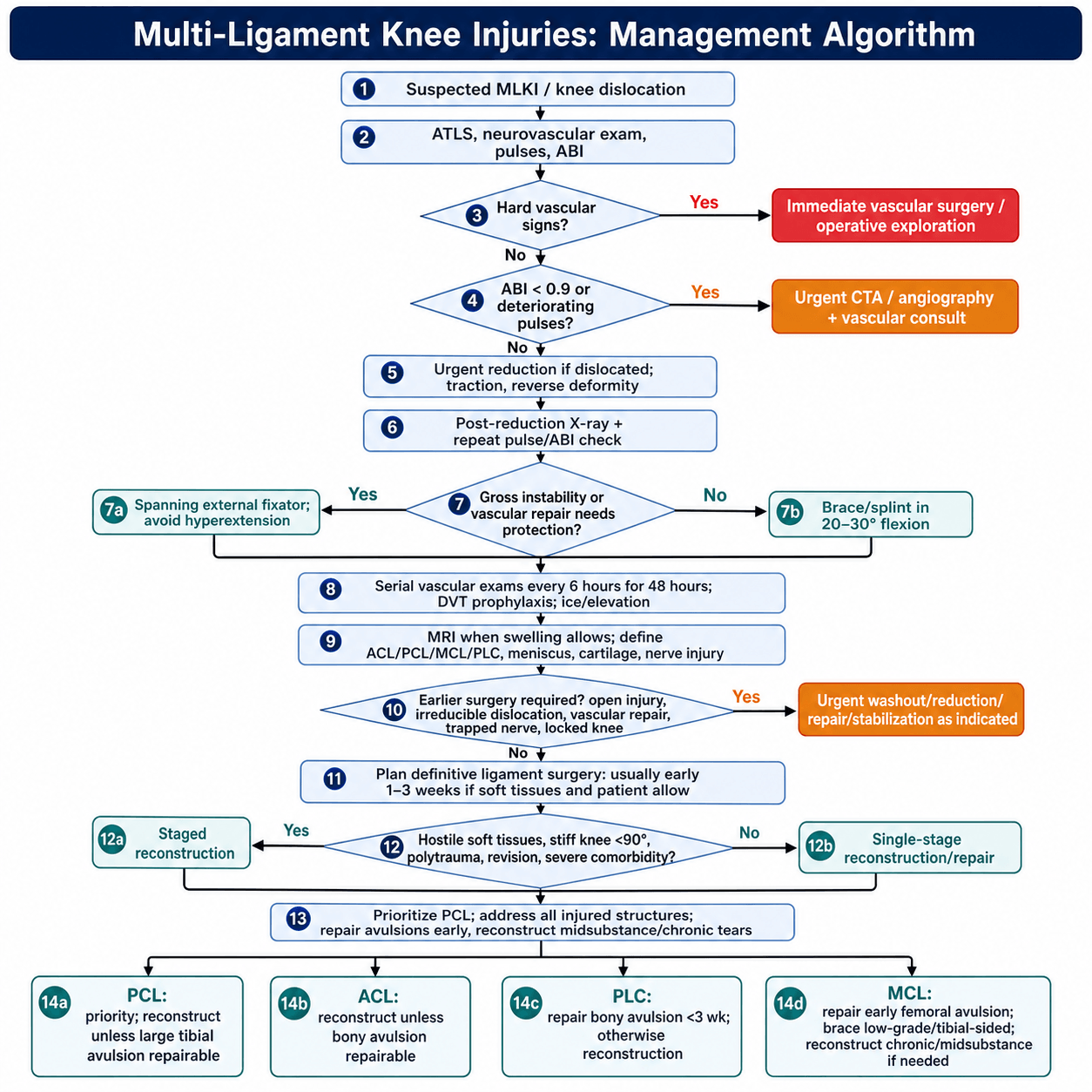
Priorities in the emergency department. Vascular assessment comes first, as set out under assessment, and everything else waits on it. Reduction is second, stabilisation third, and the ligaments are planned last.
Reduction. If the knee is still dislocated, reduce it urgently under sedation with longitudinal traction and reversal of the deformity, then take post-reduction radiographs and check the pulses again.
Stabilisation. Splint in slight flexion, 20-30 degrees, and avoid hyperextension, which stretches a vascular repair. A grossly unstable knee may need a spanning external fixator.
After reduction. Serial vascular examination continues, with ice, elevation and DVT prophylaxis. MRI follows when the swelling allows, and surgical planning follows the MRI.
After reduction the pulses may appear normal but intimal injury can progress. The serial vascular examinations run every 6 hours for at least 48 hours, and any deterioration requires urgent investigation.
Timing. The optimal window is 1-3 weeks from injury: the swelling has settled, the tissues remain identifiable for repair or reconstruction, the capsule has not yet scarred or contracted, and there has been time for MRI planning. Operating in the first week finds identifiable structures but at the cost of swelling and the risk of arthrofibrosis; waiting beyond six weeks allows definitive planning but the scarring means repair is no longer possible. The early window does require a stable patient. Levy's "early" (within three weeks) and Fanelli's "delayed" (two to three weeks) in the evidence base both land on this same window.
Some injuries cannot wait for the window:
- Open injury (urgent washout)
- Irreducible dislocation
- Vascular repair requiring a stable knee
- Trapped nerve requiring release
- Locked knee from a meniscal tear
Others justify delay beyond it: the polytrauma patient requiring stabilisation, severe soft tissue injury requiring a staged approach, or medical comorbidities requiring optimisation.
Goals and principles. Surgery aims to restore knee stability, allow early rehabilitation, prevent arthrofibrosis and optimise long-term function. Every injured structure is addressed, especially the PCL and PLC, with the PCL as the priority. The MCL and some PLC injuries can be repaired; the ACL, PCL and most PLC injuries are reconstructed; and the reconstruction is staged where severe injury, a stiff knee or a revision demands it.
- Repair Possible If
- Femoral avulsion, early presentation
- Otherwise
- Reconstruction
- Repair Possible If
- Bony avulsion within 3 weeks
- Otherwise
- Modified Larson reconstruction
- Repair Possible If
- Large bony avulsion
- Otherwise
- Reconstruction
- Repair Possible If
- Large tibial avulsion
- Otherwise
- Reconstruction
Surgical Technique
The MRI review. Identify every injured structure and decide which are repairable (avulsions) and which are mid-substance tears needing reconstruction; note meniscal and cartilage injury at the same time. Careful preoperative planning prevents intraoperative surprises and ensures all the necessary grafts and equipment are available.
Grafts. Multiple grafts are usually needed. Autograft options are hamstrings, bone-tendon-bone and quadriceps; allograft options are Achilles, tibialis anterior and posterior tibial. Graft availability and patient factors decide the mix.
Positioning. Supine with a leg holder and a lateral post for valgus stress, set up so that the knee can be flexed fully.
"Address all structures" is correct but incomplete: the sequence in which the grafts are fixed and tensioned matters as much, because tensioning in the wrong order leaves a malreduced (subluxed) tibia locked in. A widely used principle:
- Pass/prepare all grafts and drill all tunnels first (before fixing anything), checking that ACL and PCL tunnels do not converge.
- Fix the PCL first and re-establish the tibial step-off: secure the PCL tibial side, then reduce the posteriorly sagging tibia anteriorly (anterior drawer) and fix the PCL on the femur at about seventy to ninety degrees of flexion - the PCL is the central pillar, so the rest of the construct is built on a correctly positioned tibia.
- Then fix and tension the ACL near full extension / a few degrees of flexion.
- Tension the cruciates before the collaterals/PLC, then fix the collaterals and PLC last, nearer extension to about thirty degrees in neutral rotation - over-tensioning the lateral side in flexion or in external rotation over-constrains and can capture the knee.
- Confirm a full range of motion and a balanced reduction on the table before closing.
Complications
- Incidence
- 5-32%
- Prevention/Management
- Immediate recognition, vascular surgery, serial exams
- Incidence
- 25-40%
- Prevention/Management
- Recognize early, exploration if open, observe most
- Incidence
- 20-40%
- Prevention/Management
- Optimal timing, early motion, may need MUA/arthrolysis
- Incidence
- 10-20%
- Prevention/Management
- Address all structures, especially PLC
- Incidence
- 5-15%
- Prevention/Management
- Adequate graft, protect rehabilitation, address alignment
- Incidence
- 20-50%
- Prevention/Management
- Anatomic restoration, treat associated injuries
- Incidence
- Increased risk
- Prevention/Management
- Chemoprophylaxis, early mobilization
Vascular. Where arterial repair was delayed beyond eight hours, 86% came to amputation (Green & Allen 1977, PMID 845209). That is a historical figure from before duplex, CT angiography and endovascular repair, so it is not a contemporary prognosis, but it is the origin of the eight-hour rule and the reason the clock starts at injury rather than at diagnosis. Missed injuries are due to intimal tears, compartment syndrome may follow reperfusion, and a stenosed vessel can leave long-term claudication.
Nerve. Recovery of a common peroneal nerve palsy is variable, and only 50% make a meaningful recovery; consider tendon transfers if there is no recovery by 12 months. Posterior tibial nerve injury is less common but more devastating.
Stiffness. Arthrofibrosis is the most common complication affecting function. Prevention is optimal surgical timing, early range of motion and sometimes a hinged knee brace allowing protected motion; if more than 90 degrees is lost, consider manipulation under anaesthesia at 6-12 weeks.
Persistent instability. Usually a missed PLC injury or an inadequate PCL reconstruction, and it requires revision surgery, addressing all structures and considering alignment.
Postoperative Care and Rehabilitation
The protocol. Progression is slower than after an isolated ACL reconstruction and return to sport is later than after an isolated ligament injury; motion restoration is balanced against stability, and the pace is set by tissue quality and compliance.
- Knee immobilizer or hinged brace locked in extension
- Touch-down weight bearing (10-15 kg) with crutches
- Quad sets, straight leg raises
- Wound care, DVT prophylaxis
- Ice and elevation
- Progressive ROM (goal 90 degrees by 4 weeks, 120 by 6 weeks)
- Hinged brace unlocked for ROM exercises
- Continue partial weight bearing
- Avoid active hamstrings if PCL reconstructed (prevents posterior tibial sag)
- Prone hangs for extension
- Progress to full weight bearing
- Continue ROM progression (goal full ROM)
- Begin closed chain strengthening
- Stationary bike, pool exercises
- Proprioception training
- Progressive strengthening
- Full ROM expected
- Jogging at 4-6 months if PCL stable
- Sport-specific training begins
- Brace wean as strength improves
- Return to sport typically 9-12 months
- Functional testing before clearance
- Ongoing strengthening and proprioception
- Some patients require longer before high-demand activities
Protecting the PCL graft. The hamstrings cause posterior tibial translation, which stresses the PCL graft, so active hamstring work is avoided in the early postoperative period and the programme is built on quadriceps-dominant exercises.
Outcomes and Prognosis
By pattern. The Schenck type predicts the outcome:
- Outcome
- Best outcomes
- Key Factor
- No collateral injury
- Outcome
- Good outcomes
- Key Factor
- MCL often heals
- Outcome
- Worst outcomes
- Key Factor
- PLC complexity, nerve injury
- Outcome
- Variable
- Key Factor
- Depends on surgical quality
- Outcome
- Worse
- Key Factor
- Fracture complicates healing
Prognostic factors. Early surgery, complete reconstruction and good compliance predict a good result; vascular injury, nerve injury, delayed surgery and a missed PLC predict a poor one. A missed or inadequately treated PLC is the most common cause of failure.
Return to sport. Reported at 60-80% overall, better for KD-I and KD-II (70-80%) and guarded for KD-IV (40-60%). Return to high-level sport is often not achieved.
Long-term concerns. Post-traumatic osteoarthritis develops in 20-50%. Residual laxity is often acceptable if the knee is functional; stiffness needs intervention in 10-20% and chronic pain affects 10-15%.
Guidelines, Registries & Global Practice
Global epidemiology. Knee dislocation is rare. In a US national all-payer dataset of 99,688 coded knee dislocations (2010-2022), associated vascular injury occurred in only 1.1%, of which one quarter required repair (Dubin et al, J Orthop 2024). This contrasts sharply with the historical 30% figure derived from high-energy true dislocations, and the gap reflects case mix rather than contradiction. Prospective national series confirm a young, male-predominant population (mean age around 37, roughly 80% male) with common peroneal nerve injury in the order of 18% (Lustig et al, Orthop Traumatol Surg Res 2009). Obesity, including ultra-low velocity dislocation, is an independent risk factor for vascular injury and for missed diagnosis worldwide.
Major guidance, side by side. No single high-level society guideline governs the multiligament knee; practice is driven by expert consensus and systematic-review evidence, which is remarkably consistent across regions:
- Position on key issues
- ABI-based vascular triage (ABI 0.90 cut-off); operative reconstruction preferred over non-operative care; reconstruct (not repair alone) the PLC
- Evidence basis
- Prospective and systematic-review (Level I-IV)
- Position on key issues
- Combined orthoplastic and vascular pathway, urgent senior vascular review for any perfusion deficit, time-critical revascularisation
- Evidence basis
- Consensus standard of care
- Position on key issues
- Reduce and assess perfusion first; spanning external fixation for the grossly unstable, open, or vascular-repair knee; staged ligament surgery
- Evidence basis
- Consensus / case series
- Position on key issues
- Early single-stage anatomic reconstruction where soft tissues allow; address every injured structure
- Evidence basis
- Systematic review (Level IV)
The areas of genuine international agreement are: vascular assessment first with ABI 0.90 as the action threshold; early surgery (within roughly 3 weeks) beats delayed surgery; and the posterolateral corner should be reconstructed rather than repaired in isolation (Levy et al, Arthroscopy 2009).
Registry evidence. There is no dedicated multiligament knee registry; this is a ligament-reconstruction rather than an implant-arthroplasty problem, so the major joint registries (NJR, AJRR, AOANJRR, Swedish/SHAR, Norwegian, NZJR) do not capture it. The relevant population-level data come instead from national administrative datasets and prospective multicentre cohorts (e.g. the French Society of Orthopaedic Surgery series and US national database studies cited above). Where end-stage post-traumatic arthritis later requires arthroplasty, those joint registries become relevant for implant selection and survivorship.
Global practice variation.
- High-resource settings favour MRI-planned, single-stage anatomic reconstruction of all torn ligaments at 1-3 weeks, often with allograft.
- Limited-resource settings more often rely on staged surgery, autograft (allograft and graft banks may be unavailable), bracing of selected collateral injuries, and acceptance of non-operative management in older or comorbid patients.
- Allograft availability is the single largest driver of technique differences worldwide; autograft-only strategies (hamstrings, quadriceps, contralateral grafts) are well described where banks are limited.
This is a worldwide resource. Management is framed around the limb-salvage decision pathway rather than any single country's health system. Examiners test clinical decision-making, so the focus stays on vascular triage, classification and reconstruction strategy.
For any board worldwide, be ready to: run the vascular assessment algorithm with the ABI 0.90 threshold, apply the Schenck classification to a described pattern, and articulate a systematic surgical plan addressing every injured structure early. The single highest-yield concept is that a missed posterolateral corner causes reconstruction failure.
MCQ Practice Points
Q: What defines a multi-ligament knee injury? A: Injury to two or more of the four major knee ligaments (ACL, PCL, MCL, LCL/PLC). Knee dislocation is complete loss of tibiofemoral contact.
Q: What ABI threshold requires further vascular investigation in knee dislocation? A: ABI less than 0.9 requires angiography (CT or conventional). In Mills's prospective series an ABI of 0.9 or above carried a 100% negative predictive value - but on only 27 patients, verified by serial examination and duplex rather than arteriography, so it licenses admission and serial assessment rather than discharge. An intimal flap can perfuse normally and thrombose later.
Q: What is a Schenck KD-III-L injury? A: Bicruciate injury (ACL + PCL) plus lateral-sided/posterolateral corner injury. The "L" denotes lateral involvement. This pattern has the worst prognosis.
Q: What are the three main components of the posterolateral corner? A: Fibular collateral ligament (FCL), popliteus tendon, and popliteofibular ligament. These provide varus stability and external rotation control.
Q: What is the optimal timing for multi-ligament knee reconstruction? A: 1-3 weeks after injury. This allows soft tissue swelling to settle while tissues remain identifiable for repair/reconstruction, and avoids scarring that complicates delayed surgery.
Clinical Decision Scenarios
Practise clinical reasoning and management decisions out loud
“A 35-year-old motorcyclist is brought to ED after a crash. His right knee is grossly deformed. There is no open wound. The foot is pale and cool. What is your immediate management?”
“A 28-year-old footballer sustained a knee dislocation that spontaneously reduced. Vascular exam is normal. MRI shows complete ACL and PCL tears, plus posterolateral corner injury with popliteus and FCL disruption. How do you plan surgical management?”
“A patient presents 1 year after multi-ligament knee reconstruction (ACL and PCL) at another hospital. They have persistent instability with varus thrust and external rotation instability during gait. Examination shows positive dial test and external rotation recurvatum. What is your assessment?”
IMMEDIATE PRIORITIES
- Vascular assessment first - limb-threatening emergency
- Pulse check and ABI (less than 0.9 = angiography)
- Reduce if dislocated
- Serial vascular exams every 6 hours for 48 hours
SCHENCK CLASSIFICATION
- KD-I: Single cruciate + collateral(s)
- KD-II: Bicruciate only (collaterals intact)
- KD-III-M or III-L: Bicruciate + medial or lateral
- KD-IV: All four ligaments
- KD-V: Any pattern + periarticular fracture
SURGICAL TIMING AND APPROACH
- Optimal: 1-3 weeks (swelling settled, before scarring)
- Address ALL injured structures
- PCL is priority - central pillar of stability
- PLC must not be missed (causes failure)
PLC RECONSTRUCTION
- Modified Larson (fibular-based) technique
- Recreates FCL and popliteofibular ligament
- Uses allograft (Achilles or tibialis anterior)
- Protect peroneal nerve
KEY COMPLICATIONS
- Vascular injury (86% amputation if missed)
- Peroneal nerve palsy (25-40%)
- Arthrofibrosis (avoid with proper timing, early ROM)
- Persistent instability (usually missed PLC)
TRAPS AND PEARLS
- 50% spontaneously reduce - high suspicion needed
- Ultra-low velocity in obese patients still needs vascular assessment
- Intimal tears can progress - serial exams essential
- PLC deficiency most common cause of reconstruction failure
- Avoid active hamstrings early after PCL reconstruction
Evidence Base
Mills et al. The value of the ankle-brachial index for diagnosing arterial injury after knee dislocation: a prospective study
- Prospective series of 38 knee dislocations. An ABI less than 0.90 was present in 11 patients (29%) and all 11 had a surgically confirmed arterial injury. Sensitivity, specificity and positive predictive value of ABI less than 0.90 were all 100%, and the negative predictive value of an ABI of 0.90 or higher was 100%.
Dubin et al. The current epidemiology of vascular injuries associated with knee dislocation in the United States from 2010 to 2022
- Across 99,688 knee dislocations in a national all-payer database, vascular injury occurred in 1066 (1.1%), of which 262 (24.6%) required repair. Obesity, male sex, alcohol misuse and high comorbidity burden were independent risk factors.
Lustig et al. Dislocation and bicruciate lesions of the knee: epidemiology and acute stage assessment in a prospective series
- French national prospective series of 67 knees (55 male, 11 female; mean age 37). Popliteal artery lesion in 9 knees, and crucially only 1 of these 9 had a discernible distal pulse wave, underscoring that palpable pulses do not exclude arterial injury. Only 3 of the 9 went on to vascular surgical repair. Isolated common peroneal nerve injury occurred in 12 knees (18%).