Biology and Technique
- Wallerian Degeneration occurs distal to the injury site.
- Regeneration proceeds at ~1mm/day (or 1 inch/month).
- Tension-free repair is the single most important surgical principle.
- Primary repair is preferred if clean and no gap.
- Grafts (Autograft) are the Gold Standard for gaps.
- Conduits are acceptable for small gaps (less than 2cm) in small diameter nerves.
- “Motor End Plates die after 12-18 months ('Time is Muscle').
- “Sensation can recover years later (though quality diminishes).
- “The most common cause of failure is tension at the repair site.
Overview
Peripheral nerve injury creates a race between axonal regeneration and end-organ atrophy: the axon has to regrow the whole distance to its target before the motor end plates it is aiming for have degraded beyond recovery. The whole of nerve surgery is an attempt to win that race: minimise the regeneration distance (transfers), maximise the quality of the conduit (tension-free coaptation, autograft), and preserve the target (timely reconstruction, splinting).
The biology behind the race - Wallerian degeneration, Schwann-cell reprogramming, the growth cone and why chronic denervation limits recovery - is covered on the Nerve Injury and Regeneration page, with the underlying structure and conduction on Nerve Anatomy and Physiology; this page is the surgical technique.
Three questions frame every nerve case:
- Is it cut? Open injury with a deficit is assumed to be neurotmesis until proven otherwise.
- Can it be repaired without tension? If not, it needs a graft, conduit or transfer.
- Is there still a target to reinnervate? Beyond the motor window, the answer shifts from nerve reconstruction toward tendon transfer.
Anatomy
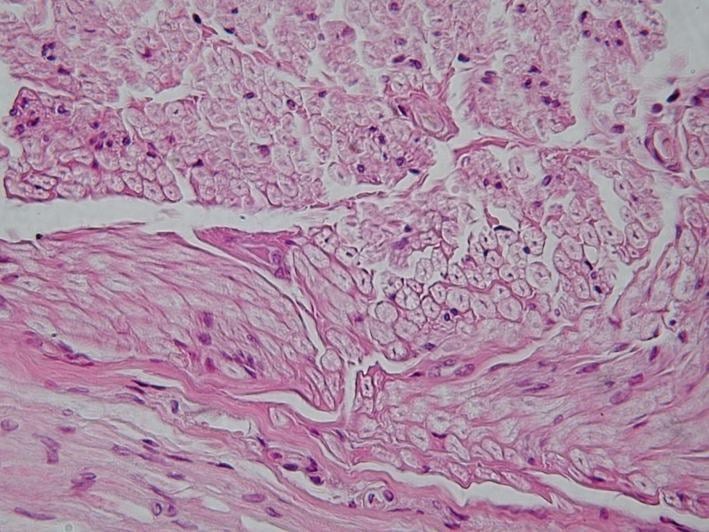
The fascicle. On a routine section a peripheral nerve is a set of fascicles, each a pale honeycomb of rounded profiles. Each ring is a myelinated fibre, the lipid myelin dissolved in processing to leave a clear space around the central axon, and the bundle is bounded by a wavy perineurium and the surrounding connective tissue. That fascicular architecture is the basis of nerve repair: the surgeon aligns the cut fascicles, by epineurial or group-fascicular coaptation, so that regenerating axons re-enter their distal endoneurial tubes.
The fascicular plexus. A nerve is not a simple cable of parallel wires. Within the epineurium the fascicles repeatedly divide, merge and exchange fibres along the length of the nerve, Sunderland's fascicular "plexus", so the cross-sectional map of motor and sensory fascicles changes every few millimetres. Two consequences follow.
- Level. Distally, near the target, the fibres have sorted into discrete motor and sensory fascicles in a stable arrangement, so the cut ends can be matched. Proximally the fascicles are still intermingled, so even a perfect coaptation misroutes many axons, one reason proximal repairs do worse.
- Mechanism. A clean transection lets you align corresponding fascicles; a crush or avulsion blurs the fascicular pattern over a length of nerve.
Pathophysiology
Wallerian degeneration. After transection the distal axon segment disintegrates and is cleared by macrophages and Schwann cells, a coordinated destruction that leaves an empty tube for the new axon to grow into. The columns of Schwann cells that remain are the bands of Bungner, which guide the regenerating axon. The distal stump must be cleared before a new axon can enter it, which is why an early repair does not mean immediate regeneration.
- 0-24 hours - axoplasm granulates, neurofilaments fragment
- 24-48 hours - calcium influx triggers cytoskeletal breakdown
- Days 3-7 - Schwann cells dedifferentiate and proliferate
- Weeks 2-4 - macrophages infiltrate and phagocytose myelin debris
- Weeks 4-8 - complete clearance creates "empty tubes" for regeneration
The molecular events. c-Jun activation in Schwann cells is the master transcription factor for dedifferentiation. The cholesterol-rich myelin debris must be cleared before regeneration can proceed, and the neurotrophic factors released (NGF, BDNF, GDNF) guide the regenerating axons.
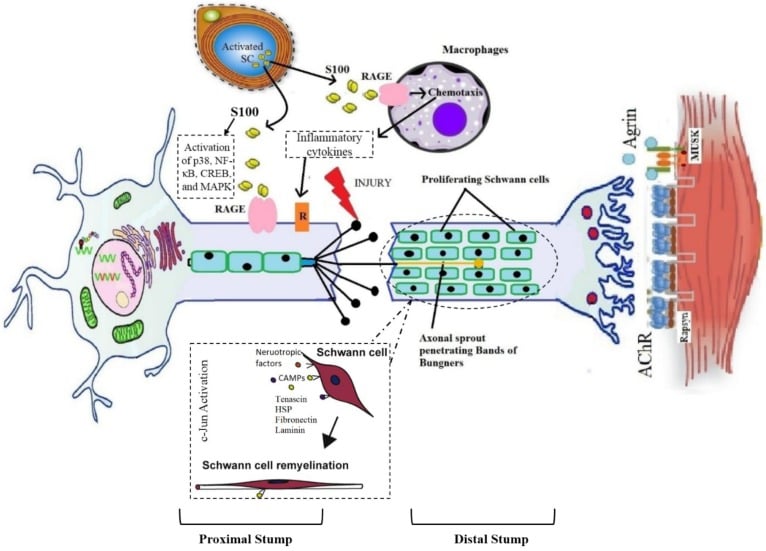
Regeneration. The proximal stump forms a growth cone, whose finger-like filopodia sample the environment, respond to chemoattractants (neurotrophins) and repellents (semaphorins), and need intact endoneurial tubes for successful guidance. Guidance is by chemotaxis (neurotrophic factors) towards the Schwann cells.
The rate. 1 mm/day, or 1 inch a month, faster in children and slower in the elderly, faster proximally and slower distally. Expected time to recovery is the distance to the target divided by 1 mm/day, plus a latent period of 1 month.
The motor end plate. Denervated end plates begin to atrophy at 3-6 months and the changes are irreversible by 12-18 months; once permanently fibrosed they cannot be reinnervated. This is the biological clock that limits proximal repairs: target-organ viability is the limiting factor.
Sensory receptors are more resilient. They can recover even years after injury, though the quality of what returns diminishes over time.
Classification Systems
Seddon grades an injury by what is left in continuity: whether the connective-tissue sheaths remain intact determines whether spontaneous recovery is possible or surgical repair or grafting is required.
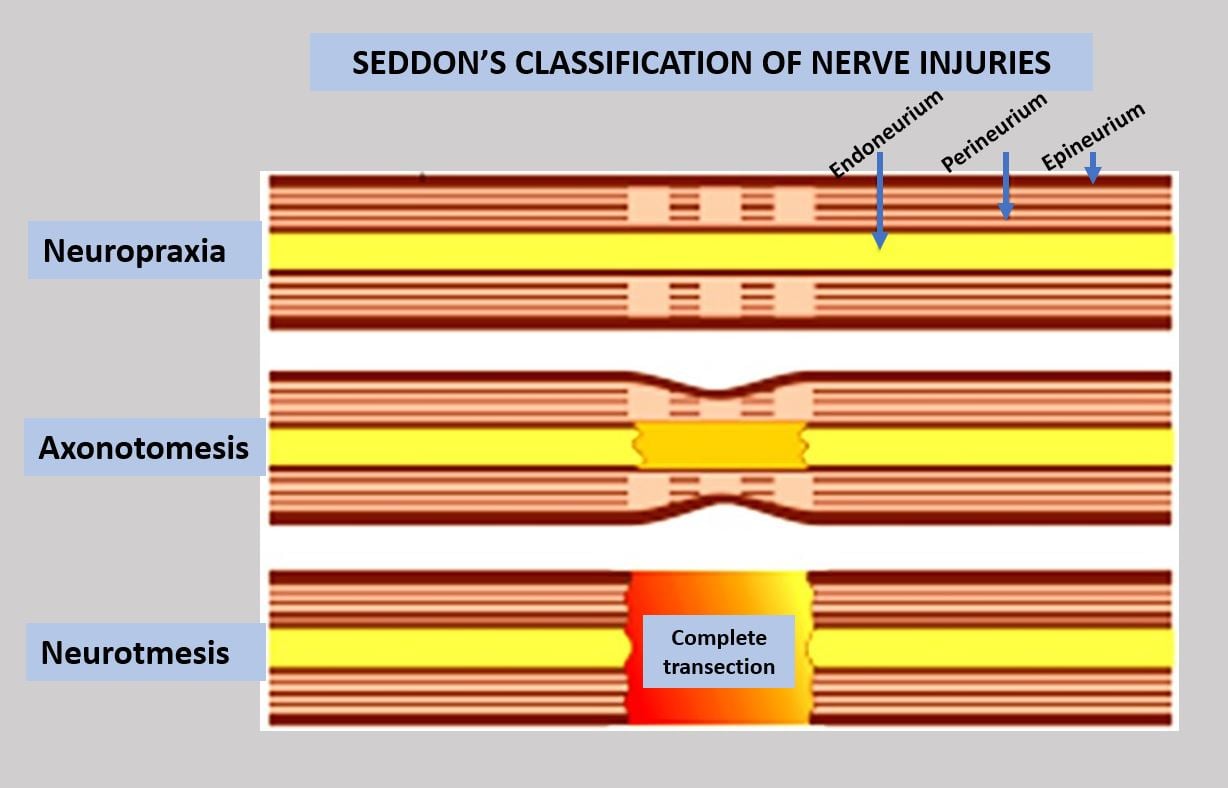
- Neurapraxia
- Myelin Block
- Axonotmesis
- Axon cut / Sheath intact
- Neurotmesis
- Complete Transection
- Neurapraxia
- No
- Axonotmesis
- Yes
- Neurotmesis
- Yes
- Neurapraxia
- No (or at site)
- Axonotmesis
- Yes (Moves distal)
- Neurotmesis
- Yes (Stays at site)
- Neurapraxia
- Hours to Weeks
- Axonotmesis
- Months (1mm/day)
- Neurotmesis
- None without surgery
- Neurapraxia
- No
- Axonotmesis
- No
- Neurotmesis
- Yes
Sunderland refines Seddon into five degrees by which layer is breached, counted from the inside out:
- Myelin - conduction block (neurapraxia)
- Axon - axon cut, sheath intact (axonotmesis)
- Endoneurium cut
- Perineurium cut
- Epineurium - complete transection (neurotmesis)
Clinical Assessment
History. Three things: the mechanism (sharp, blunt or traction), the time since injury, and the patient's age, which is prognostic.
Examination. Test individual muscles and grade each on the MRC scale. Test sensation with light touch and with static and moving two-point discrimination. Percuss along the course of the nerve for Tinel's sign; distal advancement over time is the sign of regeneration.
Nerve-repair outcomes are reported with the British Medical Research Council (Highet) scheme, and examiners expect you to grade both motor and sensory return.
Motor, M0 to M5. M0 no contraction; M1 perceptible contraction in proximal muscles; M2 perceptible contraction in proximal and distal muscles; M3 all important muscles act against resistance; M4 as M3 plus all synergic and independent movements; M5 complete (normal) recovery.
Sensory, S0 to S4. S0 no sensation; S1 deep cutaneous pain; S2 some superficial pain and touch; S2+ as S2 but with over-response (hyperaesthesia); S3 pain and touch with the over-response gone; S3+ as S3 plus good localisation and some return of two-point discrimination; S4 complete recovery with normal two-point discrimination.
"Meaningful" (useful) recovery is generally defined as M3 and S3 or better, which is the threshold the trials in the Evidence Base use when they quote recovery rates.
Investigations
Nerve conduction studies. Wait 3-4 weeks for Wallerian degeneration to complete before the baseline study; until then the distal stump still conducts. The findings sought are denervation potentials in muscle (fibrillations and positive sharp waves), and that baseline at 3-4 weeks is the standard against which recovery is monitored.
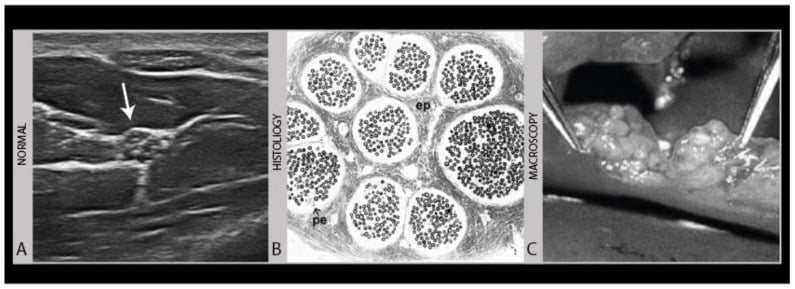
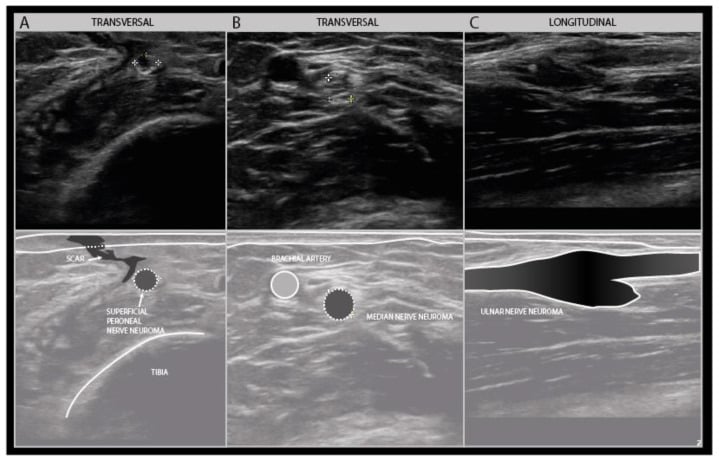
Ultrasound. Checks continuity in a closed injury, shows a stump neuroma, and can be run dynamically to look for subluxation. Digital nerves need a high-frequency (18 MHz) probe. Calibre alone is not enough: the nerve is followed continuously through the lesion, documenting fascicular continuity, stump separation, scar and the relationship to adjacent vessels or implants. A normal nerve has the same organised fascicular pattern on ultrasound, histology and at operation, so loss of the honeycomb architecture, interruption of fascicles or focal enlargement helps distinguish swelling, neuroma-in-continuity and complete transection.
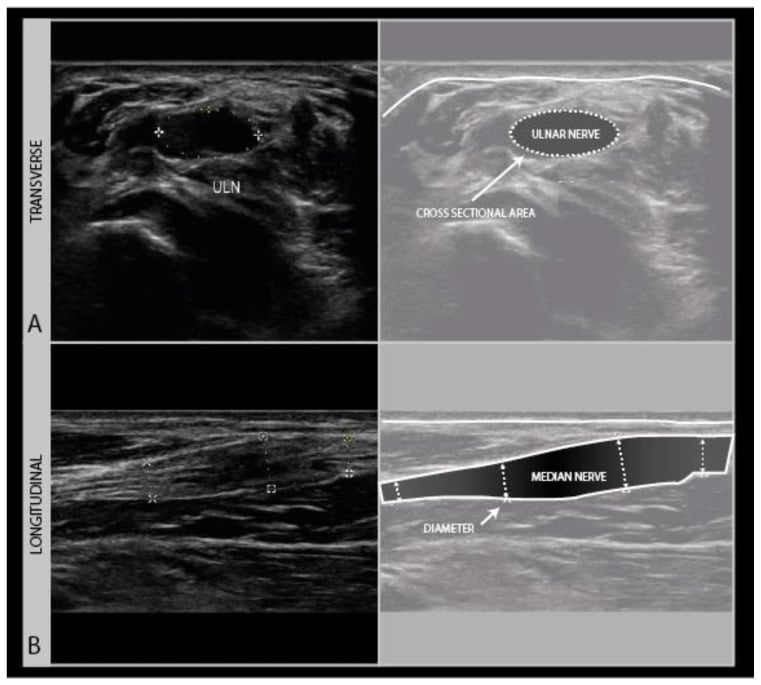
MRI. High-resolution neurography sequences; essential for the plexus, where the question is root avulsion. It is less useful for distal digital nerves because of resolution limits.
Differential Diagnosis & Decision-Making
The clinical challenge is rarely whether there is a nerve problem but which lesion, and whether it needs surgery now. The differential is really a grading and timing problem. A lesion in continuity is observed only while serial motor, sensory, Tinel and electrodiagnostic findings show progression; plateaued or absent recovery prompts exploration, where a conducting neuroma may undergo neurolysis and a non-conducting segment is resected to healthy fascicles and reconstructed without tension.
- Likely lesion
- Neurapraxia / axonotmesis
- Distinguishing clue
- Tinel marches distally over weeks
- Action
- Observe; serial exam and EMG
- Likely lesion
- Neurotmesis-in-continuity / neuroma
- Distinguishing clue
- Tinel stays at injury site; EMG no reinnervation
- Action
- Explore and reconstruct
- Likely lesion
- Transection (neurotmesis)
- Distinguishing clue
- Penetrating wound over nerve path
- Action
- Assume cut; early exploration
- Likely lesion
- Traction / plexus lesion
- Distinguishing clue
- Multiple territories, Horner sign
- Action
- Image (MRI, CT myelogram); consider transfer
- Likely lesion
- Stump neuroma
- Distinguishing clue
- Focal Tinel, no progression
- Action
- Desensitise, then surgery if refractory
- Likely lesion
- CRPS (mimic)
- Distinguishing clue
- Vasomotor/trophic change, not a single territory
- Action
- Pain team; do not re-operate blindly
The two clinical signs that drive the decision are an advancing versus static Tinel sign and the presence or absence of reinnervation on serial EMG at around 3 months.
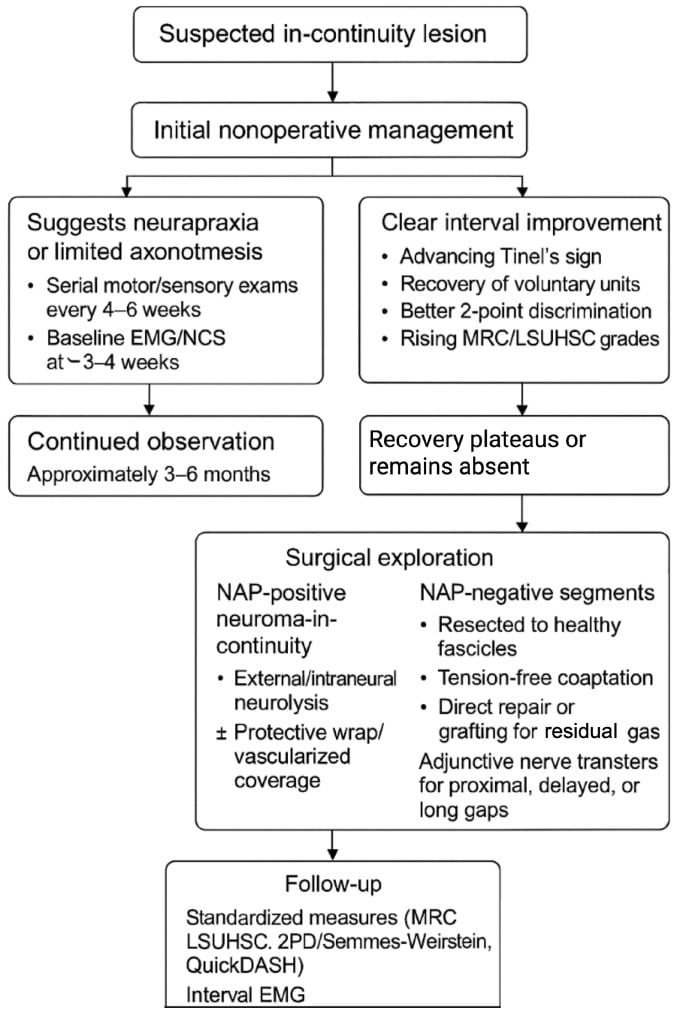
Management Algorithm
In a closed injury it is hard to tell axonotmesis from neurotmesis, and waiting 3-6 months is standard. That rule does not apply to a penetrating wound with a deficit: assume the nerve is cut, do not wait, explore early.
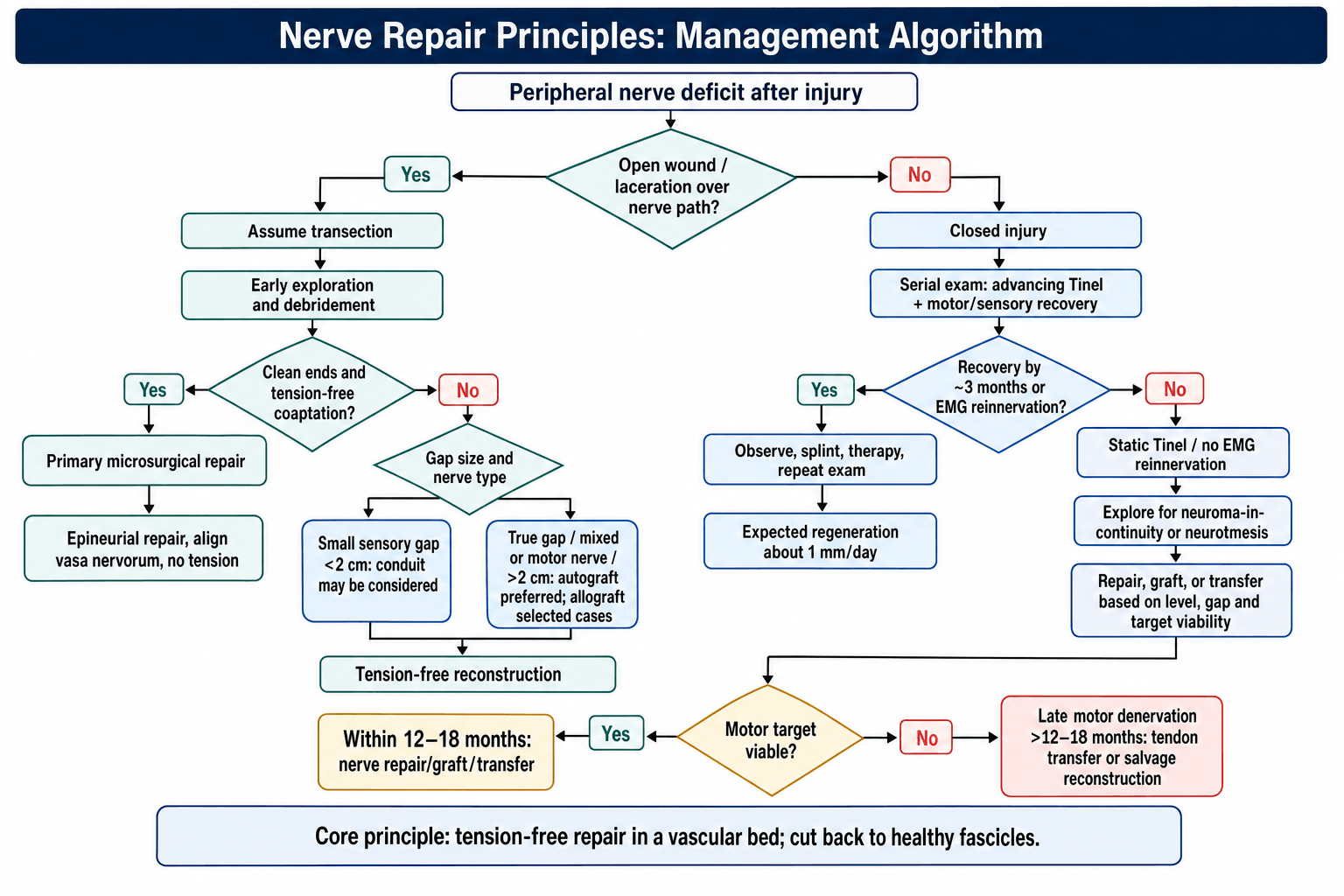
When to repair. Timing follows the wound:
- Immediate (primary) repair, within 24-48 hours - sharp, clean lacerations. The anatomy is clear, nothing has retracted and it is a single procedure; the cost is an emergency setting with perhaps a less optimal team. This is the standard of care for clean glass and knife injuries.
- Delayed primary repair, 1-3 weeks - crush, avulsion and contaminated wounds. The zone of injury declares itself (demarcation) and fibrosis defines the healthy ends, on an elective list with an experienced team; the cost is retraction, which may require a graft. This is the strategy for high-energy or contaminated wounds.
- Secondary reconstruction, beyond 3 months - a missed diagnosis or failed conservative management. The options are grafts and nerve transfers, and salvage procedures are considered here; motor recovery is poor if the delay exceeds 12 months.
Bridging the gap. If the ends meet without tension they are repaired directly. If they do not, the choice lies between autograft, conduit and allograft.
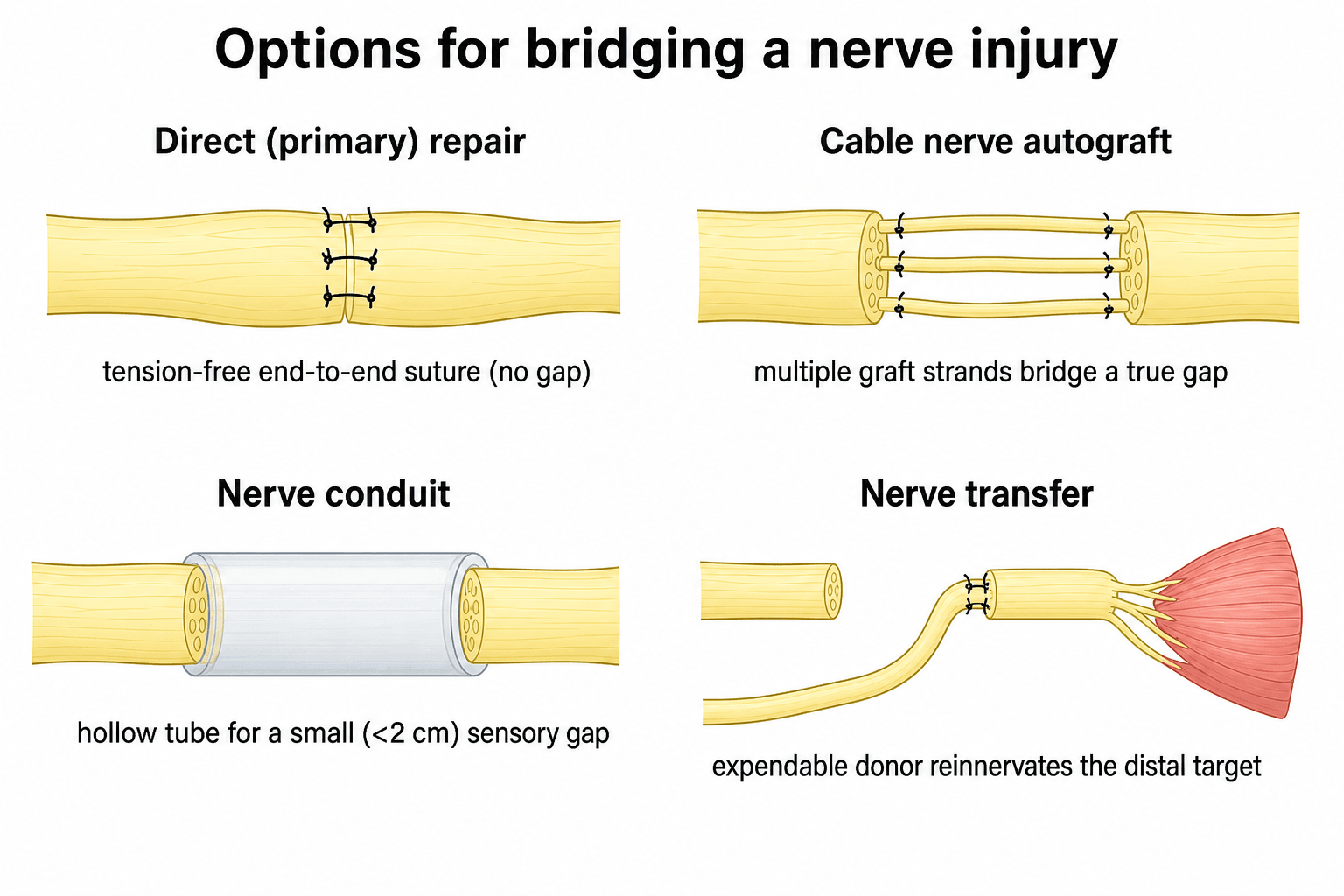
Autograft is the gold standard for any gap that cannot be closed without tension. A cable graft of several strands bridges the defect, and the graft brings its own Schwann cells and basal lamina; the price is donor-site morbidity, usually numbness. The direction of a sural graft must be reversed (valves).
The donors:
- Sural (calf) - the standard for long gaps
- Medial antebrachial cutaneous (arm)
- Lateral antebrachial cutaneous (forearm)
- Saphenous - the alternative lower-limb donor
Surgical Technique
The principles. A tension-free coaptation, in a good vascular bed, after cutting back to healthy fascicles, done with microsurgical technique and fine suture. Tension causes ischaemia, and avoiding it is the key to the whole operation.
Epineurial repair. The standard for most digital and peripheral nerves: 2-4 sutures of 8-0, 9-0 or 10-0 nylon through the epineurium, never entering the fascicles, with the surface vessels (vasa nervorum) lined up to secure the rotational alignment. The ends are trimmed to healthy tissue, aligned and approximated without gapping or bunching; if the joint position or the suture line has to hold tension, grafting is safer than a forced primary repair. It is faster and less inflammatory than fascicular repair.
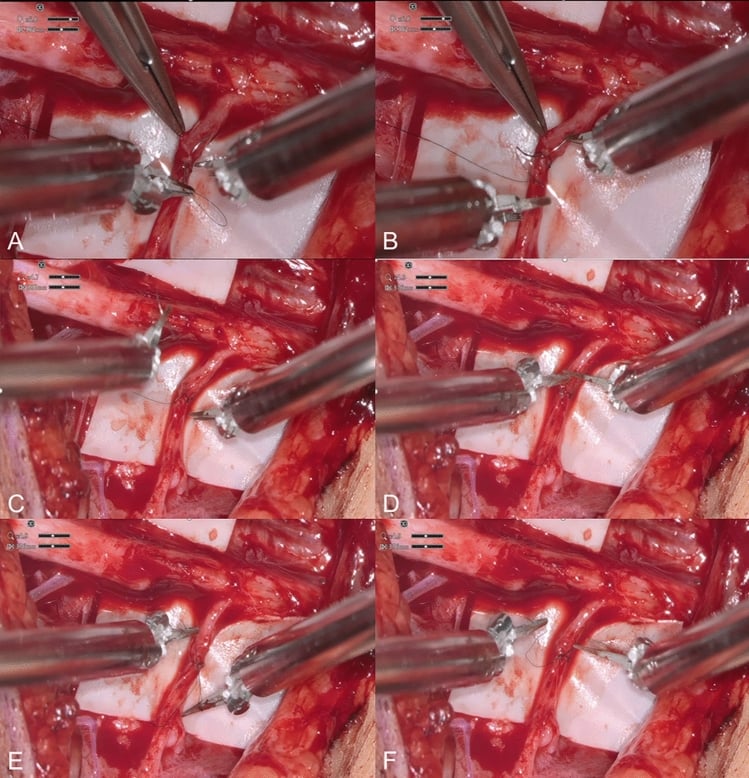
Group fascicular repair. For the major mixed nerves (median, ulnar) with distinct motor and sensory bundles, the fascicular groups (the motor branch, for example) are repaired separately. Where distinct groups are identifiable, as in the ulnar nerve at the wrist, matching them can improve targeting; proximally, where the fascicles are plexiform, it adds scar without clear benefit. Randomised and comparative data have not consistently shown superiority over epineurial repair, and it costs scar burden, operative time and technical difficulty, so it is reserved for specific situations such as the ulnar nerve at the wrist.
Nerve Transfers
The concept. Rob Peter to pay Paul: a redundant or expendable proximal nerve branch is coapted to a critical distal target, bypassing the injury site and reducing the regeneration distance. A high-level injury becomes a low-level one, close to the motor end plate, and recovery is faster.
- Oberlin transfer - ulnar fascicle to biceps, for musculocutaneous injury
- AIN to ulnar - anterior interosseous nerve as the motor donor, for high ulnar nerve palsy
- Spinal accessory to suprascapular - for brachial plexus injury
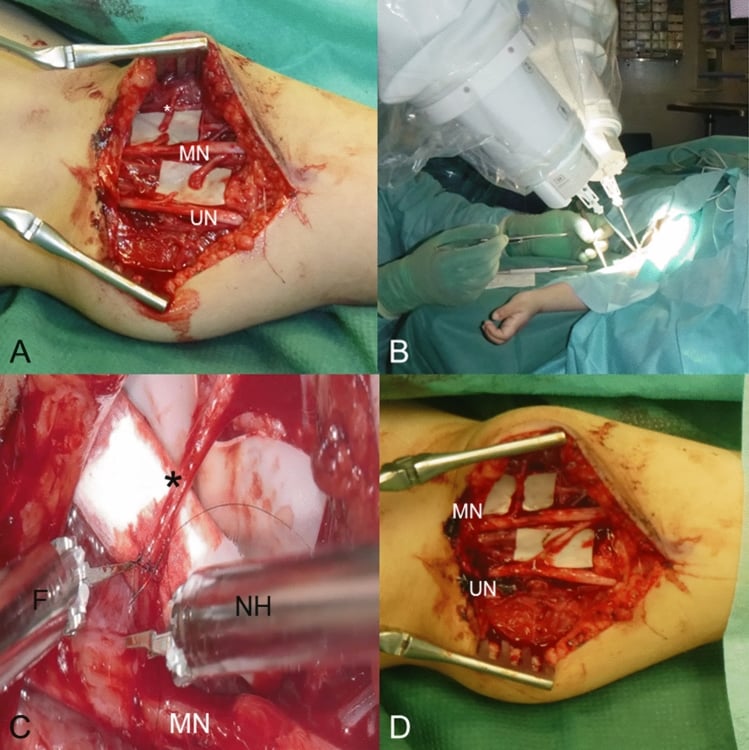
Double fascicle transfer. Elbow flexion is restored by selecting expendable fascicles from the ulnar and median nerves and coapting them distally to the biceps and brachialis motor branches. The donor fascicles are confirmed by stimulation, divided as distally as possible and joined close to the motor targets.
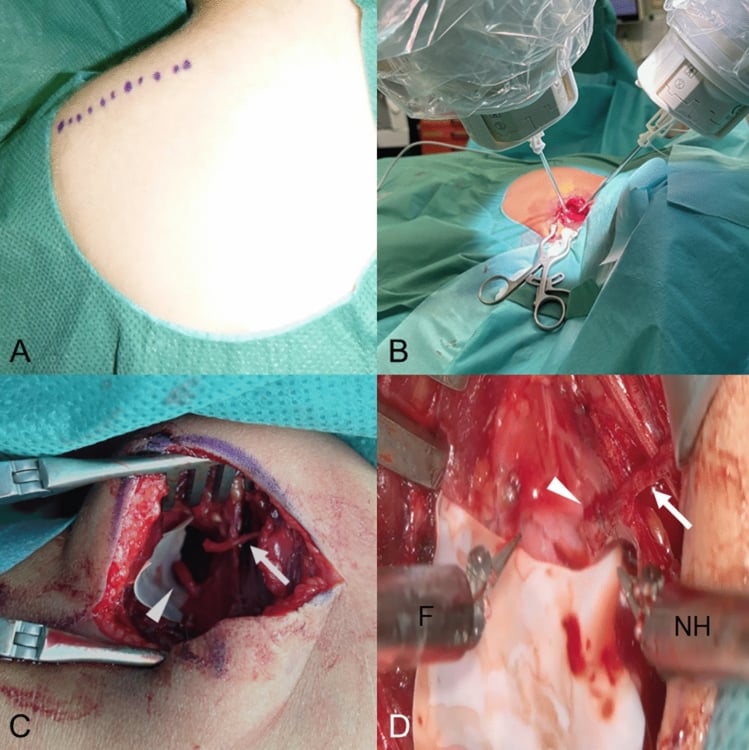
Spinal accessory to suprascapular. A dorsal approach identifies donor and recipient above the scapular spine, divides the recipient proximally and completes a short tension-free coaptation. The distal repair reduces the regeneration distance to supraspinatus and infraspinatus while preserving the accessory nerve branches needed for trapezius.
Complications
- Neuroma - a painful lump at the repair site, the product of failed regeneration
- CRPS - pain syndrome
- Failure of motor recovery - atrophy and irreversible motor end-plate fibrosis, the biological clock
- Cold intolerance - a permanent symptom in almost all nerve injuries
- Mismatch - a sensory axon growing into a motor tube, and wasted
- Cross-talk - synkinesis, rare in peripheral nerves, common in the facial nerve
The neuroma on ultrasound. Traumatic neuromas vary from small focal enlargements to long disorganised segments. Ultrasound maps the neuroma's cross-sectional and longitudinal extent, its continuity and its proximity to scar or vessels before the choice between neurolysis, resection and reconstruction, relocation or targeted nerve treatment.
Postoperative Care
Splint in a protective position to relieve tension on the repair. Protected gliding (controlled active motion) prevents adhesion.
Wean the splint with gradual extension. Begin desensitisation with texture exposure.
Sensory discriminative training (Dellon) and motor biofeedback or mirror therapy. Neural plasticity plays a huge role in the outcome.
Prognosis
What decides the outcome. Age is the most important factor: children regenerate excellently, adults over 60 poorly. The rest of the table follows from the biology above.
- Better Outcome
- Children
- Worse Outcome
- Adults greater than 60
- Better Outcome
- Distal
- Worse Outcome
- Proximal
- Better Outcome
- Sharp cut
- Worse Outcome
- Crush/avulsion
- Better Outcome
- Early repair (within 3 months is best)
- Worse Outcome
- Delayed repair
- Better Outcome
- Direct repair
- Worse Outcome
- Long graft (tension kills a repair)
- Better Outcome
- Pure motor/sensory
- Worse Outcome
- Mixed nerve
The outcome. Normal two-point discrimination is rarely achieved in adults; about 6-10 mm is a good result.
Guidelines, Registries & Global Practice
Global Epidemiology
- Peripheral nerve injury complicates an estimated 2-3% of trauma admissions and a higher proportion of upper-limb lacerations.
- The upper limb dominates: digital, median and ulnar nerves account for the majority of repaired civilian injuries, most commonly from glass, knife and power-tool lacerations in young working-age men.
- Lower-limb and high-energy plexus injuries are less common but carry a far worse prognosis and a heavier disability and economic burden.
- In conflict and high-energy settings, blast and gunshot mechanisms shift the pattern toward longer gaps, contamination and delayed reconstruction.
Side-by-Side Guidance
There is no single randomized "level 1" guideline mandating one repair method; practice is driven by surgical principle plus society/consensus statements. Where bodies differ, it is mainly in emphasis.
- BOA / BSSH (UK)
- Early exploration and repair
- AAOS / ASSH (US)
- Early exploration and repair
- AO / consensus (Europe)
- Early exploration and repair
- BOA / BSSH (UK)
- Observe 3 months, then re-image/EMG
- AAOS / ASSH (US)
- Observe with serial exam/EMG
- AO / consensus (Europe)
- Observe; baseline EMG at 3-4 weeks
- BOA / BSSH (UK)
- Tension-free graft preferred for true gaps
- AAOS / ASSH (US)
- Autograft gold standard; allograft accepted
- AO / consensus (Europe)
- Tension-free coaptation; graft if any tension
- BOA / BSSH (UK)
- Short (under 2-3 cm) small sensory gaps only
- AAOS / ASSH (US)
- Short sensory gaps only
- AO / consensus (Europe)
- Short sensory gaps only
- BOA / BSSH (UK)
- Strongly endorsed for proximal/plexus injury
- AAOS / ASSH (US)
- Strongly endorsed; expanding indications
- AO / consensus (Europe)
- Endorsed for proximal injury
The shared, exam-critical message across all bodies: tension-free coaptation, the biological clock for motor end plates, and early exploration of open injuries with a deficit.
Registries & Evidence Sources
- RANGER registry (processed nerve allograft): the largest peripheral nerve outcome dataset, reporting ~82% meaningful recovery for gaps up to 70 mm.
- Unlike arthroplasty, there is no global implant survivorship registry for nerve repair; evidence comes from trials, meta-analyses and the allograft registry rather than national joint-style registries.
High-Resource vs Limited-Resource Practice
- Typical reality
- Microscope, dedicated hand units, processed allograft and conduits available, early hand therapy, nerve transfers offered
- Typical reality
- Loupe magnification, autograft preferred (low cost, no supply chain), delayed presentation common, therapy access limited
In limited-resource settings, autograft remains the workhorse because it needs no commercial supply chain; conduits and processed allografts are cost- and availability-limited. Delayed presentation makes the 12-18 month motor window a frequent reason for primary tendon transfer rather than nerve reconstruction.
Controversies & Areas of Uncertainty
Allograft versus autograft for long gaps. Registry and meta-analysis data suggest comparable meaningful recovery for short-to-moderate gaps, but high-quality head-to-head evidence for long motor gaps (over 50-70 mm) is limited, which is why autograft remains the reference for critical motor defects.
The conduit gap limit. The commonly quoted ceiling of 2-3 cm in small sensory nerves is expert opinion, not a threshold defined by a single trial; outcomes deteriorate as gap and nerve diameter increase.
Timing of surgery for closed injuries. The "wait 3 months" rule balances spontaneous recovery against the motor end-plate clock. There is genuine uncertainty about the optimal cut-off, and earlier nerve transfer is increasingly favoured for proximal injuries to beat the clock.
MCQ Practice Points
Q: At what rate does a nerve regenerate? A: Approximately 1mm per day (or 1 inch per month).
Q: What is the maximum gap suitable for a nerve conduit in a digital nerve? A: Generally accepted as less than 2cm (some say 3cm maximum).
Q: What is the most significant predictor of poor outcome in adults? A: Increasing Age (especially greater than 60).
Q: Which structure guides the regenerating axon? A: The Basal Lamina of the Schwann Cell (Bands of Bungner).
Q: What is the critical time limit for motor recovery after nerve injury? A: 12-18 months - after this time, motor end plates undergo irreversible fibrosis and atrophy, so muscle recovery is not possible.
Viva Scenarios
Practise clinical reasoning and management decisions out loud
“You are exploring a cut median nerve at the wrist. The ends are retracted. You cannot approximate them without flexing the wrist 45 degrees. What do you do?”
“A patient presents 18 months after a laceration to the Ulnar nerve at the forearm. They have no sensation and no intrinsics (Claw hand). They want surgery.”
“A patient has a painful stump neuroma after a digital nerve injury. It's Tinel positive.”
Principles
- Tension-Free Repair
- Clean Preparation
- Microsurgical alignment
- Early protected motion
Timing
- Primary: Less than 48 hours - best outcomes, clean wounds
- Delayed: 2-3 weeks - contaminated/crushed injuries
- Secondary: Greater than 3 months - if recovery plateau
- Nerve regeneration rate: 1mm/day (1 inch/month)
- Advanced Tinel sign indicates regeneration progress
Options
- 1. Primary Repair
- 2. Nerve Conduit (Gap less than 2cm)
- 3. Nerve Autograft (Gap greater than 2cm)
- 4. Nerve Transfer
Evidence Base
Interfascicular Grafting (Tension Principle)
- Series of median and ulnar nerve injuries reconstructed with interfascicular nerve grafts
- Established that a tension-free graft outperforms a primary repair held together under tension
- Articulated the principle that tension at the coaptation causes ischaemia and intraneural fibrosis
Oberlin Transfer (Original Description)
- Four patients with C5-C6 root avulsion treated by transfer of ~10% of the ulnar nerve to the biceps motor branch
- Restored elbow flexion without significant impairment of hand function
- Introduced distal nerve transfer as a paradigm for brachial plexus reconstruction
Conduit vs Microsurgical Repair (RCT)
- Randomized prospective trial of 30 median or ulnar nerve injuries in the distal forearm, 5-year follow-up
- Silicone tube repair was at least as good as conventional microsurgical suture for sensory and motor recovery
- Cold intolerance was significantly less severe in the tubular repair group
Sensory Re-education
- Reviewed published sensory re-education programmes after nerve suture
- More patients reached the highest level of recovery (S4) with structured re-education
- Time to peak recovery shortened (≈2 years versus ≈5 years without re-education)
Autograft vs Allograft vs Conduit (Meta-analysis)
- 35 studies, 1559 nerve gap repairs (5-70 mm), PRISMA meta-analysis
- Meaningful recovery comparable for autograft and allograft regardless of gap or nerve type
- Conduits inferior for short sensory gaps (62% MR versus autograft 82% and allograft 87%)
Processed Nerve Allograft Registry (RANGER)
- Largest peripheral nerve registry: 385 subjects, 624 processed nerve allograft repairs
- 82% meaningful recovery across sensory, mixed and motor repairs for gaps up to 70 mm
- Recovery fell with longer gaps (91% for under 15 mm versus 69% for 50-70 mm)
Digital Nerve Repair (Updated Meta-analysis)
- 15 studies, 625 digital nerve repairs analysed for sensory outcome
- Autograft was statistically superior on static two-point discrimination
- Both autograft and allograft outperformed conduit repair when a gap was present