Benign Fibrous Lesion | Most Common Incidental Bone Finding | Self-Limiting
- Nonossifying fibroma is the most common incidental bone lesion found in children and adolescents
- Distinguished from fibrous cortical defect by size: NOF larger than 3cm, FCD smaller than 3cm
- Classic location: eccentric metaphyseal lesion in distal femur or proximal/distal tibia
- Radiographic appearance: bubbly, lobulated lytic lesion with sclerotic rim, cortically-based
- Natural history: spontaneous healing with skeletal maturity in over 95% of cases requiring no treatment
- “Distinguish NOF from FCD based on size (3cm threshold) - both are same pathological entity
- “Pathologic fracture risk if lesion occupies over 50% cortical diameter or longer than 33mm
- “Multiple NOFs suggest Jaffe-Campanacci syndrome: NOFs plus café-au-lait spots, mental retardation, hypogonadism
- “Treatment indicated only for: pathologic fracture, impending fracture, persistent pain, or failure to resolve
Clinical Imaging
Imaging Atlas


NOF is the most common incidental bone finding in children. Seen in 30-40% of children on knee radiographs. Over 95% resolve spontaneously with skeletal maturity. Majority are asymptomatic and require observation only.
High fracture risk if over 50% cortical diameter or length greater than 33mm. Mirels score not validated for benign lesions. Prophylactic curettage and bone grafting indicated for impending fracture.
Multiple NOFs plus extraskeletal features: café-au-lait macules (smaller and more numerous than NF1), mental retardation, hypogonadism, cryptorchidism, cardiovascular anomalies. Distinct from neurofibromatosis type 1.
Classic radiographic appearance is diagnostic. Biopsy unnecessary if typical features present: metaphyseal, eccentric, bubbly, sclerotic rim, cortically-based. Biopsy only if atypical features or diagnostic uncertainty.
BENIGNNonossifying Fibroma Key Features
Hook:NOF is BENIGN: Bubbly, Eccentric, NO malignancy, Incidental, Growth plate, Narrow rim!
KNEESCommon Locations
Hook:NOF loves KNEES: Knee region, Near metaphysis, Eccentric, Either femur/tibia!
FIPPIndications for Treatment
Hook:Treat NOF with FIPP: Fracture, Impending fracture, Persistent pain, Persistence!
Overview and Epidemiology
Nonossifying fibroma (NOF) is a benign fibrous bone lesion representing the most common incidental radiographic finding in children and adolescents. It is a developmental abnormality rather than a true neoplasm, arising from failure of ossification at the metaphyseal cortex. The lesion consists of fibrous tissue with characteristic storiform (whorled) pattern on histology.
NOF and fibrous cortical defect (FCD) represent the same pathological entity, distinguished only by size. Lesions smaller than 3cm are termed fibrous cortical defects, while those 3cm or larger are called nonossifying fibromas. Both follow identical natural history with spontaneous regression during skeletal maturation.
Understanding NOF is critical for exams because: (1) it is the most common bone lesion encountered in pediatric radiographs; (2) recognition prevents unnecessary biopsy and treatment; (3) knowledge of natural history guides appropriate observation; (4) identification of high-risk features prevents pathologic fractures; and (5) multiple NOFs indicate Jaffe-Campanacci syndrome requiring systemic evaluation.
- Age: Peak 2-20 years, rare after skeletal maturity
- Sex: Male greater than female ratio 2:1
- Prevalence: 30-40% of children on knee radiographs
- Ethnic: No racial predilection identified
- Distal femur: 40% of cases (most common site)
- Proximal tibia: 25% of cases
- Distal tibia: 15% of cases
- Fibula: 10% of cases (proximal greater than distal)
- Other: Rare in upper limb, pelvis (under 5%)
The terms "nonossifying fibroma" and "fibrous cortical defect" describe the SAME pathological entity. The distinction is purely based on size (3cm threshold) and does not reflect different biological behavior. Some authors use "metaphyseal fibrous defect" as an umbrella term encompassing both FCD and NOF. For exam purposes, know that FCD smaller than 3cm, NOF 3cm or larger, but both are identical histologically and clinically.
Pathophysiology and Histology
Pathogenesis
Nonossifying fibroma is not a true neoplasm but rather a developmental anomaly arising from aberrant ossification at the metaphyseal cortex. The prevailing theory suggests failure of normal remodeling during enchondral ossification, resulting in persistence of fibrous tissue within the cortex.
The lesion arises in the metaphysis during skeletal growth and may appear to migrate toward the diaphysis as the bone elongates. This migration is actually illusory - the lesion remains stationary while the growth plate moves away during longitudinal growth. With skeletal maturity, the fibrous tissue undergoes spontaneous replacement by normal bone in over 95% of cases.
- Origin: Failure of normal metaphyseal remodeling
- Timing: Occurs during periods of rapid skeletal growth
- Location: Always metaphyseal at inception
- Evolution: Appears to migrate diaphyseally with growth
- Resolution: Spontaneous ossification with skeletal maturity
- Active phase: Expansion during skeletal growth (2-15 years)
- Static phase: Stable size approaching maturity (15-20 years)
- Healing phase: Gradual ossification and resolution (18-30 years)
- Residual phase: Complete incorporation or small scar (over 95%)
Histological Features
The microscopic appearance of NOF is characterized by whorled (storiform) pattern of spindle cells with scattered multinucleated giant cells and hemosiderin-laden macrophages (foam cells). This appearance is identical to fibrous cortical defect regardless of lesion size.
| Feature | Nonossifying Fibroma | Fibrous Dysplasia | Desmoplastic Fibroma |
|---|---|---|---|
| Cell pattern | Storiform (whorled) spindle cells | Irregular Chinese characters | Dense collagen bundles |
| Giant cells | Scattered throughout | Absent | Absent |
| Foam cells | Abundant hemosiderin-laden | Absent | Absent |
| Bone formation | None (purely fibrous) | Woven bone production | None (purely fibrous) |
| Mitotic activity | Low to absent | Low | Variable |
| Border | Well-demarcated | Poorly defined | Infiltrative |
- Spindle cells: Arranged in storiform (whorled) pattern
- Giant cells: Multinucleated osteoclast-like cells scattered
- Foam cells: Lipid and hemosiderin-laden macrophages
- Collagen: Abundant fibrous tissue, no bone formation
- Vascularity: Minimal, sparse blood vessels
- vs Fibrous dysplasia: No bone formation in NOF, storiform pattern
- vs Desmoplastic fibroma: NOF has giant cells and foam cells
- vs Eosinophilic granuloma: NOF lacks eosinophils
- vs Aneurysmal bone cyst: NOF solid, no blood-filled spaces
Classification
Size-Based Classification:
- Fibrous Cortical Defect (FCD): Less than 3cm in greatest dimension - lower fracture risk
- Nonossifying Fibroma (NOF): 3cm or larger - higher fracture risk if large
Jaffe-Campanacci Syndrome:
- Multiple NOFs with extraskeletal manifestations (cafe-au-lait spots, mental retardation, cardiovascular abnormalities)
- Distinct from neurofibromatosis
Fracture Risk Classification:
- Low risk: Lesion less than 33% of bone diameter, less than 3cm
- Moderate risk: 33-50% of bone diameter
- High risk: Greater than 50% of bone diameter
See detailed "Classification Systems" section below.
Clinical Presentation
Symptoms
The vast majority of nonossifying fibromas are completely asymptomatic and discovered incidentally on radiographs obtained for unrelated reasons (trauma, growth assessment, sports screening). When symptomatic, presentation is typically due to pathologic fracture or, rarely, dull aching pain over the lesion.
- Discovery: Incidental finding on radiographs
- Symptoms: None, completely asymptomatic
- Function: No limitation in activities
- Examination: Normal physical findings
- Mechanism: Imaging for trauma, knee pain, growth concerns
- Onset: Sudden pain after minor trauma
- Mechanism: Fall during sports or play
- Location: Through weakened cortex at lesion
- Type: Usually transverse or short oblique pattern
- Risk factors: Lesion over 50% cortical diameter, active child
Persistent pain at site of NOF WITHOUT fracture is RARE and should prompt consideration of alternative diagnosis. If confirmed NOF on imaging, pain may indicate stress reaction in thinned cortex (impending fracture). Consider activity modification and close radiographic surveillance. If pain persists despite rest, consider prophylactic curettage and grafting.
Physical Examination
Physical examination is typically unremarkable in asymptomatic NOF. When pathologic fracture has occurred, findings are those of acute fracture: swelling, tenderness, deformity, and unwillingness to bear weight.
Systematic Examination Approach
- Swelling: None unless pathologic fracture
- Deformity: None unless displaced fracture
- Gait: Normal unless fracture or impending fracture
- Skin: Normal overlying skin, no discoloration
- Muscle: No atrophy (chronic NOF causes no weakness)
- Tenderness: None unless fracture or large lesion
- Mass: Usually not palpable (intraosseous)
- Warmth: No increased temperature
- Crepitus: Only if acute fracture present
- Active ROM: Full and painless unless fracture
- Passive ROM: Full and painless unless fracture
- Strength: Normal unless pain inhibition from fracture
- Stress test: Gentle axial loading may elicit pain if impending fracture
- Neurovascular: Always intact unless displaced fracture
- Compartments: Soft unless acute fracture with swelling
The key examination finding in NOF is the ABSENCE of findings. Normal examination in child with incidental metaphyseal lytic lesion on radiograph supports diagnosis of NOF. Any abnormal findings (swelling, warmth, restricted motion) without trauma history should prompt reconsideration of diagnosis or investigation for complications.
Classification Systems
Size-Based Classification
The primary classification distinguishes fibrous cortical defect from nonossifying fibroma based solely on size. This is an arbitrary distinction as both represent identical pathological entities.
- Size: Smaller than 3cm in greatest dimension
- Synonym: Metaphyseal fibrous defect
- Location: Metaphyseal cortex, eccentric
- Clinical significance: Lower fracture risk
- Management: Observation only, no treatment needed
- Size: 3cm or larger in greatest dimension
- Synonym: Fibroxanthoma (older term, avoid)
- Location: Metaphyseal cortex, may be multilocular
- Clinical significance: Higher fracture risk if very large
- Management: Observation or treatment if high fracture risk
This completes the size-based classification.
Investigations
Radiographic Features
Plain radiographs provide definitive diagnosis in classic cases, eliminating need for further imaging or biopsy. The characteristic appearance is a well-defined, eccentric, lobulated lytic lesion with narrow sclerotic rim in the metaphyseal cortex.
- Location: Metaphyseal, eccentric, cortically-based
- Appearance: Bubbly, lobulated, soap-bubble pattern
- Border: Sharp sclerotic rim (1-2mm thick)
- Matrix: Purely lytic, NO mineralization
- Cortex: Thinned but intact unless fractured
- Periosteum: No periosteal reaction unless fractured
- Active phase: Well-defined lytic, expanding slowly
- Static phase: Stable size, sclerotic rim persists
- Healing phase: Progressive sclerosis from periphery
- Healed phase: Completely replaced by normal bone
- Migration: Apparent diaphyseal shift (growth plate moves)
If lesion demonstrates ALL classic features (metaphyseal, eccentric, cortical, bubbly, sclerotic rim, NO periosteal reaction), diagnosis is NOF and no further imaging or biopsy needed. Observation with serial radiographs is appropriate. Deviation from ANY classic feature warrants additional investigation to exclude other diagnoses.
Advanced Imaging
Additional imaging is RARELY needed when radiographs show classic NOF features. However, certain clinical scenarios may warrant cross-sectional imaging or bone scan.
| Modality | Indication | Findings in NOF | Limitations |
|---|---|---|---|
| MRI | Atypical features or soft tissue concern | T1 low, T2 variable signal; no soft tissue mass | Not needed for classic cases; expensive |
| CT | Pathologic fracture evaluation | Better cortical detail; rule out other fracture | Radiation exposure; rarely changes management |
| Bone scan | Multiple lesions suspected | Mildly increased uptake in active phase | Not specific; unnecessary if radiographs classic |
| PET scan | Not indicated | Variable FDG uptake possible | Never indicated for NOF diagnosis |
Imaging Atlas


Biopsy Considerations
Biopsy is unnecessary in over 95% of cases when radiographic appearance is classic. Indications for biopsy are limited to atypical features raising concern for alternative diagnosis.
- Classic metaphyseal location
- Eccentric cortically-based position
- Bubbly lytic appearance with sclerotic rim
- Age 2-20 years, asymptomatic
- Size consistent with NOF (larger than 3cm) or FCD (smaller than 3cm)
- Central medullary (not eccentric cortical)
- Periosteal reaction without trauma
- Soft tissue mass component
- Age over 30 years or under 2 years
- Rapidly enlarging despite skeletal maturity
- Pain without fracture in classic-appearing lesion
If biopsy required for atypical NOF, use CT-guided core needle biopsy rather than open biopsy when possible. Excisional biopsy risks pathologic fracture through weakened cortex. Send for histopathology with clinical history and imaging to facilitate accurate interpretation. Frozen section not useful as diagnosis requires assessment of architectural pattern.
Differential Diagnosis
The differential diagnosis of eccentric metaphyseal lytic lesion in children includes several entities, distinguished by age, location, imaging features, and clinical presentation.
| Lesion | Age | Location | Radiographic Features | Key Distinguishing Feature |
|---|---|---|---|---|
| Nonossifying fibroma | 2-20y | Eccentric cortical metaphysis | Bubbly, sclerotic rim, no periosteal reaction | Classic location and appearance; asymptomatic |
| Aneurysmal bone cyst | Under 20y | Eccentric metaphysis/diaphysis | Expansile, blown-out cortex, fluid levels MRI | More expansile; fluid-fluid levels on MRI |
| Simple bone cyst | 5-15y | Central metaphysis (proximal humerus/femur) | Central, fallen fragment sign if fractured | Central location (not eccentric); fallen fragment |
| Fibrous dysplasia | Under 30y | Diaphyseal or metaphyseal | Ground glass, expansile, shepherd crook (femur) | Ground glass matrix; bone expansion; monostotic/polyostotic |
| Eosinophilic granuloma | 5-15y | Diaphyseal greater than metaphyseal | Punched-out lytic, periosteal reaction common | Periosteal reaction; systemic symptoms possible |
| Chondromyxoid fibroma | 10-30y | Eccentric metaphysis (tibia, femur) | Lytic, lobulated, eccentric, sclerotic rim | Rare; more aggressive appearance; biopsy needed |
| Giant cell tumor | 20-40y | Epiphyseal extending to metaphysis | Lytic, expansile, subarticular, no sclerotic rim | Epiphyseal location; older age; more aggressive |
When faced with metaphyseal lytic lesion in child, use this approach: (1) Location - eccentric cortical favors NOF, central favors simple cyst; (2) Age - 2-20y fits NOF, over 20y consider GCT; (3) Appearance - bubbly with sclerotic rim is NOF, ground glass is fibrous dysplasia; (4) Periosteal reaction - absent in NOF except if fractured, present in eosinophilic granuloma; (5) Symptoms - asymptomatic favors NOF, painful suggests ABC or EG.
Management
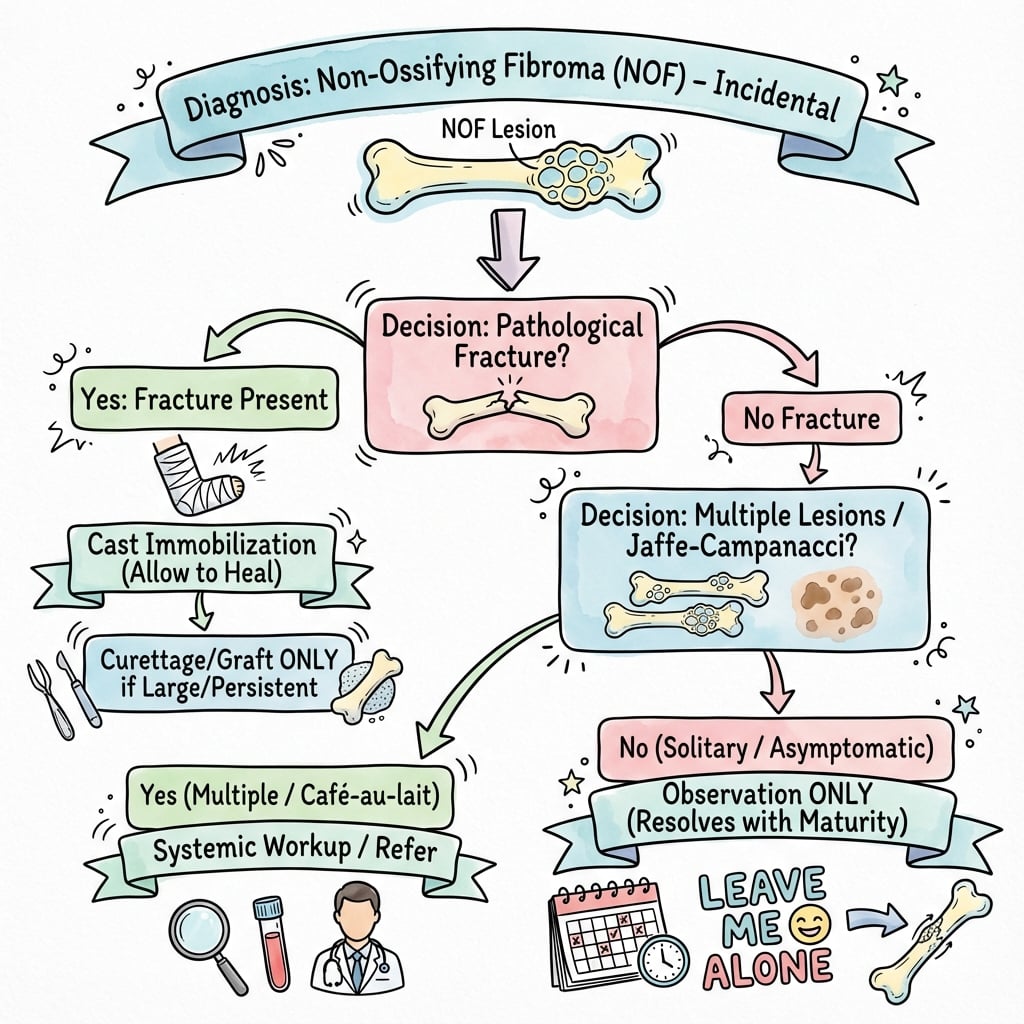
Decision-Making Framework
Management of nonossifying fibroma follows algorithmic approach based on fracture risk assessment, symptoms, and skeletal maturity. Over 95% require observation only.
- Asymptomatic NOF/FCD
- Cortical involvement under 50%
- Lesion length under 33mm
- Patient/family reassured
- Serial radiographs 6-12mo
- Cortical involvement over 50%
- Lesion length over 33mm
- Active high-impact sports
- Family anxiety despite counseling
- Pathologic fracture healed
- Recurrent fractures
- Persistent symptoms
- Failure to heal fracture
Fracture Risk Assessment
The primary indication for intervention in NOF is prevention of pathologic fracture. Risk stratification guides treatment decisions.
| Risk Factor | Low Risk | Moderate Risk | High Risk | Management |
|---|---|---|---|---|
| Cortical involvement | Under 33% | 33-50% | Over 50% | High risk: prophylactic treatment |
| Lesion length | Under 20mm | 20-33mm | Over 33mm | High risk: prophylactic treatment |
| Location | Upper limb, fibula | Distal tibia | Distal femur, proximal tibia | High risk in weight-bearing bones |
| Activity level | Sedentary | Recreational sports | Competitive high-impact | High risk: counsel activity modification |
| Age | Approaching maturity | Mid-adolescence | Young child (active growth) | High risk: lesion may enlarge with growth |
Mirels scoring system for pathologic fracture risk is NOT validated for benign lesions like NOF. It was developed for metastatic bone disease. For NOF, use cortical involvement over 50% and length over 33mm as thresholds for prophylactic treatment. These are evidence-based criteria specific to NOF fracture risk.
Conservative Management
Observation with serial radiographic follow-up is appropriate for vast majority of NOFs. Counseling regarding fracture risk and activity modification is essential component.
Observation Protocol
- Confirm diagnosis with radiographs (AP and lateral)
- Assess fracture risk (cortical involvement, length)
- Educate family: benign, self-limiting, high cure rate
- Reassure: no cancer risk, no biopsy needed
- Activity: no restrictions unless high fracture risk
- Repeat AP and lateral radiographs
- Assess: size change, cortical involvement, healing
- Stable or smaller: continue observation
- Enlarging: reassess fracture risk, consider treatment
- Serial radiographs until skeletal maturity
- Document progressive healing (sclerosis)
- Majority show complete resolution by maturity
- Discontinue imaging once healed or skeletal maturity
- Complete ossification of lesion OR
- Skeletal maturity reached with stable lesion
- No further radiographs needed
- Reassure: no long-term sequelae expected
For low-risk NOF (under 50% cortical involvement, under 33mm length): NO activity restrictions needed. Child may participate in all sports without limitation. For moderate-risk NOF (33-50% cortical, 20-33mm): consider activity modification avoiding high-impact contact sports until lesion heals or prophylactic treatment performed. For high-risk NOF: recommend activity restriction or prophylactic surgery prior to sports participation.
This completes the management algorithm section.
Surgical Management
Surgical intervention is required in minority of cases, primarily for pathologic fracture, impending fracture, or rarely persistent pain. The surgical principle is intralesional curettage with bone grafting.
Surgical Indications
Absolute and relative indications for surgical treatment of nonossifying fibroma.
- Pathologic fracture: After fracture healing (4-6 weeks immobilization)
- Impending fracture: Over 50% cortical involvement OR over 33mm length
- Recurrent fractures: Multiple fractures through same lesion
- Failure to heal: Fracture non-union through NOF (rare)
- Persistent pain: Ongoing symptoms despite conservative management (rare)
- Diagnostic uncertainty: Atypical features requiring tissue diagnosis
- Family anxiety: Severe anxiety despite counseling (consider carefully)
- Failure to resolve: Persistent lesion beyond skeletal maturity (very rare)
If pathologic fracture occurs through NOF, allow fracture to HEAL FIRST before definitive surgical treatment. Immobilize in cast for 4-6 weeks until fracture unites, then perform curettage and grafting as staged procedure. Attempting curettage through acute fracture risks poor bone graft incorporation and complications. Exception: displaced fracture requiring open reduction - perform curettage and grafting at same setting.
This completes the surgical indications section.
Complications
Disease-Related Complications
Complications of the lesion itself are rare, with pathologic fracture being the primary concern.
- Incidence: 5-10% of all NOFs, higher if large (over 50% cortex)
- Mechanism: Minor trauma in child with thinned cortex
- Fracture pattern: Transverse or short oblique through lesion
- Treatment: Cast immobilization until healed (4-6 weeks), then curettage and graft
- Healing: Fracture heals normally; perform surgery after union
- Persistent pain: Very rare without fracture, may indicate impending fracture
- Progressive enlargement: Expected during growth, rarely continues beyond maturity
- Failure to resolve: Under 5% persist beyond skeletal maturity
- Malignant transformation: NEVER reported (zero risk)
Treatment-Related Complications
Complications from surgical intervention are uncommon but include typical surgical risks.
| Complication | Incidence | Prevention | Management |
|---|---|---|---|
| Wound infection | Under 2% | Prophylactic antibiotics, sterile technique | Antibiotics; I&D if abscess |
| Recurrence | Under 5% | Thorough curettage, extend to all lobulations | Revision curettage and grafting |
| Graft fracture | Under 3% | Protected weight-bearing 6 weeks | Usually heals with immobilization |
| Donor site morbidity | 5-10% if iliac crest autograft | Meticulous technique, adequate closure | Analgesia, usually resolves spontaneously |
| Neurovascular injury | Under 1% | Know anatomy, careful dissection | Nerve/vascular repair if identified intraoperatively |
Recurrence after curettage and grafting is rare (under 5%) in NOF, much lower than other benign bone tumors like giant cell tumor. If recurrence occurs, confirm diagnosis with histopathology (ensure not misdiagnosed initially), then perform revision curettage and grafting. Consider adjuvants (phenol, burr) if not used initially. Second recurrence extremely rare - if occurs, consider alternative diagnosis.
Controversies and Areas of Uncertainty
NOF is biologically simple but management thresholds remain debated. Examiners often probe the soft edges of the size criteria and the role of prophylactic surgery.
The over-50% cortical-width and over-33mm-length criteria come from a retrospective fractured-lesion cohort (Arata, Mayo Clinic). Easley and Kneisl showed that 59% of large NOFs exceeding these thresholds never fractured, and all fractures that did occur healed with casting alone. Size predicts risk but does not, by itself, justify prophylactic curettage.
Most pathologic fractures through NOF unite uneventfully with non-operative treatment, and the lesion frequently heals as the fracture consolidates. Curettage and grafting is reserved for refracture, non-union, very large persistent defects, or diagnostic doubt - not automatic after every fracture.
A classic metaphyseal, eccentric, sclerotic-rimmed lytic lesion in an appropriately aged child is a do-not-touch diagnosis. Biopsy is reserved for atypical features. Incidental perilesional marrow edema on MRI (16% in Farooq and Belair) reflects healing, not aggression, and should not trigger biopsy.
The true incidence of multifocal disease is underestimated from a single index lesion. Some advocate a limited skeletal survey (lower radiation than bone scan) when multiple lesions are suspected, while others reserve imaging for clinical features of Jaffe-Campanacci syndrome. No consensus protocol exists.
State the size thresholds, then immediately qualify them: "These thresholds flag risk but evidence (Easley and Kneisl) shows most large NOFs do not fracture and fractures heal non-operatively, so I individualise based on the bone involved, the child's activity, and family preference rather than treating a number." This demonstrates judgement rather than rote rule-following.
Guidelines, Registries and Global Practice
NOF is a clinical-radiographic diagnosis rather than a registry-tracked implant condition, so high-level society guidance is sparse; practice is driven by consensus textbooks and orthopaedic oncology principles applied worldwide.
Global Epidemiology
- Prevalence: incidental fibrous cortical defects in roughly 30-40% of children on knee imaging
- Age: peak 2-20y, exceptionally rare after physeal closure
- Sex: modest male predominance (about 2:1)
- Site: over 80% around the knee (distal femur greater than proximal tibia greater than distal tibia), fibula next
- No geographic or ethnic predilection reported
- National joint/implant registries (NJR, AJRR, AOANJRR, SHAR) do not track NOF - it involves no implant
- Bone-tumour registries (e.g. national sarcoma/tumour databases) record it only when biopsied, biasing series toward atypical or fractured lesions
- Most NOFs never enter any dataset because they resolve without intervention
Side-by-Side Principles Across Practice Settings
| Theme | Orthopaedic Oncology Consensus (e.g. AAOS/JAAOS reviews) | European / EFORT-aligned Practice | Practical Implication |
|---|---|---|---|
| Diagnosis | Radiographic diagnosis sufficient for classic lesions; biopsy only if atypical | Same; cross-sectional imaging reserved for atypical or fracture cases | No routine biopsy or MRI for the classic lesion |
| Asymptomatic small lesion | Observation; serial radiographs as needed | Observation, often discharge if incidental and small | Reassure family, avoid over-imaging |
| Large weight-bearing lesion | Consider prophylaxis if over 50% cortex / over 33mm, individualised | Individualised; many observe given Easley/Kneisl data | Shared decision; surgery not automatic |
| Pathologic fracture | Cast to union; curettage/graft for selected residual defects | Non-operative union favoured; surgery selectively | Operate the minority, not the majority |
| Multiple lesions | Evaluate for Jaffe-Campanacci; limited skeletal survey | Same multidisciplinary workup | Look beyond bone for syndromic features |
High- vs Limited-Resource Variation
- MRI readily available but used sparingly (cost-conscious, do-not-touch lesion)
- Iliac crest autograft, allograft chips, and synthetic substitutes all accessible
- Serial radiographic surveillance until maturity is feasible and routine
- Plain radiography alone usually adequate - aligns with the do-not-touch principle
- When grafting is needed, local autograft is preferred over costly substitutes
- Emphasis on family reassurance and clinical follow-up where imaging access is limited; overtreatment avoided
Evidence Base
Original Description and Natural History
- Foundational description of fibrous cortical defects/NOFs as benign developmental lesions of the metaphyseal cortex in growing tubular bones
- Established spontaneous regression as the expected natural history
- The 30-40% childhood prevalence figure derives from subsequent imaging surveys building on this work
Pathologic Fracture Risk Thresholds (Mayo Clinic)
- 23 fractured NOFs (mean age 12y) over a 49-year Mayo Clinic experience
- Every lesion occupied over 50% of bone width on both AP and lateral radiographs
- Vertical length exceeded 33mm in all non-fibular lesions
- Generated the widely cited over-50% cortical-width and over-33mm-length thresholds for impending fracture
Radiomorphological Natural History
- Long-term follow-up showed fibrous metaphyseal defects follow a characteristic radiographic course over time, not a single static appearance
- Radiographic stage allows estimation of the age of the lesion
- Origins related to tendon and ligament insertions, with progressive spontaneous healing
Jaffe-Campanacci Syndrome (Original Series)
- 10 patients with multiple non-ossifying fibromata plus extraskeletal congenital anomalies
- Anomalies included café-au-lait spots, mental retardation, hypogonadism/cryptorchidism, ocular and cardiovascular malformations
- Proposed a distinct malformation syndrome allied to but separate from neurofibromatosis
- Skeletal lesions still regress and heal after skeletal maturity
Prophylactic Surgery Questioned
- 22 patients with large NOFs in weight-bearing bones studied for fracture risk
- 13 (59%) had NOT fractured despite exceeding the established size thresholds
- All 9 fractures that did occur healed uneventfully with closed reduction and casting
- Concluded size criteria predict risk but do not mandate prophylactic curettage
MRI Characteristics with Pathologic Correlation
- 19 pathologically proven NOFs analysed on MRI with pathologic correlation
- All lesions T1-hypointense; 79% T2-hypointense
- Low T2 signal reflected hypercellular fibrous tissue and hemosiderin
- Hypointensity and internal septation on T2 were the distinguishing MRI features
Edema-Like Marrow Signal on MRI
- 77 knee MRIs in patients up to 20 years reviewed for perilesional edema-like marrow signal
- Edema-like marrow signal present in 16% (12% otherwise unexplained)
- No significant association with age, gender, or lesion size
- Likely reflects active healing/involution in this classic do-not-touch lesion
Exam Viva Scenarios
Practise clinical reasoning and management decisions out loud
“A 12-year-old boy presents with knee pain after football. Radiographs show a 2.5cm eccentric, bubbly, lytic lesion with sclerotic rim in the distal femoral metaphysis. The lesion occupies approximately 40% of the cortical diameter. Examine the radiograph and discuss your management.”
“A 14-year-old competitive basketball player presents with a 4.5cm eccentric metaphyseal lytic lesion in the proximal tibia occupying 60% of the cortical diameter. He is asymptomatic but his radiologist report mentions nonossifying fibroma. Discuss your management approach.”
“You review radiographs of an 8-year-old boy with developmental delay showing multiple eccentric metaphyseal lytic lesions in both femora and tibiae bilaterally (total 6 lesions). Physical examination reveals 15 café-au-lait macules and undescended testes. What is your diagnosis and management?”
Definition & Epidemiology
- Benign fibrous bone lesion, most common incidental finding in children (30-40%)
- Developmental abnormality, NOT true neoplasm
- FCD smaller than 3cm vs NOF 3cm or larger (same entity, size-based distinction)
- Age 2-20 years, male greater than female 2:1
- Over 95% spontaneous resolution with skeletal maturity
Classic Location & Appearance
- Distal femur 40%, proximal tibia 25%, distal tibia 15%, fibula 10%
- Metaphyseal, eccentric, cortically-based (NOT central medullary)
- Bubbly, lobulated, soap-bubble lytic appearance
- Narrow sclerotic rim (1-2mm), NO periosteal reaction unless fractured
- Migrates diaphyseally with growth (growth plate moves, lesion stationary)
Histology
- Storiform (whorled) pattern of spindle cells
- Scattered multinucleated giant cells
- Hemosiderin-laden macrophages (foam cells)
- NO bone formation (purely fibrous)
- Well-demarcated border, low mitotic activity
Clinical Presentation
- 95% asymptomatic, incidental finding on radiographs
- 5% pathologic fracture (minor trauma through weakened cortex)
- Pain without fracture RARE - consider impending fracture or alternative diagnosis
- Physical exam normal unless fracture present
- NO systemic symptoms (fever, weight loss) - purely local lesion
Fracture Risk Assessment
- High risk if over 50% cortical diameter involvement
- High risk if lesion length over 33mm (Arata criteria)
- Location: weight-bearing bones (femur, tibia) higher risk than fibula/upper limb
- Activity: high-impact sports increase fracture risk
- Mirels score NOT validated for benign lesions (only for metastases)
Management Algorithm
- Observation (95%): asymptomatic, low fracture risk, serial radiographs 6-12 months
- Prophylactic surgery (4%): over 50% cortex, over 33mm length, active sports
- After fracture (1%): immobilize until healed, then curettage and graft
- NO biopsy if classic radiographic appearance in appropriate age
- NO activity restrictions unless high fracture risk
Surgical Technique
- Intralesional curettage through cortical window
- Bone grafting: autograft (iliac crest) preferred over allograft/substitute
- Send tissue for histopathology (confirm diagnosis)
- Protected weight-bearing 6 weeks until graft incorporation
- Return to sports 3-6 months after radiographic healing
Jaffe-Campanacci Syndrome
- Multiple NOFs (10-100 lesions) plus extraskeletal features
- Café-au-lait macules (smaller, more numerous than NF1)
- Mental retardation/developmental delay
- Hypogonadism, cryptorchidism, cardiovascular anomalies
- Non-hereditary (sporadic), distinct from NF1 (autosomal dominant)
Differential Diagnosis
- Simple bone cyst: central (not eccentric), fallen fragment sign if fractured
- Aneurysmal bone cyst: more expansile, fluid-fluid levels on MRI
- Fibrous dysplasia: ground glass matrix, bone expansion, different age
- Eosinophilic granuloma: periosteal reaction, diaphyseal, systemic symptoms
- Giant cell tumor: epiphyseal, older age (20-40y), more aggressive
Exam Pearls
- Most common bone lesion in children - know this cold
- No biopsy needed if classic features - avoid unnecessary procedures
- 95% heal spontaneously - observation is primary treatment
- Surgery ONLY for high fracture risk or after fracture
- Zero malignant potential - entirely benign, reassure families
References
-
Caffey J. On fibrous defects in cortical walls of growing tubular bones. Adv Pediatr. 1955;7:13-51.
-
Ritschl P, Karnel F, Hajek P. Fibrous metaphyseal defects - determination of their origin and natural history using a radiomorphological study. Skeletal Radiol. 1988;17(1):8-15.
-
Arata MA, Peterson HA, Dahlin DC. Pathological fractures through non-ossifying fibromas. J Bone Joint Surg Am. 1981;63(6):980-988.
-
Campanacci M, Laus M, Boriani S. Multiple non-ossifying fibromata with extraskeletal anomalies: a new syndrome? J Bone Joint Surg Br. 1983;65(5):627-632.
-
Betsy M, Kupersmith LM, Springfield DS. Metaphyseal fibrous defects. J Am Acad Orthop Surg. 2004;12(2):89-95.
-
Kumar R, Madewell JE, Lindell MM, Swischuk LE. Fibrous lesions of bones. Radiographics. 1990;10(2):237-256.
-
Easley ME, Kneisl JS. Pathologic fractures through nonossifying fibromas: is prophylactic treatment warranted? J Pediatr Orthop. 1997;17(6):808-813.
-
Hau MA, Kim I, Kattapuram S, et al. Accuracy of CT-guided biopsies in 359 patients with musculoskeletal lesions. Skeletal Radiol. 2002;31(6):349-353.
-
Jee WH, Choe BY, Kang HS, et al. Nonossifying fibroma: characteristics at MR imaging with pathologic correlation. Radiology. 1998;209(1):197-202.
-
Mankin HJ, Trahan CA, Fondren G, Mankin CJ. Non-ossifying fibroma, fibrous cortical defect and Jaffe-Campanacci syndrome: a biologic and clinical review. Chir Organi Mov. 2009;93(1):1-7.
-
Moser RP Jr, Sweet DE, Haseman DB, Madewell JE. Multiple skeletal fibroxanthomas: radiologic-pathologic correlation of 72 cases. Skeletal Radiol. 1987;16(5):353-359.
-
Stacy GS, Dixon LB. Pitfalls in MR image interpretation prompting referrals to an orthopedic oncology clinic. Radiographics. 2007;27(3):805-826.
-
Mirra JM, Gold RH, Rand F. Disseminated nonossifying fibromas in association with café-au-lait spots (Jaffe-Campanacci syndrome). Clin Orthop Relat Res. 1982;(168):192-205.
-
Gleeson TG, O'Connell JX, Munk PL. Imaging features of nonossifying fibroma. J Comput Assist Tomogr. 2008;32(4):615-621.
-
Drennan DB, Maylahn DJ, Fahey JJ. Fractures through large nonossifying fibromas. Clin Orthop Relat Res. 1974;(103):82-88.