Acetabular Overcoverage | Females | Labral Damage
- Acetabular overcoverage causes impingement during flexion
- Lateral centre-edge angle greater than 40° indicates overcoverage
- Middle-aged females predominantly affected
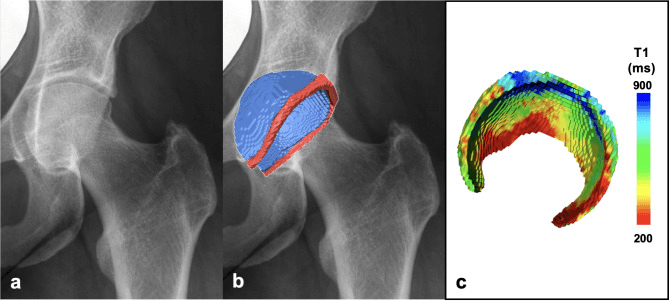
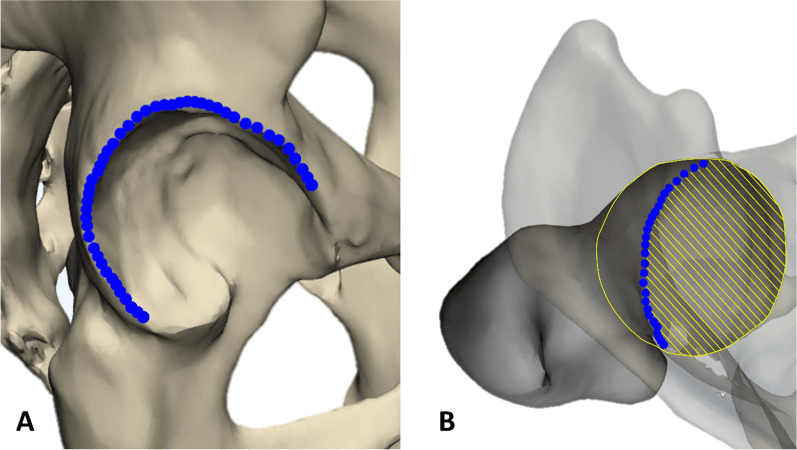
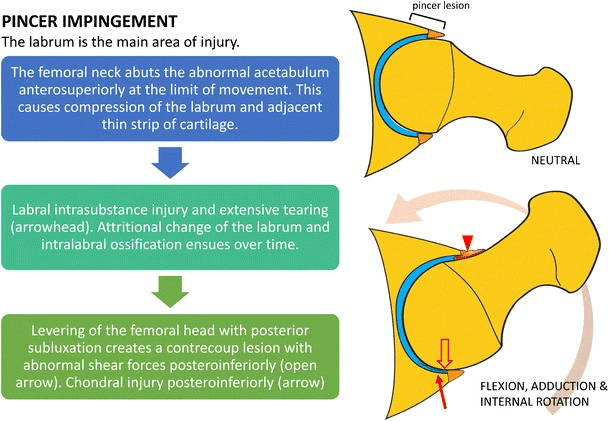
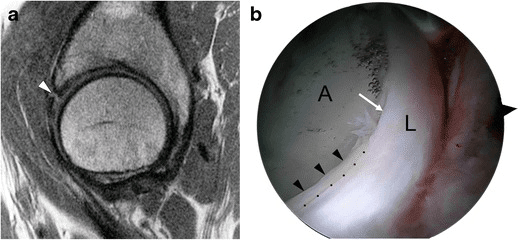
- Labrum crushed between rim and femoral head (inside-out damage)
- Rim trimming or periacetabular osteotomy may be needed
- “Coxa profunda: Acetabular floor medial to ilioischial line
- “Cross-over sign: Indicates acetabular retroversion
- “Contre-coup lesion: Posteroinferior cartilage damage
- “Combined FAI (cam + pincer) most common (86%)
Overview & Pathoanatomy
Pincer-type femoroacetabular impingement occurs when the acetabulum provides excessive coverage of the femoral head, leading to impingement during hip motion. The femoral head is normal and the socket is the problem, the reverse of cam impingement, where an aspherical head is at fault.
Global or focal. Overcoverage is either global, the whole socket enclosing more of the head, or focal at the anterior rim:
- Coxa profunda (global): a deep acetabulum, its floor touching or medial to the ilioischial line
- Protrusio acetabuli (global): the femoral head itself projects medial to the ilioischial line; the more severe form
- Acetabular retroversion (focal): the anterior rim extends beyond the posterior rim, creating focal anterior overcoverage and a cross-over sign on the AP pelvis
Pathophysiology — Mechanism of Damage
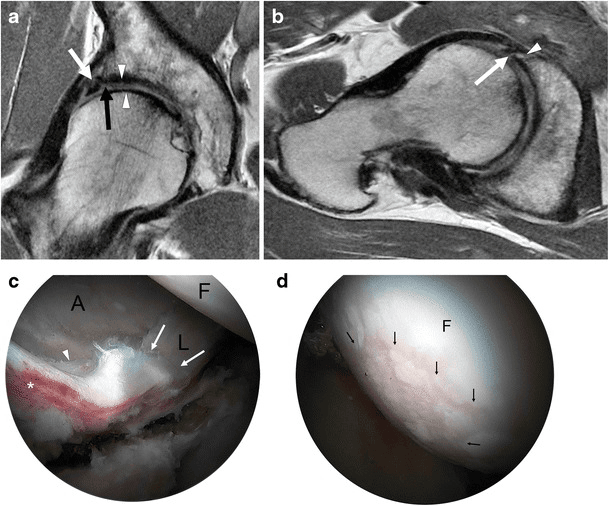
Crush against shear. During hip flexion the femoral head impinges on the overcovered rim and the labrum is crushed between rim and head, damage that runs inside-out. Cam impingement works the other way round: the aspherical head shears the cartilage off the bone from the outside in, and the labrum is initially spared.
Beck's patterns. Beck's analysis of 302 hips confirmed the two patterns. Pincer produced a circumferential, narrow strip of rim cartilage damage, with the labrum crushed, degenerate and ossified.
The contre-coup lesion. As the femoral head abuts the anterior rim it levers within the socket and drives cartilage damage at the posteroinferior acetabulum. This contre-coup lesion is characteristic of pincer mechanics.
Why most FAI is combined. Isolated pincer is uncommon, 16 of 302 hips in Beck's series. In practice the additive cam (shear) and pincer (crush) mechanisms coexist, which is why both the femoral and the acetabular sides usually need addressing.
Clinical Presentation
History. Middle-aged women typically present with groin pain that is activity-related, particularly with hip flexion. They may have had symptoms for longer than patients with cam FAI, as the cartilage damage is less aggressive initially.
Examination. Look for:
- A positive FADIR test: flexion, adduction and internal rotation reproduces the groin pain
- Reduced rotation, particularly internal rotation in flexion
- End-range flexion, which may provoke impingement symptoms
Investigations & Diagnosis
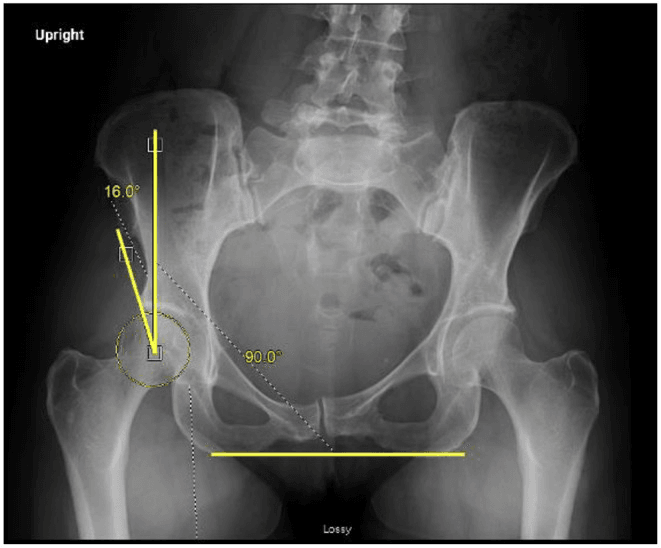
The AP pelvis. The key pincer measurements are all made on it: the lateral centre-edge angle, the cross-over sign and its companion signs (next section), and the relation of the acetabular floor and femoral head to the ilioischial line that defines coxa profunda and protrusio.
Lateral centre-edge (LCE) angle. The angle at the centre of the femoral head between a vertical line and a line to the lateral edge of the sourcil. Normal is 25-40°; over 40° indicates overcoverage (pincer), and under 25° dysplasia.
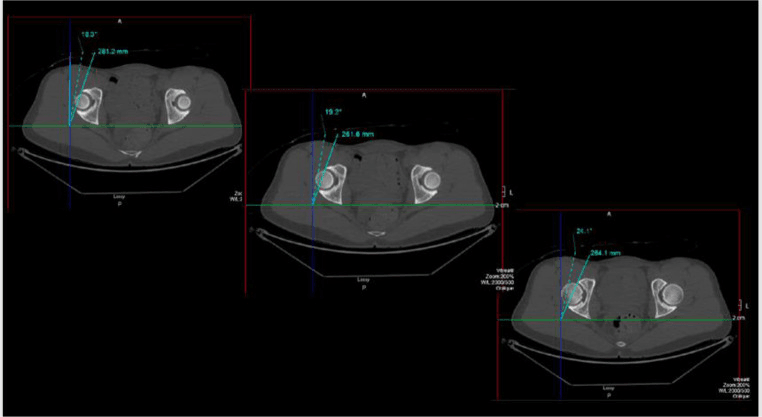
CT. Best for assessing version, retroversion against anteversion, and it shows the bony morphology. Version changes from level to level, and measuring it at the 1, 2 and 3 o'clock positions distinguishes focal anterior overcoverage from global retroversion and guides the correction strategy.
MRI or MR arthrography. Shows the crushed labrum, the cartilage damage and the posteroinferior contre-coup lesion. Assess for a cam component, as most FAI is combined.
Reading Acetabular Retroversion — The Radiographic Triad
The cross-over sign alone does not tell you why an acetabulum is retroverted. Read with the posterior wall and ischial spine signs, it separates a focal anterior overhang, which can be trimmed, from a globally retroverted hemipelvis that is posteriorly deficient, and that distinction drives the whole operative decision.
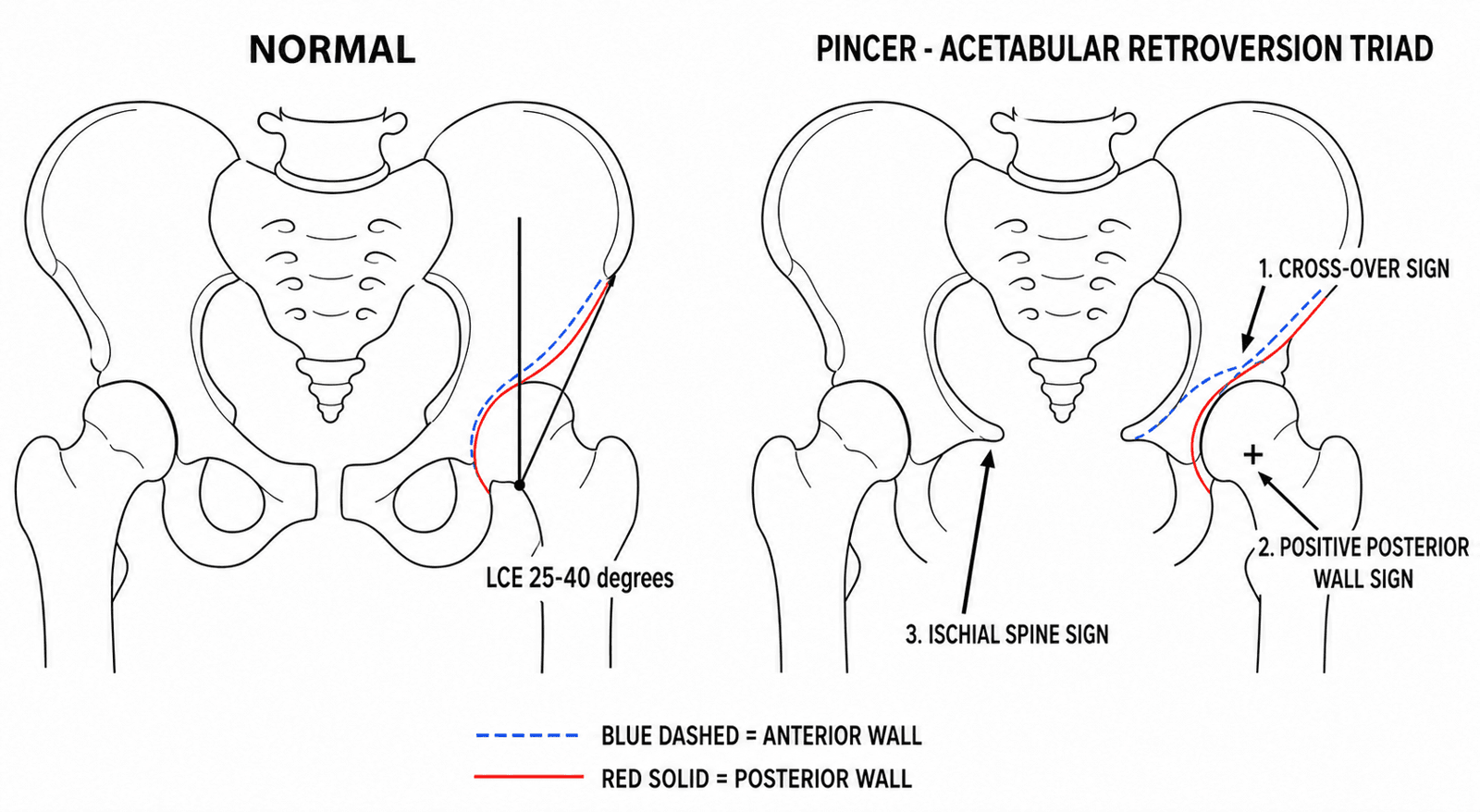
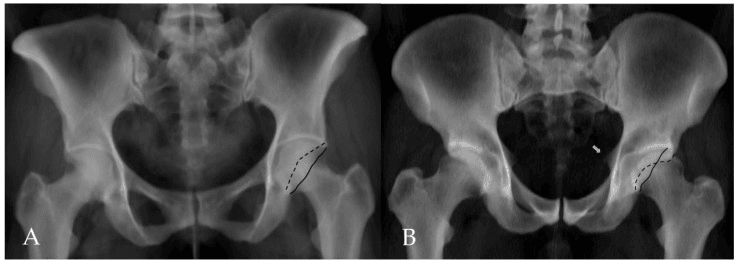
Cross-over (figure-of-eight) sign. On a well-centred AP pelvis the anterior wall line normally stays medial to the posterior wall line all the way to the lateral edge. When the upper acetabulum is retroverted, the anterior wall line crosses the posterior wall line before reaching the lateral sourcil. The proportion of the acetabular opening above the cross-over point, the retroversion index, grades severity: the larger that fraction, the more of the socket is retroverted.
Posterior wall sign. Normally the posterior wall line runs at or lateral to the centre of the femoral head. A positive sign means the posterior wall lies medial to the head centre and the socket is posteriorly deficient. This is the key discriminator: a positive posterior wall sign implies the whole acetabulum is retroverted, so trimming the anterior rim would only worsen an already inadequate posterior wall.
Ischial spine sign. A prominent ischial spine projecting medially into the pelvic inlet, beyond the pelvic brim, reflects rotation of the entire hemipelvis. It correlates strongly with true acetabular retroversion rather than an isolated anterior bump.
Putting it together. Two hips that both show a cross-over sign can need different operations:
- Cross-over with a negative posterior wall sign (posterior wall lateral to the head centre) and no ischial spine sign suggests focal anterior overcoverage, suited to arthroscopic or open rim trimming
- Cross-over plus a positive posterior wall sign plus a positive ischial spine sign points to global retroversion with posterior deficiency. Trimming the anterior rim worsens instability, so reorienting the socket with a reverse periacetabular osteotomy is preferred over resecting an already deficient posterior column
Is the AP Pelvis Valid? Rotation & Tilt Pitfalls
Every pincer sign above is projection-dependent. A rotated or tilted pelvis can manufacture a cross-over sign where none exists, or hide a real one, so before calling a hip retroverted, and certainly before trimming its rim, the film must be shown to be a neutral, well-centred AP pelvis. This is why the imaging literature flags pelvic orientation as the dominant pitfall in diagnosing pincer morphology.
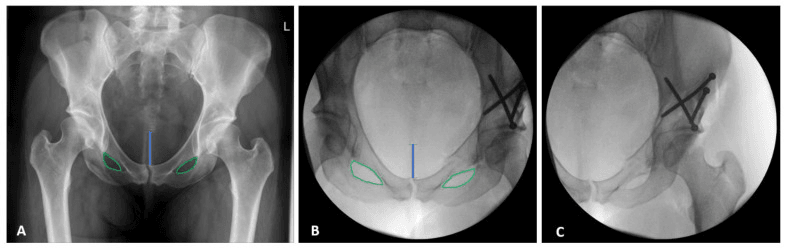
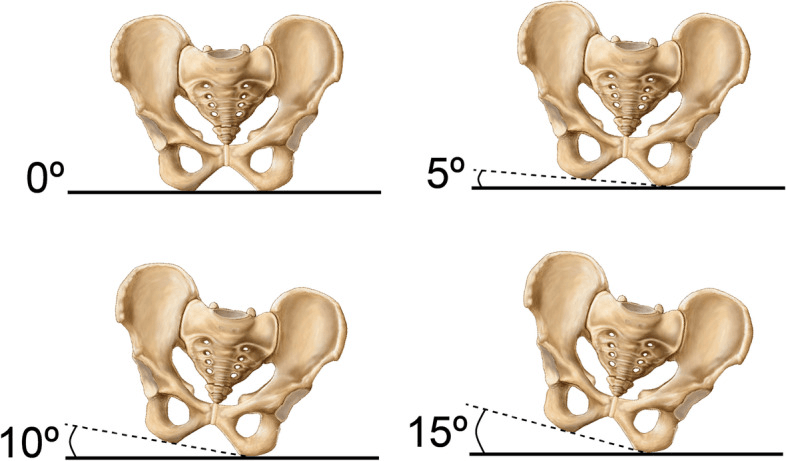
Rotation. Judged by the symmetry of the obturator foramina and iliac wings, with the coccyx tip overlying the pubic symphysis. Rotation of the pelvis toward the affected hip swings the anterior wall laterally and can create a false cross-over sign; rotation away can abolish a genuine one.
Tilt. Pelvic flexion or extension in the sagittal plane, judged by the vertical distance between the tip of the coccyx and the upper border of the pubic symphysis. Increased tilt (a more extended pelvis, the coccyx further from the symphysis) reduces apparent anterior coverage and can mask retroversion, whereas an anteriorly tilted pelvis exaggerates the anterior wall and can fake a cross-over sign. Because tilt differs between supine and standing and between individuals, a functional standing film is often more representative.
The rule. An isolated positive sign on a malrotated or tilted radiograph is not a diagnosis, and a false cross-over sign from pelvic malrotation is a classic trap. Repeat a standardised, well-centred AP pelvis, and if genuine doubt remains, use CT to measure true acetabular version rather than resecting bone on the strength of one projection-sensitive line.
Differential Diagnosis
The overcovered, painful hip overlaps with several other causes of young-adult groin pain. The discriminator for pincer FAI is acetabular overcoverage with a crushed (inside-out) labrum and contre-coup posteroinferior damage.
- Key discriminator
- Overcoverage; pain at end-range flexion; middle-aged female
- Imaging hallmark
- LCE greater than 40°, cross-over/posterior wall/ischial spine signs; contre-coup lesion
- Pitfall
- Mistaking pelvic malrotation for a true cross-over sign
- Key discriminator
- Aspherical head-neck junction; young athletic male; outside-in shear
- Imaging hallmark
- Alpha angle 55° or more, loss of head-neck offset; anterosuperior chondral delamination
- Pitfall
- Assuming cam only — most FAI is combined
- Key discriminator
- Undercoverage and instability, not impingement
- Imaging hallmark
- LCE less than 20-25°, increased Tonnis angle, lateralised head
- Pitfall
- Treating as pincer and rim-trimming a dysplastic hip (disastrous)
- Key discriminator
- Global overcoverage with axial migration; systemic disease
- Imaging hallmark
- Head medial to ilioischial line; bilateral
- Pitfall
- Missing the underlying systemic cause
- Key discriminator
- Pain over pubic symphysis/adductor origin, resisted adduction
- Imaging hallmark
- Normal acetabular coverage; symphyseal/adductor changes on MRI
- Pitfall
- Attributing groin pain to incidental rim morphology
- Key discriminator
- Anterior snapping, pain with resisted hip flexion
- Imaging hallmark
- Dynamic ultrasound shows tendon snap; coverage normal
- Pitfall
- Operating on FAI when psoas is the pain generator
- Key discriminator
- Older patient, rest/night pain, global ROM loss
- Imaging hallmark
- Joint space narrowing, osteophytes (Tonnis 2-3)
- Pitfall
- Offering joint preservation when OA is established
The diagnostic injection. An intra-articular local anaesthetic injection, with greater than 80% temporary relief, is the single most useful test to confirm the hip joint as the pain source before any rim-altering surgery.
Management
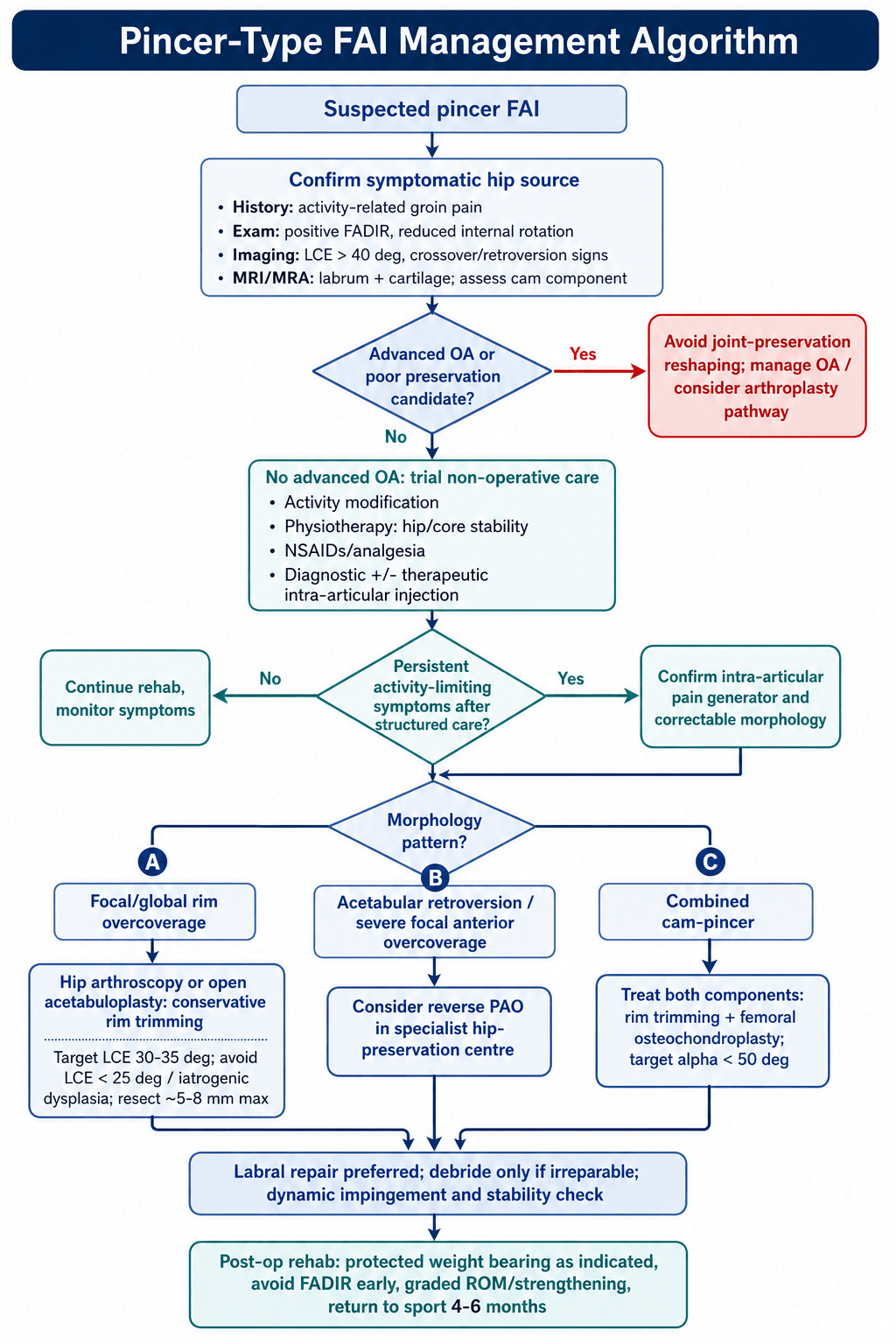
Non-operative care. Once a symptomatic intra-articular hip source is confirmed and established osteoarthritis excluded, non-operative care is tried first:
- Activity modification, avoiding end-range flexion positions
- Physiotherapy for hip stability and core strengthening
- Analgesia and NSAIDs for symptomatic relief
- Intra-articular injection, diagnostic and temporarily therapeutic
Surgery. For persistent, activity-limiting symptoms the operation follows the morphology, and results are good with appropriate treatment.
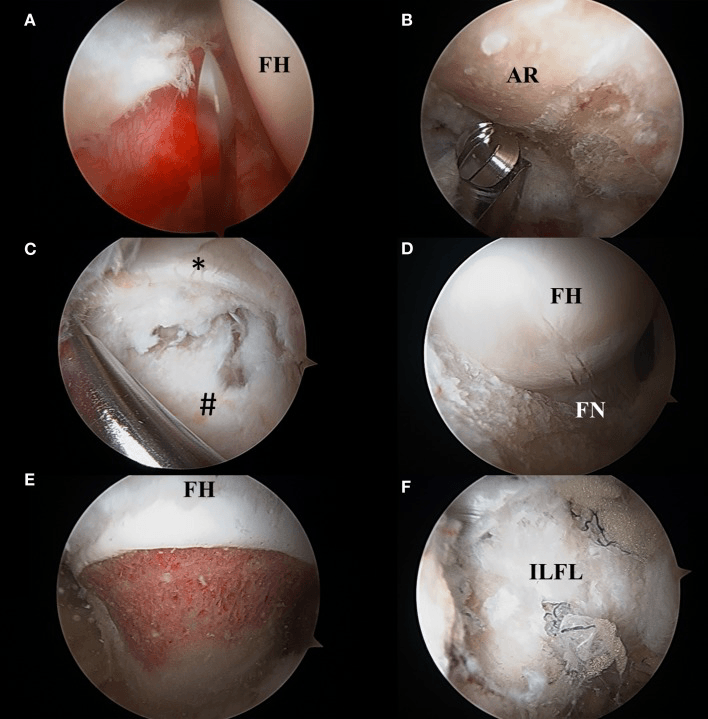
Rim trimming (acetabuloplasty). The overcovering rim is resected, arthroscopically or open, to reduce impingement. Keep it conservative: target an LCE of 30-35°, resect roughly 5-8 mm, and avoid iatrogenic dysplasia, the risk of aggressive trimming.
The labrum. Repair is preferred; debride only if the labrum cannot be repaired.
Reverse periacetabular osteotomy. For global acetabular retroversion the acetabulum is reoriented to antevert it, rather than trimming a socket whose posterior wall is already deficient (see the triad above).
The cam component. Most FAI is combined, so if a cam is present, perform a femoral osteochondroplasty as well, targeting an alpha angle under 50°.
Complications
Iatrogenic dysplasia. The most feared complication. Excessive rim trimming reduces the LCE angle below 25° and converts a stable, overcovered hip into an unstable, undercovered one, far more disabling than the original pathology and difficult to revise. Hence the conservative resection limits above, with coverage reassessed dynamically.
Persistent or recurrent impingement. Most commonly from under-treating a coexisting cam component (residual alpha angle greater than 50°) or from inadequate rim correction. Failing to address both sides of a combined hip leads to ongoing pain.
Loss of the labral seal. Labral debridement rather than repair removes the suction-seal and proprioceptive function, contributing to instability and accelerated fluid-pressurisation and cartilage wear.
Progression to osteoarthritis. Established chondral damage at the time of surgery (Outerbridge III-IV, Tonnis 2-3) predicts poor results and progression to OA. Joint preservation cannot reverse advanced cartilage loss.
Procedure-specific risks. Arthroscopy and reverse PAO each carry their own:
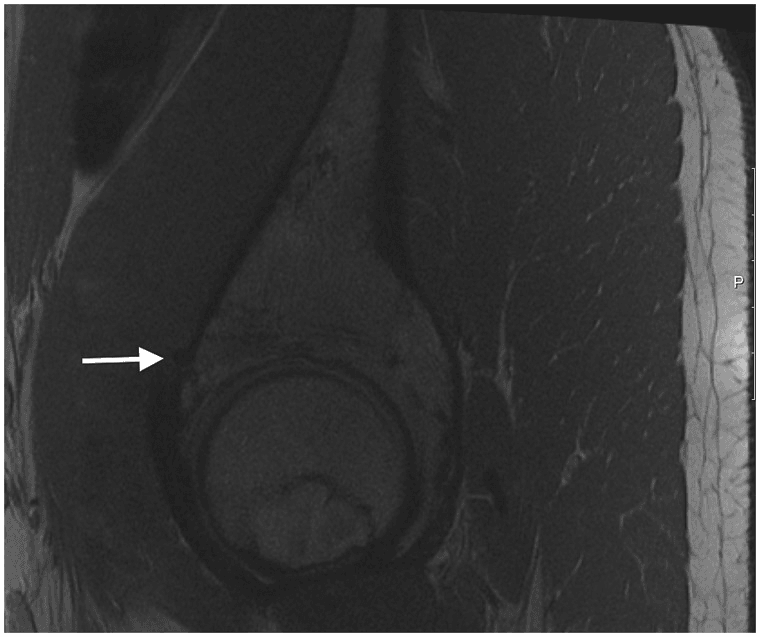
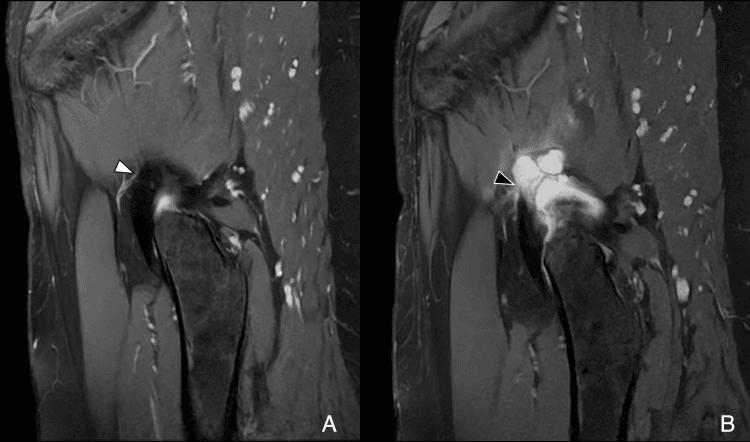
- Arthroscopy: traction-related pudendal or sciatic neurapraxia and perineal injury, lateral femoral cutaneous nerve injury at the portals, fluid extravasation, and (rarely) deep joint infection, one case in UK FASHIoN
- Reverse PAO for retroversion: nerve injury (LFCN, sciatic), non-union of the osteotomies, over- or under-correction, intra-articular extension, and heterotopic ossification
Guidelines, Registries & Global Practice
Global Epidemiology
- Pincer morphology (LCE greater than 40°, cross-over sign) is found in a minority of symptomatic FAI; combined cam-pincer dominates clinical series, with isolated pincer the least common subtype (Beck: 16/302).
- Isolated pincer tends to present in middle-aged women, whereas cam-dominant disease clusters in younger active men — a consistent demographic pattern across European, North American and Asian cohorts.
- Asymptomatic overcoverage exists in the general population, so morphology alone never equals disease; the FAI syndrome requires symptoms + signs + imaging together.
Side-by-Side Guidance
- Position
- Arthroscopic surgery acceptable for symptomatic FAI without OA
- Emphasis
- Strict patient selection; trained hip arthroscopists; audit of outcomes
- Position
- Supports surgery for appropriately selected FAI syndrome
- Emphasis
- Confirm intra-articular source; exclude established OA before correction
- Position
- Open surgical dislocation and (reverse) PAO for complex/retroverted hips
- Emphasis
- Preserve the posterior wall; reorient rather than over-resect in retroversion
- Position
- Triad definition: symptoms + clinical signs + imaging findings
- Emphasis
- Treat the patient, not the radiograph; conservative care is legitimate first line
Registry & Outcome Signals
- There is no dedicated FAI implant registry (the procedure is reshaping, not implantation), so the evidence base rests on RCTs (UK and Australian FASHIoN) and large arthroscopy cohorts rather than joint registries.
- Registry-level data become relevant only downstream: iatrogenic dysplasia and failed FAI surgery feed into PAO and early arthroplasty workloads, where national joint registries (NJR, AOANJRR, SHAR) track the high revision burden of THA in patients under 55.
High- vs Limited-Resource Practice Variation
- Well-resourced settings: MR arthrogram or dGEMRIC, dedicated hip-arthroscopy expertise, structured physiotherapy programmes, and access to PAO for retroversion.
- Limited-resource settings: diagnosis rests on a good AP pelvis and clinical examination; management is weighted toward activity modification, analgesia and physiotherapy, with surgery reserved for clear, correctable morphology and referred to centres with arthroscopic capability.
Related pages: Femoroacetabular Impingement is the parent topic covering the syndrome as a whole, and Cam FAI the sibling morphology - worth reading together, because the two coexist in 86% of impinging hips and this page's own Beck card found isolated pincer in only 16 of 302; Labral Tears of the Hip for the structure that is crushed inside-out here and whose repair or reconstruction is the other half of the operation; Hip Dysplasia in the Adult for the opposite end of the coverage spectrum and, critically, for the iatrogenic dysplasia that over-resection of the rim creates - a complication more disabling than the disease; Hip Arthroscopy for the access, portals and learning curve on which every outcome here depends; Hip Osteoarthritis for the endpoint Ganz proposed impingement causes, a claim far better supported for cam than for over-coverage; Ischiofemoral Impingement for the extra-articular impingement that mimics this and is missed on an AP pelvis; Athletic Pubalgia for the groin pain that coexists and must be excluded before the hip is blamed; and Total Hip Arthroplasty Indications for the decision that follows once the joint space has gone.
Controversies & Areas of Uncertainty
Does isolated pincer truly exist? Beck's data found isolated pincer in only 16 of 302 hips, and much of the early literature may have overdiagnosed it from rotated or tilted pelvic radiographs. Many apparent "cross-over signs" disappear on correctly oriented films, raising doubt about how often pure pincer is the real pathology.
Rim trimming vs reverse PAO for retroversion. For focal anterior overcoverage from acetabular retroversion, arthroscopic rim trimming risks worsening a globally deficient (posteriorly inadequate) socket, whereas reverse periacetabular osteotomy reorients the whole acetabulum. Distinguishing focal-anterior from global retroversion (posterior wall sign, ischial spine sign) is the key, unresolved selection question.
How much surgery does the RCT evidence justify? UK FASHIoN showed only a modest benefit over physiotherapy (iHOT-33 difference 6.8), and the Australian secondary analysis found no morphology-specific predictor of surgical benefit. The size of the true treatment effect — and which overcovered hips genuinely benefit — remains debated.
Labral repair vs reconstruction vs debridement. Repair is generally preferred to preserve the suction seal, but the calcified, degenerate labrum of long-standing pincer disease is often not repairable, and the role of labral reconstruction (graft) versus selective debridement in this setting is not settled.
MCQ Practice Points
Q: What LCE angle indicates pincer morphology? A: Greater than 40 degrees. Normal is 25-40°. Less than 25° is dysplasia.
Q: What does the cross-over sign indicate? A: Acetabular retroversion - the anterior wall crosses the posterior wall on AP pelvis, indicating focal anterior overcoverage.
Q: What is the pattern of labral damage in pincer FAI? A: Inside-out - the labrum is crushed between the acetabular rim and femoral head. This differs from cam where damage is from shear forces (outside-in).
Exam Viva Scenarios
Practise clinical reasoning and management decisions out loud
“A 40-year-old woman has groin pain. X-ray shows LCE angle of 45° and a cross-over sign. What is the diagnosis and how do you manage her?”
“You are seeing a 32-year-old recreational runner with 14 months of progressive right groin pain in your sports clinic. He has failed 6 months of physiotherapy and activity modification. On examination, he has a positive FADIR test and reduced internal rotation in flexion (15° vs 35° on the left). His plain radiographs show an alpha angle of 65° on the lateral view and a lateral center-edge (LCE) angle of 43° on the AP pelvis, with a positive cross-over sign indicating acetabular retroversion. MR arthrogram demonstrates an anterosuperior labral tear with adjacent chondral delamination (Outerbridge grade II) and a posteroinferior chondral lesion at the acetabulum (contre-coup lesion, Outerbridge grade II). He is asking about surgical treatment. How do you counsel this patient about his diagnosis and surgical management?”
“You are seeing a 35-year-old woman in your clinic who underwent hip arthroscopy for pincer-type FAI 9 months ago at another institution. Her pre-operative lateral center-edge (LCE) angle was 42° with a cross-over sign. The operative report documents arthroscopic rim trimming and labral debridement. She initially improved for 3 months post-operatively but has developed new symptoms over the past 6 months: a sensation of hip instability, clicking, and feeling that her hip 'wants to come out' particularly with pivoting movements. She now walks with a limp and uses a stick for stability. On examination, she has an apprehension sign with hip extension and external rotation (concerned the hip will dislocate posteriorly), and her hip feels subluxable on dynamic testing. New plain radiographs show the joint space is preserved (3mm), but the post-operative LCE angle now measures 18° (down from pre-op 42°). The femoral head appears to be subluxing laterally on the standing AP pelvis. MRI shows the labrum has been completely debrided (absent), and there is thinning of the anterior acetabular rim. What is your assessment and management plan?”
Key Facts
- Acetabular overcoverage
- LCE angle greater than 40 degrees
- Middle-aged females
- Labrum crushed (inside-out)
Overcoverage Signs
- Coxa profunda (floor to line)
- Protrusio (head medial to line)
- Cross-over sign (retroversion)
Damage Pattern
- Inside-out labral damage
- Labrum crushed between rim and head
- Contre-coup lesion posteroinferiorly
Treatment
- Rim trimming (acetabuloplasty)
- Labral repair
- PAO for retroversion
- Address cam if combined
Evidence Base
Ganz et al. — FAI as a cause of hip osteoarthritis
- Proposed femoroacetabular impingement as a mechanism of early osteoarthritis in non-dysplastic hips, based on more than 600 surgical dislocations
- Pincer mechanism: abnormal contact between an overcovering acetabular rim and the femoral head-neck junction during motion (not axial load)
- Surgical treatment aims to improve clearance for hip motion and relieve femoral abutment against the rim
- Early intervention proposed to decelerate degenerative progression in young patients
Beck et al. — Hip morphology and acetabular cartilage damage pattern
- 302 hips analysed; only 26 had isolated cam and 16 isolated pincer — combined impingement was by far the most common
- Pincer impingement: circumferential, narrow strip of acetabular cartilage damage; the labrum is crushed between rim and femoral neck (inside-out), with degeneration and ossification
- Cam impingement: anterosuperior cartilage shear with labrocartilage separation (outside-in), labrum initially spared
- Labral damage signals ongoing impingement and rarely occurs in isolation
Tannast et al. — Radiographic diagnosis of FAI
- Defines the radiographic criteria separating pincer from cam morphology on a correctly oriented AP pelvis
- Pincer signs: cross-over (figure-of-eight) sign for retroversion, posterior wall sign, ischial spine sign, coxa profunda and protrusio for global overcoverage
- Emphasises pelvic tilt and rotation as major pitfalls that falsely create or mask a cross-over sign
- Lateral centre-edge angle quantifies coverage (overcoverage when elevated)