Intra-articular fractures of the distal tibia (Tibial Plafond)
- Soft Tissue is King: Respect the envelope. Do not plate through swollen skin.
- Staged Protocol: 1. ExFix (Span) to 2. CT Scan (Plan) to 3. ORIF (Fix) when swelling subsides (10-21 days).
- 3 Columns: Fixation strategy relies on rebuilding the Anterolateral, Anteromedial, and Posterior columns.
- Syndesmosis: Often intact in Pilon (unlike rotational ankle fractures) because the force is axial.
- “Varus vs Valgus: Determines which column failed in tension vs compression.
- “Open Fractures: High rate due to thin medial skin cover.
- “Compartment Syndrome: Always check calcaneal compartment.
Overview and Epidemiology
A pilon (French for "pestle") fracture is an intra-articular fracture of the distal tibial metaphysis involving the weight-bearing dome, the plafond. It typically results from high-energy axial loading, the talus driven into the tibia.
Who. The distribution is bimodal. Young men sustain high-energy injuries, from a fall from height or a motor vehicle accident. Elderly women sustain low-energy injuries, a variant of the rotational ankle fracture.
How common, and what comes with it. Pilon fractures make up 1-10% of lower-extremity fractures. The fibula is fractured in 75-85%, 20-25% are open, and the injury is associated with polytrauma.
Anatomy
The plafond and its columns. The plafond is the weight-bearing articular surface of the distal tibia, trapezoidal in shape and wider anteriorly than posteriorly. The AO concept divides the distal tibia into three columns, or pillars, and the fixation strategy relies on rebuilding them:
- Medial column: the medial malleolus and the anteromedial cortex, with the anterior lip
- Anterolateral column: the Chaput tubercle, which carries the Tillaux-Chaput fragment; the syndesmosis is usually attached to it
- Posterior column: the posterior malleolus, which carries the Volkmann fragment
The fibula acts as a lateral buttress. A fractured fibula indicates significant instability.
The ligaments. The syndesmosis comprises the AITFL, the PITFL, the transverse ligament and the interosseous membrane. It is often intact in an axial pilon fracture, because the force is vertical rather than rotational. The deltoid ligament has deep and superficial components and is important for medial stability; assess it by palpating the medial gutter. The spring (calcaneonavicular) ligament supports the talar head and can be injured in high-energy variants where the injury extends significantly into the foot.
The soft-tissue envelope. The anteromedial face of the tibia is strictly subcutaneous, with no muscle cover, and is the danger zone for wound breakdown. The fascial compartments of the leg and their contents:
- Anterior: deep peroneal nerve and anterior tibial artery
- Lateral: superficial peroneal nerve
- Posterior: tibial nerve and posterior tibial artery
- Deep posterior
Blood supply and incisions. Knowledge of the vascular supply is critical for incision planning.
- Anterior tibial artery: becomes the dorsalis pedis and is the main supply to the anterior compartment structures; its perforators supply the anterolateral skin, which is the territory of the anterolateral approach
- Posterior tibial artery: the main supply to the medial ankle and deep posterior compartment; its medial malleolar branch is at risk during medial approaches
- Peroneal artery: supplies the lateral compartment, with branches contributing to the syndesmotic region
The anteromedial tibial skin is a watershed between the anterior and posterior tibial angiosomes, which makes it highly susceptible to necrosis. The skin bridge between an anterolateral and a posteromedial incision must be at least 7 cm.
Classification Systems
Two systems are in use. Rüedi-Allgöwer grades displacement and comminution; AO/OTA separates extra-articular, partial articular and complete articular fractures, and 43-C is the true pilon.
- Description
- Intra-articular, non-displaced
- Description
- Displaced, but the articular fragments are recognisable and congruous, implying that standard ORIF is feasible
- Description
- Displaced, with metaphyseal impaction and articular comminution: the "explosion" fracture
Grading the Soft-Tissue Injury: the Tscherne Classification
Why grade it. A formal grade communicates the severity of the soft-tissue injury, guides timing and predicts wound complications. The Tscherne classification grades the closed soft-tissue injury:
- Grade 0: negligible soft-tissue injury; a simple fracture from an indirect force
- Grade I: superficial abrasion or contusion from fragment pressure within; a mild-to-moderate fracture
- Grade II: deep contaminated abrasion with local skin and muscle contusion and impending compartment syndrome; a more severe, often direct-force fracture
- Grade III: extensive skin contusion or crushing, severe muscle damage, subcutaneous degloving, and overt compartment syndrome or arterial injury
How it maps to management. The higher the grade, the longer the wait behind the spanning fixator and the higher the threshold for open incisions. Blisters, swelling and the wrinkle sign are how you track the envelope back to a safe, low grade before definitive ORIF.
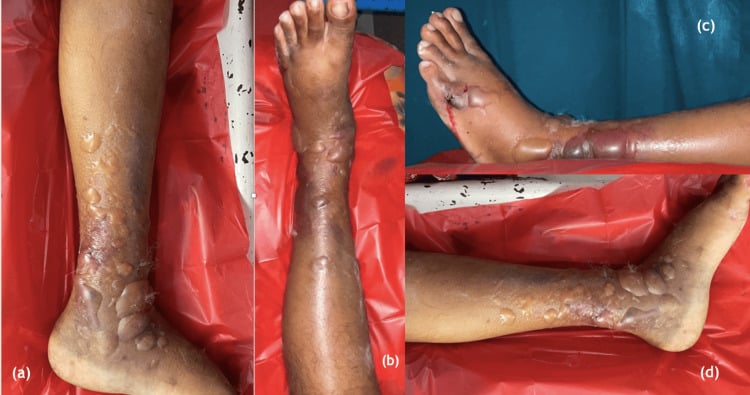
Reading the blisters. The type of blister tells you the depth of the injury.
- Clear fluid blisters are an epidermal injury, and can be operated through, carefully.
- Haemorrhagic blisters are a dermal or subdermal injury. Do not incise them; wait for epithelialisation.
Open injuries are graded separately, by Gustilo-Anderson (developed in the open-fracture topic). Tscherne grades the closed soft-tissue injury that governs most pilon timing.
Clinical Assessment
History. Establish the mechanism, a fall from height or a twist. Ask about smoking, which is critical to the wound-healing prognosis, and about diabetes and neuropathy.
Look. Note the deformity (varus or valgus, shortening) and the skin: open wounds (medial side), tenting, fracture blisters and the degree of swelling. A foot held in external rotation may suggest a pronation-external rotation (PER) injury.
Feel. Palpate the entire tibia, the ankle mortise, the medial malleolus and the fibula. Check whether the compartments are tense; the anterior and deep posterior are at highest risk, and always check the calcaneal compartment of the foot. Record the dorsalis pedis and posterior tibial pulses before and after reduction.
Move. Do not attempt active motion when the ankle is clearly fractured. Passive motion, assessed gently, evaluates joint stability.
Nerves. Test the deep peroneal nerve (sensation in the first web space, EHL power) and the tibial nerve (plantar sensation, FHL power). Document meticulously, because neurological injury may follow from the swelling or from compartment syndrome.
Associated injuries. Because the mechanism is an axial load, examine the lumbar spine (L1) and the calcaneus, the lover's triad.
All high-energy pilon fractures are at risk, in the leg or in the foot. Monitor for pain out of proportion and pain on passive stretch of the toes, and consider prophylactic fasciotomy if the swelling is severe.
Investigations
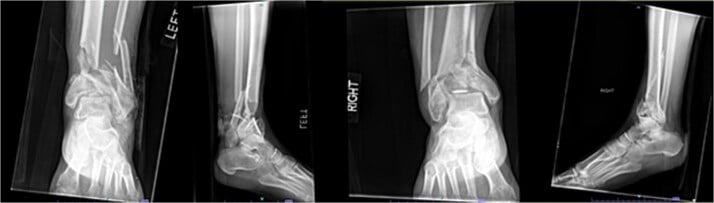
Radiographs. Take AP, lateral and mortise views of the ankle, full-length views of the tibia and fibula, and foot views including the calcaneus. Look for:
- Articular step-off
- Varus or valgus angulation
- Impaction of the talus into the tibia
- The level of the fibular fracture
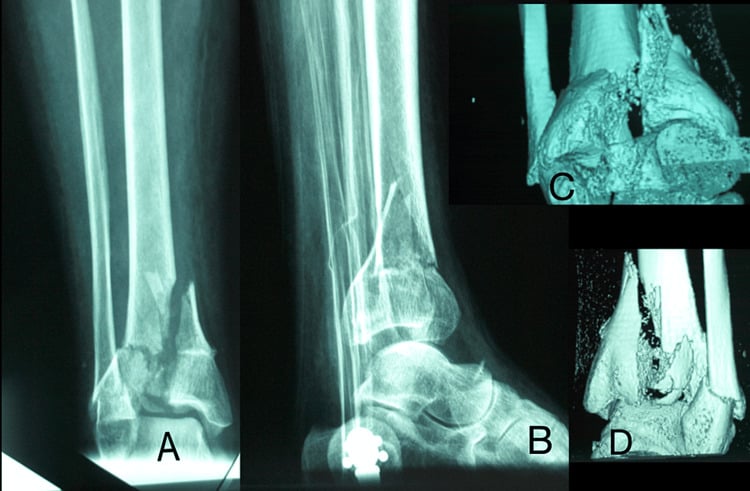
The double contour sign. A doubled subchondral line on the AP or mortise film ("double contour" or "double density") betrays an impacted or rotationally malreduced articular fragment. It warns of residual incongruity and should prompt CT correlation and correction.
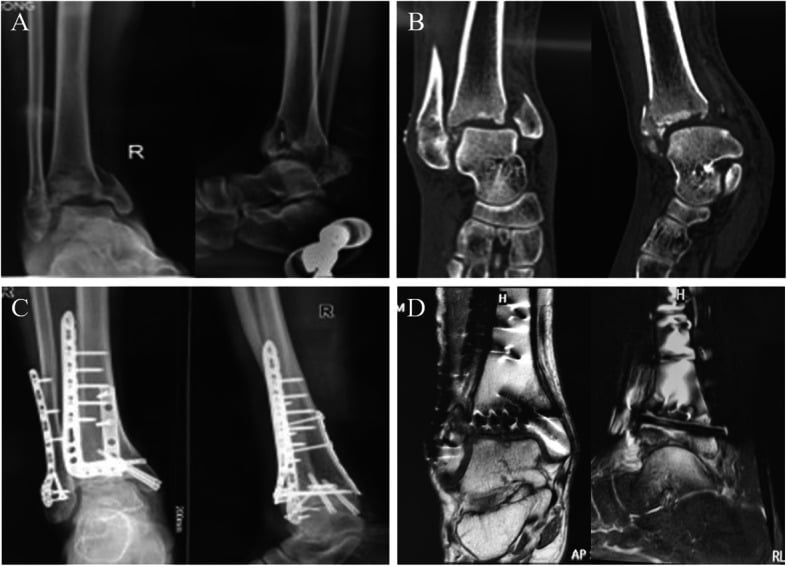
CT. CT is mandatory for operative planning, and is taken after the spanning fixator has restored length: ligamentotaxis pulls the major fragments apart and makes them readable. Each plane answers its own question:
- Axial: the Mercedes Benz sign, a Y-shaped fracture line separating the three constant fragments, anterolateral (Tillaux-Chaput), medial and posterior (Volkmann)
- Sagittal: the size and impaction of the posterior fragment
- Coronal: varus or valgus, and central die-punch impaction
The fracture-line families. High-energy pilon fractures cluster into a sagittal family and a coronal family of primary fracture lines (Topliss). Comminution and impaction are usually maximal at the anterolateral or anteromedial plafond, depending on the position of the foot at impact: dorsiflexion drives the anterior fragment, plantarflexion the posterior. Recognising the family tells you which column to buttress and which approach to use.
The die-punch fragment is a central, impacted osteochondral fragment driven up into the metaphysis. Find it on the coronal cut before surgery; its reduction is the third step of the fixation sequence.
Differential Diagnosis
- Mechanism
- Axial load (talus driven into tibia)
- Key Distinguishing Feature
- Intra-articular comminution + metaphyseal impaction; syndesmosis often intact
- Implication
- Staged management, guarded prognosis
- Mechanism
- Rotational / torsional
- Key Distinguishing Feature
- Malleolar fracture lines without plafond impaction; syndesmosis often disrupted
- Implication
- Often early single-stage ORIF, good prognosis
- Mechanism
- Bending / axial
- Key Distinguishing Feature
- Fracture spares the articular surface
- Implication
- Nail or plate; better outcome than true pilon
- Mechanism
- Axial + dorsiflexion
- Key Distinguishing Feature
- Body/neck of talus involved; talar dome AVN risk
- Implication
- Different fixation, AVN surveillance
- Mechanism
- Axial load at the knee
- Key Distinguishing Feature
- Proximal (not distal) articular surface; check both ends in fall-from-height
- Implication
- Screen the ipsilateral limb and spine
Management Algorithm
The soft-tissue envelope dictates the timing of every step, which is why the gold standard is staged: span, scan, plan, then fix.
Stage 0, in the emergency department. Reduce any dislocation immediately and hold the limb in a well-padded posterior slab. Obtain AP, lateral and mortise radiographs; give analgesia, elevate, and give antibiotics if the fracture is open.
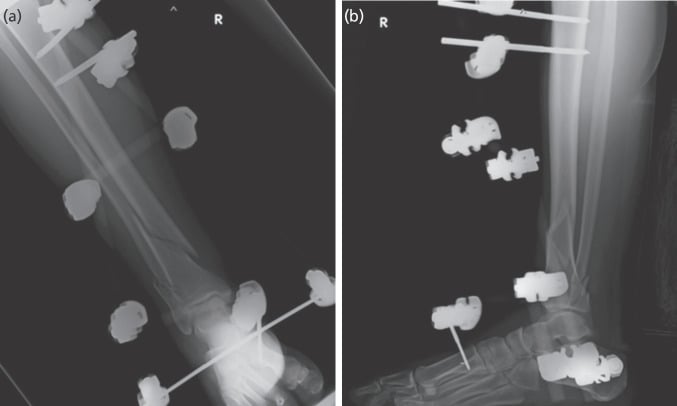
Stage 1, in theatre within 24 hours. Apply a spanning external fixator (delta frame); an acute presentation, within 6-12 hours, is spanned immediately. The frame restores length and stabilises the fracture while the soft tissues recover, and the CT follows. Whether to fix the fibula at this stage is controversial (see Controversies).
Stage 2, the wait. Typically 10-21 days, while the oedema resolves; elevate. The signal to proceed is the wrinkle sign (the skin wrinkles when pinched) together with epithelialisation of the fracture blisters.
Operating through blistered or swollen skin guarantees wound breakdown and infection. Do not plate through swollen skin: the wrinkle sign is mandatory before definitive surgery.
Stage 3, definitive fixation. ORIF with anatomical specific plates, through an approach dictated by the CT and the column concept (see Surgical Technique).
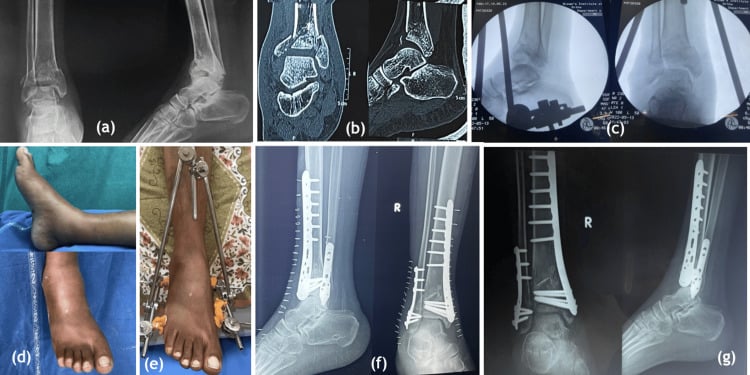
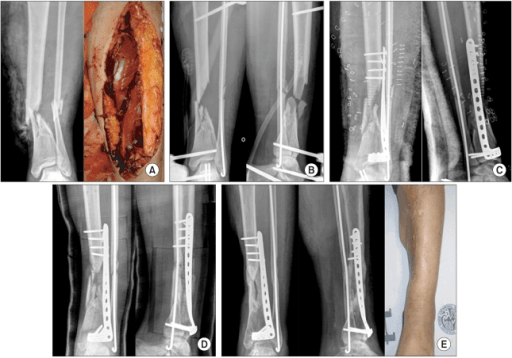
Span, Scan, PlanSurgical Strategy
Hook:Don't rush in. Span it, Scan it, then Plan it.
Choosing definitive treatment. The options and their indications:
- Non-operative: non-displaced (type I) fractures, patients too sick for surgery (extreme comorbidities), and soft tissues too compromised for any incision (for example, vascular disease). Cast immobilisation for 6-12 weeks, non-weight-bearing.
- ORIF: displaced intra-articular fractures (types II and III), open fractures and polytrauma. The goal is anatomical reduction of the articular surface and fixation stable enough to allow early motion.
- Definitive circular external fixation: severe type III (C3) injuries, a poor soft-tissue envelope, and elderly or comorbid patients.
- Primary arthrodesis: a non-reconstructable articular surface (the C3 "explosion"), or an elderly, low-demand patient. Fusion is with a blade plate or a nail.
Severe comminution in the elderly points to a circular frame or fusion, where reconstruction is not possible or the bone stock is poor.
Surgical Technique
Approaches. Each approach reaches particular columns, and the CT decides which are needed.
Anteromedial. The interval lies between tibialis anterior and the tibia, and there is no true internervous plane. It gives fixation of the medial column, and of the posterior column indirectly. The saphenous vein and nerve are at risk, and so is the skin, which lies in the watershed.
Anterolateral. The interval lies between peroneus tertius and extensor hallucis longus (or tibialis anterior). It gives fixation of the anterolateral (Chaput) fragment and the lateral column, allows visualisation of the joint surface, and has better muscle cover over the plate than the medial side. The superficial peroneal nerve is at risk, seen in the subcutaneous fat.
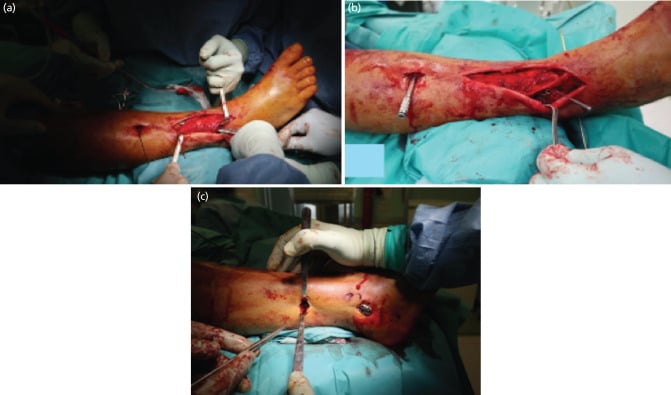
Posterolateral. The interval lies between peroneus brevis and FHL, and gives fixation of the posterior malleolus (Volkmann fragment). It can be done acutely or staged.
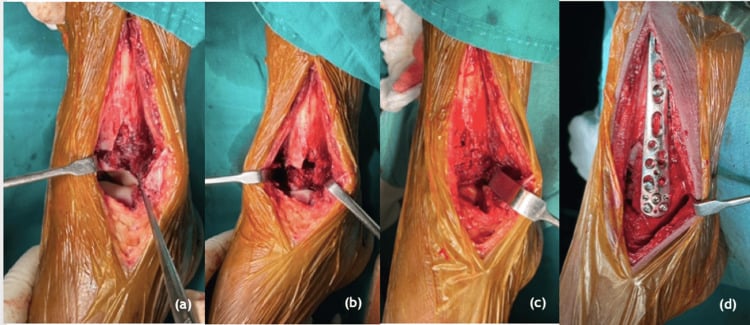
The fixation sequence: back to front, lateral to medial.
- Posterior column. Restore the posterior wall first, with a buttress plate through the posterolateral approach, to verify length and provide a backstop.
- Anterolateral column. Open the fracture like a book through the anterolateral approach, and reduce the key Chaput fragment to the distal fibula (if it has been fixed) or to the posterior block.
- Articular surface. Disimpact the central die-punch fragments, bone-graft the void and reduce the articular surface to the frame of the columns. Leaving a die-punch fragment impacted guarantees articular incongruity.
- Medial column. Reduce the medial malleolus to the block and apply a medial or anteromedial buttress plate.
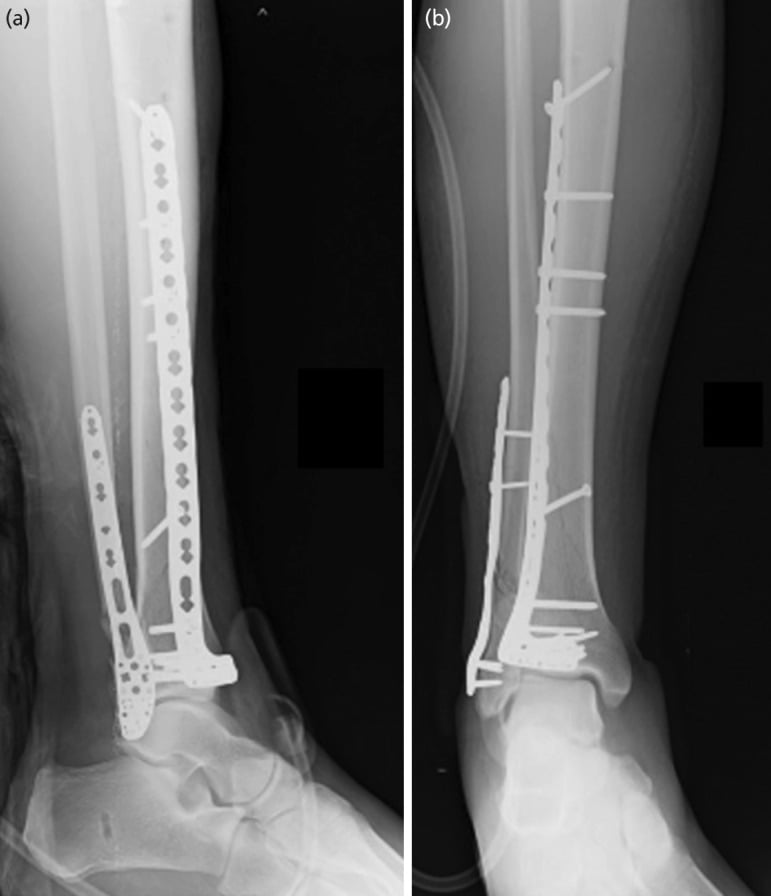
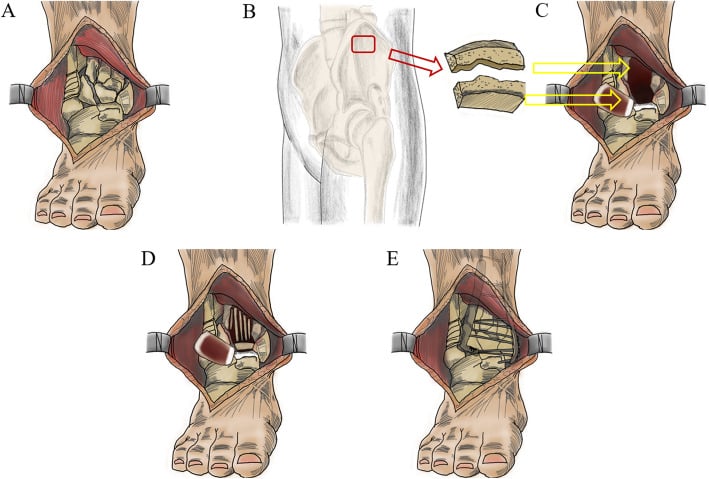
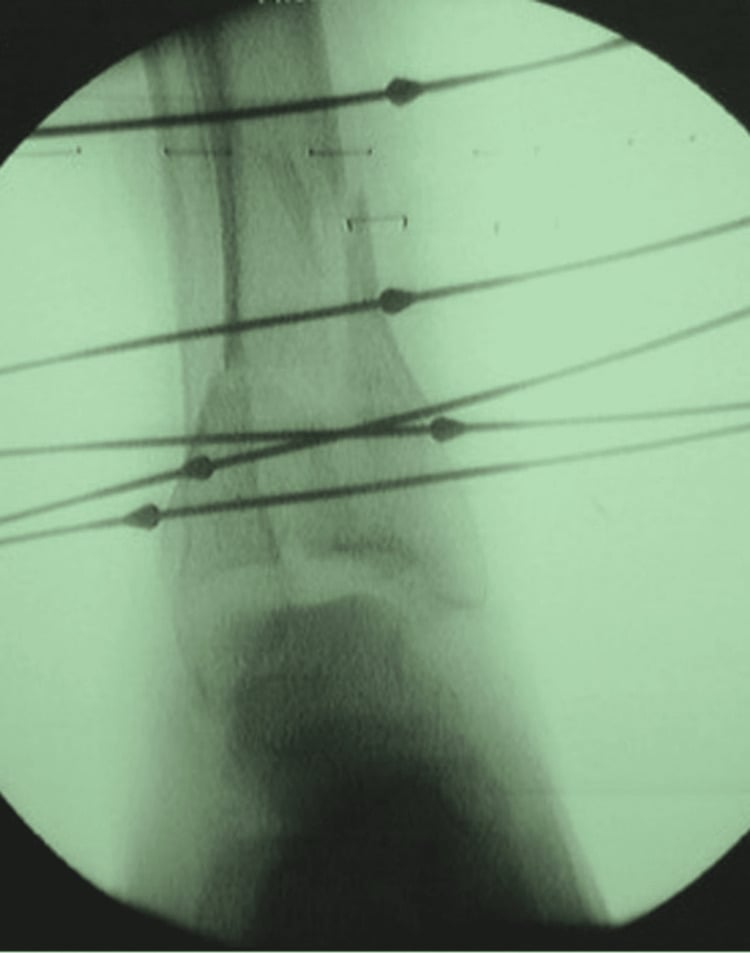
Circular frames. An Ilizarov or TSF frame uses olive wires to reduce and compress the fragments. It allows early weight-bearing, and axial loading stimulates healing.
Complications
Wound breakdown and infection. Wound dehiscence or infection occurs in 10-30%, the highest rate in orthopaedic trauma. Deep infection runs at 5-15% in closed fractures and higher in open ones, and Staphylococcus aureus is the most common pathogen. Treat it with debridement and antibiotics, retaining the hardware if it is stable and removing it if it is loose; deep infection often requires free-flap coverage or amputation.
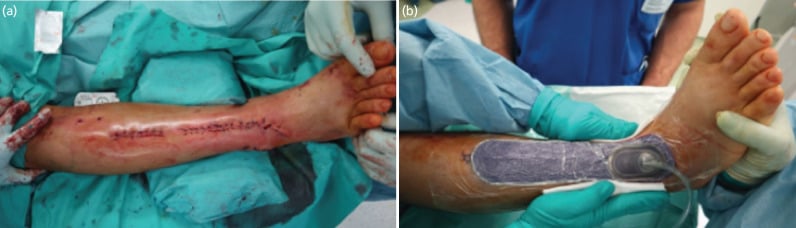
Protecting the wound. The anteromedial skin is precarious. Vacuum dressings (PICO) are often used prophylactically, and any necrosis must be debrided early and covered with a flap.
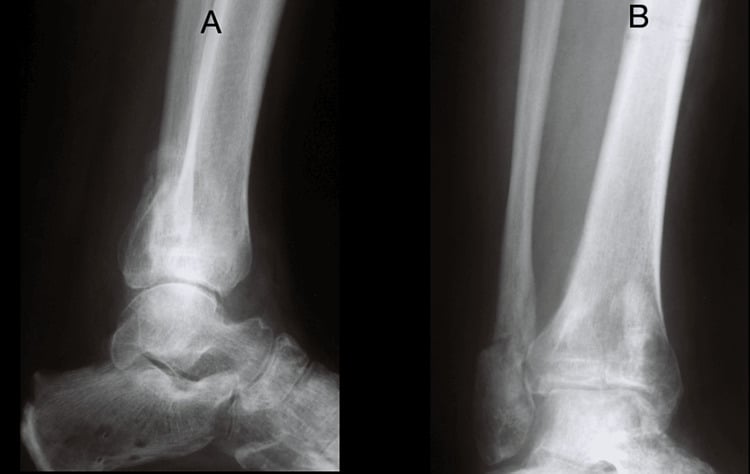
Post-traumatic arthritis. Seen in 50% or more, almost inevitable in type III injuries, and correlated with the quality of reduction (step-off under 2 mm). Treatment is ankle arthrodesis, or arthroplasty in the elderly.
Stiffness is near-universal, from intra-articular scarring, cartilage damage and prolonged immobilisation (arthrofibrosis). Loss of 10-20° of dorsiflexion is common, and loss of dorsiflexion is the most debilitating: it affects gait, which then requires greater knee flexion. Manage it with early range-of-motion exercises and aggressive physiotherapy; manipulation under anaesthesia rarely helps.
Nonunion and malunion. Nonunion (5-10%) occurs at the metaphyseal junction. Malunion into varus is common.
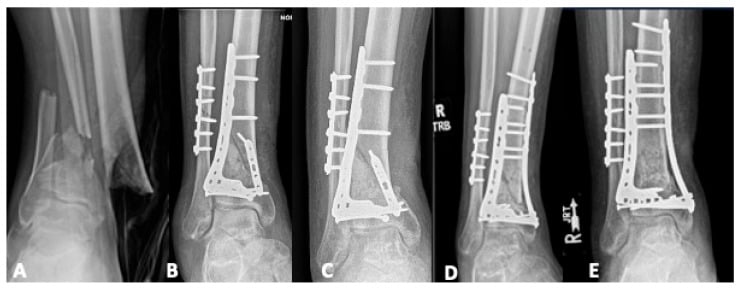
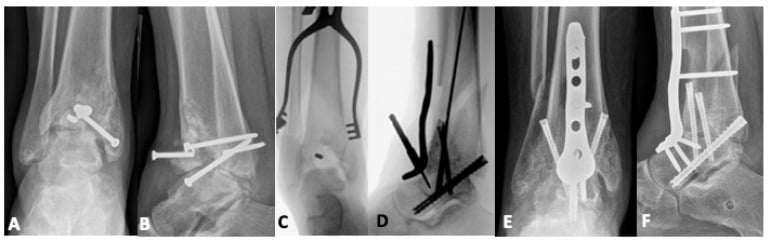
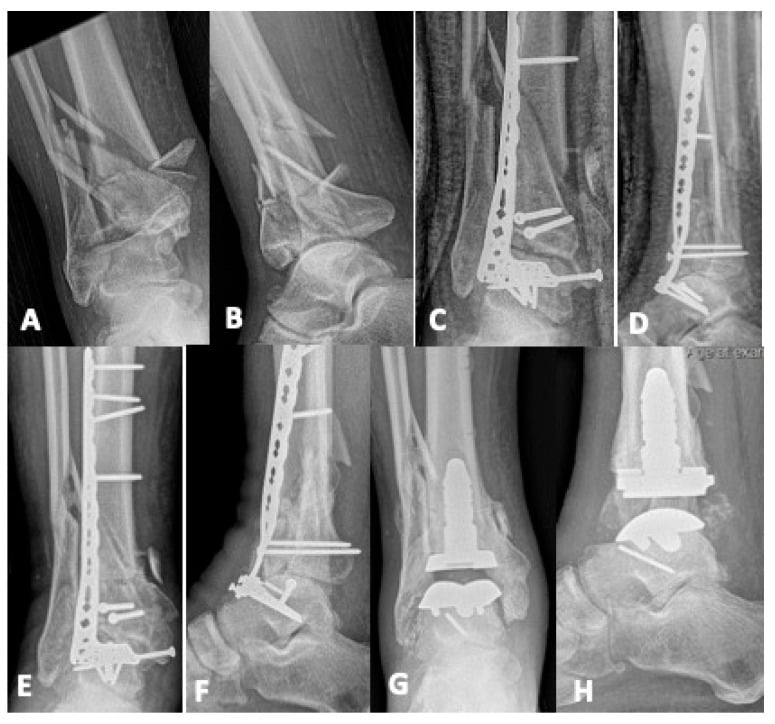
Hardware problems.
- Plate breakage: risk factors are early weight-bearing, severe comminution and poor reduction. Remove the plate, bone-graft and re-plate, or consider an intramedullary nail.
- Prominent hardware: from the thin soft tissue over the anteromedial tibia. Remove it once union is achieved (6-12 months post-operatively).
- Screw irritation: periarticular screws protruding into the joint can cause synovitis. Remove prominent screws.
Deep vein thrombosis. The risk is high, from lower-limb trauma, non-weight-bearing and immobilisation. Prophylaxis is LMWH or aspirin, the choice based on bleeding risk and institutional protocol. Diagnosis rests on clinical suspicion (calf swelling, pain) and duplex ultrasound, and treatment is anticoagulation.
Chronic pain may take the form of complex regional pain syndrome (CRPS); prevention with vitamin C is discussed under Controversies.
Postoperative Care
Motion waits for the wound, and full load waits for radiographic union.
- Weeks 0-2, the wound. Splint in neutral, strict elevation, non-weight-bearing, no ankle movement. Active toe movement, isometric quadriceps and gluteal exercises, and knee range of motion, aiming at wound healing and oedema control; ensure the wound has healed before ankle motion begins.
- Weeks 2-6, motion. A removable boot and active ankle pumping (dorsiflexion and plantarflexion), but no inversion or eversion, which stresses the columns. Still non-weight-bearing.
- Weeks 6-12, motion and loading. Restore ankle range with ankle pumps, Theraband resistance and a stationary bike. Begin weight-bearing, partial at first for proprioception, progressing from touch-toe to as tolerated on radiographic union, and to full weight-bearing by 12 weeks if the radiographs show union.
- From 12 weeks, function. Proprioception, power and return to activity: single-leg stance, calf raises and, late, plyometrics.
Outcomes and Prognosis
What to tell the patient. Return to work takes on average 12 months. AOFAS scores are typically 70-80/100, and 10-20% require a fusion within 5-10 years. Manage expectations from the start: "Your ankle will never be normal again."
Guidelines, Registries & Global Practice
Global epidemiology:
- Pilon fractures represent roughly 1-10% of lower-limb fractures and under 1% of all fractures worldwide.
- Bimodal distribution: high-energy axial loading in young males (falls from height, road traffic, occupational) and lower-energy rotational variants in older, often osteoporotic patients.
- Associated fibular fracture in 75-85% and open injury in 20-30% of high-energy patterns; incidence is rising with motorisation in low- and middle-income regions.
Side-by-side guidance (where societies differ in emphasis):
- Core Position
- Two-stage protocol: spanning external fixation then delayed staged ORIF once soft tissues recover; column-based reduction strategy.
- Core Position
- Open fractures: prompt IV antibiotics, combined ortho-plastic care, definitive skeletal and soft-tissue cover within 72h (often single-stage fix-and-flap at a specialist centre).
- Core Position
- Endorses staged management; mandatory CT after spanning fixation for articular planning; reduction quality emphasised as outcome driver.
- Core Position
- Recognises circular (Ilizarov / hexapod) fixation as a valid definitive alternative, especially with poor soft tissues or in limited-resource settings.
Registry & evidence notes:
- No implant registry tracks pilon plates the way arthroplasty registries track joints; outcome evidence comes from trauma cohorts and trials (Wyrsch, Sirkin, Pollak above).
- Anatomically pre-contoured locking plates are now standard in high-resource settings; large cohorts (e.g. circular-frame series) confirm high union rates with frames where plating is contraindicated.
High- vs Limited-Resource Practice Variation
- Well-resourced centres: Two-stage ORIF with CT planning, pre-contoured locking plates, ortho-plastic flap cover, prophylactic negative-pressure dressings.
- Limited-resource / remote settings: Definitive circular or hybrid external fixation is often preferred - it avoids implant cost, allows weight-bearing, and tolerates a compromised soft-tissue envelope. Where a peripheral hospital cannot offer definitive care, the principle is span and stabilise, then refer: apply a spanning external fixator (even a simple unilateral frame), give analgesia, elevate, document neurovascular and compartment status, give antibiotics and tetanus cover for open injuries, and transfer to a major trauma centre with CT and reconstructive capability.
Consent & Documentation (universal)
- Counsel every patient on the high complication burden: wound breakdown, infection, near-universal stiffness, post-traumatic arthritis and possible future arthrodesis, plus the alternatives (non-operative care, circular frame, primary fusion).
- Document neurovascular and compartment status before and after any reduction, antibiotic timing for open injuries, and clear return instructions for wound review and compartment-syndrome warning signs.
Related pages: Ankle Fractures for the rotational injury this must be separated from - a malleolar pattern and a plafond pattern look similar on a poor AP film and are entirely different problems; Tibial Shaft Fractures for the proximal continuation and the nailing decision when the fracture extends into the diaphysis; Talus Fractures and Calcaneal Fractures for the other injuries of the same axial-load mechanism, which should be actively looked for and are commonly missed alongside; Compartment Syndrome of the Leg for the emergency that coexists with high-energy plafond injury and is masked by a spanning frame; Open Fracture Management for the debridement and coverage pathway that runs in parallel in the 20-30% of these that are open; Ilizarov and External Fixation for the circular-frame technique that is both the temporising and, in some units, the definitive treatment; Ankle Arthritis for the endpoint that essentially every type-II and III fracture reaches radiographically, and the arthrodesis or replacement decision that follows; and Distal Tibial Physeal Injuries for the immature equivalent, where the physis fails before the plafond does.
Controversies and Areas of Uncertainty
Fibular fixation. Sirkin's staged protocol (see Evidence) fixed the fibula immediately, alongside the spanning fixator, and the one-page summary follows it. Fixation restores length and the lateral column and aids reduction, but it adds a lateral incision that increases lateral wound complications, and it can lock in malreduction or compromise the skin bridge. The staged-protocol decision is to fix it if an anteromedial approach is planned and to avoid it if an anterolateral approach is planned, because of the skin bridge; put more cautiously, fix it when planning a medial-based approach or when length is otherwise unrecoverable, and consider leaving it when an anterolateral approach is planned.
Definitive ORIF or definitive circular frame. No high-quality trial proves either superior for severe patterns. Frames avoid wound complications and allow loading, but carry pin-site problems and a burden for the patient; the choice is driven by the soft tissues, comorbidities, surgeon expertise and resources.
The timing of ORIF. "Wait for the wrinkle sign" (typically 10-21 days) is widely taught, but the precise safe window is not standardised. It depends on the individual soft-tissue response rather than a fixed day count.
Four-column theory: must every column be fixed? A long-term cohort (Bakan 2023, Injury) found no functional or radiological difference between fully and partly supported columns in 43-C fractures, challenging the dogma that every fractured column needs its own implant.
Primary arthrodesis or reconstruction. In the non-reconstructable 43-C3 fracture and the elderly low-demand patient, arthrodesis trades motion for a durable, single-procedure outcome. The threshold for choosing it remains a matter of judgement.
Early weight-bearing is permitted with a stable circular frame. After plate ORIF it remains cautious and is not yet supported by robust comparative data.
Adjuncts of uncertain benefit. Prophylactic negative-pressure wound therapy over incisions, and vitamin C (500 mg daily, proposed to prevent CRPS; controversial evidence but low harm), have plausible mechanisms but limited high-level evidence.
MCQ Practice Points
Q: Which column of the distal tibia typically includes the Tillaux-Chaput tubercle? A: Anterolateral Column.
Q: What is the 'Mercedes Benz Sign' on CT axial view? A: The confluence of fracture lines separating the Medial, Anterolateral, and Posterior fragments.
Q: What is the most common long-term complication of Type III Pilon fractures? A: Post-traumatic Osteoarthritis (PTOA).
Q: What is the minimum skin bridge required between anteromedial and anterolateral incisions? A: 7 cm. Less than this risks necrosis of the skin bridge.
Q: Which nerve is at risk during an Anterolateral approach? A: Superficial Peroneal Nerve (runs in subcutaneous fat layer).
Q: What is the staged protocol for Pilon fractures? A: Span (ExFix) → Scan (CT after reduction) → Plan (Choose approach based on fragments) → Fix (Wait for Wrinkle Sign, then ORIF). Definitive surgery typically at 10-21 days.
Q: What is the infection rate for open Pilon fractures? A: 10-15% deep infection rate, despite staged protocol. Requires early debridement, antibiotics, and often free flap coverage for Grade IIIB.
Clinical Decision Scenarios
Practise clinical reasoning and management decisions out loud
“A 40-year-old male presents with a Grade 3B open Pilon fracture 6 hours after a motorbike crash. Soft tissue loss medial side.”
“Referral tells you: 'It's just an ankle fracture, can you admit?' You see the X-ray is a comminuted Pilon.”
“An 82-year-old female, multiple comorbidities (NIDDM, CAD), presents with a Type C3 Pilon fracture after a fall from standing. Swelling is significant.”
Key Concepts
- Axial Load Mechanism
- Soft Tissue dictates timing
- Span, Scan, Plan
- 3 Column Fixation
Emergency Steps
- Reduce
- Spanning ExFix (Delta)
- CT Scan
- Elevate x 14 days
X-ray Signs
- Articular step-off
- Metaphyseal impaction
- Mercedes Benz Sign (Axial CT)
- Double Contour sign
Complications
- Wound Breakdown (Disaster)
- Infection
- Arthritis (Inevitable?)
- Varus Malunion
Evidence
ORIF vs External Fixation (Landmark RCT)
- Randomized prospective study of 39 tibial plafond fractures (17 type III, 10 open).
- ORIF group had 15 complications in 7 patients vs 4 complications in the external fixation group; complications after ORIF were more severe.
- Three amputations, all in the ORIF group.
- No significant difference in clinical score or radiographic osteoarthritis between groups; all type II/III fractures developed some OA.
Staged Protocol for Soft-Tissue Management
- 56 fractures: immediate fibular ORIF plus spanning external fixator, then delayed plating once swelling subsided (mean 12.7 days closed, 14 days open).
- Closed fractures: all wounds healed; 17% partial-thickness necrosis treated non-operatively; one late osteomyelitis (3.4%).
- Open fractures: two deep infections (10.5%), including one below-knee amputation.
- No skin grafts, rotation flaps or free transfers required for the surgical wounds.