The Unstable Scapula
- Most winging is neurogenic: serratus anterior (medial) or trapezius (lateral).
- The long thoracic nerve comes from roots C5, C6 and C7 (the nerve of Bell).
- Wall push-up test brings out medial winging; resisted abduction brings out lateral winging.
- Most neurogenic palsy improves spontaneously - observe 12 to 24 months before salvage - but a significant minority keep residual winging and weakness, so do not promise full recovery.
- “Painful onset with patchy shoulder-girdle weakness suggests neuralgic amyotrophy (Parsonage-Turner).
- “Pectoralis major (sternal head) transfer is the salvage of choice for fixed serratus anterior palsy.
- “Eden-Lange transfer (levator scapulae + both rhomboids) is the salvage for fixed trapezius palsy.
Overview
Definition. Scapular winging is abnormal protrusion of the scapula away from the chest wall because the muscles that hold it flat and rotate it, mainly serratus anterior and trapezius, are weak, detached or imbalanced.
Why it matters. The scapula is the stable platform from which the arm works, and normal overhead elevation needs smooth scapulothoracic rhythm, the scapula rotating upward as the arm rises. When a key stabiliser fails, the scapula lifts off the chest wall, the shoulder loses power and elevation, and the patient develops pain and fatigue.
The causes. The most common are serratus anterior dysfunction from long thoracic nerve injury, giving medial winging, and trapezius dysfunction from spinal accessory nerve injury, giving lateral winging. Less commonly, direct muscle avulsion or rhomboid (dorsal scapular nerve) weakness is responsible, and acute traumatic tears of serratus anterior, trapezius and rhomboids are under-recognised causes (Didesch and Tang, 2019; DOI).
Anatomy
Serratus anterior and the long thoracic nerve. Serratus anterior arises from the upper 8 or 9 ribs, wraps around the chest wall, and inserts on the deep surface of the medial scapular border. It protracts the scapula and, crucially, produces upward rotation so that the glenoid faces up for overhead reach; it also holds the medial border flat against the thorax.
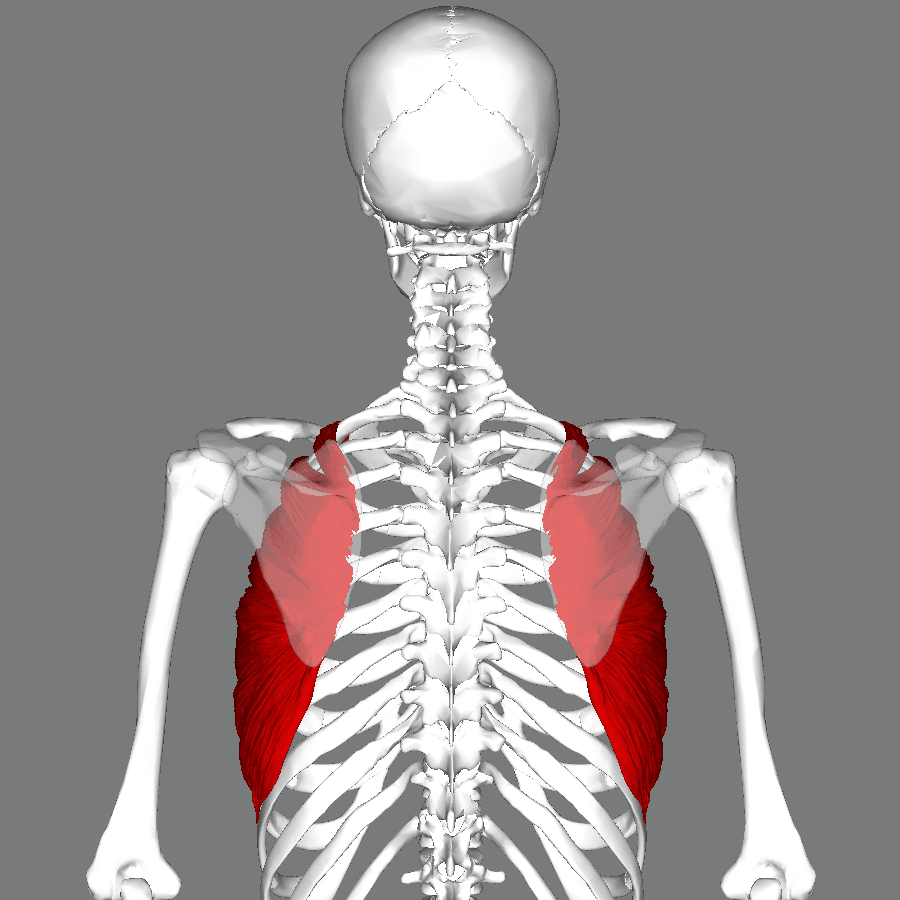
Its nerve is the long thoracic nerve (the nerve of Bell), from roots C5, C6 and C7. The nerve runs superficially on the surface of serratus anterior, which makes it vulnerable to traction and direct trauma. Loss of the muscle produces medial winging: the medial border lifts off and drifts towards the spine, and forward elevation is limited and weak.
Trapezius and the spinal accessory nerve. The broad trapezius runs from the occiput and spinous processes to the spine of the scapula and the clavicle. Its three parts together suspend and upwardly rotate the scapula:
- Upper - elevates and rotates
- Middle - retracts
- Lower - depresses and rotates
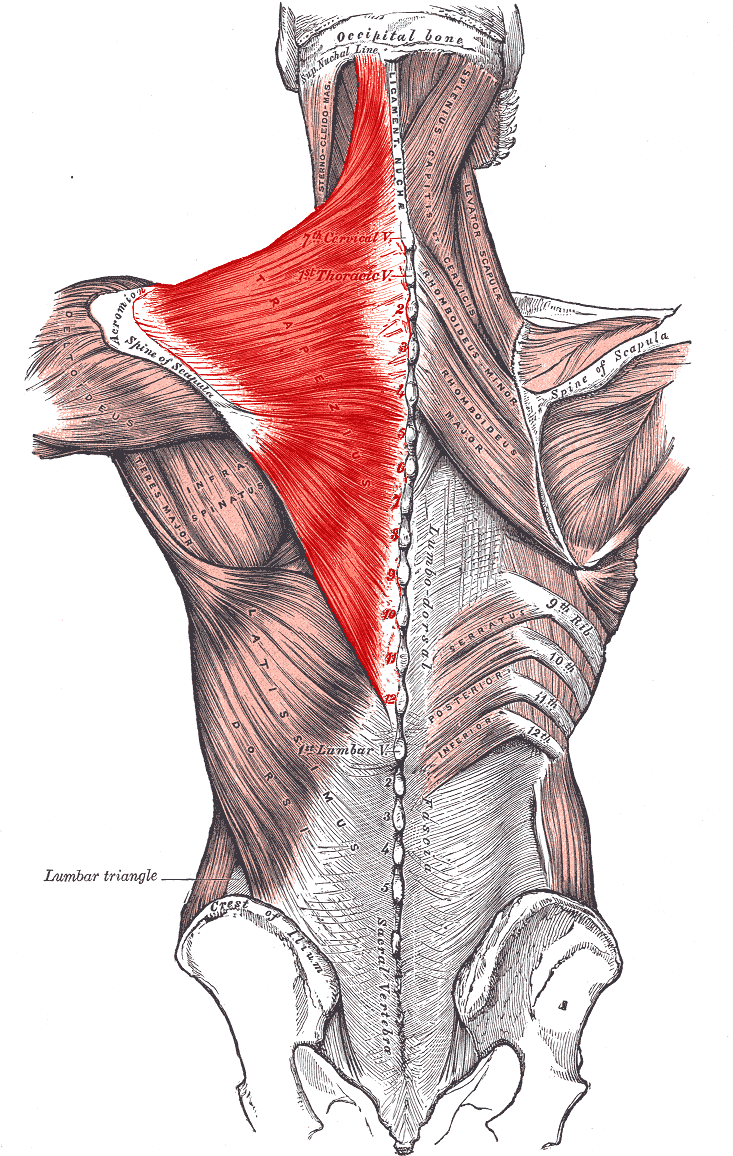
Its nerve is the spinal accessory nerve (cranial nerve XI), which runs superficially across the posterior triangle of the neck, where it is easily injured during lymph node biopsy or neck dissection. Loss of the muscle produces lateral winging: the shoulder droops, the scapula translates laterally and rotates downward, abduction is weak, and the neckline looks asymmetric.
The rhomboids and the dorsal scapular nerve. Rhomboid major and minor retract and stabilise the medial border, and levator scapulae elevates the superior angle; the rhomboids are supplied by the dorsal scapular nerve (C5). Rhomboid palsy is rare and often missed. It gives a subtle medial winging with the scapula translated slightly laterally and the inferior angle rotated outward, the opposite rotation to serratus palsy.
Pathophysiology
The long thoracic nerve. Its long superficial course makes it vulnerable, and the recognised mechanisms are:
- Traction - sudden depression of the shoulder, sport, heavy lifting
- Compression by a backpack ("rucksack palsy")
- Often no clear injury - an inflammatory neuritis (neuralgic amyotrophy) is increasingly recognised
The spinal accessory nerve. Its superficial course in the posterior cervical triangle makes it susceptible to injury, and iatrogenic injury after a surgical procedure is one of the most common causes of trapezius palsy (Wiater and Bigliani, 1999). The causes are:
- Iatrogenic - the most common: cervical lymph node biopsy, excision in the posterior triangle, or neck dissection
- Trauma - penetrating or blunt, to the posterior triangle
TRAPCauses of Winging
Hook:A heavy TRAP on the shoulder wings the scapula.
Classification
By direction. The working classification, and the most useful clinically, because it points straight to the nerve:
- Medial (dynamic) winging - serratus anterior palsy; the inferior angle rotates towards the midline
- Lateral winging - trapezius palsy; the inferior angle rotates outward
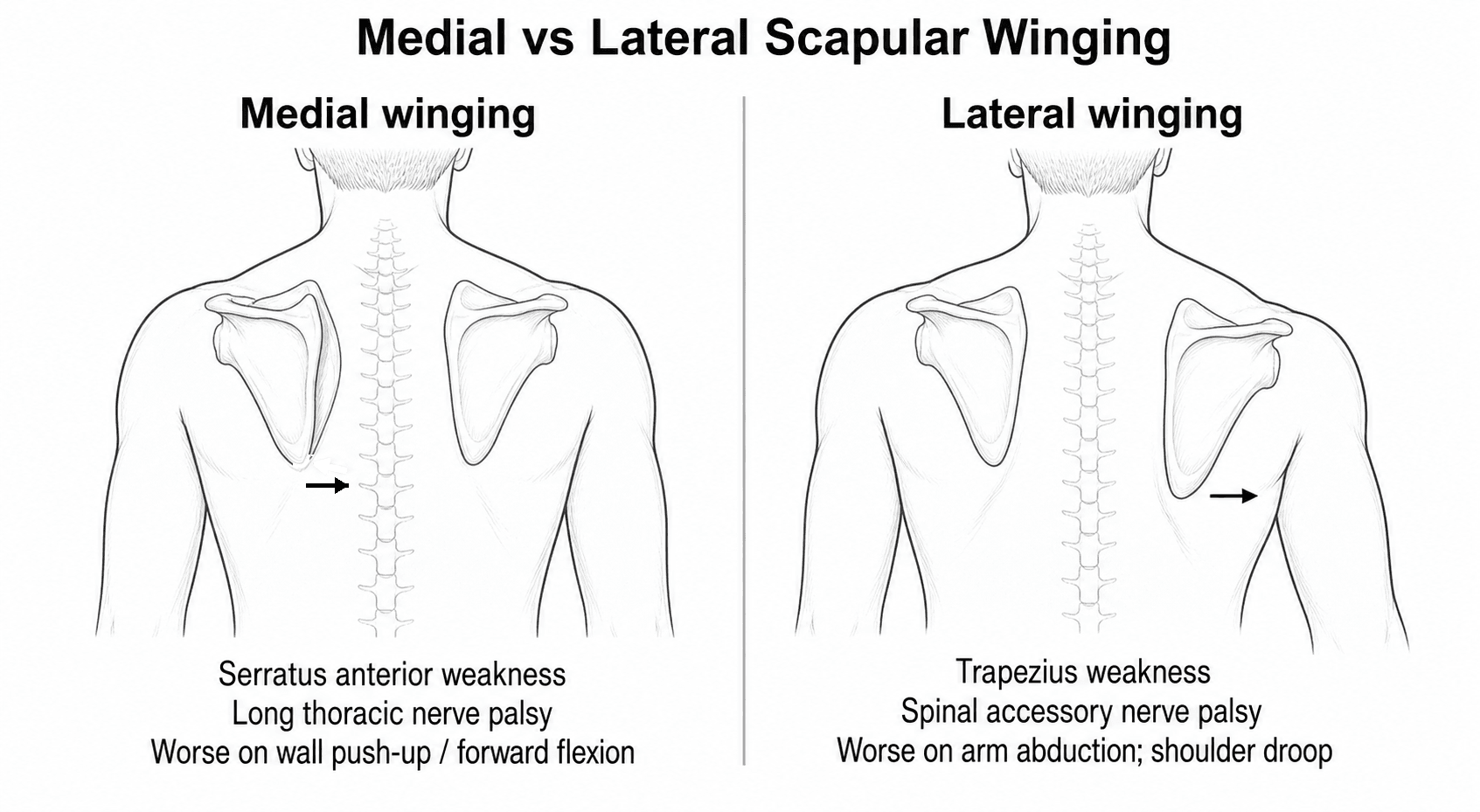
By cause. Neurogenic winging is the most common.
- Neurogenic - long thoracic (serratus), spinal accessory (trapezius), dorsal scapular (rhomboids)
- Muscular or soft tissue - direct avulsion or tear of serratus, trapezius or rhomboids; facioscapulohumeral muscular dystrophy (FSHD)
- Bony or mechanical - osteochondroma of the scapular undersurface, malunion, and scapulothoracic bursitis ("snapping scapula") causing pseudo-winging
Scapular Dyskinesis and the Kibler Classification
Dyskinesis is not winging. Not every abnormal scapula is a true (structural or neurogenic) winging. Scapular dyskinesis is altered scapular position and movement, usually a problem of muscle control, timing and overuse rather than a fixed nerve or muscle lesion, and it is the commonest scapular abnormality in overhead athletes.
Why it matters. Dyskinesis contributes to subacromial impingement, rotator cuff overload and instability, and it is treated with rehabilitation, not surgery. Kibler described a visual classification by which part of the scapula is most prominent.
- Prominent border
- Inferior angle prominent (tilts dorsally)
- Underlying fault
- Loss of anterior-tilt control (often serratus / lower trapezius)
- Prominent border
- Whole medial border prominent
- Underlying fault
- Excess internal rotation about a vertical axis
- Prominent border
- Superomedial border prominent (shrug pattern)
- Underlying fault
- Early or excess superior translation
- Prominent border
- Symmetric, normal
- Underlying fault
- Reference (normal) pattern
The SICK scapula is an overuse dyskinesis in throwers: Scapular malposition, Inferior medial border prominence, Coracoid pain and malposition, and dysKinesis. The scapular assistance and scapular retraction tests help judge whether the dyskinesis is driving impingement or instability, and most dyskinesis responds to a graded scapular-stabilisation programme.
Reserve the label "winging" for a structural cause - a serratus or trapezius palsy, or a muscle or bony lesion - confirmed by direction and EMG.
Snapping Scapula Syndrome (Scapulothoracic Bursitis)
Definition. Snapping scapula syndrome is painful, audible or palpable crepitus during scapulothoracic motion, sometimes with pseudo-winging, caused by mechanical incongruity between the scapula and the chest wall. It is a key mechanical mimic to separate from neurogenic winging because the nerves and EMG are normal: crepitus with a normal EMG points to the bone, not the nerve.
The bursae. The scapulothoracic articulation has two main bursae, plus smaller adventitial bursae at the superomedial and inferior angles, any of which can inflame:
- Infraserratus - between serratus anterior and the chest wall
- Supraserratus - between subscapularis and serratus anterior
Imaging the bursa. Bursitis may coexist with a ventral osteochondroma. In the example below, fat-suppressed MRI shows a large bursal effusion, while ultrasound confirms the collection dynamically, guides needle placement and documents near-complete decompression after aspiration.
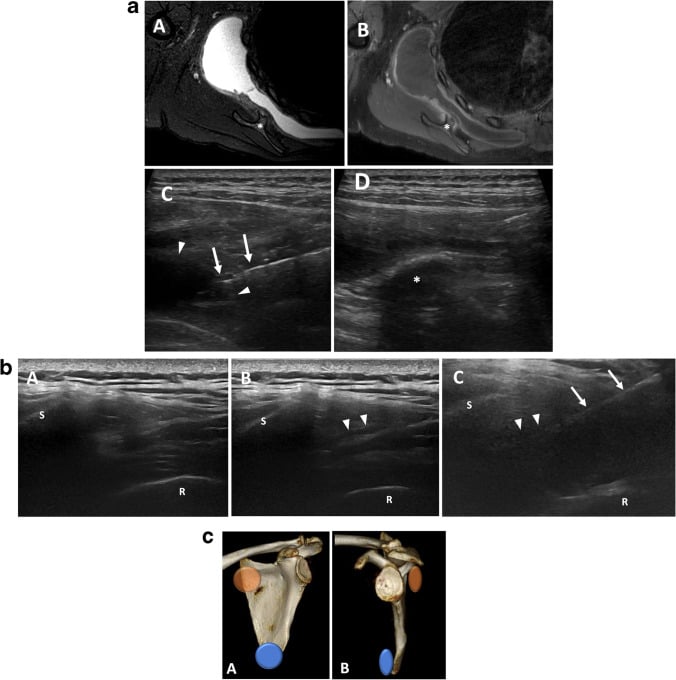
The osteochondroma. A ventral scapular osteochondroma can lever the scapula away from the thoracic wall and create static pseudo-winging, and one at the superior angle can occupy the scapulothoracic interval and displace the scapula posteriorly. The lesion may be subtle on a tangential radiograph but conspicuous on CT, which is why CT is required when painful crepitus or fixed pseudo-winging persists despite normal electrodiagnostic studies. CT distinguishes a mechanical block from neurogenic winging and defines the osseous stalk, its relationship to the ribs and the resection plane before excision.
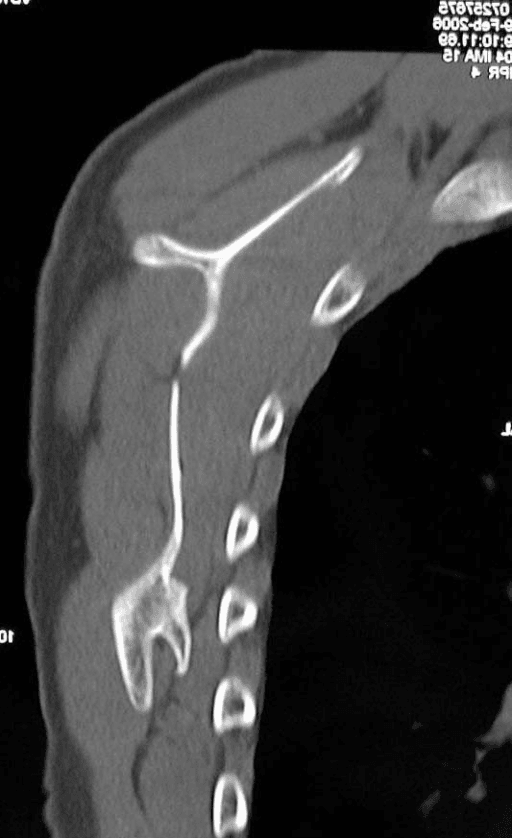
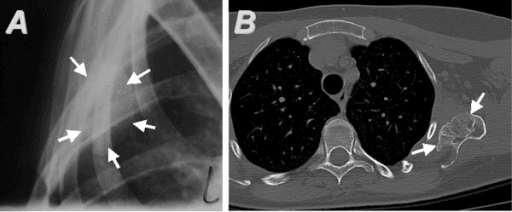
Treatment. Most cases are treated with physiotherapy and a bursal injection, and resection is reserved for refractory disease.
- Detail
- Osteochondroma (commonest), Luschka's tubercle at the superomedial angle, scapular or rib malunion
- Action
- CT to define; excise the lesion
- Detail
- Scapulothoracic bursitis, muscle atrophy or fibrosis
- Action
- Physiotherapy, posture correction, NSAIDs, bursal steroid injection
- Detail
- Persistent painful crepitus despite conservative care
- Action
- Bursectomy and superomedial angle resection (open or arthroscopic)
Clinical Assessment
History. A sudden painful onset suggests neuralgic amyotrophy. Ask about recent neck surgery or biopsy (accessory nerve), trauma, backpack use and sport (archery, tennis, swimming, weightlifting). Ask what the patient cannot do; overhead work and pushing are typically affected.
Inspection. Look from behind with the patient relaxed, then provoke. A drooping shoulder and asymmetric neckline point to the trapezius; a scapula that rests flat and wings on pushing points to serratus. A drooping shoulder and winging after a lymph node biopsy or neck dissection is spinal accessory nerve injury until proven otherwise, so look for the posterior triangle scar.
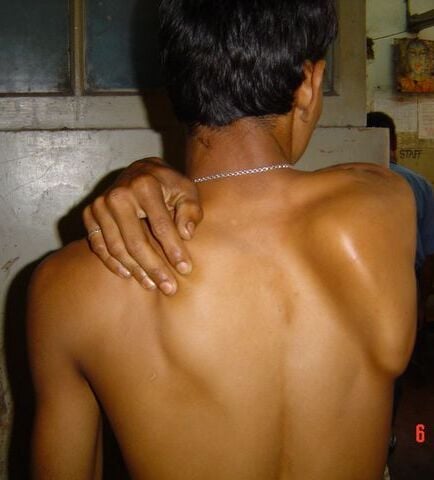
Provocation.
- Wall push-up - the patient pushes against a wall, and the medial winging of serratus palsy is exaggerated
- Forward flexion or arm raise - brings out medial (serratus) winging
- Resisted abduction or shoulder shrug - brings out lateral (trapezius) winging and reveals trapezius weakness
Investigations
Electrodiagnostic studies are the key test. EMG and nerve conduction studies confirm the diagnosis, localise the lesion (serratus, trapezius or rhomboids) and grade its severity. Needle EMG of serratus anterior or trapezius shows denervation in neurogenic palsy, and on serial testing EMG detects reinnervation, which guides the timing of surgery.
Imaging.
- Plain radiographs and CT - exclude bony causes (osteochondroma, malunion) and pseudo-winging
- MRI - muscle atrophy, mass lesions and, increasingly, nerve pathology
- High-resolution ultrasound - dynamic assessment of the nerve and the muscle
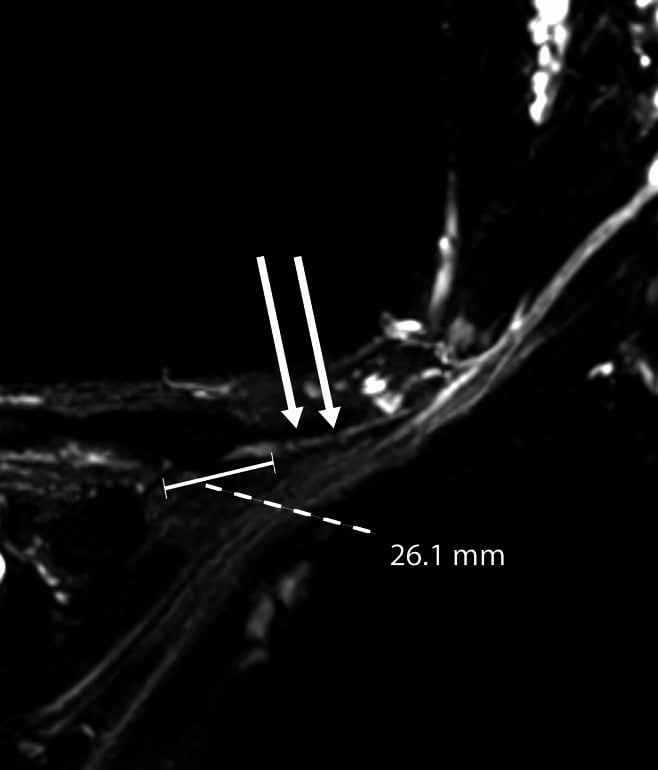
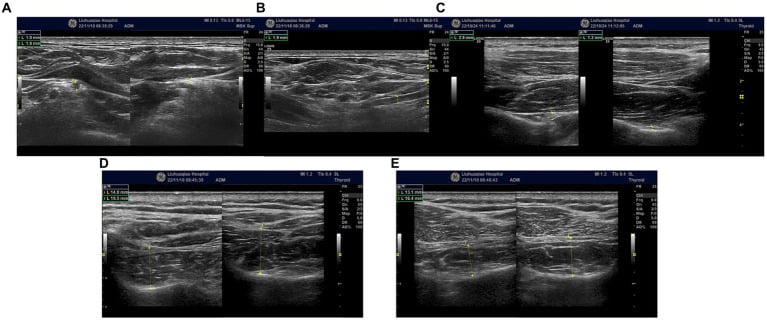
Hourglass constrictions. Improved MRI and high-resolution ultrasound have identified pathognomonic hourglass-like nerve constrictions in neuralgic amyotrophy, which has shifted the condition from a purely clinical diagnosis towards imaging-guided diagnosis and, in selected cases, surgery (Gstoettner et al., 2020; DOI). A constriction localises a structural lesion within the nerve rather than merely showing secondary muscle denervation. On ultrasound, side-to-side comparison along the nerve can show focal swelling, which can support the diagnosis and guide targeted exploration; in the example below the symptomatic suprascapular nerve is enlarged at its origin and through the notch compared with the contralateral side.
Differential Diagnosis
The classic trap is calling every protruding scapula "serratus palsy". Decide the direction of winging first, then look for the cause.
- Distinguishing Feature
- Medial winging, worse on push-up, inferior angle to midline
- Key Test
- EMG serratus; long thoracic nerve
- Distinguishing Feature
- Lateral winging, drooping shoulder, neck scar
- Key Test
- EMG trapezius; accessory nerve
- Distinguishing Feature
- Subtle medial winging, inferior angle rotated laterally
- Key Test
- EMG rhomboids
- Distinguishing Feature
- Severe pain first, then patchy weakness, often bilateral/post-viral
- Key Test
- MRI/US nerve constrictions; EMG
- Distinguishing Feature
- Bilateral, facial weakness, family history, young patient
- Key Test
- Genetic testing, CK, EMG
- Distinguishing Feature
- Painful crepitus, pseudo-winging, no denervation
- Key Test
- CT scapula (bony lesion)
- Distinguishing Feature
- Reproducible on demand, painless, normal nerves
- Key Test
- Normal EMG; psychological assessment
Bilateral, symmetric winging with facial weakness in a young patient is FSHD, not a nerve injury. And a painful, sudden-onset palsy that does not respect a single nerve - especially after a viral illness or vaccination - is neuralgic amyotrophy, which is treated very differently from a simple traction palsy.
Management Algorithm
Natural history. Most neurogenic winging recovers spontaneously, and the natural history justifies patience before salvage surgery. Most patients with serratus palsy regain function with conservative treatment, although recovery may take up to 2 years (Wiater and Flatow, 1999). Not everyone recovers fully: residual winging, weakness and fatigability persist in a meaningful proportion, and the older view that almost all long thoracic nerve palsies recover within 2 years is an oversimplification (Wu and Ng, 2023; DOI). That is why a proactive nerve-surgery approach is gaining ground for persistent cases.
First line for neurogenic palsy. Physiotherapy (scapular stabiliser strengthening, and range of motion to avoid stiffness), activity modification and analgesia. Scapulothoracic orthoses are described but are often poorly tolerated. Continue for roughly 12 to 24 months with serial clinical and EMG review for reinnervation before considering salvage.
Surgical Technique
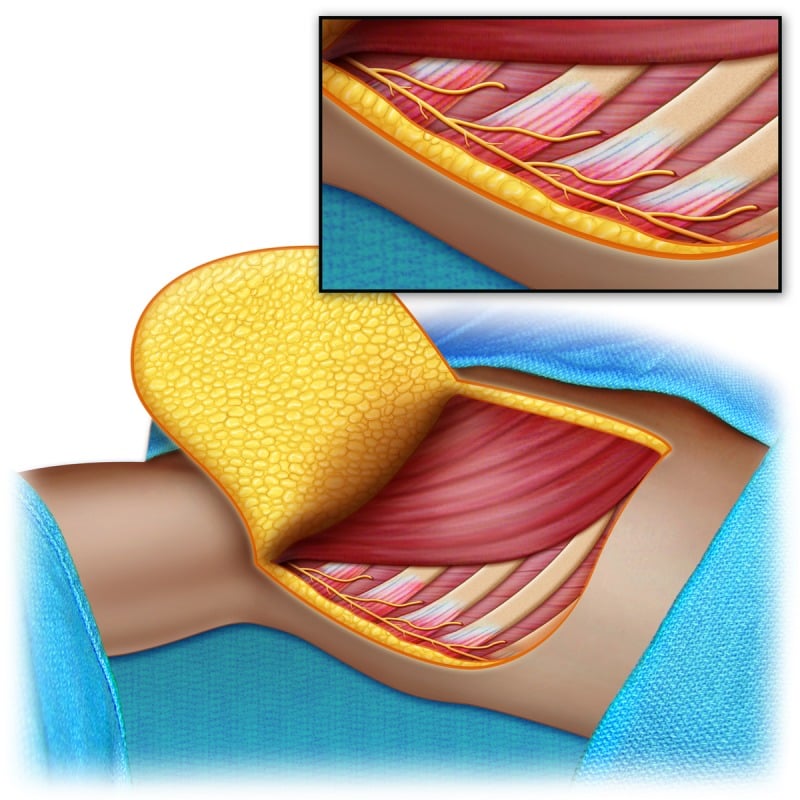
Pectoralis major transfer for serratus palsy. The aim is to replace the lost upward-rotation and stabilising pull of serratus anterior. The sternal head of pectoralis major is mobilised and transferred to the inferior angle of the scapula, usually lengthened with an autograft (fascia lata, hamstring) to reach.
- Two-incision approach (anterior axillary fold and over the inferior scapular angle).
- Harvest the sternal head of pectoralis major.
- Lengthen with fascial or tendon graft if needed.
- Pass deep to the chest wall soft tissue to the inferior angle.
- Fix to the scapula and tension with the arm at the side.
Results. Transfer of the sternal head of pectoralis major to the inferior angle of the scapula reinforced with fascia or tendon autograft consistently improves function, eliminates winging and reduces pain (Wiater and Flatow, 1999; Galano et al., 2008; DOI).
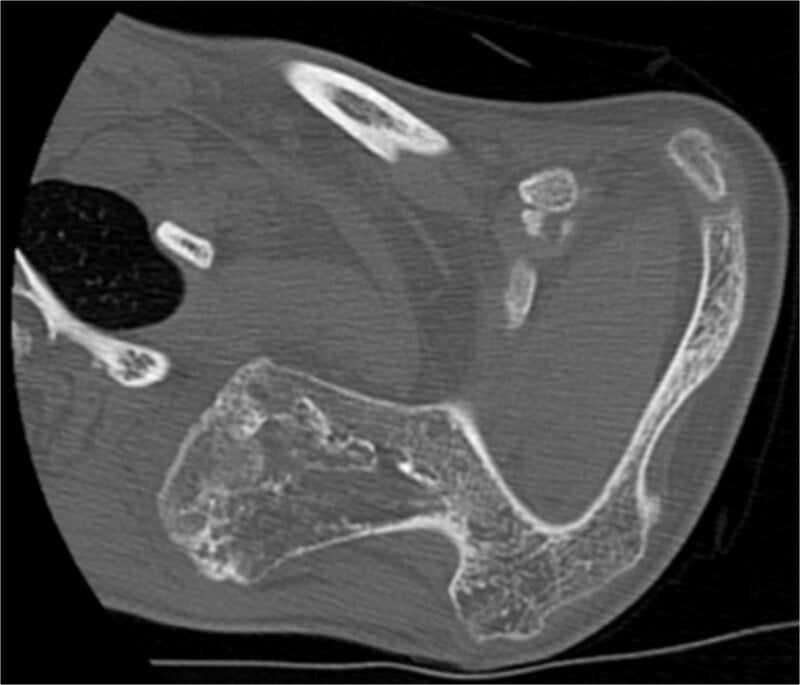
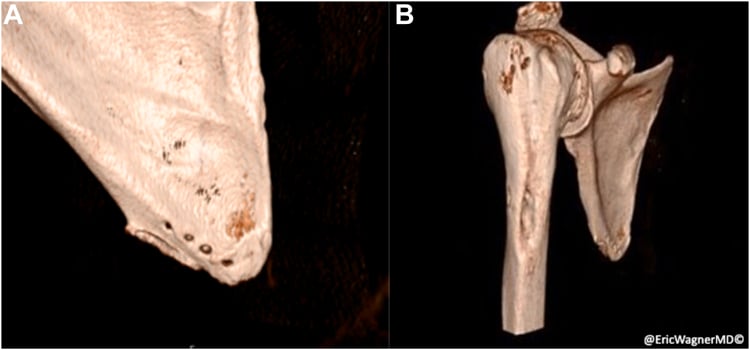
Direct transfer. Pectoralis major can also be transferred directly, with a humeral bone plug fixed to the inferior scapula. When excursion permits, bone-to-bone fixation can provide a short, robust construct without an interposed tendon graft. In the example below, postoperative CT demonstrates the humeral bone plug incorporated at the inferior scapula and the corresponding donor site.
Complications
Missed or wrong diagnosis. Calling lateral (trapezius) winging "serratus palsy" sends the surgeon to the wrong operation, and missing FSHD or neuralgic amyotrophy leads to inappropriate early surgery. Always confirm the direction of winging and back it with EMG.
Tendon-transfer problems. The problems are graft stretch or rupture, recurrence of winging and under-tensioning; adequate graft length and secure scapular fixation reduce recurrence. Wound problems also occur: superficial infection is the commonest reported complication in transfer series.
Scapulothoracic fusion. Rib instrumentation risks pneumothorax and pleural effusion, and careful subperiosteal rib technique limits pleural injury. Non-union and hardware problems are the other risks.
Postoperative Care
- Sling/abduction support after tendon transfer to protect the repair.
- Gentle passive range of motion to avoid stiffness; no active loading of the transfer.
- Begin active scapular control and assisted elevation.
- Start retraining the transferred muscle to fire in its new role.
- Progressive strengthening and return to function.
- Heavy lifting and sport deferred until the transfer is strong and winging is controlled.
Guidelines, Registries and Global Practice
Global Epidemiology
- Serratus anterior palsy (long thoracic nerve) is the most common cause of true scapular winging, typically affecting active young adults through traction, sport or neuritis.
- Trapezius palsy (spinal accessory nerve) is most often iatrogenic, following posterior triangle neck surgery or lymph node biopsy.
- Neuralgic amyotrophy is now recognised as more common than historically assumed, often post-viral or post-vaccination, and frequently underlies "idiopathic" winging.
Side-by-Side Practice Comparison
- Serratus (Long Thoracic)
- Medial
- Trapezius (Spinal Accessory)
- Lateral
- FSHD (Myopathy)
- Bilateral / mixed
- Serratus (Long Thoracic)
- Conservative ~12 to 24 months
- Trapezius (Spinal Accessory)
- Early nerve repair if recent injury
- FSHD (Myopathy)
- Genetic dx, supportive
- Serratus (Long Thoracic)
- Neurolysis if refractory
- Trapezius (Spinal Accessory)
- Repair/graft within ~12 months
- FSHD (Myopathy)
- Not applicable
- Serratus (Long Thoracic)
- Pectoralis major transfer
- Trapezius (Spinal Accessory)
- Eden-Lange transfer
- FSHD (Myopathy)
- Scapulothoracic arthrodesis
Practice Variation: High vs Limited Resource Settings
- High-resource: Routine EMG, high-resolution ultrasound and MRI for nerve constrictions, microsurgical nerve repair and the full range of tendon transfers and fusion.
- Limited-resource: Diagnosis is often clinical (direction of winging plus provocation tests); conservative rehabilitation is the mainstay, and tendon transfers or fusion deliver high value where microsurgical nerve reconstruction is unavailable.
- Across all settings: Skilled physiotherapy for scapular stabilisation and a watchful period for spontaneous recovery are emphasised before any salvage surgery.
MCQ Practice Points
Q: What are the root values of the long thoracic nerve? A: C5, C6 and C7 (the nerve of Bell).
Q: Medial winging worse on a wall push-up indicates weakness of which muscle? A: Serratus anterior (long thoracic nerve palsy).
Q: Lateral winging with a drooping shoulder after posterior triangle neck surgery suggests injury to which nerve? A: The spinal accessory nerve (cranial nerve XI), causing trapezius palsy.
Q: What is the salvage tendon transfer for fixed serratus anterior palsy? A: Transfer of the sternal head of pectoralis major to the inferior angle of the scapula (often with a fascial/tendon graft).
Q: Which muscles are transferred in the Eden-Lange procedure? A: Levator scapulae, rhomboid minor and rhomboid major, moved laterally to recreate the trapezius vectors.
Q: What imaging finding is now considered a hallmark of neuralgic amyotrophy? A: Hourglass-like nerve constrictions on high-resolution MRI or ultrasound.
Additional Quiz Questions
Viva Scenarios
Practise clinical reasoning and management decisions out loud
“A 28-year-old recreational tennis player has aching and weakness reaching overhead for 3 months. From behind, the right scapula sits flat at rest but the medial border lifts off and drifts towards the spine when he pushes against the wall.”
“A 45-year-old woman has a drooping right shoulder, pain and difficulty abducting the arm six months after an excisional lymph node biopsy in the posterior triangle of the neck. The scapula sits laterally and droops; winging worsens on abduction.”
“A 22-year-old man has slowly progressive bilateral scapular winging and difficulty raising both arms. On closer look he has mild facial weakness and cannot fully close his eyes. His father had similar shoulder problems.”
Pattern Recognition
- Medial winging, worse on push-up = serratus / long thoracic (C5-7)
- Lateral winging, drooping shoulder = trapezius / spinal accessory (XI)
- Subtle medial winging, angle rotated out = rhomboids / dorsal scapular
- Bilateral + facial weakness = FSHD
Causes (TRAP)
- Trauma / Traction
- Rucksack / Repetitive sport
- Amyotrophy (neuralgic / Parsonage-Turner)
- Postsurgical (neck biopsy - accessory nerve)
Investigations
- EMG / NCS - confirm, localise, grade, follow reinnervation
- MRI / ultrasound - muscle atrophy and nerve constrictions
- CT - exclude bony / snapping scapula
Treatment Ladder
- Conservative physio for ~12 to 24 months (neurogenic)
- Nerve surgery (neurolysis / repair) ideally within 12 months
- Serratus salvage: pectoralis major transfer
- Trapezius salvage: Eden-Lange; FSHD: scapulothoracic fusion
Evidence Base
Anatomy, Etiology, and Management of Scapular Winging (Review)
- Comprehensive review of anatomy, etiology, evaluation and treatment of scapular winging
- Most common causes: serratus anterior dysfunction from long thoracic nerve injury (medial winging) and trapezius dysfunction from spinal accessory nerve injury (lateral winging)
- Acute traumatic tears of serratus anterior, trapezius and rhomboids are under-recognised causes
- Distinguishes management of neurogenic winging from traumatic muscular detachment