Acral Lentiginous Melanoma of the Nail Unit | Hutchinson Sign | ABCDEF Criteria
- Subungual melanoma is an acral lentiginous melanoma arising from the nail matrix melanocytes
- Hutchinson sign (pigment extending onto the proximal or lateral nail fold) is highly suggestive but NOT pathognomonic - a named pseudo-Hutchinson sign occurs in Laugier-Hunziker syndrome, racial pigmentation and paediatric matrix naevi, and the sign is absent in many true melanomas
- Average diagnostic delay is 6-12 months due to confusion with subungual haematoma or fungal infection
- Nail matrix biopsy is essential for diagnosis — never assume pigmentation is benign without histology
- “ABCDEF of nail melanoma: Age 50-70, Brown-Black Band, Change, Digit (thumb/great toe), Extension onto fold, Family history
- “Subungual haematoma grows out with the nail; melanoma does NOT migrate distally
- “Biopsy the nail MATRIX (not just the bed) — that is where melanoma arises
Overview and Epidemiology
Subungual melanoma is a rare but aggressive variant of acral lentiginous melanoma that arises in the nail matrix, and accounts for 0.7-3.5% of all cutaneous melanomas. It is the most common type of melanoma in patients with darker skin tones (Fitzpatrick V-VI), the commonest subtype in Asian and Black populations, where it accounts for a disproportionate share of melanoma diagnoses.
Who and where. The peak age is 50-70 years, though it can occur at any age, and most series show a slight male predominance. The thumb (25-40%) and the great toe (25-30%) are the commonest sites.
Why it presents late. The average delay from first symptom to diagnosis is 6-12 months, and 25-30% are first diagnosed as a haematoma, a fungal infection or a benign naevus. Patients therefore frequently present with thick, advanced lesions, a median Breslow thickness of 2.5-4.0 mm, and a poorer prognosis than other cutaneous melanomas.
Why it is missed. Subungual haematoma, onychomycosis, benign melanonychia, ethnic melanonychia and subungual foreign body all mimic early melanoma, and patients and clinicians alike may put dark nail changes down to trauma or fungal infection, especially in younger patients. The nail plate hides the matrix lesion beneath it and makes clinical assessment difficult. And nail matrix biopsy needs a specific technique and referral to a specialist.
What it costs. Treatment often requires amputation of the affected digit, and survival depends on the stage at diagnosis (see Outcomes and Prognosis). A high index of suspicion and early biopsy are the most important tools for improving outcomes.
Pathophysiology
The nail unit. The unit comprises the nail matrix (germinal and sterile matrix), nail bed, nail plate, proximal nail fold and lateral nail folds. The germinal matrix, the proximal portion beneath the proximal nail fold, produces the nail plate and contains the melanocytes from which subungual melanoma arises.
How a band forms. Matrix melanocytes transfer melanin to onychocytes, the cells of the nail plate, and when they are activated or neoplastic the result is a longitudinal pigmented band, melanonychia. The matrix has no granular layer, and its melanocytes lie singly among the basal keratinocytes at a ratio of about 1:5 to 1:10, similar to epidermal melanocytes elsewhere but with distinct patterns of pigmentation.
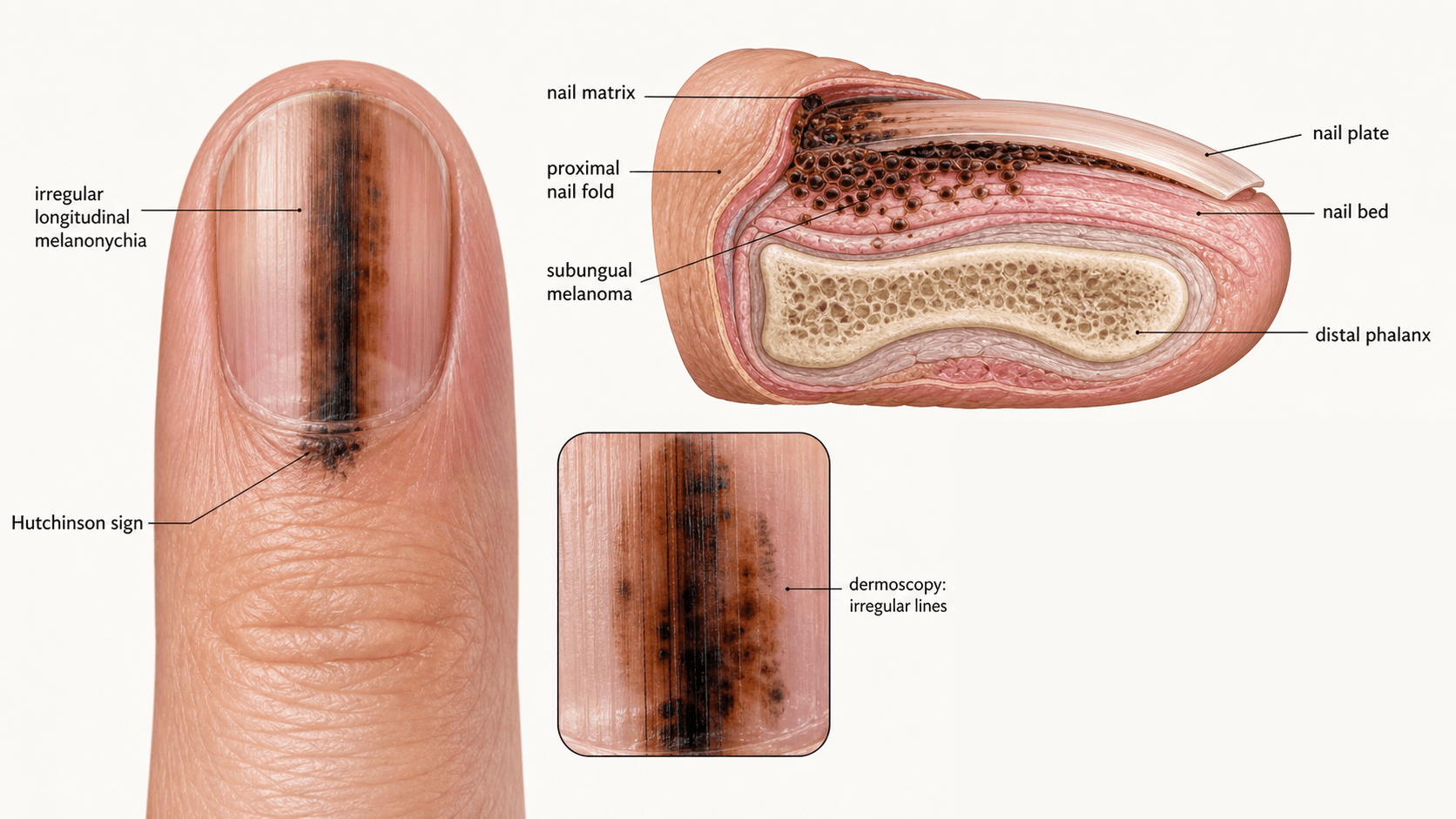
Subtypes. Four patterns are described, from disease confined to the matrix epithelium to the nodular variant that destroys the nail.
- Growth Pattern
- Radial growth along basal layer, then vertical
- Clinical Appearance
- Slowly widening pigmented band with Hutchinson sign
- Prognosis
- Variable — depends on Breslow at diagnosis
- Growth Pattern
- Rapid vertical growth phase with minimal radial
- Clinical Appearance
- Nodule, ulceration, rapid nail destruction
- Prognosis
- Poor — often thick at presentation
- Growth Pattern
- Spindle cells with dense stromal fibrosis
- Clinical Appearance
- May be amelanotic (non-pigmented), firm mass
- Prognosis
- Higher local recurrence, lower nodal metastasis
- Growth Pattern
- Confined to matrix epithelium, no invasion
- Clinical Appearance
- Pigmented band only, no mass or ulceration
- Prognosis
- Excellent with complete excision
Molecular pathology. KIT mutations and amplifications are more common in acral lentiginous melanomas, subungual included, than in other melanoma subtypes. BRAF V600E mutations are less frequent (15-20%, against 40-50% in non-acral cutaneous melanomas), and NRAS mutations are also uncommon. The profile has therapeutic implications: KIT inhibitors (imatinib) may be considered for metastatic disease with KIT mutations.
Classification and Staging
Subungual melanoma is staged by the AJCC melanoma staging system (8th edition), which applies the same T (tumour thickness), N (nodal) and M (metastasis) criteria as cutaneous melanoma elsewhere. Breslow thickness is the primary determinant of the T category.
- Breslow Thickness
- No invasive component
- Ulceration
- N/A
- 5-Year Survival (approximate)
- Near 100 percent with complete excision
- Breslow Thickness
- Less than 0.8 mm (T1a) or 0.8-1.0 mm (T1b)
- Ulceration
- T1b = less than 0.8 mm WITH ulceration, or 0.8-1.0 mm with or without ulceration (mitotic rate no longer in the T category since AJCC 8th)
- 5-Year Survival (approximate)
- 85-95 percent
- Breslow Thickness
- 1.01-2.0 mm
- Ulceration
- T2a without ulceration, T2b with ulceration
- 5-Year Survival (approximate)
- 70-85 percent
- Breslow Thickness
- 2.01-4.0 mm
- Ulceration
- T3a without ulceration, T3b with ulceration
- 5-Year Survival (approximate)
- 50-70 percent
- Breslow Thickness
- Greater than 4.0 mm
- Ulceration
- T4a without ulceration, T4b with ulceration
- 5-Year Survival (approximate)
- 30-50 percent
Most subungual melanomas present as T3 or T4 because of the diagnostic delay.
Clinical Assessment
History. Start with when the band was first noticed and how quickly it has changed since. Then ask about:
- Preceding trauma
- Widening, darkening or extension onto the skin
- Pain, bleeding, nail splitting or nail loss
- Weight loss, lymphadenopathy and other skin lesions
- A family history of melanoma or dysplastic naevus syndrome
Examination. Inspect all 20 nails to establish whether one digit or several are involved, then examine the affected digit:
- The band: width, colour (uniform or variegated) and borders
- The proximal and lateral nail folds, for Hutchinson sign
- The nail plate: distortion, splitting, crumbling or destruction
- The digit: swelling, mass, ulceration or bleeding
- The regional nodes: epitrochlear and axillary for the upper limb, inguinal for the lower limb
Hutchinson sign is the extension of brown-black pigmentation from the nail matrix onto the proximal or lateral nail fold. It represents the radial growth phase of melanoma spreading beyond the confines of the nail unit onto the periungual epidermis, and it is the single most important clinical sign of subungual melanoma: if you see it, biopsy is mandatory. A micro-Hutchinson sign, visible only on dermoscopy, may be an earlier indicator.
The sign is not 100% sensitive: early melanomas confined to the matrix may show no periungual extension, so its absence does not exclude melanoma. Nor is it pathognomonic, because a pseudo-Hutchinson sign occurs in benign conditions: Laugier-Hunziker syndrome, racial pigmentation and paediatric matrix naevi. Biopsy is the definitive discriminator.
The ABCDEF rules gather these features into a checklist to run on every pigmented band.
ABCDEFABCDEF Criteria for Nail Melanoma
Hook:Use ABCDEF for every pigmented nail band — miss one letter and you may miss the melanoma!
Investigations
First line. Examination and dermoscopy come first, with clinical photography to document the appearance for serial comparison. Any concerning feature leads to biopsy without delay.
Nail matrix biopsy is the gold standard, and it must include the matrix, where the melanoma originates, rather than the bed alone. It is technically demanding:
- Map the band: identify the exact proximal origin of the pigmented band on the nail surface
- Digital ring block
- Digital tourniquet (a Penrose drain or finger tourniquet) for a bloodless field
- Reflect the proximal nail fold through lateral incisions
- Remove the overlying nail plate to see the matrix directly
- Take a 3 mm punch or an elliptical excision of the pigmented area, including the full thickness of the matrix epithelium and the underlying dermis
The specimen. Send it for dermatopathology review with the clinical context, requesting immunohistochemistry (S-100, HMB-45, Melan-A, SOX10, Ki-67). Breslow thickness is measured from the granular layer, or its matrix equivalent, to the deepest point of invasion.
Staging, if invasive. Sentinel lymph node biopsy is part of staging above 1 mm Breslow (see Management). The imaging and bloods:
- Radiograph of the digit if the lesion is nodular or ulcerated, to check for bone involvement
- MRI of the digit, which may assess the depth of soft-tissue and bone involvement in thick tumours
- CT chest, abdomen and pelvis, or PET-CT, for thick melanomas (Breslow over 4 mm) or confirmed nodal disease
- Baseline LDH, a prognostic marker in metastatic disease
Management Algorithm
The decision. Breslow thickness decides the operation. In situ disease is excised with the digit preserved. For invasive disease amputation at an appropriate level remains the standard in most guidelines, and the wide local excision of the nail unit listed below for the thinnest lesions is the digit-preserving option some centres advocate (see Controversies). Conservative excision is not attempted for thick invasive disease. Sentinel lymph node biopsy is recommended for invasive melanoma with Breslow thickness over 1 mm, as for cutaneous melanoma.
Goal. Complete excision with clear margins while preserving digit function. In situ disease has an excellent prognosis with complete excision, but clear margins can be hard to achieve within the anatomical constraints of the nail unit.
Before surgery. Histology confirms in situ disease with no invasive component, and the extent of pigmentation is assessed clinically, with dermoscopy, to plan the margins. Consent covers recurrence, nail deformity, and the need for wider excision if the pathology is upgraded.
The excision. Reflect the proximal nail fold and excise the involved area of the nail matrix with 5-10 mm margins. Close primarily if possible, or use a split-thickness skin graft or local flap for a large defect. Nail loss is expected if the entire germinal matrix is excised, so counsel the patient beforehand.
Follow-up. Clinical review every 3-6 months for at least 5 years, with a full-body skin examination at each visit because of the risk of a second primary melanoma. If the margins were close or positive, re-excision is mandatory.
Complications
The complications are oncological (recurrence and metastasis) and functional (the cost of the operation to the digit and nail).
- Incidence
- 10-20 percent after conservative excision
- Risk Factors
- Positive margins, in situ disease at margins
- Management
- Re-excision or amputation if not already performed
- Incidence
- 20-40 percent in tumours greater than 2 mm Breslow
- Risk Factors
- Thick tumours, ulceration, high mitotic rate
- Management
- SLNB + completion lymphadenectomy or adjuvant therapy
- Incidence
- 15-30 percent in Stage III disease
- Risk Factors
- Thick primary, positive nodes, high mitotic rate
- Management
- Systemic immunotherapy or targeted therapy
- Incidence
- Universal — depends on digit and level
- Risk Factors
- Amputation level, dominant hand involvement
- Management
- Rehabilitation, prosthetics, occupational therapy
- Incidence
- Near 100 percent after matrix excision
- Risk Factors
- Extent of matrix resected
- Management
- Counsel pre-operatively; cosmetic prosthetic nail
Outcomes and Prognosis
Breslow thickness at diagnosis is the single most important prognostic factor, and it directly reflects the duration of the diagnostic delay.
- Breslow
- No invasion
- 5-Year Survival
- Near 100 percent
- Key Prognostic Feature
- Complete excision is curative
- Breslow
- Less than 2.0 mm, no ulceration
- 5-Year Survival
- 80-95 percent
- Key Prognostic Feature
- Thin tumours do well with adequate surgery
- Breslow
- Greater than 1 mm with ulceration or greater than 2 mm
- 5-Year Survival
- 50-80 percent
- Key Prognostic Feature
- Thick tumours carry worse prognosis
- Breslow
- Any Breslow with nodal metastasis
- 5-Year Survival
- 40-70 percent (depends on nodal burden)
- Key Prognostic Feature
- Number of positive nodes is the key determinant
- Breslow
- Any Breslow with distant spread
- 5-Year Survival
- 15-30 percent (improving with immunotherapy)
- Key Prognostic Feature
- LDH level, sites of metastasis, treatment response
- Best prognosis: in situ or thin melanoma (Breslow under 1 mm) with clear margins, no ulceration and a negative sentinel node
- Poor prognosis: thick melanoma (Breslow over 4 mm), ulceration, high mitotic rate, a positive sentinel node, elevated LDH
The exam question trap is always the patient with a "dark nail attributed to trauma" that turns out to be melanoma.
Guidelines, Registries & Global Practice
- Subungual melanoma accounts for 0.7-3.5 percent of all cutaneous melanomas worldwide
- Most common melanoma subtype in darker-skinned populations (Asian, African, Hispanic)
- Thumb and great toe are the most commonly affected sites across all populations
- Diagnostic delay is a universal problem, averaging 6-12 months globally
- High-resource: Dermoscopy, specialist nail matrix biopsy, sentinel node biopsy, immunotherapy for adjuvant and metastatic treatment
- Limited-resource: Clinical diagnosis supplemented by punch biopsy, standard amputation, limited access to SLNB and immunotherapy
- Universal principle: Outcome depends on early biopsy and adequate surgical margins more than on technology
- Education gap: Raising awareness among primary care physicians about Hutchinson sign and the need for biopsy is the most impactful intervention worldwide
- Diagnosis Emphasis
- Biopsy any suspicious nail pigmentation; dermoscopy adjunctive
- Surgical Treatment
- Amputation for invasive disease; margin guidelines per Breslow thickness
- Adjuvant Therapy
- Immune checkpoint inhibitors or BRAF/MEK inhibitors for Stage III-IV
- Diagnosis Emphasis
- Urgent referral for any new nail band with Hutchinson sign
- Surgical Treatment
- Excision or amputation based on Breslow; SLNB for greater than 1 mm
- Adjuvant Therapy
- NICE-approved immunotherapy regimens for adjuvant and metastatic use
- Diagnosis Emphasis
- Early biopsy emphasised; avoid prolonged antifungal trial without response
- Surgical Treatment
- Amputation standard for invasive; functional surgery for in situ
- Adjuvant Therapy
- Adjuvant immunotherapy or targeted therapy per molecular profile
- Diagnosis Emphasis
- High awareness due to acral lentiginous predominance in Asian populations
- Surgical Treatment
- Amputation with level determined by tumour extent; SLNB increasingly adopted
- Adjuvant Therapy
- KIT testing recommended; imatinib for KIT-mutated metastatic disease
There is no dedicated registry for subungual melanoma specifically. Melanoma registries (national cancer registries, AJCC melanoma database) include subungual cases but do not separate them for analysis in most instances. The evidence base consists predominantly of retrospective case series and literature reviews, with no randomized controlled trials specific to subungual melanoma management. Treatment recommendations are therefore extrapolated from general melanoma guidelines (NCCN, ESMO, BAD) with anatomical modifications for the nail unit.
Record in every patient with pigmented nail lesion:
- Presence or absence of Hutchinson sign
- Number of digits affected, band width, colour characteristics
- Duration of pigmentation and any documented change
- Dermoscopy findings if available
- Biopsy performed — site (matrix vs bed), technique, and histopathology result
- If biopsy not performed, documented reason and plan for follow-up with timeline
A missed or delayed diagnosis of subungual melanoma is a recurring source of medicolegal claims worldwide. Any pigmented nail lesion in an adult that is new, single-digit, widening, or associated with Hutchinson sign must be biopsied — never observe without histological exclusion.
Controversies & Areas of Uncertainty
For thin invasive melanomas (less than 2 mm Breslow), some centres advocate wide local excision of the nail unit rather than amputation, citing comparable local control rates. However, evidence is limited to small retrospective series, and amputation remains the standard of care in most guidelines for any invasive subungual melanoma.
The optimal level of amputation is debated. Some advocate amputation one joint proximal to the tumour, while others argue for the minimum level achieving clear margins. There is no Level I evidence comparing functional outcomes and oncological control between different amputation levels.
Sentinel lymph node biopsy is recommended for invasive melanomas greater than 1 mm Breslow, extrapolated from cutaneous melanoma guidelines. However, specific data on SLNB outcomes in subungual melanoma are limited. Lymphatic drainage from the nail unit may be variable, and false-negative rates have not been specifically studied.
Immunotherapy and targeted therapy indications are extrapolated from general melanoma trials (which include few subungual cases). Whether the distinct molecular profile of acral melanomas (more KIT, less BRAF) translates to different treatment responses is an area of active research.
MCQ Practice Points
Q: What is Hutchinson sign and what does it indicate? A: Pigmentation extending onto the proximal or lateral nail fold. It indicates radial growth of melanoma beyond the nail matrix onto the periungual skin. It is the most clinically important sign of subungual melanoma, though its absence does not exclude early disease.
Q: Where should a biopsy be taken from to diagnose subungual melanoma? A: The nail matrix (germinal matrix), not the nail bed. Subungual melanoma arises from melanocytes in the nail matrix. The biopsy technique involves reflecting the proximal nail fold, removing the overlying nail plate, and taking a punch or elliptical biopsy of the pigmented area of the matrix.
Q: How do you distinguish subungual haematoma from subungual melanoma? A: Haematoma migrates distally with nail growth; melanoma does not. Haematoma follows identifiable trauma, has uniform colour, and resolves over 2-3 months as the nail grows out. Melanoma is a progressive, widening, darkening band without a clear trauma history. Hutchinson sign is present only in melanoma. If in doubt, biopsy.
Q: What is the standard surgical treatment for invasive subungual melanoma with Breslow greater than 2 mm? A: Amputation of the affected digit at an appropriate level for clear margins, combined with sentinel lymph node biopsy. The amputation level is determined by the extent of the tumour — typically at the interphalangeal or metacarpophalangeal/metatarsophalangeal joint. Conservative excision is not recommended for thick invasive melanomas due to high local recurrence rates.
Q: What molecular mutations are more common in acral lentiginous melanoma (including subungual) compared with other cutaneous melanomas? A: KIT mutations and amplifications are significantly more common in acral lentiginous melanomas, while BRAF V600E mutations are less frequent (15-20 percent vs 40-50 percent in non-acral cutaneous melanomas). This has therapeutic implications — KIT inhibitors (imatinib) may be effective in metastatic disease with KIT mutations.
Exam Viva Scenarios
Practise clinical reasoning and management decisions out loud
“A 58-year-old woman presents with a 4-month history of a gradually widening dark brown band on her right thumbnail. She initially attributed it to trauma from gardening but it has continued to widen and darken. On examination, there is a 5 mm wide pigmented band extending the full length of the nail plate, with faint brown pigmentation visible on the proximal nail fold. No palpable lymphadenopathy. What is your diagnosis and management?”
“A 65-year-old man presents with a 12-month history of progressive dark discolouration and destruction of his left great toe nail. He was treated with oral antifungal medication by his general practitioner for 8 months with no improvement. On examination, the nail plate is completely destroyed with a darkly pigmented, ulcerated nodular lesion replacing the nail bed and matrix, extending 5 mm onto the dorsal skin of the toe. There is a 2 cm firm, palpable lymph node in the left inguinal region. Biopsy confirms acral lentiginous melanoma, Breslow 6.5 mm, ulcerated, mitotic rate 8 per mm squared. What is your staging and management plan?”
Key Clinical Features
- Acral lentiginous melanoma arising from nail matrix melanocytes
- Most common melanoma in darker-skinned populations (Fitzpatrick V-VI)
- Thumb and great toe are the most common sites
- Average diagnostic delay of 6-12 months due to misdiagnosis as haematoma or fungal infection
Diagnosis
- Hutchinson sign = pigmentation on proximal or lateral nail fold. Highly suggestive, NOT pathognomonic (pseudo-Hutchinson: Laugier-Hunziker, racial pigmentation, paediatric naevi) and often absent in true melanoma
- ABCDEF criteria: Age, Band (greater than 3 mm, widening), Change, Digit (thumb/great toe), Extension, Family
- Subungual haematoma grows out with nail; melanoma does NOT migrate distally
- Biopsy the nail MATRIX (not bed) — 3 mm punch or elliptical under tourniquet with fold reflected
Treatment Algorithm
- In situ: wide excision of the involved matrix with 5-10 mm margins
- Invasive less than 2 mm: wide excision or amputation; SLNB for greater than 1 mm
- Invasive greater than 2 mm: amputation at appropriate level + SLNB
- Node-positive: therapeutic lymph node dissection + adjuvant immunotherapy
Staging and Prognosis
- AJCC 8th edition staging (same as cutaneous melanoma elsewhere)
- Breslow thickness is the most important prognostic factor
- Most present thick (median 2.5-4.0 mm) — hence prognosis is worse than other cutaneous melanomas
- 5-year survival: in situ near 100 percent, Stage II 50-80 percent, Stage IV 15-30 percent
Molecular and Therapeutic Points
- KIT mutations more common; BRAF V600E less common (15-20 percent) than in non-acral melanoma
- KIT testing is essential — opens targeted therapy with imatinib for metastatic disease
- Adjuvant immunotherapy (nivolumab, pembrolizumab) for Stage III disease
- Multidisciplinary management: surgical oncology, medical oncology, dermatopathology
Evidence Base and Key Trials
'Functional' surgery in subungual melanoma
- Retrospective comparison of 62 stage I-II subungual melanomas from the Tuebingen registry: 31 amputations (in or proximal to the DIP joint) versus 31 'functional' surgeries (local excision with partial distal phalanx resection and 3D margin histology), median follow-up about 4.5 years
- Amputation did NOT fare better than functional surgery; tumour thickness, ulceration and level of invasion were the significant prognostic factors for recurrence-free survival
- Limited excision with assured clear margins gave better cosmetic and functional results without worsening prognosis