Extension Type | Pulseless Pink Hand | Gartland Classification
- Most common elbow fracture in children (peak age 5-7)
- Extension type (97%): FOOSH with hyperextension
- Brachial artery at risk (pulseless with pink/white hand)
- AIN most common nerve injured (extension type)
- Gartland III = surgical emergency
- “Pink pulseless hand: Reduce urgently, reassess perfusion
- “If pink and perfused post-reduction: May observe
- “If white/non-perfused post-reduction: Explore brachial artery
- “Cubitus varus (gunstock deformity) = malunion complication
Overview and Epidemiology
The supracondylar humerus fracture is the most common elbow fracture in children, with a peak age of 5-7 years. Two patterns share the name, told apart by mechanism and by the direction in which the distal fragment displaces:
- Extension type, 97% - a fall on the outstretched hand with the elbow hyperextended
- Flexion type, 3% - a direct blow, covered in its own section below
Elbow Anatomy in Children
The supracondylar region. This is the thinnest, weakest part of the distal humerus: a flat segment of bone between the medial and lateral columns, bounded by the coronoid and olecranon fossae. In the 5-7 year age group it is undergoing remodelling and is mechanically vulnerable, which is why it fails before the ligaments rupture. The adult elbow is the reverse, and there dislocation predominates.
Ossification centres. CRITOE gives the order, with approximate ages in years, and helps in identifying fracture patterns: Capitellum (1), Radial head (3), Internal (medial) epicondyle (5), Trochlea (7), Olecranon (9), External (lateral) epicondyle (11).
Carrying angle. Normally 5-15° of valgus, and assessed against the opposite side. A cubitus varus (gunstock) malunion loses it.
The neurovascular bundle. The brachial artery travels anterior to brachialis and crosses in front of the elbow joint, where the proximal fragment can kink, trap or lacerate it. The table sets out where each structure lies and which displacement endangers it.
- Location
- Anterior, crosses fracture site
- Risk with Displacement
- Posterolateral (extension) displacement
- Location
- Anterior, with artery
- Risk with Displacement
- Posterolateral (extension) displacement
- Location
- Lateral, near lateral column
- Risk with Displacement
- Posteromedial displacement
- Location
- Medial, posterior to epicondyle
- Risk with Displacement
- Flexion type, medial wire insertion
Mechanism and Pathophysiology
Extension type. A fall on the outstretched hand transmits a hyperextension force through a locked olecranon, levering the distal fragment posteriorly. The proximal shaft fragment is driven anteriorly into brachialis and the overlying neurovascular bundle.
The anterior spike. The anteriorly migrating proximal spike is the source of the classic complications. It tents or buttonholes brachialis, producing the pucker sign, and stretches or kinks the brachial artery and the closely applied median nerve and AIN.
Direction predicts the nerve. Posterolateral displacement tethers the anteromedial structures, the median nerve and AIN. Posteromedial displacement threatens the laterally placed radial nerve. Examiners will ask which nerve is at risk for a given displacement pattern.
Classification
Gartland's classification of the extension type rests on displacement and on what remains of the posterior cortex. Wilkins added type IV.
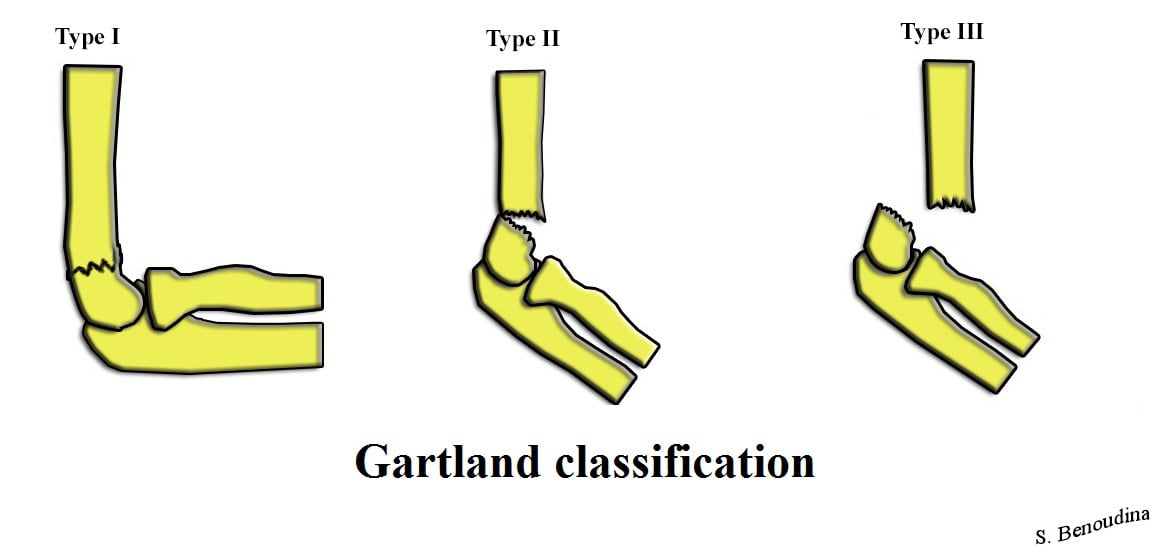
- Displacement
- Undisplaced or minimally displaced, posterior cortex intact
- Treatment
- Cast
- Displacement
- Hinged on the intact posterior cortex; extension angulation only
- Treatment
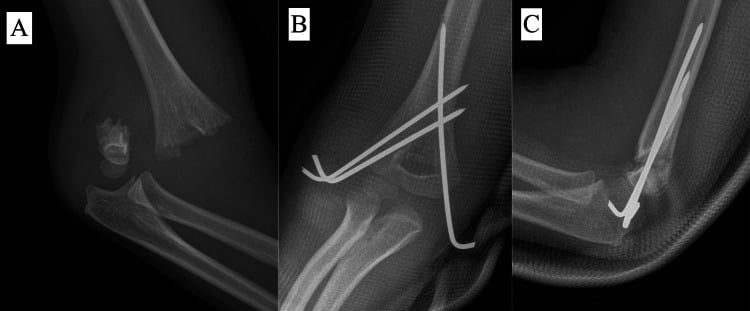
- Closed reduction + K-wires
- Displacement
- Hinged, with rotation or translation (less stable)
- Treatment
- Closed reduction + K-wires
- Displacement
- Complete, no cortical contact; posteromedial (the more common direction, approximately three-quarters; radial nerve at risk)
- Treatment
- Urgent closed reduction + K-wires
- Displacement
- Complete, no cortical contact; posterolateral (less common; median/AIN and brachial artery at risk)
- Treatment
- Urgent closed reduction + K-wires
- Displacement
- Multidirectional instability: unstable in flexion and extension
- Treatment
- K-wire fixation in flexion and extension
In type I the fat pad sign may be the only clue.
Type IV is diagnosed dynamically under anaesthesia, not from a static radiograph: it is assigned only when the distal fragment is unstable in both flexion and extension. It carries the highest neurovascular risk.
Clinical Assessment
Examine before anything is moved. Assess and document the neurovascular state before any manipulation and again after reduction; the anterior spike and the loss of cortical contact in a displaced fracture are the reason. The 3Ps are the checklist: pulse, perfusion and paralysis.
Vascular. Feel the brachial and radial pulses, check capillary refill and look at the colour of the hand. A pink pulseless hand means the artery is kinked but collateral circulation is still perfusing the hand. A white pulseless hand is true ischaemia.
Nerves. Test each by what it does:
- AIN - the OK sign, a circle made with the thumb and index finger, which needs FPL (thumb IP flexion) and FDP to the index (index DIP flexion). The most commonly injured nerve in the extension type; the median nerve comes next
- Median - thenar power and sensation
- Radial - wrist and finger extension, and sensation
- Ulnar - interossei and little-finger sensation; the nerve at risk in the flexion type
Investigations
Radiographs. An AP and a true lateral of the elbow. The lateral is essential for classification.
Fat pads. Normally the posterior fat pad is not visible and the anterior fat pad is small and lies close to the bone. A visible posterior fat pad is always abnormal and indicates an occult fracture; an anterior fat pad displaced into a "sail sign" suggests an effusion or occult fracture.
The anterior humeral line. Drawn along the anterior humeral cortex on the lateral film, it should pass through the capitellum, classically through its middle third. A line passing anterior to the capitellum indicates extension. On the film after reduction that is an extension malreduction: the distal fragment remains posteriorly displaced, and it will result in cubitus varus if not corrected.
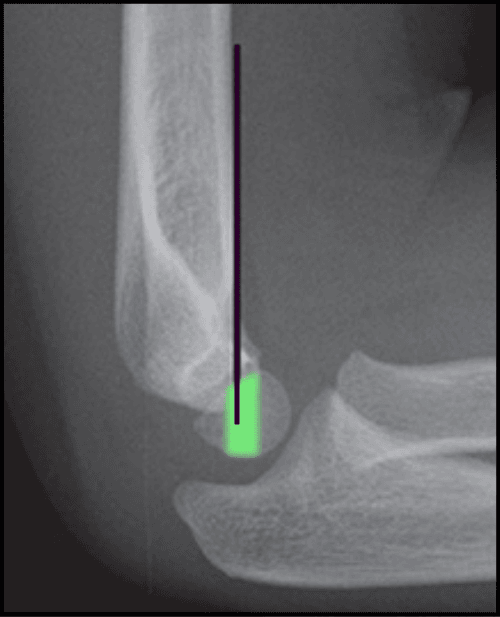
Herman and colleagues measured the line on 60 normal paediatric elbows read twice by three observers (DOI). It passed through the middle third in only 52% of normal elbows, the anterior third in 31%, and the posterior third in 18%. In children under four years it fell nearly equally in the anterior or the middle third; in older children it reached the middle third in 62%.
So a line through the anterior third in a toddler is frequently NORMAL. The error runs toward over-diagnosis — calling a Gartland II, or condemning an acceptable reduction on the post-fixation film, in an elbow that was never displaced. Under four, weigh the fat-pad signs, the clinical findings and the contralateral elbow before trusting the line.
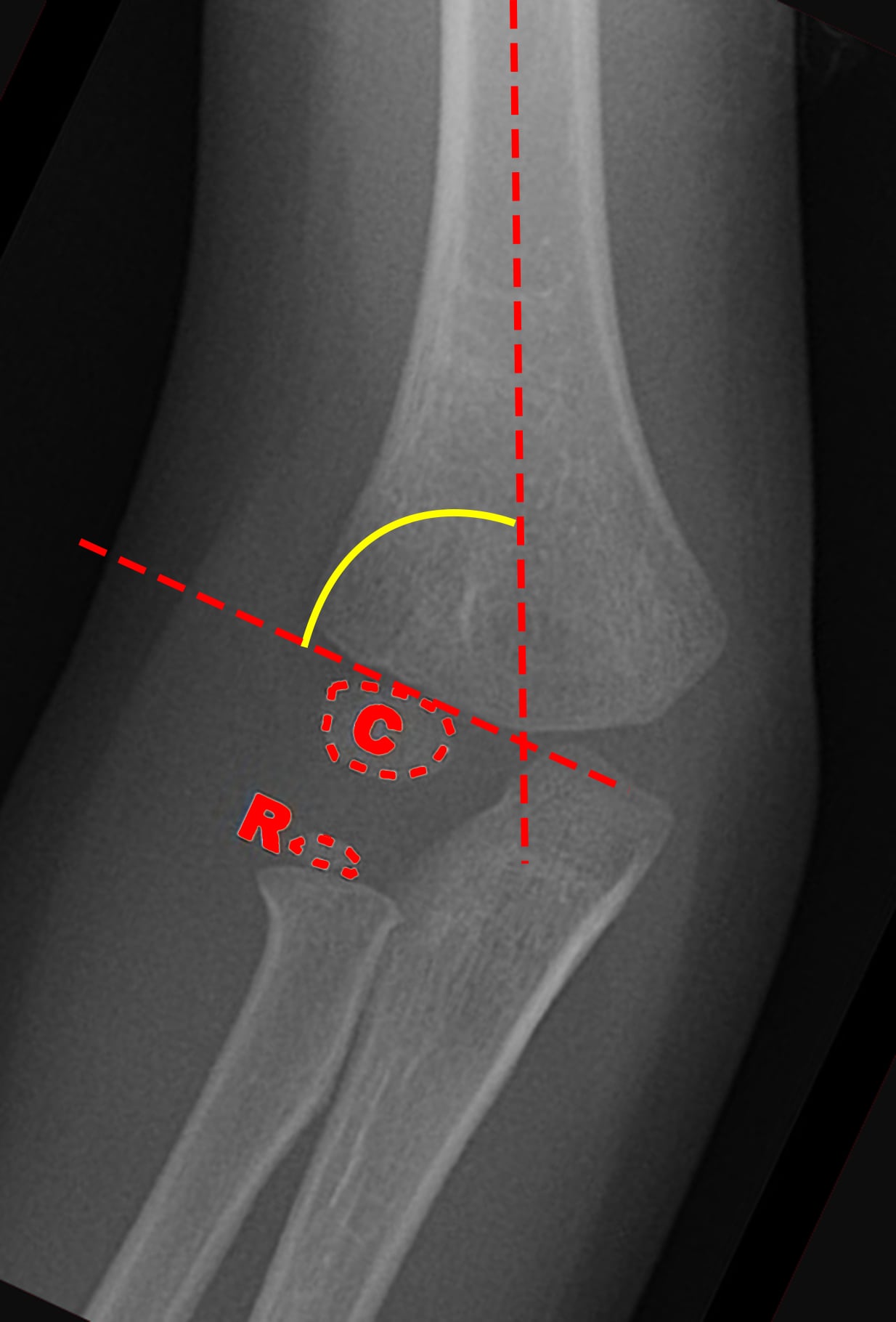
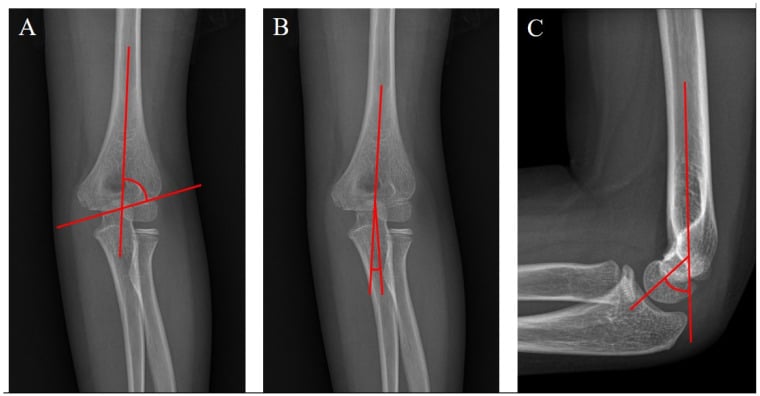
Baumann angle. The angle between the humeral shaft axis and the capitellar physis on a true AP film. Normal values are age- and technique-dependent rather than a fixed universal 70-75°: the mean is about 71°, but normal spans 54-90° across healthy children (PMID 42024825). Compare with the uninjured elbow; more than 5° of side-to-side loss suggests varus malreduction.
Checking the reduction. Intraoperative fluoroscopy, then AP and lateral views after fixation with the quality of reduction documented:
- AP - Baumann angle matching the opposite side; the ulnohumeral angle can be measured on the same view
- Lateral - the age-appropriate anterior humeral line/capitellar relationship restored, comparing with the opposite elbow in young children if uncertain; the humerocapitellar angle can be added
- Rotation - the teardrop shape of the lateral column should be symmetrical
- Wires - through both cortices
Differential Diagnosis
The displaced supracondylar fracture is rarely subtle, but the undisplaced fracture and the swollen, painful paediatric elbow have several mimics. Telling them apart changes management entirely.
- Distinguishing features
- Anterior humeral line anterior to capitellum; transcondylar tenderness; both columns involved
- Key pitfall
- Type I seen only as raised fat pad — easily missed
- Distinguishing features
- Tenderness lateral; Salter-Harris IV; risk of non-union and progressive valgus
- Key pitfall
- Internal oblique view needed; under-treated displacement
- Distinguishing features
- Medial tenderness; check for incarceration in joint after dislocation
- Key pitfall
- Fragment trapped in joint mistaken for trochlear ossification
- Distinguishing features
- Infant/toddler; whole epiphysis displaces medially; consider non-accidental injury
- Key pitfall
- Mistaken for elbow dislocation (rare in young children)
- Distinguishing features
- Radiocapitellar line disrupted; older child/adolescent
- Key pitfall
- Coexisting fracture missed post-reduction
- Distinguishing features
- Toddler, axial-traction mechanism, arm held pronated, NO swelling
- Key pitfall
- Imaging normal — clinical diagnosis, reduces with supination/flexion
Management
Undisplaced (type I). An above-elbow cast at 90° of flexion for 3-4 weeks, with a radiograph at 1 week to confirm that the fracture has not displaced. Avoid hyperflexion, which compromises the circulation.
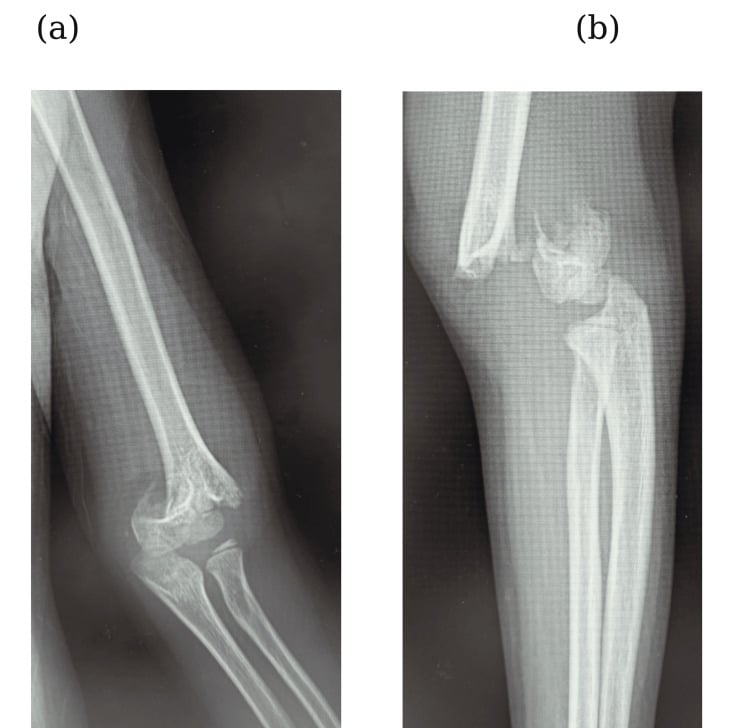
Displaced (types II and III). Closed reduction under general anaesthesia and fluoroscopy, then K-wire fixation, described under Surgical Technique.
How urgent. Displaced fractures, type III especially, are taught as surgical emergencies, and the evidence refines that by the state of the limb. The well-perfused, neurologically intact displaced fracture does not need overnight surgery, but delay over 8 hours raised the open reduction rate (Walmsley). The limb-threatening white hand and the open fracture remain true emergencies.
The pulseless hand. Vascular injury is a surgical emergency, and the first intervention is urgent reduction. What follows depends on the hand after reduction:
- Pink pulseless hand - reduce urgently. If the hand is pink and perfused after reduction, observe closely, even without a palpable pulse; there is no exploration if it is well perfused
- White pulseless hand - true ischaemia. Reduce urgently; if it is still white after reduction, explore the brachial artery
- Compartment syndrome - fasciotomies
There is no randomised evidence for this sequence. Consensus favours it, and routine vascular exploration of every pulseless hand is not supported: the white, cold hand is explored.
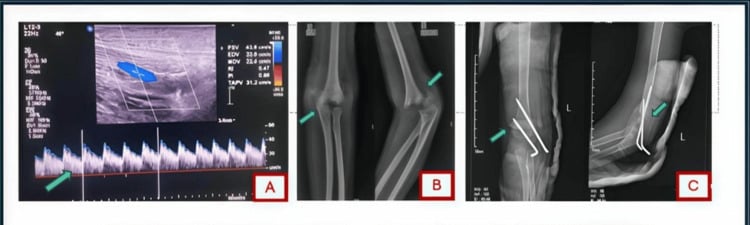
Imaging does not decide. Duplex can document perfusion, but urgent reduction is the first intervention and imaging must not delay theatre in a threatened limb. Adjunctive imaging, MRI or CT angiography, rarely changes acute decisions in the threatened limb, and duplex and angiography add little to the pink pulseless hand (Griffin).
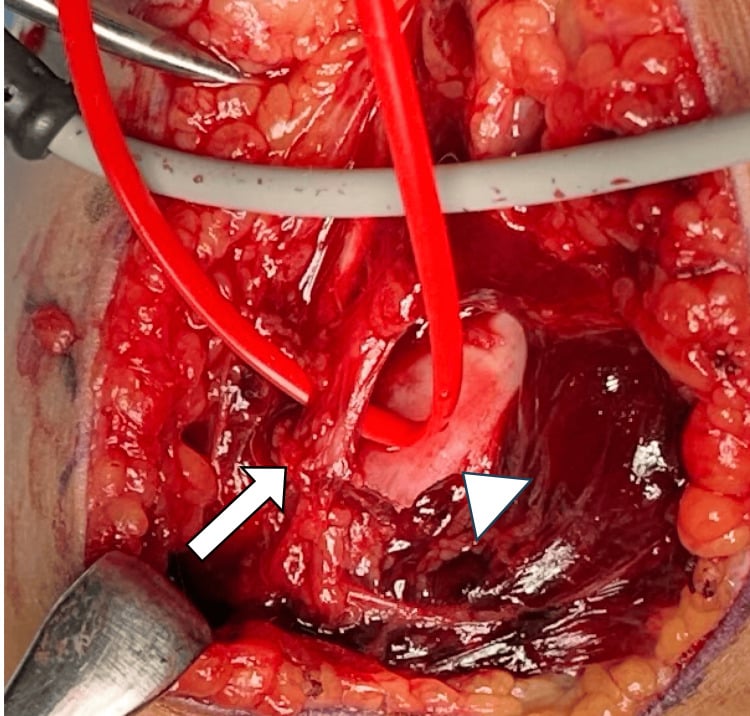
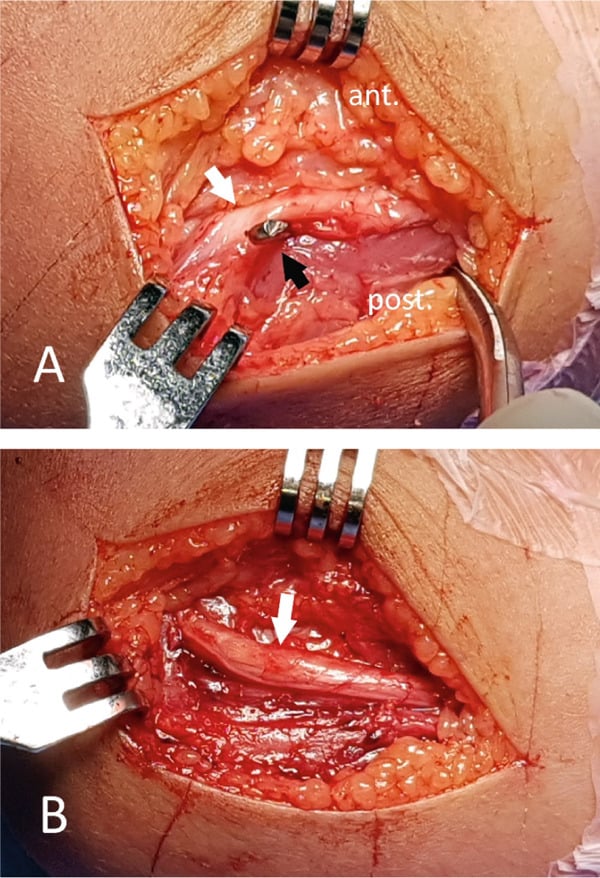
At exploration. Persistent poor perfusion after reduction means exploring for entrapment, kinking, spasm, intimal injury or transection of the brachial artery.
Surgical Technique
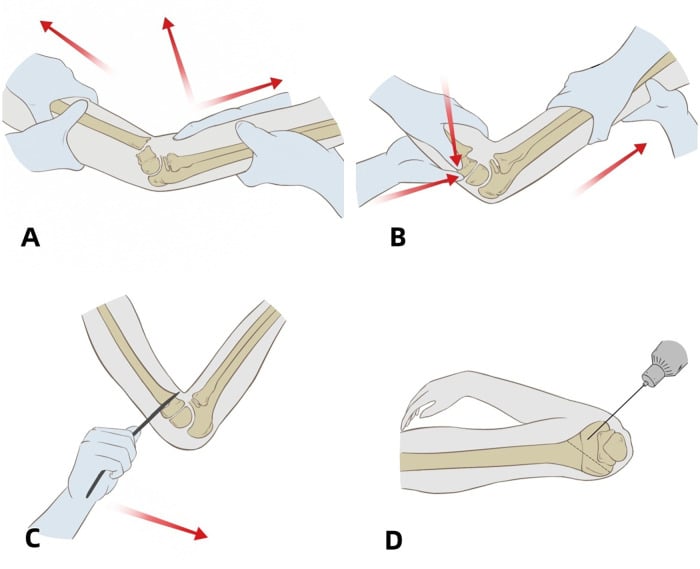
Closed reduction of the extension type, under fluoroscopy:
- Longitudinal traction with the elbow extended
- Correct medial or lateral displacement
- Correct rotation: pronation for posteromedial, supination for posterolateral displacement
- Flex the elbow while milking the distal fragment anteriorly
- Apply varus or valgus correction as needed
- Check the reduction on fluoroscopy, as set out under Investigations
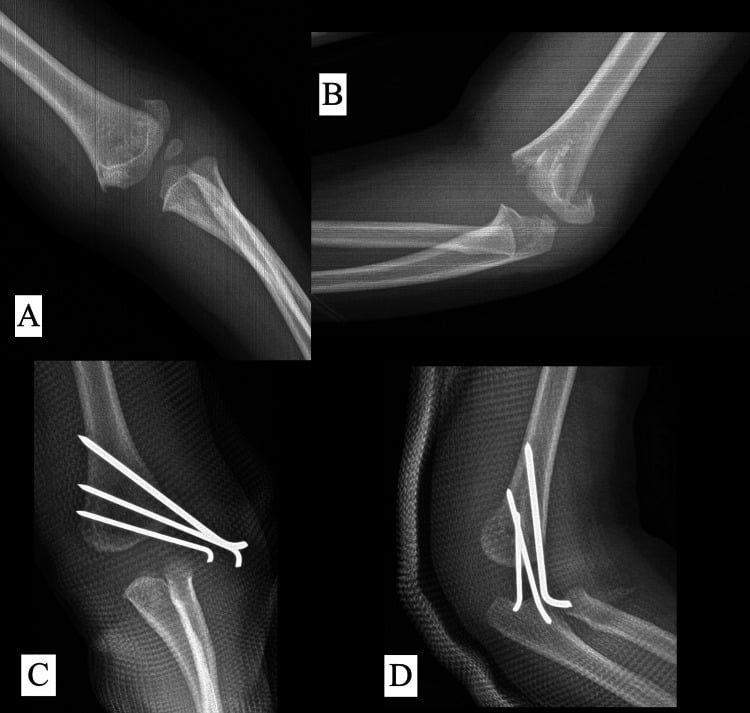
Wire configuration. Two lateral divergent wires avoid the ulnar nerve and are biomechanically adequate for most fractures. Crossed wires, lateral plus medial, are biomechanically stronger, but the medial wire puts the ulnar nerve at risk.
- Advantages
- Avoids ulnar nerve
- Disadvantages
- Less rotational stability
- Advantages
- Maximum stability
- Disadvantages
- Ulnar nerve risk
- Advantages
- Good stability, no nerve risk
- Disadvantages
- More wires, more time
What the evidence says. Crossed pins resist loss of reduction slightly better (Xing meta-analysis) but triple the iatrogenic ulnar nerve risk (Dekker), so most surgeons default to lateral entry. When extra stability is needed, the medial pin goes in through a mini-open incision; in Xing's small mini-open subgroup the excess ulnar risk was no longer statistically detectable, which is not proof that it is abolished.
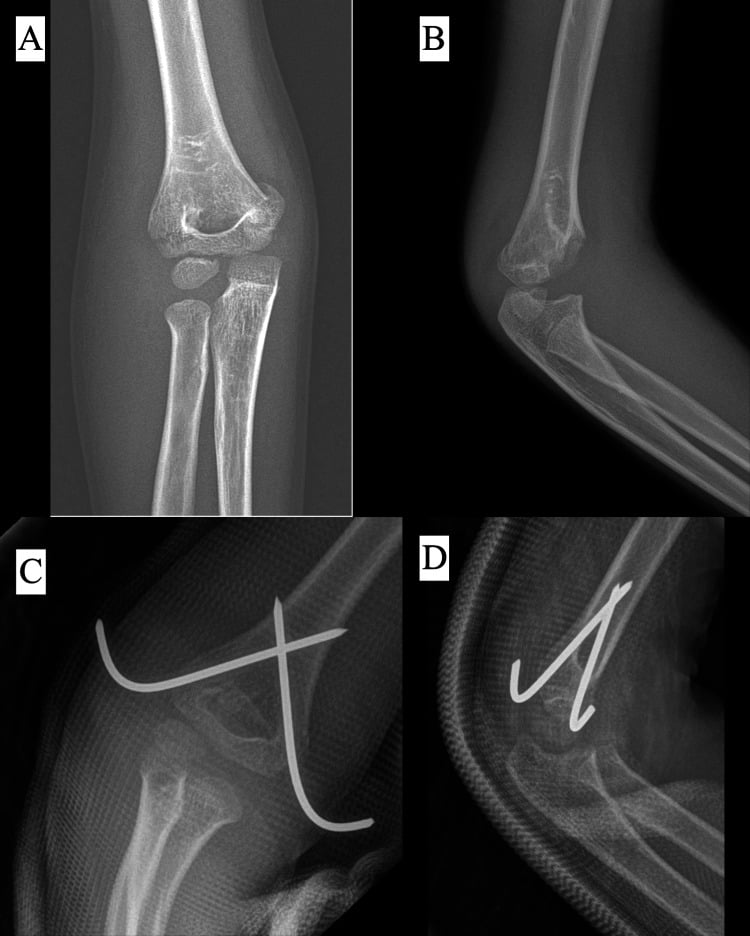
Lateral wires. Enter the lateral column proximal to the capitellum and diverge, one anterior and one posterior, engaging both cortices. Use 1.6mm or 2.0mm K-wires. Divergence and bicortical purchase matter more than the number of wires.
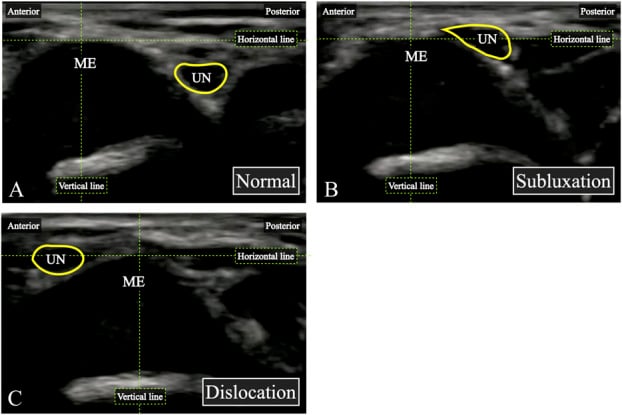
The medial wire, if needed. Flexion can move the ulnar nerve anteriorly, so a medial pin is unsafe without palpation and protected insertion:
- Flex the elbow only 20-30°; minimal flexion protects the nerve
- Palpate the ulnar nerve behind the medial epicondyle
- Make a small stab incision and dissect bluntly to bone
- Insert the wire under direct vision of the bone
- Do not hyperextend the elbow while inserting it
Open reduction is indicated for:
- Failed closed reduction after 2 attempts
- A pucker sign, meaning soft-tissue interposition
- Vascular compromise requiring exploration
- An open fracture
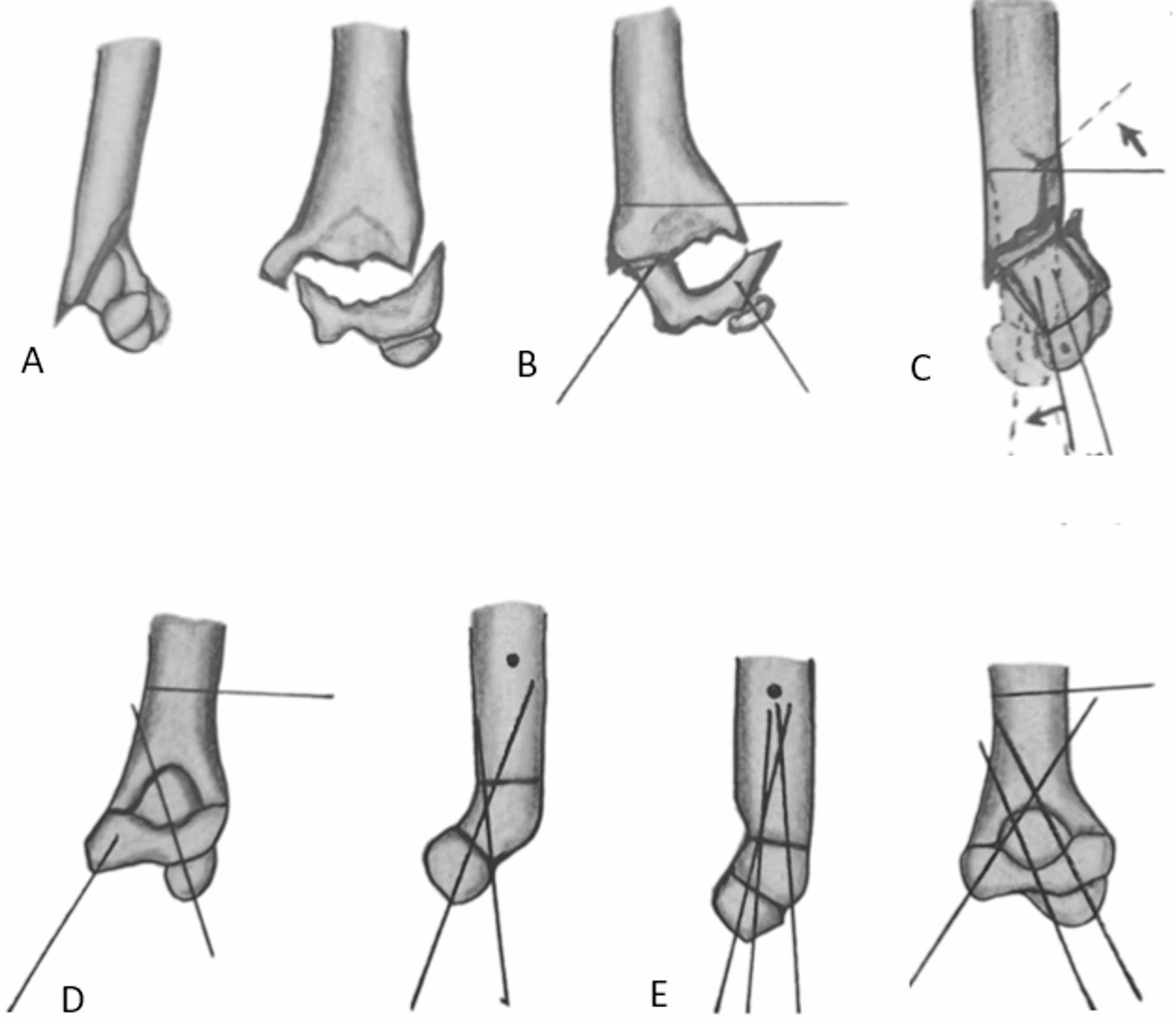
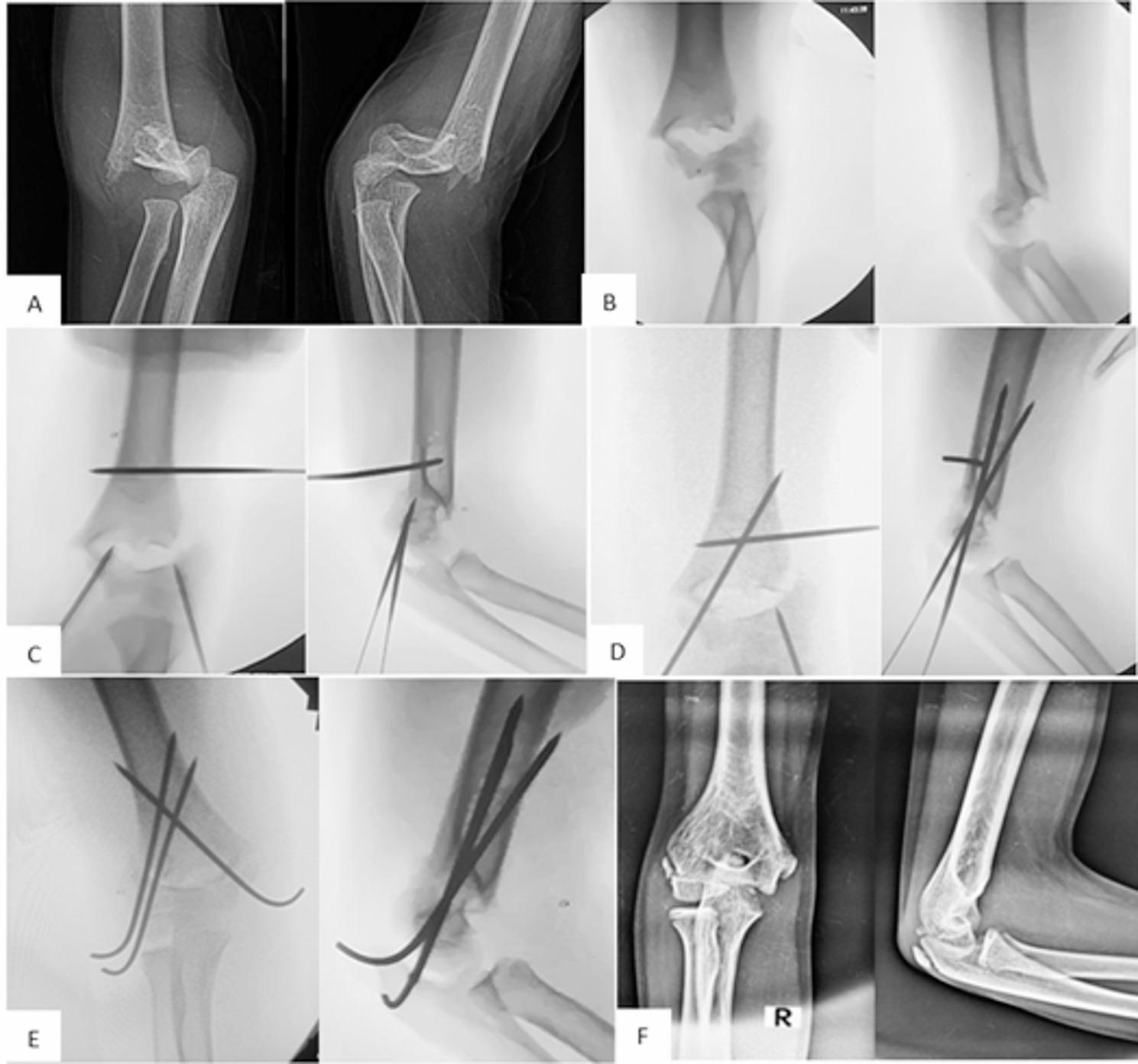
Irreducible fractures. Wire-assisted techniques are used after failed closed reduction. In the three-wire technique, provisional wires control translation and rotation before definitive crossed fixation; it is not a substitute for open reduction when soft tissue or neurovascular structures are interposed. In selected irreducible type IV fractures a K-wire can act as a joystick, but blind aggressive leverage is unsafe near the anterior neurovascular bundle.
Complications and Outcomes
Outcomes. Most children achieve excellent results, with full range of motion typically restored within 6-12 weeks. The malunion rate is low with an anatomic reduction.
- Rate
- 90%+
- Key Factor
- Anatomic reduction, no aggressive PT
- Rate
- 5-15%
- Key Factor
- Malreduction (rotation, varus tilt)
- Rate
- 90%+
- Key Factor
- Most are neurapraxias
- Rate
- Rare
- Key Factor
- Missed compartment syndrome
Vascular. Brachial artery injury and compartment syndrome are the early threats. Volkmann's ischaemic contracture is the rare but devastating result of missed ischaemia or a missed compartment syndrome.
Nerve injury. Nerve palsy occurs in 5-10%, the AIN most often in the extension type, and most recover spontaneously as neurapraxias.
Iatrogenic ulnar nerve injury. The medial wire injures the ulnar nerve in 2-5%. A postoperative ulnar deficit demands immediate review of the wire position: remove the medial wire and convert to lateral-only fixation. Most recover spontaneously.
Late. Cubitus varus (gunstock deformity) is the most common complication and has its own section below. Stiffness is usually temporary. Myositis ossificans is rare in children.
Cubitus Varus and the Corrective Supracondylar Osteotomy
A triplanar malunion. Although it is called cubitus "varus", the deformity combines varus angulation, extension and, crucially, internal rotation of the distal fragment. It is driven chiefly by uncorrected internal rotation and medial column collapse at reduction rather than by simple varus angulation, which is why rotation must be controlled intra-operatively. The gunstock appearance is what the child and family notice; the carrying angle is lost or reversed.
Mostly cosmetic, not entirely benign. It usually does not limit function, and most are observed. The recognised sequelae are why a symptomatic or severe deformity is corrected rather than simply observed:
- Posterolateral rotatory instability
- Tardy (late) ulnar or PIN nerve palsy
- An increased risk of a later lateral condyle fracture
- Snapping triceps and medial elbow pain
When to correct. A cosmetically unacceptable or progressive deformity, functional limitation, or symptomatic instability or nerve compromise. Correction is usually deferred until the deformity is established and remodelling has plateaued, typically at least a year, and with adequate remaining bone stock. Assess coronal tilt, extension and rotation on the preoperative films.
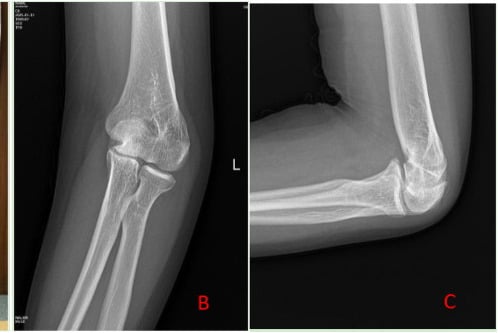
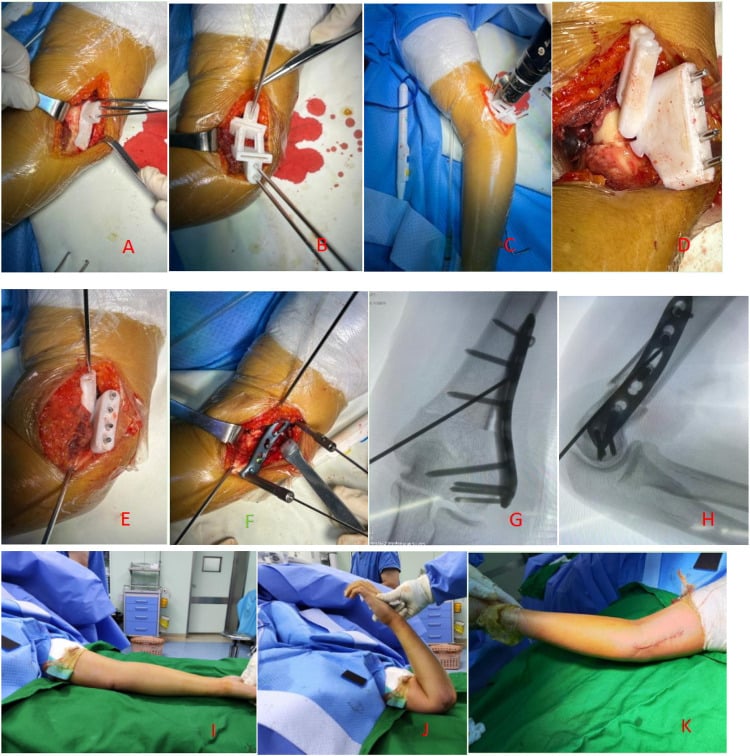
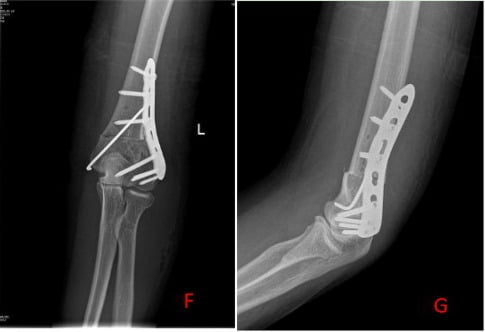
How to correct. A distal humeral (supracondylar) osteotomy realigns all three planes:
- Lateral closing-wedge - the simplest and commonest, but it can leave a prominent lateral condyle, the "bump"
- Dome - a better cosmetic contour, technically harder
- Step-cut and complex multiplanar or oblique osteotomies
- CT-planned patient-specific guides, increasingly used for the rotational component; one option for complex rotational deformity, not a routine requirement
Fixation is typically K-wires, a plate or a lateral external fixator. The radial and ulnar nerves are at risk, and the rotational and lateral-prominence components must be addressed, not just the varus angle. Judge the correction by carrying angle, sagittal alignment, rotation and lateral prominence.
The Flexion-Type Supracondylar Fracture (the other 3%)
Reversed mechanism. A direct blow to the back of the flexed elbow, or a fall onto the point of the elbow, drives the distal fragment anteriorly, the opposite of the extension injury. On the lateral radiograph the anterior humeral line therefore passes posterior to the capitellum.
The ulnar nerve, not the AIN. The distal fragment displaces anteriorly and often into valgus, drawing the ulnar nerve taut behind the medial epicondyle, so the ulnar nerve is the nerve most at risk. Test ulnar motor function (interossei, Froment) and sensation specifically.
Reduce in the opposite direction. After traction and correction of translation and rotation, the fragment is controlled and the elbow is often held or pinned in relative extension rather than the deep flexion used for the extension type. The closed reduction can be awkward, and the fracture is prone to losing reduction in flexion.
More often open. Flexion-type fractures are more often irreducible closed, from soft-tissue interposition, an unstable pattern or ulnar nerve tethering, and so have a higher open-reduction rate. Fixation is still with K-wires, with the same caution over the medial pin.
Postoperative Care
Immobilisation. An above-elbow backslab or cast with the elbow at 60-80° of flexion, not hyperflexed, which risks the circulation. The forearm sits in neutral or slight pronation and the limb is elevated.
Monitoring. Neurovascular checks every hour for the first 24 hours, a check that the cast is not too tight, and a watch for compartment syndrome: pain with passive finger extension.
- Target
- Present
- Action if Abnormal
- Urgent review, check cast
- Target
- Less than 2 seconds
- Action if Abnormal
- Loosen cast, elevate
- Target
- Controlled
- Action if Abnormal
- If severe - compartment syndrome?
- Target
- Active
- Action if Abnormal
- Document, reassure if nerve injury
Follow-up. The protocol after pinning:
- 1 week - radiograph to confirm the reduction is maintained
- 3-4 weeks - K-wire removal and transition to a sling
- 6 weeks - assess range of motion; discharge if recovered
- 3-6 months - if there are concerns about stiffness or deformity
Rehabilitation. Most children need no formal physiotherapy: active play is encouraged and range of motion returns spontaneously. Avoid aggressive passive stretching, which risks myositis ossificans, and counsel parents that the stiffness is temporary and will improve with normal activity.
Guidelines, Registries & Global Practice
Global Epidemiology
- Most common elbow fracture in children; accounts for roughly 55-70% of paediatric elbow fractures worldwide
- Peak incidence age 5-7 years; non-dominant (left) arm slightly more often affected
- Extension type ~97-98%; flexion type 2-3% (flexion type skews slightly older and female, often higher-energy mechanism)
- Common mechanisms globally: falls from playground equipment, monkey bars, trampolines and bunk beds
- Displaced (II/III) fixation
- Closed reduction + percutaneous pinning; lateral OR medial-lateral acceptable
- Vascular emphasis
- Urgent reduction for pulseless, poorly perfused (at-risk) limb
- Displaced (II/III) fixation
- Timely reduction and K-wire fixation; consultant-led decision
- Vascular emphasis
- Document perfusion; immediate surgery for the threatened limb
- Displaced (II/III) fixation
- CRPP standard; lateral entry first-line, mini-open for medial pin
- Vascular emphasis
- Reduce first; explore only the persistently ischaemic (white) hand
- Displaced (II/III) fixation
- Lateral-entry preferred to minimise iatrogenic ulnar injury
- Vascular emphasis
- Expectant approach to the well-perfused pink pulseless hand
Related pages: Malunion and Delayed Union for the general principles behind the cubitus varus correction this page sets out in its own osteotomy section; Volkmann Contracture is the endpoint of a missed compartment syndrome and the reason the pain-on-passive-finger-extension sign outranks the radial pulse; Forearm Compartment Syndrome for that diagnosis in full, including why an anaesthetised or very young child cannot report it; Anterior Interosseous Nerve Syndrome and Median Nerve Anatomy for the nerve most often injured by posterolateral displacement - the AIN branch has no sensory territory, which is why it is missed unless the OK sign is tested; Ulnar Nerve Anatomy for the nerve at risk from the medial pin and the anatomy behind the mini-open technique; Radial Nerve Anatomy for the nerve injured by posteromedial displacement; Lateral Condyle Fractures (Paediatric) and Medial Epicondyle Fractures for the two elbow injuries most often confused with this one on a swollen child's radiograph; Nursemaid Elbow for the atraumatic differential in the toddler who will not use the arm; Elbow Dislocations for the injury the displaced fracture mimics clinically; and Elbow Stiffness and Contracture for the late functional consequence of prolonged immobilisation.
MCQ Practice Points
Q: What is the most common mechanism and displacement pattern for pediatric supracondylar fractures?
A: Extension-type (95-97%): Fall on outstretched hand with elbow extended and hyperextended. Distal fragment displaces posteriorly. Flexion-type (3-5%): Fall on flexed elbow or direct blow; distal fragment displaces anteriorly - higher rate of ulnar nerve injury. Extension type further classified by displacement direction: Posteromedial (most common in extension type) - radial nerve at risk; Posterolateral - median/AIN at risk. Understanding displacement pattern predicts neurovascular injury risk.
Q: How do you assess reduction quality using radiographic parameters in supracondylar fractures?
A: Baumann's angle (AP view): Angle between humeral shaft axis and physeal line of capitellum; normal 70-75 degrees; should match opposite side. Anterior humeral line (lateral view): Line along anterior humeral cortex should pass through middle third of capitellum; if anterior to capitellum, extension malreduction. Coronoid line: Line along anterior coronoid should not pass posterior to anterior humeral cortex. Rotation: On lateral, assess teardrop of lateral column for symmetry. Intraoperative fluoroscopy essential to confirm reduction.
Q: What are the indications for open reduction in pediatric supracondylar fractures?
A: Open fractures - require debridement and stabilization. Vascular compromise not corrected by closed reduction - explore brachial artery. Irreducible fractures - soft tissue interposition (brachialis muscle, median nerve, brachial artery can become entrapped; "pucker sign" on skin indicates buttonholed structures). Neurological deficit worsening after reduction - nerve may be trapped. Open reduction via anterior approach allows visualization of neurovascular structures. Delayed presentation (greater than 5-7 days) with significant swelling may require open approach.
Q: What is the "pucker sign" and its clinical significance in supracondylar fractures?
A: The pucker sign is skin dimpling or puckering at the antecubital fossa indicating that the proximal fragment has buttonholed through the brachialis fascia. Structures at risk of entrapment: Brachialis muscle, brachial artery, median nerve. Significance: Suggests closed reduction may be impossible - the entrapped soft tissues block reduction. If pucker sign persists after reduction attempt, suspect soft tissue interposition and consider open reduction via anterior approach. Associated with higher rates of neurovascular injury.
Q: What is Volkmann's ischemic contracture and how does it develop after supracondylar fractures?
A: Volkmann's ischemic contracture is the devastating end-result of missed forearm compartment syndrome. Pathophysiology: Vascular injury or swelling leads to elevated compartment pressure, causing muscle ischemia and necrosis. As muscles fibrose, they shorten, causing flexion contracture of wrist and fingers (worse with elbow extension, MCP extension). Classic position: Flexed wrist, extended MCP, flexed IP joints. Prevention: Recognize compartment syndrome early (6 P's: Pain with passive stretch, Pallor, Pulselessness, Paresthesias, Paralysis, Pressure). Emergent fasciotomy if suspected.
Exam Viva Scenarios
Practise clinical reasoning and management decisions out loud
“A 6-year-old presents with a displaced supracondylar fracture and a pink but pulseless hand. How do you manage?”
“You are managing a 7-year-old with a Gartland Type III posterolateral supracondylar fracture. In theatre under general anesthesia, you notice a skin dimple (pucker sign) in the antecubital fossa. After two attempts at closed reduction, you cannot achieve adequate alignment - the distal fragment keeps subluxating posteriorly. Fluoroscopy shows persistent posterior displacement with the anterior humeral line passing anterior to the capitellum. The hand is pink and well perfused. What is your next step and how would you proceed?”
“You performed closed reduction and crossed K-wire fixation (one lateral, one medial wire) for a Gartland Type III supracondylar fracture in a 5-year-old girl last night. The fracture was perfectly reduced with good wire position on post-operative X-rays. This morning on ward rounds, the mother reports the child cannot spread her fingers apart and has numbness in the little finger. Pre-operatively, all nerve function was documented as intact. On examination, you confirm ulnar nerve palsy with weak interossei, inability to abduct/adduct fingers, and diminished sensation in the ulnar distribution. What is your assessment and management?”
Gartland Classification
- I: Undisplaced - cast
- II: Hinged on posterior cortex
- III: Complete displacement - emergency
Neurovascular
- Brachial artery at risk
- AIN most common nerve (extension)
- Check OK sign (FPL, FDP index)
- 3Ps: Pulse, Perfusion, Paralysis
Pink Pulseless Algorithm
- Reduce urgently
- Pink post-reduction: Observe
- White post-reduction: Explore artery
Fixation
- Lateral K-wires (2 divergent) - safer
- Crossed wires - stronger, ulnar nerve risk
- Avoid hyperflexion in cast
Evidence Base
Key Evidence
- Original three-type classification
- Foundation for current management
- Modified by Wilkins (Type IV added)
- Multiple studies show no significant difference in stability for most fractures
- Lateral-only avoids ulnar nerve injury (0% vs 2-5%)
- Crossed preferred for very unstable (Type IV) fractures
- Finding
- Similar outcomes, lateral safer
- Evidence Level
- Level II (meta-analyses)
- Finding
- Within 8 hours if possible
- Evidence Level
- Level IV
- Finding
- Reduce first, most perfuse
- Evidence Level
- Level IV
Landmark Evidence
Crossed versus lateral-only pinning: meta-analysis of 19 RCTs
- Meta-analysis of 19 randomised controlled trials, 1297 Gartland type II and III fractures
- Medial-lateral crossed pinning had LOWER loss of reduction (RR 0.70, 95% CI 0.52-0.94) than lateral-only
- Crossed pinning had HIGHER iatrogenic ulnar nerve injury (RR 2.21, 95% CI 1.11-4.41)
- With a mini-open medial pin the excess ulnar risk was no longer statistically detectable (RR 1.73, 95% CI 0.47-6.31) - a small subgroup, not proof of safety
- No difference in Baumann angle, carrying angle, Flynn excellent grading or pin-tract infection
Crossed vs lateral entry: systematic review and meta-analysis
- 13 studies (7 RCTs, 6 prospective cohorts), 1158 displaced extension-type fractures
- No difference in Flynn outcome (RR 1.07) or loss of reduction (crossed 11.6% vs lateral 12.4%)
- Iatrogenic ulnar nerve injury: 4.1% (crossed) vs 0.3% (lateral entry) — roughly threefold higher
- Conclusion: lateral entry is safest if the surgeon wishes to avoid all ulnar nerve risk
Pink pulseless hand in Gartland III: therapeutic consensus
- 404 Gartland type III fractures; 68 (17%) had acute vascular injury, 63 pink pulseless and 5 white/cold
- Pink pulseless hands treated by urgent closed reduction and pinning, then close observation
- Radial pulse restored immediately in 42 and within hours-to-11 days in 18 of the pink pulseless group
- All 5 ischaemic (white) hands and 3 failed reductions underwent exploration — brachial artery incarcerated at fracture
- At mean 8.4 years all patients had a palpable radial pulse and full spontaneous nerve recovery
The pink pulseless hand: literature review of vascular management
- Review of case series on management of the pink pulseless hand after fracture reduction
- A pink pulseless hand after reduction can be managed expectantly with close observation
- Angiography and colour duplex add little to acute decision-making
- Exploration is indicated only if additional signs of vascular compromise develop
Delay to surgery increases the need for open reduction
- 171 closed Gartland III fractures without vascular compromise, retrospective comparison
- Surgery under 8 hours from presentation (126) versus over 8 hours (45)
- Delay over 8 hours raised the open reduction rate to 33.3% vs 11.2% (p less than 0.05)
- No difference in overall complication rate between early and delayed groups
Nerve injuries: spontaneous recovery and role of exploration
- 272 displaced Gartland II/III fractures; nerve injury in 48 (18%) overall
- Iatrogenic (post-treatment) nerve injury in 39 (14%), predominantly ulnar (34 of 39)
- All nerve injuries resolved clinically at a mean of 3.5 months (range 3 weeks to 8 months)
- Routine early wire removal or nerve exploration not indicated; mini-open pinning reduces nerve risk
AAOS Clinical Practice Guideline: pediatric supracondylar humerus fracture
- Closed reduction with percutaneous pinning recommended for displaced (type II/III) fractures
- Either lateral-entry or medial-and-lateral pin configurations are acceptable for displaced fractures
- If a medial pin is used, techniques to avoid iatrogenic ulnar nerve injury are advised
- Urgent closed reduction for a fracture with absent pulse and poor perfusion (limb at risk)