A structured way to build a differential | VITAMIN CDEF / VINDICATE | Fast pattern recognition plus slow analysis | Beat the biases that cause diagnostic error
- The surgical sieve is a checklist of categories of disease (vascular, infective, inflammatory, traumatic, autoimmune, metabolic, idiopathic, neoplastic, congenital, degenerative, endocrine, functional) that you run through so your differential is complete rather than just the first thing you thought of
- It is a System 2 (analytical) tool - a deliberate framework that backs up fast pattern recognition (System 1) and stops you committing to the first plausible answer
- Diagnostic error comes from BOTH biased reasoning and gaps in knowledge, and the popular slogan that it is 'a thinking problem, not a knowledge problem' does not survive the evidence - know the named biases (anchoring, premature closure, availability, confirmation) because they are examinable and they describe real failures, but know also that error rates FALL as expertise and knowledge rise, that the size of the contribution biases actually make is not well established, and that teaching clinicians to spot their own biases has NOT been shown to reduce error while reorganising knowledge has
- In a viva, structure scores marks: starting with a named framework (VITAMIN CDEF or VINDICATE) and a sensible order shows the examiner an organised, safe mind even before you reach the right answer
- The sieve is a tool, not a script - tailor it to the clinical context (a painful joint, a bone lesion, a limping child) and lead with the dangerous and common diagnoses, not an exhaustive list read off in random order
- “If you go blank in a viva, fall back on the sieve out loud - 'I would think about this in categories: vascular, infective, inflammatory...' - it buys time and demonstrates a safe, systematic approach
- “Always say the can't-miss diagnoses first (infection, malignancy, fracture, vascular compromise) - examiners reward safety, not just completeness
- “Premature closure - settling on a diagnosis before it is fully verified - is the single most common reasoning error; the sieve is the antidote
- “Tie the sieve to the patient: a hot swollen joint is septic arthritis until proven otherwise, but the sieve reminds you of gout, reactive arthritis, haemarthrosis and a flare of inflammatory arthritis too
Overview
What the sieve is. The surgical sieve is a checklist of the broad categories of disease (vascular, infective, traumatic, neoplastic and so on) that you run through to make sure your differential diagnosis is complete. Instead of listing the first two or three diagnoses that spring to mind, you ask of each category in turn: could this be vascular? infective? a tumour? It is one of the oldest and most reliable aids to clinical reasoning, and exactly the kind of structured thinking examiners want to see.
How clinicians reason. Clinical reasoning, the route from a presenting problem to a diagnosis, is now understood through a dual-process model. System 1 is fast, intuitive pattern recognition: you glance at an x-ray and "just know" it is a scaphoid fracture. System 2 is slow, effortful analysis, working methodically through a differential.
Where the sieve fits. Experienced clinicians rely heavily on System 1 because it is efficient, and it is also where most snap errors come from. The sieve is a System 2 safety net: a deliberate cross-check of the intuitive answer against a complete list of possibilities.
What the exam asks. Three threads recur: how to build a complete differential with a named sieve, how the brain actually reasons and why intuition is both useful and dangerous, and why diagnoses get missed, which means the cognitive biases behind diagnostic error and how a structured approach guards against them.
Principles: How the Surgical Sieve Works
Breadth before depth. Faced with a symptom or a sign, you do not jump to the most likely diagnosis. You first generate possibilities across every category of disease, then narrow them down using the history, examination and investigations.
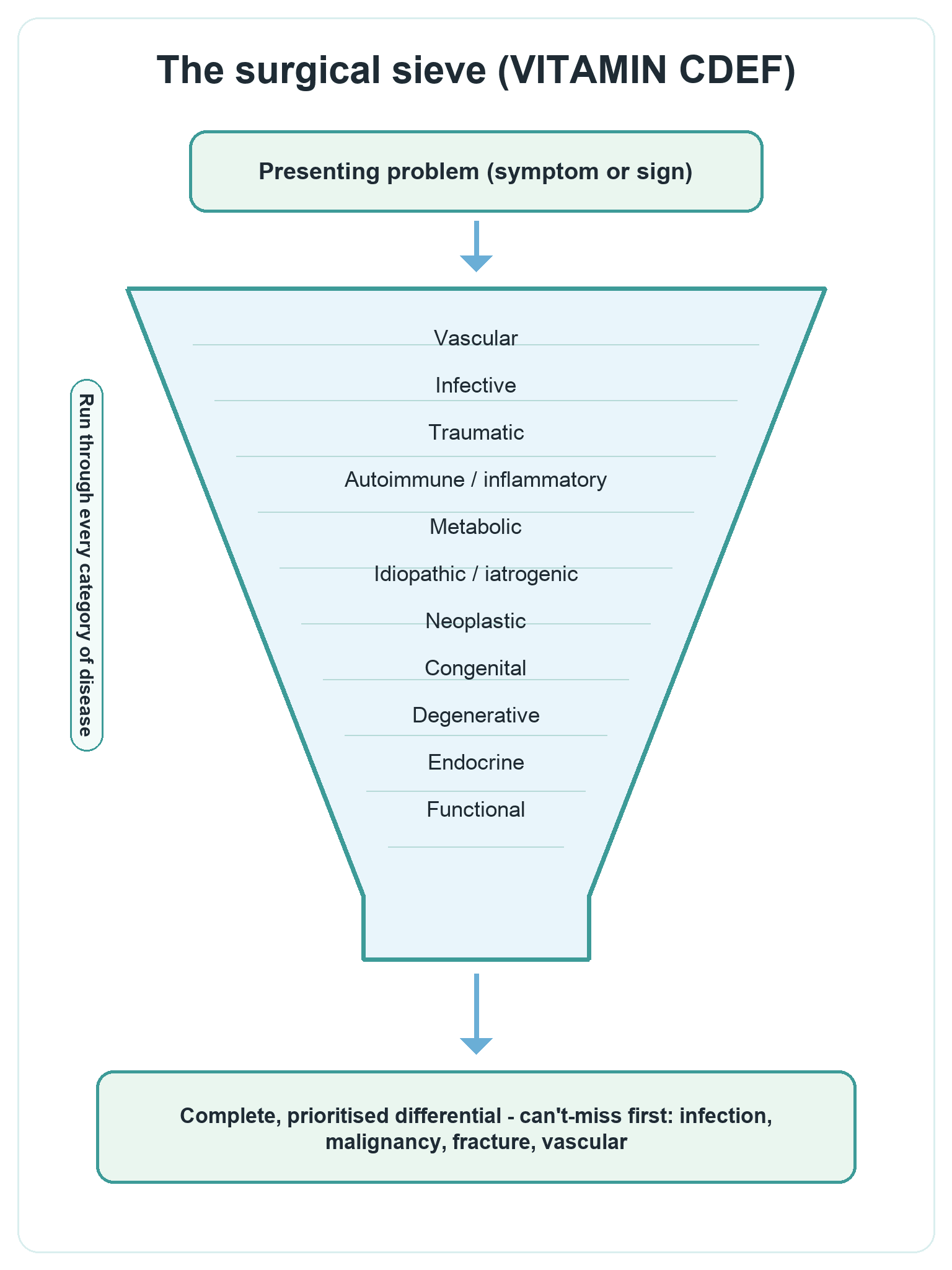
The mnemonics. The categories are remembered with a mnemonic, and the two most popular cover the same ground. VITAMIN CDEF is set out below. VINDICATE runs Vascular, Infective/inflammatory, Neoplastic, Degenerative, Iatrogenic/idiopathic, Congenital, Autoimmune, Traumatic and Endocrine/metabolic. Use whichever you remember under pressure.
- What it means
- Problems of blood supply
- Orthopaedic examples
- Avascular necrosis, compartment syndrome, ischaemia, infarction, haemorrhage, haemarthrosis
- What it means
- Infection of bone, joint or soft tissue
- Orthopaedic examples
- Septic arthritis, osteomyelitis, discitis, abscess, necrotising fasciitis
- What it means
- Mechanical injury
- Orthopaedic examples
- Fracture, dislocation, ligament and tendon rupture, soft-tissue injury
- What it means
- Immune-driven inflammation
- Orthopaedic examples
- Rheumatoid arthritis, seronegative arthritis, ankylosing spondylitis, reactive arthritis, crystal arthropathy
- What it means
- Disordered chemistry
- Orthopaedic examples
- Gout, osteomalacia, Paget disease, storage disorders
- What it means
- No cause found, or caused by treatment (drugs, surgery)
- Orthopaedic examples
- Idiopathic scoliosis, post-surgical complication
- What it means
- Benign or malignant primary tumour, or metastasis
- Orthopaedic examples
- Osteosarcoma, giant cell tumour, metastasis, myeloma
- What it means
- Present from birth or developmental, including inherited conditions
- Orthopaedic examples
- Developmental dysplasia of the hip, skeletal dysplasia, club foot
- What it means
- Wear and ageing
- Orthopaedic examples
- Osteoarthritis, disc degeneration, rotator cuff tendinopathy
- What it means
- Disordered hormones
- Orthopaedic examples
- Hyperparathyroid bone disease, thyroid and diabetic effects on bone
- What it means
- Pain or disability with no structural cause found
- Orthopaedic examples
- Functional pain
The Anatomical (Structural) Sieve
What it asks. The aetiological sieve (VITAMIN CDEF) asks what kind of process is at work. The "surgical sieve" has a second, complementary axis: the anatomical (structural) sieve asks which structure is responsible, working through the tissue layers at the site of the problem. It is especially useful for a localised problem, such as a painful joint, a lump or a single region, where listing every disease category helps less than asking which structure here is the culprit.
- Orthopaedic example of pathology
- Cellulitis, sinus, ganglion, lipoma, skin malignancy over a lump
- Orthopaedic example of pathology
- Compartment syndrome, muscle tear or haematoma, myositis, soft-tissue sarcoma
- Orthopaedic example of pathology
- Tendinopathy, tendon rupture, tenosynovitis, bursitis
- Orthopaedic example of pathology
- Sprain, instability, capsulitis
- Orthopaedic example of pathology
- Fracture, osteomyelitis, primary or metastatic tumour, metabolic bone disease
- Orthopaedic example of pathology
- Osteoarthritis, septic or inflammatory arthritis, crystal arthropathy, loose body
- Orthopaedic example of pathology
- Entrapment, neuroma, referred radicular pain
- Orthopaedic example of pathology
- Ischaemia, aneurysm, deep vein thrombosis, vascular malformation
- Orthopaedic example of pathology
- Pain referred from a proximal joint or the spine (for example hip pathology presenting as knee pain)
Using both together. The anatomical sieve localises the problem to a structure, and the aetiological sieve then asks what process is affecting it. Together they generate a complete yet focused differential quickly, and they are a classic recovery move when a "causes of a lump / painful joint" viva question stalls.
Dual-Process Theory: How Clinicians Actually Think
Two systems. Modern theory describes two systems of thinking that work together.
- System 1 (intuitive)
- Fast, automatic, effortless
- System 2 (analytical)
- Slow, deliberate, effortful
- System 1 (intuitive)
- Pattern recognition - matches to remembered examples
- System 2 (analytical)
- Step-by-step reasoning through possibilities
- System 1 (intuitive)
- Familiar, classic presentations in experienced hands
- System 2 (analytical)
- Unfamiliar, complex or atypical presentations
- System 1 (intuitive)
- Prone to cognitive bias and snap errors
- System 2 (analytical)
- Limited by working memory; tiring and time-consuming
- System 1 (intuitive)
- This is the answer the sieve cross-checks
- System 2 (analytical)
- This is the system the sieve belongs to
Switching between them. Neither system is inherently better. The evidence is that experts use both, and the safest clinicians deliberately switch from intuition to analysis when something does not fit. This switch is sometimes called executive override: a brief time-out to ask "what else could this be?" and run the sieve.
The reverse danger. Fast intuition can also override good analysis, as when a clinical decision rule is ignored because "it just looks like a sprain".
Cognitive Biases and Diagnostic Error
Bias and knowledge. Diagnostic error is common, and it comes from both biased reasoning and gaps in knowledge. Error rates fall as expertise and knowledge rise, and the size of the contribution the named biases actually make is not well established (Norman, below). "Diagnostic error is a thinking problem, not a knowledge problem" is a slogan the evidence on this page contradicts, so do not claim in a viva that knowledge is not the issue.
The named biases. They are still worth knowing, because they are examinable and they name real failure modes. Examiners like you to be able to name them and say how to mitigate each.
- What it is
- Fixating on the first piece of information and failing to adjust
- How to guard against it
- Deliberately re-weigh later findings; ask 'what does not fit?'
- What it is
- Accepting a diagnosis before it is fully verified - the commonest error
- How to guard against it
- Run the sieve; ask 'what else could this be?' before committing
- What it is
- Favouring a diagnosis that comes to mind easily (recent or memorable)
- How to guard against it
- Consider base rates - what is actually common in this patient?
- What it is
- Seeking evidence that fits your hunch and ignoring the rest
- How to guard against it
- Actively look for evidence against your leading diagnosis
- What it is
- Inheriting a previous label and carrying it on unchecked
- How to guard against it
- Re-take the history yourself; re-examine the assumptions
- What it is
- Being swayed by how the problem is presented to you
- How to guard against it
- Re-frame neutrally; restate the problem in your own words
- What it is
- Over-trusting your own judgement and skipping the check
- How to guard against it
- Use checklists and the sieve; seek a second opinion when unsure
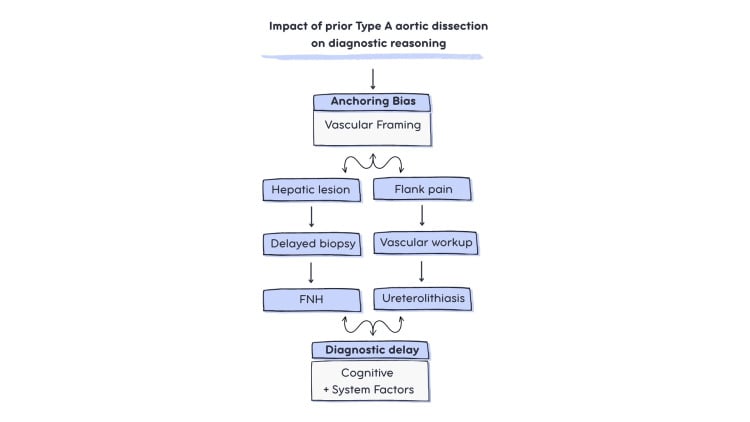
The defence. The practical defence against all of these is the same: a deliberate System 2 cross-check using a structured tool. The surgical sieve is one such tool; checklists, "diagnostic time-outs" and actively asking "what is the worst this could be, and have I excluded it?" are others.
What reduces error. Simply teaching clinicians to "slow down and avoid bias" does not reliably reduce errors on its own, and teaching them to recognise their own biases has not been shown to reduce error. What helps more is better organised knowledge and practice with feedback, so that both pattern recognition and analytical checks improve; reorganising and deepening knowledge produces small but consistent reductions. The sieve is most useful as a habit that prompts the analytical cross-check, combined with genuine knowledge of the conditions in each category.
Causes of Error in Clinical Reasoning: Bias, Knowledge and Dual Process
- Clinical reasoning follows a dual-process model: fast intuitive Type 1 thinking and slow analytical Type 2 thinking
- Both Type 1 and Type 2 reasoning can produce diagnostic errors
- Type 1 errors arise from the ASSOCIATIVE nature of memory; Type 2 errors arise from the LIMITED CAPACITY of working memory, which constrains computation - so slowing down is not itself a guarantee
- The likelihood of error DECREASES with increasing expertise and knowledge - the single most consistent finding in the review
- Biases such as availability can be induced experimentally, but the extent to which they actually contribute to diagnostic error IS NOT WELL ESTABLISHED
- Educational strategies aimed only at teaching clinicians to recognise their biases are ineffective at reducing errors
- Strategies focused on the reorganisation of knowledge produce small but consistent benefits
Cognitive Debiasing: Origins of Bias and the Theory of Debiasing
- Diagnostic failure is strongly influenced by the psychology of the decision-maker, framed by dual-process theory
- Most cognitive and affective biases arise in the fast, intuitive Type 1 processes that dominate everyday decisions
- Biases come from two sources: innate, evolutionary shortcuts and biases acquired through training and environment
- Fatigue, sleep deprivation and cognitive overload increase the risk of biased decisions; debiasing requires a deliberate switch from intuitive to analytical thinking
Bayesian Reasoning: Weighting the Differential
Weighting the list. The sieve generates the list; Bayesian reasoning decides how to weight it. Every diagnosis starts with a pre-test probability, how likely it is before testing, driven by prevalence and the clinical picture. Each finding or test result updates that probability up or down toward a post-test probability. This is the quantitative complement to the qualitative sieve.
- What it means / how to use it
- Likelihood of the diagnosis before testing (prevalence plus the clinical picture); it sets the starting point for everything that follows
- What it means / how to use it
- A highly SENSITIVE test, when NEGATIVE, helps rule a diagnosis OUT
- What it means / how to use it
- A highly SPECIFIC test, when POSITIVE, helps rule a diagnosis IN
- What it means / how to use it
- How much a result shifts probability: an LR greater than 10 (or less than 0.1) moves it a large, often decision-changing amount; an LR near 1 is uninformative
- What it means / how to use it
- Below the test threshold the probability is too low to test; above the treatment threshold it is high enough to treat without further tests; testing is worthwhile only in between
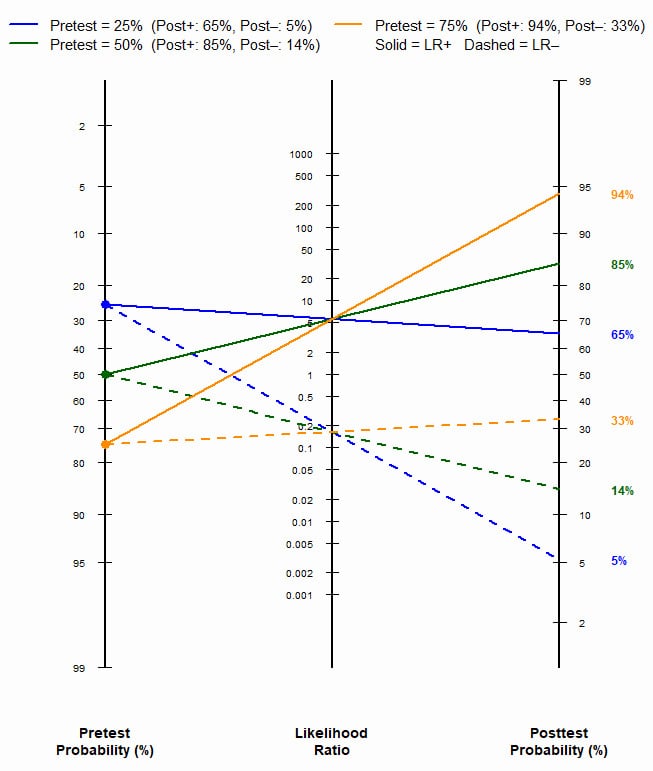
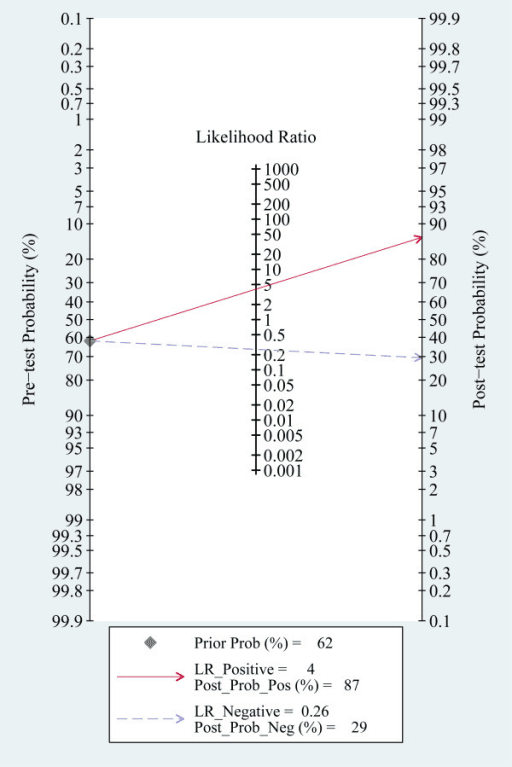
At the bedside. This explains why a hot joint with a high pre-test probability of sepsis is aspirated and often treated empirically, whereas the same test is not ordered when the pre-test probability is trivial. The sieve makes the differential complete, but prioritising it requires probability: lead with what is both dangerous and, given this patient's pre-test probability, actually likely.
Using the Sieve Well (and Its Limits)
Silent, then prioritised. Used badly, the sieve becomes a mechanical recital; used well, it is a fast, silent safety check. Run through the categories internally and quickly, pull out the ones that fit the clinical picture, and present a focused, prioritised differential. Reciting every category aloud, irrelevant ones included, wastes time and sounds rote.
A complete differential is not the same as a long one. Use the sieve to make sure you have considered every category, then present a short, prioritised list - the can't-miss diagnoses first, then the likely ones. The examiner wants to see that you thought broadly and then chose wisely.
Tailor it. Filter the categories through the clinical context, whether a bone lesion, a hot joint or a limping child, and emphasise the ones that actually matter there. For a hot, swollen joint the sieve points you to infection (septic arthritis), crystals (gout), trauma (haemarthrosis) and an inflammatory flare, not to congenital causes. The sieve is a prompt to be complete, not a script to read.
Can't-miss first. Examiners reward a safe clinician. Front-load infection, malignancy, fracture and vascular compromise where relevant, then work through the rest of the sieve. Demonstrating safety is worth more than an exhaustive list and it protects the patient, while a long list read in random order that buries septic arthritis or tumour scores poorly.
Structure needs knowledge. The framework cannot substitute for knowing the actual diseases. A confident "neoplastic" category is useless if you cannot name the relevant tumours; structure plus knowledge is what scores.
A structured differential should always keep septic arthritis at the top of an acute monoarthritis until it is excluded, because a missed joint infection destroys cartilage within days. The sieve widens the list; it never demotes the can't-miss diagnosis. Aspirate the joint if in doubt.
Clinical Relevance
In the viva. A question that asks for "the causes of" or "your differential" is an explicit invitation to use a sieve. Name the structure first ("I would use a surgical sieve, thinking in categories: vascular, infective, inflammatory..."): structure shown out loud earns marks even before the right answer, and a structured, safety-first answer scores far better than a scattergun list.
On call. In the emergency and on-call setting, where you are tired and busy, the deliberate analytical cross-check is exactly what stops a fracture, a tumour or a joint infection being missed.
In clinic. The sieve keeps rare-but-serious diagnoses on the radar when a patient does not fit the usual pattern. Knowing how to build a complete differential, how your own mind reasons and which biases catch clinicians out is core basic-science material.
Guidelines, Registries and Global Practice
- Diagnostic error is a recognised global patient-safety priority: bodies such as the WHO and national patient-safety agencies highlight diagnostic safety as a major source of avoidable harm, and structured reasoning is a core mitigation across all health systems.
- Surgical-style sieves are taught worldwide under various mnemonics (VITAMIN CDEF, VINDICATE, and others). They cover the same categories of disease; candidates should use whichever they recall reliably under pressure - examiners reward the structure, not a particular acronym.
- Dual-process theory and cognitive debiasing are part of medical-education curricula internationally (for example in medical-school clinical-reasoning courses and postgraduate training), reflecting consensus that reasoning skills are teachable and examinable, not just innate.
- The consistent message across settings: a structured differential plus genuine knowledge plus feedback on missed cases is what reduces diagnostic error - not exhortation to "be careful". The surgical sieve is the practical, examinable expression of that principle.
Exam Viva Scenarios
Practise clinical reasoning and management decisions out loud
“The examiner shows you a plain radiograph with a lytic lesion in the proximal tibia of a young adult and asks for your differential diagnosis.”
“The examiner asks: 'A junior repeatedly anchors on the obvious injury and misses the second one. How do you think about clinical reasoning, and how do you avoid diagnostic error?'”
The Sieve (Categories)
- VITAMIN CDEF or VINDICATE - cover the same ground
- Vascular, Infective, Inflammatory/autoimmune, Traumatic
- Metabolic/Endocrine, Idiopathic/Iatrogenic, Neoplastic
- Congenital, Degenerative, Functional
How the Mind Reasons
- System 1: fast, intuitive pattern recognition
- System 2: slow, analytical - where the sieve belongs
- Safe clinician uses both and switches when things do not fit
- Executive override: deliberate time-out to re-think
The Biases (Why Diagnoses Are Missed)
- Anchoring: stuck on the first impression
- Premature closure: stopping too early (commonest)
- Availability: favouring a recently seen diagnosis
- Confirmation, diagnostic momentum, framing, overconfidence
Viva Technique
- Name the framework first - structure scores marks
- Lead with can't-miss diagnoses: infection, malignancy, fracture, vascular
- Tailor the sieve to the presentation; do not recite it all
- Structure plus real knowledge - the sieve is not a substitute for facts
Evidence: Does a Diagnostic Aid Help?
Diagnostic Aids: The Surgical Sieve Revisited
- 48 THIRD-YEAR MEDICAL STUDENTS, not practising clinicians, compared the surgical sieve against a hand-held diagnostic wheel the authors had built
- Both aids prompted users to generate a GREATER NUMBER of diagnoses, and there was no significant difference between the two aids
- The outcome measured was the COUNT of diagnoses generated - not their accuracy, not whether the correct diagnosis was among them, and not whether anything was missed
- The comparator, the Compass Medicine, is a three-disc handheld wheel the authors DESIGNED THEMSELVES, modelled on the wheels used in antenatal clinics - the study is an evaluation of the authors' own device
- The authors describe it as a preliminary study
So what does the evidence actually support? Put the two papers side by side and the answer is narrower than the enthusiasm usually attached to it. A category framework broadens what a novice writes down - that is Chai's finding, and it is worth having, because the commonest novice failure is a differential of one. But the named biases - anchoring, availability, confirmation, premature closure, overconfidence - while real and describable, have a contribution to actual diagnostic error that is not well established, and the intervention that follows most naturally from naming them, teaching clinicians to spot their own biases, has not been shown to reduce error. What has, modestly and consistently, is reorganising and deepening knowledge. The defensible position is therefore that the sieve earns its place as a completeness prompt and a communication structure - it stops you committing to the first plausible answer, and in a viva it demonstrates an organised mind - while the durable protection against missing a diagnosis remains knowing the diseases well enough to recognise them. A framework cannot retrieve a diagnosis you have never learned.