Multisystem Autoimmune Disease | Jaccoud Arthropathy | Multifocal AVN | Perioperative Risk
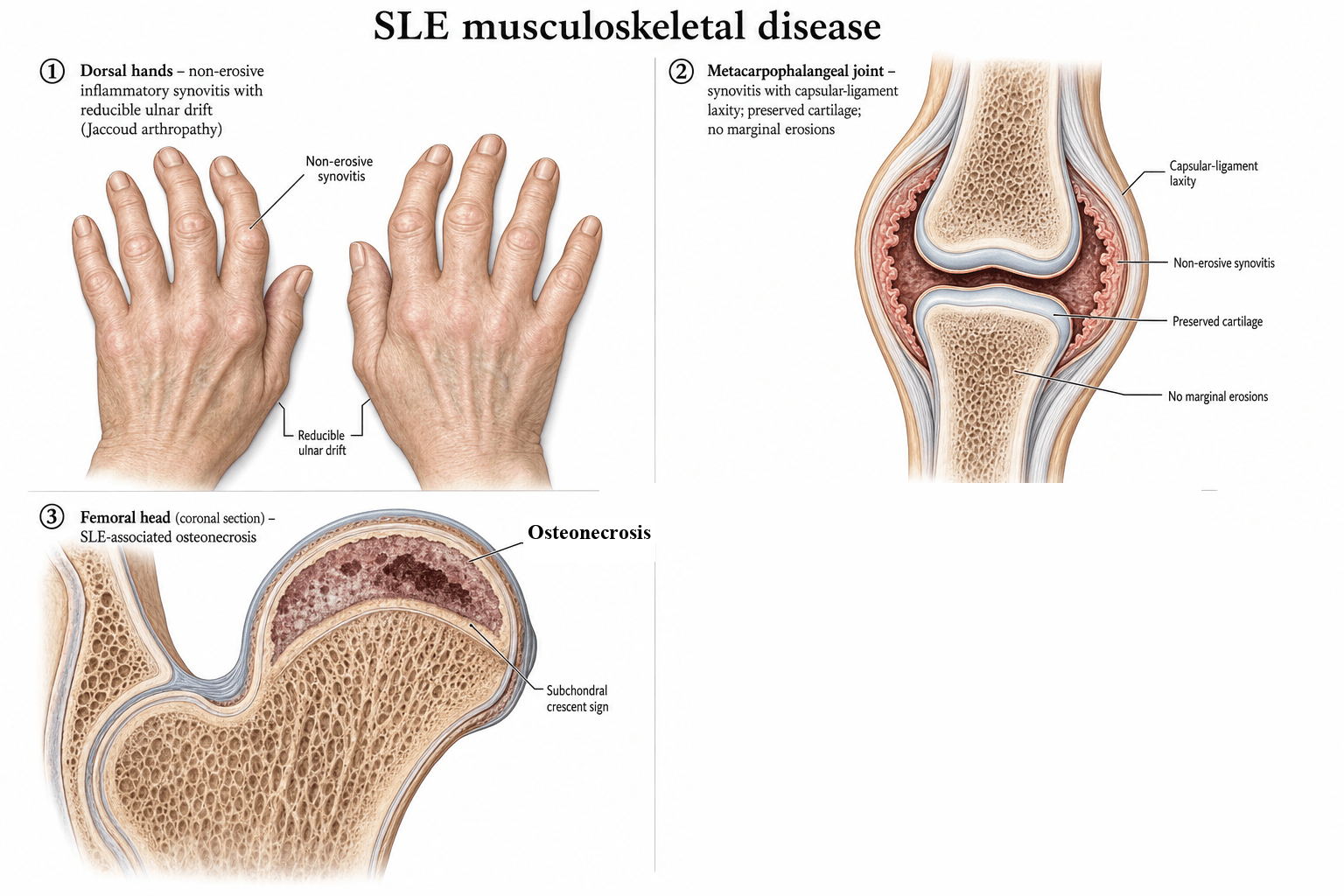
- SLE arthritis is typically non-erosive but Jaccoud deformity produces reducible swan-neck / ulnar deviation
- AVN in SLE is commonly multifocal (30-50%) - image BOTH hips and knees when one site presents
- Highest AVN risk: cumulative prednisolone greater than 3-5 g, daily dose greater than 20 mg, pulse therapy, Raynaud, vasculitis, antiphospholipid antibodies
- Antiphospholipid syndrome (APS) raises perioperative thromboembolism risk - 10-15% of SLE patients
- Perioperative steroid cover and VTE prophylaxis are mandatory - even for arthroplasty in stable disease
- “Jaccoud = reducible; rheumatoid = fixed and erosive - the differential at the MCP/PIP
- “Multifocal AVN is a SLE signature: ask for MRI of contralateral joint when you see one AVN
- “Always check aPL antibodies (lupus anticoagulant, anti-cardiolipin, anti-beta2 GPI) before theatre
- “Capillaritis, Raynaud, livedo reticularis point to APS - screen for thrombosis history
- “Active lupus nephritis or CNS lupus markedly increases perioperative morbidity - defer elective surgery
Overview and Epidemiology
Musculoskeletal complaints are the most common reason a patient with SLE first presents to a clinician, and they remain the leading cause of morbidity through the disease course. The orthopaedic surgeon meets SLE in three principal scenarios: a hand deformity that mimics rheumatoid arthritis (Jaccoud arthropathy), avascular necrosis of the femoral head in a young patient on steroids, and the perioperative management of an SLE patient listed for arthroplasty or fracture fixation.
Who. SLE affects roughly 30-50 per 100,000 adults worldwide, with a 9:1 female-to-male ratio and peak onset in the second to fourth decade.
Symptom or sign. Joint symptoms reach 90% or more across the disease course, and that is the figure usually quoted, but it is arthralgia, and arthralgia is not synovitis. In the 1,000-patient European cohort followed prospectively for 10 years, objective arthritis occurred in 48.1%, still the commonest single manifestation of the disease, ahead of malar rash (31.1%) and nephropathy (27.9%). Quote whichever endpoint the question asks for, and never treat a 90% symptom figure as a licence to call a painful lupus joint inflamed.
Bone and hand. The cumulative incidence of symptomatic AVN in SLE cohorts is 5-15%. Asymptomatic MRI-detected lesions are found in up to 40%, a different endpoint and not a range with the symptomatic figure. AVN is the dominant musculoskeletal cause of disability. Jaccoud arthropathy affects 5-12% of patients, increasing with disease duration and severity.
What kills them. In the same European cohort, deaths divided almost evenly between active SLE (26.5%), thrombosis (26.5%) and infection (25%), and thrombosis became the commonest cause in the second 5 years as inflammatory manifestations settled and vascular ones did not. The surgical corollary is that thromboprophylaxis deserves the same seriousness as infection prophylaxis, not less.
Pathophysiology
Two mechanisms. The orthopaedic phenotypes of SLE arise from two separable but overlapping mechanisms. Inflammatory capsuloligamentous laxity, from immune complex deposition in synovium and peri-articular soft tissues, underlies Jaccoud arthropathy and is the principal driver of hand deformity. Ischaemic bone death, from corticosteroid-induced adipocyte hypertrophy, a rise in intraosseous pressure and microvascular thrombosis from antiphospholipid antibodies, underlies avascular necrosis. The two are not mutually exclusive: a patient may have Jaccoud hands and bilateral femoral head AVN.
- Driver
- Type III hypersensitivity, complement activation
- Clinical Phenotype
- Non-erosive polyarthritis, tenosynovitis
- Modifiable?
- Yes - immunosuppression (HCQ, MMF, biologics)
- Driver
- Chronic inflammation + fibrotic remodelling
- Clinical Phenotype
- Jaccoud deformity (ulnar deviation, swan neck)
- Modifiable?
- Limited - splints, synovectomy
- Driver
- Intraosseous fat cell hypertrophy, raised pressure
- Clinical Phenotype
- Subchondral ischaemia, AVN
- Modifiable?
- Yes - steroid-sparing regimens
- Driver
- Antiphospholipid antibodies, vasculitis
- Clinical Phenotype
- Bone infarcts, atypical AVN distribution
- Modifiable?
- Yes - anticoagulation where indicated
- Driver
- Autoimmune muscle inflammation (overlap syndromes)
- Clinical Phenotype
- Proximal weakness, raised CK
- Modifiable?
- Yes - immunosuppression
How the Jaccoud hand deforms. The synovitis is immune-complex driven and often transient. The deformity comes from what chronic inflammation does to the soft tissues around the joint:
- The capsuloligamentous structures weaken: the MCP volar plate, the PIP collateral ligaments and the extensor hood
- The extensor tendons slip ulnarly at the MCP joints and the intrinsic muscles shorten
- Ulnar deviation, swan-neck and boutonniere deformities follow, all passively correctable early
The articular cartilage is preserved despite the deformity, and there is no bony erosion. Ultrasound or MRI may show non-erosive synovitis. The hand looks rheumatoid and is structurally different.
How the bone dies. Beyond the marrow fat and thrombosis in the table, osteocytes and adipocytes in the subchondral bone undergo apoptosis, and fat emboli from steroid-induced marrow change may play a part. The end result is subchondral fracture, femoral head collapse and secondary OA.
Who gets AVN. Cumulative steroid dose is the dominant modifiable risk factor. The risk factors to recall:
- Cumulative dose greater than 3-5 g prednisolone equivalent
- Daily dose greater than 20 mg, pulse therapy, higher peak doses and rapid tapering
- Elevated disease activity: vasculitis, renal disease and Raynaud phenomenon, which compromises the microvasculature of bone
- Antiphospholipid antibodies, through thrombosis of subchondral vessels
- Disease duration, since longer disease means a longer exposure window
Classification and Types
- Prevalence
- Commonest, greater than 80%
- Key Features
- Migratory pain, no swelling
- Management
- NSAIDs, hydroxychloroquine
- Prevalence
- 50-60%
- Key Features
- Symmetrical, reversible
- Management
- DMARDs, short-course steroids
- Prevalence
- 5-12%
- Key Features
- Reducible deformity, no erosion
- Management
- Splints, synovectomy, tendon rebalancing
- Prevalence
- Under 5%
- Key Features
- Erosive arthritis with SLE features
- Management
- Treat as RA; methotrexate often required
- Prevalence
- 5-15% symptomatic
- Key Features
- Multifocal, steroid-related
- Management
- Core decompression, arthroplasty
- Prevalence
- Under 10%
- Key Features
- Overlap with dermatomyositis / polymyositis
- Management
- Immunosuppression, physio
Rhupus is a small but important subgroup: erosive arthritis with SLE serology, behaving clinically like RA.
Clinical Assessment
History. Establish the lupus, its activity and its complications as well as the joint:
- Lupus features: malar rash, photosensitivity, oral ulcers, serositis, renal disease, cytopenias, neurological involvement
- Disease activity: SLEDAI score, BILAG index and current immunosuppression
- Joints: pain, swelling and morning stiffness, usually minutes rather than the hours of RA
- AVN: groin, buttock, knee or shoulder pain, especially after steroid bursts
- Thrombosis: DVT, PE, stroke, transient ischaemic attack, pregnancy morbidity
Examination. Look beyond the painful joint:
- Hands: the pattern of deformity (reducible ulnar deviation, swan-neck, boutonniere), the squeeze test, FDS and FDP function
- Skin: periungual erythema, livedo reticularis, digital ulceration, Raynaud
- Hips, knees and shoulders: log roll, FABER, FADIR, range of movement, antalgic gait, limb length, and the contralateral joint whenever one AVN site is found
- System screen: blood pressure, urine dipstick, fundoscopy, lymphadenopathy
The Jaccoud hand. Inspect the hand at rest, where ulnar deviation, swan-neck and boutonniere may be obvious. Then correct the deformity passively: the examiner can straighten a Jaccoud hand, whereas the rheumatoid deformity is fixed, resists correction and shows erosions on X-ray. This is the key clinical sign that separates the two.
Then test function. Despite dramatic-looking deformity, Jaccoud hands often retain good grip and key-pinch, and a Jaccoud hand may function better than an RA hand with less obvious deformity.
- SLE / Jaccoud
- Ulnar deviation, reducible
- Rheumatoid
- Ulnar deviation, fixed
- Key Discriminator
- Jaccoud corrects with passive movement
- SLE / Jaccoud
- Common, reducible
- Rheumatoid
- Common, often fixed
- Key Discriminator
- Jaccoud lacks erosions
- SLE / Jaccoud
- Absent (key)
- Rheumatoid
- Present early
- Key Discriminator
- MRI / ultrasound sensitive in RA
- SLE / Jaccoud
- Mild, often non-erosive
- Rheumatoid
- Marked, pannus, erosions
- Key Discriminator
- Power Doppler may be quiet in SLE
- SLE / Jaccoud
- Often preserved despite deformity
- Rheumatoid
- Loss of function tracks deformity
- Key Discriminator
- Jaccoud hand is more cosmetic than crippling
Screening for AVN. The bedside tests and the imaging that follows them:
- What to Look For
- Passive internal/external rotation of hip
- Sensitivity
- Moderate - painful in early AVN
- Notes
- Non-specific but useful screen
- What to Look For
- Impingement signs
- Sensitivity
- Moderate
- Notes
- Differential: labral tear, OA, FAI
- What to Look For
- Image both hips when one is symptomatic
- Sensitivity
- High for multifocal disease
- Notes
- Mandatory in SLE
- What to Look For
- Bone marrow oedema, double-line sign, fat signal
- Sensitivity
- Gold standard
- Notes
- Detects pre-collapse AVN
SLE is one of the classic causes of multifocal AVN, which is bilateral or multifocal in 30-50% of affected patients; the second site is most often the contralateral hip, then the knees, shoulders and talus. A young patient on steroids with one painful joint should trigger MRI of at least both hips and both knees, and some centres add shoulders and ankles. Finding pre-collapse disease changes management from arthroplasty to joint-preserving core decompression, and missing the contralateral lesion is a recurring exam pitfall.
Investigations
Immunology. The core panel is ANA, anti-dsDNA, anti-Smith and anti-SSA/SSB, with complement: C3 and C4 are low in active disease. The table sets out what each antibody means to the surgeon.
Antiphospholipid screen. The screen is lupus anticoagulant (a functional assay), anti-cardiolipin IgG and IgM, and anti-beta2 glycoprotein I, and a positive result is confirmed after 12 weeks.
- Disease Association
- greater than 95% of SLE - sensitive, not specific
- Surgical Implication
- No direct surgical relevance
- Disease Association
- Specific, tracks nephritis activity
- Surgical Implication
- High titre = defer elective surgery, renal risk
- Disease Association
- Highly specific for SLE
- Surgical Implication
- Confirms diagnosis, no direct surgical action
- Disease Association
- Sjögren, neonatal lupus, congenital heart block
- Surgical Implication
- Counsel on pregnancy, neonatal risk
- Disease Association
- Thrombosis risk despite prolonged aPTT in vitro
- Surgical Implication
- Pre-op VTE prophylaxis plan mandatory
- Disease Association
- Thrombosis, pregnancy morbidity
- Surgical Implication
- VTE risk; may need bridging anticoagulation
Inflammatory markers. The ESR is often raised. The CRP is variable, and often normal even with active disease.
SLE can be serologically active with a normal CRP, and CRP can spike with serositis or infection independently of disease activity. A persistently normal CRP with active joint pain points to non-erosive inflammatory arthritis rather than septic arthritis; a sudden CRP rise in a patient on steroids should prompt a search for infection rather than assumed flare.
Imaging. Radiographs of symptomatic joints are often normal early. MRI is the gold standard for AVN: it detects pre-collapse disease while joint-preserving surgery is still possible. It shows:
- Bone marrow oedema
- The double-line sign on T2: a low-signal outer band and a high-signal inner band
- A geographic subchondral lesion
Where AVN occurs. The femoral head is the commonest site (90%), followed by the femoral condyles, humeral head, talus and lunate. The ARCO or Ficat stage dictates the choice between joint preservation and arthroplasty.
Management Algorithm
First line, for every patient. Hydroxychloroquine is the cornerstone DMARD at 200-400 mg/day, with yearly retinal toxicity screening after 5 years. Lifestyle measures sit alongside it: sun avoidance, smoking cessation, vitamin D, weight-bearing exercise and infection prevention. NSAIDs are useful for arthralgia but carry renal and GI risk in lupus nephritis.
Persistent synovitis. Use short-course oral prednisolone at the minimum effective dose, less than 7.5 mg/day where possible. Add a DMARD (methotrexate, azathioprine, leflunomide or mycophenolate mofetil), or belimumab, an anti-BAFF monoclonal approved for active SLE with musculoskeletal or cutaneous involvement.
Refractory disease. This is specialist territory. Rituximab gives B-cell depletion for refractory disease, with the strongest evidence in vasculitis and haematologic lupus. Anifrolumab, a type I interferon receptor antagonist, is approved for moderate to severe SLE, and voclosporin or cyclophosphamide belong to lupus nephritis protocols.
The steroid principle. Cumulative steroid exposure is the dominant modifiable driver of musculoskeletal morbidity in SLE, and steroid-sparing strategies are central to reducing AVN risk. The goal is the lowest cumulative steroid dose that controls disease, with steroid-sparing agents used early.
Complications
- Mechanism
- Steroid + microvascular thrombosis
- Risk Factors
- Cumulative dose greater than 3-5 g, pulses, APS
- Management
- MRI screening, joint-preserving surgery, arthroplasty
- Mechanism
- Immunosuppression, steroid-induced skin fragility
- Risk Factors
- HCQ, MMF, belimumab, rituximab, steroids
- Management
- Pre-op optimisation, antibiotic prophylaxis, surveillance
- Mechanism
- Antiphospholipid antibodies, surgery trigger
- Risk Factors
- Positive lupus anticoagulant, prior thrombosis
- Management
- Bridging anticoagulation, extended prophylaxis
- Mechanism
- Surgical stress, steroid withdrawal
- Risk Factors
- Active disease at operation, abrupt withdrawal
- Management
- Stress-dose steroids, continue DMARDs where safe
- Mechanism
- Steroid-induced collagen impairment
- Risk Factors
- Long-term steroids, poor nutrition
- Management
- Tension-free closure, prolonged antibiotics
- Mechanism
- Active underlying inflammation
- Risk Factors
- Steroid-dependent disease
- Management
- Optimise medical control before surgery
Spontaneous tendon rupture. A steroid-treated lupus patient who ruptures a major tendon after trivial or no trauma is a classic viva trap. Chronic steroid use plus a lupus enthesopathy degrades the tendon-bone junction, so ruptures are typically at the insertion and the tendon quality is poor.
Where and how it presents. The extensor mechanism is classic: the patellar, quadriceps and Achilles tendons, and the finger extensors. Bilateral and multiple ruptures are characteristic and a strong clue to the diagnosis. The story is a sudden extensor lag, a palpable gap and inability to straight-leg-raise after a minor stumble; because simultaneous or sequential bilateral rupture is described, always examine and image the contralateral side.
Repair. Surgical repair is harder than in normal tendon, with friable tissue and a high re-rupture rate. Use augmentation or reinforcement, protect the repair with longer immobilisation, and optimise the steroid dose first. A missed or late repair retracts and becomes a reconstruction.
An atraumatic patellar or quadriceps tendon rupture in a young person on steroids is SLE (or chronic kidney disease or RA) until proven otherwise. Check the other leg.
Glucocorticoid-induced osteoporosis. AVN gets the attention, but the same steroids cause GIOP, the commonest cause of secondary osteoporosis and a distinct complication that must not be conflated with AVN. Glucocorticoids suppress osteoblasts and prolong osteoclast survival, causing rapid bone loss in the first 3-6 months of therapy that falls disproportionately on trabecular bone (vertebrae, femoral neck), so fractures occur at a higher bone density than in postmenopausal osteoporosis.
The fractures. The result is vertebral fragility fractures, often atraumatic or asymptomatic, and hip and wrist fractures. Lupus adds inflammation, renal impairment, low vitamin D and reduced mobility on top of the steroid effect.
Prevention and treatment. Start with the steroid dose itself:
- The lowest effective steroid dose
- Calcium and vitamin D
- Fracture risk assessed with FRAX (with the glucocorticoid adjustment) and DXA
- A bisphosphonate (or denosumab) for patients on significant ongoing steroids or with a prior fragility fracture, per glucocorticoid-osteoporosis guidance
GIOP or AVN. GIOP is generalised low bone mass with fragility fracture, assessed by DXA and vertebral imaging. AVN is focal subchondral bone death, shown on MRI by the double-line sign. Both are steroid-driven and can coexist, so a steroid-treated lupus patient needs both a bone-protection plan and AVN vigilance.
Catastrophic APS (CAPS) is a rare but greater than 50% mortality syndrome of multi-organ microthrombosis developing over days, often triggered by infection, surgery, or anticoagulation withdrawal. In an SLE patient with positive aPL antibodies who deteriorates rapidly after an operation (renal failure, respiratory distress, neurological signs, skin necrosis), think CAPS, escalate to ICU, and start anticoagulation + plasma exchange + high-dose steroids. Early recognition is the difference between survival and death.
Outcomes and Prognosis
- Outcome
- 80-90% achieve quiescent disease
- Complication Rate
- HCQ retinopathy, DMARD toxicity
- Notes
- Multidisciplinary care essential
- Outcome
- 60-80% joint survival at 5 years
- Complication Rate
- Low morbidity, donor site (if graft)
- Notes
- Best in small lesions, young patients
- Outcome
- Good pain relief, 90% 10-year survival
- Complication Rate
- PJI 2-4%, VTE 2-3%
- Notes
- Higher than matched OA - counsel patient
- Outcome
- Variable, mostly cosmetic gain
- Complication Rate
- Recurrence common if disease active
- Notes
- Optimise medical control first
Prognosis. The good prognostic markers are early hydroxychloroquine, a low cumulative steroid dose, quiescent disease at the time of surgery, normal renal function and no APS antibodies. The adverse markers are cumulative prednisolone greater than 5 g, lupus nephritis, positive lupus anticoagulant, multifocal AVN, recurrent infection and active serositis at the time of surgery.
Guidelines, Registries & Global Practice
- SLE prevalence is 30-50 per 100,000 worldwide, with higher rates and greater severity in women of African, Hispanic, and South Asian ancestry
- MSK involvement is the commonest organ manifestation across all populations - around 90% of patients report joint symptoms at some point, while objective arthritis was documented in 48.1% of the 1,000-patient European cohort over 10 years
- AVN rates vary with steroid prescribing practices; studies in the Asia-Pacific and African regions report symptomatic AVN in 5-15% of cohorts
- Antiphospholipid antibodies are found in 30-40% of SLE patients but only 10-15% develop clinical APS
- High-resource: multidisciplinary lupus clinics integrate rheumatology, nephrology, dermatology, orthopaedics, and pharmacy
- Limited-resource: hydroxychloroquine, low-dose steroids, and aspirin form the backbone; access to MRI for AVN screening and to biologics is variable
- Perioperative risk: low-resource settings may not have ready access to perioperative stress-dose steroid protocols or extended VTE prophylaxis
- Arthroplasty access: SLE patients with end-stage AVN may face long waits for joint replacement in publicly funded systems
- MSK focus
- Treat-to-target, HCQ for all unless contraindicated
- Steroid guidance
- Minimise cumulative dose; switch to DMARDs early
- Perioperative guidance
- Multidisciplinary assessment, screen aPL pre-op
- MSK focus
- DMARDs, biologics for refractory disease
- Steroid guidance
- Lowest effective dose; osteoporosis prophylaxis
- Perioperative guidance
- Stress-dose steroids, VTE prophylaxis for APS
- MSK focus
- HCQ, immunosuppressives, biologics by pathway
- Steroid guidance
- Same minimal-dose principle
- Perioperative guidance
- Pre-op assessment in rheumatology clinic
- MSK focus
- Biannual MSK assessment; AVN screening in high risk
- Steroid guidance
- Resource-adapted steroid minimisation
- Perioperative guidance
- Perioperative protocols vary by centre
There is no dedicated arthroplasty registry for SLE AVN, but national joint registries (NJR, AJRR, AOANJRR) capture patients with secondary OA due to AVN, including SLE subgroups. Reported outcomes show higher PJI, VTE, and revision rates than matched primary OA, reinforcing the need for enhanced perioperative protocols. The evidence base for medical management is dominated by RCTs of biologics and DMARDs; surgical evidence is largely case series and cohort studies.
Record in every SLE patient before surgery:
- Cumulative and current prednisolone dose
- aPL antibody status (lupus anticoagulant, anti-cardiolipin, anti-beta2 GPI) with dates of testing
- Disease activity score (SLEDAI or BILAG) within 4 weeks of surgery
- Renal function, urine protein, complement, anti-dsDNA
- Plan for stress-dose steroids, VTE prophylaxis, and antibiotic prophylaxis
- Communication with rheumatology and anaesthesia
A pre-operative checklist protects the patient and demonstrates governance in any jurisdiction.
Controversies & Areas of Uncertainty
Belimumab is a B-lymphocyte stimulator (BLyS) inhibitor. There is no consensus on stopping it perioperatively; many units hold for 4 weeks before and 4 weeks after elective surgery to reduce infection risk, while others continue it. The decision should be individualised with rheumatology.
Rituximab produces B-cell depletion lasting months. Emergency surgery during B-cell depletion carries high infection risk. Elective surgery is usually deferred until B-cell recovery. For trauma or urgent cases, screen for hypogammaglobulinaemia and consider IVIG.
DOACs (rivaroxaban, apixaban) are inferior to warfarin in patients with thrombotic APS, particularly triple-positive disease. Warfarin remains standard for APS-related arterial or recurrent venous thrombosis. The orthopaedic team should be aware when consenting for VTE prophylaxis.
Small studies suggest statins may reduce AVN risk by reducing intraosseous fat, and bisphosphonates may delay collapse in pre-collapse disease. Evidence is not yet strong enough for universal recommendation, but they are reasonable adjuncts in high-risk patients on long-term steroids.
MCQ Practice Points
Q: What is the structural basis of Jaccoud arthropathy? A: Capsuloligamentous laxity without bony erosion. Chronic synovitis in SLE weakens the MCP volar plate, collateral ligaments, and extensor hood, allowing tendon subluxation and reducible deformity. The articular cartilage is preserved - this is the key distinction from RA, where the deformity is fixed and erosive on X-ray.
Q: What is the dominant modifiable risk factor for AVN in SLE? A: Cumulative corticosteroid dose. The risk rises sharply with cumulative prednisolone greater than 3-5 g, daily doses greater than 20 mg, and pulse methylprednisolone. Non-modifiable contributors include Raynaud phenomenon, vasculitis, and antiphospholipid antibodies. Steroid-sparing strategies (azathioprine, MMF, belimumab) are central to AVN prevention.
Q: What is the most appropriate imaging for suspected AVN of the femoral head in a young SLE patient with normal X-rays? A: MRI of both hips and the knees. MRI is the gold standard for pre-collapse AVN, demonstrating bone marrow oedema and the pathognomonic double-line sign on T2. Bilateral imaging is mandatory because 30-50% of SLE AVN is multifocal; contralateral disease is often asymptomatic at presentation.
Q: A patient on 8 mg/day prednisolone is listed for total hip arthroplasty. What is your steroid plan? A: Stress-dose hydrocortisone cover. Continue the morning dose; give 50 mg IV hydrocortisone at induction, then 25 mg IV every 8 hours for 24-48 hours, then taper back to the oral dose. Abrupt withdrawal risks adrenal crisis. Do not stop hydroxychloroquine - it reduces post-operative flare and thrombosis risk.
Q: When is perioperative bridging anticoagulation indicated in SLE? A: Definite antiphospholipid syndrome with prior thrombosis. A single positive aPL test without clinical events is not APS. For patients with lupus anticoagulant, anti-cardiolipin, or anti-beta2 GPI on two occasions 12 weeks apart AND a history of thrombosis, surgery is a high-risk trigger for catastrophic APS and extended anticoagulation (often 4-6 weeks or longer) is indicated. Liaise with haematology.
Exam Viva Scenarios
Practise clinical reasoning and management decisions out loud
“A 28-year-old woman with SLE on 15 mg/day of prednisolone for 3 years (cumulative dose approximately 18 g) and a history of bilateral DVT presents with bilateral hip and right knee pain. Hip X-rays show subchondral collapse of the right femoral head (Ficat IV) and a sclerotic crescent sign on the left (Ficat III). MRI confirms bilateral femoral head AVN and a 3 cm lesion in the medial femoral condyle. aPL antibodies are positive (lupus anticoagulant and anti-cardiolipin IgG). How would you manage her?”
“A 45-year-old man with SLE controlled on 5 mg/day prednisolone and 200 mg/day hydroxychloroquine is listed for elective total knee arthroplasty for AVN-related secondary OA. He has quiescent disease (SLEDAI 2), normal renal function, and positive anti-cardiolipin IgM at low titre. His GP has stopped his aspirin. What is your perioperative plan?”
Core Definitions
- SLE = multisystem autoimmune disease, 9:1 female predominance, peak onset 20-40 years
- MSK is the commonest organ involvement - joint symptoms in about 90%, but objective arthritis in 48.1% over 10 years (1,000-patient cohort); do not swap the symptom figure for the sign
- Jaccoud arthropathy = reducible deformity without bony erosion (5-12%)
- AVN in SLE is multifocal in 30-50% of cases (bilateral hips, knees, shoulders)
Jaccoud vs RA Hand
- Jaccoud: reducible deformity, no erosions on X-ray, function often preserved
- RA: fixed deformity, early erosions, function tracks deformity
- Test by passive correction - examiner can straighten a Jaccoud hand
- Management: hand therapy first, synovectomy or tendon realignment if symptomatic
AVN Risk Factors
- Cumulative prednisolone greater than 3-5 g equivalent
- Daily dose greater than 20 mg or pulse methylprednisolone
- Raynaud phenomenon, vasculitis, antiphospholipid antibodies
- Multifocal AVN is a SLE signature - image contralateral joint and screen both hips and knees
Imaging Algorithm
- X-ray often normal in early AVN (Ficat I-II)
- MRI is gold standard - bone marrow oedema, double-line sign on T2
- Bilateral hips plus knees MRI when one AVN is identified
- ARCO / Ficat stage dictates joint-preserving vs arthroplasty decision
Perioperative Checklist
- Stress-dose hydrocortisone for any patient on greater than 5 mg/day prednisolone
- Continue hydroxychloroquine - reduces flare and thrombosis risk
- Screen aPL antibodies (lupus anticoagulant, anti-cardiolipin, anti-beta2 GPI)
- Extended VTE prophylaxis for 4-6 weeks, especially in APS
Antiphospholipid Syndrome Pearls
- APS in 10-15% of SLE; requires clinical event plus persistent aPL on 2 tests 12 weeks apart
- Catastrophic APS - greater than 50% mortality, often surgery-triggered, treat with anticoagulation + plasma exchange + steroids
- Warfarin remains standard for thrombotic APS; DOACs inferior in triple-positive disease
- Positive aPL alone (no events) does not mandate perioperative anticoagulation change
Evidence Base and Key Trials
The 1982 revised criteria for the classification of systemic lupus erythematosus
- Eleven criteria covering mucocutaneous, serosal, renal, neurological, haematological, and immunological features
- Four or more criteria, present serially or simultaneously, classify the patient; the set was 96 per cent sensitive and 96 per cent specific when tested on SLE and control data from 18 participating clinics
- Included arthritis as a non-erosive, non-deforming joint involvement pattern - distinguishing it from RA
- Raynaud phenomenon and alopecia were deliberately EXCLUDED from the 1982 revision for low sensitivity and specificity, which is why their presence carries no classification weight despite being common in lupus
2019 European League Against Rheumatism/American College of Rheumatology classification criteria for systemic lupus erythematosus
- Entry criterion: positive ANA at a titre of 1:80 or greater on HEp-2 cells - without it the patient cannot be classified whatever else is present
- Additive weighted criteria in 7 clinical domains (constitutional, haematological, neuropsychiatric, mucocutaneous, serosal, musculoskeletal, renal) and 3 immunological domains (antiphospholipid antibodies, complement, SLE-specific antibodies), individually weighted from 2 to 10
- A patient is classified at 10 or more points, and only the highest-weighted criterion within each domain counts
- Joint involvement scores 6 - clinician-observed synovitis in 2 or more joints, or tenderness in 2 or more with 30 minutes of morning stiffness
- Developed in four phases, with weights and thresholds refined in a derivation cohort of 1,001 subjects and then tested in a separate validation cohort of 1,270
- Validation cohort: 96.1% sensitivity and 93.4% specificity, against 82.8%/93.4% for ACR 1997 and 96.7%/83.7% for SLICC 2012 - the gain over SLICC is almost entirely in SPECIFICITY, which is what the ANA entry criterion buys