Peroneal Spastic Flatfoot
- Definition: Abnormal connection between two tarsal bones (Fibrous, Cartilaginous, or Osseous).
- Presentation: Rigid flatfoot, frequent ankle sprains, 'Peroneal Spastic Flatfoot'.
- Onset: Symptoms start when the coalition ossifies (stiffens). 8-12y for CN, 12-16y for TC.
- X-ray Signs: Anteater Nose (CN), C-Sign (TC), Talar Beaking (Dorsal).
- Treatment: Conservative (Rest/Cast) → Resection (if under 50% of joint) → Fusion (Triple/Subtalar).
- “CN coalition ossifies FIRST (8-12y), TC coalition LATER (12-16y).
- “Anteater Nose Sign = CN Coalition (elongated anterior calcaneus).
- “C-Sign = TC Coalition (continuity of talus/calcaneus on lateral).
- “Resection of TC coalition is only viable if under 50% of the joint is involved and no arthrosis.
- “Bilateral in 50% of cases.
Overview and Epidemiology
A tarsal coalition is a failure of segmentation between two or more tarsal bones, leaving a bridge that is fibrous (syndesmosis), cartilaginous (synchondrosis) or osseous (synostosis). The incidence is less than 1% of the population, and the condition is bilateral in 50% of cases.
Two bars account for nearly all of it. Calcaneonavicular (CN) and talocalcaneal (TC) coalitions make up more than 90% of all coalitions.
Why it presents in adolescence. The coalition is congenital, but the young child has no symptoms because a cartilaginous or fibrous bar still allows some motion. Symptoms start when the bar ossifies, CN typically at 8-12 years and TC at 12-16 years. The rigid bridge restricts or abolishes subtalar motion and transfers stress to the neighbouring joints and ligaments.
Peroneal spastic flatfoot is a misnomer. The rigid valgus hindfoot causes adaptive shortening of the peroneal tendons. The tightness is contracture, not true spasm or spasticity.
Aetiology and Anatomy
Aetiology. The leading theory is failure of differentiation and segmentation of primitive mesenchyme. Most cases are isolated, with autosomal dominant inheritance and variable penetrance. Coalitions also occur as part of syndromes, where multiple coalitions are common:
- Fibular hemimelia
- Apert syndrome
- Nievergelt-Pearlman syndrome
- Other limb-deficiency and proximal focal femoral deficiency phenotypes
The calcaneonavicular bar bridges the anterior process of the calcaneus to the lateral or dorsal navicular. The origin of extensor digitorum brevis (EDB) overlies it, and EDB is the workhorse interposition tissue after resection.
The talocalcaneal bar almost always involves the middle facet at the sustentaculum tali. Flexor hallucis longus runs beneath the sustentaculum, and the posterior tibial neurovascular bundle, flexor digitorum longus and tibialis posterior lie just medial to it, all at risk during a medial resection.
Classification Systems
Coalitions are classified by location and by the tissue forming the bridge, and middle-facet TC coalitions also have a CT classification of their own.
- Calcaneonavicular (CN)
- ~45-50%
- Talocalcaneal (TC)
- ~45-50%
- Calcaneonavicular (CN)
- 8 - 12 years
- Talocalcaneal (TC)
- 12 - 16 years
- Calcaneonavicular (CN)
- Anterior Calcaneus - Navicular
- Talocalcaneal (TC)
- Middle Facet (Sustentaculum), almost always
- Calcaneonavicular (CN)
- Anteater Nose on the lateral
- Talocalcaneal (TC)
- C-Sign on the lateral; CT defines extent
- Calcaneonavicular (CN)
- Oblique Foot
- Talocalcaneal (TC)
- Lateral Foot / Harris Axial
- Calcaneonavicular (CN)
- Excellent (Resection)
- Talocalcaneal (TC)
- Variable (Resection vs Fusion)
Rare sites. Talonavicular, calcaneocuboid and cubonavicular coalitions occur, and multiple coalitions occur in syndromic feet.
By tissue. The bridge runs from fibrous, the most mobile, to osseous, the most rigid:
- Syndesmosis: a fibrous bridge, the most mobile and often radiographically occult
- Synchondrosis: a cartilaginous bridge
- Synostosis: a complete osseous bridge, the most rigid and the easiest to see on plain film
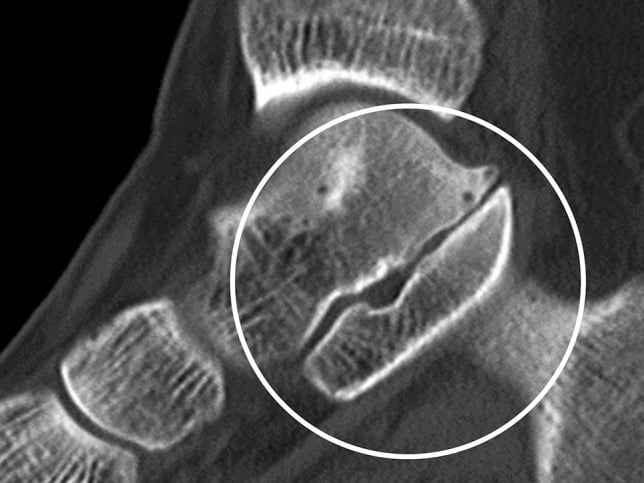
Rozansky CT classification of middle-facet TC coalition. A CT-based system that guides resectability. Higher types and larger facet involvement predict poorer resection outcomes.
- Type I: osseous (synostosis)
- Type II: non-osseous, downsloping sustentaculum, posterior facet parallel
- Type III: non-osseous, posterior facet not parallel (worse alignment)
- Type IV: posterior subtalar joint subluxation
Clinical Assessment
History. The adolescent complains of vague hindfoot or midfoot pain, worse with activity, of stiffness ("my foot doesn't move right") and of a progressive flatfoot. Recurrent ankle sprains are common because a rigid hindfoot cannot accommodate uneven ground, and they are how the diagnosis is missed: recurrent sprains in an adolescent with a flat foot should make you think of a coalition.
Examination. The foot is a rigid flatfoot (pes planus) with a valgus heel. Subtalar inversion and eversion are restricted, and the foot may be locked in valgus. Tenderness localises the bar:
- Sinus tarsi: CN coalition
- Medial malleolus and sustentaculum: TC coalition
The toe-raise test separates rigid from flexible. In a coalition the heel stays in valgus and does not invert as the patient rises onto the toes, which marks the flatfoot as rigid.
Investigations
Plain radiographs. Three views, each with a job:
- Lateral: the anteater nose (an elongated anterior process of the calcaneus) of a CN coalition, the C-sign of a TC coalition, and the talar beak
- Oblique: the best view for a CN coalition
- Harris axial: can show a TC coalition (middle-facet angulation)
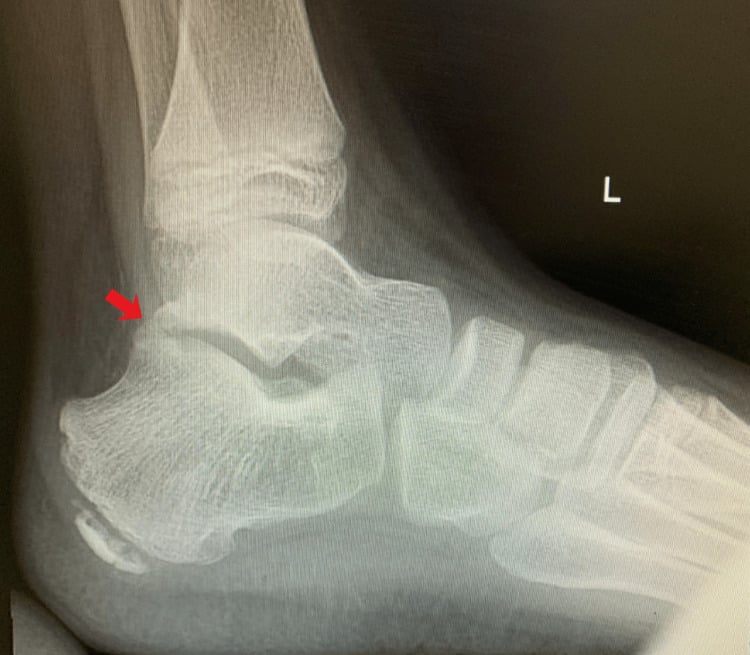
Indirect signs of a TC coalition. On plain film these are the prompt for cross-sectional imaging, not a replacement for it.
- What it is
- Continuous C-shaped line: medial talar dome curving into the inferior sustentaculum tali
- Why it occurs
- The enlarged sustentaculum is bridged to the talus, fusing the two outlines into one ring
- What it is
- The normal clear lucent line of the middle subtalar facet cannot be seen
- Why it occurs
- The facet is bridged/obliterated by the coalition, so its joint line disappears
- What it is
- Broad, rounded, dysplastic sustentaculum tali
- Why it occurs
- Altered load and failed segmentation remodel the sustentaculum
- What it is
- Dorsal beak on the talar head/neck
- Why it occurs
- Traction/periosteal response to abnormal motion or stress
- What it is
- Joint-space loss, sclerosis, talus abutting calcaneus
- Why it occurs
- Late degenerative change in long-standing or large coalitions
- What it is
- Rounded (domed) talar dome and tibial plafond
- Why it occurs
- Compensatory ankle motion develops to replace the stiff subtalar joint
Reading the signs. In a rigid adolescent flatfoot the absent middle-facet sign and the C-sign are the two that most reliably point to a TC coalition. The talar beak and posterior-facet changes are supportive but less specific. The beak is a reactive traction spur, not the coalition itself, and (per Wilde) it does not by itself contraindicate resection.
A middle-facet TC coalition is commonly non-osseous, so do not expect to "see the bar" on plain film. Hunt for the absent middle-facet sign and the C-sign first, then confirm and size the coalition on CT.
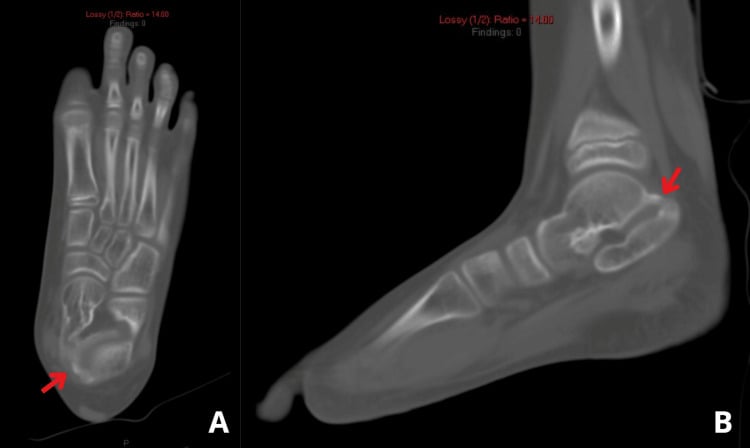
CT is the gold standard. It confirms the diagnosis and defines the location and extent of the bar. For a TC coalition it quantifies the percentage of facet involvement and the heel valgus, which is the resectability question, and it shows degenerative change and excludes a second (double) coalition.
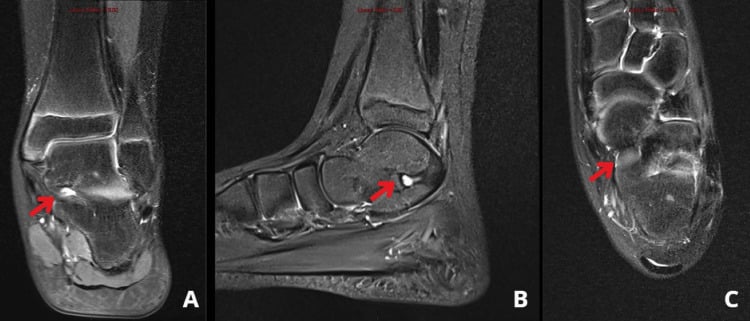
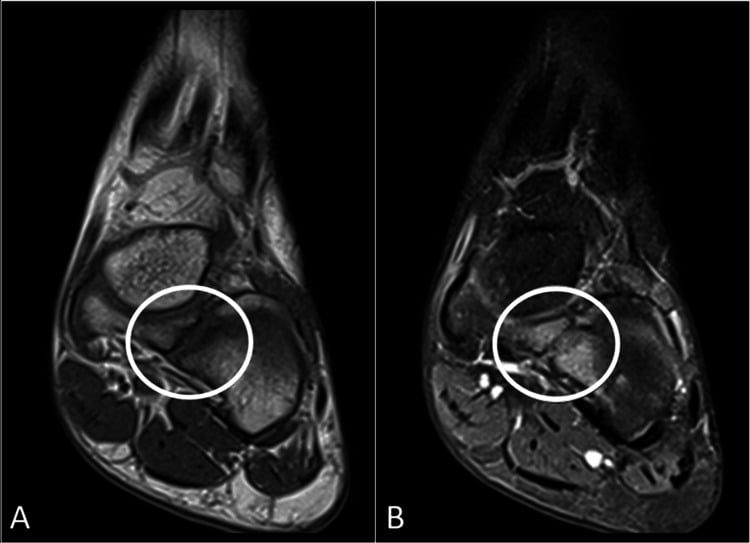
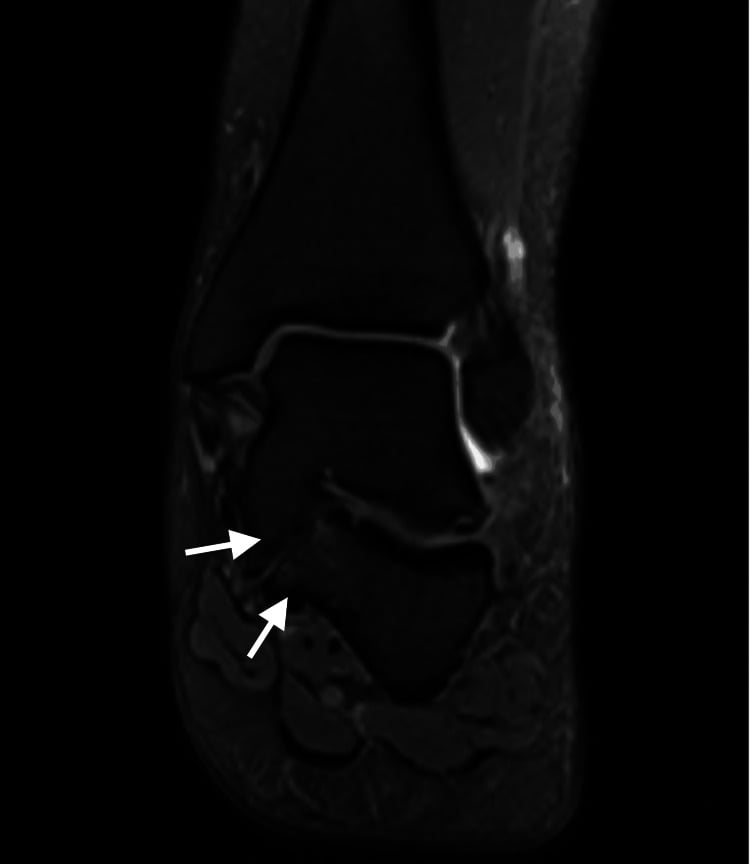
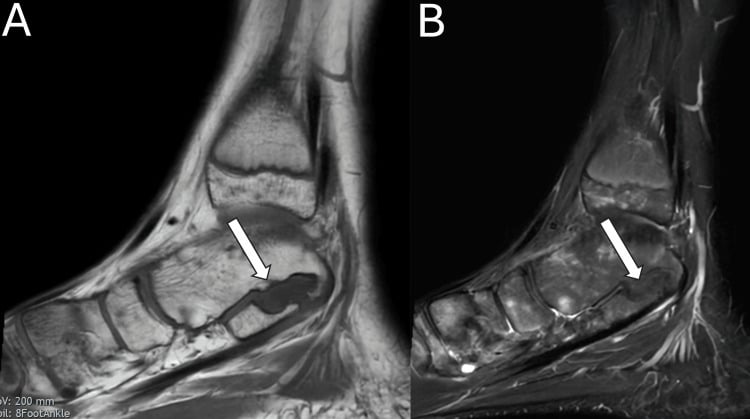
MRI is reserved for the purely fibrous or cartilaginous bar that CT cannot show as bone, when CT is negative but suspicion is high. It best distinguishes fibrous from cartilaginous tissue and shows stress response. A fibrous coalition retains a low-signal fibrous interface with surrounding reactive marrow signal, rather than continuous cortex and trabeculae.
Differential Diagnosis
The cardinal task is separating a rigid painful flatfoot (coalition) from the far more common flexible flatfoot and from other causes of a stiff adolescent hindfoot.
- Key Discriminator
- Onset 8-16 yr, recurrent sprains, heel stays valgus on toe-raise
- Subtalar Motion
- Reduced / absent
- Confirmatory Test
- CT (TC) or oblique X-ray (CN)
- Key Discriminator
- Arch reconstitutes on tiptoe / Jack test; usually painless
- Subtalar Motion
- Normal / supple
- Confirmatory Test
- Clinical (mobile, correctable)
- Key Discriminator
- Medial midfoot pain over navicular, painful single-heel-rise
- Subtalar Motion
- Often preserved
- Confirmatory Test
- X-ray accessory ossicle, MRI tendon
- Key Discriminator
- Morning stiffness, effusion, other joints, raised inflammatory markers
- Subtalar Motion
- Reduced (effusion/synovitis)
- Confirmatory Test
- MRI synovitis, serology
- Key Discriminator
- Focal bony tenderness, age-specific apophysis/ossific changes
- Subtalar Motion
- Usually preserved
- Confirmatory Test
- MRI / focal X-ray
- Key Discriminator
- Night pain, NSAID-responsive (osteoid osteoma), systemic signs
- Subtalar Motion
- Variable
- Confirmatory Test
- MRI / thin-slice CT / bloods
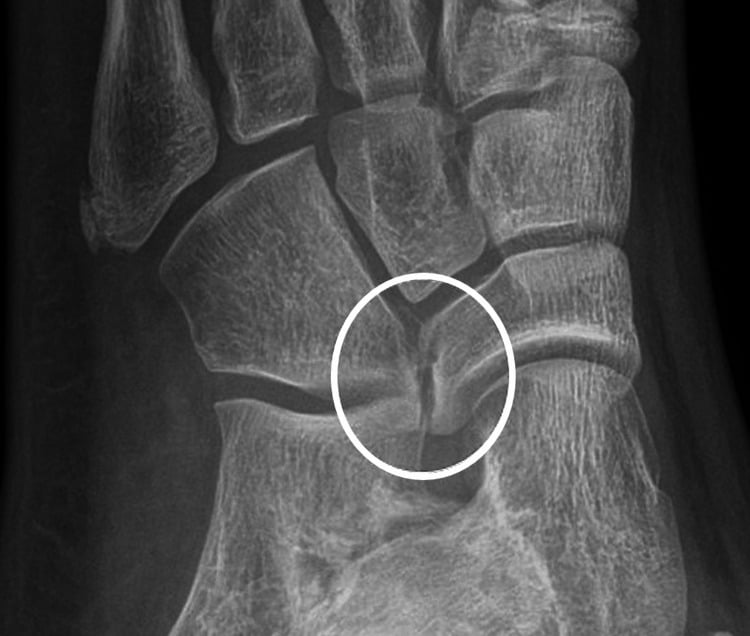
Mimics of a calcaneonavicular bar. Calcaneus secundarius, or an acute fracture of the anterior process, can be mistaken for a CN coalition. The ossicles of calcaneus secundarius are smooth and well corticated and sit beside the anterior calcaneal process without bony continuity.
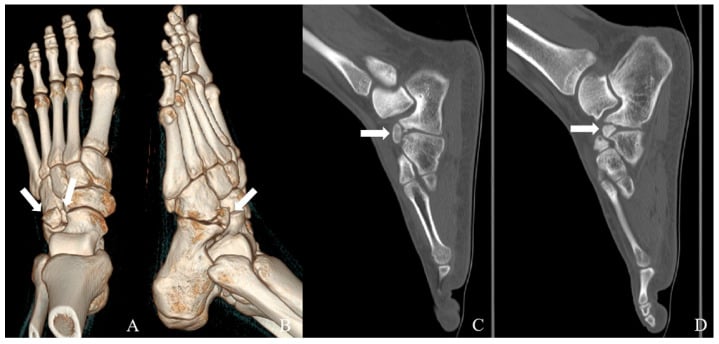
Rare coalitions. When symptoms and stiffness persist but the common CN and TC sites are normal, consider a rare coalition such as cubonavicular. Correlate an unusual radiographic bridge with CT or MRI before attributing symptoms to it.
Management Algorithm
Non-operative treatment first. A trial is indicated at initial presentation and for mild symptoms, and about 30% may resolve or become manageable without surgery.
- Activity modification: avoid uneven ground
- Immobilisation: a short leg walking cast for 3-6 weeks to settle inflammation
- Orthotics: a UCBL or medial arch support (rigid support)
Resection aims to restore motion and relieve pain. A CN coalition is resected and the gap filled with EDB muscle or a fat graft, with excellent results in about 80-90%. A TC coalition is resected at the middle facet with fat-graft interposition, and does well if the criteria are met:
- Less than 50% of the joint involved
- No arthrosis
- No severe heel valgus (greater than 16-20°)
Where the 50% comes from. Wilde measured coalition area on coronal CT as a proportion of the posterior facet, which is not how the figure is usually estimated today. The evidence card below explains why the threshold is best read as describing a phenotype (a small bar in a well-aligned foot without arthrosis) rather than as an independent cut-off.
Fusion is for the foot resection cannot help. Resecting a TC coalition that involves more than 50% of the facet gives a poor outcome, so fuse instead. The indications are:
- TC coalition with more than 50% involvement
- Severe valgus deformity
- Arthrosis
- Failed resection
Subtalar fusion is used when the problem is isolated, and triple arthrodesis when the adjacent joints are affected.
Hindfoot Valgus: Resect, Realign, or Fuse
Resection fixes the bar, not the heel. Excising the coalition restores motion and relieves pain, but it does not by itself correct a fixed hindfoot valgus. The flatter and more valgus the heel, the worse resection alone performs: Wilde's poor-outcome group all had heel valgus of more than 16°. The decision is therefore a three-way choice, driven by the deformity as much as by the size of the coalition.
- Operation
- Resection + interposition alone
- Rationale
- Motion restored; alignment acceptable, no correction needed
- Operation
- Resection + a deformity-correcting hindfoot osteotomy
- Rationale
- Realigns the heel so the resection is not loaded into valgus; preserves the joints
- Operation
- Arthrodesis (subtalar or triple)
- Rationale
- Fusion both removes the painful joint and corrects the alignment
Assess the deformity before choosing. Look at standing heel valgus and forefoot abduction (the "too many toes" sign), and at how much of it is flexible, correcting on tiptoe or on a Coleman block, and how much is fixed. Weight-bearing imaging supports the assessment and quantifies arch collapse and hindfoot alignment.
Adding an osteotomy. A correctable valgus accompanying a resectable bar is the classic indication for adding a realigning osteotomy, such as a lateral column lengthening or a medialising calcaneal osteotomy, at the time of resection. Whether to do it at the index resection or stage it remains debated. The technique and indications of these osteotomies belong to the flatfoot topics; for a coalition, the point is that significant valgus must be addressed, not ignored.
Surgical Technique
CN Coalition Resection
- Ollier's incision, lateral and oblique over the sinus tarsi.
- Identify the EDB muscle belly and reflect it.
- Identify the bar from calcaneus to navicular and excise a generous rectangular block, 1 cm minimum, to prevent regrowth.
- Check that the navicular and calcaneal surfaces are clear, and check motion.
- Interpose the EDB origin, sewn into the defect and anchored to deep tissue or the plantar aspect.
- Cast for 2 weeks, then early range of motion.
Before the graft goes in. Fat interposition fills the resection gap and separates the raw bone surfaces to reduce re-ossification. Confirm that the resection is wide enough and complete before inserting it, because incomplete visualisation and residual bar are major causes of persistent stiffness.
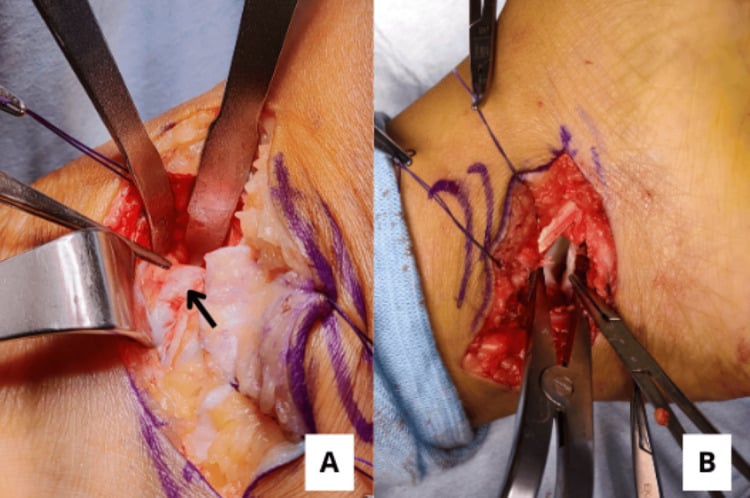
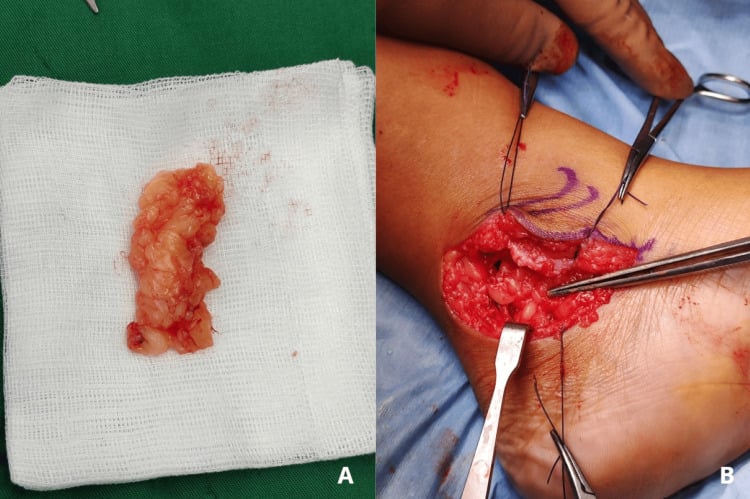
The shingled coalition. Here the sustentaculum overlaps and fuses to the talus. Recognising this morphology changes the resection, because uncontrolled excision risks deltoid injury and loss of sustentacular support. The sustentacular fragment can be osteotomised under fluoroscopic control and fixed back, preserving the deltoid attachment and medial support.
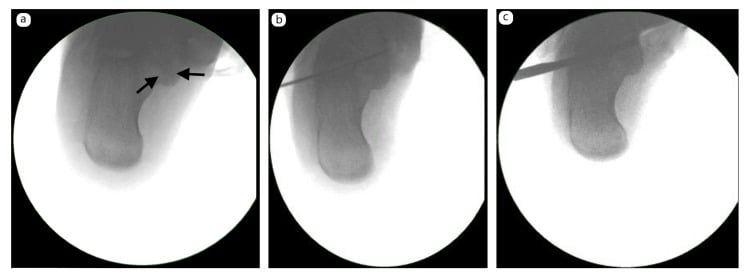
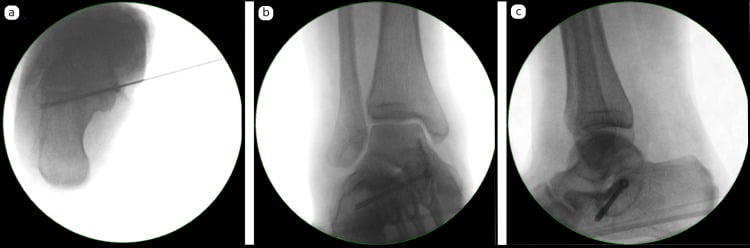
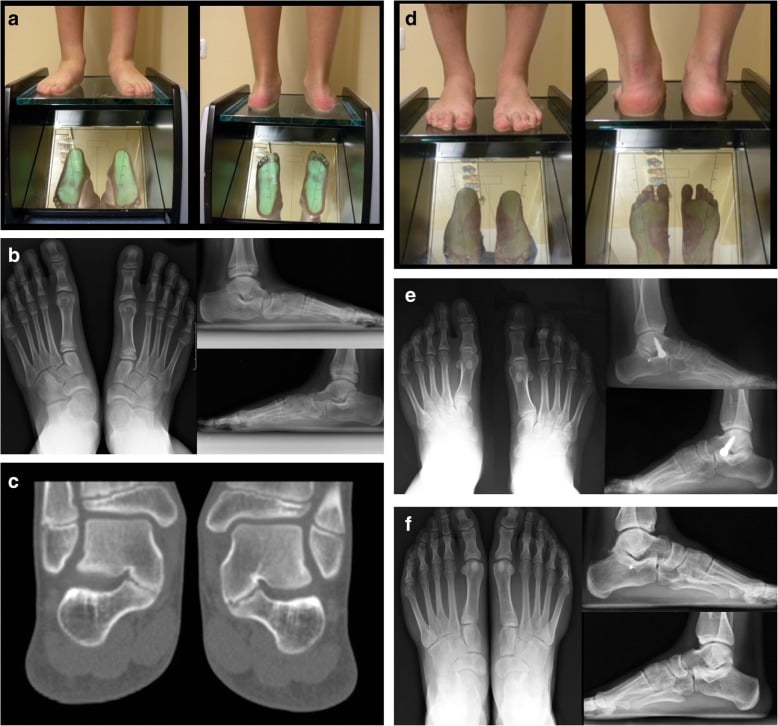
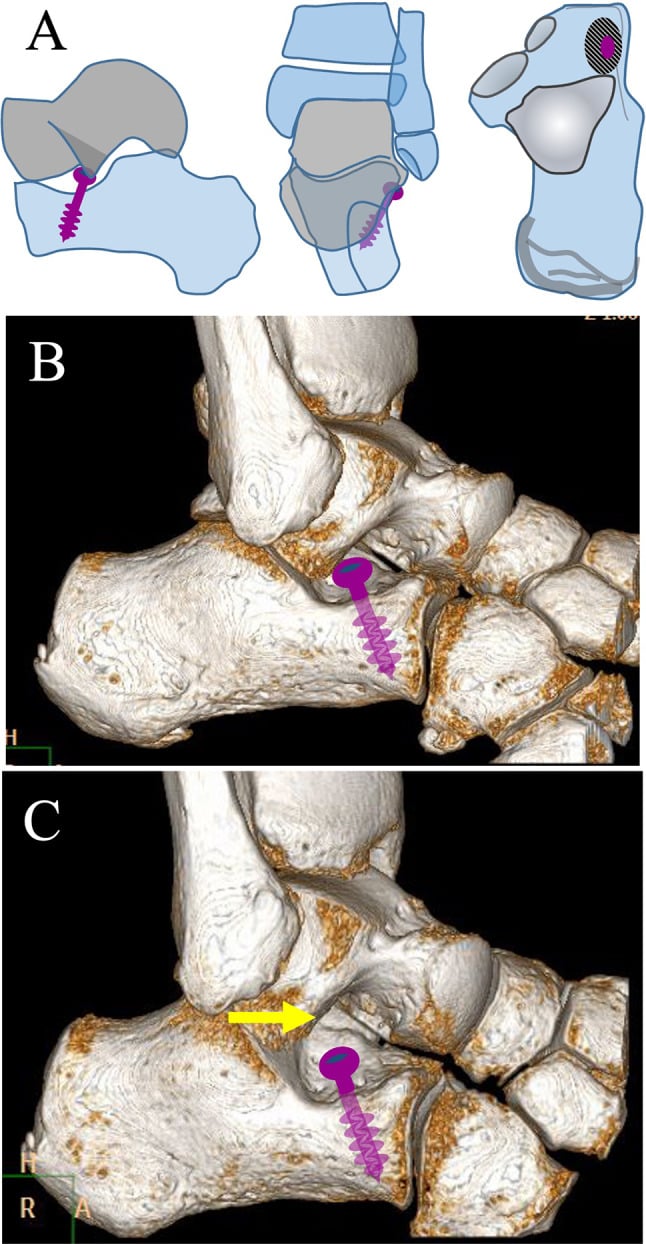
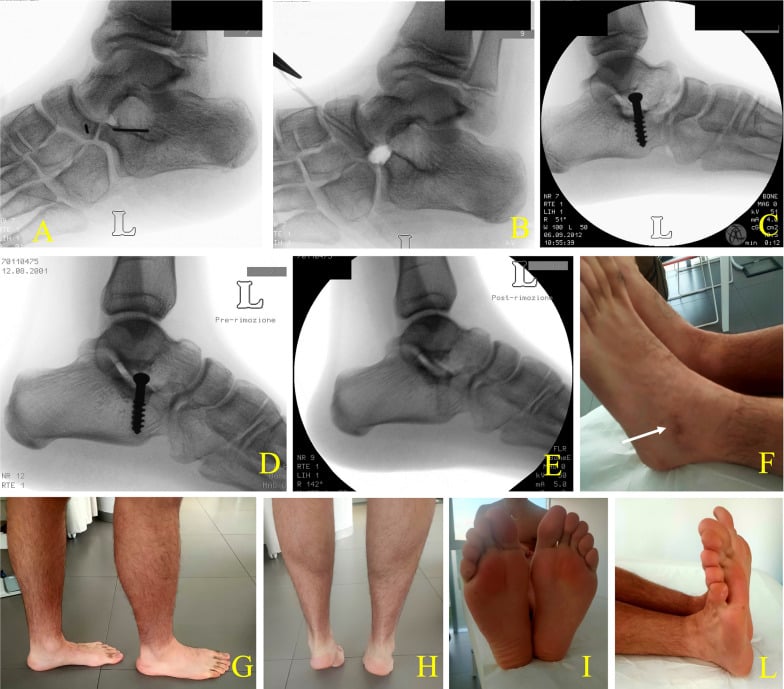
Resection with realignment. When valgus remains structural after resection, the procedures can be combined, adding an extra-articular calcaneal screw to the resection. The medial resection and lateral screw use separate limited incisions, and the extra-articular screw corrects the associated valgus. In the cases illustrated below, correction was maintained until planned screw removal, and in the calcaneonavicular case follow-up showed restoration of the arch and recovered hindfoot motion.
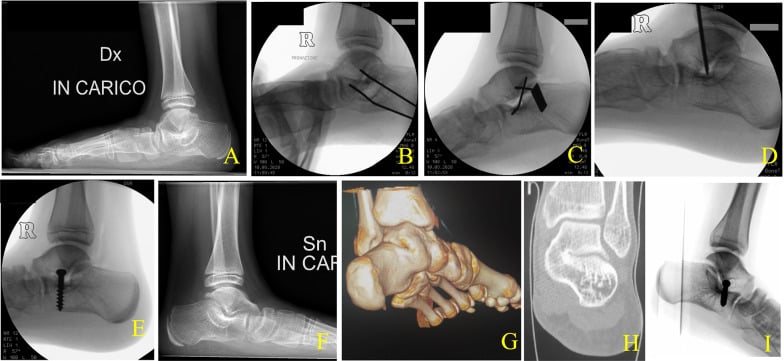
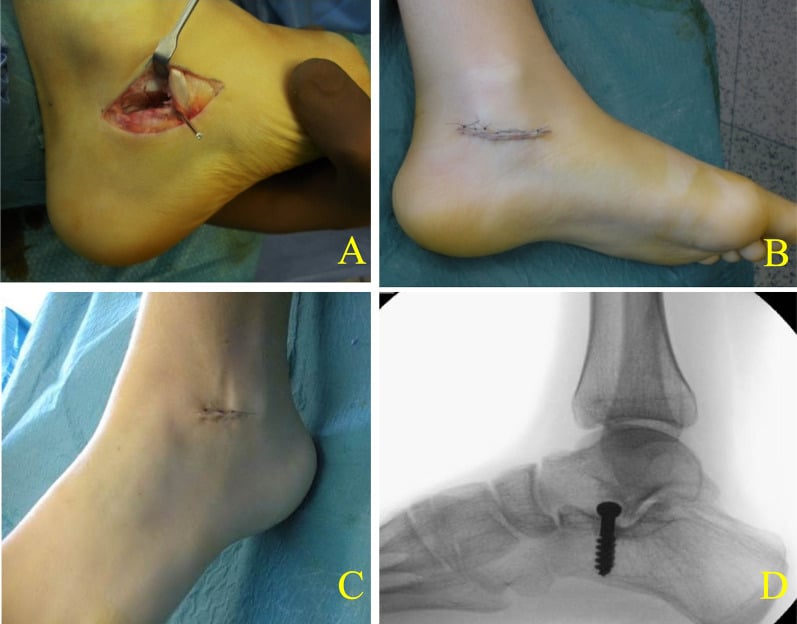
Complications
- Cause
- Inadequate resection (greater than 50% remaining)
- Prevention
- Resect greater than 1cm block, Interposition (EDB/Fat)
- Cause
- Degenerative changes, Missed double coalition
- Prevention
- Pre-op CT, Triple Fusion if arthrosis
- Cause
- Lateral approach incision
- Prevention
- Identify nerve, careful retraction
- Cause
- Medial approach tension
- Prevention
- Gentle retraction
Complications of non-treatment are progressive valgus deformity, contracture and shortening of the peroneal tendons, and arthritis of the subtalar and talonavicular joints.
Postoperative Care
The repair is protected in a splint or cast at first, and range of motion and strength are then built up gradually as healing progresses. Progression of weight bearing depends on the stability of fixation and on healing.
Outcomes
CN resection is usually very successful, relieving pain and improving motion. TC resection depends on size, with involvement under 50%; above that, consider primary fusion. Bone can regrow, and interposition material helps to prevent this.
Imaging after resection. Follow-up imaging is reserved for persistent symptoms or concern about incomplete resection or recoalition.
Guidelines, Registries & Global Practice
Global epidemiology
- Population prevalence is classically quoted as under 1%, but cadaveric and CT studies suggest the true figure may approach 1-13%, with many coalitions remaining asymptomatic. CN and TC together account for over 90% of cases; bilateral in roughly 50%.
- Slight male predominance; autosomal-dominant inheritance with variable penetrance.
Society guidance — practical points (no dedicated coalition guideline exists)
- Imaging emphasis
- Weight-bearing X-rays first; CT to map TC extent, MRI for fibrous/cartilaginous bars
- Treatment stance
- Non-op trial, then joint-preserving resection; fusion as salvage
- Imaging emphasis
- Oblique view for CN, CT for TC sizing
- Treatment stance
- Same staged approach; emphasis on realistic counselling re: stiffness
- Imaging emphasis
- CT and increasingly MRI to characterise tissue type and arthritis
- Treatment stance
- Growing interest in arthroscopic/endoscopic resection
- Imaging emphasis
- CT remains the reference standard for resectability decisions
- Treatment stance
- Resect when criteria met; preserve motion where possible
Registry note: There is no national registry specific to tarsal coalition; outcome data come from single-centre series and the Garg 2023 systematic review rather than arthroplasty-style registries.
High- vs limited-resource practice
- Where CT/MRI is freely available, the resect-vs-fuse decision is CT-driven. In limited-resource settings the diagnosis often rests on plain radiographs (oblique for CN, Harris axial and lateral C-sign for TC) plus clinical examination, and management leans on prolonged casting/orthoses with surgery reserved for refractory cases.
- Terminology: Historically "peroneal spastic flatfoot"; "rigid (painful) flatfoot" is preferred, as the peroneal tightness is contracture, not spasticity.
Related pages: Rigid Flatfoot is the presentation this condition causes and the page that sets out the wider differential, and Flexible Flatfoot is what must be excluded first - the distinction is made by whether the arch reconstitutes on tiptoe or with the Jack test, and a rigid hindfoot in an adolescent is a coalition until proven otherwise; Subtalar Arthritis is what an unresected or failed talocalcaneal coalition becomes, and it carries the fusion decision this page's salvage section refers to - note that its own evidence base shows the sustentaculum is not the reliable landmark it is assumed to be; Talonavicular Arthritis for the other joint of the transverse tarsal complex, and for the Astion finding that fusing it abolishes motion at the remaining hindfoot joints, which is why a talonavicular-sparing fusion matters here; Sinus Tarsi Syndrome for the lateral hindfoot pain that mimics an impinging coalition; Accessory Navicular is the other developmental ossicle causing a painful adolescent flatfoot, on the medial rather than the lateral side; Congenital Vertical Talus for the rigid flatfoot presenting in infancy rather than adolescence; Adult Flatfoot Deformity for the acquired deformity that a longstanding coalition can be mistaken for in the older patient; Calcaneal Fractures for the post-traumatic route to the same stiff, valgus hindfoot; and Juvenile Idiopathic Arthritis for the inflammatory cause of a painful stiff foot in the same age group, which imaging will not distinguish without the history.
Controversies & Areas of Uncertainty
- Resection thresholds for TC: The classic 50% facet / 16-degree valgus cut-offs (Wilde) are widely taught, but Luhmann & Schoenecker reported good outcomes in some feet exceeding these limits and argued the CT criteria should guide counselling, not absolute operative choice. There is no level-I evidence defining a hard cut-off.
- Best interposition material: EDB, fat graft, bone wax and vascularised adipofascial flaps have all been used. Fat-graft and EDB give comparable results; any interposition appears better than none for reducing reossification, but no randomised comparison exists.
- Arthroscopic / endoscopic resection: Posterior arthroscopic TC resection (Knörr) and endoscopic CN resection are emerging, with good early series and complete resection without recurrence — but follow-up is short and the technique demanding.
- Concomitant deformity correction: Whether to add a calcaneal lengthening / medialising osteotomy for marked hindfoot valgus at the time of resection (rather than relying on resection alone) is debated.
- Fusion vs joint-preservation in large/arthritic TC: When resection is unsuitable, subtalar versus triple arthrodesis (and timing in the growing foot) remains individualised.
MCQ Practice Points
Q: Which coalition presents earlier? A: Calcaneonavicular (8-12 years). Talocalcaneal presents later (12-16 years).
Q: What is the 'Anteater Nose' sign? A: Elongation of the anterior process of the calcaneus, seen on lateral X-ray, indicated Calcaneonavicular coalition.
Q: What does the C-Sign indicate? A: Talocalcaneal coalition. A continuous C-shaped line formed by the medial outline of the talar dome and inferior outline of the sustentaculum tali on lateral X-ray.
Q: What is the size cutoff for resecting a TC coalition? A: 50%. If over 50% of the facet is involved, resection has poor outcomes. Fusion is preferred.
Q: What happens to the heel during a toe raise test in tarsal coalition? A: The heel stays in Valgus (does NOT invert). This indicates a RIGID flatfoot. (In flexible flatfoot, the heel inverts).
Clinical Decision Scenarios
Practise clinical reasoning and management decisions out loud
“What is the diagnosis and workup?”
“Can you resect this?”
“What do you advise, and what is the evidence for non-operative care?”
Key Features
- Rigid Flatfoot
- Age 8-16 (Ossification)
- Bilateral 50%
- Recurrent Sprains
CN Coalition
- 8-12 years
- Anteater Nose
- Oblique View
- Resection Excellent
TC Coalition
- 12-16 years
- C-Sign
- CT Essential
- Less than 50% to Resect
Management
- Cast 4-6wks first
- Resect CN + EDB
- Resect TC (Small)
- Fuse TC (Large)
Evidence Base
The 50% Rule for TC Resection
- 20 feet (17 patients under 16 yr) with symptomatic TC coalition treated by bar resection.
- Excellent/good results in the 10 feet where coronal CT showed coalition area 50% or less of the posterior facet, with heel valgus under 16 degrees and no arthritis.
- Fair/poor results in the 10 feet where coalition exceeded 50% of the posterior facet (heel valgus over 16 degrees, joint narrowing, lateral talar impingement).
- Talar beaking present in 70% but did not impair outcome.
Anteater-Nose Sign (CN)
- Anterior tubular prolongation of the superior calcaneus ('anteater nose') approaching/overlapping the navicular on the lateral film.
- Present in all 30 feet with calcaneonavicular bar but in none of 125 control feet (second-decade children).