TGCT | PVNS | GCT-TS | CSF1-Driven Neoplasm | Synovial Proliferation
- TGCT is a neoplasm driven by CSF1 overexpression (not an inflammatory condition)
- Localised type (formerly GCT of tendon sheath): firm digital nodule, low recurrence after excision
- Diffuse type (formerly PVNS): infiltrative synovial proliferation of large joints, high recurrence
- MRI shows low T1 and low T2 signal due to haemosiderin, with blooming artefact on gradient echo
- Pexidartinib is a CSF1R tyrosine-kinase inhibitor approved for symptomatic diffuse TGCT not amenable to surgery
- “TGCT = most common synovial tumour of the hand (localised type)
- “Haemosiderin blooming on gradient-echo MRI is virtually pathognomonic
- “CSF1 overexpression recruits CSF1R-positive macrophages (ligand-receptor mechanism)
- “Diffuse PVNS of the knee: anterior then posterior synovectomy for complete clearance
Overview and Epidemiology
Tenosynovial giant cell tumour (TGCT) is the most common synovial neoplasm. It is a true neoplasm driven by CSF1 overexpression, not an inflammatory or reactive process, and its localised and diffuse types behave very differently and must be distinguished. It bridges pathology (a translocation and haemosiderin-laden macrophages), imaging (the blooming artefact on MRI) and treatment (surgery versus targeted therapy), and pexidartinib, targeted therapy against the CSF1R pathway, has shifted how diffuse disease is treated.
Terminology. TGCT is the unified WHO term. It replaces giant cell tumour of tendon sheath (GCT-TS) for the localised type and pigmented villonodular synovitis (PVNS) for the diffuse type. Pathologists now regard "pigmented villonodular synovitis" as obsolete nomenclature, though clinicians still use it.
Who gets it. The incidence is approximately 10 per million person-years, with the diffuse type rarer at 1-2 per million. The peak is at 30-50 years, with a slight female predominance for the diffuse type.
- Localised type - the most common soft-tissue tumour of the hand after ganglion cyst, most common in the fingers, with the index and middle most frequent
- Diffuse type - the knee (approximately 80%), hip, ankle, shoulder and elbow
What it does. The diffuse type causes chronic, progressive pain and joint effusion, and recurrent haemarthrosis is the hallmark of diffuse intra-articular disease.
Left untreated. Prostaglandins and metalloproteinases cause bone erosion and joint damage, so untreated disease goes on to secondary osteoarthritis, with limited range of motion and mechanical symptoms along the way. After treatment, recurrence is the dominant clinical challenge in diffuse disease.
Pathophysiology
The driver. A chromosomal translocation, most commonly t(1;2)(p13;q35), fuses CSF1 to COL6A3 and places the CSF1 (colony-stimulating factor 1) gene under the control of the COL6A3 promoter, so CSF1 is overexpressed constitutively. The translocation is present in approximately 70% of cases; trisomy 5 and trisomy 7 are found in some cases instead.
A minority drives the majority. Only 2-15% of the cells carry the translocation. These neoplastic cells secrete abundant CSF1, which recruits CSF1R-expressing monocytes and macrophages by a paracrine ligand-receptor mechanism, and the recruited cells make up the vast majority of the tumour mass, often more than 90%. They differentiate into the multinucleated giant cells, haemosiderin-laden macrophages and foam cells that characterise the histology.
The drug target. Pexidartinib blocks the CSF1R tyrosine kinase and so halts the recruitment cascade. The paracrine recruitment model is the molecular rationale for pexidartinib and the other CSF1R inhibitors.
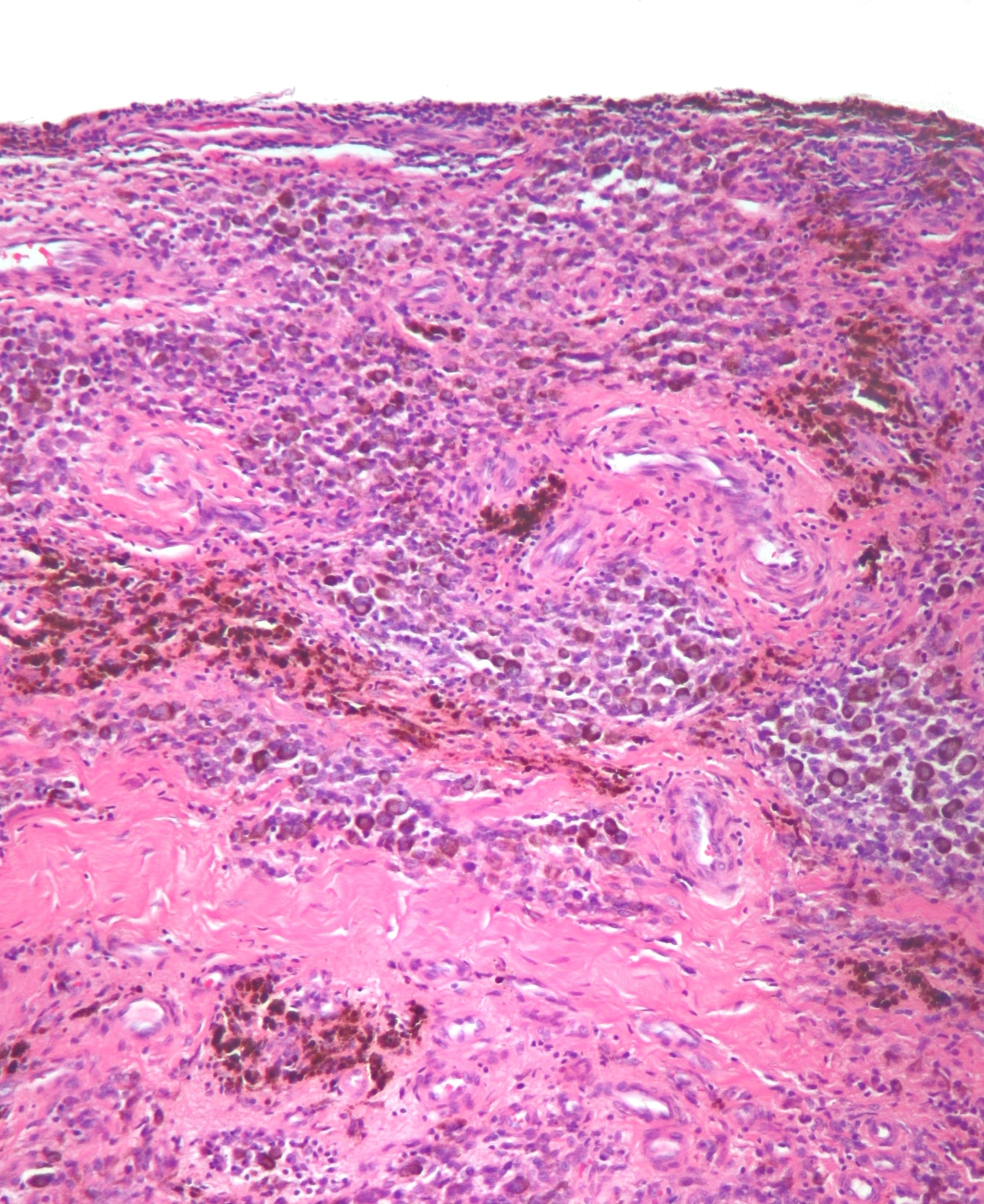
Histology. Three cell populations, in varying proportion with foam (xanthoma) cells, inflammatory cells and fibrosis:
- Mononuclear stromal cells with round to oval nuclei, among which lie the neoplastic cells; immunohistochemistry separates them from the recruited histiocytes (see Investigations)
- Osteoclast-like multinucleated giant cells, scattered, with 5-50 nuclei per cell
- Haemosiderin-laden macrophages, dark brown pigment that is Prussian blue positive
- Localised (GCT-TS)
- Well-circumscribed, encapsulated nodule
- Diffuse (PVNS)
- Infiltrative, sheet-like synovial proliferation
- Localised (GCT-TS)
- Tendon sheath of digits (hand and foot)
- Diffuse (PVNS)
- Large joint synovium (knee, hip, ankle)
- Localised (GCT-TS)
- Focal, discrete attachment
- Diffuse (PVNS)
- Diffuse, villonodular, entire joint
- Localised (GCT-TS)
- Rare (pressure remodelling if large)
- Diffuse (PVNS)
- Common — subchondral cysts and erosions
- Localised (GCT-TS)
- Present but focal
- Diffuse (PVNS)
- Abundant — gives brownish discoloration
Classification and Types
The WHO 2020 classification recognises localised and diffuse TGCT, and diffuse disease is further divided into intra-articular and extra-articular patterns. Imaging is critical for telling them apart and for planning the surgical approach.
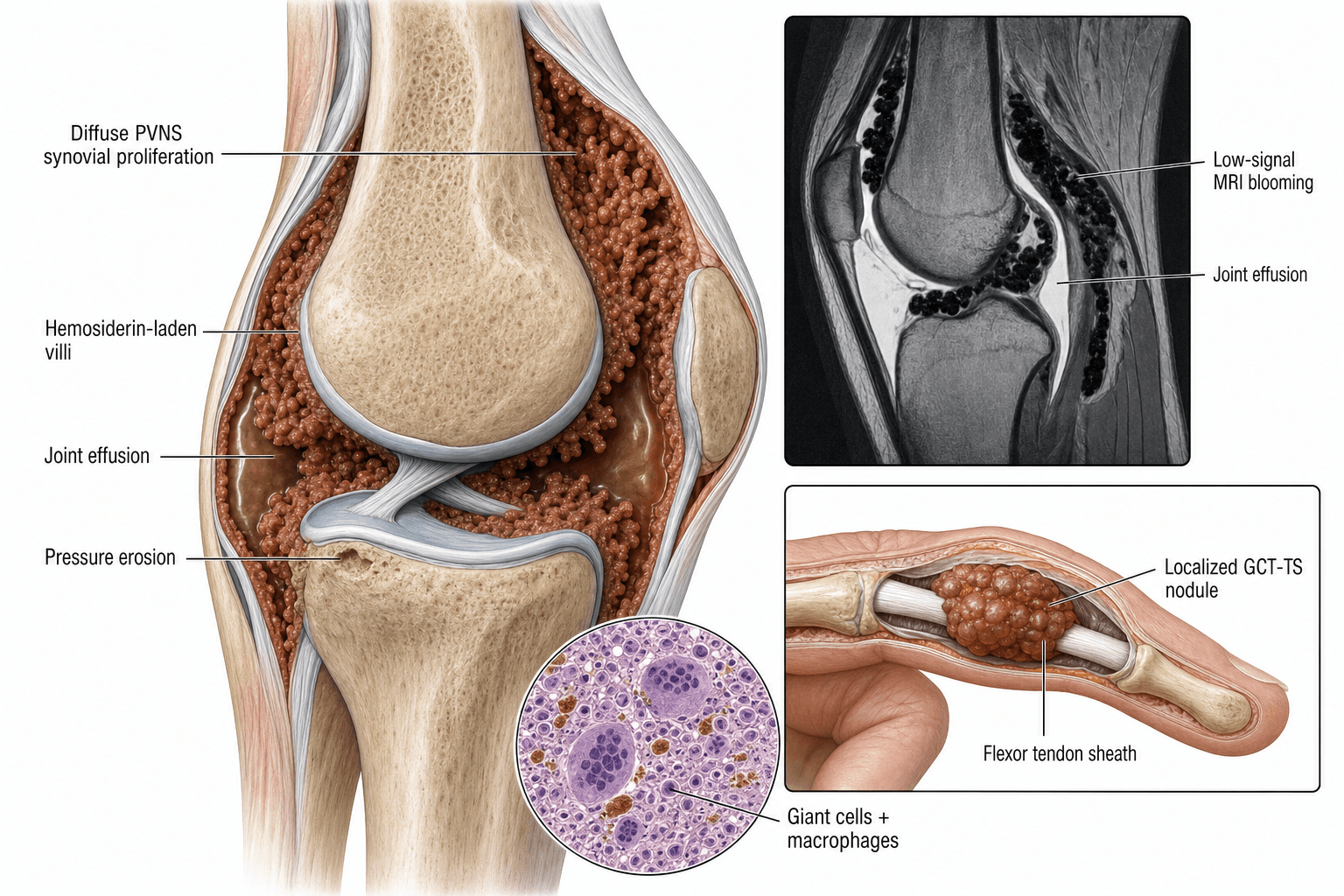
Localised TGCT (formerly giant cell tumour of tendon sheath). A well-circumscribed nodule attached to a tendon sheath, most frequently on the volar surface of the index and middle fingers, usually 1-3 cm across. Recurrence after excision is much lower than for the diffuse type.
Diffuse TGCT (formerly PVNS). An infiltrative neoplasm of large-joint synovium, with villous and nodular proliferation, brownish haemosiderin discolouration and high recurrence rates. It may be intra-articular, or extend outside the joint.
Extra-articular TGCT. Disease that extends beyond the joint capsule, or arises primarily in the bursae and tendon sheaths of large joints. It may extend into popliteal cysts, the calf or the thigh, requires wider excision, and is the most challenging subgroup for surgical clearance.
- Intra-articular
- Yes
- Extra-articular
- No — breaches capsule
- Intra-articular
- Arthroscopic synovectomy
- Extra-articular
- Open excision, may need combined approaches
- Intra-articular
- 20-40 percent
- Extra-articular
- 30-50 percent or higher
- Intra-articular
- Symptomatic, unresectable cases
- Extra-articular
- Often first-line when complete excision impossible
Clinical Assessment
The localised lesion. Months to years of slow growth of a firm, non-tender nodule on the volar surface of a digit. It is usually painless or minimally painful, occasionally causes mild discomfort on flexion, may cause clicking or limited flexion if large, and rarely compresses a nerve. Ask about previous excisions, because the nodule may be a recurrence.
Examining the nodule. It is firm, fixed to deep tissues and does not transilluminate, and the skin is freely mobile over it. The key clinical distinction is from a ganglion cyst, which transilluminates and is fluctuant, and from a foreign-body granuloma, which follows a penetrating injury.
The diffuse lesion. An insidious onset over months to years of progressive, aching joint pain, recurrent effusions and limited range of motion, with mechanical symptoms of locking, catching and giving way. Aspiration gives brownish or blood-stained fluid, negative for crystals and organisms. Ask about previous synovectomy, since recurrence is common.
Recurrent unexplained haemarthrosis in a young-to-middle-aged adult with no trauma history must raise suspicion for diffuse TGCT until proven otherwise. The triad of chronic joint swelling, bloody aspiration, and absence of trauma or coagulopathy warrants urgent MRI with gradient-echo sequences.
- Joint Fluid
- Brown / blood-stained
- MRI Signal
- Low T1 + low T2 + blooming
- Key Discriminator
- Diffuse synovial thickening with haemosiderin
- Joint Fluid
- Not usually aspirated
- MRI Signal
- Circumscribed low-T2 nodule
- Key Discriminator
- Well-defined mass on tendon sheath, no joint involvement
- Joint Fluid
- Clear or slightly blood-stained
- MRI Signal
- Multiple loose bodies (calcified rings)
- Key Discriminator
- Radiodense loose bodies on X-ray; T2 bright cartilage nodules
- Joint Fluid
- Variable
- MRI Signal
- Heterogeneous, often near joint but extra-articular
- Key Discriminator
- Aggressive features, calcifications, distant from joint line
- Joint Fluid
- Frank blood
- MRI Signal
- Low T2 haemosiderin but pan-articular destruction
- Key Discriminator
- History of bleeding disorder, multiple joints affected
- Joint Fluid
- Negatively birefringent crystals
- MRI Signal
- Low T2 but no blooming artefact
- Key Discriminator
- Serum urate, clinical gout history, no haemosiderin
- Joint Fluid
- Straw-coloured
- MRI Signal
- Low T2 but no blooming
- Key Discriminator
- Systemic amyloidosis, bilateral, periarticular deposition
Both produce haemosiderin-laden synovium with low T2 signal, and the blooming artefact is present in both; what differs is the distribution and clinical context: haemophiliac arthropathy affects multiple joints in a patient with a known bleeding disorder and shows pan-articular destruction rather than focal villonodular masses, whereas TGCT is monoarticular without a coagulopathy history.
Investigations
Radiographs. AP and lateral views of the affected joint, with dedicated views for digits. The localised type usually gives a normal film, but may show a soft-tissue density or pressure remodelling of the adjacent bone.
The diffuse type on the film. Diffuse disease shows periarticular soft-tissue swelling and lucency, subchondral cysts and bone erosions with sclerotic margins, with the joint space preserved early and narrowing late in advanced disease. Look for the absence of calcification, which distinguishes TGCT from synovial chondromatosis and synovial sarcoma.
MRI is the gold standard and the essential investigation, with T1, T2, fat-saturated T2, proton density and gradient-echo (GRE) sequences.
The signal. The thickened, nodular synovial proliferation shows on all sequences, and the hallmark is low signal on both T1 and T2, from haemosiderin deposited in the proliferative synovium: haemosiderin-laden fibrous synovium is low on T1, and haemosiderin and fibrosis make it dark on T2, which distinguishes it from most synovial tumours. The dominant haemosiderin effect is T2* susceptibility, not T1 shortening.
The blooming artefact. On GRE sequences the magnetic susceptibility of haemosiderin produces dramatic signal loss that makes the deposits look larger and darker than on spin-echo sequences. This blooming is virtually pathognomonic for TGCT, although haemophiliac arthropathy shows it too. Amyloid arthropathy and gouty tophi also produce a low-T2 synovial mass, but they do not bloom.
Reading the scan. A localised lesion is a well-circumscribed nodule adjacent to the tendon sheath, low on T2, with homogeneous enhancement. Diffuse disease is extensive, infiltrative, villonodular synovial thickening, low on T2 with blooming, with a joint effusion and bone erosions. Before surgery, stage the extent: the anterior and posterior compartments, extra-articular extension and popliteal involvement.
Gradient-echo MRI is the critical sequence for TGCT. Blooming is absent on standard spin-echo T1 and T2, so if you suspect TGCT and the MRI protocol does not include GRE, request it specifically. The blooming artefact is the imaging equivalent of Prussian blue staining on histology — it proves haemosiderin is present.
Biopsy is kept for the case that does not fit, by core needle under imaging guidance or arthroscopically. Histology is required before systemic therapy, to confirm the diagnosis and exclude synovial sarcoma. Indications:
- Atypical presentation
- Rapid growth
- Concern for sarcoma
- Before starting pexidartinib
A common viva follow-up is "how does the pathologist confirm it, and how is it told apart from giant cell tumour of bone or a sarcoma?" The key is to separate the two cell populations:
- The neoplastic large mononuclear (dendritic-like) cells carry the CSF1 rearrangement and are the diagnostic population. They are typically desmin positive (a dendritic-cell pattern, not smooth-muscle) and clusterin positive; a subset express CD163/CD68. CSF1 over-expression can be shown by in-situ hybridisation, and CSF1 rearrangement by FISH in difficult cases.
- The recruited reactive cells (the bulk) are small mononuclear histiocytes and osteoclast-like multinucleated giant cells that are CD68 / CD163 positive (macrophage markers), plus haemosiderin-laden macrophages (Prussian blue positive) and foam (xanthoma) cells.
- Telling it apart. From giant cell tumour of bone, the giant cells look identical, but GCT of bone is centred in epiphyseal bone and carries the H3F3A G34W mutation, not a CSF1 rearrangement. From synovial sarcoma: monophasic spindle cells, SS18-SSX / t(X;18), TLE1 positive. And benign TGCT lacks the marked atypia, atypical mitoses and necrosis of a malignant lesion.
Management Algorithm
The principle. Localised TGCT is treated by marginal excision and has a low recurrence rate. Diffuse TGCT needs a complete synovectomy and has a high one, 20-50%.
Where pexidartinib fits. Pexidartinib is for symptomatic diffuse TGCT where surgery is not feasible or has failed, reserved for diffuse disease in which the risk-benefit ratio of further surgery is unfavourable. It is not indicated for localised TGCT, where surgery is curative with low recurrence.
- Diagnosis
- Localised TGCT (GCT-TS), MRI confirm
- Treatment
- Marginal excision
- Key Pearl
- Most common synovial tumour of the hand
- Diagnosis
- Diffuse TGCT (PVNS), MRI blooming artefact
- Treatment
- Combined anterior + posterior synovectomy
- Key Pearl
- High recurrence — counsel patient preoperatively
- Diagnosis
- Biopsy confirmation, CSF1R staining
- Treatment
- Pexidartinib (CSF1R inhibitor)
- Key Pearl
- Scheduled LFT monitoring (REMS); hepatotoxicity black-box warning
The goal of marginal excision is complete removal with preservation of the surrounding structures: the neurovascular bundles, tendons and joint capsule.
Before surgery. MRI delineates the extent and the relationship to the tendons and neurovascular bundles. Counsel about a 5-15% recurrence rate and the transient stiffness to be expected, with physiotherapy afterwards. Palpate and mark the nodule pre-operatively, because it may be difficult to find under anaesthesia.
The excision.
- Extensile zigzag (Bruner) or mid-lateral incision over the nodule
- Identify and protect the neurovascular bundles, expose the tendon sheath, and dissect circumferentially around the mass
- Remove the nodule with a thin rim of attached tendon sheath (marginal excision)
- Send the entire specimen for histology, to confirm the diagnosis and exclude sarcoma
After surgery (weeks 0-4). A splint for 3-5 days, then early active mobilisation, with tendon gliding exercises, scar massage and a gradual return to full activity. Check the wound at 2 weeks and review the histology, then assess for recurrence at 3 and 12 months.
If it recurs. Repeat marginal excision is standard for a localised recurrence, with the histology re-examined to make sure the diagnosis is correct and there are no atypical features. Adjuvant treatment is not routinely indicated for the localised type.
The most common site for recurrence after localised TGCT excision is the original surgical bed, usually due to incomplete excision or satellite nodules missed at the index procedure. Meticulous circumferential dissection with a thin cuff of normal tendon sheath minimises recurrence without sacrificing tendon function.
Complications
Recurrence, with its rates by type and approach, is set out under Management and Outcomes. The other complications:
- Incidence
- Common in long-standing diffuse TGCT
- Risk Factors
- Chronic bone erosion, delayed diagnosis
- Management
- Joint replacement if end-stage (counselling for recurrence risk)
- Incidence
- Common after extensive synovectomy
- Risk Factors
- Multiple procedures, prolonged immobilisation
- Management
- Early ROM, CPM, intensive physiotherapy
- Incidence
- Less than 5 percent (digit excisions)
- Risk Factors
- Recurrent surgery with scarred anatomy
- Management
- Meticulous dissection, identify structures early
- Incidence
- Elevated LFTs in approximately 10-15 percent
- Risk Factors
- Pre-existing liver disease, concurrent hepatotoxins
- Management
- LFT monitoring, dose reduction or discontinuation
The most significant long-term complication of diffuse TGCT is progressive joint destruction from bone erosions and secondary osteoarthritis. This is preventable with early diagnosis and appropriate management. Delayed diagnosis is common — the mean time from symptom onset to TGCT diagnosis is approximately 2-4 years for diffuse disease. A high index of suspicion for any chronic monoarticular haemarthrosis with bloody aspirate is essential.
Outcomes and Prognosis
- Treatment
- Marginal excision
- Recurrence Rate
- 5-15 percent
- Long-term Function
- Excellent — normal hand function in majority
- Treatment
- Combined synovectomy
- Recurrence Rate
- 20-30 percent
- Long-term Function
- Good to fair — some residual stiffness common
- Treatment
- Arthroscopic anterior synovectomy
- Recurrence Rate
- 40-50 percent
- Long-term Function
- Fair — high recurrence, often needs revision
- Treatment
- Pexidartinib
- Recurrence Rate
- N/A (suppression, not cure)
- Long-term Function
- Good symptom control while on treatment; tumour regrows if stopped, though the regrowth rate off treatment is not well quantified
- Treatment
- Joint replacement after tumour control
- Recurrence Rate
- Recurrence around prosthesis possible
- Long-term Function
- Variable — functional improvement, monitor for recurrence
Prognostic factors. The best prognosis goes with the localised type, a first-time excision, complete margins and a digit location. A poor prognosis goes with the diffuse type, extra-articular extension, multiple prior recurrences, and a hip or ankle location, which is harder to access for complete synovectomy.
Local, not distant. Conventional TGCT does not metastasise; it is a locally aggressive neoplasm. Its morbidity comes from local destruction, functional impairment and the morbidity of repeated surgical interventions.
A complete answer must acknowledge the rare malignant tenosynovial giant cell tumour (malignant diffuse-type giant cell tumour) - because it behaves like a sarcoma and the over-simplification "TGCT is always benign" is a trap:
- Definition (Bertoni): either a sarcoma arising in conjunction with a benign TGCT, or a recurrence of a previously typical TGCT as a high-grade sarcoma. The malignant areas show frank cytological atypia, enlarged nucleoli, atypical mitoses, necrosis and a high mitotic rate, with sheets of the mononuclear cells losing the usual admixed giant cells.
- Who/where: typically older adults with large, diffuse, multiply-recurrent lower-limb lesions (knee, foot/ankle, hip) - malignant change in a long-standing or repeatedly recurrent diffuse TGCT.
- Behaviour: genuinely metastasises (lung and regional lymph nodes) and carries a poor prognosis - this is the exception to the "no metastasis" rule.
- Management: wide (oncological) resection rather than synovectomy, regional nodal assessment, and consideration of (neo)adjuvant chemotherapy/radiotherapy in a sarcoma multidisciplinary unit; not a disease for arthroscopic synovectomy or pexidartinib alone.
Exam point: suspect malignant TGCT when a diffuse lesion is large, recurrent, in an older patient, rapidly enlarging, or shows necrosis/atypia/high mitotic activity on biopsy - it can metastasise and needs sarcoma-style wide resection, unlike conventional TGCT.
Guidelines, Registries & Global Practice
- Localised TGCT: most common in the hand, seen across all populations and regions
- Diffuse TGCT: rare tumour, approximately 1-2 per million person-years, no strong geographic or ethnic predilection
- Age distribution: 30-50 years peak, slight female predominance for diffuse type
- Joint distribution: knee overwhelmingly most common for diffuse type (approximately 80 percent)
- High-resource: MRI with GRE sequences standard; arthroscopic combined synovectomy; pexidartinib available through REMS programmes
- Limited-resource: ultrasound-guided diagnosis; open synovectomy more common; pexidartinib access limited by cost
- Universal principle: diagnosis relies on characteristic MRI findings; complete surgical excision remains the gold standard regardless of setting
- Radiotherapy: adjuvant EBRT more commonly used in Europe and Asia than North America for multiply recurrent diffuse TGCT
- Diagnosis
- MRI with GRE; biopsy if atypical; histology mandatory before systemic therapy
- Surgical Treatment
- Complete synovectomy for diffuse; marginal excision for localised
- Medical Therapy
- Pexidartinib for symptomatic diffuse TGCT not amenable to surgery
- Diagnosis
- MRI staging; core biopsy before treatment decisions
- Surgical Treatment
- Combined anterior + posterior synovectomy; adjuvant RT for high-risk
- Medical Therapy
- Pexidartinib or nilotinib (off-label); clinical trial enrolment encouraged
- Diagnosis
- MRI with GRE sequences; aspirate for bloody effusion
- Surgical Treatment
- Surgical excision; combined approach for diffuse knee disease
- Medical Therapy
- Pexidartinib with REMS programme; LFT monitoring mandatory
- Diagnosis
- Unified nomenclature: TGCT (localised and diffuse); CSF1 rearrangement testing
- Surgical Treatment
- Classification guide, treatment recommendations per local practice
- Medical Therapy
- Recognises CSF1R-targeted agents as therapeutic option
There is no dedicated global arthroplasty or implant registry for TGCT as it is not an implant-driven disease. The evidence base consists of the ENLIVEN randomised trial (pexidartinib), multiple institutional surgical series, and systematic reviews of recurrence rates. The WHO 2020 classification unified the nomenclature under "tenosynovial giant cell tumour" with localised and diffuse subtypes, moving away from PVNS and GCT-TS terminology in pathology reporting — though clinicians still widely use the historical terms.
Record in every suspected TGCT case:
- MRI performed with gradient-echo sequences (state whether blooming artefact present or absent)
- Histological confirmation before initiating systemic therapy
- Pre-operative counselling regarding recurrence rates (5-15 percent localised, 20-50 percent diffuse)
- For pexidartinib: baseline LFTs, REMS enrolment documentation, LFT monitoring plan
- Multidisciplinary discussion documented (radiology, pathology, orthopaedic oncology)
TGCT is a rare tumour where delayed diagnosis (mean 2-4 years) and incomplete surgery are recurring themes in medicolegal claims. Thorough documentation of staging, counselling, and surgical planning is essential.
Controversies & Areas of Uncertainty
No randomised trial has compared arthroscopic with open synovectomy, and there probably never will be one. What exists is the individual-patient meta-analysis cited above, and it does not show the two to be equivalent: for diffuse knee disease, arthroscopic synovectomy alone recurred significantly more often than open synovectomy (OR 0.47, p=0.024) and more than a combined open-plus-arthroscopic approach (OR 0.19, p=0.003). The counter-arguments are real - arthroscopy gives better visualisation of the posterior recesses, and institutional series with meticulous technique report good results - but the honest summary is that the pooled data favour open or combined access, at low certainty, and selection is the obvious confounder since the knees selected for open surgery are unlikely to resemble those selected for arthroscopy. Treat this as a preference supported by weak evidence rather than a settled equivalence.
External beam radiotherapy (30-40 Gy) is used in some centres as adjuvant treatment after synovectomy for high-risk diffuse TGCT, particularly after multiple recurrences or incomplete resection. Evidence comes from retrospective series showing reduced recurrence, but there is no randomised trial. Concerns include joint stiffness, radiation arthropathy, and theoretical risk of secondary malignancy. Practice varies significantly between continents.
Pexidartinib is suppressive in mechanism rather than cytotoxic - it withdraws the CSF1R signal that recruits the bulk of the tumour, and the neoplastic clone carrying the translocation remains. Whether that means therapy must be indefinite is genuinely unsettled: the published long-term data report duration of response on treatment (median 46.8 months by tumour volume score, with 42% still on drug at cutoff) rather than systematically reporting what happens after planned discontinuation, so the regrowth rate off treatment is not well quantified. Given that the serious hepatic events cluster in the first 2 months and were reversible, the risk calculus for continuing differs from that for starting. Continuous, intermittent and taper-based strategies all remain undefined, and this is a reasonable thing to say is unknown in a viva.
For end-stage degenerative change secondary to diffuse TGCT, total joint replacement (particularly TKA) is a reasonable option. However, the risk of TGCT recurrence in the prosthetic joint is not well quantified. Some surgeons recommend a disease-free interval before arthroplasty; others proceed with concurrent synovectomy and replacement. No consensus guideline exists.
MCQ Practice Points
Q: What is the molecular driver of TGCT and what is its mechanism? A: CSF1 overexpression due to a translocation (most commonly t(1;2)(p13;q35)) that fuses CSF1 to the COL6A3 promoter. The neoplastic cells (small minority) overexpress CSF1, which recruits CSF1R-expressing macrophages (the bulk of the tumour). This paracrine recruitment mechanism is the basis for CSF1R-targeted therapy with pexidartinib.
Q: What MRI finding is pathognomonic for TGCT? A: Blooming artefact on gradient-echo (GRE) sequences. Haemosiderin within the proliferative synovium causes magnetic susceptibility artefact, producing dramatic signal loss on GRE that appears larger and darker than on spin-echo sequences. The synovium is low signal on both T1 and T2-weighted images. This triad (low T1, low T2, blooming GRE) is characteristic.
Q: How do localised and diffuse TGCT differ in behaviour and management? A: Localised TGCT (formerly GCT of tendon sheath): well-circumscribed digital nodule, marginal excision, 5-15 percent recurrence. Diffuse TGCT (formerly PVNS): infiltrative synovial proliferation of large joints, combined anterior and posterior synovectomy, 20-50 percent recurrence. Pexidartinib is reserved for unresectable diffuse disease.
Q: When is pexidartinib indicated and what monitoring is required? A: Symptomatic diffuse TGCT not amenable to surgical improvement. It is a CSF1R tyrosine-kinase inhibitor that blocks macrophage recruitment. Monitoring requires LFTs at baseline, weekly for the first 8 weeks, every 2 weeks for the next month, then every 3 months (REMS programme) due to a black-box warning for hepatotoxicity. It is suppressive, not curative — tumour regrows if discontinued.
Q: A 30-year-old presents with recurrent bloody knee aspirates. Name three differential diagnoses and the key discriminator for each. A: Diffuse TGCT — MRI blooming artefact, monoarticular. Haemophiliac arthropathy — polyarticular, known bleeding disorder. Synovial chondromatosis — radiodense loose bodies on X-ray, T2-bright cartilage nodules. Synovial sarcoma — aggressive imaging features, heterogeneous enhancement, often extra-articular.
Q: What is the main driver of recurrence in diffuse TGCT and how is it minimised? A: Incomplete synovectomy — leaving residual disease in the posterior compartment is the most common cause of recurrence in knee TGCT. A combined anterior and posterior synovectomy reduces recurrence from approximately 50 percent (anterior only) to approximately 20-30 percent (combined approach). Adjuvant radiotherapy may be considered for multiply recurrent or high-risk cases.
Exam Viva Scenarios
Practise clinical reasoning and management decisions out loud
“A 34-year-old woman presents with a 2-year history of recurrent swelling of her right knee. She has had three episodes of large, blood-stained knee effusions aspirated at her GP. There is no history of trauma or bleeding disorder. Examination reveals a moderate effusion, diffuse synovial thickening, and limited flexion to 100 degrees. X-rays show preserved joint space with subchondral cysts in the medial femoral condyle. What is your differential diagnosis, investigation, and management plan?”
“A 42-year-old man presents with a 1-year history of a slowly enlarging, firm, non-tender mass on the volar surface of his right index finger at the level of the proximal phalanx. It does not transilluminate. He has had one prior excision of a similar lump at the same site 3 years ago which recurred. He is otherwise well. What is the diagnosis, how do you investigate, and what is your management?”
Pathogenesis
- CSF1 overexpression from t(1;2)(p13;q35) translocation (CSF1-COL6A3 fusion)
- Neoplastic minority overexpresses CSF1, recruits CSF1R-positive macrophage majority
- TGCT is a true neoplasm, not an inflammatory condition (WHO 2020 unified nomenclature)
- Does not metastasise — locally aggressive only
Classification
- Localised (GCT-TS): well-circumscribed, digits, marginal excision, 5-15 percent recurrence
- Diffuse (PVNS): infiltrative, large joints (knee 80 percent), synovectomy, 20-50 percent recurrence
- Extra-articular: breaches capsule, highest recurrence, widest excision needed
- WHO 2020 unified both under TGCT — PVNS and GCT-TS are now obsolete pathological terms
Imaging
- Low T1 + low T2 + blooming on GRE = haemosiderin = pathognomonic for TGCT
- Gradient-echo sequence is mandatory — blooming artefact distinguishes from other synovial masses
- X-rays: subchondral cysts with sclerotic margins, preserved joint space early, no calcification
- MRI staging: map anterior and posterior compartments and extra-articular extension before surgery
Surgical Management
- Localised: marginal excision with cuff of tendon sheath, protect neurovascular bundles
- Diffuse knee: combined anterior + posterior synovectomy (arthroscopic or open)
- Anterior-only synovectomy is inadequate — recurrence approaches 50 percent
- Adjuvant radiotherapy considered for multiply recurrent or incomplete resection
Pexidartinib
- CSF1R tyrosine-kinase inhibitor — blocks macrophage recruitment
- FDA approved 2019 for symptomatic diffuse TGCT not amenable to surgery
- Black-box warning: hepatotoxicity — REMS programme, LFTs weekly for 8 weeks, every 2 weeks for the next month, then every 3 months
- Suppressive not curative — tumour regrows upon discontinuation
Evidence Base and Key Trials
Pexidartinib for treatment of advanced tenosynovial giant cell tumour (ENLIVEN)
- Randomised, double-blind, placebo-controlled phase 3 trial: 120 patients with symptomatic advanced TGCT for whom surgery was not recommended, assigned to pexidartinib (n=61) or placebo (n=59)
- Primary endpoint was OVERALL RESPONSE AT WEEK 25 by central RECIST v1.1 review - not a volumetric threshold - and it was 39% (24 of 61) with pexidartinib versus 0% (0 of 59) with placebo, absolute difference 39% (95% CI 27-53), p less than 0.0001
- Dosing was a 1000 mg/day loading regimen for 2 weeks then 800 mg/day for 22 weeks
- THREE patients developed mixed or cholestatic hepatotoxicity - aminotransferases at least 3 times the upper limit of normal with bilirubin and alkaline phosphatase at least twice normal - one lasting 7 months and confirmed on biopsy
- The data monitoring committee halted enrolment SIX PATIENTS SHORT OF TARGET because of that hepatotoxicity signal; serious adverse events occurred in 13% versus 2%, and hair colour change was the commonest adverse effect at 67%
Long-term outcomes of pexidartinib in tenosynovial giant cell tumors
- POOLED analysis of three cohorts, not simply the ENLIVEN extension: a phase 1 extension (n=39), ENLIVEN patients randomised to pexidartinib (n=61), and ENLIVEN crossover patients (n=30) - 130 patients in total, median treatment duration 19 months (range 1 to 76 or more)
- RECIST overall response rate 60%, and 65% by tumour volume score - substantially higher than the 39% seen at week 25 in ENLIVEN
- THE REASON FOR THE DIFFERENCE IS TIME, NOT A BETTER COHORT: median time to response was 3.4 months by RECIST, with only 62% of eventual responders having responded by 6 months and 92% by 18 months
- Responses were durable - median duration of response by tumour volume score reached 46.8 months - and 42% of patients remained on treatment at the data cutoff
- Four of 130 (3%) had mixed or cholestatic hepatotoxicity, all occurring within the first 2 months and ALL REVERSIBLE, with recovery over 1 to 7 months; 92% of liver abnormalities were simple aminotransferase elevations, and hair colour change was again commonest at 75%