Greater Trochanteric Pain Syndrome | Lateral Hip Pain | Gluteal Tendinopathy vs Bursitis
- Greater trochanteric pain syndrome (GTPS) is the preferred umbrella term encompassing trochanteric bursitis, gluteal tendinopathy, and ITB pathology
- Up to two-thirds of lateral hip pain is due to gluteal tendinopathy, not true bursitis
- Finkelstein test is NOT for trochanteric bursitis — use palpation over greater trochanter and resisted external rotation
- Conservative management (physiotherapy, NSAIDs, activity modification) is first-line for at least 6-8 weeks
- Corticosteroid injection provides short-term relief but may worsen gluteal tendon pathology if tendinopathy is the primary driver
- “GTPS is the third most common musculoskeletal presentation in primary care after back and knee pain
- “Trendelenburg sign and weak hip abduction suggest gluteal tendinopathy rather than isolated bursitis
- “MRI differentiates bursitis (fluid in bursa) from tendinopathy (tendon thickening, partial tear)
- “Do NOT inject corticosteroid near gluteal tendon insertions without imaging guidance
Greater Trochanteric Pain Syndrome (GTPS) is the correct modern term. Trochanteric bursitis, gluteal tendinopathy, and ITB friction syndrome are sub-diagnoses under this umbrella. Do not use 'bursitis' as a catch-all in the exam — specify the underlying pathology.
Gluteal tendinopathy is more common than true bursitis. Up to two-thirds of GTPS patients have gluteus medius or minimus tendinopathy or tears. Differentiating the two changes management: tendinopathy requires progressive loading, not just anti-inflammatory measures.
Palpation over greater trochanter reproduces pain. Resisted hip abduction in side-lying (30 degrees abduction) provokes gluteal tendon pain. Single-leg stance for 30 seconds reproduces lateral hip pain in GTPS. Trendelenburg sign suggests abductor weakness from tendinopathy.
Conservative first: minimum 6-8 weeks of structured physiotherapy (hip abductor strengthening, ITB stretching, activity modification). Injection only after conservative failure. Surgical referral reserved for refractory cases with confirmed tendon tears.
- Likely Diagnosis
- Trochanteric bursitis
- First-line Treatment
- NSAIDs, physiotherapy, ice, activity modification
- Key Pearl
- Often self-limiting with conservative care
- Likely Diagnosis
- Gluteal tendinopathy
- First-line Treatment
- Progressive abductor loading program (12 weeks)
- Key Pearl
- Mimics bursitis but needs tendon-specific rehab
- Likely Diagnosis
- Chronic GTPS with possible partial tear
- First-line Treatment
- Image-guided injection, consider PRP if tendinopathy
- Key Pearl
- MRI before injection to confirm target pathology
LATERALGTPS Differential Diagnosis
Hook:Think LATERAL when evaluating lateral hip pain — the cause is not always the trochanter!
Overview and Epidemiology
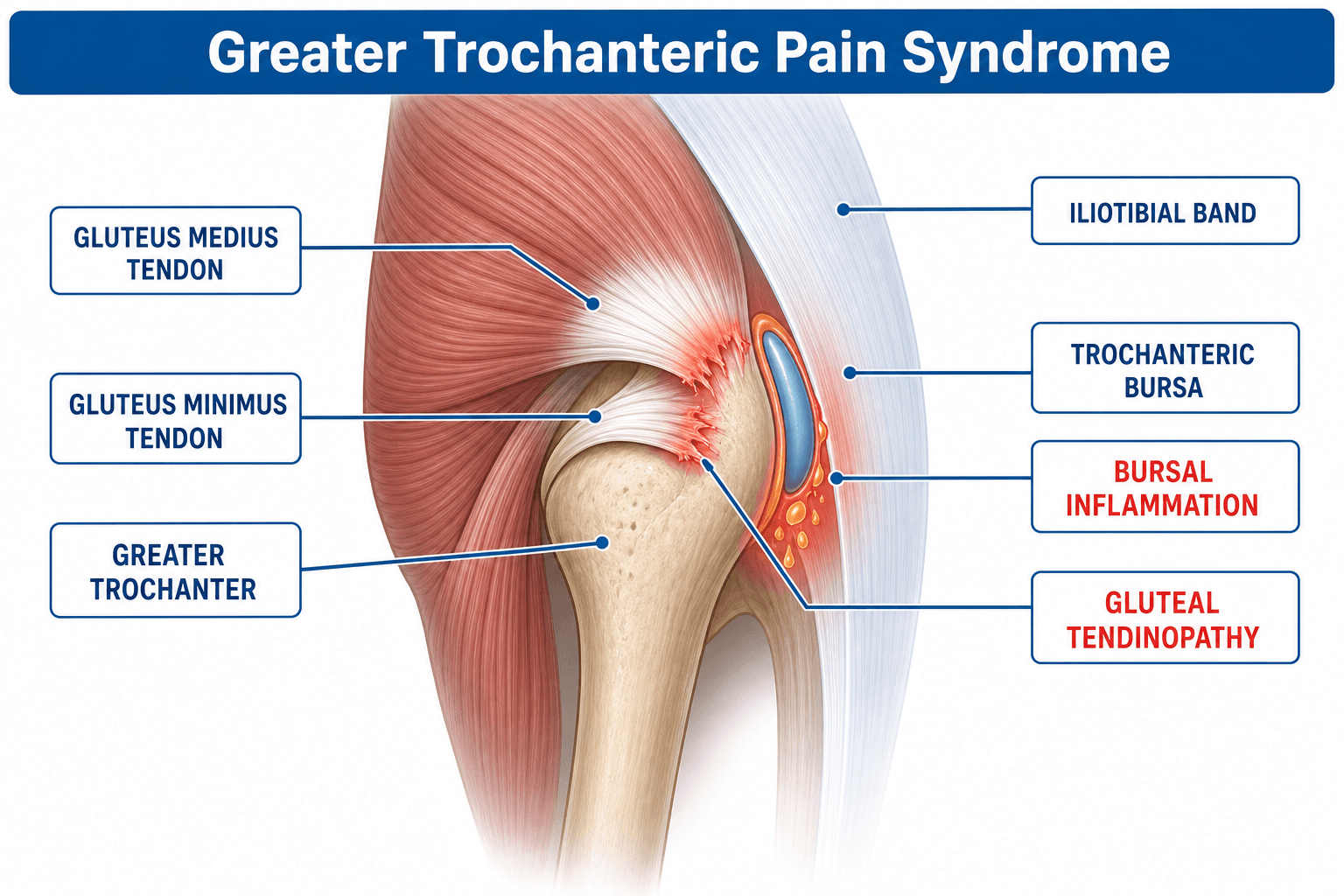
Greater trochanteric pain syndrome (GTPS) is one of the most common musculoskeletal complaints, with an estimated incidence of 1.8 per 1000 per year. It is the third most frequent reason for primary care musculoskeletal consultation after low back pain and knee pain. Despite its prevalence, it is frequently misdiagnosed as hip osteoarthritis or lumbar radiculopathy, leading to delayed or inappropriate treatment. In the exam, distinguishing GTPS from lumbar spine referral and hip OA is a classic differential diagnosis challenge.
- Prevalence: 10-25 percent of adults will experience lateral hip pain
- Sex: Female-to-male ratio approximately 4:1
- Peak age: 40-60 years (perimenopausal women at highest risk)
- Associations: Obesity, lumbar spine pathology, hip OA, total hip replacement
- Bilateral: Up to one-third of cases
- Subgluteus maximus bursa: Largest and most commonly inflamed (overlies greater trochanter)
- Subgluteus medius bursa: Deep to gluteus medius tendon
- Subgluteus minimus bursa: Deep to gluteus minimus tendon
- Gluteus medius/minimus insertions: Lateral and superoposterior facets of greater trochanter
- ITB: Overlies greater trochanter, friction can contribute to pain
Pathophysiology
The term 'trochanteric bursitis' is historically entrenched but anatomically imprecise. Modern imaging (MRI, ultrasound) demonstrates that true bursitis accounts for only a minority of cases. The majority of patients have gluteus medius or minimus tendinopathy, with or without associated bursal inflammation. The bursae may be secondarily inflamed from adjacent tendon pathology, mechanical friction, or direct pressure. In the exam, using the term 'GTPS' and then specifying the underlying pathology demonstrates a higher level of understanding than defaulting to 'bursitis'.
- Trochanteric Bursitis
- Inflammation of subgluteal bursa
- Gluteal Tendinopathy
- Degeneration / micro-tears of gluteus medius/minimus tendon
- ITB Syndrome
- Friction of ITB over greater trochanter
- Trochanteric Bursitis
- Acute onset, overuse, direct pressure
- Gluteal Tendinopathy
- Female 40-60, insidious onset, abductor weakness
- ITB Syndrome
- Runners, cyclists, repetitive flexion/extension
- Trochanteric Bursitis
- Point tenderness, warm bursa, swelling
- Gluteal Tendinopathy
- Weak abduction, Trendelenburg, pain on resisted abduction
- ITB Syndrome
- Pain at 30 degrees of flexion (Noble test), tight ITB
- Trochanteric Bursitis
- Fluid in bursa, normal tendon
- Gluteal Tendinopathy
- Tendon thickening, increased signal, partial or full tear
- ITB Syndrome
- ITB thickening, fluid deep to ITB
Three main bursae around the greater trochanter:
- Subgluteus maximus (trochanteric bursa): Largest, overlies the trochanter superficial to gluteus medius
- Subgluteus medius: Deep to gluteus medius tendon, at its insertion
- Subgluteus minimus: Deep to gluteus minimus tendon
The subgluteus maximus bursa is the one most commonly inflamed in clinical 'trochanteric bursitis'. It sits between the gluteus maximus and the greater trochanter / gluteus medius tendon.
Gluteus medius is the primary hip abductor and pelvic stabiliser during gait. Its tendon insertion on the greater trochanter is analogous to the supraspinatus insertion on the greater tuberosity of the shoulder. Like rotator cuff disease:
- Tendinopathy progresses from reactive to degenerative if overloaded
- Partial-thickness tears may progress to full-thickness tears
- Corticosteroid injection may provide temporary relief but risks further tendon degradation
- Progressive loading is the evidence-based treatment for tendinopathy
The "rotator cuff of the hip" analogy is only useful if you know the footprint, which is examinable anatomy and explains where tears occur and where injections should (and should not) go. The greater trochanter has four facets (Pfirrmann/Robertson anatomy):
- Anterior facet - insertion of gluteus minimus.
- Lateral facet - the main insertion of gluteus medius.
- Superoposterior facet - the second insertion of gluteus medius.
- Posterior facet - the "bald" facet, covered by the trochanteric (subgluteus maximus) bursa, with no tendon insertion.
Clinical translation: gluteus minimus tears are anterior; gluteus medius tears (the commonest) are at the lateral/superoposterior facets - directly under the point of maximal tenderness; and a corticosteroid aimed at the bursa belongs over the posterior bald facet, NOT into the tendon footprint, which is exactly why image guidance matters. The tear sequence mirrors the cuff: anterior gluteus minimus and lateral gluteus medius fail first, analogous to supraspinatus.
Classification and Types
GTPS Sub-diagnoses
- Pathology
- Degeneration of gluteus medius/minimus tendons
- Typical Features
- Insidious onset, abductor weakness, Trendelenburg positive
- Prevalence in GTPS
- Approximately 50-66 percent
- Pathology
- Inflammation of subgluteal bursae without tendon pathology
- Typical Features
- Acute tenderness, swelling, pain on direct pressure
- Prevalence in GTPS
- Approximately 15-20 percent
- Pathology
- Friction or tightness of iliotibial band over trochanter
- Typical Features
- Pain on flexion-extension, runners and cyclists, Noble test positive
- Prevalence in GTPS
- Approximately 10-15 percent
- Pathology
- Tendinopathy with secondary bursitis
- Typical Features
- Features of both tendon and bursal pathology
- Prevalence in GTPS
- Approximately 15-25 percent
Understanding the subtype guides management: tendinopathy needs loading, bursitis needs anti-inflammatory measures, and ITB syndrome needs stretching and biomechanical correction.
- External (coxa saltans externa) - the iliotibial band / gluteus maximus tendon snaps over the greater trochanter. This is the type within the GTPS spectrum: a palpable/visible lateral snap, often reproducible by the patient, worse with the hip moving from extension into flexion; managed with ITB/abductor stretching and load management, and surgical ITB lengthening (e.g. a Z-plasty or cross/diamond release) only for refractory painful snapping.
- Internal (coxa saltans interna) - the iliopsoas tendon snaps over the iliopectineal eminence or femoral head; the snap is anterior/groin, reproduced moving from flexion-abduction-external rotation into extension; managed with stretching, ultrasound-guided iliopsoas injection, and arthroscopic/open psoas lengthening if refractory.
- Intra-articular - a loose body, labral tear or chondral flap causes a true mechanical catch/lock; this is NOT a tendon snap and needs joint imaging (MR arthrogram) and arthroscopy.
Exam point: lateral snap = external (ITB over trochanter, part of GTPS); anterior/groin snap = internal (iliopsoas); a true painful catch with locking = intra-articular - do not lump them all as "snapping hip."
Clinical Assessment
- Pain location: Lateral aspect of hip, may radiate to lateral thigh (but NOT below knee)
- Aggravating factors: Lying on affected side, climbing stairs, rising from chair, crossing legs
- Night pain: Common — difficulty sleeping on the affected side
- Onset: Insidious (tendinopathy) vs acute (bursitis)
- Functional limitation: Difficulty with stairs, prolonged walking, side-sleeping
- Previous treatment: NSAIDs, physiotherapy, injections (response and duration)
- Inspect: Gait pattern (Trendelenburg), pelvic tilt, muscle wasting (gluteal)
- Palpate: Point tenderness over greater trochanter (posterolateral aspect most common)
- ROM: Usually full hip range of motion (unlike hip OA which restricts internal rotation)
- Resisted abduction: Pain at 30 degrees abduction in side-lying (gluteal tendinopathy)
- Single-leg stance: 30 seconds — pain reproduction is highly sensitive for GTPS
- Trendelenburg: Pelvis drops on contralateral side during single-leg stance
- Neurological: Screen lumbar spine to exclude radiculopathy
GTPS is frequently misdiagnosed. Key distinguishing features:
- GTPS: Lateral hip tenderness, full hip ROM (especially internal rotation), pain on trochanteric palpation, normal neurological exam
- Hip OA: Groin pain (more than lateral), restricted internal rotation, pain on flexion-adduction-internal rotation (FADIR may be positive), radiographic changes
- Lumbar radiculopathy (L4-L5): Pain radiates below knee, dermatomal sensory changes, reflex changes, positive neural tension signs, tenderness over lumbar paraspinals rather than trochanter
Do not assume lateral hip pain is trochanteric bursitis without examining the lumbar spine and hip joint.
STANDClinical Assessment of Lateral Hip Pain
Hook:STAND on one leg to screen for GTPS — the 30-second single-leg stance is the best provocative test!
Investigations
Imaging Protocol
Views: AP pelvis, lateral hip (cross-table lateral or frog lateral)
Look for: Greater trochanteric enthesophytes, calcific tendinopathy, hip OA (joint space narrowing), femoral neck stress fracture (may be normal early), pelvic pathology
Clinical correlation: Radiographs are often normal in isolated GTPS — their primary role is excluding other pathology (hip OA, fracture, tumour)
Indication: Refractory symptoms after 6-8 weeks of conservative management, or when gluteal tendon tear is suspected (Trendelenburg, weakness)
Findings in bursitis: Fluid distension of subgluteal bursae (high T2 signal), peritrochanteric oedema
Findings in tendinopathy: Increased T2 signal within gluteus medius/minimus tendons, tendon thickening, partial or full-thickness tears, tendon retraction
Hip joint assessment: Concurrent labral tears, chondral damage, femoroacetabular impingement
Indication: Dynamic assessment of peritrochanteric structures, image-guided injection
Findings: Bursal fluid, tendon thickening, calcifications, real-time assessment of ITB snapping
Advantage: Allows simultaneous diagnostic and therapeutic injection under direct visualization
Limitation: Operator-dependent, cannot assess deep structures or hip joint as well as MRI
The diagnosis of GTPS is primarily clinical. Imaging is not required for typical presentations. Request MRI when: (1) symptoms are refractory to 3 months of conservative management, (2) there is significant abductor weakness suggesting a tendon tear, (3) there is diagnostic uncertainty (possible hip OA, stress fracture, or lumbar pathology), or (4) surgical planning is being considered. MRI is the gold standard for differentiating bursitis from tendinopathy and grading tendon tears.
Management Algorithm
Conservative Management (First-Line for All Patients)
Goal: Reduce pain and inflammation, restore hip abductor function, address biomechanical factors
Conservative Protocol
Relative rest: Avoid aggravating activities (cross-legged sitting, lying on affected side, climbing stairs excessively)
Ice: Ice massage over greater trochanter for 15 minutes, 3-4 times daily
NSAIDs: Oral NSAIDs (if not contraindicated) for 2-4 weeks for pain relief and anti-inflammatory effect
Sleep modification: Pillow between knees, avoid sleeping on affected side
Education: Reassure regarding benign nature, explain condition and expected timeline
Physiotherapy referral: Structured hip abductor strengthening program
Isometric exercises: Isometric hip abduction in side-lying (pain-free)
Progressive loading: Graduated from isometric to isotonic to functional exercises
Stretching: ITB, hip flexors, piriformis — adjunctive, not primary treatment
Manual therapy: Trochanteric soft tissue mobilization, myofascial release
Biomechanical correction: Footwear, gait retraining, core stability
Progressive resistance: Theraband, weight-bearing exercises, single-leg balance
Functional retraining: Stair climbing, sit-to-stand, return to sport-specific activities
Maintenance program: Independent home exercise program for long-term management
Review at 12 weeks: If still symptomatic, consider imaging and injection
For gluteal tendinopathy, the rehabilitation approach follows tendinopathy principles: start with isometric loading (pain reduction), progress to isotonic loading (strength), then functional loading. This is different from isolated bursitis management which focuses on anti-inflammatory measures. Always assess which pathology predominates — it guides the rehab approach.
PRICESConservative Management Protocol
Hook:PRICES is the first-line protocol for GTPS — commit to 6-8 weeks before escalating!
Complications
- Incidence
- 15-30 percent develop chronic symptoms
- Risk Factors
- Delayed diagnosis, inadequate rehab, obesity
- Management
- Multidisciplinary pain management, re-evaluate diagnosis
- Incidence
- Partial tears may progress to full-thickness
- Risk Factors
- Repeated corticosteroid injections, continued overload
- Management
- Surgical repair if full-thickness with functional deficit
- Incidence
- Reported with multiple injections into tendon
- Risk Factors
- More than 3 injections, blind technique, tendinopathy
- Management
- Avoid steroid into tendon, use image guidance, limit injections
- Incidence
- Common — delayed diagnosis frequent
- Risk Factors
- Not examining lumbar spine or hip joint, reliance on X-rays
- Management
- Always perform full lumbar and hip examination
- Incidence
- Variable depending on procedure
- Risk Factors
- Obesity, smoking, diabetes, poor tissue quality
- Management
- Appropriate patient selection, rehabilitation adherence
The most clinically significant 'complication' of trochanteric bursitis/GTPS is incorrect diagnosis. Patients with lumbar radiculopathy, hip OA, femoral neck stress fractures, or femoroacetabular impingement may present with lateral hip pain and be inappropriately treated for bursitis. Always perform a complete examination including lumbar spine assessment, hip joint assessment, and neurological screening before diagnosing GTPS.
Outcomes and Prognosis
- Treatment
- NSAIDs + physiotherapy +/- one injection
- Expected Outcome
- 80-90 percent resolution within 3-6 months
- Long-term Prognosis
- Excellent, low recurrence with activity modification
- Treatment
- Progressive loading program (12 weeks)
- Expected Outcome
- 60-80 percent significant improvement with structured rehab
- Long-term Prognosis
- Good with ongoing maintenance exercises
- Treatment
- Rehabilitation first, consider PRP, surgery if refractory
- Expected Outcome
- 50-70 percent improve with non-operative management
- Long-term Prognosis
- Variable — may progress, monitor with MRI
- Treatment
- Surgical repair (open or endoscopic)
- Expected Outcome
- 70-85 percent good-to-excellent in case series
- Long-term Prognosis
- Functional improvement but rarely full strength return
Best prognosis: Isolated bursitis, acute presentation, compliant with physiotherapy, normal BMI, no associated lumbar or hip pathology
Poor prognosis: Chronic symptoms (over 6 months), gluteal tendon tears, obesity, concurrent lumbar spine pathology, previous hip surgery (especially lateral approach THR), poor compliance with rehabilitation
Key message: Early and accurate diagnosis with appropriate rehabilitation gives the best outcomes. Corticosteroid injection should not replace structured physiotherapy.
Guidelines, Registries & Global Practice
- GTPS incidence: Approximately 1.8 per 1000 per year in primary care populations
- Female predominance: 4:1 ratio, peak age 40-60 years, perimenopausal women at highest risk
- Associations: Obesity (BMI over 30), low back pain, hip OA, total hip replacement (lateral approach)
- Post-THR: Up to 20 percent of patients develop GTPS after total hip replacement via lateral approach due to abductor disruption
- Bilateral involvement: Reported in up to one-third of cases
- High-resource settings: MRI readily available for refractory cases, image-guided injections, specialised hip physiotherapy, endoscopic surgical options
- Limited-resource settings: Clinical diagnosis with trial of conservative management, blind injection if available, plain radiographs to exclude other pathology
- Universal principle: Diagnosis is clinical, first-line treatment is conservative (physiotherapy, NSAIDs, activity modification), and outcomes depend more on rehabilitation compliance than on access to advanced imaging or injections
- Global consensus: Conservative management before injection; imaging before surgery; GTPS as umbrella term
- Diagnosis Emphasis
- Clinical diagnosis; radiographs to exclude OA and fracture; MRI for refractory cases
- First-line Treatment
- Physiotherapy (abductor strengthening), NSAIDs, activity modification for minimum 6-8 weeks
- Injection Guidance
- Image-guided corticosteroid for true bursitis; PRP as emerging option for tendinopathy
- Diagnosis Emphasis
- GTPS as umbrella term; differentiate from hip OA and lumbar referral
- First-line Treatment
- Education plus progressive exercise program; NICE recommends physiotherapy as first-line
- Injection Guidance
- Corticosteroid injection if conservative measures fail; ultrasound guidance preferred
- Diagnosis Emphasis
- Clinical assessment; imaging not routinely needed for diagnosis
- First-line Treatment
- Self-management advice, exercise referral, consider topical or oral NSAIDs
- Injection Guidance
- Corticosteroid injection for persistent symptoms; limit to 3 injections per site
- Diagnosis Emphasis
- Clinical diagnosis with emphasis on differentiating tendinopathy from bursitis
- First-line Treatment
- Load management and progressive strengthening; avoid corticosteroid as first-line
- Injection Guidance
- PRP or image-guided injection only after structured rehabilitation trial
There is no dedicated arthroplasty or implant registry for GTPS, as most cases are managed non-operatively. However, national joint replacement registries (NJR UK, AOANJRR Australia) track post-THR abductor complications including GTPS after lateral approach. The evidence base is evolving from small case series and expert opinion to higher-quality RCTs such as the LEAP trial, which demonstrated the superiority of exercise-based management over corticosteroid injection.
Record in every GTPS presentation:
- Examination of hip joint (ROM, impingement tests) to exclude hip OA
- Lumbar spine assessment to exclude radiculopathy
- Trochanteric palpation, single-leg stance test, Trendelenburg sign, and resisted abduction
- Duration and adequacy of conservative management before injection
- Injection: image-guided vs blind, corticosteroid vs PRP, response documented
- If MRI performed: document bursitis vs tendinopathy vs tear — guides ongoing management
A missed hip OA diagnosis or femoral neck stress fracture in a patient labelled as 'trochanteric bursitis' is a recurring source of medicolegal claims. Always examine the hip joint and lumbar spine before attributing lateral hip pain to GTPS.
Controversies & Areas of Uncertainty
Corticosteroid provides faster short-term relief but worse long-term outcomes compared to exercise. PRP shows promising medium-term results for tendinopathy in limited studies, but high-quality RCTs are lacking. The choice remains resource-dependent and patient-specific. Neither injection should replace rehabilitation.
Tendinopathy-based loading protocols (isometric to isotonic to functional) are recommended, but the optimal exercise type, dose, and duration are not precisely defined. Most protocols recommend 8-12 weeks of progressive loading, with maintenance exercises ongoing. Individual tailoring based on pain response and functional progress is key.
Endoscopic gluteus medius repair is increasingly performed but has no RCT evidence of superiority over open repair. Theoretical advantages include smaller incisions and lower morbidity, but outcomes are comparable in case series. Surgeon experience and tear characteristics determine approach.
Extracorporeal shockwave therapy (ESWT) has shown benefit in some case series for refractory GTPS, particularly calcific tendinopathy. However, evidence quality is low and it remains an adjunctive option rather than a standard treatment. Not universally available.
MCQ Practice Points
Q: What is the preferred term for lateral hip pain over the greater trochanter? A: Greater trochanteric pain syndrome (GTPS). This umbrella term encompasses trochanteric bursitis, gluteal tendinopathy, and ITB pathology. 'Trochanteric bursitis' is a specific sub-diagnosis, not the overall condition. The exam rewards candidates who use the correct terminology and understand the spectrum.
Q: What is the most common underlying pathology in GTPS? A: Gluteal tendinopathy (gluteus medius or minimus). MRI studies show that approximately 50-66 percent of GTPS cases have gluteal tendon pathology as the primary driver, with isolated bursitis being less common. This distinction is important because tendinopathy requires progressive loading, while bursitis is managed with anti-inflammatory measures.
Q: What is the most sensitive clinical test for GTPS? A: The single-leg stance test. Standing on the affected leg for 30 seconds reproduces lateral hip pain in the vast majority of GTPS patients. Point tenderness over the greater trochanter is common but non-specific. Resisted abduction in side-lying at 30 degrees is more specific for gluteal tendinopathy.
Q: How do you differentiate GTPS from hip osteoarthritis clinically? A: Hip ROM. GTPS has full hip range of motion (especially internal rotation), while hip OA restricts internal rotation and flexion. GTPS pain is reproduced by trochanteric palpation and single-leg stance, while hip OA pain is reproduced by FADIR (flexion-adduction-internal rotation) and is typically groin-predominant. Radiographs show OA changes; GTPS radiographs are typically normal.
Q: What is the evidence-based first-line management for GTPS? A: Structured physiotherapy with progressive hip abductor strengthening. The LEAP trial demonstrated that education plus exercise was superior to corticosteroid injection at 52 weeks. Conservative management should be trialled for a minimum of 6-8 weeks before considering injection, and 3-6 months before considering surgery.
Q: What are the risks of corticosteroid injection in GTPS? A: Tendon degradation if injected into the gluteal tendons (rather than the bursa). Image guidance (ultrasound) is recommended to ensure accurate placement. Corticosteroid provides short-term relief (4-12 weeks) but does not offer long-term benefit and may worsen underlying tendinopathy. The LEAP trial showed exercise was superior to injection at one year.
Exam Viva Scenarios
Practise clinical reasoning and management decisions out loud
“A 52-year-old woman presents with a 3-month history of right lateral hip pain. It is worse when she lies on her right side at night and when climbing stairs. She has tried over-the-counter ibuprofen with partial relief. On examination, there is point tenderness over the right greater trochanter. Hip range of motion is full and pain-free except for pain on resisted abduction in side-lying. Trendelenburg sign is negative. Lumbar spine examination is normal. What is the diagnosis and how would you manage this?”
“A 58-year-old woman has had left lateral hip pain for 9 months despite physiotherapy and two corticosteroid injections (the last one 3 months ago). She now has a positive Trendelenburg sign on the left and reports weakness when trying to abduct the leg against gravity. MRI shows a full-thickness tear of the gluteus medius tendon at its insertion on the greater trochanter with 2 cm of retraction and associated bursal fluid. What is your diagnosis and management plan?”
Key Terminology and Anatomy
- GTPS = umbrella term for lateral hip pain (bursitis, tendinopathy, ITB syndrome)
- Gluteal tendinopathy is the most common cause (50-66 percent of GTPS), not bursitis
- Subgluteus maximus bursa is the most commonly inflamed bursa
- Gluteus medius inserts on superoposterior facet of greater trochanter (like supraspinatus analogy)
Diagnosis
- Clinical diagnosis: point tenderness over trochanter, full hip ROM, pain on single-leg stance
- Trendelenburg and weak abduction suggest tendinopathy rather than isolated bursitis
- Always examine lumbar spine and hip joint to exclude referred pain and OA
- MRI gold standard for differentiating bursitis from tendinopathy and grading tears
Differential Diagnosis
- Hip OA: groin pain, restricted internal rotation, radiographic changes
- Lumbar radiculopathy L4-L5: pain below knee, neurological signs, SLR positive
- Femoral neck stress fracture: progressive weight-bearing pain, urgent MRI needed
- Meralgia paraesthetica: burning anterolateral thigh, sensory changes
Management Algorithm
- First-line: structured physiotherapy (progressive abductor loading) for minimum 6-8 weeks
- Second-line: image-guided injection (corticosteroid for bursitis, PRP for tendinopathy)
- Third-line: surgical referral for documented tendon tears with functional deficit after 6 months
- Activity modification throughout: avoid side-sleeping, crossing legs, excessive stairs
Evidence-Based Pearls
- LEAP trial: exercise superior to corticosteroid injection at 52 weeks
- Corticosteroid injection risks tendon damage if placed into gluteal tendons
- Image-guided injection accuracy approximately 90 percent vs 50 percent blind
- Gluteal tendon tears are the hip equivalent of rotator cuff tears
Evidence Base and Key Trials
Exercise compared to a control condition or other conservative treatment options in patients with Greater Trochanteric Pain Syndrome: a systematic review and meta-analysis of randomized controlled trials
- Six randomised trials including 733 patients, appraised with ROB2 and graded with GRADE
- USE THE AUTHORS' OWN QUALIFIER: in the long term exercise SLIGHTLY reduces hip pain and disease severity and SLIGHTLY improves patient-reported function and global rating of change against a control condition. The direction is consistent and the effect is small
- Against corticosteroid injection, the one outcome exercise improved in the long term was GLOBAL RATING OF CHANGE - which is the same outcome, and the same limitation, as in the Mellor trial below
- Only two of the six trials compared exercise with corticosteroid injection, two compared it with shockwave therapy and one with a different exercise programme
- No serious adverse events were reported in any trial
Gluteal Tendinopathy: Integrating Pathomechanics and Clinical Features in Its Management
- Gluteal tendinopathy is the primary pathology in the majority of GTPS cases
- The condition is analogous to rotator cuff disease of the hip — progressive tendon degeneration
- Corticosteroid injection may provide temporary pain relief but risks further tendon degeneration
- Progressive loading (isometric to isotonic to functional) is the recommended rehabilitation approach