Posteromedial Impingement | Olecranon Osteophyte | Thrower's Elbow
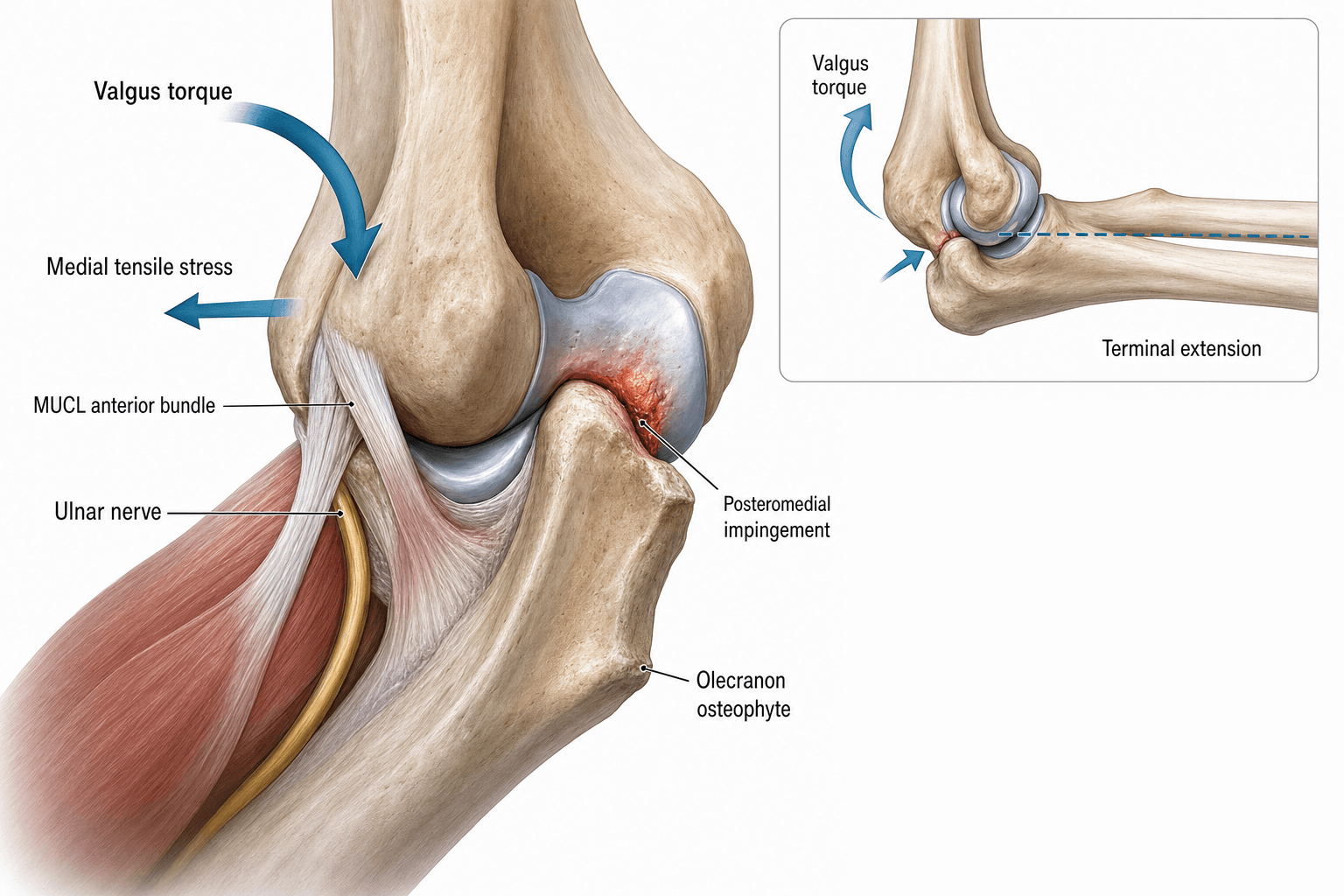
- Valgus extension overload = posteromedial olecranon tip impingement against olecranon fossa during terminal extension
- Repetitive valgus stress in overhead throwing creates shear forces at the posteromedial compartment
- Olecranon osteophyte formation is a reactive response to chronic impingement microtrauma
- UCL insufficiency increases valgus opening, worsening posteromedial impingement
- Isolated osteophyte debridement without addressing UCL insufficiency can DESTROY the elbow
- “VEO is one of the three valgus extension overload pathologies in throwers (with UCL injury and flexor-pronator strain)
- “Posteromedial elbow pain on forced extension = valgus extension overload until proven otherwise
- “Always stress-test the UCL before considering isolated osteophyte debridement
- “The 'valgus extension snap' test reproduces pain at the posteromedial olecranon tip
Overview and Epidemiology
Valgus extension overload (VEO) is impingement of the posteromedial olecranon tip against the olecranon fossa, and one of the most important pathologies in the overhead throwing athlete. Over time the repetitive microtrauma produces posteromedial osteophytes, chondral damage and loose bodies.
Who. Predominantly overhead throwing athletes: baseball pitchers, javelin throwers and cricket fast bowlers. They are typically aged 18-35, their peak competitive years. The dominant arm is the one affected, although the non-dominant arm may show similar but milder changes.
Why it matters. Isolated osteophyte debridement in an elbow with insufficiency of the ulnar collateral ligament (UCL) can convert a stable but painful elbow into an unstable and catastrophically damaged one. That is why UCL integrity is always assessed before surgery.
Pathophysiology
The load. Valgus torque in the late cocking and early acceleration phases puts the medial elbow under tension and the lateral elbow under compression. Torque peaks at 50-74 Nm in late cocking and remains high, approaching 64 Nm, into acceleration, with the olecranon acting as a fulcrum. Early acceleration adds the maximum angular velocity.
The impingement. Valgus combined with extension concentrates force on the medial olecranon as posteromedial shear. The olecranon tip engages the fossa in the terminal 10-20 degrees of extension, and terminal extension repeatedly drives the posteromedial tip into the medial wall of the fossa.
- Valgus Force
- Low
- Medial Tension
- Minimal
- Lateral Compression
- Low
- Posteromedial Shear
- Minimal
- Valgus Force
- Peak (50-74 Nm)
- Medial Tension
- Maximum UCL tension
- Lateral Compression
- High radiocapitellar
- Posteromedial Shear
- Increasing
- Valgus Force
- High
- Medial Tension
- UCL at limit
- Lateral Compression
- High
- Posteromedial Shear
- Peak posteromedial
- Valgus Force
- Decreasing
- Medial Tension
- Eccentric flexor-pronator
- Lateral Compression
- Moderate
- Posteromedial Shear
- Terminal impingement
Which structure, which phase. Knowing which phase of the throw produces the predominant stress helps correlate the symptoms with the injured structure.
- Primary Stress
- Peak valgus torque
- Structure at Risk
- UCL anterior bundle (tensile)
- Clinical Correlate
- Acute UCL tear if single catastrophic event
- Primary Stress
- Valgus plus rapid extension
- Structure at Risk
- Posteromedial olecranon fossa wall
- Clinical Correlate
- Acute VEO pain, posteromedial impingement
- Primary Stress
- Maximum compressive force laterally
- Structure at Risk
- Radiocapitellar joint
- Clinical Correlate
- Lateral pain, radiocapitellar chondromalacia
- Primary Stress
- Extension plus valgus plus distraction
- Structure at Risk
- Flexor-pronator mass, UCL, posteromedial olecranon
- Clinical Correlate
- Combined pathologies common at this phase
The osteophyte. Repetitive impaction between the olecranon tip and the medial wall of the fossa produces an osteophyte on the posteromedial aspect of the tip, specifically there and not laterally. It is a reactive response to chronic impingement microtrauma: a secondary response to the underlying biomechanical pathology, not the primary problem. The sequence runs from cartilage fibrillation to subchondral sclerosis, then osteophyte formation, then loose bodies.
The cartilage. Chondral damage follows its own sequence, ending in posteromedial compartment degenerative arthritis:
- Posteromedial chondral softening from impaction
- Fibrillation and partial-thickness loss
- Full-thickness defect exposing subchondral bone
- Loose bodies from delaminated cartilage and fractured osteophytes
The ligament. The anterior bundle of the UCL is the primary restraint to valgus stress, providing approximately 55 percent of valgus stability. While it is intact, the posteromedial olecranon tip makes controlled contact with the fossa in terminal extension. When it attenuates or tears, valgus opening increases, and the tip is driven earlier, further medially and more forcefully into the fossa wall.
The vicious cycle. UCL insufficiency worsens posteromedial impingement, which generates osteophytes and chondral damage, which in turn produce loose bodies and inflammation that further compromise elbow mechanics.
When the UCL is insufficient, the posteromedial osteophyte acts as a secondary stabiliser against valgus stress: a load-bearing block. Removing it without addressing the ligament removes that restraint and can accelerate valgus instability, with catastrophic results.
Classification and Types
The posteromedial impingement osteophyte in throwers must always be evaluated in the context of overall medial elbow stability.
- Key Pathology
- Posteromedial osteophyte only
- UCL Status
- Intact (stable)
- Typical Findings
- Pain on terminal extension, no valgus laxity
- Treatment Principle
- Arthroscopic debridement alone is appropriate
- Key Pathology
- Osteophyte plus UCL attenuation/tear
- UCL Status
- Insufficient (lax)
- Typical Findings
- Valgus laxity on stress testing, medial pain
- Treatment Principle
- UCL reconstruction PLUS osteophyte debridement
- Key Pathology
- Osteophyte with fragmentation; CT may show large osteophytes and MRI chondral damage
- UCL Status
- Variable (assess individually)
- Typical Findings
- Chronic stiffness, mechanical locking, catching, effusions
- Treatment Principle
- Loose body removal plus address osteophyte and UCL; may need posteromedial chondral assessment
- Key Pathology
- Osteophyte compressing cubital tunnel
- UCL Status
- Variable
- Typical Findings
- Medial hand tingling, positive Tinel, nerve subluxation
- Treatment Principle
- Nerve transposition may be needed alongside debridement
Clinical Assessment
History. An overhead thrower (baseball pitcher, javelin thrower, cricket fast bowler, or the tennis serve) with posteromedial elbow pain during terminal extension, of insidious onset over months to seasons. Ask about:
- Popping
- Clicking, catching or locking, which suggest loose bodies
- Loss of throwing velocity or accuracy
- Tingling in the ring and small fingers, which raises concern for ulnar neuritis
Examination. Inspect the carrying angle and look for medial swelling and muscle atrophy. The key finding is tenderness at the posteromedial olecranon tip; palpate the medial epicondyle and the UCL as well. Terminal extension is painful, and an osteophyte or loose body may block it mechanically. The UCL is stress-tested with the moving valgus stress test, the gravity valgus test and the milking test.
The valgus extension snap test. With the arm stabilised, the examiner applies a valgus stress and quickly extends the elbow from 30 degrees of flexion to full extension. Pain at the posteromedial olecranon tip during terminal extension is a positive test: it reproduces the impingement mechanism and localises the pathology to the posteromedial compartment.
- Technique
- Valgus stress applied while extending elbow rapidly
- Positive Finding
- Posteromedial pain at terminal extension
- Structure Tested
- Posteromedial olecranon impingement (VEO)
- Technique
- Valgus torque applied while flexing/extending through range
- Positive Finding
- Pain between 120 and 70 degrees flexion
- Structure Tested
- UCL anterior bundle insufficiency
- Technique
- Patient pulls thumb with elbow at 90 degrees, valgus applied
- Positive Finding
- Medial pain at UCL
- Structure Tested
- UCL insufficiency
- Technique
- Passive extension with direct posteromedial palpation
- Positive Finding
- Crepitus and pain at posteromedial tip
- Structure Tested
- Osteophyte or loose body in posteromedial gutter
VEO produces pain at terminal extension on the valgus extension snap test. UCL insufficiency produces pain in the mid-range, 120-70 degrees, on the moving valgus stress test. A positive snap test does not exclude UCL insufficiency and the two frequently coexist, so the moving valgus stress test is always performed as well. Missing the UCL component and performing isolated osteophyte debridement is a well-documented cause of surgical failure and accelerated elbow destruction.
The thrower's elbow. A thrower's elbow has multiple overlapping pathologies, so every structure is assessed. Medially, flexor-pronator overload raises traction spurs on the medial epicondyle, and UCL insufficiency allows excessive valgus opening. Laterally, valgus torque compresses the radiocapitellar joint, and the compression causes radiocapitellar chondromalacia and lateral compartment degeneration. The ulnar nerve may be irritated by medial osteophytes, loose bodies or traction.
- Key Localising Feature
- Pain specifically on terminal extension with valgus
- Discriminating Test
- Positive valgus extension snap test
- Key Imaging Finding
- Posteromedial olecranon osteophyte on CT/axial radiograph
- Key Localising Feature
- Medial pain during late cocking / early acceleration
- Discriminating Test
- Positive moving valgus stress test
- Key Imaging Finding
- UCL discontinuity or thickening with surrounding oedema on MRI
- Key Localising Feature
- Medial epicondyle origin tenderness, pain on resisted wrist flexion
- Discriminating Test
- Resisted pronation reproduces pain
- Key Imaging Finding
- Flexor-pronator tendon thickening or partial tear on MRI
- Key Localising Feature
- Tingling in ring and small fingers, positive Tinel at cubital tunnel
- Discriminating Test
- Nerve conduction studies if equivocal
- Key Imaging Finding
- Ulnar nerve oedema or subluxation on MRI
- Key Localising Feature
- Medial epicondyle pain in skeletally immature thrower
- Discriminating Test
- Pain on resisted flexion-pronation, open physis on X-ray
- Key Imaging Finding
- Widened medial epicondyle physis on AP radiograph
- Key Localising Feature
- Posterior pain, worse with throwing, night pain possible
- Discriminating Test
- Direct olecranon tenderness, positive resisted extension test
- Key Imaging Finding
- Olecranon fracture line on CT or MRI
Don't miss the olecranon stress fracture. It is the posterior-pain differential that must not be missed alongside VEO. The same repetitive valgus-extension throwing load that drives posteromedial impingement also stresses the olecranon itself, producing a stress fracture, classically an oblique or transverse line and often physeal or metaphyseal in adolescents. It commonly coexists with UCL insufficiency and VEO, because valgus laxity raises olecranon stress.
The clues that it is a stress fracture rather than VEO are pain on resisted elbow extension (triceps loading) and focal olecranon tenderness, rather than the terminal-extension valgus snap, sometimes with night pain. Plain films are often normal early; MRI (marrow oedema) or CT (the fracture line) confirms it.
- Low-risk patterns are managed by activity cessation
- A displaced or sclerotic non-union, or a persistent symptomatic line in a high-demand thrower, is fixed with an intramedullary screw, with bone grafting of a non-union
The underlying UCL and VEO problem must be addressed too. Debriding a posteromedial osteophyte will not treat a coexisting olecranon stress fracture, so image for it before operating.
The lateral counterpart: capitellar OCD. Valgus throwing load is tension medially (UCL, VEO) but compression laterally at the radiocapitellar joint, and the classic examinable lateral lesion is osteochondritis dissecans (OCD) of the capitellum. It affects the adolescent or young thrower or gymnast, typically 11-16 years, and presents with lateral elbow pain, an effusion, a flexion contracture (loss of terminal extension) and mechanical catching or locking if a fragment loosens. It is graded by stability:
- A stable lesion with an open capitellar physis is treated non-operatively (rest from throwing, often 3-6 months), with good healing
- An unstable lesion, a loose body, or a lesion in a closing or closed physis needs arthroscopic management: drilling, fixation, microfracture, or fragment removal with osteochondral grafting (OATS)
Distinguish it from Panner disease, a self-limiting osteochondrosis of the whole capitellar ossific nucleus in the younger child (under about 10 years), which remodels with rest and does not form loose bodies. The thrower's elbow therefore has matched medial-tension (VEO, UCL) and lateral-compression (capitellar OCD) pathologies, and both compartments are assessed.
Investigations
Radiographs. AP, lateral, oblique and axial views of the elbow. The axial view at 45 degrees of flexion is the single most valuable plain film for VEO: it profiles the posteromedial olecranon tip and shows osteophytes that may be hidden on the standard AP and lateral views, so request it whenever VEO is suspected. Look for a posteromedial olecranon osteophyte, olecranon fossa sclerosis, loose bodies, medial epicondyle calcification and joint space narrowing.
Up to 90 percent of professional baseball pitchers have radiographic evidence of posteromedial osteophytes, so correlate clinically before attributing symptoms to one.
CT. Essential for planning and superior to MRI for bone detail. It defines the osteophyte's size, location and exact morphology, the depth of the fossa and any fossa involvement, and so determines how much bone can safely be removed without destabilising the elbow. CT with 3D reconstruction is the gold standard for operative planning.
MRI. Mandatory in every patient with VEO findings, to rule out UCL insufficiency before any surgical intervention. In the ligament, look for thickening, a partial-thickness undersurface tear, a full-thickness tear and surrounding oedema. MRI also shows chondral damage, loose bodies, flexor-pronator pathology, ulnar nerve signal and bone marrow oedema.
Dynamic ultrasound. Assesses UCL laxity under valgus stress in real time, showing joint-space opening that can be compared with the contralateral side. It is operator-dependent and does not visualise the deep chondral surfaces.
Management Algorithm
The decision. Management starts non-operatively. Failure after 12 weeks of conservative management is the point for surgical evaluation, and the state of the UCL then chooses the operation: arthroscopic debridement alone when the ligament is proven competent, and debridement combined with UCL reconstruction when it is insufficient.
Aim. Reduce posteromedial impingement through biomechanical modification, inflammation control and progressive rehabilitation.
Mechanics. The most common cause of VEO is poor throwing mechanics, particularly inadequate or late trunk rotation, or dropping the elbow below shoulder height during the cocking phase. Biomechanical coaching and video analysis are essential components of non-operative management. Without correcting the underlying mechanics, the osteophyte will recur even after successful surgery.
Rehabilitation Protocol
Complete cessation of throwing, for 6-12 weeks minimum, with NSAIDs, ice and activity modification. Physiotherapy begins flexor-pronator strengthening and forearm pronation exercises, and video analysis of the throwing mechanics identifies the fault patterns.
Progressive strengthening of the flexor-pronator mass, triceps and biceps, with gentle terminal extension stretching that avoids forceful extension. Core and scapular stabilisation addresses proximal kinetic chain deficits, and activity returns gradually.
A tossing programme once pain-free, then an interval throwing programme of graduated distance and intensity, maintaining the corrected throwing pattern. Any posteromedial pain means stop and reassess.
SCOPESurgical Decision-Making in VEO
Hook:SCOPE the elbow properly before you scope the elbow surgically!
Complications
Iatrogenic instability first. The most important complication to prevent is iatrogenic instability from inappropriate debridement, and it is entirely preventable:
- A thorough pre-operative UCL assessment, by physical examination and MRI
- Osteophyte resection limits planned on CT
- Reconstruction of the UCL whenever there is any question about ligament integrity
- Cause and Risk Factors
- Osteophyte removed as secondary stabiliser without UCL reconstruction (reported in such cases); missed UCL insufficiency, aggressive resection
- Prevention / Management
- Always stress-test the UCL pre-operatively and reconstruct if insufficient; established instability needs urgent UCL reconstruction and may need a hinged external fixator
- Cause and Risk Factors
- Excessive bone removal beyond osteophyte; poor visualisation, inadequate pre-operative CT planning
- Prevention / Management
- Use CT to plan resection limits; intra-operative fluoroscopy
- Cause and Risk Factors
- Persistent throwing mechanics fault; no biomechanical analysis or coaching before return to throwing
- Prevention / Management
- Mandatory throwing mechanics correction post-operatively; revision debridement only if mechanics addressed
- Cause and Risk Factors
- Arthroscopic instrumentation near cubital tunnel; posteromedial portal placement too medial
- Prevention / Management
- Careful portal placement; consider open nerve transposition
- Cause and Risk Factors
- Osteophyte encroachment on cubital tunnel, traction
- Prevention / Management
- Cubital tunnel release or anterior transposition
- Cause and Risk Factors
- Chronic impingement, loose bodies, UCL laxity
- Prevention / Management
- Arthroscopic chondral management; activity modification
- Cause and Risk Factors
- Osteophyte fragmentation, chondral delamination
- Prevention / Management
- Arthroscopic removal; address underlying impingement
- Cause and Risk Factors
- Post-operative scarring limiting motion; prolonged immobilisation, complex procedure
- Prevention / Management
- Early gentle ROM; avoid excessive resection
Outcomes and Prognosis
- Population
- Early VEO, UCL intact, willing to modify mechanics
- Expected Outcome
- 60-70 percent return to throwing with mechanics correction
- Return to Throwing
- 3-4 months with interval throwing programme
- Population
- Symptomatic osteophyte, confirmed stable UCL
- Expected Outcome
- 85-90 percent return to prior level of competition
- Return to Throwing
- 3-6 months post-operatively
- Population
- VEO with UCL insufficiency
- Expected Outcome
- 80-90 percent return to throwing (professional athletes)
- Return to Throwing
- 12-18 months post-operatively
- Population
- UCL insufficient but not recognised
- Expected Outcome
- Poor; recurrent pain, instability, accelerated degeneration
- Return to Throwing
- Requires revision UCL reconstruction; outcomes inferior
Prognosis. The best prognosis belongs to isolated VEO with an intact UCL, treated early, with good biomechanical coaching and arthroscopic debridement limited to the osteophyte. It is poor with an unrecognised UCL insufficiency treated by isolated debridement, chronic posteromedial chondral damage, multiple prior surgeries, or throwing mechanics that cannot be corrected. The single greatest predictor of surgical success is accurate pre-operative assessment of UCL integrity.
Guidelines, Registries & Global Practice
- Baseball pitchers: Highest incidence worldwide (USA, Japan, Korea, Caribbean, Latin America)
- Javelin throwers: Significant prevalence in European and Commonwealth nations
- Cricket fast bowlers: Increasingly recognised in cricket-playing nations worldwide (England, South Asia, the West Indies, Australia)
- Other overhead sports: Tennis serve, volleyball spike, handball throwing motion
- Up to 90 percent of professional baseball pitchers have radiographic posteromedial osteophytes
- High-resource (USA, Japan, Australia): MRI and dynamic ultrasound for UCL assessment; advanced arthroscopic techniques with throwing mechanics analysis and biomechanical labs
- Limited-resource: Radiographs and clinical examination for diagnosis; open debridement when arthroscopy unavailable; rehabilitation-based management emphasised
- Universal principle: UCL integrity assessment is mandatory regardless of resource setting - the clinical examination (moving valgus stress test) is the most important tool
- Return-to-sport protocols: Standardised interval throwing programs are used globally regardless of resource level
- Diagnosis Emphasis
- Moving valgus stress test plus MRI for UCL; CT for osteophyte characterisation
- Acute Management
- Minimum 3 months rest, biomechanical coaching, flexor-pronator rehabilitation
- Surgical Approach
- Arthroscopic debridement if UCL intact; combined UCL reconstruction if insufficient
- Diagnosis Emphasis
- Clinical examination first; radiographs including axial view; MRI for UCL assessment
- Acute Management
- Structured physiotherapy and throwing modification; consider PRP injection adjunct
- Surgical Approach
- Arthroscopic debridement with careful patient selection; UCL reconstruction in specialist centres
- Diagnosis Emphasis
- Systematic assessment of all medial elbow structures; CT for surgical planning
- Acute Management
- Rehabilitation protocol with graduated return; biomechanical analysis essential
- Surgical Approach
- Arthroscopic technique with defined resection limits; combined procedures as indicated
- Diagnosis Emphasis
- High clinical suspicion in throwing athletes; ultrasound increasingly used for dynamic UCL assessment
- Acute Management
- Prolonged conservative management favoured before surgical intervention
- Surgical Approach
- Arthroscopic debridement standard; UCL reconstruction in specialist elbow centres
There is no dedicated global registry for VEO outcomes. Evidence comes primarily from retrospective case series from major throwing sports centres (American Sports Medicine Institute, Kerlan-Jobe Orthopaedic Clinic, and similar institutions). The evidence base is dominated by Level 4 studies, with biomechanical cadaveric studies providing the strongest support for the principle that osteophytes are secondary stabilisers. The return-to-play data after UCL reconstruction (approximately 83-90 percent in professional baseball) is among the best-studied outcomes in sports elbow surgery.
Record in every throwing athlete with posteromedial elbow pain:
- Moving valgus stress test result (positive or negative for UCL insufficiency)
- Valgus extension snap test result (positive or negative for VEO)
- UCL integrity on MRI (intact, partial tear, full tear)
- Osteophyte characterisation on CT (size, location, fossa involvement)
- Throwing mechanics assessment performed or referred
- Discussion of surgical risk if UCL insufficient: debridement alone is contraindicated
Missing the UCL component in a patient who proceeds to isolated osteophyte debridement is a well-documented source of surgical failure and medicolegal claims. Document the UCL assessment in every case.
Controversies & Areas of Uncertainty
Partial undersurface UCL tears pose a dilemma: some can be managed with rehabilitation and augmented repair, while others progress to require reconstruction. No consensus exists on the threshold for reconstruction versus repair in the context of simultaneous VEO. Decision-making is individualised based on sport, level of competition, and biomechanical demands.
The safe limit of posteromedial olecranon resection is often called debated, but the cadaveric study cited on this page is more specific - and more conservative - than the usual paraphrase. Resecting in 3 mm increments from 0 to 9 mm, strain in the anterior bundle rose with flexion angle, with valgus torque, and with resection beyond 3 mm; the difference between a 6 mm and a 3 mm resection was significant at 110 degrees with added torque (p=0.004), and in two of the seven elbows the anterior bundle ruptured outright during testing after the 9 mm resection. The authors' stated conclusion is that resecting more than 3 mm of the posteromedial olecranon may jeopardise the anterior bundle - so quote 3 mm rather than 4 to 6, and read the number as the point beyond which you trade impingement relief for valgus instability. Resect the osteophyte and stop; intra-operative fluoroscopy and CT-based templating help define where osteophyte ends and native olecranon begins.
Internal brace augmentation (collagen-coated tape) during UCL reconstruction may allow accelerated rehabilitation, but long-term outcome data specific to VEO patients is limited. This technique is gaining acceptance in high-level throwing athletes.
PRP and stem cell injections for partial UCL tears and chondral damage associated with VEO remain investigational. Some centres report promising early results, but high-quality trials are lacking. These adjuncts should not replace established surgical principles.
Exam Viva Scenarios
Practise clinical reasoning and management decisions out loud
“A 24-year-old professional baseball pitcher presents with posteromedial right elbow pain for 4 months. The pain occurs during the late acceleration phase and is worse on terminal extension. He reports occasional clicking but no locking. Physical examination reveals tenderness at the posteromedial olecranon tip, a positive valgus extension snap test, and a negative moving valgus stress test. His UCL feels stable. Radiographs show a posteromedial olecranon osteophyte. What is your diagnosis and management?”
“A 28-year-old javelin thrower presents with medial and posteromedial elbow pain for 8 months. He has lost throwing distance and reports a 'pop' sensation. Examination reveals posteromedial olecranon tenderness, a positive valgus extension snap test, AND a positive moving valgus stress test with pain between 120 and 70 degrees. MRI shows a partial-thickness undersurface tear of the UCL with surrounding edema and a posteromedial osteophyte. How would you manage this?”
Key Pathomechanics
- Repetitive valgus stress during throwing drives posteromedial olecranon tip into olecranon fossa
- Terminal extension in valgus concentrates force on posteromedial compartment
- Osteophyte forms as reactive response to chronic impingement microtrauma
- UCL insufficiency increases valgus opening, worsening posteromedial impingement
- Posteromedial osteophyte acts as secondary valgus stabiliser when UCL is insufficient
Diagnosis
- Posteromedial elbow pain on terminal extension in overhead throwing athlete
- Valgus extension snap test positive (reproduces posteromedial pain at terminal extension)
- Axial radiograph at 45 degrees flexion shows posteromedial osteophyte best
- MRI mandatory to assess UCL integrity before any surgical intervention
- CT superior for characterising osteophyte size and planning resection limits
Treatment Algorithm
- Conservative first: rest, biomechanical coaching, flexor-pronator rehab (3 months trial)
- UCL intact with persistent VEO: arthroscopic osteophyte debridement and loose body removal
- UCL insufficient with VEO: UCL reconstruction PLUS osteophyte debridement (combined)
- NEVER debride osteophyte in UCL-insufficient elbow without simultaneous reconstruction
- Throwing mechanics correction is mandatory to prevent recurrence
Critical Pitfalls
- Missed UCL insufficiency is the most dangerous error in VEO management
- Isolated debridement with unrecognised UCL tear causes catastrophic instability
- Over-resection of olecranon beyond the osteophyte risks iatrogenic instability
- Failure to address throwing mechanics leads to osteophyte recurrence
- Ulnar nerve assessment is essential: osteophytes may compress the nerve in the cubital tunnel
Outcomes
- Conservative management: 60-70 percent return with mechanics correction
- Arthroscopic debridement (UCL intact): 85-90 percent return to competition
- UCL reconstruction plus debridement: 80-90 percent return to throwing
- Failed isolated debridement (missed UCL): poor outcomes, requires revision surgery
- Return to throwing timeline: 3-6 months (debridement alone) or 12-18 months (UCL reconstruction)
Evidence Base and Key Trials
Valgus extension overload in the pitching elbow
- The paper that named the syndrome - FIVE baseball pitchers, three college and two professional, average age 24, with pain arising between the acceleration and follow-through phases of the pitch
- A posteromedial olecranon osteophyte was present in all five, impinging on the articular wall of the olecranon fossa and often producing chondromalacia there
- THE WARNING THE PAPER ACTUALLY MAKES is about missing the lesion, not about instability: the commoner straight-posterior osteophyte was also present in every case, and if only that posterior osteophyte is removed the posteromedial lesion is left behind and the disability persists
- Excision of the posteromedial osteophyte through a posterolateral approach let all five return for one full season at maximum effectiveness, at an average follow-up of one year
Outcome of elbow surgery in professional baseball players
- Seventy-two professional baseball players undergoing arthroscopic or open elbow surgery, 59 followed for a minimum of 2 years (average 42 months)
- Diagnoses: posteromedial olecranon osteophyte 65%, ulnar collateral ligament injury 25%, ulnar neuritis 15%, and intra-articular loose bodies in 39%
- Return to play: 80% returned for at least one season and 73% at the same or higher level - but 17% retired because of the elbow
- The finding that should govern practice: ONE THIRD needed two or more procedures, and 25% of those required UCL RECONSTRUCTION after removal of a posteromedial olecranon osteophyte. Patients with posteromedial osteophytes had the highest reoperation rate of any group, while those who had UCL reconstruction had a HIGHER rate of return to play
- The authors' interpretation is the lesson: UCL injury was probably underestimated in this cohort because initial treatment was directed at the secondary injury - the osteophyte - rather than the primary one
Medial collateral ligament strain with partial posteromedial olecranon resection: a biomechanical study
- SEVEN cadaveric elbows with the medial collateral ligament INTACT - the experiment resected normal posteromedial olecranon in sequential 3 mm increments from 0 to 9 mm and measured strain in the anterior bundle with an electromagnetic tracking device, under hand weight alone, hand weight plus 1.75 Nm and hand weight plus 3.5 Nm
- Anterior-bundle strain rose with increasing flexion angle, increasing valgus torque, and resection BEYOND 3 mm
- The difference between a 6 mm and a 3 mm resection was significant at 110 degrees of flexion with 3.5 Nm added torque (p=0.004)
- IN TWO OF THE SEVEN ELBOWS THE ANTERIOR BUNDLE RUPTURED OUTRIGHT during testing after the 9 mm resection
- The authors' conclusion is a number, and it is more conservative than the usual paraphrase: resection of more than 3 mm may jeopardise the function of the anterior bundle
Outcome of ulnar collateral ligament reconstruction of the elbow in 1281 athletes: Results in 743 athletes with minimum 2-year follow-up
- 1281 patients over 19 years (1988-2006) - 1266 reconstructions and 15 repairs, all by a modification of the Jobe technique with subcutaneous ulnar nerve transposition
- 942 reached the minimum 2 years; 743 (79% of those) were actually contacted, at an average of 37 months
- 617 of the 743 (83%) returned to their previous level of competition or higher, including 610 (83%) after reconstruction
- Average time from surgery to starting to throw 4.4 months; to full competition 11.6 months, with a range extending to 72 months
- Complications in 148 patients (20%) - 16% minor and 4% major
Arthroscopy of the elbow: a long-term clinical review
- 172 patients undergoing 187 elbow arthroscopies over 7 years by 7 different surgeons - a general elbow-arthroscopy series, not a series of throwers
- Posterior impingement was the commonest diagnosis at 96 patients (51%), with loose bodies in 72 (31%) and degenerative joint disease in 32
- Modified Figgie score rose from 27.7 to 45.4 overall, the largest gain being in the pain component; in professional athletes 31.2 to 46.9
- Complications in 3 of 187 procedures (1.6%) - but ONE WAS A TRANSECTED ULNAR NERVE requiring microsurgical repair
- Of 55 baseball players contacted, 8 could not return to their previous level of competition