Inadequate 25-OH Vitamin D | Rickets in Children | Osteomalacia in Adults
- Vitamin D deficiency causes rickets in children (growth plate abnormalities) and osteomalacia in adults (defective mineralisation)
- 25-OH vitamin D less than 25 nmol/L = severe deficiency requiring urgent replacement
- Proximal myopathy (waddling gait, difficulty rising) is a key clinical feature
- Replacement protocol: 50,000 IU weekly for 6-8 weeks, then 800-2000 IU daily maintenance
- Orthopaedic implications: delayed fracture healing, aseptic loosening, periprosthetic fracture risk
- “Vitamin D deficiency is a public health problem - screen high-risk populations preoperatively
- “Target 25-OH vitamin D greater than 75 nmol/L before elective arthroplasty
- “Vitamin D receptors in muscle - deficiency causes proximal muscle weakness independent of bone disease
- “Secondary hyperparathyroidism develops as compensatory response to hypocalcaemia
Overview and Epidemiology
Vitamin D deficiency is defined by an inadequate serum 25-hydroxyvitamin D (25-OH vitamin D), the major circulating form and the best marker of vitamin D status. The consequences follow in order: intestinal calcium absorption is impaired, secondary hyperparathyroidism compensates, and skeletal disease follows. That disease is rickets in children, whose growth plates are affected, and osteomalacia in adults, with defective bone mineralisation.
Who is deficient. Deficiency or insufficiency affects an estimated 1 billion people worldwide. The figures for particular groups:
- 30-50% of community-dwelling elderly have levels below 50 nmol/L
- 40-60% of institutionalised elderly are deficient across high-income countries
- 50-70% of hip fracture patients are deficient
- 25-40% of patients develop deficiency after bariatric surgery without supplementation
- Dark-skinned populations at high latitudes carry a 5-10 times higher risk
Where they live. Prevalence rises with latitude. Above 35 degrees north or south, winter UVB is too weak for cutaneous synthesis. Immigrants from equatorial regions to high latitudes are a high-risk population, and South Asian, Middle Eastern and East African migrants to high-latitude countries are a recognised high-risk group, combining skin pigmentation with concealing dress.
Vitamin D Metabolism and Physiology
Made in the skin. UVB radiation at 290-315 nm converts 7-dehydrocholesterol in the skin to pre-vitamin D3, which isomerises to vitamin D3 (cholecalciferol). This requires adequate sun exposure, and melanin blocks UVB absorption, so dark skin needs 3-5 times longer exposure.
Taken in the diet. The natural sources are fatty fish (salmon, mackerel), fish liver oils and egg yolks; milk, cereals and orange juice are fortified. Diet typically provides 200-400 IU daily, which is insufficient without supplementation in high-risk groups.
Activated in two steps. One hydroxylation in the liver, one in the kidney:
- Liver. 25-hydroxylase converts vitamin D3 to 25-OH vitamin D, the primary storage form.
- Kidney. 1-alpha hydroxylase converts 25-OH vitamin D to 1,25-dihydroxy vitamin D (calcitriol), the active hormone, tightly regulated by PTH, calcium and phosphate.
What it does. Its primary role is calcium homeostasis, through four actions:
- Increases intestinal calcium absorption by upregulating calcium-binding proteins in the small intestine
- Provides adequate calcium and phosphate for hydroxyapatite formation, and so for bone mineralisation
- Enhances distal tubular calcium reabsorption
- Suppresses PTH secretion when calcium is adequate
Beyond the skeleton. Vitamin D receptors in skeletal muscle regulate calcium-dependent contraction, which is the basis of the myopathy described below. Vitamin D also modulates innate and adaptive immunity, so deficiency increases infection risk, and it has anti-proliferative effects in many tissues.
Q: Why is 25-OH vitamin D the best marker of vitamin D status?
A: 25-OH vitamin D has a long half-life (2-3 weeks) and reflects total body stores from both cutaneous synthesis and dietary intake. 1,25-dihydroxy vitamin D has a short half-life (4-6 hours) and is tightly regulated; it can be normal or even elevated in deficiency, because the compensatory secondary hyperparathyroidism stimulates 1-alpha hydroxylase. 25-OH vitamin D is therefore the screening and monitoring test.
Pathophysiology of Deficiency
The metabolic cascade. Once 25-OH vitamin D falls below 50 nmol/L, the derangements run in sequence:
- Intestinal calcium absorption falls, its efficiency dropping from 30-40% to 10-15%
- Mild hypocalcaemia triggers the parathyroid glands
- Secondary hyperparathyroidism: PTH rises to maintain the serum calcium
- PTH-mediated bone resorption releases calcium from the skeleton
- PTH inhibits proximal tubular phosphate reabsorption, and the kidney wastes phosphate
- Hypophosphataemia impairs mineralisation
- Osteoid accumulates but cannot mineralise: osteomalacia
- Skeletal deformities and fractures follow in severe, prolonged deficiency
The PTH rise is an appropriate physiological response that holds serum calcium in the normal range. It is not primary hyperparathyroidism, which is autonomous PTH secretion. PTH normalises once vitamin D is repleted, so treat the vitamin D deficiency, not the PTH.
Same disease, different age. Rickets is the deficiency acting on open, actively growing plates: the growth plate fails to mineralise, growth is stunted and milestones are delayed. Osteomalacia is the same deficiency once the plates have closed; growth is complete and normal, and the failure lies in mineralisation of osteoid.
The myopathy. Vitamin D receptors in skeletal muscle regulate calcium homeostasis within the myocytes, and deficiency impairs calcium-dependent contraction. The weakness is proximal, hip flexors and shoulder abductors more than distal muscles, and biopsy shows type II (fast-twitch) fibre atrophy. It is independent of bone disease, can occur without osteomalacia, and resolves with replacement.
Classification
By level. Vitamin D status is classified on the serum 25-OH vitamin D, and treatment intensity escalates with severity.
- nmol/L
- Less than 25
- ng/mL
- Less than 10
- Clinical Action
- Urgent replacement, osteomalacia risk
- nmol/L
- 25-50
- ng/mL
- 10-20
- Clinical Action
- Replacement therapy required
- nmol/L
- 50-75
- ng/mL
- 20-30
- Clinical Action
- Supplementation recommended
- nmol/L
- 75-125
- ng/mL
- 30-50
- Clinical Action
- Target for bone health
- nmol/L
- Greater than 250
- ng/mL
- Greater than 100
- Clinical Action
- Toxicity risk
Reading the thresholds. Below 25 nmol/L deficiency is severe and goes with symptomatic disease; most osteomalacia occurs at these levels. 50 nmol/L is the minimum target for bone health and 75-125 nmol/L is optimal. Where sufficiency begins is disputed between the major bodies, as the Controversies section sets out.
Conversion: 1 ng/mL = 2.5 nmol/L. The severe threshold of 25 nmol/L is 10 ng/mL.
By cause. The causes group by where the pathway fails:
- Inadequate synthesis: the elderly have less 7-dehydrocholesterol in the skin; dark skin at high latitude; an indoor, homebound or institutionalised life; cultural clothing covering the skin; sunscreen overuse.
- Inadequate intake: a vegan diet, or too little fortified food.
- Malabsorption: coeliac disease, Crohn's disease, post-bariatric surgery and pancreatic insufficiency.
- Impaired activation: cholestatic liver disease impairs 25-hydroxylation, the primary activation step; chronic kidney disease impairs 1-alpha hydroxylation, the final one.
- Increased catabolism: anticonvulsants (phenytoin, phenobarbital, carbamazepine) and rifampicin induce hepatic vitamin D metabolism.
Clinical Presentation
Many patients are asymptomatic until a pathological fracture or an incidental biochemical finding brings them to attention.
Bone pain. The pain is diffuse and worse with weight-bearing, and pressure on the sternum, ribs, tibia or pelvis reproduces it. Pathological fractures follow minimal trauma, often at the site of a Looser zone, and severe, prolonged deficiency leaves kyphosis and bowed legs.
Weakness. The proximal myopathy shows as difficulty rising from a chair (hip flexors and knee extensors), climbing stairs (quadriceps) and reaching overhead (shoulder abductors), with a waddling (Trendelenburg) gait from hip abductor weakness. Patients also describe diffuse myalgia and cramping, and pervasive fatigue with reduced exercise tolerance.
Hypocalcaemia, if severe. Paraesthesiae around the mouth and in the fingers and toes, muscle cramps and spasms, and, rarely, tetany with carpopedal spasm or laryngospasm.
Examination. The gait is antalgic from pain or waddling from Trendelenburg weakness. Sternal pressure, rib compression and pelvic compression are painful, and chronic cases show leg bowing or kyphosis.
Power and reflexes. Hip flexion (iliopsoas) and knee extension (quadriceps) are reduced to grade 3-4 out of 5, the patient cannot rise from a squat without using the hands, and the deep tendon reflexes are reduced.
Signs of tetany. Look for them when hypocalcaemia is severe:
- Chvostek's sign: facial twitch on tapping the facial nerve
- Trousseau's sign: carpopedal spasm on inflating a blood pressure cuff
General. Pallor reflects anaemia of chronic disease in severe deficiency. In rickets the dentition is poor, with delayed eruption and enamel defects.
Investigations
25-OH vitamin D. This is the primary screening test, for the reasons in the pearl above; 1,25-dihydroxy vitamin D is not useful for screening. Measure it in any patient with suspected deficiency or bone disease. Preoperative screening before arthroplasty is discussed under Orthopaedic Implications.
Supporting biochemistry. The PTH-driven pattern is what to recognise:
- Calcium low-normal or low, because secondary hyperparathyroidism compensates at first
- Phosphate typically low, from PTH-mediated renal phosphate wasting
- PTH elevated, the secondary hyperparathyroidism itself
- ALP elevated, from osteoblast activity (explained in the pearl below)
- 24-hour urine calcium low, under 2.5 mmol per 24 hours; the calcium-creatinine clearance ratio helps exclude familial hypocalciuric hypercalcaemia
Looking for the cause. Creatinine and eGFR assess for chronic kidney disease, and liver function tests screen for cholestatic disease. Coeliac serology (anti-TTG, anti-endomysial antibodies) is sent if malabsorption is suspected, and inflammatory markers if inflammatory bowel disease is.
Looser zones. Pseudofractures are pathognomonic of osteomalacia: radiolucent bands perpendicular to the cortex, with no periosteal reaction. They are characteristically bilateral and symmetric, which distinguishes them from stress fractures. Common sites are the femoral neck, pubic rami, ribs, scapula and proximal ulna, and the most exam-relevant are the medial femoral neck, pubic rami and lateral scapular border.
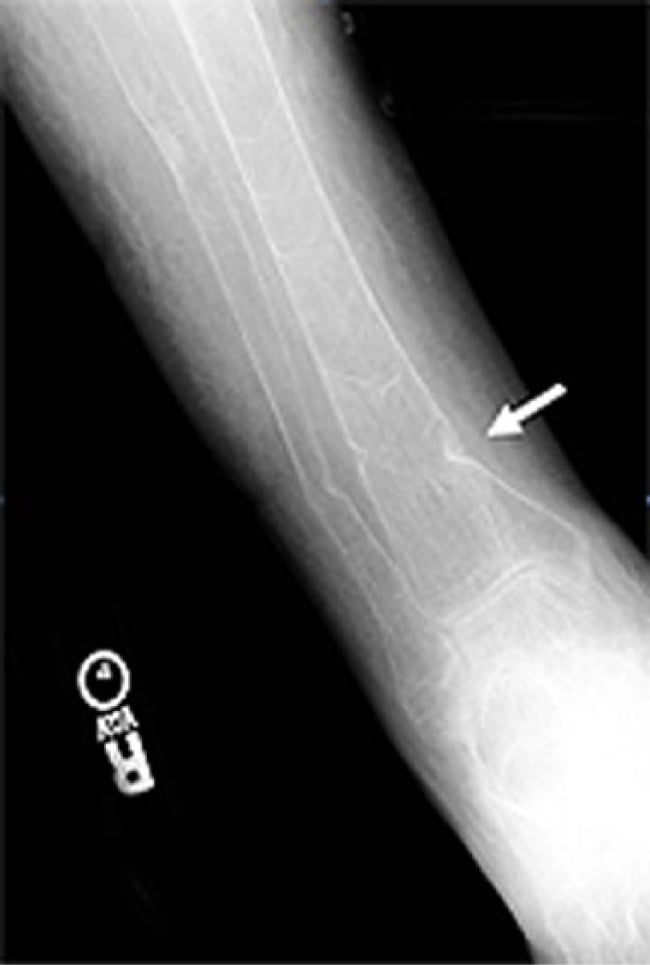
The rest of the film. Generalised osteopenia, cortical thinning and a coarsened trabecular pattern, with pathological fractures at the sites of Looser zones.
Further imaging if needed. A bone scan shows multiple symmetric hot spots at the Looser zones, MRI shows bone marrow oedema at pseudofracture sites, and CT assesses fracture risk and helps plan surgery.
DEXA. Bone mineral density is low (T-score less than -2.5 at spine or hip), but DEXA alone cannot distinguish osteomalacia from osteoporosis, so the biochemistry is essential to the diagnosis.
Bone biopsy. Biopsy is the gold standard but is rarely needed in practice, because the diagnosis is typically made on clinical, biochemical and radiographic grounds. It is an iliac crest biopsy with tetracycline double-labelling, processed as undecalcified sections for histomorphometry. The indications:
- Diagnostic uncertainty after clinical, biochemical and radiographic evaluation
- Suspected hypophosphatasia or a rare mineralisation disorder
- Excluding other bone diseases, such as renal osteodystrophy or osteopetrosis
What biopsy shows. In vitamin D deficiency osteomalacia:
- Increased osteoid volume, greater than 15% (normal less than 5%)
- Widened osteoid seams, greater than 12 micrometres thick
- Prolonged mineralisation lag time, greater than 100 days (normal less than 25 days)
- Reduced mineralisation surface, with tetracycline double-labelling showing a delayed mineralisation front
Diagnosis and Differential
Making the diagnosis. A low 25-OH vitamin D with the supporting biochemical pattern above makes the diagnosis, with a normal or elevated 1,25-dihydroxy vitamin D. Looser zones on radiographs confirm osteomalacia.
Q: Why is alkaline phosphatase elevated in vitamin D deficiency osteomalacia?
A: Osteoblast hyperactivity. Osteoblasts continue to produce osteoid (unmineralised bone matrix) but cannot mineralise it for lack of calcium and phosphate, so osteoid accumulates in large amounts and osteoblast activity rises. Alkaline phosphatase is an osteoblast enzyme, so levels rise markedly. In osteoporosis ALP is normal, because bone formation is simply reduced and there is no excess osteoid production.
Differential diagnosis. Several conditions mimic vitamin D deficiency osteomalacia, especially when the biochemistry is only partly typical. The pattern of calcium, phosphate, ALP, PTH and 25-OH vitamin D usually separates them.
- Calcium
- Low-normal or low
- Phosphate
- Low
- ALP / PTH
- ALP high, PTH high
- Discriminating feature
- Low 25-OH vitamin D, Looser zones, responds to D
- Calcium
- Normal
- Phosphate
- Normal
- ALP / PTH
- ALP normal, PTH normal
- Discriminating feature
- Normal biochemistry; fragility fractures, low BMD
- Calcium
- High
- Phosphate
- Low
- ALP / PTH
- ALP high, PTH high
- Discriminating feature
- Hypercalcaemia with non-suppressed PTH
- Calcium
- Low or high
- Phosphate
- High
- ALP / PTH
- ALP high, PTH very high
- Discriminating feature
- Reduced eGFR, high phosphate, low calcitriol
- Calcium
- Normal
- Phosphate
- Low
- ALP / PTH
- ALP high, PTH normal
- Discriminating feature
- Normal 25-OH vitamin D, high renal phosphate wasting (FGF23)
- Calcium
- Normal or high
- Phosphate
- Normal or high
- ALP / PTH
- ALP LOW, PTH normal
- Discriminating feature
- Low ALP (the key clue), elevated pyridoxal-5-phosphate
- Calcium
- Normal
- Phosphate
- Normal
- ALP / PTH
- ALP very high, PTH normal
- Discriminating feature
- Focal disease, normal calcium/phosphate, classic radiology
Hypophosphatasia is the trap when ALP is low rather than high - never give bisphosphonates. Hypophosphataemic rickets/osteomalacia (XLH, tumour-induced) has a normal 25-OH vitamin D with isolated renal phosphate wasting and will NOT respond to standard cholecalciferol; it needs phosphate plus active vitamin D (or burosumab for FGF23-driven disease).
Management
Principles. Check the baseline 25-OH vitamin D first, because the level guides the dosing intensity. Replace with oral cholecalciferol (vitamin D3), preferred as more potent than D2, and add calcium. Oral absorption is adequate unless malabsorption is severe, so IV replacement is not used unless the situation is critical.
Vitamin D Replacement Phases
For 25-OH vitamin D below 25 nmol/L, give cholecalciferol 50,000 IU weekly for 6-8 weeks, or 4000-6000 IU daily for 8-12 weeks, with oral calcium 1000-1500 mg daily in divided doses with meals.
For moderate deficiency (25-50 nmol/L), give 3000-5000 IU daily or 20,000 IU weekly, either for 8-12 weeks.
Continue 800-2000 IU daily, lifelong if the risk persists, with calcium 1000-1200 mg daily from diet plus supplements if needed. Recheck 25-OH vitamin D at 3 months, aiming for greater than 75 nmol/L, the level that is optimal for bone health, fracture prevention and arthroplasty outcomes, then monitor annually once stable.
Check calcium and phosphate at 1, 3 and 6 months, then annually. PTH and alkaline phosphatase should normalise, on the timeline given under Prognosis. Repeat 25-OH vitamin D annually to confirm maintenance, and DEXA at 2 years to assess response.
In severe, prolonged deficiency with marked secondary hyperparathyroidism, rapid vitamin D and calcium replacement can cause hungry bone syndrome: profound hypocalcaemia and hypophosphataemia as the demineralised skeleton avidly takes up minerals. The risk factors are PTH greater than 150 pg/mL, very low vitamin D (less than 12.5 nmol/L) and prolonged deficiency. Monitor calcium closely in the first 2 weeks; IV calcium gluconate may be required if symptomatic tetany develops.
Malabsorption. Coeliac disease, Crohn's disease and bariatric surgery need higher doses, 50,000 IU weekly long-term or 3000-6000 IU daily. Check 25-OH vitamin D at 3 months to confirm an adequate rise, and consider IM or IV replacement in the rare patient with severe malabsorption.
Chronic kidney disease. Below an eGFR of 30 mL/min, activated vitamin D (calcitriol) is required, because standard cholecalciferol is ineffective without 1-alpha hydroxylation. The dose is calcitriol 0.25-1 microgram daily, titrated to PTH and calcium, with monitoring for hypercalcaemia and hyperphosphataemia.
Institutionalised elderly. Universal supplementation is recommended, 800-1000 IU daily with calcium 1200 mg daily, and in this group the combination with calcium reduces fracture risk. The Evidence Base below shows how far that finding travels: in unselected, vitamin D-replete adults, supplementation has not prevented fractures.
Treating the cause. Treat the underlying condition alongside replacement:
- Coeliac disease: a strict gluten-free diet restores absorption
- Inflammatory bowel disease: control the inflammation, and use the higher doses above
- Post-bariatric surgery: lifelong high-dose supplementation is mandatory
- Cholestatic liver disease: supplement the fat-soluble vitamins (A, D, E, K)
- Enzyme-inducing anticonvulsants and rifampicin: increase the vitamin D dose, or change to a non-inducing anticonvulsant
- Cholestyramine binds vitamin D: separate the doses by 4 hours
- Orlistat blocks fat absorption: avoid it or increase the dose
Sunlight. Encourage safe sun exposure, 10-15 minutes of midday sun on the arms and legs 2-3 times weekly, and avoid excessive sunscreen so that some UVB penetrates, balanced against the risk of skin cancer. Add the dietary sources above, and supplement universally in high-risk groups: the elderly, dark skin and high latitude.
Orthopaedic Implications
Fracture healing. Deficiency delays union or causes nonunion, because callus mineralisation is inadequate. There is too little calcium and phosphate to mineralise it, osteoblast function and differentiation are impaired, and angiogenesis is reduced (vitamin D regulates VEGF). Healing bone is mechanically weaker, and union takes 50-100% longer than in vitamin D-replete patients.
The fracture patient. Optimise vitamin D before elective fracture fixation, and replace aggressively after an acute fracture, at 50,000 IU weekly. Monitor union, which may need longer protected weight-bearing, and bone stimulation is worth considering if delayed union persists.
Before arthroplasty. Roughly one-third of arthroplasty patients are deficient preoperatively, and deficiency is markedly more frequent in periprosthetic joint infection. Consider measuring 25-OH vitamin D before elective arthroplasty, especially in high-risk patients, and delay surgery until repleted if deficiency is severe (less than 25 nmol/L). Where deficiency is found, optimise to greater than 50-75 nmol/L before surgery, as many units screen and do; aim for greater than 75 nmol/L, the level optimal before elective arthroplasty.
What deficiency costs the arthroplasty. The problems run from the operating table to the late follow-up:
- Intraoperatively, poor bone quality: soft bone, reduced screw purchase, and a risk of periprosthetic fracture during insertion, especially with press-fit stems
- Infection, with an odds ratio of 2.4, attributed to vitamin D's role in immune function
- Delayed mobilisation, because the proximal myopathy impairs rehabilitation, and a prolonged hospital stay
- Aseptic loosening from impaired osseointegration of uncemented implants
- Periprosthetic fracture with minimal trauma
Reading the infection link. The association is not proof of cause. Separately, the Maier study measured 25-OH vitamin D when the infection presented (see the Evidence Base), and high-quality outcome trials showing that correcting deficiency improves implant outcomes are still lacking.
After arthroplasty. Continue vitamin D and calcium indefinitely. Aggressive physiotherapy overcomes the muscle weakness, and thromboprophylaxis covers the risk of prolonged immobilisation.
Pathological fractures. In osteomalacia the high-risk sites are:
- Femoral neck, often bilateral, at sites of Looser zones
- Proximal femur: subtrochanteric and intertrochanteric
- Pelvis: pubic rami and sacrum
- Ribs, multiple and painful
- Vertebrae: compression fractures
Deficiency also brings progressive skeletal deformity (bowing) and accelerated osteoporosis.
Surgical Considerations
Medical management first. In pathological fractures, optimise medical management first with vitamin D and calcium replacement, and replace aggressively around the operation to accelerate healing.
The bone. Osteomalacic bone is soft and poorly mineralised, so screws have reduced purchase and holding power, and intraoperative fracture is more likely. Fix fractures with caution, spreading the load: longer plates with more screws, locking plates to minimise screw toggle, and cement augmentation for screw purchase, including in proximal femur fractures.
Prophylactic fixation. Looser zones involving greater than 50% of the cortex carry a high fracture risk. Impending fractures (Looser zones greater than 50% of the cortical width, symptomatic) are fixed prophylactically with an intramedullary nail or plate, optimising vitamin D before and after.
Arthroplasty fixation. Press-fit components may fail in poor-quality bone. Cemented fixation is preferred, and should be considered whenever the bone is very osteopenic.
- Standard Bone
- Good
- Osteomalacic Bone
- Poor - use locking screws
- Standard Bone
- Standard
- Osteomalacic Bone
- Extended with more screws
- Standard Bone
- Uncemented
- Osteomalacic Bone
- Cemented preferred
- Standard Bone
- 6-8 weeks
- Osteomalacic Bone
- 12+ weeks (3-6 months)
- Standard Bone
- 8-12 weeks
- Osteomalacic Bone
- 16-24 weeks
- Standard Bone
- 3 months
- Osteomalacic Bone
- 6+ months
Postoperative care. Continue replacement at 50,000 IU weekly with calcium 1200 mg daily, and extend the protected weight-bearing. Check calcium at 1 week and 1 month and vitamin D at 3 months postoperatively, expect PTH and ALP to normalise, and confirm union on serial radiographs. Long-term care is the lifelong maintenance and monitoring above, addressing the underlying cause if deficiency persists.
Prognosis and Outcomes
Biochemical response. The expected timeline:
- Calcium and phosphate normalise by 4-12 weeks
- PTH decreases by 3-6 months, and may take longer with severe secondary hyperparathyroidism
- Alkaline phosphatase declines by 6-12 months, and may rise at first as bone heals
Clinical response. The expected timeline:
- Bone pain improves by 6-12 weeks
- Muscle weakness reverses by 3-6 months as the proximal myopathy resolves
- Looser zones heal by 6-12 months, with radiographic evidence of mineralisation
- Fracture risk decreases once vitamin D is greater than 50 nmol/L
Poor prognostic factors. The outlook is worse with:
- Severe, prolonged deficiency, which may leave permanent skeletal deformities
- An uncontrolled underlying cause, such as malabsorption or chronic kidney disease
- Non-compliance with supplementation
- Concurrent osteoporosis, which may require additional antiresorptive therapy
Guidelines, Registries & Global Practice
Global Epidemiology
- Vitamin D deficiency or insufficiency affects an estimated 1 billion people worldwide
- Highest burden at high latitudes in winter, in darker-skinned populations, and in concealed-dress and institutionalized groups
- Nutritional rickets remains common in parts of South Asia, the Middle East and sub-Saharan Africa, and persists in migrant communities at high latitude
Side-by-Side Guidance
- Sufficiency target
- Over 75 nmol/L (at-risk)
- Key position
- Risk-based testing; treat deficiency with D2 or D3; no universal screening
- Sufficiency target
- 50 nmol/L (population)
- Key position
- 50 nmol/L meets needs of 97.5% of population; cautions against higher targets
- Sufficiency target
- Over 50 nmol/L; 400 IU/day intake
- Key position
- Population intake advice; treat symptomatic deficiency
- Sufficiency target
- Infants 400 IU/day
- Key position
- Supplementation plus food fortification to eradicate nutritional rickets
High- vs Limited-Resource Practice
- High-resource settings: ready 25-OH vitamin D assays, fortified foods, and cholecalciferol availability; debate is about screening intensity and targets.
- Limited-resource settings: assays may be unavailable and diagnosis is clinical plus radiographic; emphasis shifts to public-health prevention (food fortification, antenatal and infant supplementation) over individual testing.
- Calcium deficiency (low dietary intake) is a co-driver of rickets in some low-income regions, so calcium as well as vitamin D may be needed.
Be able to state the controversy: thresholds differ between the Endocrine Society (over 75 nmol/L) and the IOM (50 nmol/L), and large RCTs (VITAL) show no fracture benefit in replete adults - so target treatment to genuine deficiency, not the whole population.
Controversies and Areas of Uncertainty
The exam-relevant debates in vitamin D centre on who to test, what level to aim for, and when supplementation actually helps.
Societies disagree. The US Institute of Medicine treats 50 nmol/L (20 ng/mL) as adequate for the population, whereas the Endocrine Society and many bone specialists favour over 75 nmol/L for at-risk patients. Higher targets risk over-treatment; lower targets risk under-treating true skeletal disease.
The VITAL trial (25,871 unselected US adults) found vitamin D 2000 IU daily did not reduce fractures, falls or cancer in people who were not deficient. The benefit seen in older meta-analyses is concentrated in deficient, institutionalized or co-supplemented (calcium) populations - argue against blanket supplementation.
Deficiency is common before arthroplasty and is associated with infection, but there is no high-quality RCT proving that correcting it improves implant outcomes. Practice ranges from routine screening to risk-based testing only.
Weekly loading (e.g. 50,000 IU weekly) is standard, but single very large annual boluses (e.g. 500,000 IU) have been associated with a paradoxical increase in falls and fractures and are now discouraged.
Related pages: Osteomalacia and Rickets are the same disease of defective mineralisation in the mature and growing skeleton respectively, and are what severe deficiency actually produces; Calcium Homeostasis and Metabolic Bone Disease holds the PTH-calcium-phosphate axis that makes sense of every biochemical pattern on this page, with Hyperparathyroidism covering the secondary form that deficiency drives and the primary form that must be distinguished from it; Osteoporosis is the commonest reason a surgeon checks a vitamin D level, and Bisphosphonates is the reason it must be corrected first - an antiresorptive given to a deficient patient risks symptomatic hypocalcaemia and will not work properly; DEXA and Bone Densitometry and Metabolic Bone Imaging cover the imaging that distinguishes low bone mass from unmineralised osteoid, including the Looser zone; Bone Healing and Nonunion Management are where the Brinker card belongs clinically - screen the unexplained nonunion metabolically before operating again; Glucocorticoid-Induced Secondary Osteoporosis is a common coexisting cause of fragility; XLH and Oncogenic Osteomalacia covers the phosphate-wasting mimics that do not respond to plain vitamin D; and Periprosthetic Joint Infection is the association the Maier card reports, where reverse causation has never been excluded.
MCQ Practice Points
Q: What is the threshold for severe vitamin D deficiency?
A: 25-OH vitamin D less than 25 nmol/L (less than 10 ng/mL). This level is associated with high risk of osteomalacia, rickets, secondary hyperparathyroidism, and pathological fractures. Requires urgent replacement with high-dose cholecalciferol (50,000 IU weekly for 6-8 weeks).
Q: What is the appropriate vitamin D replacement regimen for severe deficiency (25-OH vitamin D less than 25 nmol/L)?
A: Cholecalciferol 50,000 IU weekly for 6-8 weeks, followed by maintenance 800-2000 IU daily. Alternative: 4000-6000 IU daily for 8-12 weeks. Always add calcium 1000-1500 mg daily. Recheck 25-OH vitamin D at 3 months - target greater than 75 nmol/L for optimal bone health.
Q: Why does vitamin D deficiency cause proximal muscle weakness?
A: Vitamin D receptors (VDR) in skeletal muscle regulate calcium-dependent muscle contraction. Deficiency impairs myocyte calcium homeostasis, causing Type II muscle fiber atrophy (fast-twitch fibers). Clinical manifestations: waddling gait, difficulty rising from chair, difficulty climbing stairs. Resolves with vitamin D replacement over 3-6 months.
Q: Why should you screen for vitamin D deficiency before elective arthroplasty?
A: Roughly one-third of arthroplasty patients are vitamin D deficient preoperatively, and 25-OH vitamin D is significantly lower in patients with periprosthetic joint infection. Deficiency is associated with delayed mobilization and is biologically linked to impaired osseointegration and immune function. Many units screen and optimize to over 50-75 nmol/L before surgery, though high-quality RCT evidence that correction improves implant outcomes is still lacking.
Q: What is hungry bone syndrome and when does it occur in vitamin D deficiency treatment?
A: Hungry bone syndrome occurs when rapid vitamin D and calcium replacement in severe, prolonged deficiency causes profound hypocalcemia and hypophosphatemia as the demineralized skeleton avidly takes up minerals. Risk factors: marked secondary hyperparathyroidism (PTH greater than 150 pg/mL), very low vitamin D (less than 12.5 nmol/L), prolonged disease. Monitor calcium closely in first 2 weeks of treatment. May require IV calcium gluconate if symptomatic tetany develops.
D2 versus D3: Which Form to Prescribe
Cholecalciferol (D3) is generally preferred as the more potent form, yet the Endocrine Society guidance (Holick 2011) records that either vitamin D2 or D3 is acceptable for treating deficiency - an apparent tension worth resolving.
- The two forms. Cholecalciferol (D3) is the form made in skin and found in animal foods; ergocalciferol (D2) is plant/fungal-derived and the traditional high-dose prescription form. Both are 25-hydroxylated in the liver and then activated in the kidney by the same pathway.
- Why D3 is generally preferred. Dose-for-dose, D3 raises and sustains serum 25-OH-D more effectively than D2: D3's 25-hydroxy metabolite binds vitamin D binding protein with higher affinity and is cleared more slowly (longer half-life), so it holds a higher steady-state level. D2 is metabolised and cleared faster, and large intermittent D2 doses can even transiently lower measured 25-OH-D3. This difference matters most for maintenance and for intermittent (weekly / monthly) or bolus regimens.
- When it does not matter. For correcting simple deficiency with frequent (daily or weekly) dosing, either form works, which is why the Endocrine Society accepts D2 or D3. D2 remains useful as a vegetarian/vegan-acceptable prescription high-dose option and where D3 is unavailable.
- The exam answer. Prefer D3 (especially for maintenance and intermittent dosing); accept D2 as an equivalent option for correcting deficiency and for patients who need a non-animal source.
Q: Is cholecalciferol (D3) or ergocalciferol (D2) better for treating vitamin D deficiency? A: Both are activated by the same hepatic-then-renal pathway and either corrects deficiency (Endocrine Society), but D3 is generally preferred because, dose-for-dose, it raises and sustains 25-OH-D more effectively - its 25-OH metabolite binds vitamin-D-binding-protein tighter and clears more slowly (longer half-life), which matters most for maintenance and intermittent/bolus dosing. D2 remains a useful vegetarian/vegan-acceptable prescription option.
Replete Vitamin D Before Any Antiresorptive
- Why replete first. A vitamin-D-deficient skeleton is in a PTH-driven, calcium-hungry state, leaning on bone resorption to defend the serum calcium. Giving a potent antiresorptive (bisphosphonate or denosumab) switches off that resorption while the gut is still absorbing calcium poorly, and can precipitate severe symptomatic hypocalcaemia - the classic denosumab / zoledronate hypocalcaemia trap. So check and correct 25-OH-D and calcium, and confirm normocalcaemia, before the first antiresorptive dose.
- Do not treat osteomalacia with a bisphosphonate. Antiresorptives treat osteoporosis (too little otherwise-normal bone); osteomalacia is unmineralised osteoid, which a bisphosphonate does not fix and may worsen by further suppressing turnover. Because DEXA cannot separate the two (it reads both as low BMD), a low-BMD patient with the osteomalacic biochemical pattern (low phosphate, high ALP, high PTH, low 25-OH-D, Looser zones) must be repleted and re-assessed, not simply started on an antiresorptive.
- The sequence. Replete vitamin D and calcium, confirm calcium/phosphate/ALP/PTH have normalised and any osteomalacia has healed, then re-measure BMD and start an antiresorptive only if genuine osteoporosis persists.
Q: A patient with a low DEXA T-score is found to be vitamin D deficient - can you start a bisphosphonate? A: Not yet. Correct the vitamin D and calcium first and confirm normocalcaemia - giving a bisphosphonate or denosumab to a deficient, PTH-driven skeleton can cause severe hypocalcaemia. And be sure you are not treating osteomalacia (unmineralised osteoid - low phosphate, high ALP/PTH, low 25-OH-D, Looser zones), which DEXA cannot distinguish from osteoporosis and which a bisphosphonate does NOT fix. Replete, re-assess biochemistry and BMD, and start an antiresorptive only if genuine osteoporosis persists.
Exam Viva Scenarios
Practise clinical reasoning and management decisions out loud
“A 68-year-old woman is listed for total knee arthroplasty. Preoperative blood tests show 25-OH vitamin D 22 nmol/L, calcium 2.1 mmol/L, PTH 145 pg/mL, alkaline phosphatase 180 U/L. What is your assessment and management?”
“A 52-year-old man presents with tibial shaft fracture nonunion 9 months post-intramedullary nailing. Initial fracture was low-energy. He smokes 10 cigarettes daily. Blood tests show 25-OH vitamin D 28 nmol/L. How do you assess and manage this nonunion?”
“A 14-month-old child presents with delayed walking and bowing of the legs. X-rays show widened metaphyses with cupping and fraying at the distal femur and proximal tibia. Blood tests show 25-OH vitamin D 18 nmol/L, calcium 1.9 mmol/L, phosphate 0.8 mmol/L, PTH 220 pg/mL, alkaline phosphatase 650 U/L. How do you diagnose and manage this child?”
Key Pathophysiology
- Vitamin D deficiency leads to reduced intestinal calcium absorption
- Compensatory secondary hyperparathyroidism (PTH elevates to maintain calcium)
- PTH causes bone resorption and renal phosphate wasting (hypophosphatemia)
- Inadequate calcium and phosphate impairs mineralization - osteomalacia (adults) or rickets (children)
Vitamin D Thresholds
- Severe deficiency: less than 25 nmol/L (less than 10 ng/mL)
- Deficiency: 25-50 nmol/L
- Insufficiency: 50-75 nmol/L
- Optimal for bone health: 75-125 nmol/L
- Target for arthroplasty: greater than 75 nmol/L
Clinical Features
- Adults: Bone pain, proximal myopathy (waddling gait, difficulty rising), fractures
- Children: Bowing deformities, rachitic rosary, delayed milestones, craniotabes
- Proximal muscle weakness: hip flexors, shoulder abductors (vitamin D receptors in muscle)
- Looser zones (pseudofractures): bilateral, symmetric, perpendicular to cortex
Replacement Protocol
- Severe deficiency (less than 25 nmol/L): Cholecalciferol 50,000 IU weekly for 6-8 weeks
- Maintenance: 800-2000 IU daily (lifelong if risk persists)
- Always add calcium 1000-1500 mg daily
- Recheck 25-OH vitamin D at 3 months - target greater than 75 nmol/L
- Special populations: malabsorption requires higher doses (3000-6000 IU daily), CKD requires calcitriol
Orthopaedic Implications
- Delayed fracture healing - prolonged by 50-100%, risk of nonunion
- Arthroplasty complications: increased infection (OR 2.4), delayed mobilization, aseptic loosening
- Screen preoperatively - optimize to greater than 75 nmol/L before elective surgery
- Pathological fractures: prophylactic fixation for Looser zones greater than 50% cortex
- Soft bone - poor screw purchase, consider cemented fixation, cement augmentation
Complications
- Hungry bone syndrome: rapid replacement causes profound hypocalcemia (demineralized skeleton avidly takes up minerals)
- Risk factors: PTH greater than 150, vitamin D less than 12.5 nmol/L, prolonged deficiency
- Monitor calcium closely first 2 weeks, may require IV calcium gluconate
- Secondary hyperparathyroidism: appropriate response to hypocalcemia (not primary HPT)
Evidence Base and Key Studies
Vitamin D and Fracture Prevention
- Meta-analysis of double-blind RCTs in adults aged 60 and over (5 RCTs for hip fracture, n=9294; 7 RCTs for nonvertebral fracture, n=9820)
- Cholecalciferol 700-800 IU daily reduced hip fracture by 26% (pooled RR 0.74) and any nonvertebral fracture by 23% (pooled RR 0.77) vs calcium or placebo
- Low-dose 400 IU daily showed no significant fracture benefit (hip RR 1.15)
- All included trials used cholecalciferol; benefit seen in both ambulatory and institutionalized elderly
Vitamin D Deficiency and Periprosthetic Joint Infection
- Single-centre study measuring serum 25-OH vitamin D across primary arthroplasty (n=109), aseptic loosening (n=31) and periprosthetic joint infection (n=50)
- Low vitamin D levels were common in all subgroups, reflecting high baseline prevalence in arthroplasty patients
- 25-OH vitamin D was significantly lower in periprosthetic joint infection than in primary arthroplasty or aseptic loosening (p less than 0.001)
- Vitamin D was framed as a modifiable immune mediator potentially relevant to infection risk
Metabolic and Endocrine Abnormalities in Nonunions
- Case series: 37 nonunion patients meeting screening criteria (unexplained nonunion, multiple low-energy fractures, or non-displaced pubic rami/sacral nonunion) referred to endocrinology
- 31 of 37 (84%) had at least one new metabolic or endocrine diagnosis
- Vitamin D deficiency was the most common new finding (25 of 37 patients, 68%)
- 8 patients achieved union with medical treatment alone (no further surgery), at a mean of 7.6 months