Creep | Stress Relaxation | Hysteresis | Rate-Dependent
- Viscoelasticity = Time-dependent mechanical behaviour combining viscous and elastic properties
- Creep = Progressive deformation under constant load
- Stress relaxation = Force decreases at constant deformation
- Hysteresis = Energy lost as heat during loading-unloading cycles
- Strain-rate sensitivity = Stiffer and stronger at higher loading rates
- “All biological tissues are viscoelastic
- “Ligaments, tendons, and intervertebral discs exhibit strong viscoelastic behaviour
- “Creep explains loss of fracture reduction over time
- “Stress relaxation explains why initial cast tension decreases
Overview
Viscoelasticity is time-dependent mechanical behaviour that combines the characteristics of viscous fluids and elastic solids. A purely elastic material returns to its original shape the moment it is unloaded; a viscoelastic material shows time-dependent strain and stress responses instead.
Two components. The elastic component stores energy and provides immediate, reversible deformation. The viscous component dissipates energy and causes time-dependent, irreversible flow.
Why it matters. All biological tissues behave viscoelastically. Their viscoelastic properties determine how they respond to physiological and traumatic loads, how implants interact with them, and how injuries occur.
Principles and Mechanisms
The ideal solid. An elastic material obeys Hooke's law: stress is proportional to strain. Deformation is instantaneous and completely reversible, the energy is stored, and there is no time dependence.
The ideal fluid. A viscous material obeys Newton's law of viscosity: stress is proportional to strain rate. Deformation is permanent, the energy is dissipated as heat, and the behaviour is rate-dependent.
The viscoelastic material. It combines the two, so its response depends on both the magnitude and the rate of strain. Deformation has an immediate and a time-dependent component, and some of the energy is stored while some is dissipated.
How the time dependence shows. The response depends on how fast the load is applied. The material goes on deforming after the load has stopped changing, and when it is held at a constant deformation the force required falls with time.
Temperature. Viscoelastic properties are temperature-dependent: higher temperatures increase viscous behaviour and lower temperatures increase elastic behaviour. This is relevant to cryopreserved tissues and to temperature effects on implants.
Key Viscoelastic Phenomena
Creep
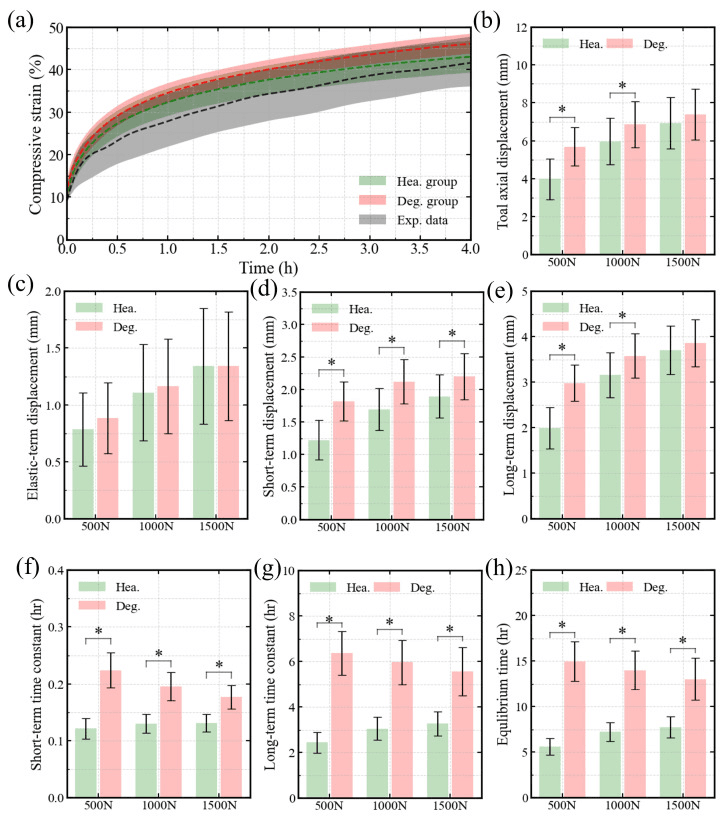
Creep is a progressive increase in deformation under constant load. The viscous component allows the material to keep deforming although the load does not change. Deformation is rapid at first, then slows asymptotically toward equilibrium.
The three phases. A creep curve shows primary and secondary creep, and sometimes tertiary creep:
- Primary creep: rapid initial deformation at a decreasing rate
- Secondary creep: a constant, steady-state rate of deformation
- Tertiary creep: accelerating deformation leading to failure
Where it shows. Creep lies behind the daily loss of disc height, the loss of a fracture reduction held in a cast or external fixator, the elongation of ligament grafts under constant tension and the deformation of polyethylene, each taken up with its tissue or implant below. It is also how a scoliosis brace works, applying a constant force that produces gradual correction, and it is why total disc replacement devices may subside into the endplates.
Stress Relaxation
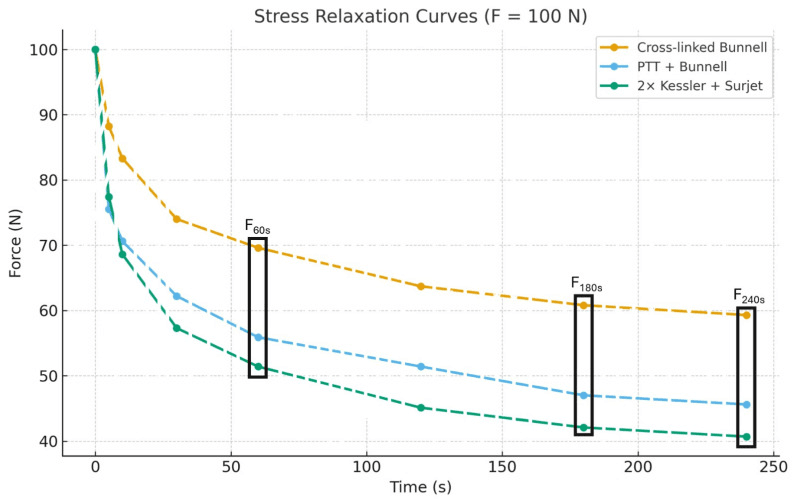
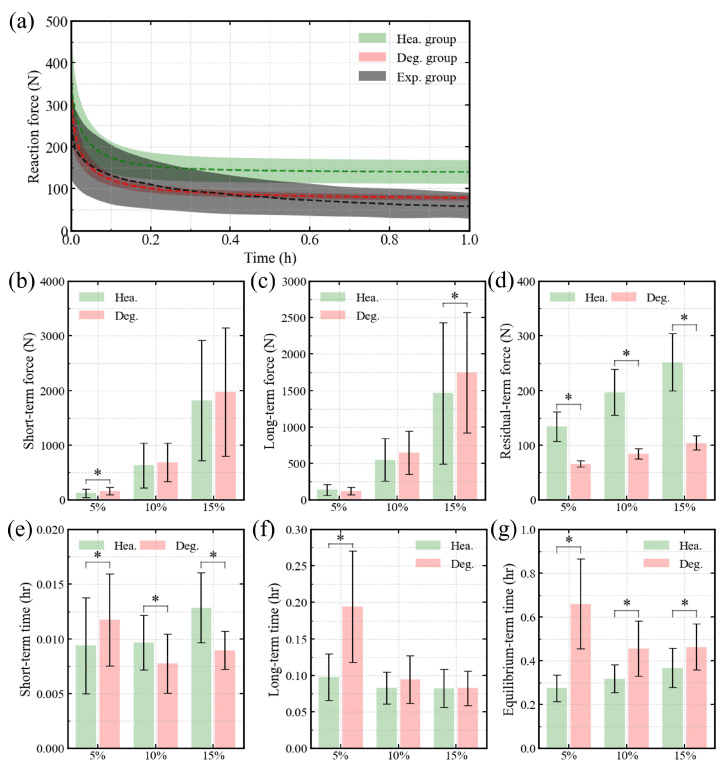
Stress relaxation is a progressive decrease in the force required to maintain a constant deformation. At constant strain the internal stresses redistribute and decrease, because the viscous component allows molecular rearrangement.
Time course. The decay is exponential. Most of the relaxation occurs in the first minutes to hours, and it continues at a slower rate for days to weeks.
Where it shows. Casts become loose as the initial swelling subsides and the tissues relax. Only the second of these is stress relaxation, which is why the distinguishing clue in the table further down is tension falling while limb girth is unchanged. A fracture reduction maintained by ligamentotaxis loses tension over time; graft, plate and fixator-wire tension are covered under clinical implications.
Hysteresis
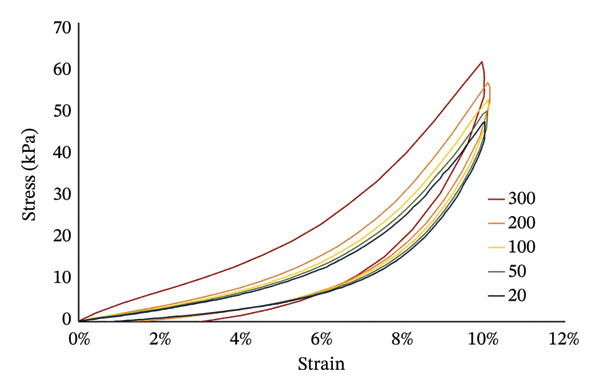
Hysteresis is the energy dissipated when a material is loaded and then unloaded. The energy absorbed during loading is not completely recovered during unloading, so the two curves do not overlap: the loading curve lies above the unloading curve and the difference is dissipated as heat. The area of the loop on the stress-strain curve is the energy lost, and a larger area means more dissipation.
Why it matters. Hysteresis is a protective mechanism: tissues absorb impact energy through it, which protects deeper structures, and it affects the damping of vibrations and impacts. Ligaments and intervertebral discs show significant hysteresis. Repeated loading causes cumulative energy dissipation, which may contribute to tissue heating during repetitive loading.
Strain-Rate Sensitivity
The mechanical properties depend on the rate at which load is applied. Materials are stiffer and stronger at higher strain rates and more compliant at lower rates. At high rates the viscous component has less time to flow and the material behaves more elastically; at low rates viscous flow contributes more.
How large is the effect? It depends on the tissue, and the answer is smaller than usually taught. In bone, Carter and Hayes found that strength and modulus scale with strain rate to the power of 0.06: real, but modest, since a thousandfold increase in rate raises them by roughly half. In ligament the effect can be smaller still.
The ligament data. Dorlot tested 38 canine ACLs across strain rates spanning more than three orders of magnitude (0.12 to 220% per second) and found the mechanical behaviour not sensitive to strain rate within that range. Human studies show only modest effects within physiological rates. The dramatic rate effects appear mainly at extreme impact rates and at the bone-ligament junction, where failure shifts between avulsion and mid-substance with rate. Both the bone and the canine ligament papers are carded in the Evidence Base.
The safe position for an examination. Rate-dependence is a genuine property of every biological tissue, its magnitude varies by tissue and is often modest, and the common claim that slow bench testing greatly underestimates in-vivo strength is better supported for bone than for ligament. That applies equally to the teaching that static tests underestimate tissue strength during dynamic activities and that ligaments tear in sport at higher loads than in laboratory testing. Impact testing still gives different results from quasi-static testing, and physiological loading rates should be used when testing.
CRHSViscoelastic Phenomena
Hook:CRHS: the four viscoelastic behaviours every tissue shows
Mathematical Models
The models build tissue behaviour from two ideal elements: a spring, the elastic element, and a dashpot, the viscous element.
Maxwell model. Spring and dashpot in series. It models stress relaxation well: under constant strain, stress decreases exponentially, with a relaxation time equal to viscosity divided by elastic modulus. Under constant load it predicts instantaneous elastic deformation followed by continued viscous flow, that is, infinite deformation, so it does not model creep accurately.
Kelvin-Voigt model. Spring and dashpot in parallel. It models creep well, giving a delayed elastic response: deformation under constant load is time-dependent but ultimately reaches the elastic equilibrium value. It predicts no instantaneous deformation, which is unrealistic, and it cannot model stress relaxation.
Standard linear solid. A three-parameter combination of Maxwell and Kelvin-Voigt elements that models both creep and stress relaxation: an instantaneous elastic response, followed by a time-dependent response approaching equilibrium. It is the most realistic simple model for biological tissues, approximates actual tissue behaviour better, and is used in finite element modelling.
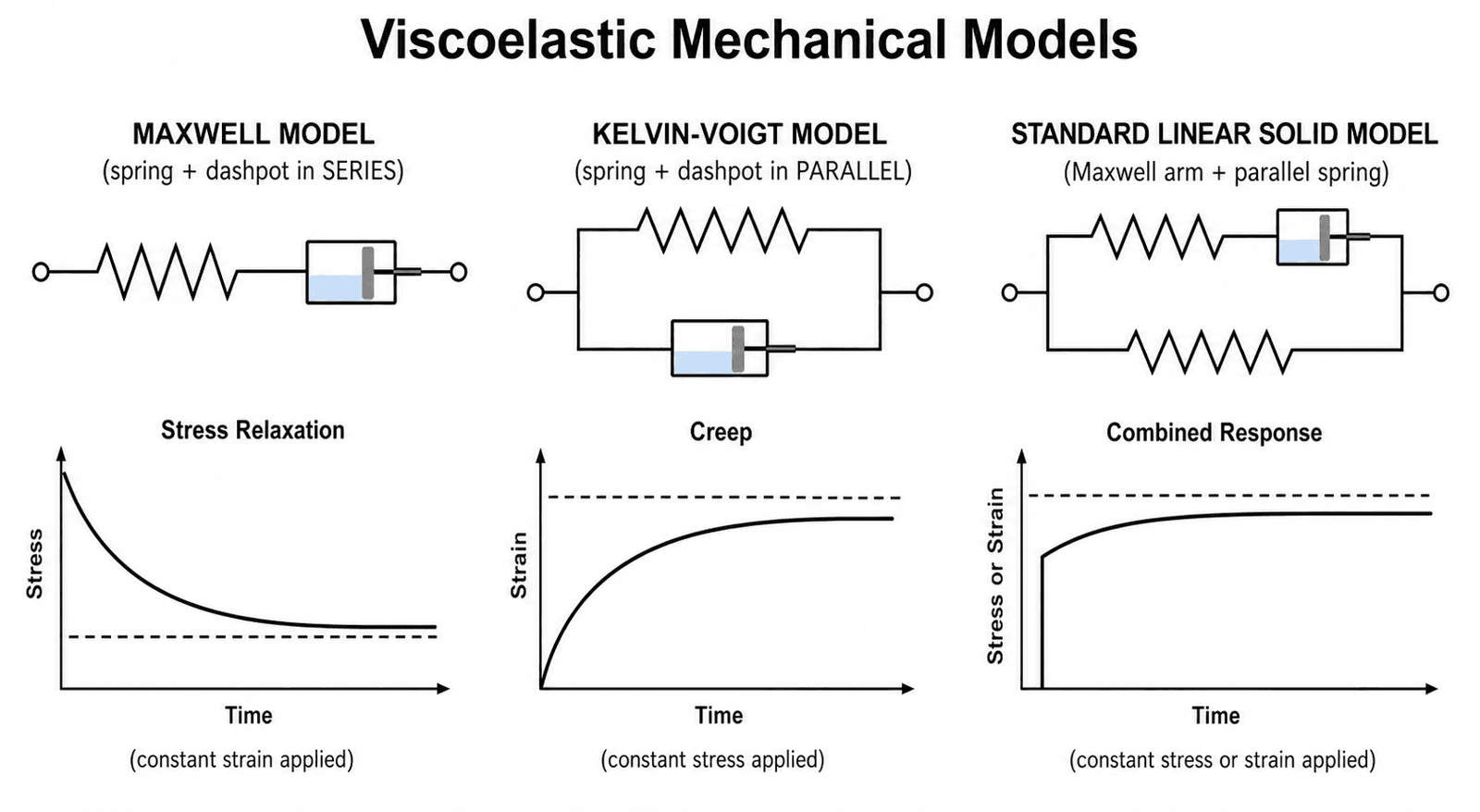
Beyond three elements. A generalised Maxwell model places multiple Maxwell elements in parallel and fits stress relaxation data better; a generalised Kelvin-Voigt model places multiple Kelvin-Voigt elements in series and fits creep data better. Quasi-linear viscoelasticity (QLV), proposed by Fung, is an advanced model for soft tissues that separates the time-dependent and strain-dependent responses.
Tissue Composition and Viscoelasticity
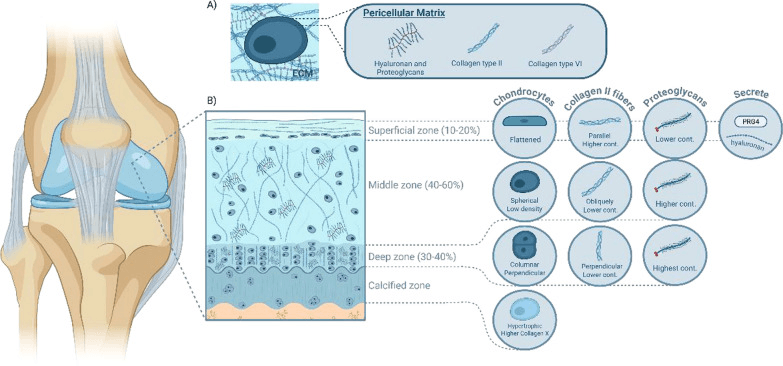
The solid phase. Collagen fibres form the structural framework and provide elastic stiffness; their crimp pattern allows initial compliance, and uncrimping contributes to the toe region. Proteoglycans hydrate the matrix, trap water within it and resist fluid flow, contributing to the time-dependent response. Elastin provides elastic recoil.
The fluid phase. Interstitial water, and its flow through the matrix, contributes to the viscous behaviour. Water content, and with it the degree of viscoelasticity, varies by tissue.
- Water Content
- 60-80%
- Viscoelasticity
- High (biphasic)
- Water Content
- 70-90%
- Viscoelasticity
- Very high
- Water Content
- 60-70%
- Viscoelasticity
- Moderate-high
- Water Content
- 10-20%
- Viscoelasticity
- Low-moderate
Fluid flow is the viscous behaviour. High water content means a more viscoelastic tissue, and degeneration reduces fluid content.
Clinical Applications in Orthopaedics
Bone. Bone is moderately viscoelastic, more viscous when wet, and rate-sensitive. Its creep is minimal compared with soft tissues and matters in long-term loading. At impact rates it is much stronger and stiffer and fails more brittly, so high-energy fractures have more comminution; cortical bone Young's modulus increases approximately 30% at physiological strain rates compared with quasi-static loading. Bone density measurement may vary with loading rate.
Articular cartilage. Cartilage is highly viscoelastic because fluid flows through its solid matrix, so a biphasic model (solid matrix plus fluid) is required. Under a constant load fluid exudes and cartilage thickness decreases with sustained loading, recovering when the load is removed. Joint loading patterns affect cartilage health: cyclic loading may be protective, and prolonged static loading may be harmful.
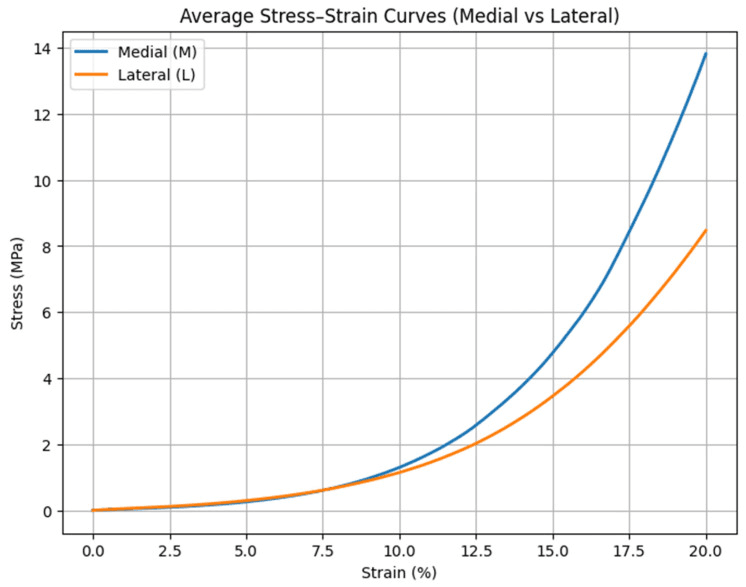
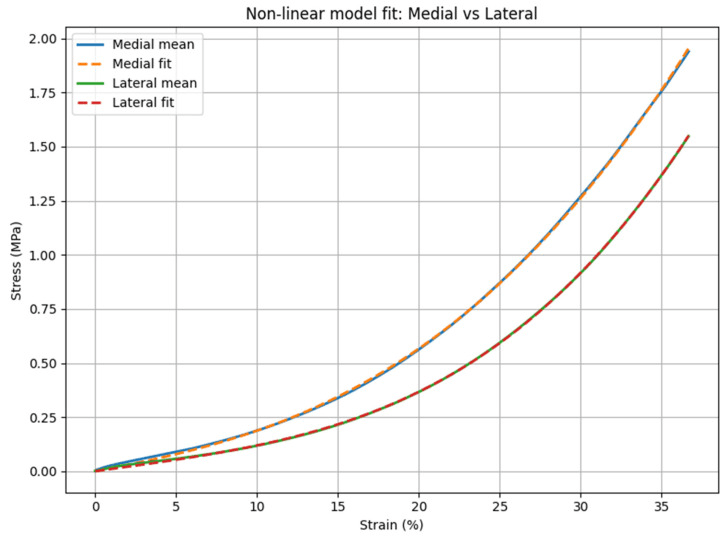
Ligaments and tendons. These are strongly viscoelastic and exhibit all four phenomena. Their hysteresis dissipates energy and protects the joint during impact, while repeated loading causes progressive damage. Graft creep and relaxation are covered under clinical implications, and preconditioning has its own section.
Intervertebral disc. The disc is highly viscoelastic through fluid movement in the nucleus pulposus and annulus fibrosus. Under body weight fluid exudes and disc height decreases during the day, recovering overnight when the spine is unloaded in the recumbent position; young adults may lose up to 20 mm of height during a typical day. When the spine is held in a fixed position, intradiscal pressure decreases.
The disc in practice. Diurnal variation affects spinal mechanics, and morning stiffness relates to overnight fluid accumulation. Disc degeneration alters the viscoelastic properties.
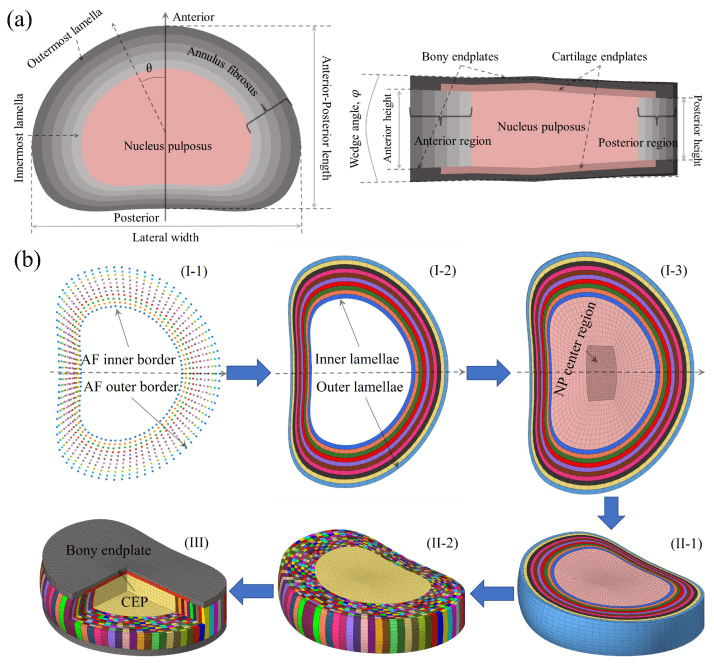
Meniscus. The meniscus is moderately viscoelastic, and collagen fibre orientation affects its behaviour. Viscoelastic damping absorbs impact and protects the articular cartilage from shock loading. Meniscal tears alter the viscoelastic properties, and meniscectomy removes the shock-absorbing function.
Clinical Implications
Fracture fixation. Alignment maintained by a cast or external fixator may worsen over time through creep of the soft tissues, and serial radiographs monitor for loss of reduction. Compression plates lose some compression force over weeks, while dynamic compression continues as bone resorbs and remodels. External fixator and circular frame wires lose tension over days and may require retensioning.
Ligament reconstruction. The initial tension applied during ACL reconstruction decreases through stress relaxation. Some surgeons pretension grafts cyclically; others retension, or account for the expected relaxation. Viscoelastic creep may contribute to residual laxity after reconstruction, so proper initial tension is important.
Spine. The disc's viscoelastic properties allow it to share load with the facets over time and affect intradiscal pressure measurements. Viscoelastic settling affects construct behaviour after instrumentation, and loss of disc height after fusion affects adjacent segments.
Arthroplasty. Ultra-high molecular weight polyethylene is viscoelastic: creep contributes to its deformation and wear, and highly crosslinked polyethylene reduces creep. In soft-tissue balancing, ligament stress relaxation affects stability, and an initially tight balance may loosen.
Injury. High-energy trauma produces different injury patterns from low-energy trauma, with different bone fragments and different soft-tissue damage. Dashboard injuries differ from gradual compression injuries.
Testing and Measurement
- Protocol
- Apply a constant load; measure deformation over time and plot strain against time
- Result
- Creep curve
- Parameters measured or application
- Initial elastic strain, time-dependent strain, creep rate, equilibrium strain
- Protocol
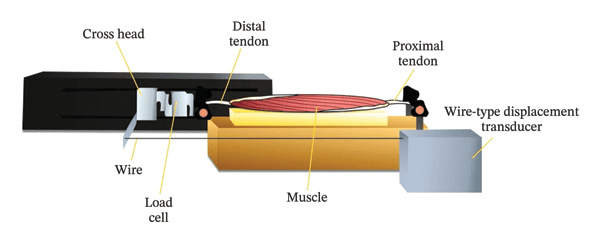
- Apply a constant deformation; measure force over time and plot stress against time
- Result
- Decay curve
- Parameters measured or application
- Initial stress, relaxation time constant, equilibrium stress
- Protocol
- Cyclically load and unload the specimen; plot stress against strain for a complete cycle
- Result
- Hysteresis loop
- Parameters measured or application
- Loop area (energy dissipated), loop width
- Protocol
- Apply a sinusoidal oscillating load; measure the resulting strain
- Result
- Storage modulus, loss modulus, phase lag
- Parameters measured or application
- Characterises frequency-dependent viscoelastic properties
Complex Modulus and the Loss Tangent (tan delta)
Storage modulus, loss modulus and phase lag are the numbers examiners use to turn the qualitative idea of hysteresis into a measurable material property.
The phase lag. When a sinusoidal strain is applied, stress and strain are out of phase by a phase angle delta, and this lag is the fingerprint of viscoelasticity. The angle places the material between the two ideals:
- Purely elastic solid: zero degrees; stress and strain exactly in phase, all energy stored and returned
- Purely viscous fluid: ninety degrees; stress leads strain by a quarter cycle, all energy dissipated
- Viscoelastic material: between zero and ninety degrees; the closer to ninety, the more viscous (dissipative) the behaviour
The complex modulus. The complex (dynamic) modulus is written E* = E' + iE''. The storage modulus (E') is the in-phase component: the elastic energy stored and recovered each cycle, the solid-like stiffness contribution. The loss modulus (E'') is the out-of-phase component: the energy dissipated as heat each cycle, the viscous damping contribution.
The loss tangent. tan delta = E'' / E' is the damping coefficient, a single dimensionless number for how lossy a material is. A larger tan delta means more energy dissipated per cycle and a larger hysteresis loop, so it is the frequency-domain counterpart of loop area. Because viscous flow is rate-dependent, E', E'' and tan delta all vary with loading frequency, which is exactly why the same tissue shows strain-rate sensitivity.
Clinical relevance. Damping, a high tan delta, is how the meniscus, intervertebral disc, articular cartilage and heel fat pad attenuate impact and protect the underlying bone and cartilage. Degeneration and ageing reduce tissue tan delta, so more shock is transmitted. Implant liners, shock-absorbing insoles and prosthetic feet are selected partly on their damping behaviour.
Preconditioning
What it is. Preconditioning is the application of several cycles of loading and unloading, to a fixed strain or load, before any measurement is recorded. During the first few cycles the response is not reproducible: the stress-strain curve shifts, the peak stress at a given strain falls, and the hysteresis loop shrinks from cycle to cycle. After roughly the first several to ten cycles the loops superimpose and the tissue reaches a repeatable, steady-state ("preconditioned") response.
Why it happens. The tissue is reorganising internally toward a stable configuration. Crimped collagen fibres are progressively recruited and aligned, interstitial fluid and proteoglycan-bound water redistribute, and weak, labile inter-fibre bonds break; once these have equilibrated, successive cycles look identical.
In the laboratory. Mechanical properties must be measured from the preconditioned steady state, otherwise the data are irreproducible and cannot be compared between specimens. Standard biomechanical protocols precondition specimens, commonly for around ten cycles, before recording. Woo et al (1986) showed that hysteresis area was significantly reduced only in the first few loading cycles, the signature of preconditioning.
In the body. An athletic warm-up is preconditioning of living tissue. Cyclic sub-maximal loading stabilises the viscoelastic response, slightly lowers stiffness and dissipates the large first-cycle energy loss, which is one biomechanical rationale for warming up before sport. The very first loading cycle of the day (the first squat, the first pitch, the first steps out of bed) shows the largest hysteresis and the greatest tissue lengthening.
Not fatigue. Preconditioning is largely recoverable with rest. That distinguishes it from fatigue damage, in which microdamage accumulates and is permanent.
Differentiating the Viscoelastic Phenomena
The commonest exam error is confusing the four phenomena, or confusing viscoelastic creep with plastic deformation. The controlled variable tells them apart.
- Controlled (held constant)
- Load
- What changes
- Deformation increases over time
- Reversible?
- Yes (recovers when unloaded)
- Distinguishing clinical clue
- Disc/stature shortens through the day, recovers overnight
- Controlled (held constant)
- Deformation (strain)
- What changes
- Force/stress decays over time
- Reversible?
- Partly
- Distinguishing clinical clue
- Cast or graft tension falls though limb girth unchanged
- Controlled (held constant)
- Cyclic load-unload
- What changes
- Energy lost between curves
- Reversible?
- Energy not recovered
- Distinguishing clinical clue
- Shock absorption; loop shrinks with preconditioning
- Controlled (held constant)
- Nothing (rate varies)
- What changes
- Stiffness/strength rise with rate
- Reversible?
- Elastic at any single rate
- Distinguishing clinical clue
- High-energy trauma = comminution
- Controlled (held constant)
- Load beyond yield
- What changes
- Permanent deformation
- Reversible?
- No (irreversible)
- Distinguishing clinical clue
- Implant bending, bone fails past yield point
- Controlled (held constant)
- Repeated sub-yield cycles
- What changes
- Cumulative microdamage
- Reversible?
- No
- Distinguishing clinical clue
- Stress fracture, implant fatigue failure
Creep and stress relaxation are viscoelastic and largely recoverable (the disc rehydrates overnight; a relaxed graft is not torn). Plastic deformation and fatigue are permanent. In a viva, always state whether load or deformation is the controlled variable, and whether the change is recoverable.
Guidelines, Registries & Global Practice
Viscoelasticity is a basic-science principle rather than a disease, so there are no disease-specific society guidelines. Its translation into practice runs through implant-testing standards, registry-derived wear/loosening data, and curriculum frameworks that are shared worldwide.
Standards and Testing Frameworks
- Relevance to viscoelasticity
- Hip and bearing wear simulation; explicitly separates creep ("bedding-in") from true wear in polyethylene volume loss
- Relevance to viscoelasticity
- Knee wear simulation; early polyethylene deformation is dominated by creep before steady-state wear
- Relevance to viscoelasticity
- Characterisation and specification of UHMWPE and highly-crosslinked PE, the principal viscoelastic implant material
- Relevance to viscoelasticity
- Fracture-fixation teaching that compression and reduction are partly lost to soft-tissue and implant stress relaxation over time
Registry Signals
Arthroplasty registries do not measure viscoelasticity directly, but its consequences appear as outcomes. The NJR (UK), AOANJRR (Australia), AJRR (US) and SHAR/Swedish registries consistently show lower revision for wear/osteolysis with highly-crosslinked polyethylene than with conventional UHMWPE, consistent with reduced creep and wear of crosslinked material. Registry data therefore serve as the large-scale clinical correlate of the bench creep findings (Williams et al, 2003).
High- vs Limited-Resource Practice
- Practical handling of viscoelastic effects
- Specify load history, strain rate, temperature, hydration and preconditioning; compare like-for-like protocols and report time-dependent as well as equilibrium response
- Practical handling of viscoelastic effects
- Interpret settling, graft tension, alignment and bearing penetration in their full mechanical and biological context; serial change is not attributable to viscoelasticity alone
Education: Viscoelasticity is core basic-science curriculum in orthopaedic training worldwide, where candidates are expected to define creep, stress relaxation, hysteresis and rate-dependence and apply them to fixation, grafting and bearing surfaces.
Related pages: Articular Cartilage Structure holds the biphasic composition that makes cartilage time-dependent, and it is fluid flow through the solid matrix rather than intrinsic polymer viscosity that produces most of the behaviour described here; Intervertebral Disc Biology is the tissue in which creep is most visible clinically, through diurnal stature loss and the foraminal narrowing the Pollintine card measures; Ligament Biology and Tendon Healing carry the crimp-and-collagen structure behind the toe region, hysteresis and the stress relaxation that loosens a graft after fixation; Polyethylene UHMWPE and XLPE and Highly Crosslinked Vitamin E Polyethylene cover the bearing material whose creep must be distinguished from true wear - a distinction that confounds every gravimetric simulator study including the one carded here; Tribology and Wear and Wear Mechanisms separate those two processes formally; Implant and Fracture Biomechanics applies stress relaxation to construct stability, and Ilizarov External Fixation is where it bites hardest, since wire tension falls measurably in the days after frame application; and Joint Biomechanics: Spine, Hip and Knee place these tissue properties into whole-joint loading.
Controversies & Areas of Uncertainty
Is cartilage time-dependence viscoelasticity or fluid flow? Biphasic theory (Mak, Lai and Mow, 1987; Setton, Zhu and Mow, 1993) shows that cartilage creep is dominated by flow-dependent drag of interstitial fluid through a porous matrix, not by intrinsic solid-matrix viscoelasticity. Lumping both together as "viscoelastic" is a simplification examiners may probe.
Disc or vertebra in spinal creep? It is widely taught that the disc drives diurnal height loss. Pollintine et al (2010) showed that the vertebral bodies deform more elastically and that the disc contributes only about half of creep, with the balance from the vertebrae and neural-arch impaction.
Does graft pretensioning improve outcomes? Cyclic pretensioning reduces in-vitro stress relaxation. High-quality clinical evidence that it lowers residual laxity or improves patient-reported outcomes after ACL reconstruction remains limited and inconsistent.
Polyethylene creep or wear? Early polyethylene penetration on radiographs reflects a mix of creep ("bedding-in") and true wear. Separating the two is non-trivial and affects how early radiographic penetration is interpreted (Williams et al, 2003).
MCQ Practice Points
Q: What is creep in viscoelastic materials? A: Progressive increase in deformation under constant load. Example: disc height decreases during the day under body weight.
Q: What is stress relaxation? A: Progressive decrease in force required to maintain constant deformation. Example: casts become loose as tissues relax.
Q: What does hysteresis represent? A: Energy dissipation during loading-unloading cycles. Area between loading and unloading curves represents energy lost as heat.
Q: What does the Maxwell viscoelastic model consist of? A: Spring and dashpot in series. Models stress relaxation behavior well.
Q: What does the Kelvin-Voigt model consist of? A: Spring and dashpot in parallel. Models creep behavior well.
Q: How do materials behave at higher strain rates? A: Stiffer and stronger. High-energy trauma produces more comminuted fractures because bone is stronger but more brittle at impact rates.
Exam Viva Scenarios
Practise clinical reasoning and management decisions out loud
“What is viscoelasticity and how is it relevant to orthopaedic tissues?”
“Explain the difference between creep and stress relaxation with clinical examples.”
“How does strain-rate sensitivity affect injury patterns in high-energy versus low-energy trauma?”
Core Concepts
- Time-dependent behavior combining elastic and viscous properties
- All biological tissues are viscoelastic
- Four key phenomena: CRHS mnemonic
- Temperature-dependent behavior
Creep
- Constant load → increasing deformation
- Example: disc height loss during day
- Example: fracture reduction loss in cast
- Three phases: primary, secondary, tertiary
Stress Relaxation
- Constant deformation → decreasing force
- Example: cast becomes loose over time
- Example: ACL graft loses initial tension
- Exponential decay with time
Hysteresis
- Energy dissipation in loading cycles
- Loading and unloading curves differ
- Area between curves = lost energy
- Protective impact absorption
Strain-Rate Sensitivity
- Higher rates → stiffer and stronger
- High-energy trauma causes comminution
- Static testing underestimates dynamic strength in BONE; in ligament the effect is small across physiological rates (Dorlot)
- Physiological rates needed for testing
Mathematical Models
- Maxwell (series): stress relaxation
- Kelvin-Voigt (parallel): creep
- Standard Linear Solid: both behaviors
- QLV for soft tissues (Fung)
Clinical Applications
- Bone: moderate viscoelasticity, rate-sensitive
- Ligaments: strong viscoelasticity, all phenomena
- Disc: highly viscoelastic, diurnal variation
- Cartilage: biphasic, fluid flow effects
Key Numbers
- Stature (whole spine, all discs plus soft tissue): 15-20mm lost over a day - a single motion segment averages only about 2mm (Pollintine)
- Bone: strength and modulus scale with strain rate to the power 0.06 - about 50% stiffer per thousandfold rate increase (Carter and Hayes)
- Wire tension: decreases over days-weeks
- Preconditioning: stabilizes tissue response
Evidence Base
Foundational textbooks (Fung's Biomechanics: Mechanical Properties of Living Tissues, Springer; Lakes' Viscoelastic Materials, Cambridge University Press) remain the standard references for quasi-linear viscoelastic theory and the spring-dashpot models, and are cited as Guideline-level core texts.
Carter and Hayes - The compressive behavior of bone as a two-phase porous structure
- Trabecular bone tested over strain rates of 0.001 to 10 per second
- Both strength and modulus were proportional to strain rate raised to the 0.06 power
- Strength proportional to the square, and modulus to the cube, of apparent density
- Marrow enhanced properties only at the highest strain rate via restricted viscous flow
Mak, Lai and Mow - Biphasic indentation of articular cartilage: theoretical analysis
- Derived the biphasic (KLM) solution for indentation creep and stress relaxation of cartilage
- Instantaneous response governed by the solid-matrix shear modulus (behaves incompressible at t=0)
- Transient creep and relaxation controlled by frictional drag of interstitial fluid flow (inversely proportional to permeability)
- Allows intrinsic material properties to be extracted from indentation tests
Setton, Zhu and Mow - Biphasic poroviscoelastic behavior of articular cartilage: role of the surface zone
- Confined-compression creep of bovine osteochondral plugs with and without the surface zone
- In intact cartilage, flow-dependent mechanisms (frictional drag plus fluid pressurization) alone described creep
- Surface removal increased permeability and creep rate, shifting load support onto the solid matrix
- The articular surface maintains low permeability to sustain interstitial fluid pressurization
Pollintine et al - Time-dependent compressive deformation of the ageing spine
- 117 cadaveric thoracolumbar motion segments creep-loaded at 1 kN for up to 2 hours
- The disc contributed 51 percent of creep deformation; vertebral bodies showed greater elastic deformation
- Total 2-hour compressive deformation averaged 2.24 mm and rarely exceeded 3 mm
- Creep increased with age as intradiscal pressure fell with disc degeneration
Butler et al - Location-dependent variations in the material properties of the anterior cruciate ligament
- Human cadaveric ACL subunits failed in tension at a constant strain rate of 100 percent per second
- Anterior bundles stiffer and stronger (modulus 284 vs 155 MPa; max stress 38 vs 15 MPa) than posterior
- Strain energy density to maximum stress was higher in anterior bundles
- Regional heterogeneity is relevant to graft selection and reconstruction
Dorlot et al - Load elongation behavior of the canine anterior cruciate ligament
- 38 canine ACLs tested over strain rates from 0.12 to 220 percent per second
- Mechanical behavior was NOT sensitive to strain rate within the physiologic range tested
- Reversible (elastic) range limited to about 14 percent elongation (around 200 N)
- Freezing stiffened the ligament; behavior was stable from room temperature to 45 C
Woo et al - Effects of postmortem storage by freezing on ligament tensile behavior
- Rabbit MCL-bone complexes tested fresh versus after 1.5 to 3 months frozen at minus 20 C
- Cyclic stress relaxation and load-deformation behavior were unchanged by careful freezing
- Hysteresis area was significantly reduced only in the first few loading cycles
- Supports controlled freezing for storage of test specimens
Williams et al - Wear and deformation of ceramic-on-polyethylene hip replacements with microseparation
- Hip simulator study of ceramic-on-polyethylene bearings with swing-phase microseparation
- Microseparation locally deformed the polyethylene rim, attributed to creep
- Crosslinked PE volume change fell from 25.6 to 5.6 mm3 per million cycles under microseparation
- Polyethylene creep and viscoelastic deformation influence bearing wear behavior