Bankart or Latarjet? Glenoid Bone Loss, ISIS and the Glenoid Track
Bankart vs Latarjet for anterior shoulder instability: how glenoid bone loss, the glenoid track and the ISIS decide the operation, and what the trials show.
By OrthoVellum Editorial TeamPublished 12 min read
Educational content for clinicians, not medical advice. Editorial policy
Key points
- Bone loss decides the operation. In Burkhart and De Beer's 194 arthroscopic Bankart repairs, recurrence was 4% without significant bone defects and 67% with them (89% in contact athletes).
- Glenoid loss has two thresholds that answer different questions: about 20–25% predicts re-dislocation after an isolated Bankart, and about 13.5% marks where function deteriorates even in shoulders that stay in.
- The glenoid track (0.83 × glenoid diameter minus the glenoid defect) is compared with the Hill-Sachs interval. Off-track lesions had 74% recurrent instability at about 10 years after isolated Bankart repair, against 27% for on-track lesions.
- In a multicentre RCT of primary surgery in men aged 16–25, redislocation at 2 years was 21% after arthroscopic Bankart and 2% after open Latarjet; the Latarjet carries a higher overall complication rate.
- For an off-track Hill-Sachs with subcritical glenoid loss, Bankart plus remplissage is the main alternative to Latarjet; the head-to-head randomised trial (STABLE) is still running.
On this page9 sections
A young patient has had a third anterior dislocation, and the question on the list is Bankart vs Latarjet: repair the labrum, or transfer the coracoid? The short answer is that bone decides. An arthroscopic Bankart repair is a soft-tissue operation and works when the glenoid arc is close to intact and the Hill-Sachs lesion stays on-track. Once glenoid loss reaches the critical range, or a deficient glenoid is paired with an engaging humeral lesion, a bony procedure such as the Latarjet is the operation that holds. This post sets out how to measure that, the two thresholds, the glenoid track, the ISIS, and what the trials show. The clinical background is on the anterior shoulder instability topic page.
Why does bone loss decide the operation?
A Bankart repair reattaches the anteroinferior labrum and capsule to the glenoid rim. It restores a soft-tissue bumper and ligament tension, but it cannot restore a rim that is no longer there. The paper that made this concrete is Burkhart and De Beer (2000): 194 consecutive arthroscopic Bankart repairs, 101 of them in contact athletes, mostly South African rugby players.
They defined significant bone defects as an inverted-pear glenoid or an engaging Hill-Sachs lesion. Recurrence was 4% in the 173 shoulders without them and 67% in the 21 with them. In contact athletes the figures were 6.5% and 89%. Their conclusion was that patients with significant bone deficits are not candidates for arthroscopic Bankart repair, and that with significant glenoid loss the surgeon should consider a Latarjet with a large coracoid graft.
Bone loss is also progressive. In the MOON Shoulder Instability cohort of 892 patients (Hettrich and colleagues, 2023 (opens in a new tab)), the number of prior dislocations was the factor most strongly associated with glenoid loss, Hill-Sachs lesions and combined lesions. Each additional dislocation raised the odds of a combined lesion by 95%. A shoulder that would have done well with a Bankart repair after the second episode may need a bony procedure after the sixth. The Bankart lesions page covers the soft-tissue lesion itself.
How is glenoid bone loss measured?
The view. The inferior glenoid is normally close to a circle. On an en-face (sagittal-oblique) 3D reconstruction, a best-fit circle is drawn on the intact inferior glenoid and the defect is expressed as a percentage of it. 3D CT is the reference standard; 3D MRI has been validated as an alternative and spares the radiation. In unilateral instability, the contralateral glenoid can serve as the template.
The method. The two common methods do not give the same number for the same defect. The width (linear) method expresses the defect width as a fraction of the circle's diameter, and tends to read slightly higher. The surface-area (Pico) method expresses the missing area as a fraction of the circle. Any percentage quoted against a threshold should state which was used.
Plain films. They do not quantify loss, but they screen for it. The West Point axillary and Bernageau views show the anteroinferior rim; the AP in external rotation and the Stryker notch view profile the Hill-Sachs lesion. Two of the ISIS items, worth four of its ten points, come from the AP radiograph.
At arthroscopy. The inverted pear corresponds to substantial loss, conventionally quoted at about 25–30%. The full measurement technique, with worked CT figures, is on the glenoid bone loss assessment page.
Critical and subcritical: what do 20% and 13.5% mean?
The classical critical threshold is about 20–25% glenoid loss. Above it, an isolated soft-tissue Bankart repair fails too often, and bony reconstruction is the standard answer. Di Giacomo, Itoi and Burkhart described glenoid grafting at 25% or more as the consensus of recent authors.
The subcritical figure comes from Shaha and colleagues (2015): 72 patients (73 shoulders) after isolated arthroscopic Bankart repair at a single military institution, divided into quartiles of glenoid loss, followed for a mean of 48 months. Re-dislocation did not differ across the lower three quartiles (7.3% combined) and rose to 27.8% in the top quartile (20–35.5% loss). So 20% is the right number if the question is whether the shoulder will dislocate again.
Function told a different story. WOSI scores worsened with every quartile, and above 13.5% loss they reached a level consistent with a poor clinical outcome. This held even in patients who never re-dislocated. A shoulder that stays in after a Bankart repair at 17% loss has not necessarily done well.
Two cautions keep this from becoming a rule. The cohort was young, military and under high mandatory activity, close to the worst case, and the study was a level III retrospective cohort. And the long view is mixed: in Lau and colleagues' 17-year follow-up of 75 patients after arthroscopic Bankart repair, 29% had re-dislocated, but redislocation was not related to the initial severity of glenoid loss. Function was impaired with loss of 7% or more, which the authors judged not severe enough to warrant a different operation. The threshold debate is not settled, and the honest position is a band of increasing concern from about 13.5% upwards, weighed against the patient.
What is the glenoid track?
Glenoid loss is half of a bipolar problem. The other half is the Hill-Sachs lesion, the posterolateral humeral head impaction, and the two interact. A Hill-Sachs lesion causes instability only if the glenoid rim can drop into it.
Yamamoto and colleagues (2007) (opens in a new tab) mapped glenoid contact on the humeral head in nine cadaveric shoulders in abduction, external rotation and horizontal extension. The contact zone, the glenoid track, had a medial margin about 18.4 mm from the cuff footprint, equivalent to 84% of the glenoid width. A Hill-Sachs lesion that extends medial to that margin can engage. Di Giacomo, Itoi and Burkhart (2014) turned this into the on-track/off-track method used clinically:
- Glenoid track width = 0.83 × the diameter of the inferior glenoid circle, minus the width of the anterior glenoid defect.
- Hill-Sachs interval (HSI) = the width of the Hill-Sachs lesion plus the bone bridge between its medial edge and the cuff footprint.
- If the HSI is greater than the track, the lesion is off-track and engages. If it is smaller, it is on-track.
Because the glenoid defect is subtracted from the track, the same Hill-Sachs lesion can move from on-track to off-track as the glenoid erodes. That is the bipolar interaction in a single calculation. The humeral side is covered in Hill-Sachs lesions.
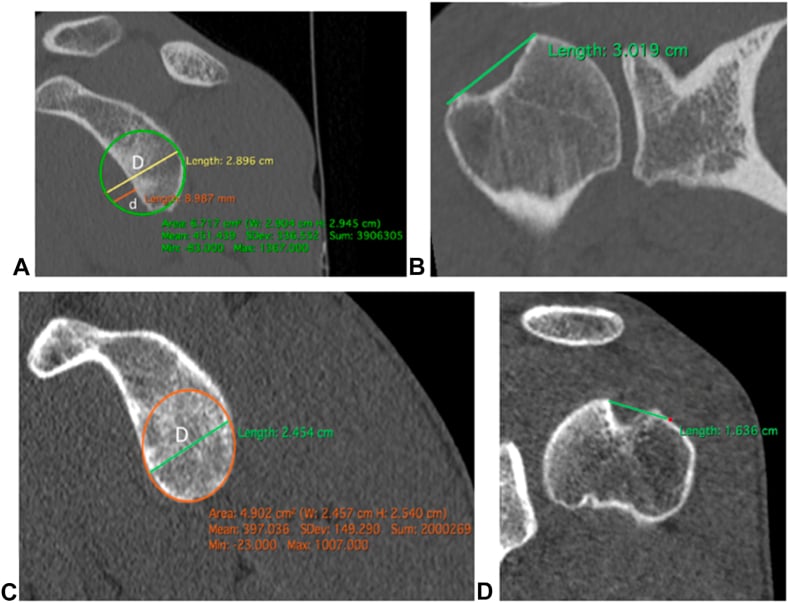
Working the figure. In panel A the circle diameter is about 29 mm and the defect about 9 mm, so the track is 0.83 × 29 − 9, roughly 15 mm. The HSI in panel B is about 30 mm, twice the track: off-track. In panel C the diameter is about 24.5 mm with no defect, giving a track of about 20 mm, and the HSI in panel D is about 16 mm: on-track.
Does it predict failure? At Balgrist, Schwihla and colleagues (2023) applied the method to 163 shoulders after isolated arthroscopic Bankart repair, followed for a mean of 124 months. Recurrent instability (dislocation, subluxation or apprehension, or revision) occurred in 74% of off-track shoulders and 27% of on-track ones. Revision for instability was 48% against 13%. Their conclusion: an off-track lesion should be converted to on-track at surgery.
What does the ISIS add?
Bone measurements say nothing about the patient's age or sport. Balg and Boileau's Instability Severity Index Score combines both into a 10-point preoperative score, derived from 131 patients after arthroscopic Bankart repair with a mean follow-up of 31 months.
| ISIS item | Criterion | Points |
|---|---|---|
| Age at surgery | 20 or under | 2 |
| Level of sport | Competitive | 2 |
| Type of sport | Contact or forced overhead | 1 |
| Shoulder hyperlaxity | Present | 1 |
| Hill-Sachs lesion | Visible on the AP radiograph in external rotation | 2 |
| Glenoid contour | Loss of the sclerotic inferior contour on the AP radiograph | 2 |
A score over 6 carried a recurrence risk of 70% after arthroscopic Bankart repair, and the authors stopped offering it to those patients in favour of a Bristow-Latarjet. The score was tested retrospectively on the same population that generated it, and external validation has been variable. In the Finnish randomised trial below, mean ISIS was under 3 in both arms, yet 21% of the Bankart group re-dislocated within two years, and neither the ISIS nor its components was significantly associated with early failure. Use the ISIS to flag the high-risk patient; use the CT to decide what the bone needs.
Other modifiers sit outside the score: a first dislocation before 20, many prior dislocations, seizures (which drive very high recurrence and bilateral disease), generalised laxity, and occupational demand in soldiers and collision athletes.
What does the trial evidence show?
A randomised trial of primary surgery. Kukkonen and colleagues (2022) randomised 122 men aged 16–25 with recurrent traumatic anteroinferior instability after a first dislocation treated non-operatively, across eight Finnish public hospitals. Bony Bankart and Hill-Sachs lesions were not exclusions; about a third of each arm had a glenoid defect the trial defined as significant (defect length at least half the glenoid width on en-face CT). At two years, with 91 patients analysed (25% loss to follow-up):
- Redislocation: 21% (10 patients) after arthroscopic Bankart against 2% (1) after open Latarjet (p=0.006).
- Return to the previous top level of competitive sport: 1 patient (9%) against 5 (56%).
- No significant difference in any other secondary outcome, including WOSI.
The population was young men only, follow-up was two years, and the dropout rate was high, so the result does not transfer directly to older or lower-demand patients.
Meta-analyses. An earlier review (An and colleagues, 2016 (opens in a new tab)) pooled eight retrospective comparative studies and found lower recurrence after Latarjet. A 2024 meta-analysis by Hossein Zadeh and colleagues included 21 studies (3 RCTs) and 13,176 shoulders. After arthroscopic Bankart the risk of recurrence and revision for instability was about three times higher (RR 3.08, 95% CI 2.03–4.68). The Bankart group had about 47% fewer total complications (RR 0.53, 95% CI 0.31–0.90).
What the Latarjet costs. In Griesser and colleagues' systematic review of 45 level IV studies (1,904 shoulders), the total complication rate after Bristow-Latarjet was 30%. Recurrent dislocation was 2.9%, recurrent subluxation 5.8%, and unplanned reoperation about 7%. The musculocutaneous and axillary nerves are most at risk, and the suprascapular nerve is endangered by screws exiting posteriorly. Graft position drives the late problems: a graft placed too lateral risks arthritis, one placed too medial risks recurrence.
Durability. Hovelius and colleagues (opens in a new tab) followed 118 Bristow-Latarjet repairs for 15 years: 98% of patients were satisfied and redislocation was rare. Pending their radiological follow-up, the authors recommended the operation only for revision after failed surgery, by surgeons familiar with it, so the series supports durability rather than routine primary use. The steps are in the Latarjet coracoid transfer operative guide.
Where does remplissage fit?
Remplissage fills the Hill-Sachs defect with posterior capsule and infraspinatus, converting an off-track lesion into an extra-articular, functionally on-track one. It is added to an arthroscopic Bankart repair, and it is the main alternative to the Latarjet when the humeral side is the dominant problem and glenoid loss is subcritical. Technique is on the remplissage page.
- Bankart with or without remplissage. In MacDonald and colleagues' RCT (108 patients, Hill-Sachs lesion with glenoid loss under 15%), recurrent instability at two years was 18% without remplissage against 4% with it, with 6 revisions against none. Patient-reported outcomes did not differ.
- Bankart plus remplissage against Latarjet. Haroun and colleagues (2020) pooled four comparative studies (379 patients, mostly level III) with engaging lesions and subcritical glenoid loss. Recurrence was similar (RR 0.72, 95% CI 0.37–1.41), and complications were about seven times more likely after Latarjet (RR 7.37). A later single-centre retrospective series of 108 patients with 20% loss or less reached the same conclusion in both primary and revision cases (Charles and colleagues, 2024 (opens in a new tab)).
- The trial that will answer it. STABLE is a multicentre RCT randomising 114 patients with recurrent instability and 10–20% glenoid loss (3D CT, best-fit circle) to Bankart plus remplissage or Latarjet, with WOSI at 24 months as the primary outcome. Its results are not yet published.
How do the numbers translate into an operation?
| Scenario | Bone status | Usual operation |
|---|---|---|
| Low-risk patient, minimal bone loss | Glenoid loss small; Hill-Sachs on-track | Arthroscopic Bankart repair |
| Off-track Hill-Sachs, limited glenoid loss | Engaging humeral lesion; glenoid subcritical | Bankart plus remplissage, or Latarjet |
| Subcritical loss in a high-risk patient | About 13.5–20% loss with high ISIS, collision sport or off-track lesion | Latarjet favoured; remplissage an option if the humeral side dominates |
| Critical glenoid loss | About 20–25% or more; inverted pear at the upper end | Latarjet or free bone block |
| Failed previous soft-tissue repair | Any, usually with progression | Bony procedure rather than a repeat isolated Bankart |
The rows overlap on purpose. Subcritical loss with an off-track lesion sits in two rows, and the choice between them rests on age, sport, laxity, the ISIS and the patient's view of a higher complication rate against a lower recurrence rate. For revision after a failed stabilisation, a systematic review of 16 studies (713 shoulders) found recurrence of 8.4% after open Latarjet, with redislocation in 0.9% (Ali and colleagues, 2021 (opens in a new tab)).
In the exam
Examiners rarely want a single answer. They want the reasoning in order: measure the bone, place the Hill-Sachs on the track, score the patient, then choose, and say what the alternative costs. Examination signs worth knowing for the clinical part are covered in shoulder special tests and their accuracy, and structuring the answer in passing the orthopaedic viva.
Frequently asked questions
How much glenoid bone loss needs a Latarjet?
Classically, glenoid loss of about 20–25% is the critical level above which an isolated soft-tissue Bankart repair re-dislocates too often (an inverted-pear glenoid at arthroscopy corresponds to roughly 25% or more), and a bony procedure such as the Latarjet is indicated. In a military cohort, function had already deteriorated above about 13.5%, so many surgeons consider augmentation in the subcritical range, particularly in young, high-demand patients or with an off-track Hill-Sachs lesion.
What is an off-track Hill-Sachs lesion?
The glenoid track is the zone of the humeral head that contacts the glenoid in abduction and external rotation. Its width is about 0.83 times the glenoid diameter minus the width of any glenoid defect. The Hill-Sachs interval is the lesion's width plus the bone bridge to the cuff footprint. If the interval is wider than the track, the lesion is off-track and will engage the glenoid rim.
Is the Latarjet better than an arthroscopic Bankart repair?
For preventing recurrence, the evidence favours the Latarjet: a Finnish RCT in men aged 16–25 found redislocation at 2 years in 21% after arthroscopic Bankart and 2% after open Latarjet, and a 2024 meta-analysis found about three times the risk of recurrence and revision after Bankart. The Latarjet has a higher overall complication rate, so the choice depends on bone loss and recurrence risk.
What is the Instability Severity Index Score (ISIS)?
The ISIS is Balg and Boileau's 10-point preoperative score built from age at surgery, level and type of sport, shoulder hyperlaxity, a Hill-Sachs lesion on the AP radiograph in external rotation and loss of the inferior glenoid contour. In the derivation cohort of 131 patients, a score over 6 carried a 70% recurrence risk after arthroscopic Bankart repair, and the authors suggested a Bristow-Latarjet instead.
Can Bankart repair with remplissage replace a Latarjet?
In selected patients, possibly. For an engaging or off-track Hill-Sachs lesion with subcritical glenoid loss, a 2020 meta-analysis of four comparative studies found similar recurrence after Bankart plus remplissage and Latarjet, with about seven times the complication risk after Latarjet. These were mostly level III studies; the STABLE randomised trial comparing the two in 10–20% glenoid loss is ongoing.
References
- Burkhart SS, De Beer JF. Traumatic glenohumeral bone defects and their relationship to failure of arthroscopic Bankart repairs: significance of the inverted-pear glenoid and the humeral engaging Hill-Sachs lesion. Arthroscopy 2000;16(7):677-694. DOI (opens in a new tab)
- Balg F, Boileau P. The instability severity index score. A simple pre-operative score to select patients for arthroscopic or open shoulder stabilisation. J Bone Joint Surg Br 2007;89(11):1470-1477. DOI (opens in a new tab)
- Di Giacomo G, Itoi E, Burkhart SS. Evolving concept of bipolar bone loss and the Hill-Sachs lesion: from 'engaging/non-engaging' lesion to 'on-track/off-track' lesion. Arthroscopy 2014;30(1):90-98. DOI (opens in a new tab)
- Shaha JS, Cook JB, Song DJ, et al. Redefining 'critical' bone loss in shoulder instability: functional outcomes worsen with 'subcritical' bone loss. Am J Sports Med 2015;43(7):1719-1725. DOI (opens in a new tab)
- Lau LC, Chau WW, Ng R, et al. Reconsidering 'critical' bone loss in shoulder instability: 17-year follow-up study following arthroscopic Bankart repair. Adv Orthop 2024;2024:5598107. DOI (opens in a new tab)
- Schwihla I, Wieser K, Grubhofer F, Zimmermann SM. Long-term recurrence rate in anterior shoulder instability after Bankart repair based on the on- and off-track concept. J Shoulder Elbow Surg 2023;32(2):269-275. DOI (opens in a new tab)
- Kukkonen J, Elamo S, Flinkkilä T, et al. Arthroscopic Bankart versus open Latarjet as a primary operative treatment for traumatic anteroinferior instability in young males: a randomised controlled trial with 2-year follow-up. Br J Sports Med 2022;56(6):327-332. DOI (opens in a new tab)
- Hossein Zadeh R, Daliri M, Sadeghi M, et al. Arthroscopic Bankart repair vs. Latarjet procedure for recurrent shoulder instability: a meta-analysis of clinical outcomes and complication rates in general and athletic populations. J Shoulder Elbow Surg 2024;33(12):e652-e674. DOI (opens in a new tab)
- Griesser MJ, Harris JD, McCoy BW, et al. Complications and re-operations after Bristow-Latarjet shoulder stabilization: a systematic review. J Shoulder Elbow Surg 2013;22(2):286-292. DOI (opens in a new tab)
- MacDonald P, McRae S, Old J, et al. Arthroscopic Bankart repair with and without arthroscopic infraspinatus remplissage in anterior shoulder instability with a Hill-Sachs defect: a randomized controlled trial. J Shoulder Elbow Surg 2021;30(6):1288-1298. DOI (opens in a new tab)
- Haroun HK, Sobhy MH, Abdelrahman AA. Arthroscopic Bankart repair with remplissage versus Latarjet procedure for management of engaging Hill-Sachs lesions with subcritical glenoid bone loss in traumatic anterior shoulder instability: a systematic review and meta-analysis. J Shoulder Elbow Surg 2020;29(10):2163-2174. DOI (opens in a new tab)
- Khan M, Bedi A, Degen R, et al; STABLE Investigators. Multicentre randomised controlled trial comparing Bankart repair with remplissage and Latarjet procedure in shoulder instability with subcritical bone loss (STABLE): study protocol. BMJ Open 2024;14(11):e089831. DOI (opens in a new tab)
Study the full topic
Included in Pro
Go deeper with Pro
See what Pro includesShare this article
Cite this article
OrthoVellum Editorial Team. Bankart or Latarjet? Glenoid Bone Loss, ISIS and the Glenoid Track [Internet]. OrthoVellum; 2026 Oct 2 [cited 2026 Oct 2]. Available from: https://www.orthovellum.com/blog/bankart-vs-latarjet
About this content
Prepared by the OrthoVellum Editorial Team from cited sources, under our editorial policy.
For education and exam preparation; not medical advice or a substitute for clinical judgement and local guidance.
Spotted an error? Tell us; every report is read.
Get new articles by email
New clinical explainers, landmark-trial summaries and exam guidance from the OrthoVellum blog. No account needed; unsubscribe from any email.