Motion-Preserving Surgery | Patient Selection Critical | Outcomes Improving
- TAA preserves motion (total sagittal arc about 30°, dorsiflexion the limiting direction) compared to the fixed ankle of an arthrodesis
- Ideal candidate: age 50-65, BMI under 30, intact ligaments, good bone stock, minimal deformity
- Contraindications: active infection, avascular necrosis of talus, severe neuropathy, inadequate bone stock
- Modern 3-component mobile-bearing designs show superior outcomes to fixed-bearing
- AOANJRR shows TAA revision rate 15% at 10 years vs 8% for ankle arthrodesis
- “TAA vs arthrodesis: give the motion and adjacent-joint benefits as the sizes they actually are. The long-term gait study cited here found sustained gains in cadence, step length and walking speed, but total sagittal ROM rose by only 2.0 degrees, and it had no fusion comparator. The adjacent-joint benefit is real but small in absolute terms: subtalar fusion at 5 years was 0.7% after replacement against 2.8% after arthrodesis - roughly 2 percentage points, set against a 5-year major revision rate running 23% versus 11% the other way
- “TARVA RCT (Ann Intern Med 2022): no significant difference between TAR and fusion in MOXFQ walking/standing at 1 year - both improve
- “Alignment critical: varus/valgus malalignment over 10° associated with early failure
- “Periprosthetic cysts common (40%) but not always clinically significant - monitor with CT
Overview and Epidemiology
Scope note. This page is the dedicated total ankle arthroplasty (TAR) procedure guide — implants, patient selection, technique and outcomes. For the full spectrum of ankle arthritis management (conservative care, arthrodesis, distraction arthroplasty, and the TAR-versus-fusion decision in context), see ankle arthritis.
What it is. Total ankle arthroplasty has evolved from a rarely performed procedure with poor outcomes to a viable motion-preserving alternative to ankle arthrodesis for end-stage ankle osteoarthritis with disability despite conservative management. It preserves ankle motion and improves objectively measured gait, and it reduces the need for later subtalar fusion, though by about two percentage points at five years rather than dramatically. Patient selection and surgical precision decide whether it succeeds.
Survivorship, stated precisely. The registries on this page do not support parity with hip and knee replacement. The National Joint Registry linkage study for England and Wales (PMID 37345846) reports 90.2% survival at five years; the Norwegian registry (PMID 17966015), the early registry-era benchmark, reports 89% at five years falling to 76% at ten, and its authors describe the revision rate as acceptable against other ankle series but high compared with total knee and hip arthroplasty. Every major registry finds the revision burden higher than for hip and knee replacement, so quote five-year figures around 90% and a ten-year figure closer to three-quarters, and do not claim the ankle has caught up. Registry data (AOANJRR, Norwegian, NJR) confirm the improvement over earlier designs in real-world practice.
Who has it. Mean age at surgery is 60 years, with 40-75 the optimal range. Post-traumatic arthritis accounts for 70% of cases, primary osteoarthritis 20% and inflammatory arthropathy 10%; the sexes are equally represented in post-traumatic disease, while females predominate in inflammatory arthritis. The intended patient is sedentary to moderately active, not the high-impact athlete or heavy labourer.
Indications and Contraindications
The primary indication is end-stage ankle arthritis in an appropriate candidate who has failed extensive conservative management. The best candidate profile: age 55, BMI 26, unilateral post-traumatic OA, sedentary-to-moderate activity, neutral alignment, intact ligaments, good bone stock, a non-smoker, compliant, with realistic expectations.
- Patient Characteristics
- Age 50-65, failed conservative management, disability
- Expected Outcome
- Pain relief, motion preservation, return to moderate activity
- Patient Characteristics
- Age over 50, low-moderate demand, good bone stock
- Expected Outcome
- Excellent pain relief, maintain independent gait
- Patient Characteristics
- RA, PsA with controlled disease, bilateral involvement
- Expected Outcome
- Pain relief superior to fusion, protect adjacent joints
- Patient Characteristics
- Nonunion or malunion of previous fusion, adequate bone stock
- Expected Outcome
- Restoration of motion, adjacent joint protection
Relative indications. Favourable but not ideal: these patients need counselling about increased complication risk and the possible need for staged procedures. Age over 60 brings lower activity demand and reduced implant stress, but the bone quality must still be good despite age. Bilateral ankle arthritis, where motion preservation is critical for gait, is staged 6 months apart if both ankles are replaced. Ipsilateral hindfoot or midfoot arthritis may need simultaneous or staged fusions. A correctable coronal deformity of 10-15° may need a staged supramalleolar osteotomy or ligament reconstruction first. A BMI of 30-35 raises complication risk without being an absolute bar: optimise weight and counsel about the increased failure risk.
Absolute contraindications. Do not attempt TAA in their presence: the failure rate is high and the complications can be catastrophic, and each should prompt strong consideration of arthrodesis as the safer alternative. A patient unable to follow the strict postoperative weight-bearing protocol is in the same category.
- Reason
- Cannot implant prosthesis in infected field
- Alternative
- Treat infection, then consider delayed reconstruction
- Reason
- Inadequate bone stock for component fixation - no platform for the component
- Alternative
- Tibiotalocalcaneal fusion or talar replacement
- Reason
- Charcot risk, poor protective sensation
- Alternative
- Ankle arthrodesis or accept conservative management
- Reason
- Wound healing compromised, amputation risk
- Alternative
- Vascular optimisation or acceptance of disability
- Reason
- Nonunion, infection, wound complications
- Alternative
- Must quit 6 weeks minimum before surgery
- Reason
- Uncorrectable, leads to edge loading
- Alternative
- Arthrodesis after deformity correction
- Reason
- Insufficient platform for component stability
- Alternative
- Bone grafting, structural allograft, or fusion
Relative contraindications. Proceed with extreme caution, because each increases the failure risk significantly; multiple risk factors together warrant counselling about a high probability of failure and an offer of fusion instead.
- Risk
- Higher activity demands, longer implant lifespan required
- Mitigation Strategy
- Consider fusion; if TAA, counsel about likely revision
- Risk
- High-impact loading leads to early failure
- Mitigation Strategy
- TAA incompatible with heavy manual work - consider fusion
- Risk
- Increased wound complications, implant stress, failure
- Mitigation Strategy
- Mandatory weight loss; delay surgery if BMI over 40
- Risk
- Wound healing concerns, infection risk, neuropathy
- Mitigation Strategy
- Optimise glycaemic control (HbA1c under 7.5%); screen for neuropathy
- Risk
- Higher risk of recurrence with implant
- Mitigation Strategy
- Extended antibiotic course; consider fusion instead
- Risk
- Deltoid incompetence or severe lateral laxity
- Mitigation Strategy
- Attempted reconstruction; if it fails, consider fusion
- Risk
- Previous flaps, radiation, extensive scarring
- Mitigation Strategy
- May require staged soft tissue optimisation
STABLETAA Patient Selection Criteria
Hook:A STABLE ankle foundation is required for successful arthroplasty - any instability leads to early failure!
Anatomy and Biomechanics
The joint. The talocrural joint is a highly congruent, constrained hinge that transmits 3-5 times body weight during gait. The tibial plafond is a concave articular surface, wider anteriorly, and requires a flat tibial component with stable fixation; the talar dome is convex with a trochlear contour, and an anatomic talar component preserves its bone stock.
Motion. Normal ankle motion is roughly 20° dorsiflexion and 50° plantarflexion, but gait itself requires only about 10° of dorsiflexion and 20° of plantarflexion. A replaced ankle achieving a 30° arc can therefore walk near-normally without approaching native range.
The talus. It has no muscular attachments and relies entirely on the surrounding arteries: the artery of the tarsal canal, the artery of the tarsal sinus and the deltoid branches. That dependence makes it vulnerable to avascular necrosis, and extensive dissection compromises the supply.
The ligaments. The deltoid complex medially and the lateral collateral complex (ATFL, CFL, PTFL) provide the coronal-plane stability that TAA success depends on, and incompetence of either edge-loads the polyethylene.
- Deltoid incompetence (medial stability, resists valgus and external rotation) lets the talus tilt into valgus: the medial clear space opens and the polyethylene edge-loads laterally
- Lateral laxity (resists varus and inversion) lets the talus tilt into varus: medial edge loading and medial gutter impingement
Classification Systems
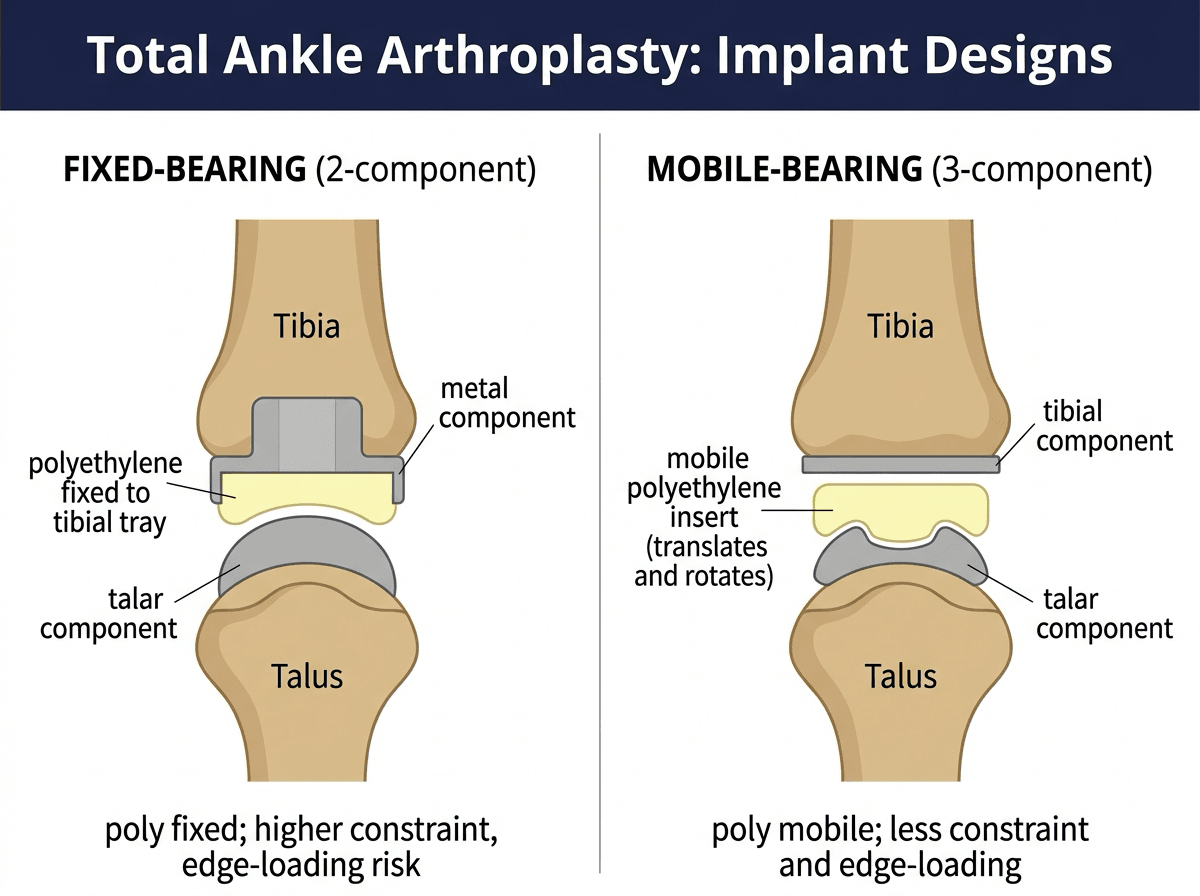
Implants are classified by generation, and the generations tell the story of why modern designs look the way they do.
First generation (1970s-1980s): cemented and constrained. Two components, tibia and talus, with no polyethylene insert, a flat tibial surface and no translation. Cement concentrated stress at the bone-cement interface, the metal-on-plastic articulation wore and produced osteolysis, over-constraint caused early mechanical failure, and non-anatomic loading caused subsidence and talar collapse. Aseptic loosening exceeded 50% at five years. The examples are the Mayo (1974), St Georg (1978) and TPR (1974) ankles, and the unacceptably high failure rates led to a recommendation against TAA in the 1980s-1990s that nearly ended the field.
Second generation (1990s-2000s): uncemented and semi-constrained. Porous coating gave biological fixation, a separate UHMWPE insert reduced wear, and a flat or sulcus tibial surface improved conformity; the anterior approach became standard, with less soft-tissue disruption but a required violation of extensor hallucis longus. The designs still needed extensive bone resection, the fixed bearing still constrained motion, and malalignment produced edge loading. The examples are the Agility (1984) and Buechel-Pappas (1988) ankles. Five-year survival improved to 80%, but ten-year survival was only 60-70% and revision rates stayed high: uncemented fixation proved the concept, and the fixed bearing limited longevity.
Third generation (2000s-present): mobile-bearing and anatomic. Three components: a flat or sulcus tibial component, uncemented with porous coating or pegs; an anatomic talar component, uncemented with a central peg or dual pegs; and a mobile polyethylene insert between them that translates and rotates, reducing constraint and edge loading. The sulcus in the tibial surface gives anterior-posterior stability with mobility, allowing 10° of anterior-posterior translation. The anatomic talar component preserves bone stock and contour, which is what makes later revision or conversion to fusion possible; porous coating achieves 90% osseointegration at two years without cement stress; and a minimally invasive approach preserving the soft-tissue envelope reduced wound complications from 20% to 10%. Current implants include the mobile-bearing STAR (Stryker) and the fixed-bearing Infinity (Stryker), Cadence (Integra), INBONE (Wright Medical) and Salto Talaris (Integra), supported by the TARVA RCT, the STAR pivotal trial and multiple national registry studies. This is mature technology with reproducible good outcomes in appropriately selected patients.
Fourth generation (2020s-future): patient-specific and 3D-printed. CT-based planning maps the patient's anatomy for a precise fit, titanium lattice structures are printed for bone ingrowth, custom cutting guides improve alignment and reduce operative time, and modular components allow intraoperative adjustment; robotics-assisted implantation, biologic coatings to enhance osseointegration and convertible designs are the stated future directions. Against that, most studies have under five years of follow-up, the implants cost 2-3 times a standard implant, not all designs are FDA approved, the planning software and technique need specific training, and no superiority over modern third-generation designs has been shown. Long-term outcome data are needed before widespread adoption can be recommended.
- 5-Year Survival
- 40-50%
- 10-Year Survival
- Under 30%
- 15-Year Survival
- Under 20%
- 5-Year Survival
- 70-80%
- 10-Year Survival
- 60-70%
- 15-Year Survival
- 40-50%
- 5-Year Survival
- About 90% (NJR 90.2%; Norwegian registry 89%)
- 10-Year Survival
- 76% (Norwegian registry)
- 15-Year Survival
- Data pending
Clinical Assessment
A well-executed TAA in a poor candidate will fail, and the wrong patient is the most common cause of preventable failure. The assessment establishes whether the ankle, the patient and their expectations suit a replacement, whether staged procedures are needed first, or whether fusion is the safer offer.
History. Characterise the pain (rest versus activity-related, night pain) and its cost in function (walking distance, stairs, activities of daily living), and record what has already been tried: injections, bracing, physiotherapy, surgery. Establish the aetiology (trauma, inflammatory, primary osteoarthritis) and the medical comorbidities that threaten the wound and the implant: diabetes, peripheral vascular disease, neuropathy. Ask about occupation and activity goals, because a heavy-labour occupation contraindicates TAA and high-impact sport is unrealistic after it, and record smoking status, because active tobacco use is a contraindication until the patient has stopped.
Examination. Watch the gait (antalgic pattern, foot progression angle, hindfoot alignment) and measure standing hindfoot varus or valgus, clinically and on the hindfoot-alignment radiograph. Record active and passive dorsiflexion and plantarflexion, and decide whether any deformity is fixed or corrects with manual stress. Test the ligaments with varus and valgus stress and an anterior drawer, check the dorsalis pedis and posterior tibial pulses and sensation, inspect the skin for scars, coverage and previous approaches, and examine the subtalar, talonavicular and midfoot joints, because a stiff or painful hindfoot complicates the operation and a painful adjacent joint may be the real pain source.
- Assesses
- ATFL integrity
- Positive Finding
- Anterior subluxation of talus over 10mm
- Significance for TAA
- May require lateral ligament reconstruction
- Assesses
- Lateral collateral complex
- Positive Finding
- Talar tilt over 10° compared to contralateral
- Significance for TAA
- Significant instability - may contraindicate TAA
- Assesses
- Deltoid ligament
- Positive Finding
- Talar tilt over 10° or medial gapping
- Significance for TAA
- Deltoid incompetence leads to valgus subsidence
- Assesses
- Hindfoot mobility
- Positive Finding
- Stiffness or pain with inversion/eversion
- Significance for TAA
- Fixed hindfoot deformity complicates TAA
Outcome scores. Baseline scores are essential for outcome assessment. The validated measures are:
- AOFAS Ankle-Hindfoot Score - pain, function and alignment on a 100-point scale; the minimal clinically important difference is 10 points
- FAAM - Foot and Ankle Ability Measure, with ADL and sports subscales
- VAS pain - 0-10
- SF-36 - general health quality of life
- EQ-5D - health utility for cost-effectiveness
What to promise. The realistic goals are pain reduction, better walking and a return to low-impact activity: a normal walking pattern without a limp, stairs without a rail, and normal shoes for most patients, with an expected arc of about 30° (on average 10° dorsiflexion and 20° plantarflexion). The patient must understand that a replaced ankle is not a normal ankle: no high-impact sport, heavy labour or running, and the modification is lifelong.
Differential diagnosis. Several conditions mimic or coexist with end-stage ankle osteoarthritis, and each changes the plan.
- Distinguishing Features
- Hindfoot (not anterior ankle) pain, pain on inversion/eversion rather than dorsi/plantarflexion
- Key Investigation
- Selective diagnostic injection; weight-bearing CT
- Implication for TAA
- If the ankle is not the pain source, TAA will not relieve symptoms - may need hindfoot fusion
- Distinguishing Features
- Deep aching pain, may follow trauma or steroid/alcohol use
- Key Investigation
- MRI (low T1 signal, collapse); CT for bone stock
- Implication for TAA
- Significant talar AVN is a contraindication to TAA - favours TTC fusion
- Distinguishing Features
- Polyarticular, morning stiffness, systemic features; gout - acute crystal attacks
- Key Investigation
- Inflammatory markers, serology, urate, joint aspirate
- Implication for TAA
- Acceptable for TAR if disease controlled; registries show RA survivorship at least as good as OA
- Distinguishing Features
- Hot swollen joint, fever, raised CRP/ESR
- Key Investigation
- Aspiration with Gram stain/culture, bloods
- Implication for TAA
- Active infection is an absolute contraindication - eradicate before any implant
- Distinguishing Features
- Gross deformity disproportionate to pain, neuropathy (e.g. diabetes)
- Key Investigation
- Clinical exam, radiographs, sensory testing
- Implication for TAA
- Contraindication to TAA - high failure; consider fusion or bracing
- Distinguishing Features
- Recurrent giving-way, positive anterior drawer / talar tilt
- Key Investigation
- Stress radiographs, MRI of ligaments
- Implication for TAA
- Ligament reconstruction may be needed before or with TAA to avoid edge loading
Investigations
Standing radiographs. The first-line study is a standing series: AP ankle, mortise, lateral ankle and a hindfoot alignment view. Read them for joint space narrowing and subchondral sclerosis, coronal deformity (tibiotalar angle, talar tilt), sagittal deformity (anterior tibial translation, posterior talar subluxation), the quality and quantity of tibial and talar bone stock, and osteophytes and bone cysts. The measurements that matter:
- Tibiotalar angle - normal 90° ± 3°
- Talar tilt - normal under 5°
- Anterior translation - normal under 3mm
- Hindfoot alignment angle on the hindfoot view
CT. A 3D CT is highly recommended for preoperative planning. It gives an accurate assessment of bone stock and cysts, detects talar body AVN, measures deformity precisely in all planes, templates component size and position, assesses the subtalar and talonavicular joints and plans the bone cuts. It is particularly useful in revision cases and complex deformity.
MRI. Selective, not routine: suspected talar AVN, soft-tissue assessment of ligaments and tendons, osteochondral lesions and cyst characterisation. A straightforward primary TAA does not need one.
SPECT-CT. Rarely, for a diagnostic dilemma when conventional imaging is inconclusive: the painful TAA (identifying component loosening), an uncertain pain source in polyarticular disease, and distinguishing subtalar from ankle arthritis.
Contraindications on imaging: Talar AVN (low signal on MRI, collapse on CT), severe bone loss (inadequate platform for components), uncorrectable deformity (over 20° coronal or sagittal plane), deltoid insufficiency with valgus tilt, large uncontained bone cysts (over 15mm). These findings should prompt consideration of arthrodesis instead of TAA.
Management Algorithm
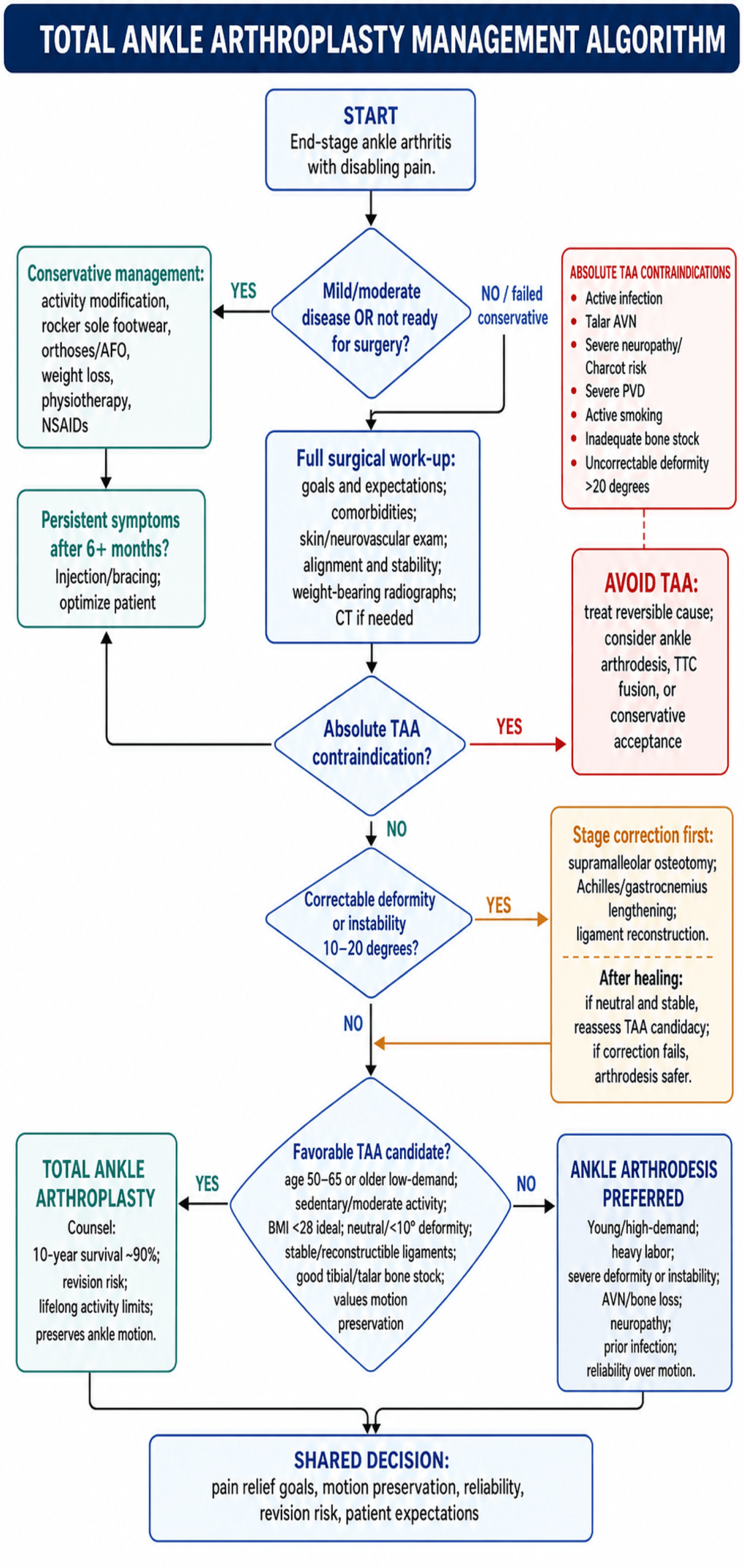
The decision. The fundamental choice in end-stage ankle arthritis is between a motion-preserving arthroplasty and a motion-sacrificing arthrodesis, and it is not either/or: it is individualised to the patient's age, activity demands, bone quality, deformity, ligament stability and expectations. There is no universal right answer. Both procedures relieve pain effectively with different trade-offs, and TARVA's comparable one-year outcomes put the choice squarely on patient factors.
Conservative management rarely reverses ankle osteoarthritis; it buys time for the right surgical candidate. It is the right choice for early disease, for the patient with medical contraindications to surgery, for the patient who prefers to delay, and as optimisation before a definitive procedure.
Conservative Treatment Escalation
- Activity modification - avoid high-impact activity and prolonged standing
- Footwear - cushioned shoes with rocker-bottom soles
- Orthotics - custom foot orthoses, ankle-foot orthosis (AFO)
- Weight loss if BMI is elevated, to reduce joint load
- Physiotherapy - ankle range of motion, strengthening, proprioception
- NSAIDs - oral or topical
- Corticosteroid injection - intra-articular, 1-3 times per year (maximum 3 lifetime)
- Hyaluronic acid injection - limited evidence in the ankle (better for the knee)
- PRP injection - emerging, with insufficient evidence currently
- Bracing - Arizona brace or similar to limit motion
Surgery is indicated when comprehensive conservative management has failed over 6 or more months, pain limits activities of daily living, the patient cannot work or do what they want to do, and the patient is willing to accept the surgical risks and the rehabilitation.
Supramalleolar Osteotomy: Realignment and the Joint-Preserving Alternative
The principle. A tibial (with or without fibular) osteotomy just proximal to the plafond redistributes load away from the overloaded side of the joint, shifting the mechanical axis toward the better-preserved compartment: conceptually the ankle equivalent of a high tibial osteotomy at the knee. For varus ankle OA (medial overload) the configuration is a medial opening-wedge (or lateral closing-wedge) osteotomy; for valgus OA (lateral overload), a medial closing-wedge (or lateral opening-wedge), chosen to neutralise the deformity and any tibial plafond obliquity.
Two roles. As a joint-preserving alternative in its own right, it suits the younger or higher-demand patient with mid-stage, asymmetric OA, reasonable residual joint space, preserved motion and a congruent or correctable joint: it keeps the native joint and defers arthroplasty or fusion. As a staging step before TAA, it corrects supramalleolar deformity so the prosthesis sits on a neutral mechanical axis, since uncorrected deformity drives edge loading and early failure. It is not a treatment for end-stage concentric arthritis.
Caveats. It requires adequate residual joint space and motion; nonunion, hardware problems and incomplete correction are the main complications; and it is frequently combined with hindfoot or soft-tissue procedures to balance alignment fully.
Surgical Technique
Alignment is everything. A neutral mechanical axis (tibiotalar angle 90° ± 3°) is mandatory: varus or valgus malalignment over 5° doubles the failure risk, so navigation or intraoperative fluoroscopy confirms the axis before final implantation.
Balance and bone. Ligament balancing is essential: if the ankle is unstable to varus stress, reconstruct the lateral ligaments; if unstable to valgus, address deltoid competence. Preserve bone, because a later revision or conversion to fusion depends on what is left.
Consent. The discussion covers the complication figures set out in the Complications section, from wound problems and nerve injury through loosening, subsidence and fracture to the revision rate at 10 years, and the fact that conversion to fusion is complicated by bone loss. It also covers the lifelong activity restrictions.
Equipment. Have ready:
- Implant system - STAR, Infinity, Cadence or INBONE, by surgeon preference
- Sizing templated on AP and lateral radiographs
- Cutting guides - system-specific jigs
- Power tools - oscillating saw, drill for peg holes
- Fluoroscopy - C-arm positioned for AP and lateral ankle views
- Retractors - self-retaining ankle distractor, Hohmann retractors
- Trial components - a full set
- Backup plan - ankle arthrodesis implants available if the TAA is aborted
Preoperative Optimisation
- Smoking cessation - mandatory
- Weight loss - target BMI under 30 if elevated
- Diabetes control - optimise glycaemic control
- Vascular assessment - ABI if PVD suspected
- Dental clearance - address any oral infection
Deformity correction, ligament reconstruction and hindfoot fusion follow the staged protocol in the Management section, with full healing and rehabilitation before the replacement.
- 3D CT analysis - confirm bone stock, plan the bone cuts
- Component sizing - template tibial and talar components
- Approach planning - review previous incisions and soft tissue
- Anaesthesia - regional versus general with nerve block
- VTE prophylaxis - plan mechanical and pharmacological
Complications
The scale of the problem. Complication rates after TAA are significantly higher than after hip or knee replacement: an overall complication rate of 30-40%, a reoperation rate of 20-25% and a revision rate of 15% at 10 years. Wound complications are the most common, followed by aseptic loosening, subsidence, periprosthetic fracture and infection, and across the registries aseptic loosening, subsidence and instability are the leading reasons for revision, with conversion to fusion the commonest salvage. Patient selection and technical precision are what keep these figures down.
- Incidence
- 10% superficial, 2% deep
- Risk Factors
- Smoking, diabetes, obesity, prior surgery
- Management
- Superficial: dressings, antibiotics. Deep: debridement ± flap, component removal if infected
- Incidence
- 8% at 10 years
- Risk Factors
- Malalignment, obesity, high activity
- Management
- Revision TAA if adequate bone stock, fusion if severe bone loss
- Incidence
- 5% (talar more common)
- Risk Factors
- Osteoporosis, overcorrection, undersized component
- Management
- Often asymptomatic if under 2mm, but can lead to instability. If over 5mm, revision may be required
- Incidence
- 3% (tibia, talus, malleoli)
- Risk Factors
- Trauma, osteoporosis, oversized component
- Management
- ORIF if fracture stable, revision if component loose
- Incidence
- 5% superficial peroneal, 2% deep peroneal
- Risk Factors
- Excessive retraction, direct injury
- Management
- Superficial: observation (usually recovers). Deep: may require tendon transfer if foot drop
- Incidence
- 10-15% not satisfied
- Risk Factors
- Malalignment, adjacent joint arthritis, component loosening
- Management
- Investigate source: injections, further imaging, consider revision or fusion
- Incidence
- 20%
- Risk Factors
- Extensive soft tissue dissection
- Management
- Usually asymptomatic; excision if limits ROM significantly
- Incidence
- 40% on CT
- Risk Factors
- Polyethylene wear debris, stress shielding
- Management
- Monitor with serial CT; revise if expanding or symptomatic
Early, 0-6 weeks. Wound dehiscence declares itself at 2-3 weeks; meticulous closure, elevation and minimal tension prevent it, and local wound care, VAC therapy and delayed closure or a flap if the defect is large treat it; deep wound complications requiring flap coverage occur in 3%. Deep infection presents with fever, drainage, pain and wound erythema; prophylactic antibiotics and sterile technique reduce it, and it is treated by debridement and intravenous antibiotics, with component removal if the organism is virulent. Venous thromboembolism occurs in 2-3% despite mechanical and pharmacological prophylaxis, presents as leg swelling, chest pain or dyspnoea, and is treated with anticoagulation per protocol, with an IVC filter if recurrent. Compartment syndrome is rare (severe pain, swelling, neurological deficit); avoid tight dressings, monitor perfusion, and keep a high index of suspicion, because the treatment is emergency fasciotomy. Early complications need prompt recognition and aggressive management to salvage the reconstruction.
Medium-term, 6 weeks to 2 years. These relate to the implant-bone interface and the healing process. Subsidence presents as pain, loss of motion and radiographic settling of the component, from osteoporosis, an undersized component or premature weight-bearing. Periprosthetic fracture presents as pain, inability to bear weight and deformity, from trauma, a stress riser or osteoporosis. Persistent pain despite healing is investigated with CT, SPECT-CT and diagnostic injections for malalignment, component malposition or adjacent joint arthritis, and revised if the component is the problem. Stiffness from heterotopic ossification, adhesions or malposition is treated with physiotherapy; manipulation under anaesthesia is rarely indicated, and severe heterotopic bone is excised.
Late, over 2 years. TAA is not a lifetime solution for every patient, and late complications often need revision surgery. Aseptic loosening presents with progressive pain, swelling and instability, from micromotion, malalignment and wear-debris osteolysis. Periprosthetic cysts are often asymptomatic and found on routine imaging, from wear debris, stress shielding and osteolysis; they are revised if expanding beyond 15mm or symptomatic. Polyethylene wear, from high activity, malalignment or a thin insert, presents as instability, osteolysis and component tilt: exchange the insert, and revise the metal components if worn or loose. Instability, from ligament attenuation, wear or malalignment, presents as recurrent swelling, giving way and pain with activity, and is treated by ligament reconstruction or component revision if malpositioned. Adjacent joint degeneration (subtalar, talonavicular, midfoot pain) is less common than after fusion but does occur, and is treated by injection, bracing or fusion of the symptomatic joint if severe.
Salvage of the Failed TAA: Conversion to Arthrodesis
The core problem is bone loss. When a TAA fails, commonly from aseptic loosening, subsidence, instability or deep infection, the principal definitive salvage is conversion to arthrodesis, the leading endpoint after a failed or revised TAR in the registry data. Removing the tibial and talar components and any osteolytic cysts leaves a large segmental gap and a shortened, often poorly vascularised talus, so a simple in-situ ankle fusion is rarely possible.
Rebuilding the gap. The defect is usually reconstructed with bulk structural allograft (typically femoral-head allograft) or autograft to restore height and provide a fusion bed; without it, conversion causes unacceptable limb shortening. When the talar body is deficient or the subtalar joint is involved, the fusion is extended across the subtalar joint as a tibiotalocalcaneal (TTC) fusion stabilised with a retrograde intramedullary hindfoot nail or a blade plate, spanning tibia, talus and calcaneus: it sacrifices subtalar motion but achieves a stable construct across poor bone.
What to expect. Nonunion and complication rates are higher than after a primary ankle fusion (poor vascularity, bone loss, prior surgery, possible occult low-grade infection); union is slower and residual shortening is common. Conversion is broadly successful, roughly 80%, but it is a salvage with a real nonunion risk, not a routine fusion. Always exclude infection (aspiration, CRP/ESR) before a single-stage conversion, because an unrecognised infected TAA mandates a staged protocol. (See the dedicated ankle arthrodesis topic for primary fusion technique.)
Postoperative Care and Rehabilitation
The first two weeks are about the wound and early osseointegration, and both depend on the patient doing exactly what they are told.
Immediate Postop Protocol
- Pain control - multimodal analgesia (nerve block, IV/oral opioids, NSAIDs)
- Elevation - strict, above heart level, continuously
- Ice - cryotherapy to reduce swelling
- Splint - posterior slab in neutral, well padded
- Weight-bearing - non-weight-bearing on the affected limb
- DVT prophylaxis - mechanical (compression stockings) and pharmacological (LMWH)
- Wound check - inspect for excessive drainage or haematoma
- Mobilisation - wheelchair or crutches, no weight on the operated leg
- Elevation - continue strictly; leg up when sitting or lying
- Splint - maintain the posterior slab; do not remove it at home
- Weight-bearing - non-weight-bearing with crutches or a walker
- Wound care - keep splint and dressing dry; sponge bath only
- Pain management - wean opioids, continue NSAIDs
- Prophylaxis - LMWH for 14 days total
- Watch for fever, increasing pain, excessive swelling, drainage
- Wound assessment - remove splint and dressing, inspect the incision
- Suture removal if non-absorbable sutures were used (typically 14 days)
- Radiographs - AP and lateral ankle to assess component position
- Transition to boot - CAM walker with the ankle in neutral
- Weight-bearing - remain non-weight-bearing for another 4 weeks
- Exercises - begin gentle ankle range of motion in the boot (dorsi/plantarflexion only)
Weight-bearing before osseointegration can lead to component subsidence or loosening. Patients must remain completely non-weight-bearing for a minimum of 6 weeks, with a walker or crutches mandatory and no cheating with "touch weight-bearing".
Outcomes and Prognosis
- Total Ankle Arthroplasty
- 76% (Norwegian registry; about 90% at 5 years)
- Ankle Arthrodesis
- 95% (fusion rate)
- Significance
- Fusion more reliable but TAA improving
- Total Ankle Arthroplasty
- 15% at 10 years
- Ankle Arthrodesis
- 8% at 10 years
- Significance
- TAA requires more reoperations
- Total Ankle Arthroplasty
- 85% good-excellent
- Ankle Arthrodesis
- 90% good-excellent
- Significance
- Both effective for pain - similar outcomes
- Total Ankle Arthroplasty
- 30° arc preserved
- Ankle Arthrodesis
- 0° (fused)
- Significance
- TAA clear advantage for motion preservation
- Total Ankle Arthroplasty
- Improved cadence, step length and walking speed, with sagittal ROM up about 2 degrees - better than preoperative, not near-normal
- Ankle Arthrodesis
- Altered - compensatory midfoot motion
- Significance
- Favours TAA, but note the gait evidence here is a before-and-after series with NO fusion comparator
- Total Ankle Arthroplasty
- Lower rate of subsequent subtalar fusion: 0.7% at 5 years
- Ankle Arthrodesis
- Higher: 2.8% at 5 years
- Significance
- Real but small - about 2 percentage points absolute (HR 0.28). Weigh it against the revision burden in the row below, not as a decisive argument on its own
- Total Ankle Arthroplasty
- Low-moderate impact allowed
- Ankle Arthrodesis
- Can return to heavy labour
- Significance
- Fusion allows higher demands
- Total Ankle Arthroplasty
- 85% satisfied
- Ankle Arthrodesis
- 80% satisfied
- Significance
- Similar satisfaction rates
TARVA (Total Ankle Replacement Versus Arthrodesis) is the landmark multicentre RCT (Goldberg AJ et al, Ann Intern Med 2022): 303 patients (152 TAR, 151 fusion) across 17 UK NHS centres, aged 50-85 with end-stage ankle OA. Primary outcome was change in the Manchester-Oxford Foot Questionnaire (MOXFQ) walking/standing domain at 52 weeks. Both treatments improved significantly; the adjusted difference of -5.6 (95% CI -12.5 to 1.4) favoured TAR but was neither clinically nor statistically significant. Adverse-event totals were similar, but TAR had more wound-healing and nerve complications while fusion had more thromboembolism and nonunion (symptomatic nonunion 7%). A pre-specified post hoc analysis suggested fixed-bearing TAR was superior to fusion (-11.1, 95% CI -19.3 to -2.9). Bottom line: at 1 year both procedures are safe and effective with no clear winner, so the decision is individualised.
What predicts success. The selection criteria predict the outcome for the reasons they were chosen: age 50-65 brings lower activity demands, adequate bone quality and a reasonable lifespan expectation; a BMI under 28 reduces implant stress and wound complications; primary or post-traumatic OA gives predictable bone quality with less systemic involvement; neutral alignment or under 5° of deformity gives balanced loading without edge wear; intact or reconstructible ligaments prevent instability and component tilt; and good tibial and talar bone stock gives fixation and osseointegration. Two factors belong to the surgeon rather than the patient: experience of over 20 cases annually, which improves alignment and reduces technical error, and a third-generation mobile-bearing implant with proven longevity and a low complication rate.
What predicts failure. The mirror image. Age under 40 brings activity demands and a lifespan requirement that exceed implant durability; a BMI over 35 increases loading, wound complications and failure; varus or valgus malalignment over 10° causes edge loading, accelerated wear and loosening; uncorrectable medial or lateral laxity causes component tilt, edge loading and early loosening; osteoporosis, AVN or large cysts leave inadequate fixation and a subsidence risk; heavy labour or high-impact sport accelerates wear and loosening; smoking at surgery causes wound complications, nonunion and infection; and prior ankle or hindfoot sepsis risks reactivation around the implant.
Guidelines, Registries & Global Practice
End-stage ankle OA is predominantly post-traumatic (unlike hip/knee, which are mostly primary OA), affects a younger population, and is treated by either motion-preserving total ankle replacement (TAR) or arthrodesis. The landmark TARVA RCT found no clear superiority of either at 1 year; national registries worldwide show modern TAR has acceptable mid-term survival but is revised more often than hip or knee replacement.
Global Epidemiology
- Figure
- Post-traumatic in the majority (vs primary OA in hip/knee)
- Source / Note
- Reflected in TAA cohorts; younger, often unilateral
- Figure
- Mean ~68 years, 71% male
- Source / Note
- Goldberg AJ et al, Ann Intern Med 2022 (PMID 36375147)
- Figure
- ~90% (NJR England & Wales)
- Source / Note
- Jennison T et al, Foot Ankle Int 2023 (PMID 37345846)
- Figure
- 76% (5-yr 89%)
- Source / Note
- Fevang BT et al, Acta Orthop 2007 (PMID 17966015)
- Figure
- Rising TAR utilisation internationally; fusion still common
- Source / Note
- Multiple national registries
Guidelines & Registry Evidence, Side by Side
- Position on TAR vs fusion
- Both TAR and fusion are effective; TARVA showed no significant difference at 1 year and TAR likely cost-effective at the 20,000 GBP/QALY threshold
- Evidence level / basis
- Level 1 RCT (TARVA) + economic modelling
- Position on TAR vs fusion
- Supports TAR as an established option in appropriately selected patients; emphasises shared decision-making and surgeon/unit volume
- Evidence level / basis
- Society consensus + NJR registry
- Position on TAR vs fusion
- Mobile-bearing STAR approved on non-inferiority to fusion (pivotal trial); TAR endorsed for selected end-stage OA
- Evidence level / basis
- Level 2 controlled trial (STAR pivotal, PMID 19589303)
- Position on TAR vs fusion
- Reports real-world TAR revision higher than hip/knee; tracks implant-specific survival to guide selection
- Evidence level / basis
- Registry evidence (annual reports)
- Position on TAR vs fusion
- Long-standing data showing TAR survival below hip/knee but improving with newer designs
- Evidence level / basis
- Registry evidence (e.g. Fevang 2007)
Practice Variation
- TAR vs fusion ratio: varies markedly by country and unit; fusion remains commoner overall but TAR use is rising in high-resource settings
- Implant availability: mobile-bearing designs (e.g. STAR) widely used outside the US; fixed-bearing designs (e.g. INBONE, Infinity, Cadence) predominate in the US for historical regulatory reasons
- Centralisation: several systems concentrate TAR in higher-volume foot-and-ankle units, reflecting a registry-supported volume-outcome relationship
- Limited-resource settings: arthrodesis often preferred for reliability, lower implant cost and tolerance of heavier physical demands
- No clear winner at 1 year (TARVA): discuss TAR and fusion as genuine alternatives
- Differing complication profiles: TAR - more wound-healing/nerve issues; fusion - more VTE and nonunion (symptomatic nonunion ~7%)
- TAR is not a lifetime solution: counsel on revision risk and on conversion to fusion as the commonest salvage
- Lifelong activity modification after TAR: no running, jumping, contact sport or heavy labour
- Modifiable risk: smoking cessation and BMI optimisation before surgery (higher BMI predicts failure - PMID 37345846)
- Antibiotic prophylaxis: single dose within 60 minutes of incision (cefazolin, or a glycopeptide such as vancomycin/teicoplanin if beta-lactam allergy or MRSA risk); intra-operative redosing for prolonged surgery; routine prophylaxis limited to 24 hours.
- VTE prophylaxis: combined mechanical and pharmacological prophylaxis individualised to risk, per local/society guidance.
- Tourniquet: minimises blood loss so cell salvage is generally unnecessary.
- Surveillance: serial weight-bearing radiographs to detect subsidence, lucency and periprosthetic cysts; CT for problem-solving.
MCQ Practice Points
Q: What is the primary blood supply to the talar body that is at risk during TAA? A: The talar body is supplied chiefly by the artery of the tarsal canal (a branch of the posterior tibial artery), supplemented by the artery of the tarsal sinus (from the perforating peroneal and dorsalis pedis arteries) and deltoid branches medially. The talus has no muscular attachments and relies entirely on this peri-talar arterial supply entering at the neck and medially. Extensive anterior dissection during TAA can compromise it and lead to avascular necrosis, so soft-tissue attachments to the talar neck should be preserved. (The medial circumflex femoral artery supplies the femoral head, not the talus - a classic exam trap.)
Q: What is the biomechanical advantage of mobile-bearing (3-component) TAA designs over fixed-bearing (2-component) designs? A: Mobile-bearing designs include a mobile polyethylene insert that can translate anteroposteriorly and rotate slightly, reducing constraint and edge loading on the metal components. This decreases stress at the bone-implant interface, reducing loosening rates. Fixed-bearing designs constrain motion, leading to higher stresses and earlier failure. Registry data shows 92% survival at 10 years for mobile-bearing vs 81% for fixed-bearing designs.
Q: A 38-year-old construction worker with post-traumatic ankle OA and 12° varus deformity requests TAA because he wants to avoid fusion. How do you counsel him? A: This patient has multiple relative contraindications for TAA: (1) Young age (under 40) - higher activity demands and longer lifespan requirement exceed implant durability, (2) Heavy labor occupation - TAA incompatible with construction work (high-impact loading leads to early failure), (3) Varus deformity 12° - may require staged supramalleolar osteotomy and still have edge loading risk. I would counsel that ankle arthrodesis is better option for this patient profile - allows return to heavy labor, more predictable long-term outcome, lower revision rate (8% vs 15% at 10 years). If patient insists on TAA, counsel about very high likelihood of early failure requiring revision or conversion to fusion.
Q: During TAA, you achieve good alignment on fluoroscopy but when you trial the components, the ankle is unstable to valgus stress. What is the likely cause and how do you manage? A: Valgus instability suggests deltoid ligament incompetence. This is a critical finding - proceeding with TAA in presence of medial-sided instability leads to valgus talar tilt - the medial clear space opens and the polyethylene edge-loads laterally - with early component loosening or subsidence. Management options: (1) Deltoid ligament repair if tissue quality adequate - advance deltoid to medial malleolus with suture anchors, (2) Deltoid reconstruction using allograft or autograft if native tissue insufficient, or (3) Abort TAA and perform ankle arthrodesis if deltoid is non-reconstructible. Never proceed with unstable TAA - ensure stability with varus and valgus stress testing before final component implantation.
Q: What is the most common cause of TAA failure requiring revision? A: Aseptic loosening (40% of failures in AOANJRR data), followed by subsidence (25%), instability (20%), and infection (10%). Aseptic loosening results from micromotion at the bone-implant interface due to malalignment (varus/valgus tilt causes edge loading), polyethylene wear debris (induces osteolysis), or inadequate osseointegration (poor bone quality, premature loading). Prevention: meticulous attention to neutral alignment (tibiotalar angle 90° ± 3°), appropriate patient selection (good bone stock, BMI under 30), strict 6-week non-weight-bearing protocol, and lifelong activity restrictions.
Q: What were the key findings of the TARVA trial comparing TAR to ankle arthrodesis? A: TARVA (Goldberg AJ et al, Ann Intern Med 2022) was the first adequately powered multicentre RCT (Level 1 evidence): 303 patients aged 50-85 randomised to total ankle replacement or fusion across 17 UK NHS centres. Key findings: (1) Primary outcome (change in MOXFQ walking/standing at 52 weeks) showed no clinically or statistically significant difference (adjusted difference -5.6, 95% CI -12.5 to 1.4), with both arms improving from baseline; (2) Similar total adverse events, but TAR had more wound-healing and nerve complications and fusion had more thromboembolism and nonunion (symptomatic nonunion 7%); (3) a post hoc analysis suggested fixed-bearing TAR was superior to fusion (-11.1, 95% CI -19.3 to -2.9); (4) companion economic modelling estimated TAR is likely cost-effective at the NICE threshold. Conclusion: both treatments are safe and effective at 1 year - the choice is patient-specific. (Note: the initial report was 52-week data; longer-term survival is captured by registries such as the NJR.)
Exam Viva Scenarios
Practise clinical reasoning and management decisions out loud
“A 55-year-old office worker presents with severe ankle pain limiting walking to 200 meters. She has end-stage post-traumatic ankle OA following a pilon fracture 10 years ago. BMI 28. Radiographs show maintained coronal alignment, tibiotalar angle 92°, no talar AVN. She wants to preserve motion for walking and light recreational activities. How do you assess and manage?”
“You are performing a primary total ankle arthroplasty using a mobile-bearing 3-component system. Walk me through the key surgical steps from approach to implantation, highlighting critical technical points for achieving optimal alignment and avoiding complications.”
“A 58-year-old patient is 18 months post-TAA and develops progressive medial ankle pain and swelling over 3 months. Radiographs show 3mm of talar component subsidence and a 12mm medial talar cyst. How do you assess and manage this complication?”
Patient Selection (STABLE)
- Stock (bone): Adequate tibia/talus quality, no AVN
- Ties (ligaments): Competent or reconstructible medial/lateral ligaments
- Alignment: Coronal under 10°, sagittal under 15° (or correctable)
- BMI under 30: Obesity increases failure risk
- Low-moderate demand: Sedentary to moderate activity only
- Etiology favorable: Primary or post-traumatic OA (not AVN or severe bone loss)
Contraindications
- Infection active, Neuropathy severe, Failure of bone stock
- Extreme deformity (over 20°), Circulation inadequate
- Talus absent/destroyed, Instability uncorrectable
- Ongoing smoking, Non-compliance, Skin coverage poor
Surgical Technique Essentials
- Anterior approach: Between TA and EHL, protect neurovascular bundle laterally
- Neutral alignment: Tibiotalar 90° ± 3° - varus/valgus error leads to edge loading
- Bone preservation: Minimize resection (tibia 5-8mm, talus 3-5mm)
- Trial before implant: Assess ROM, stability, alignment
- Soft tissue balance: Deltoid release for varus, lateral reconstruction for lateral instability, deltoid repair for valgus instability
- Postop: Strict non-weight-bearing 6 weeks, then progressive in boot
Implant Designs
- Third-generation mobile-bearing: Current standard (about 90% survival at 5 years; roughly 76% at 10)
- 3-component: Tibial, talar, mobile polyethylene insert
- Mobile bearing advantage: Reduces constraint and edge loading vs fixed-bearing
- Common implants: STAR, Infinity, Cadence (surgeon familiarity important)
Complications
- Wound complications 10% (superficial) + 2% (deep infection)
- Aseptic loosening 8% at 10 years (most common failure mode)
- Subsidence 5% (talar more common) - revise if over 5mm
- Periprosthetic cysts 40% (often asymptomatic - monitor with CT)
- Nerve injury 5% (superficial peroneal) + 2% (deep peroneal)
- Conversion to fusion 15% at 10 years (80% successful but bone loss complicates)
Evidence Base and Key Studies
TARVA Trial: Total Ankle Replacement vs Arthrodesis (Landmark RCT)
- Multicentre, parallel-group, open-label RCT: 303 patients (152 TAR, 151 fusion) across 17 UK NHS trusts, age 50-85, end-stage ankle OA
- Primary outcome (change in MOXFQ walking/standing at 52 weeks): adjusted difference -5.6 (95% CI -12.5 to 1.4) favouring TAR but not clinically or statistically significant
- Both treatments significantly improved MOXFQ-W/S from baseline; total adverse events similar (109 vs 104)
- TAR: more wound-healing complications and nerve injuries; fusion: more thromboembolism and nonunion (symptomatic nonunion rate 7%)
- Post hoc analysis suggested superiority of fixed-bearing TAR over fusion (-11.1, 95% CI -19.3 to -2.9)
- Companion HTA modelling estimated ~69% probability TAR is cost-effective vs fusion at the NICE 20,000 GBP/QALY threshold
STAR Pivotal Trial: Mobile-Bearing TAR vs Fusion (Non-Inferiority)
- Prospective controlled multicentre non-inferiority study (FDA pivotal): 158 STAR ankle replacements vs 66 ankle fusion controls, plus 448 continued-access STAR cases
- Non-inferiority hypothesis for overall patient success was met for STAR vs fusion at 24 months
- Treatment efficacy higher in the replacement group due to improvement in functional scores; pain relief equivalent between groups
- Major complications and secondary surgical interventions more common in the pivotal arthroplasty group than fusion
- Secondary procedures roughly halved in the continued-access group versus the pivotal arthroplasty group (learning-curve effect)
National Joint Registry: Risk Factors for Failure of Ankle Replacement
- Data-linkage study: National Joint Registry (England & Wales) combined with NHS Digital; failure defined as removal or exchange of any component
- Overall 5-year survival 90.2% (95% CI 89.2-91.1%)
- Younger age (HR 0.96 per year) and higher BMI (HR 1.03 per unit) independently associated with increased risk of failure
- Patients with rheumatoid arthritis had higher survivorship than those with osteoarthritis (etiology HR 0.88)
Norwegian Arthroplasty Register: Long-Term TAR Survival
- Registry study: 257 primary ankle replacements in Norway 1994-2005 (212 cementless STAR, 32 cemented TPR)
- Overall survival 89% at 5 years and 76% at 10 years
- No significant effect of age, sex, prosthesis type, diagnosis or year of operation on revision risk
- Revision rate acceptable versus other ankle series but high compared with knee and hip arthroplasty
- Incidence of ankle replacement for osteoarthritis increased over the study period
National Joint Registries: Real-World TAR Revision (Registry Evidence)
- Major joint registries (AOANJRR Australia, NJR England & Wales, Nordic registries) all report higher cumulative revision for ankle replacement than for hip or knee arthroplasty
- NJR/NHS Digital linkage data: ~90% 5-year survival of primary TAR (Jennison 2023)
- Aseptic loosening, subsidence and instability are consistently the leading revision indications across registries
- Use of ankle replacement is rising internationally, though fusion remains the more frequently performed procedure
- Revision-specific modular implants show better survival than primary implants used at revision (Jennison 2023, BJJ)
Survival of Revision Ankle Arthroplasty (NJR Data-Linkage)
- National Joint Registry and NHS Digital linkage: 228 patients undergoing revision TAA, mean follow-up 2.6 years
- Survival 95.4% at 1 year, 87.7% at 3 years and 77.5% at 5 years
- Failures: of 29 (12.7%) that failed, 19 (8.3%) were converted to fusion, 9 (3.9%) re-revised and 1 amputation
- Revision-specific (modular) implants survived better than primary implants used at revision
- Use of cement was a risk factor for failure (HR 3.02, 95% CI 1.13-8.09)
Long-Term Gait Analysis After TAA (Mean 7.6 Years)
- Prospective 3-dimensional gait analysis in 33 patients (28 STAR, 5 Salto Talaris), preoperative versus minimum 5-year (mean 7.6, range 5-13 years) follow-up
- Sustained, significant improvements in cadence (+9.5 steps/min), step length (+4.4 cm) and walking speed (+0.2 m/s)
- Total sagittal range of motion increased (+2.0 degrees) with increased plantarflexion at initial contact and maximum plantarflexion
- No loss of peak ankle power despite patients ageing - first study to report objective gait outcomes beyond 5 years
- Demonstrates durable functional benefit of motion-preserving TAA on objective gait parameters
Population Comparison of Reoperation: TAA vs Ankle Arthrodesis
- Population-based study of all California inpatient admissions 1995-2004: 4705 ankle fusions vs 480 ankle replacements
- Major revision rate after replacement: 9% at 1 year and 23% at 5 years, versus 5% and 11% after fusion
- Higher risk of major revision with replacement (HR 1.93, 95% CI 1.50-2.49)
- Lower risk of subsequent subtalar fusion after replacement (0.7% vs 2.8% at 5 years; HR 0.28, 95% CI 0.09-0.87)
- Replacement also associated with higher risk of device-related infection