Cranial Migration of Odontoid | Foramen Magnum Encroachment | Occipitocervical Instability
- Basilar invagination = odontoid tip prolapses superiorly through foramen magnum
- Chamberlain line: odontoid tip greater than 6.6 mm above palato-occipital line is diagnostic
- Rheumatoid arthritis is the most common acquired cause (atlantoaxial and occipitocervical instability)
- Lower cranial nerve palsies (IX-XII) and myelopathy are hallmark presentations
- Treatment requires occipitocervical fusion; decompression alone is contraindicated without stabilisation
- “Chamberlain line = hard palate to posterior lip of foramen magnum (opisthion)
- “McGregor line = hard palate to lowest point of occipital curve (easier on lateral X-ray)
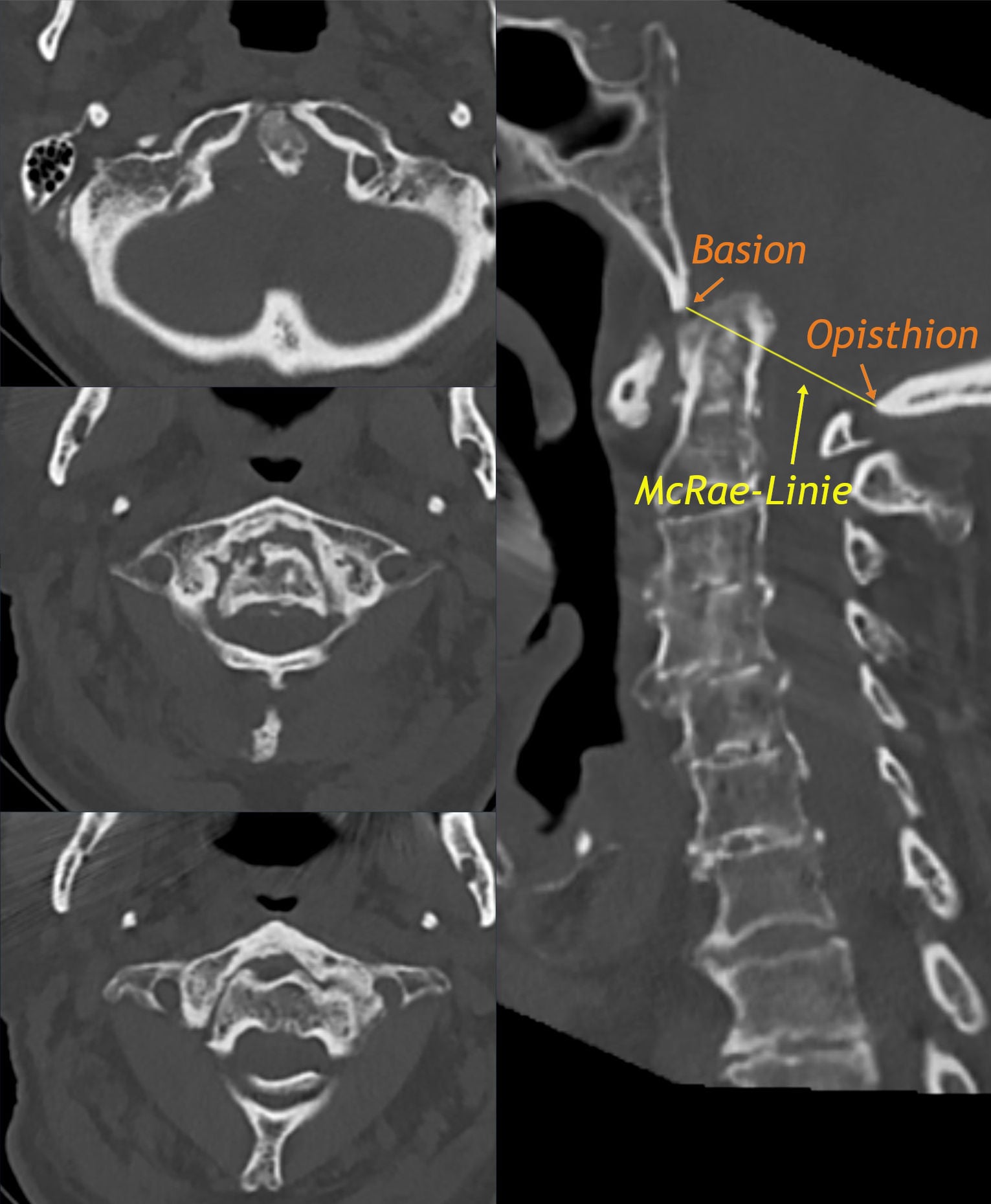
- “McRae line = anterior to posterior lip of foramen magnum (below this line is normal)
- “Ranawat line measures C2 pedicle to C1 ring on lateral view for RA basilar invagination
- “NEVER decompress without fixation in basilar invagination
Overview and Epidemiology
Basilar invagination is one presentation of a disordered craniocervical junction, and the neighbouring entities are managed differently: craniocervical junction instability for the broader chronic picture, atlantoaxial instability for the C1-C2 component that Goel showed is often the real lesion, atlanto-occipital dislocation for the acute traumatic disruption, and occipitocervical fusion for the operation most of these converge on.
Definition. Basilar invagination is the cephalad migration of the odontoid process through the foramen magnum, compressing the cervicomedullary junction. Strictly, the term belongs to the primary, developmental anomaly; basilar impression is the secondary, acquired form, in which softened bone at the skull base (rheumatoid arthritis, Paget disease, osteogenesis imperfecta) allows the skull base to settle onto the cervical spine. Both compress the brainstem and upper cervical cord, and a missed diagnosis can end in catastrophic brainstem compression.
What sits alongside it. Atlantoaxial instability may coexist, particularly in RA and in the congenital forms. Platybasia, a flattening of the skull base, often coexists as well but is a distinct measurement, described with the angular lines under Investigations.
Why it is examined. The condition tests three things at once: craniovertebral junction anatomy, the radiographic measurement lines, and the surgical principle that stabilisation, not decompression alone, is the treatment.
Who. The age at presentation is bimodal. The congenital form, often associated with the Klippel-Feil triad, Chiari I malformation and os odontoideum, presents in the second to third decade with no strong sex predilection. Rheumatoid arthritis is the most common acquired cause, affecting up to 10 percent of patients with severe RA; it presents in the fifth to seventh decade and follows RA epidemiology, so it is female predominant.
Pathophysiology
The junction. The craniovertebral junction (CVJ) comprises the occiput, the atlas (C1) and the axis (C2). The odontoid process projects upward from the body of C2 into the ring of C1 and articulates with the anterior arch of C1. Stability depends on the transverse ligament, the primary restraint against anterior translation of C1; the alar ligaments, which limit rotation and lateral flexion; and the tectorial membrane, the continuation of the posterior longitudinal ligament.
- Attachment
- Behind dens, between C1 lateral masses
- Function
- Primary restraint to anterior C1 translation
- When Disrupted
- C1-2 instability, pannus in RA
- Attachment
- Dens tip to occipital condyles
- Function
- Limit rotation and contralateral flexion
- When Disrupted
- Rotatory instability, occipitocervical subluxation
- Attachment
- Posterior dens to anterior foramen magnum
- Function
- Limits posterior C1 translation and flexion
- When Disrupted
- Vertical instability, basilar invagination
- Attachment
- Dens tip to basion
- Function
- Minor flexion restraint
- When Disrupted
- Clinically insignificant in isolation
What the migrated odontoid does. The foramen magnum is the narrowest point in the craniospinal axis. Once the odontoid tip protrudes above it, the cervicomedullary junction, the lower cranial nerves (IX-XII) and the vertebral arteries are compressed, and even a few millimetres of migration can produce devastating neurological compromise.
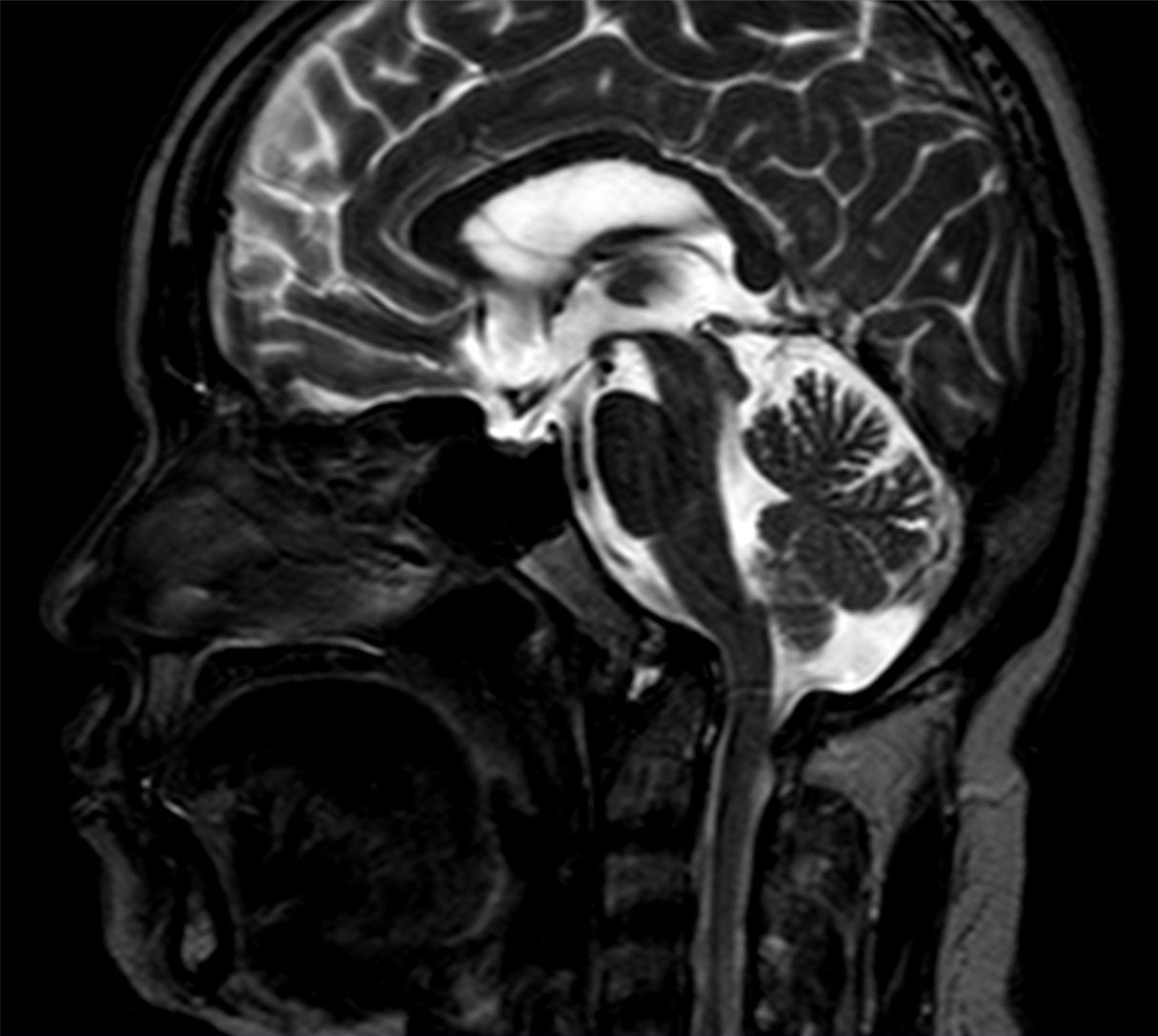
Congenital mechanisms. Failure of segmentation between C1 and the occiput (occipitalisation of C1) forces the odontoid cephalad. In os odontoideum the dens is a separated fragment and the body of C2 migrates upward. Klippel-Feil fusion of cervical vertebrae concentrates stress at the CVJ. A Chiari I malformation, herniation of the cerebellar tonsils below the foramen magnum, often coexists and worsens the brainstem compression.
Rheumatoid mechanism. Synovitis attacks the C1-2 articulations, the atlantodental and facet joints. Destruction of the transverse ligament allows anterior atlantoaxial subluxation, pannus erodes the dens and weakens the fulcrum of CVJ stability, and progressive erosion allows C2 to migrate cephalad through the foramen magnum. The pannus is also a mass in its own right, adding ventral cord compression beyond the bony impingement alone.
Classification and Types
Classification by Cause
- Specific Conditions
- Os odontoideum, C1 assimilation, Klippel-Feil, Down syndrome, Chiari I
- Mechanism
- Failure of segmentation or odontoid development
- Key Features
- Young patient, short neck, low hairline, may have syndromic features
- Specific Conditions
- Longstanding seropositive RA
- Mechanism
- Pannus erosion of transverse ligament, alar ligaments, odontoid
- Key Features
- Cervical spine involvement in 30-80 percent of RA patients
- Specific Conditions
- Paget disease, osteogenesis imperfecta, hyperparathyroidism
- Mechanism
- Bone softening allows skull base settling onto cervical spine
- Key Features
- Basilar impression rather than true invagination
- Specific Conditions
- Remote C1-2 fracture or ligament injury
- Mechanism
- Chronic instability allows gradual vertical migration
- Key Features
- History of significant cervical trauma years prior
- Specific Conditions
- C1-2 tumour (chordoma, metastasis), TB, pyogenic infection
- Mechanism
- Destructive process weakens C1-2 stability
- Key Features
- Pain out of proportion, constitutional symptoms
Two groups of causes sit outside the table. The syndromic causes are Morquio syndrome, Conradi syndrome and spondyloepiphyseal dysplasia, and rickets belongs with the bone-softening group alongside Paget disease, osteogenesis imperfecta and hyperparathyroidism. Distinguishing congenital from acquired basilar invagination is essential because the treatment approach, associated conditions, and prognosis differ significantly.
The mild/moderate/severe scheme above is descriptive. The examinable classification is Goel's, which divides basilar invagination by the presence of atlantoaxial instability and fundamentally changes the operation.
Group A, the "instability" group. There IS atlantoaxial instability: the odontoid tip is above the Chamberlain, McRae and Wackenheim's clival lines and indents the brainstem, with an abnormal (reduced) clivus-canal angle. Goel's key insight is that this is essentially a central/vertical atlantoaxial instability problem, and it is therefore reducible by posterior atlantoaxial joint distraction and fixation (Goel technique), which restores height and decompresses the cord without a transoral odontoidectomy or a foramen-magnum decompression.
Group B, the "stable" group. There is no atlantoaxial instability: the odontoid stays below the Chamberlain/McRae/Wackenheim lines and maintains its relationship to the anterior arch of C1 and the clivus, but the whole craniovertebral assembly has migrated. This group is strongly associated with Chiari malformation and syringomyelia and was traditionally treated by foramen-magnum decompression.
Goel reframed the condition: many cases previously called "irreducible" (needing transoral surgery) are Group A central atlantoaxial instability that reduces with posterior facetal distraction and C1-2/occipitocervical fixation, while Group B (no instability, Chiari-associated) is the one historically managed by decompression.
Clinical Assessment
History. Neck pain is suboccipital and radiates to the vertex, and neck pain with restricted motion is a common early complaint. Myelopathy is the most common presentation, and neurological progression shows as numbness, weakness, a change in gait and clumsiness. Ask specifically for the lower cranial nerve symptoms (dysphagia, dysarthria, a hoarse voice, tongue weakness) and the vertebrobasilar ones (vertigo, visual disturbance, syncope on rotation).
Examination. On inspection look for a short neck, a low hairline and restricted cervical rotation, the Klippel-Feil triad. The motor picture is a spastic quadriparesis with upper motor neuron signs in all four limbs. Examine the cranial nerves for palatal weakness, tongue wasting and an impaired gag reflex, and look for the cerebellar signs of brainstem and cerebellar compression: ataxia, dysmetria and nystagmus.
- Acute deterioration. Sudden worsening of myelopathy or the onset of respiratory distress signals critical brainstem compression. This is a neurosurgical emergency.
- Lhermitte sign. An electric shock sensation down the spine on neck flexion indicates cord compression at the CVJ.
- Cock-robin posture. A head tilted to one side and rotated to the other suggests atlantoaxial rotatory subluxation, which may coexist with basilar invagination.
- Sleep apnoea. Brainstem compression affecting the respiratory centres can present as central sleep apnoea.
- Signs and Symptoms
- Spastic quadriparesis, hyperreflexia, Babinski, Lhermitte
- Mechanism
- Direct cord compression by odontoid
- Significance
- Most common presentation, surgical indication
- Signs and Symptoms
- Dysphagia, dysarthria, hoarseness, tongue fasciculations
- Mechanism
- CNs exit skull base near foramen magnum
- Significance
- Highly suggestive of significant invagination
- Signs and Symptoms
- Vertigo, visual changes, brainstem TIA, syncope on rotation
- Mechanism
- Vertebral arteries pass through C1 transverse foramina
- Significance
- Bow-hunter syndrome variant at CVJ
- Signs and Symptoms
- Raised intracranial pressure, hydrocephalus, papilloedema
- Mechanism
- CSF pathway obstruction at foramen magnum
- Significance
- May need CSF diversion before fusion
Differential diagnosis. MRI is the key discriminator between basilar invagination and its mimics:
- Atlantoaxial instability without invagination - the odontoid is in a normal position but C1 translates anteriorly
- Chiari I malformation - cerebellar tonsillar herniation without odontoid migration (the two may coexist)
- Cervical spondylotic myelopathy - cord compression lower in the cervical spine, with no cranial nerve involvement
- Foramen magnum tumours (meningioma, chordoma) - similar compression but a different imaging appearance
Investigations
Radiographs. The first-line study is the lateral cervical radiograph in neutral, flexion and extension. Draw the Chamberlain, McGregor and McRae lines, and in RA add the Ranawat index. The dynamic views answer the question that shapes the operation: does the odontoid reduce on extension?
Why there are three lines. Chamberlain, McGregor and McRae were all defined on the lateral radiograph, and that is why there are three. Chamberlain's is the most specific, but the opisthion is frequently not visible on a plain film, so McGregor substituted the lowest point of the occipital curve, which always is; the price is a less specific line with a lower threshold. On a midsagittal CT or MRI reformat the opisthion is unambiguous, so Chamberlain and McRae become the usable lines and McGregor loses the problem it was invented to solve. McRae's line is the most clinically relevant because it is the actual boundary of the foramen magnum: an odontoid tip below it is normal, and one above it is invagination.
- Landmarks
- Posterior hard palate to opisthion
- Threshold
- Odontoid greater than 6.6 mm above
- Advantage
- Classic, widely taught
- Limitation
- Opisthion difficult to identify on plain X-ray
- Landmarks
- Posterior hard palate to lowest occipital curve
- Threshold
- Odontoid greater than 4.5 mm above
- Advantage
- Easiest to draw, good screening
- Limitation
- Less specific, lower threshold
- Landmarks
- Basion to opisthion (foramen magnum itself)
- Threshold
- Odontoid above this line = positive
- Advantage
- Clinically most relevant (actual foramen magnum)
- Limitation
- Requires clear visualisation of basion and opisthion
- Landmarks
- C2 pedicle centre to C1 ring line
- Threshold
- Less than 13 mm (women), less than 15 mm (men)
- Advantage
- Specifically validated for RA basilar invagination
- Limitation
- Only applicable in RA population
MRI. Mandatory for every suspected basilar invagination, with flexion-extension if tolerated. It shows the cervicomedullary junction compression, cord signal change (T2 hyperintensity is myelomalacia), the pannus mass in RA and any associated Chiari malformation, and a CSF flow study assesses obstruction at the foramen magnum. Measure the space available for the cord at the CVJ: under 13 mm is critical.
CT. Thin-slice CT of the craniovertebral junction with sagittal and coronal reconstruction is the pre-operative planning study for screw trajectory: the bony anatomy, the size of the C1 lateral masses, the thickness of the occipital bone and the course of the vertebral arteries. A 3D reconstruction is essential for understanding complex congenital anatomy, and CT assesses reducibility, whether the odontoid can be reduced on traction.
CT angiography. Obtain it when a vertebral artery anomaly is suspected, to map the artery before surgery. An anomalous vertebral artery at C1-2 occurs in up to 20 percent and affects screw placement; the patterns are a persistent first intersegmental artery, an arcuate foramen (posterior ponticulate) and an aberrant course. The purpose is to avoid vertebral artery injury during C1 lateral mass or C2 pedicle screw placement.
Chamberlain, McGregor and McRae all measure how far the odontoid has migrated upward. The clival and angular measurements detect the associated skull-base abnormality and the actual brainstem indentation:
- Wackenheim's clival line: a line drawn down the posterior surface of the clivus; extended caudally it should be tangential to the posterior aspect of the odontoid tip. If the odontoid crosses (transects) this line, basilar invagination is present. This is the line used in Goel's Group A definition above.
- Clivus-canal angle (clivoaxial angle): the angle between Wackenheim's clival line and the posterior vertebral body line of C2. It is normally roughly 150 degrees in extension to 135 degrees in flexion; an angle below about 135 degrees is abnormal and correlates with ventral brainstem kinking and myelopathy severity. It is a more functional measure than the height lines alone, and the measurement most tied to myelopathy and to surgical realignment goals.
- Platybasia (Welcker basal angle): the angle between the nasion-tuberculum line and the tuberculum-basion line, normally about 125-143 degrees; an angle over roughly 143 degrees is platybasia (flattening of the skull base). Platybasia coexists with but is distinct from invagination: platybasia alone does not compress the cord, whereas basilar invagination does. They are measured differently and must not be conflated.
Management Algorithm
Management Principles
Core principle. Stabilisation is the primary treatment. Decompression without fixation is contraindicated.
Assessment. Confirm the diagnosis with the radiographic lines and an MRI showing cord compression, and quantify the myelopathy with an mJOA score or Nurick grade. Then establish reducibility: can the odontoid be reduced on extension or on traction?
Reducibility decides the operation. If the odontoid can be reduced, posterior occipitocervical fusion alone is sufficient, because fixation in the reduced position decompresses the cord. If it is fixed in its cephalad position, a ventral decompression (transoral or endoscopic endonasal odontoidectomy) is required before the posterior fusion. An asymptomatic or minimally symptomatic patient whose invagination is non-progressive is monitored with serial imaging.
Surgical planning. Posterior occipitocervical fusion is the gold standard, typically occiput to C2 (O-C2) or occiput to C3 depending on the extent of the instability. The construct is an occipital plate, C1 lateral mass screws, C2 pedicle or pars screws and a rod, with autologous iliac crest or local bone, plus BMP (off-label), for the fusion.
After surgery. A rigid cervical collar or halo vest for 8-12 weeks, CT at 3-6 months to confirm fusion, and serial neurological examination for improvement in the myelopathy. In RA, optimise disease-modifying therapy perioperatively.
- Diagnosis
- Odontoid above Chamberlain line, Klippel-Feil features
- Treatment
- Occipitocervical fusion if symptomatic or progressive
- Key Pearl
- Screen for Os odontoideum and C1 assimilation
- Diagnosis
- Ranawat index reduced, anterior atlantodental interval widened
- Treatment
- Occipitocervical fusion, consider transoral decompression
- Key Pearl
- Most common acquired cause of basilar invagination
- Diagnosis
- MRI showing cervicomedullary junction compression
- Treatment
- Urgent occipitocervical fixation +/- ventral decompression
- Key Pearl
- Decompression without fixation is contraindicated
Complications
- Incidence
- 5-15 percent
- Risk Factors
- Severe pre-op deficit, intraoperative manipulation
- Management
- High-dose steroids, urgent MRI, check implant position
- Incidence
- 1-2 percent per screw
- Risk Factors
- Aberrant vertebral artery, complex congenital anatomy
- Management
- Tamponade, possible endovascular coiling, avoid contralateral screw
- Incidence
- 5-10 percent
- Risk Factors
- Poor bone quality (RA, osteoporosis), smoking, inadequate fixation
- Management
- Revision fixation with enhanced bone graft
- Incidence
- 3-5 percent
- Risk Factors
- Dural adhesions, ventral decompression
- Management
- Lumbar drain, watertight closure, fibrin glue
- Incidence
- Expected after O-C fusion (approximately 50 percent rotation lost)
- Risk Factors
- Occipitocervical fusion inherently sacrifices C0-1 and C1-2 motion
- Management
- Pre-operative counselling, patient acceptance
- Incidence
- 2-5 percent
- Risk Factors
- RA immunosuppression, long operative time, posterior approach
- Management
- IV antibiotics, wound debridement if hardware exposed
The most feared complication of basilar invagination, and of its surgery, is respiratory failure from brainstem compression affecting the respiratory centres. Pre-operative respiratory assessment, including forced vital capacity (FVC) and a sleep study, is mandatory, and respiratory function is monitored closely in a high-dependency setting after surgery. A fall in FVC below 1 litre or a rise in PaCO2 suggests impending respiratory failure.
Outcomes and Prognosis
- Treatment
- Posterior O-C fusion
- Expected Outcome
- 80-90 percent neurological improvement
- Long-term Function
- Good function, limited cervical rotation
- Treatment
- Ventral decompression + posterior fusion
- Expected Outcome
- 60-75 percent improvement, some residual deficit
- Long-term Function
- Functional improvement, wheelchair to walker often achievable
- Treatment
- O-C fusion, optimise medical therapy
- Expected Outcome
- Pannus regression over 6-12 months, variable neural recovery
- Long-term Function
- Depends on systemic RA control and pre-op deficit
- Treatment
- Natural history
- Expected Outcome
- Progressive myelopathy leading to quadriparesis
- Long-term Function
- High mortality from respiratory failure or sudden death
What predicts recovery. The duration and severity of myelopathy before surgery is the strongest predictor of neurological recovery, and early intervention, before cord signal change appears on MRI, gives the best outcomes. The best prognosis belongs to the young patient diagnosed early before a fixed neurological deficit, with a reducible invagination and good bone quality for fusion.
Poor prognosis. Severe pre-operative myelopathy (especially Nurick grade 4-5), a fixed irreducible deformity, RA with poor disease control, and the elderly patient with osteoporotic bone.
Guidelines, Registries & Global Practice
- RA prevalence varies from 0.3 to 1.0 percent worldwide; cervical involvement correlates with disease duration and severity
- Congenital basilar invagination has no strong geographic or ethnic predilection but higher detection in regions with advanced imaging access
- Klippel-Feil incidence approximately 1 in 40,000 births worldwide
- Down syndrome carries increased risk of atlantoaxial instability and basilar invagination (15-20 percent have AADI greater than 4.5 mm)
- High-resource: Pre-operative CT angiography, 3D navigation, neuronavigation, intraoperative CT for screw accuracy
- Limited-resource: Plain radiographic lines for screening, CT for surgical planning, fluoroscopy-guided screw placement
- Universal principle: The surgical principle (stabilisation, not decompression alone) applies regardless of resources
- Post-operative: Halo vest in limited-resource settings where modern instrumentation is unavailable; rigid collar in high-resource
- Screening
- Lateral cervical X-ray if RA disease duration greater than 5 years or any neck symptoms
- Surgical Indication
- Basilar invagination (Ranawat reduced) or AADI greater than 10 mm with myelopathy
- Approach
- Occipitocervical fusion; transoral only if irreducible
- Screening
- MRI for any RA patient with neurological signs or planned intubation
- Surgical Indication
- Progressive myelopathy, radiographic instability with cord compression
- Approach
- Posterior O-C fusion standard; ventral decompression for fixed deformity
- Screening
- CT-based classification of CVJ pathology; assess reducibility
- Surgical Indication
- Instability with or without neurological deficit in basilar invagination
- Approach
- Screw-rod construct; emphasizes intraoperative reduction techniques
- Screening
- Dynamic imaging (flexion-extension) essential for surgical planning
- Surgical Indication
- Radiographic basilar invagination + clinical myelopathy or progressive deformity
- Approach
- Tailored to reducibility; posterior-only approach increasingly favoured
No dedicated arthroplasty registry covers CVJ fusion specifically. Evidence is drawn from large single-centre neurosurgical and orthopaedic spine series (Menezes, Crockard, Goel). The Swedish and Finnish RA biologics registers capture cervical spine surgery data indirectly. The evidence base relies on level 4 case series rather than randomised trials; management principles are consensus-based and driven by natural history data showing high mortality from untreated basilar invagination.
Every RA patient undergoing general anaesthesia must have pre-operative cervical spine imaging (at minimum lateral flexion-extension radiographs). Unrecognised atlantoaxial instability or basilar invagination can cause cord injury during intubation. Alert the anaesthetist and consider fibreoptic intubation if instability is identified.
Controversies & Areas of Uncertainty
Posterior instrumentation (C1-2 or O-C2 screw-rod) can achieve intraoperative reduction in many previously "irreducible" cases, potentially avoiding the morbidity of transoral surgery. However, genuinely fixed ventral compression from chronic pannus or bony mass still requires direct decompression. The threshold for attempting posterior-only reduction is evolving.
Congenital basilar invagination found incidentally poses a management dilemma. Prophylactic fusion is generally recommended if the odontoid projects above the McRae line (even without symptoms), given the risk of catastrophic deterioration with minor trauma. However, the natural history of truly asymptomatic cases is not fully defined.
When basilar invagination coexists with Chiari I malformation, controversy exists over whether to address the ventral invagination first (odontoidectomy + fusion) or perform posterior fossa decompression. Most authorities now recommend treating the basilar invagination (ventral decompression and fusion) first, as the Chiari may improve once CVJ stability and CSF flow are restored.
Biological DMARDs (TNF inhibitors, IL-6 blockers, JAK inhibitors) may slow or halt cervical spine destruction in RA. Whether widespread biologics use is reducing the incidence of RA basilar invagination is unclear, but earlier disease control appears to decrease the need for cervical spine surgery in RA cohorts treated with biologics from disease onset.
MCQ Practice Points
Q: Which radiographic line extends from the hard palate to the lowest point of the occipital curve? A: McGregor line. This is the most practical screening line because the lowest point of the occipital curve is always visible on lateral radiographs, unlike the opisthion which can be difficult to identify. Odontoid tip greater than 4.5 mm above the McGregor line indicates basilar invagination.
Q: What is the most common acquired cause of basilar invagination? A: Rheumatoid arthritis. RA causes synovitis and pannus formation at the C1-2 articulations, eroding the transverse ligament, alar ligaments, and odontoid process. This allows progressive vertical migration of the axis through the foramen magnum.
Q: Why is posterior decompression alone contraindicated in basilar invagination? A: Because it increases instability without addressing ventral compression. Removing the posterior arch of C1 or performing suboccipital craniectomy eliminates the posterior tension band while the odontoid continues to compress the cord ventrally. This can precipitate further migration and catastrophic neurological deterioration. The treatment is stabilisation (occipitocervical fusion), not decompression.
Q: When is transoral odontoidectomy required in basilar invagination? A: When the invagination is irreducible. If the odontoid cannot be reduced into a normal position on extension or traction (confirmed on dynamic imaging), ventral decompression via transoral or endoscopic approach is necessary before posterior fusion. If reducible, posterior fusion alone in the reduced position achieves indirect decompression.
Q: What is the Ranawat index and what does it measure? A: The Ranawat index measures vertical migration of C2 in RA. It is the distance from the centre of the C2 pedicle to a line connecting the anterior and posterior arches of C1 on lateral radiograph. Normal values are greater than 13 mm in women and greater than 15 mm in men. Values below these thresholds indicate basilar invagination in RA patients.
Q: What is the primary stabiliser preventing anterior atlantoaxial translation? A: The transverse ligament. It runs behind the odontoid process, attaching to the lateral masses of C1, and is the primary restraint against anterior translation of C1 on C2. In RA, the transverse ligament is destroyed by pannus, leading to atlantoaxial instability and contributing to basilar invagination.
Exam Viva Scenarios
Practise clinical reasoning and management decisions out loud
“A 58-year-old woman with longstanding seropositive rheumatoid arthritis presents with progressive difficulty walking, bilateral hand numbness, and occasional dysphagia over the past 6 months. She has been on methotrexate and low-dose prednisone. Examination reveals spastic quadriparesis with MRC grade 4/5 in all four limbs, hyperreflexia, and bilateral Babinski signs. Lateral cervical radiograph shows the odontoid tip projecting 8 mm above the McGregor line. MRI confirms cervicomedullary junction compression with T2 cord signal change. What is your diagnosis and management plan?”
“A 24-year-old man presents with a 2-year history of progressive gait disturbance and occasional electric shock sensations down his arms on neck flexion. He has a short neck, low hairline, and restricted cervical rotation. Neurological examination reveals spastic quadriparesis (grade 4+/5), Hoffman sign positive bilaterally, and sustained ankle clonus. MRI shows the odontoid tip projecting well above the foramen magnum with cervicomedullary junction compression, a Chiari I malformation with 8 mm tonsillar descent, and syringomyelia from C2 to C6. CT confirms assimilation of the atlas to the occiput. What is your diagnosis and surgical plan?”
Key Radiographic Lines
- Chamberlain: hard palate to opisthion; odontoid greater than 6.6 mm above = positive
- McGregor: hard palate to lowest occipital curve; greater than 4.5 mm above = positive (best screening)
- McRae: basion to opisthion; odontoid above this line = invagination present (most clinically relevant)
- Ranawat (RA): C2 pedicle to C1 ring line; less than 13 mm (F) or less than 15 mm (M) = vertical migration
Aetiology
- Congenital: Os odontoideum, C1 assimilation, Klippel-Feil, Down syndrome, Chiari I
- Acquired: Rheumatoid arthritis (most common), Paget disease, osteogenesis imperfecta
- RA mechanism: pannus erodes transverse ligament and alar ligaments, allowing C2 cephalad migration
Clinical Presentation
- Myelopathy: spastic quadriparesis, hyperreflexia, Babinski, Lhermitte phenomenon
- Lower cranial nerve palsies: dysphagia, dysarthria, hoarse voice (CN IX-XII)
- Klippel-Feil triad: short neck, low hairline, restricted cervical rotation
- Vertebrobasilar insufficiency: vertigo, syncope on head rotation
Treatment Algorithm
- Reducible invagination = posterior occipitocervical fusion alone (O-C2)
- Irreducible invagination = ventral decompression (transoral) THEN posterior O-C fusion
- NEVER decompress without fixation - posterior laminectomy alone is contraindicated
- RA pannus regresses after fusion; rarely needs direct pannus excision
Critical Exam Pearls
- Stabilisation (not decompression) is the treatment - this is the most testable point
- Always image RA cervical spine before any general anaesthetic
- Reducibility determines whether ventral surgery is needed
- McRae line = actual foramen magnum boundary; if odontoid above this, cord is compressed
Evidence Base and Key Trials
Craniovertebral junction abnormalities
- Landmark review defining the clinical spectrum of craniovertebral junction abnormalities including basilar invagination in congenital and acquired forms
- Established that reducible lesions require only posterior fusion; irreducible lesions need ventral decompression first
- Chamberlain and McRae lines reliably stratify severity and guide surgical planning
- Posterior decompression without fusion worsened outcomes
Cervical spine fusion in rheumatoid arthritis
- Defined the Ranawat index for measuring vertical migration of the axis in RA patients
- Vertical migration correlates with neurological deterioration and need for surgical intervention
- Combined anterior and posterior atlantodental interval measurements predict myelopathy risk
- Established threshold values guiding surgical referral in RA cervical spine disease
Occipitocervical fusion. Indications, technique, and long-term results in thirteen patients
- Series of occipitocervical fusions demonstrating reliable fusion rates with autologous bone graft
- Neurological improvement in the majority of patients with myelopathy from CVJ pathology
- Established occipitocervical fusion as the gold standard for basilar invagination with instability
- Tri-cortical iliac crest graft with wiring technique (predating modern screw-rod systems)