Obstetric Plexopathy | Erb's and Klumpke's | Early Referral
- Definition: Stretch injury to the brachial plexus during delivery. Usually traction on the head-neck angle.
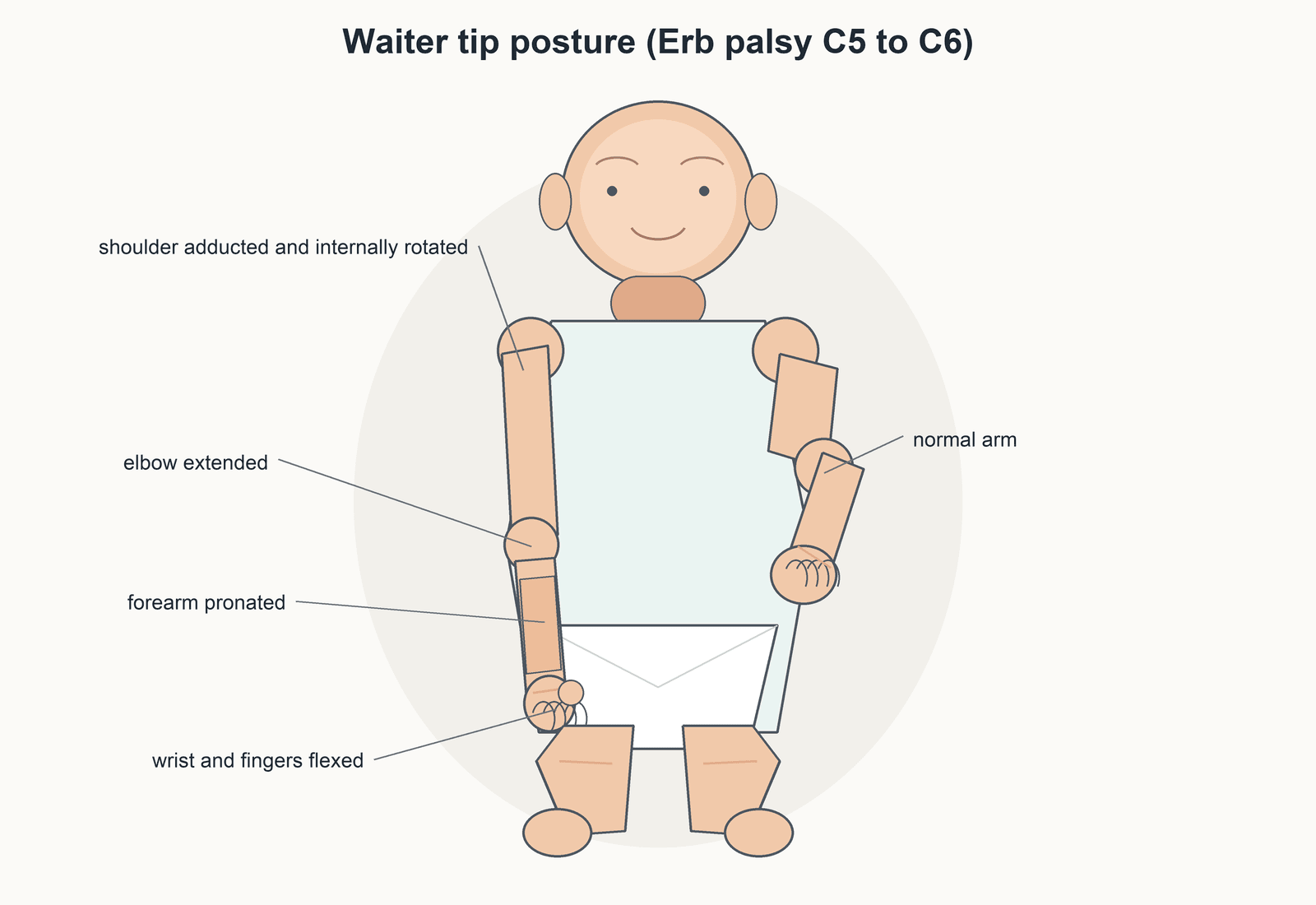
- Erb-Duchenne (C5-C6): 'Waiter's Tip' - Shoulder adducted, Elbow extended, Forearm pronated, Wrist flexed.
- Klumpke (C8-T1): 'Claw Hand' - Intrinsic weakness. Often associated with Horner's syndrome (T1 avulsion).
- Observation Window: Most recover spontaneously by 3-6 months. Surgery considered if no biceps function by 3-6 months.
- Shoulder Sequelae: Posterior dislocation (internal rotation contracture) is the major late complication.
- “Biceps recovery by 3 months predicts good overall recovery (Gilbert criteria).
- “Horner's syndrome (ptosis, miosis, anhidrosis) indicates T1 root avulsion - poor prognosis.
- “Late sequelae are primarily at the SHOULDER (Medial rotation contracture, posterior dislocation).
- “MRI of plexus is useful to identify root avulsions (pseudomeningoceles).
Overview and Epidemiology
The obstetric palsy is the same anatomy with a different clock. The levels, trunks and branches are on brachial plexus anatomy, and the adult traction injury on adult brachial plexus injury - but the two behave nothing alike. Most birth palsies recover spontaneously and the adult ones do not, which is why this page is organised around an observation window and a decision point rather than around early exploration. The other difference is that a growing shoulder remodels around the imbalance, so the late problem here is glenohumeral deformity rather than simple weakness. The nerve surgery itself is on nerve repairs and the biology that sets its timing on nerve injury and regeneration; the birth injury most often confused with it is a clavicle fracture, which also gives a pseudoparalytic arm but resolves in days.
Definition. Brachial plexus birth palsy (BPBP), also known as obstetric brachial plexus injury (OBPI), is a stretch injury to the brachial plexus occurring during delivery. It results from lateral flexion of the head away from the shoulder, which puts traction on the plexus.
Who it happens to. The incidence is 1-2 per 1000 live births, and the risk factors are these.
- Shoulder dystocia
- Macrosomia
- Forceps or vacuum delivery
- Breech presentation
Which part of the plexus. The pattern of the lesion sets both the posture and the prognosis.
- Upper plexus (Erb's, C5, C6 +/- C7) - the most common pattern and the best prognosis
- Lower plexus (Klumpke's, C8, T1) - rare in isolation, and associated with Horner's syndrome
- Total plexus (C5-T1) - a flail arm, and the worst prognosis
Pathophysiology and Mechanisms
The plexus. It is formed by the ventral rami of C5-T1 and built in five steps: roots, trunks, divisions, cords and branches. C5 and C6 make the upper trunk, C7 continues as the middle trunk, and C8 and T1 make the lower trunk; each trunk divides into an anterior and a posterior division, and the divisions regroup into the lateral, posterior and medial cords.
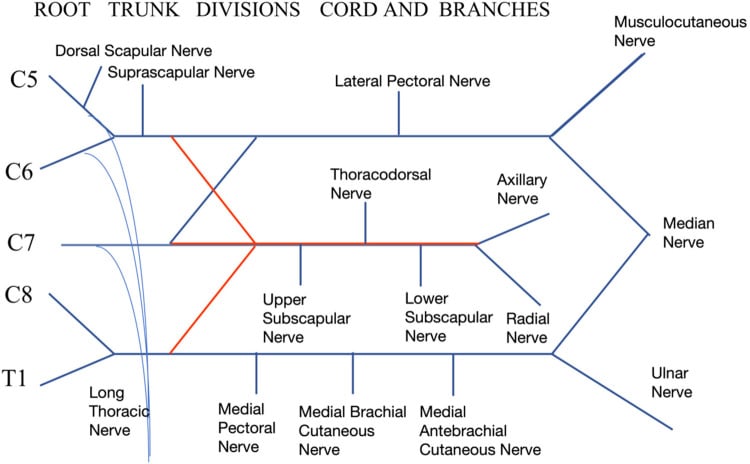
What each nerve powers. Reading a weak arm back to a level depends on the outputs.
- Musculocutaneous - biceps
- Axillary - deltoid
- Radial - triceps and wrist extensors
- Median - forearm flexors and thenar muscles
- Ulnar - intrinsics and hypothenar muscles
Robert Taylor Drinks Cold BeerBrachial Plexus Roots
Hook:Anatomy of the Plexus.
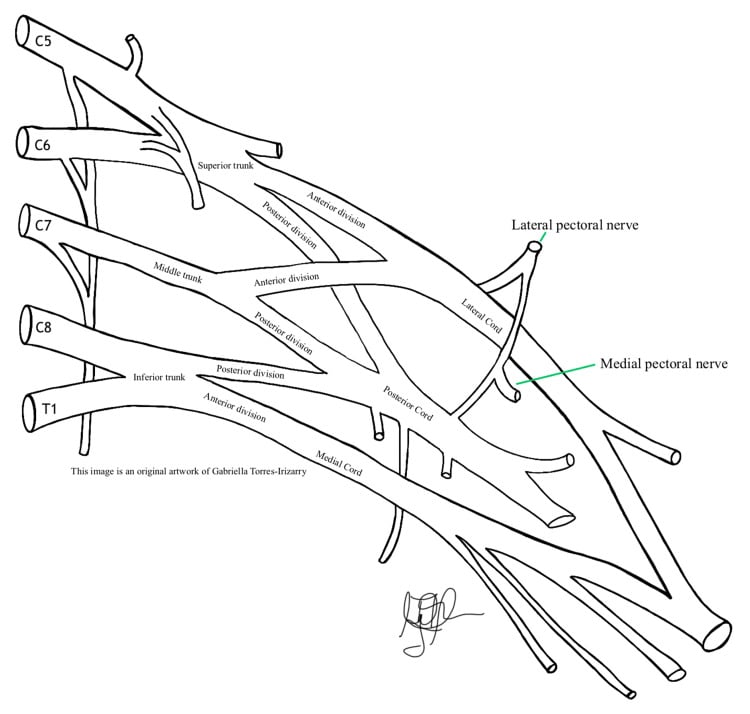
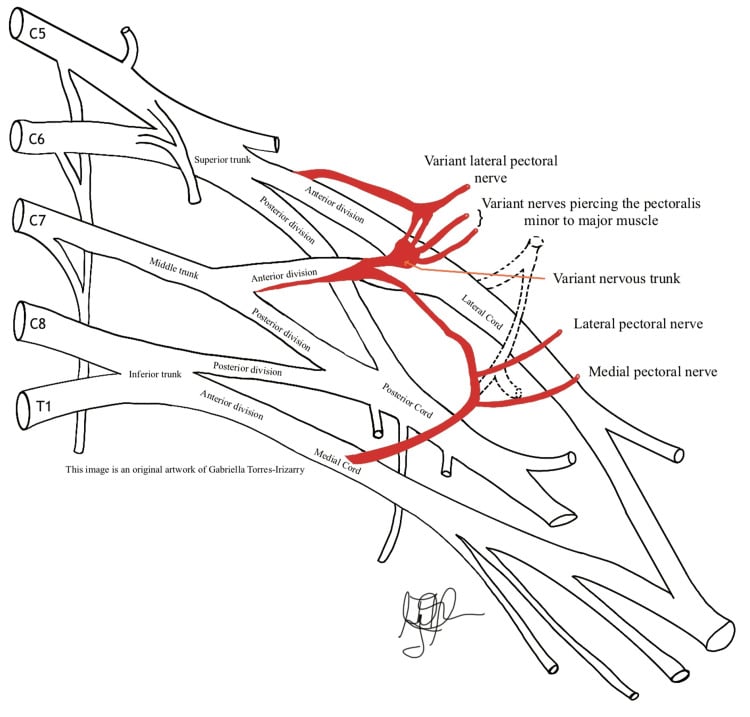
How the nerve fails. Traction produces three lesions, and they do not behave alike.
- Stretch (neurapraxia) - a temporary conduction block, with full recovery expected
- Rupture - the nerve is disrupted distal to the dorsal root ganglion and scars; grafting may be needed
- Avulsion - the root is torn from the spinal cord. There is no spontaneous recovery, and a nerve transfer is required
Why the shoulder deforms later. Strong internal rotators working against weak external rotators is a muscle imbalance, and in a growing shoulder the imbalance runs a predictable course.
- Internal rotation contracture
- Posterior subluxation of the glenohumeral joint
- Glenoid retroversion and posterior humeral head flattening
- Glenohumeral dysplasia (GHD)
Classification
Narakas Classification
Narakas groups the palsy by clinical pattern and root involvement, and the group carries the prognosis.
- Roots
- C5-C6
- Presentation
- Erb's. Shoulder/Elbow weak.
- Prognosis
- Good (over 90% regain good function, Mallet IV-V)
- Roots
- C5-C7
- Presentation
- Extended Erb's. +Wrist/Finger Ext weak
- Prognosis
- Good (70-80% recover)
- Roots
- C5-T1
- Presentation
- Total. Flail arm.
- Prognosis
- Guarded (20-30% recover)
- Roots
- C5-T1 + Horner's
- Presentation
- Total + Root Avulsion
- Prognosis
- Poor (No spontaneous recovery if avulsion)
Horner's syndrome indicates a T1 root avulsion, and it is what separates group IV from group III.
Glenohumeral Dysplasia: Staging
Waters and colleagues defined a CT/MRI grading of the glenohumeral deformity that progresses with an untreated internal-rotation contracture. The grade directs whether the joint can be rebalanced with soft tissue alone or needs a bony procedure.
- Deformity
- Normal glenoid (retroversion within normal range)
- Surgical implication
- No bony procedure needed
- Deformity
- Minimal deformity - increased glenoid retroversion, no subluxation
- Surgical implication
- Soft-tissue rebalancing
- Deformity
- Posterior subluxation of the humeral head (head sits posterior to the scapular axis)
- Surgical implication
- Reduction plus soft-tissue surgery; young glenoid may remodel
- Deformity
- Development of a false (pseudo-) glenoid posteriorly
- Surgical implication
- Bony glenoid procedure usually required
- Deformity
- Flattening of the head and glenoid with progressive (sub)luxation
- Surgical implication
- Glenoid osteotomy / reconstruction
- Deformity
- Infantile (complete) glenohumeral dislocation
- Surgical implication
- Open reduction with reconstruction
- Deformity
- Proximal humeral growth arrest
- Surgical implication
- Salvage; address growth disturbance
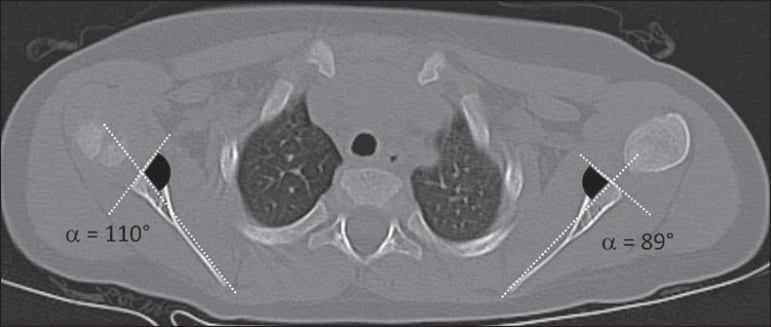
How the numbers are taken. Two measurements describe the joint: the percentage of the humeral head lying anterior to the mid-glenoid, and the glenoid version. Both are read off the axial image rather than estimated.
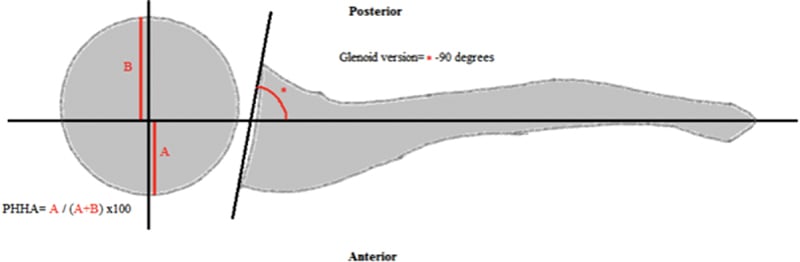
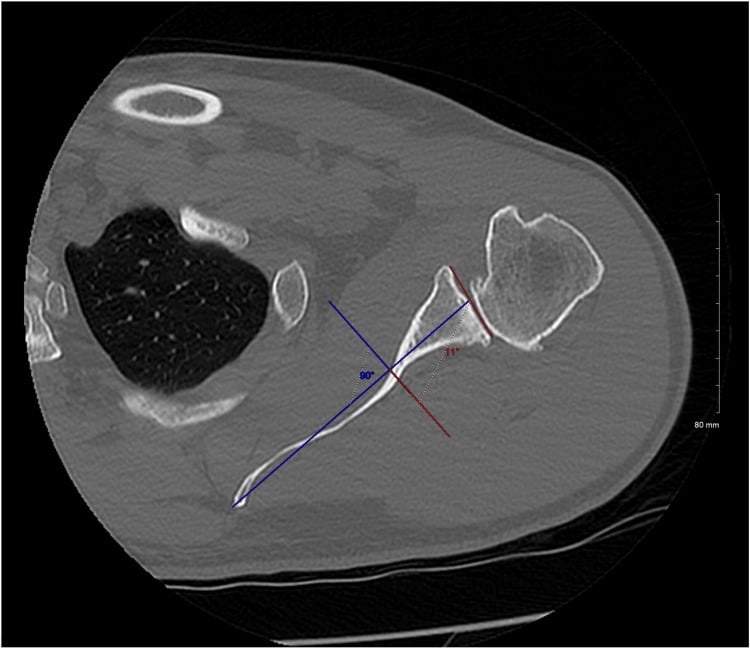
Q: How does the Waters grade of glenohumeral dysplasia change the operation? A: A reducible, low-grade joint (Types I-III) can be managed by restoring muscle balance - subscapularis release with tendon transfer - with reduction allowing the young glenoid to remodel. Once a false glenoid or fixed bony deformity has developed (Types IV-VII), soft-tissue surgery alone fails and a bony procedure is needed: a glenoid osteotomy to correct retroversion, or a humeral derotation osteotomy to reposition the functional arc of motion.
Clinical Assessment
The posture names the level. An upper-trunk palsy holds the shoulder adducted and internally rotated, the elbow extended, the forearm pronated and the wrist and fingers flexed - the waiter's tip. The weak C5-C6 muscles, deltoid, infraspinatus, biceps, supinator and the wrist extensors, are overpowered by the intact adductors and internal rotators, triceps and pronators, and the limb settles where the working muscles put it.
- Erb-Duchenne (C5-C6)
- 80-90%
- Klumpke (C8-T1)
- Less than 5%
- Erb-Duchenne (C5-C6)
- Waiter's Tip (Adducted, Pronated)
- Klumpke (C8-T1)
- Claw Hand (Intrinsic minus)
- Erb-Duchenne (C5-C6)
- Deltoid, Biceps, Supinator
- Klumpke (C8-T1)
- Intrinsics, Finger Flexors
- Erb-Duchenne (C5-C6)
- No
- Klumpke (C8-T1)
- Yes (if T1 avulsed)
- Erb-Duchenne (C5-C6)
- Good (Majority recover)
- Klumpke (C8-T1)
- Poor (Often permanent)
The newborn examination. Four things are looked for, and none of them needs equipment.
- Posture - waiter's tip, flail, or claw
- Passive range of motion - full in the newborn, so a restricted range means a contracture or a fracture
- Reflexes - Moro, in which the abducted arm does not follow, and grasp if the lower plexus is involved
- Horner's syndrome - ptosis, miosis and anhidrosis
Serial assessment. One examination says what is weak; repeated examinations say whether it is recovering, and that is the observation the whole pathway turns on. Score active movement with the Active Movement Scale (AMS), 0-7 per muscle, at every visit.
- Biceps recovery is the milestone - antigravity biceps by 3-6 months predicts a good recovery (Gilbert)
- Shoulder range - watch for the internal rotation contracture, which declares itself as an external rotation deficit
- Later - the Mallet classification, for shoulder function
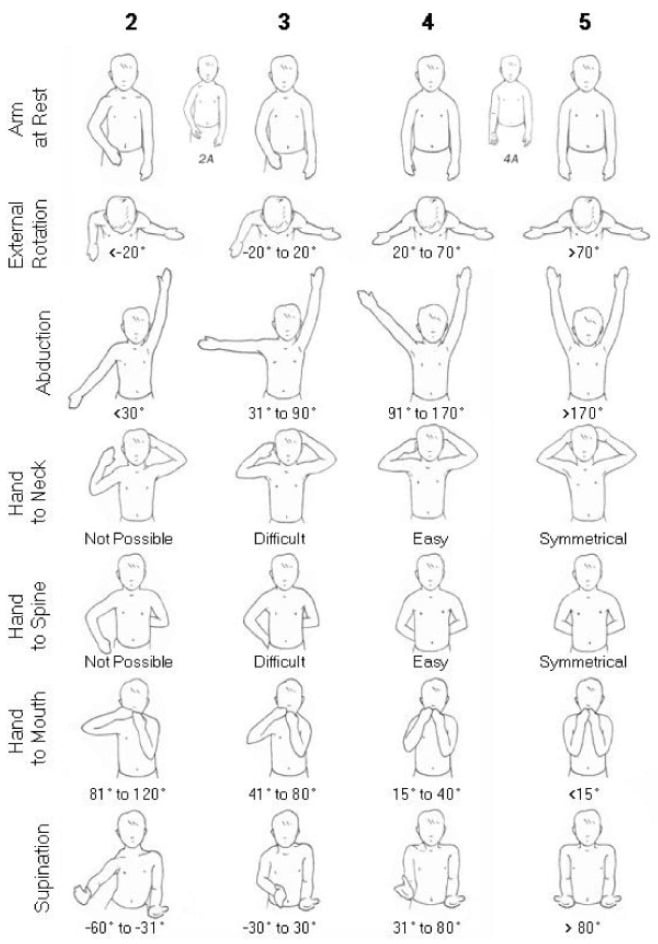
Mallet grading. The Mallet score grades shoulder function - abduction, external rotation, hand to mouth and the rest. Grade I is a flail shoulder and grade V is normal, with grades II to IV in between, and the shoulder operations are indicated against it.
Investigations
Radiographs. Clavicle and humerus at the first assessment. Always radiograph the shoulder girdle.
MRI of the plexus. Requested if there is no recovery by 3 months. It is read for two things: a pseudomeningocele at a root, which indicates avulsion, and a neuroma.
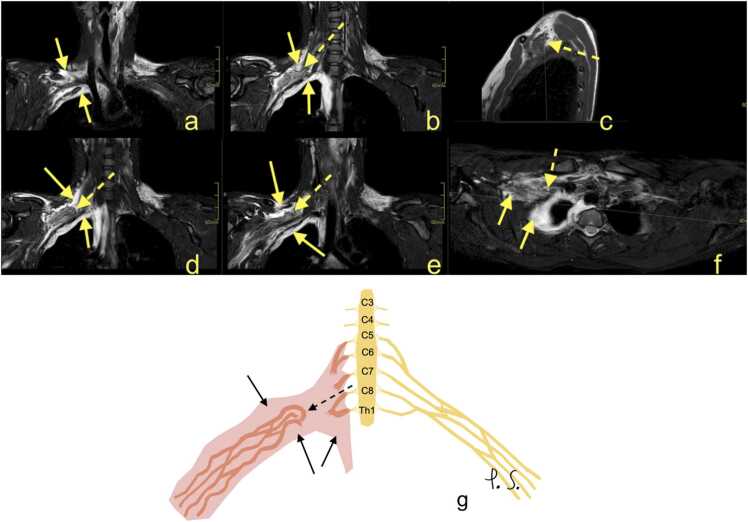
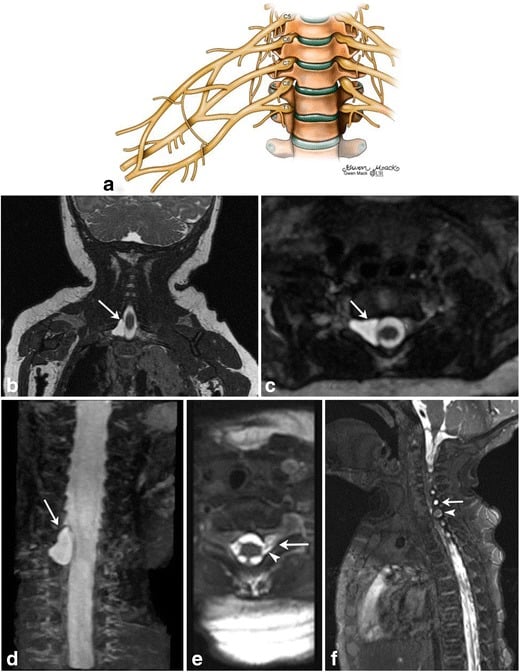
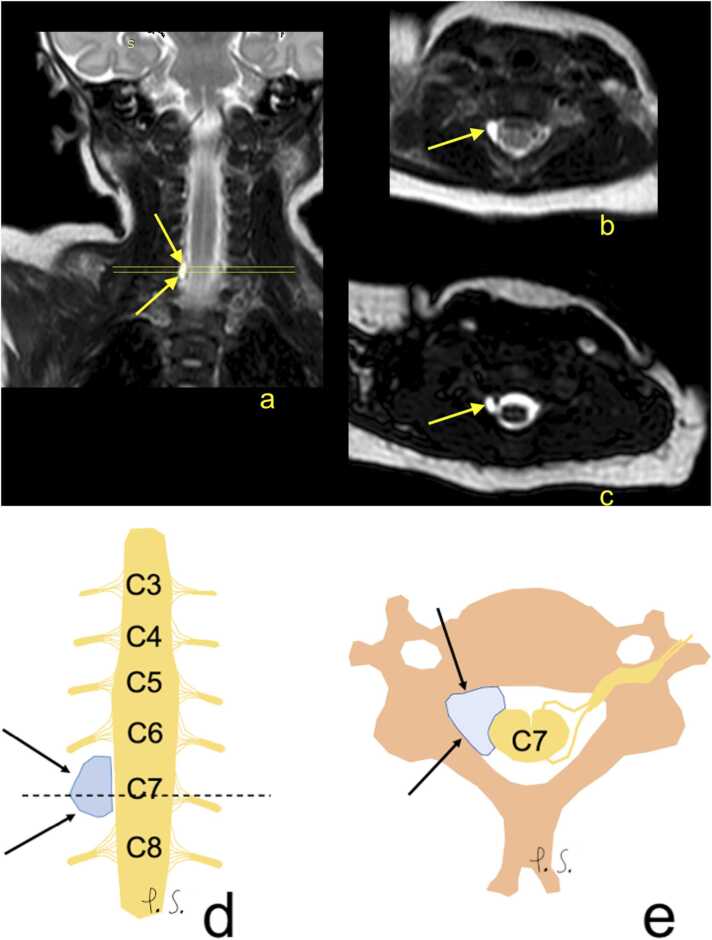
Ultrasound of the shoulder. For the child who has developed an internal rotation contracture: it assesses the glenohumeral joint for posterior subluxation and glenoid retroversion.
CT of the shoulder (3D). For surgical planning in the older child with established glenohumeral dysplasia.
Electrodiagnostics. EMG and nerve conduction studies can differentiate neurapraxia from axonotmesis or avulsion, and are often used to supplement the clinical examination. Timing matters: 3-4 weeks after the injury, which is when fibrillation potentials appear.
Differential Diagnosis
The flaccid or under-moving newborn arm has several mimics. The single most important step is to exclude a painful pseudoparalysis (fracture, infection) before attributing weakness to plexopathy.
- Distinguishing Features
- Posture-specific weakness (waiter's tip / claw), normal passive ROM, +/- Horner's
- Key Test
- Serial Active Movement Scale
- Distinguishing Features
- Crepitus, palpable callus, pain on movement, full recovery in 1-2 weeks
- Key Test
- Clavicle radiograph
- Distinguishing Features
- Pseudoparalysis, swelling, pain; epiphysis unossified so radiograph subtle
- Key Test
- Ultrasound / radiograph
- Distinguishing Features
- Pseudoparalysis with systemic signs, fever, raised inflammatory markers
- Key Test
- Ultrasound, aspiration, bloods
- Distinguishing Features
- Bilateral involvement, lower-limb signs, sphincter/respiratory compromise
- Key Test
- MRI cervical cord
- Distinguishing Features
- Emerges later, hypertonia and hyperreflexia, hand fisting, no birth event
- Key Test
- Neurological follow-up
- Distinguishing Features
- Bilateral, fixed contractures from birth, normal sensation
- Key Test
- Clinical, passive ROM
Associated Injuries
Birth plexus palsy rarely occurs in isolation - the same difficult delivery often injures neighbouring structures, and some associations carry prognostic weight.
- Clavicle and humeral fractures - the commonest association; they produce a painful pseudoparalysis that mimics, and can coexist with, the palsy
- Facial (VII) nerve palsy - from forceps pressure or the same lateral traction; usually neurapraxic and self-limiting
- Cephalohaematoma or subgaleal haemorrhage, and congenital muscular torticollis, from the birth trauma
Phrenic nerve palsy. The phrenic nerve (C3-C5) leaves the plexus very proximally, so a hemidiaphragm paralysis is an important association of high, proximal (C5) and total lesions. It can cause neonatal respiratory distress or recurrent atelectasis: look for unexplained respiratory difficulty and confirm it with a sniff test - fluoroscopy or ultrasound showing paradoxical upward diaphragm motion on inspiration. Persistent symptomatic paralysis may need diaphragm plication.
Q: Why is an associated phrenic nerve palsy a poor prognostic sign in birth plexus palsy? A: Because of where it puts the lesion. Involvement of C3-C5 implies a high, proximal traction injury at the C5 level, frequently with root avulsion, rather than a distal upper-trunk rupture - a more severe lesion.
Management Algorithm
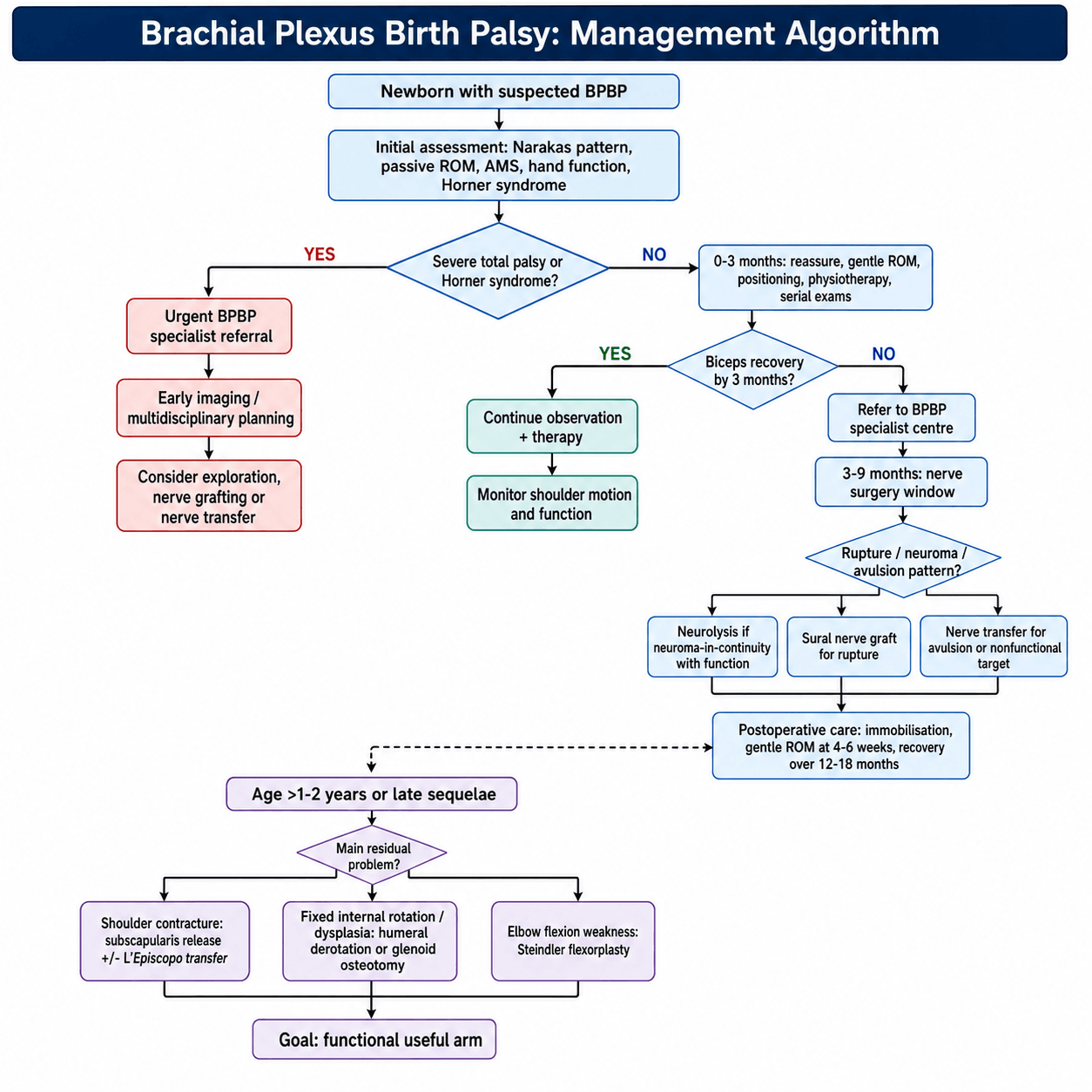
Early Management (0-3 Months)
The first three months belong to the parents, the physiotherapist and the serial examination. Nothing is done to the nerve in this period; the work is keeping the joint supple while the examination decides.
- Reassure the parents. The majority recover spontaneously.
- Gentle range-of-motion exercises, to prevent contracture, with referral to physiotherapy.
- Positioning through the full range, avoiding an adduction contracture.
- Serial examination. AMS at each visit, documenting biceps recovery.
- Referral. If there is no biceps recovery by 3 months, refer to a specialist plexus centre.
Splinting is generally not indicated in birth palsy.
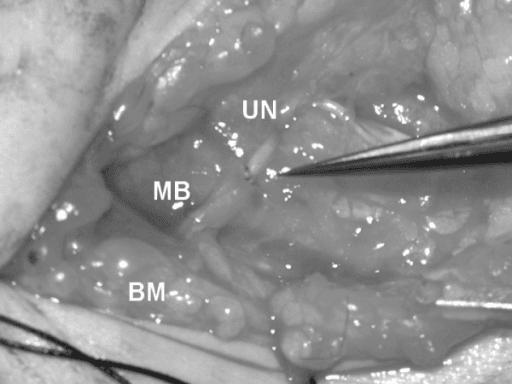
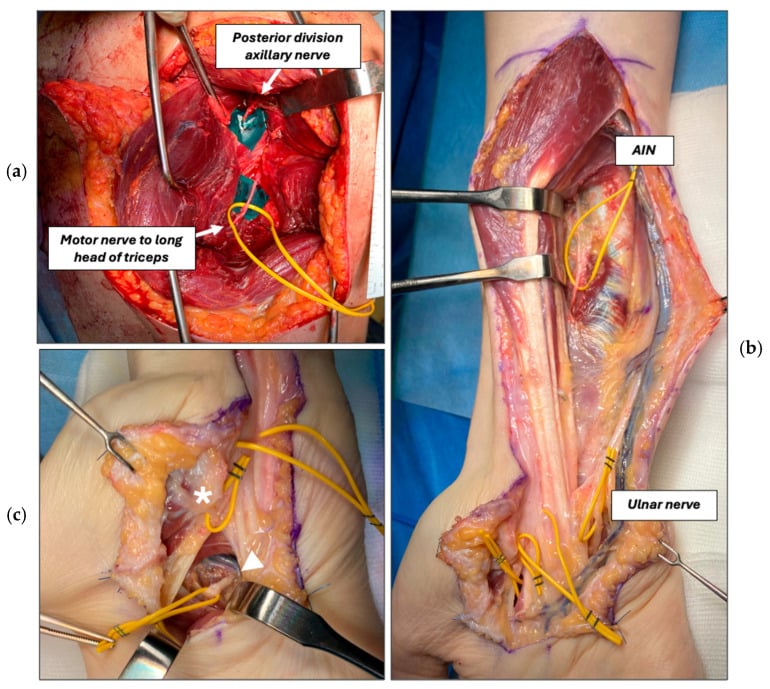
Refer, do not simply reassure. The window for nerve surgery is short, and a delayed referral misses the optimal timing for a nerve graft or transfer.
The "recovered" child. Even after a good recovery, subtle weakness and glenohumeral dysplasia can progress, so follow-up is long-term.
Surgical Technique
Release and Transfer (Shoulder)
Two operations for the same problem, and they are often combined: the release addresses the contracture, the transfer the absent active external rotation.
Anterior subscapularis release (modified Carlioz). Indicated for an internal rotation contracture of more than 20 degrees with a Mallet grade of III or less. Through an anterior axillary incision, the subscapularis is released from the humerus, lengthened or slid.
L'Episcopo, or the modified Sever-L'Episcopo. Indicated for weak external rotation, Mallet II-III. Latissimus dorsi and teres major are transferred to the posterior humerus, where they act as external rotators.
Complications
- Cause
- Muscle imbalance, Internal Rotation Contracture
- Management
- Early release, Osteotomy
- Cause
- Progressive dysplasia
- Management
- Reduction + Bony Reconstruction
- Cause
- Weak ER, Strong IR
- Management
- Stretching, Subscap Release
- Cause
- Poor biceps recovery
- Management
- Nerve transfer / Steindler
- Cause
- Abnormal re-innervation
- Management
- Botox, Selective Transfer
Glenohumeral dysplasia is the major late complication, and a joint left subluxated ends in osteoarthritis.
Postoperative Care
After nerve surgery. A sling or shoulder immobiliser, then gentle range of motion at 4-6 weeks. Recovery is expected over 12-18 months.
After tendon transfer or release. External rotation immobilisation in a spica, brace or shoulder immobiliser for 6 weeks, followed by intensive physiotherapy.
After osteotomy. A sling, with range of motion as tolerated and bone healing at 6-8 weeks.
Outcomes
What recovery looks like. Approximately 80-90% recover spontaneously, often fully or with minimal residual deficit. That headline figure depends heavily on how recovery is defined: methodologically rigorous natural-history data suggest full recovery may be closer to two-thirds, with a meaningful minority left with deficits, and over-reassurance risks late referral.
The severe end. A total palsy (Narakas III-IV) does badly, and permanent deficits are common. Nerve surgery improves function significantly but rarely restores it to normal.
Guidelines, Registries & Global Practice
Global Epidemiology:
- Incidence approximately 1-2 per 1000 live births, falling in high-resource settings. A Swedish national registry recorded a decline from 3.1 to 1.0 per 1000 cephalic vaginal births between 1997 and 2019 despite rising recognition of shoulder dystocia (PMID 36345990).
- Risk factors: shoulder dystocia, fetal macrosomia, maternal gestational diabetes, instrumental (forceps/vacuum) delivery, prolonged second stage, and breech delivery. Notably, a proportion of cases occur without documented dystocia (including caesarean births), implicating in-utero maladaptation.
- Upper-trunk (Erb's) pattern accounts for roughly 80-90% of cases and carries the best prognosis.
Side-by-Side Guidance:
- Position on Referral & Surgery
- Shoulder dystocia drills; document delivery; no routine caesarean for suspected macrosomia alone
- Emphasis
- Prevention and obstetric documentation
- Position on Referral & Surgery
- Early referral to a specialist plexus service; structured therapy pathway
- Emphasis
- Multidisciplinary specialist referral
- Position on Referral & Surgery
- Explore if no biceps by 3 months
- Emphasis
- Earliest microsurgical threshold
- Position on Referral & Surgery
- Composite Active Movement Scale; operate if score below threshold at 3 months
- Emphasis
- Quantified serial assessment
- Position on Referral & Surgery
- Surveillance for glenohumeral dysplasia; timely shoulder reconstruction
- Emphasis
- Long-term shoulder outcomes
Service Organisation & Resource Variation:
- High-resource settings: dedicated multidisciplinary plexus clinics (paediatric hand/peripheral-nerve surgery, physiotherapy, occupational therapy), early MRI and microsurgical capability, and structured glenohumeral surveillance.
- Limited-resource settings: emphasis on prevention (dystocia training, gestational diabetes screening), parent-delivered range-of-motion therapy, and clear referral pathways; advanced microsurgery and secondary reconstruction may be regionally centralised or unavailable, making timely triage critical.
- Universal principles: exclude a fracture, protect passive range of motion, document serial active movement, refer early if recovery stalls, and monitor lifelong for shoulder dysplasia regardless of setting.
Controversies & Areas of Uncertainty
When to operate on the nerve. No biceps by 3 months (Gilbert/Paris), a multi-movement composite at 3 months (Toronto/Clarke), or waiting to 6 months for partial recovery: no randomised trial has resolved the optimal threshold, and practice varies by centre.
Microsurgery versus watchful waiting. The absence of randomised data comparing primary nerve reconstruction with continued observation in incomplete upper-trunk lesions remains the field's biggest evidence gap. Decisions rest on cohort data and serial examination.
How early to intervene for the shoulder. Botulinum toxin, closed reduction and casting, arthroscopic versus open release, and the place of glenoid osteotomy are all debated for posterior subluxation. Earlier joint reduction may remodel the glenoid, but the thresholds are not standardised.
MCQ Practice Points
Q: What is the classic posture in Erb-Duchenne palsy? A: Waiter's Tip - Shoulder Adducted and Internally Rotated, Elbow Extended, Forearm Pronated, Wrist Flexed.
Q: What is the most important clinical predictor of good outcome in BPBP? A: Biceps recovery (antigravity elbow flexion) by 3-6 months.
Q: What does the presence of Horner's Syndrome indicate in BPBP? A: T1 root avulsion. Indicates poor prognosis (no spontaneous recovery of avulsed root). Nerve transfer required.
Q: What is the major late orthopedic complication of BPBP? A: Glenohumeral Dysplasia (GHD) - posterior subluxation and glenoid retroversion due to internal rotation contracture.
Q: What is the Oberlin procedure? A: A nerve transfer where a fascicle of the Ulnar nerve is transferred to the Musculocutaneous nerve (Biceps branch) to restore elbow flexion.
Viva Scenarios
Practise clinical reasoning and management decisions out loud
“What is your assessment and initial management?”
“What is your assessment and management plan?”
“Discuss prognosis and management.”
Patterns
- Erb's: C5-C6 (Waiter's Tip)
- Extended Erb's: C5-C7
- Klumpke: C8-T1 (Claw Hand)
- Total: C5-T1 (Flail)
- Horner's: T1 Avulsion
Key Milestones
- Biceps by 3 months: Good
- No Biceps by 6mo: Surgery
- 90% Erb's Recover
- Horner's = Poor Prognosis
Surgery
- Nerve Graft (Rupture)
- Nerve Transfer (Avulsion)
- Subscap Release (Contracture)
- L'Episcopo (Weak ER)
- Osteotomy (Fixed Posture)
Red Flags
- Rule out Clavicle Fracture
- Horner's = T1 Avulsion
- Refer early (by 3mo)
- Monitor for GHD
Evidence Base
Toronto Test Score & Natural History
- 66 infants reviewed; 61 (92%) recovered spontaneously, 5 (8%) required primary plexus exploration.
- Elbow flexion at 3 months alone mispredicted final recovery in 12.8% of cases.
- A combined test score (elbow flexion + elbow/wrist/thumb/finger extension) reduced misprediction to 5.2%.
Natural History Systematic Review
- Systematic review of natural-history studies of obstetric brachial plexus palsy.
- Methodologically robust studies suggest full spontaneous recovery is closer to 66%, lower than the often-quoted 90%.
- Heterogeneous outcome definitions inflate reported recovery rates.
Oberlin Transfer (Original Description)
- Four patients with C5-C6 root avulsion treated by transfer of ~10% of the ulnar nerve to the biceps motor branch.
- Restored elbow flexion with no significant impairment of hand function.
- Established intraplexal fascicular transfer as an alternative to long nerve grafts.
Double Fascicular Transfer for Elbow Flexion
- 15 patients had ulnar-to-biceps plus median-to-brachialis double transfer; 10 had at least 6 months follow-up.
- Grade 4 (MRC) elbow flexion restored in all 10 followed patients, lifting 1-5 kg.
- No secondary deficit in grip strength or sensation.
Glenohumeral Deformity: Natural History
- Prospective study; mean glenoid retroversion (glenoscapular angle) -25.7 degrees on the affected side versus -5.5 degrees on the unaffected side.
- 26 of 42 shoulders (62%) showed posterior subluxation of the humeral head on CT/MRI.
- Deformity progressed significantly with increasing age (p less than 0.001).
Shoulder Reconstruction Outcomes
- Case-control comparison of tendon transfer versus rotational humeral osteotomy, selected by age and degree of deformity.
- Global Mallet scores improved from 9.5 to 15.6 after tendon transfer and from 9.5 to 15.1 after osteotomy.
- Both procedures predictably improve shoulder function when matched to the deformity.
Epidemiology & Declining Incidence
- Swedish population registry (1997-2019): OBPP in cephalic vaginal births fell from 3.1 to 1.0 per 1000 (OR 0.31).
- Shoulder dystocia incidence rose over the same period (2.0 to 3.3 per 1000), yet OBPP still declined.
- Falling macrosomia and operative vaginal delivery explained only a small fraction of the decline.
Narakas Classification
- Defined the four-group clinical classification (Groups I-IV) by root involvement.
- Correlated extent of injury with prognosis; Group IV (total palsy with Horner's) carries the worst outlook.
- Remains the standard prognostic grouping at presentation.