Cervical Lateral Mass Fracture-Separation
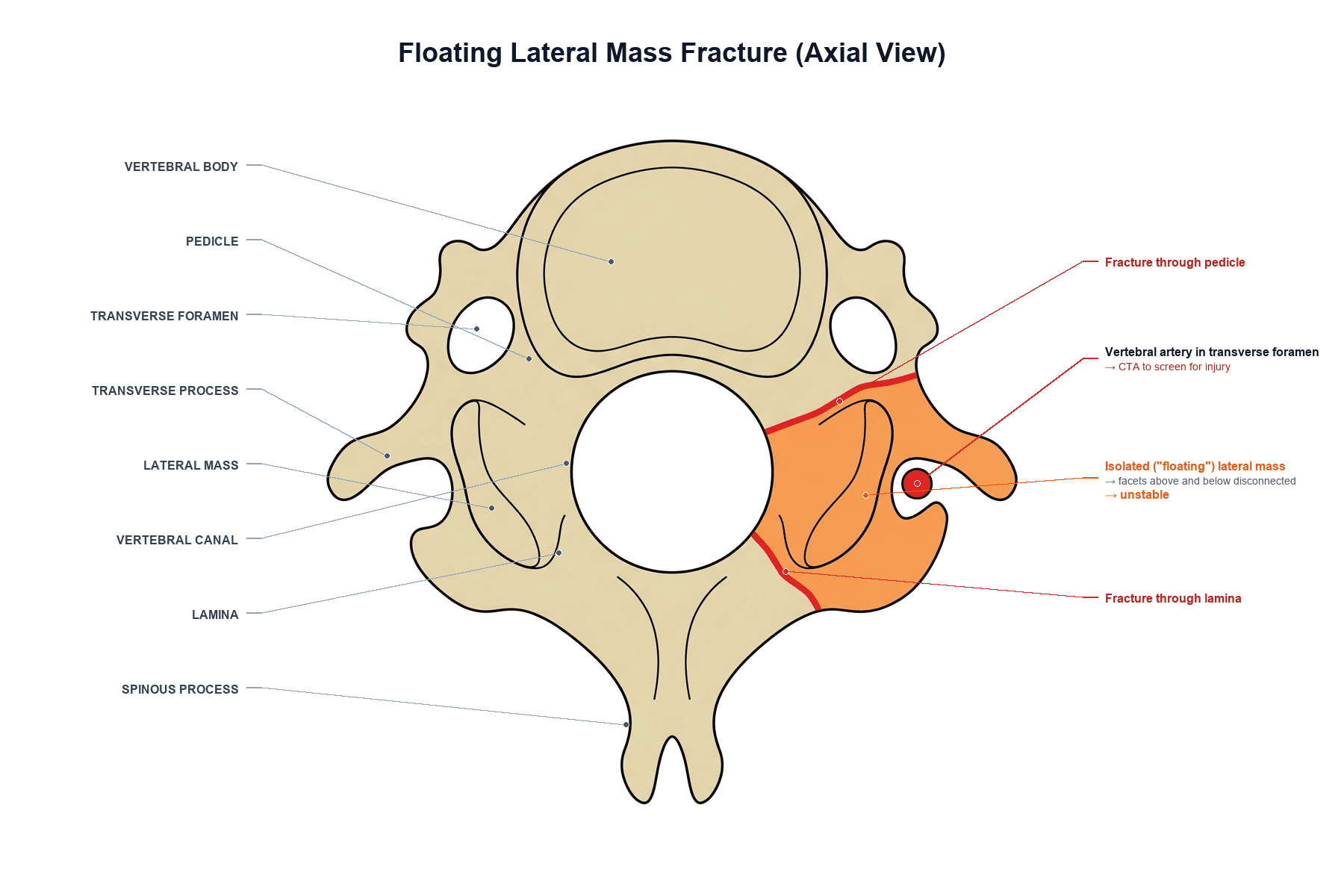
- A floating lateral mass (FLM) fracture-separation of the subaxial cervical spine is defined by a fracture through BOTH the ipsilateral LAMINA and the PEDICLE, which separates the lateral mass from the rest of the vertebra and thereby DISCONNECTS the superior and inferior articular processes (the facet joints above and below that level) - the lateral mass is left 'floating'.
- Because the lateral mass is the structural link between consecutive facet joints, isolating it removes the bony continuity of the posterolateral column and makes the segment HIGHLY UNSTABLE, prone to rotational malalignment, kyphosis and facet subluxation; the injured level often shows the lateral mass rotated into a horizontal ('reverse hamburger') orientation.
- FLM fractures result from HIGH-ENERGY trauma and are frequently associated with NERVE ROOT injury (the exiting root at that level is at risk) and with other cervical fractures or ligamentous injury, so a full assessment of the neurology and the rest of the cervical spine is essential.
- CT is the key investigation to DEFINE the pattern (lamina + pedicle fractures isolating the lateral mass, with assessment of facet alignment); because of the proximity of the lateral mass and pedicle to the TRANSVERSE FORAMEN, and because fracture patterns with DISLOCATION/SUBLUXATION carry the highest risk of BLUNT CEREBROVASCULAR INJURY (BCVI), CT ANGIOGRAPHY should be used to screen for VERTEBRAL ARTERY injury.
- Because the injury is unstable, OPERATIVE stabilisation (fusion) is commonly required and can be performed by an ANTERIOR, POSTERIOR or COMBINED approach; in reported series complications clustered in the posterior (hardware failure) and combined (respiratory) groups, while the anterior approach had fewest - so approach selection should weigh the injury pattern, alignment and associated injuries.
- NON-OPERATIVE management (rigid immobilisation) can be satisfactory for APPROPRIATELY SELECTED FLM fractures - in a reported cohort none of the carefully selected non-operatively treated patients required later surgery for subluxation - so management is individualised to stability, alignment, neurology and the patient, rather than mandating surgery for every FLM.
- “Floating lateral mass = fracture through BOTH lamina AND pedicle → isolates the lateral mass and DISCONNECTS the facet joints above and below (highly unstable).
- “High-energy; watch for nerve root injury; CT defines it and CTA screens for vertebral artery (BCVI) injury - dislocation/subluxation patterns carry the highest BCVI risk.
- “Often operative (anterior/posterior/combined); selected cases manage non-operatively with rigid immobilisation.
Fracture through both the lamina and the pedicle isolates the lateral mass, so the facet joints above and below are disconnected - the mass 'floats'. Highly unstable.
Nerve root injury at that level, and vertebral artery injury - CTA screen (dislocation/ subluxation patterns carry the highest BCVI risk).
Overview & Epidemiology
A floating lateral mass (FLM) fracture-separation is an uncommon, high-energy subtype of subaxial cervical facet injury. What the literature supports:
- How rare: the only dedicated FLM cohort (Prezelski et al, Spine 2024) identified 45 patients over a 10-year span at a single centre - a useful honest anchor for how infrequently the pattern is seen, rather than a population incidence.
- The trauma context: in a 4-year series of 690 blunt cervical spine injuries (Du et al, Spine J 2024), 66% were screened with CT angiography and BCVI was found in 30% of those screened; all 9 strokes in the series occurred in patients with BCVI.
- The vascular context: in the Denver screening experience (Biffl et al, Ann Surg 2000), blunt vertebral artery injury was diagnosed in 0.53% of blunt trauma admissions, motor vehicle crash was the most common mechanism, and 71% of patients with a vertebral artery injury had a cervical spine injury.
- Mechanism: high-energy extension-compression, extension-rotation or lateral-bending axial loads; the energy required means associated cervical and non-cervical injuries are the rule, not the exception.
Definition & Instability
A floating lateral mass fracture is defined by a fracture through both the lamina and the pedicle on one side, which separates the lateral mass from the vertebra and disconnects the superior and inferior articular processes - the facet joints above and below. Because the lateral mass is the bony link between consecutive facets, isolating it removes the posterolateral column's continuity and leaves the segment highly unstable, prone to rotation, kyphosis and facet subluxation (the lateral mass may rotate into a horizontal orientation). These are high-energy injuries, often with nerve root involvement and associated cervical injuries. CT defines the pattern, and because the lateral mass/pedicle lie next to the transverse foramen - and fracture-dislocation/subluxation patterns carry the highest risk - CTA should screen for vertebral artery (BCVI) injury.
Anatomy & Biomechanics
- The lateral mass is the column of bone between the superior and inferior articular processes of a subaxial vertebra. Its bony tethers are the pedicle anteromedially and the lamina posteromedially - fracture both and the mass, carrying both articular processes, is free.
- The neighbours that get hurt: the vertebral artery runs in the transverse foramen immediately lateral to the mass and pedicle; the exiting nerve root passes directly anterior to the mass in the neuroforamen. These two structures define the injury's danger list.
- Why isolation means instability: the facet joints guide and restrain cervical rotation and flexion, and the lateral mass is the only bony link between the facet joint above and the facet joint below. Isolate it and both joints lose their anchor - the segment is free to rotate, sublux and kyphose, and the detached mass itself may rotate into a horizontal orientation on axial imaging.
- Load path: with the posterolateral column disrupted, loads that the facets would normally share are transferred to the disc and the remaining ligaments, which is why an associated discoligamentous injury so often decides the management.
Classification Systems: FLM = AO Spine F3
Calling the injury unstable is not enough in a viva - the examinable step is to place it in the formal systems (the general subaxial frameworks are developed in our Subaxial Cervical Fractures topic):
- AO Spine subaxial classification. Alongside the morphology types (A compression, B tension-band, C translation), facet injuries are graded F1-F4 - and the floating lateral mass is the F3 subtype. Knowing the ladder shows why: F1 a nondisplaced facet fracture, F2 a facet fracture with potential instability, F3 the floating lateral mass (separation by fractures through the pedicle AND lamina), and F4 a pathologic subluxation/perched or dislocated facet.
- SLIC (Subaxial Injury Classification). Scores morphology + the discoligamentous complex + neurology; the facet disruption and any subluxation/malalignment of an FLM push the score toward the operative range, which is consistent with how unstable the injury is.
If the CTA Is Positive: Grading and Managing the Vertebral Artery Injury
- Grade it (Biffl / Denver scale). Grade I - luminal irregularity or dissection with less than about a quarter narrowing; Grade II - dissection/intramural haematoma with more than about a quarter narrowing, an intraluminal thrombus or a raised intimal flap; Grade III - pseudoaneurysm; Grade IV - complete occlusion; Grade V - transection with active extravasation.
- Treat to prevent stroke. Antithrombotic therapy (antiplatelet, e.g. aspirin, or systemic anticoagulation/heparin) is the mainstay for grades I-IV and reduces the posterior-circulation stroke risk - balanced against bleeding risk in a polytrauma patient and the timing of spinal surgery.
- Endovascular/serial imaging. Many low-grade injuries stabilise or resolve, so they are followed with repeat imaging; an enlarging Grade III pseudoaneurysm or a Grade V transection may need endovascular treatment (stent/coil/embolisation), while a Grade IV occlusion is usually managed antithrombotically.
- Coordinate with the spine plan. The antithrombotic decision is made jointly with the trauma/neuro teams around the timing of fixation.
A positive CTA is not the end: grade the BCVI (Biffl I-V), start antithrombotic therapy (antiplatelet or anticoagulation) for grades I-IV to cut stroke risk, follow low grades with repeat imaging, and reserve endovascular treatment for an enlarging pseudoaneurysm (III) or transection (V) - all balanced against bleeding and the timing of spinal stabilisation.
Clinical Assessment: Mechanism, Presentation & Non-operative Selection
- Mechanism. A high-energy extension–compression or extension–rotation load drives the inferior articular process of the level above into the lateral mass, splitting it; the same force may be applied in lateral bending with axial load. Because it takes that much energy, an isolated finding should prompt a search for associated cervical and non-cervical injuries rather than reassurance.
- Presentation. Axial neck pain with restricted, painful rotation (the fractured facet complex is the restraint), often torticollis-like posturing to the injured side. Radicular symptoms in the exiting root are common because the root sits immediately anterior to the fractured mass — document power in the myotome for that level before any intervention. A Horner syndrome, hemiparesis, ataxia or posterior circulation symptoms point at the vertebral artery, not the root.
- Non-operative selection. Where the injury is a genuinely isolated lateral mass fracture with no translation or kyphosis, an intact discoligamentous complex on MRI and normal neurology, a rigid collar for a period of weeks with upright radiographs at intervals is reasonable — the critical part is the interval imaging, because late subluxation is the failure mode that converts a conservative plan into a delayed fusion.
- What pushes toward surgery: translation or facet subluxation, progressive kyphosis, a positive discoligamentous injury on MRI, radiculopathy that does not settle, or the same injury in a multi-level or polytrauma context where a collar cannot be relied on.
Investigations
- CT (fine-cut) is definitive: it demonstrates the paired pedicle and lamina fractures, the alignment of both facet joints, and any rotation of the detached mass. Plain radiographs are insensitive - they may show malalignment but cannot exclude the injury.
- CT angiography screens the vertebral artery: the only fracture pattern independently associated with BCVI in the Du 2023 series was fracture with dislocation/subluxation (OR 3.8), with combined upper-cervical (OC-C3) and multilevel fractures also at increased risk - an FLM with any subluxation sits squarely in the screen-positive group.
- MRI is added when the discoligamentous complex must be assessed (any consideration of non-operative management) or when there is a neurological deficit to explain.
- Interval upright radiographs are not optional extras in non-operative care - they are the surveillance that catches the late subluxation which converts a collar plan into a delayed fusion.
Management Algorithm
- Assess fully. Document neurology (the exiting nerve root is at risk), assess alignment and the rest of the cervical spine, and CTA to screen for vertebral artery injury.
- Operative stabilisation is commonly required for this unstable injury - anterior, posterior or combined fusion. In reported series complications clustered in the posterior (hardware failure) and combined (respiratory) groups, with fewest in the anterior approach - so weigh injury pattern, alignment and associated injuries when choosing.
- Non-operative management (rigid immobilisation) is satisfactory for appropriately selected FLM fractures - in a reported cohort no carefully selected non-operative patient needed later surgery for subluxation.
- Individualise. Base the decision on stability, alignment, neurology and the whole injury picture rather than treating every FLM the same way.
Surgical Technique: Fixation & Its Two Hazards
If posterior fixation is chosen, the segment is usually held with lateral mass screws, and the examinable content is the trajectory — because the two structures at risk sit either side of the screw.
- Roy-Camille. Start at the midpoint of the lateral mass, aim straight lateral by about 10 degrees and perpendicular to the posterior cortex (no cephalad angulation).
- Magerl. Start 1–2 mm medial and caudal to the midpoint, aim about 25 degrees lateral and parallel to the facet joint surface (roughly 30 degrees cephalad). More lateral and cephalad angulation.
- An. Start at the midpoint, aim about 15 degrees lateral and 30 degrees cephalad.
- The principle behind all three: aim LATERAL and CEPHALAD. Medial angulation threatens the vertebral artery in the transverse foramen; insufficient cephalad angulation threatens the exiting nerve root below. Getting that single sentence out is worth more than reciting exact degrees.
Complications
- Approach-specific (Prezelski 2024 cohort): complications clustered in the posterior group (two hardware failures) and the combined group (two postoperative respiratory complications); none were observed in the anterior group.
- Vascular: an unrecognised vertebral artery injury is the catastrophic complication - in the Denver series the incidence of posterior circulation stroke was 24% and the BVI-attributable death rate 8% (Biffl 2000), which is the entire argument for CTA screening and antithrombotic therapy.
- Neurological: exiting nerve root injury at the fractured level; cord injury is uncommon unless there is subluxation or translation.
- Non-operative failure mode: late subluxation or progressive kyphosis - the reason interval upright imaging is mandatory rather than optional.
- General surgical risks: infection, pseudarthrosis, adjacent-segment degeneration, and screw-related vertebral artery or nerve root injury (medial or insufficiently cephalad trajectory).
Postoperative Care
- Neurological observations and wound surveillance
- Continue the orthosis dictated by construct stability
- After an anterior approach, monitor swallowing and watch for haematoma
- Collar duration individualised to the construct and bone quality
- Mobilise with physiotherapy; DVT prophylaxis until fully ambulant
- If a BCVI was found, continue antithrombotic therapy and plan follow-up vascular imaging with the trauma/neurovascular team
- Serial radiographs (and CT if doubt) for fusion mass, alignment and implant integrity
- Graded return to work, driving and sport once fusion is confirmed
- Long-term: counsel on adjacent-segment degeneration after cervical fusion
Outcomes & Prognosis
- Non-operative (selected): in the Prezelski cohort, none of the 25 non-operatively treated patients crossed over to surgery for subluxation - evidence that careful selection works, from a single-centre retrospective series.
- Operative: all three approaches achieved stabilisation; complications were approach-specific (posterior hardware failure, combined respiratory) rather than failures of fusion.
- Vascular outcome dominates when BCVI is present: Biffl's series associated systemic anticoagulation with fewer poor neurological outcomes, fewer strokes and less injury progression - the basis of modern antithrombotic-first management.
- Overall prognosis is governed less by the fracture than by the associated injuries and the neurological status at presentation; an isolated FLM with intact neurology and no BCVI has a favourable outlook once stabilised.
Guidelines, Registries & Global Practice
- Classification language: the AOSpine subaxial system (Vaccaro 2016) is the international common language for reporting these injuries; SLIC (Vaccaro 2007) remains the widely taught severity-score framework for the operative/non-operative threshold.
- BCVI screening: trauma-society screening protocols derived from the Denver and Memphis experiences endorse CT angiography for high-risk cervical fracture patterns - fracture-dislocation/subluxation, transverse-foraminal involvement and upper-cervical or multilevel fractures; the Du 2023 data support exactly that selection.
- Antithrombotic-first management of BCVI (antiplatelet or anticoagulation for Biffl grades I-IV, with endovascular treatment reserved for enlarging pseudoaneurysm or transection) is the consistent international practice pattern.
- Practice variation: the operative-versus-non-operative threshold for a minimally displaced FLM varies between centres and health systems; the published FLM cohort is single-centre and retrospective, so local protocols and MDT discussion appropriately govern borderline cases.
Mnemonics & Memory Aids
FLOAT
Hook:FLOAT: Fracture lamina+pedicle, Lateral mass floats, Off-line facets (unstable), Artery (CTA)/root, Treat by stabilising or selected non-op.
IDPOT
Hook:IDPOT climbs the Biffl ladder: the injured vessel goes from Irregular to Dissected to Pseudoaneurysm to Occluded to Transected - grades I-IV get antithrombotics, an enlarging III or a V goes endovascular.
M&M
Hook:M&M: Magerl takes More of both angles than Roy-Camille - and every technique aims lateral and cephalad, because medial threatens the vertebral artery and flat threatens the nerve root.
MCQ Practice Points
Q: Which two fractures define a floating lateral mass? A: Fractures through BOTH the ipsilateral lamina AND the pedicle - one fracture line alone does not isolate the mass.
Q: What is the floating lateral mass in the AO Spine subaxial classification? A: The F3 facet injury (F1 nondisplaced facet fracture, F2 potentially unstable facet fracture, F4 perched or dislocated facet).
Q: Which cervical fracture pattern carries the highest risk of blunt cerebrovascular injury? A: Fracture associated with dislocation/subluxation (OR 3.8, Du 2023) - not any single anatomical level; combined upper-cervical (OC-C3) and multilevel fractures are also at increased risk.
Q: Which two structures are at risk from a malpositioned lateral mass screw? A: The vertebral artery if the trajectory is too medial, and the exiting nerve root if cephalad angulation is insufficient.
Q: At which levels are lateral mass screws reliable, and what is used at C7 and C2? A: Lateral mass screws are reliable C3-C6; C7 usually takes a pedicle screw (thin lateral mass) and C2 a pars, pedicle or translaminar screw.
At a Glance
- Key Point
- Fracture through BOTH the ipsilateral lamina AND pedicle, isolating the lateral mass
- Key Point
- Highly unstable - the facet joints above and below are disconnected
- Key Point
- AO Spine subaxial F3 facet injury; SLIC usually scores into the operative range
- Key Point
- CT defines the pattern; CTA screens the vertebral artery (BCVI)
- Key Point
- Exiting nerve root at that level; vertebral artery in the transverse foramen
- Key Point
- Usually operative fusion (anterior/posterior/combined); carefully selected cases non-operative in a rigid collar with interval imaging
Clinical Decision Scenarios
Practise clinical reasoning and management decisions out loud
“What is a floating lateral mass fracture, and why is it unstable?”
“How would you manage a floating lateral mass fracture?”
Definition
- Fracture through BOTH lamina and pedicle isolating the lateral mass
- Disconnects superior and inferior articular processes (facets above and below)
- The lateral mass 'floats' - may rotate horizontal
Why it matters
- Highly unstable (loss of posterolateral column continuity)
- High-energy; nerve root injury common at that level
- Associated cervical fractures/ligamentous injury
Workup
- CT defines the pattern and facet alignment
- CTA to screen for vertebral artery / BCVI
- Dislocation/subluxation and upper-cervical/multilevel patterns = highest BCVI risk
Management
- Often operative stabilisation (anterior/posterior/combined)
- Anterior had fewest complications in series; posterior (hardware), combined (respiratory)
- Selected cases non-operative (rigid immobilisation) - individualise
Evidence & Key Studies
Assessing treatment of floating lateral mass (FLM) fractures of the subaxial cervical spine
- An FLM fracture involves separation of the lateral mass from the vertebra via disruption of BOTH the lamina and the pedicle, disconnecting the superior and inferior articular processes - a highly unstable injury.
- In a 10-year cohort of 45 patients (25 non-operative, 20 operative: 6 anterior, 12 posterior, 2 combined), no non-operative patient crossed over to surgery for subluxation.
- Complications occurred in the posterior (hardware failure) and combined (respiratory) groups, with none in the anterior group - suggesting carefully selected non-operative treatment can be satisfactory.
Cervical fracture patterns associated with blunt cerebrovascular injury on CT angiography
- The only fracture pattern associated with increased risk of blunt cerebrovascular injury (BCVI) was a fracture associated with dislocation/subluxation (odds ratio 3.8).
- Combined upper-cervical (occiput-C3) fractures and multilevel fractures were also associated with increased BCVI risk; among screened patients, BCVI was found in 30% and all strokes occurred in BCVI patients.
- The authors recommend CT-angiography screening for any upper-cervical, multilevel, or fracture-with-dislocation/subluxation pattern.
The devastating potential of blunt vertebral arterial injuries
- Denver screening protocol: 38 patients with 47 blunt vertebral artery injuries over 3.5 years (0.53% of blunt trauma admissions).
- Cervical spine injuries were present in 71% of BVI patients; motor vehicle crash was the most common mechanism.
- Posterior circulation stroke incidence was 24% and BVI-attributable death rate 8%.
- Systemic heparin was associated with fewer poor neurological outcomes, fewer strokes and less injury-grade progression.
The definition of the floating lateral mass (lamina + pedicle disruption disconnecting the articular processes), its instability, and the operative-versus-non-operative outcomes (including satisfactory selected non-operative treatment and the approach-specific complications) come from the cited Prezelski cohort; the association of dislocation/subluxation and upper-cervical/multilevel patterns with blunt cerebrovascular (vertebral artery) injury and the recommendation to screen with CT angiography from the cited Du study. The high-energy mechanism, the nerve-root risk and the general principles of subaxial cervical stabilisation are standard, well-established teaching. (See also our Subaxial Cervical Spine Injuries and Facet Dislocation topics.)