Neuropathic Joint Destruction | Diabetic Foot | Eichenholtz Staging | Rocker-Bottom Deformity
- Charcot neuroarthropathy = progressive destructive arthropathy in a neuropathic joint
- Most common cause is diabetes mellitus (type 1 and type 2); other causes include syringomyelia, leprosy, alcohol neuropathy
- Acute presentation mimics infection (warm, red, swollen foot) — delayed diagnosis is common and devastating
- Rocker-bottom deformity results from midfoot collapse during Stage 1, creating plantar prominence and ulceration risk
- Total contact cast (TCC) is gold standard for acute phase — prolonged immobilisation prevents further destruction
- Surgical reconstruction considered when deformity is unstable, non-braceable, or ulceration recurrent
- “Always suspect Charcot in any diabetic patient with a warm, swollen foot — even without a clear history of trauma
- “Skin temperature differential greater than 2 degrees Celsius between feet suggests acute Charcot, not cellulitis
- “Stage 0 has normal X-rays but clinical suspicion — MRI shows bone marrow oedema
- “Rocker-bottom deformity is the hallmark of midfoot Charcot — palpate the plantar prominence
Overview and Epidemiology
Charcot neuroarthropathy is a progressive destructive arthropathy of a joint that has lost its protective sensation, and one of the most devastating complications of diabetic neuropathy. The acute foot is warm, red and swollen, which is why it is so often misdiagnosed as cellulitis, deep vein thrombosis or gout, and why the delay in offloading leads to irreversible joint destruction.
Who gets it. Between 0.3 and 7.5% of patients with diabetes develop Charcot, and diabetes mellitus accounts for more than 75% of cases in developed countries. The other recognised causes are:
- Syringomyelia, which affects the upper limb
- Leprosy
- Alcohol-related neuropathy
- Spinal cord injury
- Congenital insensitivity to pain
The other foot. Between 9 and 75% of patients develop contralateral involvement over time, which is why the contralateral foot stays under surveillance and why patient education is part of the treatment.
Where in the foot. The midfoot carries 60% of disease, the rearfoot and ankle 30%, the forefoot 10%.
What it costs. The amputation risk is 15 to 30% if the disease is untreated or diagnosed late, and more than 50% of those with a rocker-bottom deformity develop plantar ulcers. Mobility, employment and independence are severely limited, hospitalisation for Charcot complications is among the most costly in diabetic foot disease, and five-year mortality after a Charcot-related amputation approaches 50%.
Pathophysiology
Two theories, one foot. Destruction requires both loss of protective sensation and repetitive microtrauma acting on bone in a vascularly active environment. The neurotraumatic and neurovascular theories are complementary: one explains why the injury goes unrecognised, the other why the bone was weak enough to break under normal loads.
Neurotraumatic. Loss of proprioception and pain sensation allows repeated micro-injury beyond what the joint can tolerate physiologically. The minor trauma that starts it — a twist, a step off a curb — goes unrecognised, and the patient keeps weight-bearing on an injured joint.
Neurovascular. Autonomic neuropathy removes sympathetic vasoconstriction, blood flow to bone rises, and osteopenia with increased resorption follows. Hyperaemic, osteopenic bone is structurally weak and fractures easily under normal loads, so the bone is already weakened before any injury arrives.
Motor neuropathy. Wasting of the intrinsic muscles and the resulting imbalance alter foot mechanics and load the foot abnormally, contributing to progressive subluxation.
The inflammatory cascade. Acute trauma in a neuropathic limb triggers an exaggerated inflammatory response — RANKL upregulation and osteoclast activation — and resorption, fragmentation and deformity then feed one another. This is what explains the speed of destruction in Stage 1.
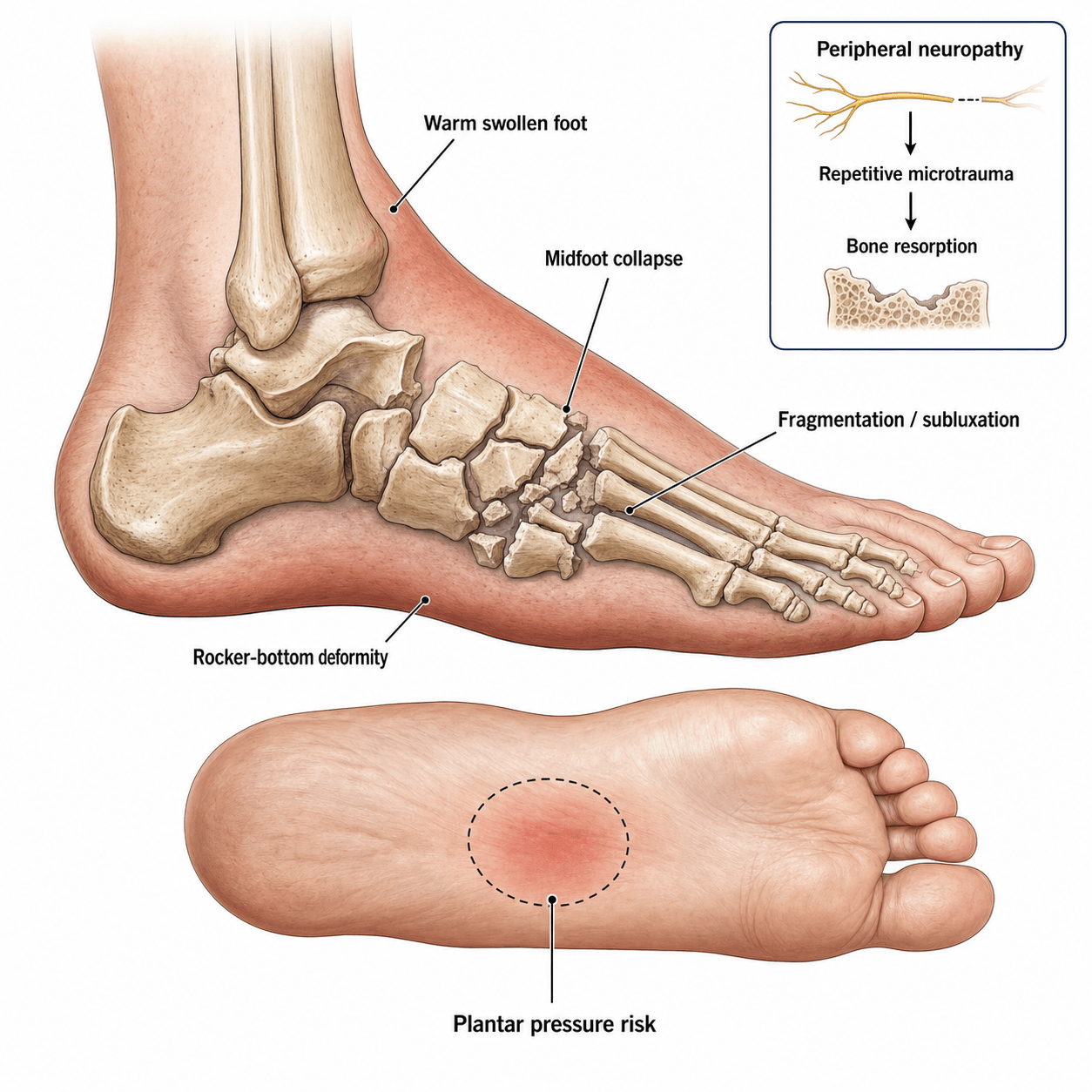
Why the midfoot gives way. The tarso-metatarsal (Lisfranc) and naviculocuneiform joints have limited intrinsic stability, so when osteopenic bone meets repetitive load these are the joints that fail. The midfoot collapses dorsally and the longitudinal arch inverts: the plantar tarsometatarsal ligaments attenuate, the cuneiforms displace dorsally, and the cuboid becomes the weight-bearing plantar prominence.
Why that prominence matters. The convex sole concentrates pressure on skin that cannot feel it. Focal pressure builds callus, the callus breaks down, and the resulting ulcer is the gateway to deep infection and amputation.
Classification and Types
Three systems are in use and they answer different questions. Eichenholtz stages the disease in time and decides the treatment. The anatomical systems of Sanders and Frykberg and of Brodsky record which joints are involved, which predicts the deformity, the ulcer risk, the prognosis and the surgical approach.

Eichenholtz Staging (Modified with Stage 0)
- Clinical Features
- Warm, swollen foot, painless or mild ache, temperature differential greater than 2 degrees Celsius
- Radiographic Findings
- Normal X-rays, MRI shows bone marrow oedema
- Treatment
- Immediate TCC, strict non-weight-bearing
- Duration
- Until temperature normalises (typically 4-8 weeks)
- Clinical Features
- Swelling, erythema, bounding pulses, joint laxity
- Radiographic Findings
- Soft tissue swelling, osteopenia, marginal fractures, fragmentation, joint subluxation, debris formation, periosteal reaction
- Treatment
- TCC, strict non-weight-bearing, serial X-rays every 4 weeks
- Duration
- Until coalescence begins (typically 3-6 months)
- Clinical Features
- Decreasing swelling and warmth, foot temperature approaches contralateral
- Radiographic Findings
- Absorption of debris, periosteal new bone formation, fusion of large fragments, decreasing sclerosis
- Treatment
- TCC with gradual progression to weight-bearing, bivalve cast
- Duration
- 2-4 months, until consolidation
- Clinical Features
- Cool, stable foot with fixed deformity (rocker-bottom, varus/valgus)
- Radiographic Findings
- Remodelled joint surfaces, mature bony consolidation and sclerosis, fixed deformity with medial arch collapse
- Treatment
- Custom orthosis (CROW boot), accommodative footwear
- Duration
- Lifetime bracing and monitoring
Stage 0 was added to Eichenholtz's original three stages to capture the pre-radiographic phase, where intervention is most effective. Recognising it is what prevents a destructive Stage 1; missing it is what leads to the rocker-bottom deformity.


Clinical Assessment
History. Patients often cannot recall a specific injury, and insidious swelling is common. Ask how long the diabetes has been present, what the glycaemic control has been (HbA1c) and whether neuropathy has ever been screened for. Ask about the other foot — a previous Charcot episode, current ulceration or deformity — and ask whether the patient has continued to weight-bear on the swollen foot.
What the patient reports. Swelling that is painless or barely painful, with redness and warmth. Some notice nothing but a change in the shape of the foot.
Examination. Start with the shape of the foot — erythema, oedema, a rocker-bottom contour, varus or valgus, medial arch collapse, the pattern of callus and any ulcer — then work through the rest in order:
- Palpate — skin temperature with an infrared dermathermometer, bony prominences, and joint stability
- Neurological — monofilament testing (10g), vibration with a 128 Hz tuning fork, proprioception, deep tendon reflexes
- Vascular — pedal pulses, capillary refill, and Doppler if the pulses are not palpable, because Charcot requires adequate perfusion to heal

Infrared dermathermometry is the most reliable tool for diagnosing and monitoring acute Charcot activity. A skin temperature difference of greater than 2 degrees Celsius between the affected and contralateral foot at comparable anatomical sites indicates active inflammation, and some authorities use greater than 2.2 degrees Celsius. Normalisation to less than 1 degree Celsius is a key criterion for moving from casting to bracing and for confirming coalescence.
Measure at every visit, every one to two weeks through the acute phase, and plot the trend to track the resolution of inflammation. A temperature that rises despite casting suggests ongoing destruction or a complication.
The two conditions it is mistaken for. A hot swollen foot in a diabetic patient is Charcot until proven otherwise; the bedside findings that separate it from cellulitis and deep vein thrombosis are set out below.
- Acute Charcot
- Minimal (neuropathy)
- Cellulitis
- Moderate to severe
- Deep Vein Thrombosis
- Calf pain, foot swelling
- Acute Charcot
- Afebrile, normal WBC, no malaise
- Cellulitis
- Fever, elevated WBC, malaise
- Deep Vein Thrombosis
- Low-grade fever possible
- Acute Charcot
- Greater than 2 degrees Celsius (focal, unilateral)
- Cellulitis
- Warm but often bilateral or less differential
- Deep Vein Thrombosis
- Often less than 2 degrees Celsius differential
- Acute Charcot
- May be normal (Stage 0) or show fragmentation
- Cellulitis
- Soft tissue swelling only
- Deep Vein Thrombosis
- Normal bone, no joint changes
- Acute Charcot
- No improvement (key discriminator)
- Cellulitis
- Improves within 48-72 hours
- Deep Vein Thrombosis
- No improvement
- Acute Charcot
- MRI (bone marrow oedema), temperature monitoring
- Cellulitis
- Blood cultures, clinical response to antibiotics
- Deep Vein Thrombosis
- Venous duplex ultrasound
The commonest error is treating acute Charcot as cellulitis. The patient is given antibiotics, the erythema partially resolves because the inflammatory phase naturally fluctuates, and weight-bearing continues on a collapsing foot. By the time Charcot is diagnosed the foot has moved from Stage 0 to Stage 1 with irreversible fragmentation. Check for neuropathy and measure the skin temperature in every diabetic patient with a swollen, red foot.
WARMRecognising Acute Charcot
Hook:A WARM neuropathic foot is Charcot until proven otherwise — do not prescribe antibiotics for presumed cellulitis without considering this diagnosis!
Investigations
Imaging stages the disease, monitors it and plans the operation.
Radiographs. First line, and weight-bearing where it is safe: AP, lateral and oblique views of the foot and ankle, repeated every 4 to 6 weeks through the acute phase to follow the stage. The stage-specific findings are in the Eichenholtz table above; three measurements quantify the collapse behind them.
- Calcaneal pitch angle — less than 15 degrees suggests midfoot collapse
- Meary angle — talar-first metatarsal deviation greater than 4 degrees indicates arch collapse
- Cuboid height — less than 0 mm relative to the medial weight-bearing line indicates significant midfoot breakdown

MRI. The test for the clinically suspicious hot swollen foot whose radiographs are normal, and a planning study before surgery, using T1, T2 fat-suppressed and STIR sequences. It shows bone marrow oedema (low on T1, high on STIR), capsular distension, soft-tissue oedema and stress fractures that are occult on radiographs. In established acute disease the marrow oedema is intense and involves several bones, often centred on the tarso-metatarsal joints.
Charcot or osteomyelitis. Both present with bone destruction in a diabetic foot, and the distinction is critical.
- Charcot — multiple bones, centred on joints, diffuse marrow oedema in a non-contiguous pattern, subluxation, cortical outline preserved in the early stages, and no adjacent ulcer or sinus tract
- Osteomyelitis — usually a single bone, adjacent to an ulcer or sinus tract, focal marrow replacement with a soft-tissue defect, cortical destruction, periosteal reaction, soft-tissue gas or fluid collection

CT. The pre-operative study. It defines bone stock, fragment position and articular involvement, and it tells you whether the bone will hold a screw or a plate. Osteotomy, fusion surfaces and hardware placement are planned on it.

Vascular assessment. Ankle-brachial index and Doppler in every patient before a cast is applied and before surgery. A cast needs adequate perfusion to heal, critical ischaemia must be addressed before immobilisation, and reconstruction requires palpable pulses or revascularisation. Beware the falsely elevated ABI: medial arterial calcification makes diabetic vessels incompressible, so toe pressures are more reliable.
The diagnosis of acute Charcot is clinical — a warm, swollen, neuropathic foot with a temperature differential. Radiographs may be normal in Stage 0, so do not wait for radiographic change before casting; MRI confirms Stage 0 but treatment begins on clinical suspicion alone. The investigation that then matters most is serial temperature monitoring, because it governs how long the cast stays on.
- Three-phase Tc-99m MDP bone scan: highly sensitive but not specific - it is positive in both Charcot and osteomyelitis, so on its own it cannot distinguish them.
- Labelled-leukocyte (white-cell) scan: uses Tc-99m-HMPAO or indium-111 labelled WBCs, which accumulate in infection. The pitfall is that haemopoietically active or remodelling Charcot marrow can also take up labelled WBCs, causing false positives.
- The decisive combination - labelled-WBC plus Tc-99m sulfur-colloid bone-marrow scan: compare the two. In osteomyelitis there is WBC uptake without matching marrow (sulfur-colloid) uptake - a spatial mismatch/incongruence is positive for infection. In uncomplicated Charcot the WBC and marrow images match (congruent) - no infection. This congruence test is the most reliable nuclear discriminator.
- FDG-PET/CT: increasingly used - osteomyelitis tends to show higher, focal uptake while Charcot shows lower-grade, diffuse uptake; it performs well around metalwork. SPECT/CT adds anatomical localisation to any of the above.
- Supporting signs: the MRI "ghost sign" (a bone poorly defined on T1 that becomes definable after contrast) and secondary signs (sinus tract, adjacent ulcer, soft-tissue collection) favour osteomyelitis.
Exam point: a plain bone scan cannot separate Charcot from osteomyelitis (both positive); when MRI is equivocal or there is metalwork, use a combined labelled-WBC + sulfur-colloid marrow scan - incongruent (WBC without marrow) = osteomyelitis, congruent = uncomplicated Charcot - with FDG-PET/CT or SPECT/CT as alternatives.
Management Algorithm
- Diagnosis
- Stage 0-1 Charcot (MRI if X-ray normal)
- Treatment
- Immediate TCC, strict non-weight-bearing
- Key Pearl
- Do NOT treat as cellulitis without considering Charcot
- Diagnosis
- Stage 2-3 Charcot, rocker-bottom
- Treatment
- Custom CROW boot or total contact orthosis
- Key Pearl
- Monitor for ulceration; consider prophylactic surgery
- Diagnosis
- Stage 3 Charcot with unstable deformity
- Treatment
- Exostectomy or reconstructive arthrodesis
- Key Pearl
- Eradicate infection before reconstruction
- Diagnosis
- MRI + biopsy, staged treatment
- Treatment
- Infection control then reconstruction vs amputation
- Key Pearl
- Infected Charcot carries highest amputation risk
Acute Charcot: Offloading and Immobilisation
The aim is to halt the destructive cycle by taking weight-bearing stress off an osteopenic, fragmenting joint. Every day without offloading in Stage 0 or 1 permits further bone destruction.
Treatment Protocol
The device. A total contact cast is the gold standard: well padded, with minimal voids, applied over a tubular stocking in total contact from the tibial tubercle to the toes.
Weight-bearing. Traditionally strict non-weight-bearing with crutches, a wheelchair or a knee scooter. Quote it that way rather than as settled fact: some units now permit partial weight-bearing in a TCC with a walking base, reasoning that complete offloading is unachievable for many of these patients and that the cast itself redistributes load. No RCT settles it, so what matters in a viva is that you can justify your choice - the goal is to unload the fragmenting midfoot, and a cast the patient actually keeps on beats a prescription they cannot follow.
Contraindications. Active ulceration with infection, critical ischaemia, and severe oedema, for which a bivalve cast is used instead.
Cast changes every one to two weeks at first, because the oedema is changing rapidly. At each change check the skin temperature and the skin itself, with radiographs at 4 weeks.
Bisphosphonates. Consider intravenous pamidronate or oral alendronate; the evidence is mixed but they may reduce disease activity.
What the patient must understand. Offloading is limb-saving treatment, not a comfort measure. This is also why an irremovable device outperforms a removable boot in practice: the commonest reason offloading fails is not that the device was wrong but that it was taken off.
Criteria for transition. A temperature differential of less than 1 degree Celsius, radiographic coalescence (Stage 2), and resolution of the erythema.
The step-down. TCC to a bivalve cast, then to a Charcot Restraint Orthotic Walker (CROW boot), with weight-bearing progressing from none to partial to full as the temperature and symptoms allow.
The target is Stage 3 with a stable, plantigrade foot in a CROW boot or a custom total contact orthosis with extra-depth footwear.
Monitoring. Temperature monthly and radiographs at 6 months. If the deformity progresses, extend the immobilisation or consider surgery.
Apply the cast with the patient prone, or supine with the leg vertical. Pad the bony prominences, then mould the cast to the contours of the leg and foot. Add a walking base only if weight-bearing is permitted, which in Stage 0-1 it usually is not. Oedema fluctuates and a loose cast causes pressure areas, and a neuropathic patient will not feel a pressure sore developing, which is why the skin is checked for ulcers at every cast change.

- Offloading Efficacy
- Gold standard (greatest pressure reduction)
- Patient Compliance
- Moderate (bulky, impractical for some patients)
- Advantages
- Best pressure reduction, enforces compliance
- Disadvantages
- Skin complications, requires skilled application
- Offloading Efficacy
- Good (less than TCC)
- Patient Compliance
- High (removable, adjustable)
- Advantages
- Removable for hygiene, adjustable fit
- Disadvantages
- Patient may remove and weight-bear
- Offloading Efficacy
- Good (similar to TCC)
- Patient Compliance
- High (cannot be removed by patient)
- Advantages
- Combines TCC efficacy with cast walker convenience
- Disadvantages
- Less evidence than traditional TCC
- Offloading Efficacy
- Complete offloading when used correctly
- Patient Compliance
- Variable
- Advantages
- Additional offloading, not device-dependent
- Disadvantages
- Requires upper body strength, fall risk

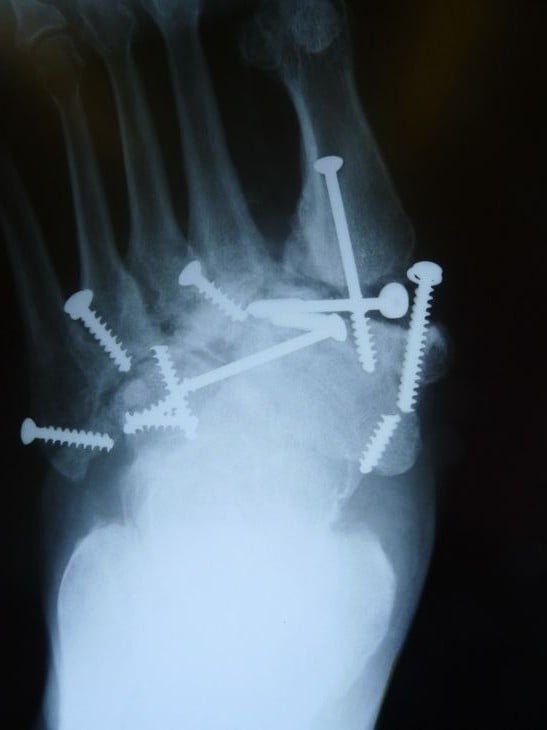
Reconstruction: Superconstruct Principles, Beaming and External Fixation
When reconstruction is undertaken in the quiescent (Eichenholtz 3) foot, fixation must work in poor-quality, osteopenic neuropathic bone across a deformity-prone foot. The "superconstruct" concept addresses this with four principles, and two fixation strategies - intramedullary beaming and circular external fixation - dominate practice.
- Rationale
- Include adjacent unaffected joints so fixation anchors in sound bone and resists recurrent collapse
- Rationale
- Locked plates, solid bolts or intramedullary beams withstand the long healing times of neuropathic bone
- Rationale
- Intramedullary axial beams and plantar (tension-side) plating maximise mechanical advantage
- Rationale
- A braceable plantigrade foot is the goal; malalignment perpetuates ulceration

- Best Suited To
- Sanders Type 2 (Lisfranc) midfoot collapse with reasonable bone stock and no active infection
- Key Points and Evidence
- Axial screws/bolts driven along the medial and lateral columns restore the arch with minimal soft-tissue stripping; Sammarco reported osseous union in 16 of 22 feet at a mean of 5.8 months, though hardware failure is common and purpose-designed Charcot beams are emerging
- Best Suited To
- Severe osteopenia, bone loss, or active/recent infection where internal hardware is hazardous
- Key Points and Evidence
- A statically applied fine-wire frame corrects severe deformity in hostile bone; Pinzur's 171-foot series showed it achieves correction but with high pin-site infection (around 30-50%), and a new neuropathic ankle can develop after frame removal


The superconstruct answer in the viva is: fuse beyond the zone of injury, use the strongest tolerable device in the most robust position, and restore a plantigrade foot. Beaming (axial intramedullary screws/bolts) suits Lisfranc midfoot Charcot with adequate bone, while circular external fixation is reserved for severe osteopenia, bone loss or infection. Tibiotalocalcaneal arthrodesis with a retrograde nail addresses ankle/hindfoot (Brodsky 3A/Sanders 4) disease. Expect prolonged healing - roughly two to three times longer than non-neuropathic fusion - and a high complication burden.
Complications
- Incidence
- Up to 50-70 percent of midfoot Charcot
- Risk Factors
- Delayed diagnosis, continued weight-bearing in Stage 1
- Management
- TCC for acute phase, CROW boot or surgery for chronic
- Incidence
- Greater than 50 percent with rocker-bottom
- Risk Factors
- Plantar bony prominence, inadequate footwear
- Management
- Exostectomy, custom orthosis, or reconstruction
- Incidence
- 10-20 percent overall, higher with ulceration
- Risk Factors
- Chronic ulceration, poor glycaemic control, peripheral vascular disease
- Management
- Staged treatment: infection control then reconstruction or amputation
- Incidence
- 10-20 percent after midfoot arthrodesis, up to 30 percent after ankle fusion
- Risk Factors
- Poor bone quality, inadequate fixation, tobacco use
- Management
- Revision arthrodesis with bone graft or amputation
- Incidence
- 9-75 percent develop bilateral disease
- Risk Factors
- Similar neuropathic and vascular risk factors
- Management
- Surveillance of contralateral foot, patient education
- Incidence
- 15-30 percent if untreated, less than 5 percent with optimal early management
- Risk Factors
- Uncontrolled infection, unreconstructable deformity, poor vascular status
- Management
- Below-knee amputation with prosthetic rehabilitation
- Incidence
- 10-25 percent during casting
- Risk Factors
- Inadequate padding, infrequent cast changes, severe oedema
- Management
- Cast change every 1-2 weeks, meticulous technique, bivalve if high risk

The Charcot cascade follows a predictable domino pattern: neuropathy leads to unrecognised injury, leading to fragmentation, leading to rocker-bottom deformity, leading to plantar ulceration, leading to deep infection, leading to amputation. Breaking the chain at Stage 0 with immediate TCC prevents the entire cascade. This is the single most important message for exam candidates.
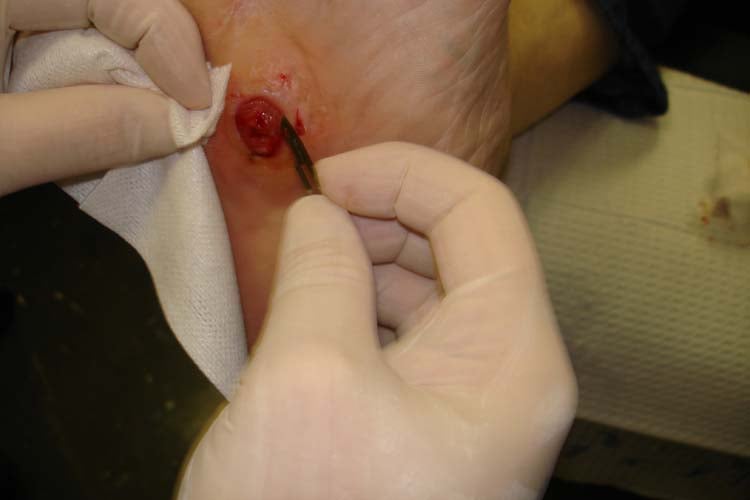
Recurrent plantar ulceration is the gateway complication - it is the step in the cascade where a deformity becomes an infection - so a viva will expect you not just to recognise the ulcer but to classify it and to assess it for underlying osteomyelitis.
Wagner classification (depth and gangrene):
- Grade 0 - intact skin, at-risk foot (deformity/callus, no ulcer).
- Grade 1 - superficial ulcer (skin only).
- Grade 2 - deeper ulcer to tendon, capsule or bone (no abscess/osteomyelitis).
- Grade 3 - deep ulcer with abscess or osteomyelitis.
- Grade 4 - localised (forefoot/heel) gangrene.
- Grade 5 - extensive gangrene of the whole foot.
University of Texas (UT) system - generally a better outcome predictor because it grades depth (0 to 3) AND stages infection/ischaemia (A to D): A = clean, B = infected, C = ischaemic, D = infected and ischaemic. Higher grade and stage independently predict non-healing and amputation, which Wagner (depth/gangrene only) captures less well.
Probe-to-bone (PtB) test: gently probing the ulcer base with a sterile blunt probe; palpable bone (or a positive probe) substantially raises the likelihood of osteomyelitis - in a high-prevalence ulcerated/Charcot foot a positive PtB has a high positive predictive value, and a negative PtB in a lower-risk setting helps argue against it. It complements cross-sectional imaging and bone biopsy, which remains the gold standard for confirming osteomyelitis and guiding antibiotic choice.
Exam point: classify the Charcot ulcer with Wagner (depth plus gangrene) or, better for predicting outcome, the University of Texas system (depth grade 0-3 plus stage A-D for infection/ischaemia), and use the probe-to-bone test at the bedside as a high-yield pointer to underlying osteomyelitis.
Outcomes and Prognosis
- Treatment
- Immediate TCC, 3-4 months
- Expected Outcome
- No deformity develops, normal or near-normal foot architecture preserved
- Amputation Risk
- Less than 5 percent
- Treatment
- TCC 4-6 months, may avoid surgery
- Expected Outcome
- Moderate deformity possible, manageable with bracing
- Amputation Risk
- 5-10 percent
- Treatment
- TCC to completion, brace thereafter
- Expected Outcome
- Fixed deformity present but may be braceable
- Amputation Risk
- 10-15 percent
- Treatment
- Reconstruction or lifelong bracing
- Expected Outcome
- Variable — depends on deformity severity and surgical success
- Amputation Risk
- 15-30 percent
Good outcomes follow early diagnosis at Stage 0, a compliant patient, adequate vascularity, well-controlled diabetes and a midfoot location. Poor outcomes follow late diagnosis at Stage 3 with ulceration, ankle or hindfoot involvement, peripheral vascular disease, poor glycaemic control, non-compliance and active infection.
Guidelines, Registries & Global Practice
- Diabetes prevalence: Rising globally — projected 783 million adults by 2045 (IDF Atlas), driving increased Charcot incidence
- Underdiagnosis: Estimated 25-50 percent of acute Charcot episodes are initially misdiagnosed (as cellulitis, gout, DVT, or sprain)
- Geographic variation: Higher detection rates in centres with dedicated diabetic foot clinics; rural and low-resource settings have worse outcomes due to delayed referral
- Leprosy-related Charcot: Remains a significant cause in endemic regions (India, Brazil, parts of Africa and Southeast Asia)
- High-resource: TCC by trained orthotists, MRI for Stage 0, multidisciplinary foot clinics (diabetology, orthopaedics, vascular, orthotics)
- Middle-resource: Serial casting with plaster of Paris, plain radiograph-based staging, limited MRI access
- Low-resource: Empirical offloading with available materials, reliance on clinical staging, limited surgical reconstruction options
- Universal principle: Early offloading is limb-saving regardless of resource setting — TCC technique is learnable with minimal equipment
- Diagnosis
- Clinical suspicion + temperature monitoring + MRI for Stage 0
- Acute Treatment
- Immediate TCC or irremovable offloading device, non-weight-bearing
- Surgery / Reconstruction
- Consider when deformity is unstable or ulceration recurrent; staged approach
- Diagnosis
- High index of suspicion in neuropathic patients; urgent MRI if X-ray normal
- Acute Treatment
- Immediate offloading with TCC, specialist referral within 24 hours
- Surgery / Reconstruction
- Reconstruction in specialist centres; infection control before surgery
- Diagnosis
- Temperature monitoring, MRI for early detection, differentiate from osteomyelitis
- Acute Treatment
- TCC gold standard; iTCC acceptable alternative for compliance
- Surgery / Reconstruction
- Exostectomy, arthrodesis, or amputation based on deformity and infection
- Diagnosis
- Stage 0 recognition as clinical priority; emphasise dermathermometry
- Acute Treatment
- Offloading is the single most important intervention
- Surgery / Reconstruction
- Reconstruction after infection control; amputation for limb-threatening situations
There is no global Charcot-specific joint registry comparable to arthroplasty registries. The evidence base relies heavily on retrospective case series, expert consensus, and cohort studies from specialist centres. The IDF-IWGDF guidelines represent the broadest international consensus. Key data on amputation rates come from national diabetic foot audit programmes (e.g., the UK National Diabetes Foot Care Audit) which track outcomes including Charcot-related amputations as a subgroup.
Record in every diabetic foot presentation with swelling:
- Skin temperature measurement and comparison to contralateral foot (in degrees Celsius)
- Monofilament testing result (positive or loss of protective sensation)
- Eichenholtz stage with radiographic description
- TCC application date, technique, and planned duration
- Patient counselling on non-weight-bearing compliance and consequences of non-compliance
- Referral to multidisciplinary diabetic foot team
A missed or delayed Charcot diagnosis resulting in amputation is a significant source of medicolegal claims worldwide. The key defence is documented consideration of Charcot in every diabetic patient presenting with foot swelling.
Controversies & Areas of Uncertainty
IV pamidronate and oral alendronate have been trialled to reduce osteoclast activity during the acute Charcot phase. Results are inconsistent — some studies show reduced disease activity markers, others show no clinical benefit. Current guidance does not mandate bisphosphonates but they may be considered as an adjunct to TCC in severe or refractory cases.
Traditional teaching mandates strict non-weight-bearing during Stage 0-1. Some centres now allow partial weight-bearing in a TCC with a walking base, arguing that complete offloading is impractical for many patients and the TCC itself provides significant load redistribution. No high-quality RCTs settle this debate definitively.
The traditional dogma is to avoid surgery during acute Stage 0-1 due to high complication rates. However, some centres advocate early surgical stabilisation (particularly for ankle/hindfoot patterns with severe subluxation) to prevent further deformity. Evidence is limited to case series and no consensus exists.
Denosumab (RANKL inhibitor) and TNF-alpha blockers have theoretical appeal as disease-modifying agents targeting the inflammatory cascade in acute Charcot. Early case reports and small series suggest reduced disease activity, but no RCTs exist. These remain experimental and are not part of standard clinical practice.
MCQ Practice Points
Q: A diabetic patient presents with a warm, swollen foot. X-rays show osteopenia and early joint subluxation but no fragmentation. What Eichenholtz stage is this? A: This represents Stage 0 transitioning to Stage 1. The presence of osteopenia and subluxation suggests the destructive process has begun, but without overt fragmentation this is still an early presentation. Immediate TCC is essential to prevent progression to full Stage 1 with fragmentation. The key exam point is that Stage 0 has normal X-rays — any radiographic change means at least early Stage 1.
Q: How do you clinically differentiate acute Charcot from cellulitis in a diabetic patient? A: Charcot: afebrile, normal WBC, neuropathic, temperature differential greater than 2 degrees Celsius, no response to antibiotics, often bilateral joint involvement. Cellulitis: febrile, elevated WBC, may or may not be neuropathic, responds to antibiotics within 48-72 hours. The temperature differential and absence of systemic inflammatory response are the most reliable discriminators.
Q: What is a rocker-bottom deformity and how does it develop in Charcot? A: Rocker-bottom deformity is collapse of the medial longitudinal arch with plantar displacement of the midfoot bones. It develops when the tarso-metatarsal or naviculocuneiform joints undergo fragmentation and subluxation in Stage 1, allowing the cuneiforms to displace dorsally and the cuboid to become a plantar prominence. The normal concave longitudinal arch inverts to become convex, creating a "rocker" sole shape. The plantar cuboid prominence causes focal pressure, callus formation, and eventual ulceration.
Q: What is the gold standard treatment for acute Charcot and what is the criterion for discontinuing it? A: Total contact cast (TCC) is the gold standard for acute Charcot (Stage 0-1). The criterion for transitioning from TCC to bracing is skin temperature normalisation (less than 1 degree Celsius difference from contralateral foot) sustained over 4 weeks, combined with radiographic evidence of coalescence (Stage 2). Duration is typically 3-6 months, guided by clinical and radiographic resolution rather than a fixed timeframe.
Q: When is surgery indicated in Charcot neuroarthropathy? A: Surgery is indicated for: (1) recurrent ulceration despite optimal conservative management, (2) unstable deformity that cannot be braced, (3) progressive deformity despite TCC, (4) acute irreducible fracture-dislocation (especially ankle), and (5) deep infection requiring staged reconstruction. Surgery should NOT be performed during acute Stage 0-1 (high complication rate) unless there is an irreducible dislocation.
Q: What are the two complementary theories for the pathogenesis of Charcot neuroarthropathy? A: Neurotraumatic theory: Loss of protective sensation allows unrecognised repetitive microtrauma to the joint, with continued weight-bearing on an injured joint causing progressive destruction. Neurovascular theory: Autonomic neuropathy causes loss of sympathetic vasoconstriction, leading to increased bone blood flow, osteopenia, and structural weakness. Both mechanisms act together — the neuropathic bone is weakened by hyperaemia and then destroyed by unperceived mechanical stress.
Exam Viva Scenarios
Practise clinical reasoning and management decisions out loud
“A 58-year-old man with type 2 diabetes of 15 years duration presents with a 5-day history of sudden painless swelling and redness of his right foot. He is afebrile with normal white cell count. He has loss of protective sensation on monofilament testing. Skin temperature is 3.5 degrees Celsius higher than the left foot at the midfoot. Weight-bearing radiographs show subtle osteopenia at the tarso-metatarsal joints but no clear fracture or subluxation. What is your diagnosis and management?”
“A 62-year-old woman with type 2 diabetes and a 2-year history of Charcot midfoot presents with recurrent ulceration over the plantar cuboid. She has a fixed rocker-bottom deformity with Meary angle of 18 degrees. The ulcer is 2cm, probes to bone, with visible bone at the base. Temperature differential is 0.5 degrees Celsius. She has palpable pedal pulses. CRP is mildly elevated. How would you manage this?”
Key Pathophysiology
- Neurotraumatic: loss of protective sensation allows unrecognised microtrauma
- Neurovascular: autonomic neuropathy causes hyperaemia, osteopenia, structural weakness
- RANKL-mediated osteoclast activation drives exaggerated inflammatory bone resorption
- Diabetes is the most common cause (greater than 75 percent); others include syringomyelia, leprosy, alcohol neuropathy
Eichenholtz Staging (Exam Essential)
- Stage 0: Pre-radiographic — normal X-ray, MRI oedema, clinical suspicion — immediate TCC
- Stage 1: Development — fragmentation, bone resorption, subluxation — TCC, strict NWB
- Stage 2: Coalescence — debris absorbed, new bone, fusion — TCC to CROW boot transition
- Stage 3: Consolidation — remodelling complete, fixed deformity — brace or surgery
Diagnosis
- Clinical: warm swollen neuropathic foot with no systemic signs — Charcot until proven otherwise
- Temperature differential greater than 2 degrees Celsius = active Charcot (use dermathermometer)
- X-rays may be normal in Stage 0 — MRI confirms bone marrow oedema
- Differentiate from cellulitis (fever, WBC, antibiotic response) and osteomyelitis (focal, adjacent ulcer)
Management Algorithm
- Acute (Stage 0-1): Total contact cast, strict non-weight-bearing, 3-6 months
- Transition: CROW boot when temperature normalises (less than 1 degree Celsius differential)
- Chronic (Stage 3): Custom orthosis, accommodative footwear, lifelong monitoring
- Surgery: Recurrent ulceration, unstable deformity, progressive collapse — after infection eradicated
Rocker-Bottom Deformity
- Midfoot collapse inverts the longitudinal arch — cuboid becomes plantar prominence
- Meary angle greater than 4 degrees indicates arch collapse; greater than 15 degrees is severe
- Plantar prominence causes pressure, callus, ulceration, and deep infection
- Treatment: exostectomy (isolated) or midfoot arthrodesis (global instability)
Surgical Reconstruction
- Exostectomy: isolated plantar prominence with stable midfoot — ulcer healing 70-90 percent
- Midfoot arthrodesis: unstable deformity — medial and lateral column fusion, plantigrade in 70-85 percent
- Ankle/hindfoot fusion: tibiotalocalcaneal nail for ankle Charcot — high complication rate (30-50 percent)
- Amputation (BKA): unreconstructable deformity, uncontrolled infection, failed reconstruction
Complications & Prognosis
- Amputation risk: less than 5 percent with early Stage 0 treatment, 15-30 percent if late
- Bilateral Charcot develops in 9-75 percent — always monitor contralateral foot
- Nonunion after surgery: 10-20 percent midfoot, up to 30 percent ankle
- Five-year mortality post-Charcot amputation approaches 50 percent
Evidence Base and Key Trials
The Charcot foot in diabetes.
- International consensus on the diagnosis and management of Charcot foot in diabetes
- Temperature differential and MRI for early (Stage 0) detection are emphasised
- TCC remains the cornerstone of treatment
The natural history of acute Charcot's arthropathy in a diabetic foot specialty clinic.
- Prospective documentation of time to resolution with TCC
- Mean duration of acute phase approximately 4 months until temperature normalisation
- Low amputation rate with consistent offloading protocol
Charcot foot syndrome.
- Acute Charcot is a medical emergency requiring immediate offloading
- Skin temperature monitoring is critical for diagnosis and resolution assessment
- Pharmacological adjuncts have inconsistent evidence
Is the Eichenholtz classification still valid for the diabetic Charcot foot?
- Review affirming the continued clinical utility of Eichenholtz staging
- Stage 0 (pre-radiographic) is critical for early intervention
- Modern imaging supports but does not replace the original framework