Avulsion or Shear Fracture | High Association with Carpal Ligament Injury | ORIF Standard
- Chauffeur's fracture = radial styloid avulsion/shear fracture
- Historical name from hand-crank car starters causing direct blow injuries
- High association with scapholunate ligament injury - must assess on all cases
- Fragment size determines treatment - small fragments may be excised, larger need ORIF
- Greater arc injury pattern must be excluded - perilunate spectrum
- “Always assess for scapholunate injury - but know the GRADE: 20% were grade-3 (the ones needing treatment); lower grades are commoner and mostly do not (PMID 17974874)
- “Fragment size greater than 5mm and articular step-off over 2mm = surgical indication
- “Headless compression screws preferred - avoids hardware prominence
- “Part of greater arc injury pattern - exclude perilunate dislocation
Overview and Epidemiology
What it is. A chauffeur's fracture is an avulsion or shear fracture of the radial styloid process of the distal radius. It is an intra-articular fracture involving the lateral aspect of the radiocarpal joint, and it is critically associated with scapholunate ligament injury - graded, because the grade decides the treatment (PMID 17974874).
The names. "Hutchinson's fracture", after Jonathan Hutchinson who described it, and "radial styloid fracture" mean the same injury, and any of the three terms may be used interchangeably in the exam.
The eponym. Chauffeurs in the early twentieth century started cars with a hand-crank. When the engine backfired the crank spun rapidly backwards and delivered a direct blow to the radial side of the wrist. The mechanism is now historical, but the eponym has survived because it is anatomically accurate about where the injury lands.
Who sustains it. Radial styloid fractures account for approximately 5% of distal radius fractures, with a bimodal age distribution: young adults hurt in sport or a motor vehicle accident, and elderly patients who fall. Men predominate among the younger patients, while the sexes are equally represented in osteoporotic fractures. The fracture occurs in isolation or as part of a greater arc injury.
Risk factors. High-energy trauma in young patients, contact sports such as snowboarding, football and rugby, motor vehicle accidents, a fall on the outstretched hand with ulnar deviation, osteoporosis in elderly patients, and previous wrist injuries.
Where this fracture's company is worked up. A radial styloid fracture is not an isolated bone injury: it is one member of the distal radius fracture family that happens to sit at a ligament attachment, and the reason it matters is the carpus. If the scapholunate ligament has failed, the problem becomes scapholunate instability and, left alone, the SLAC wrist it produces. And because the radial styloid is classified as a greater-arc injury, doubt the word "isolated" until you have excluded a perilunate dislocation - a quarter of which are missed on the first pass.
Anatomy and Biomechanics
The styloid. The radial styloid is the distal lateral projection of the radius, extending approximately 10-12mm distal to the ulnar margin of the articular surface. It articulates with the scaphoid and forms approximately 40% of the scaphoid fossa articular surface, its tip covered by articular cartilage continuous with that fossa. Mechanically it is a bony stop that prevents excessive ulnar deviation.
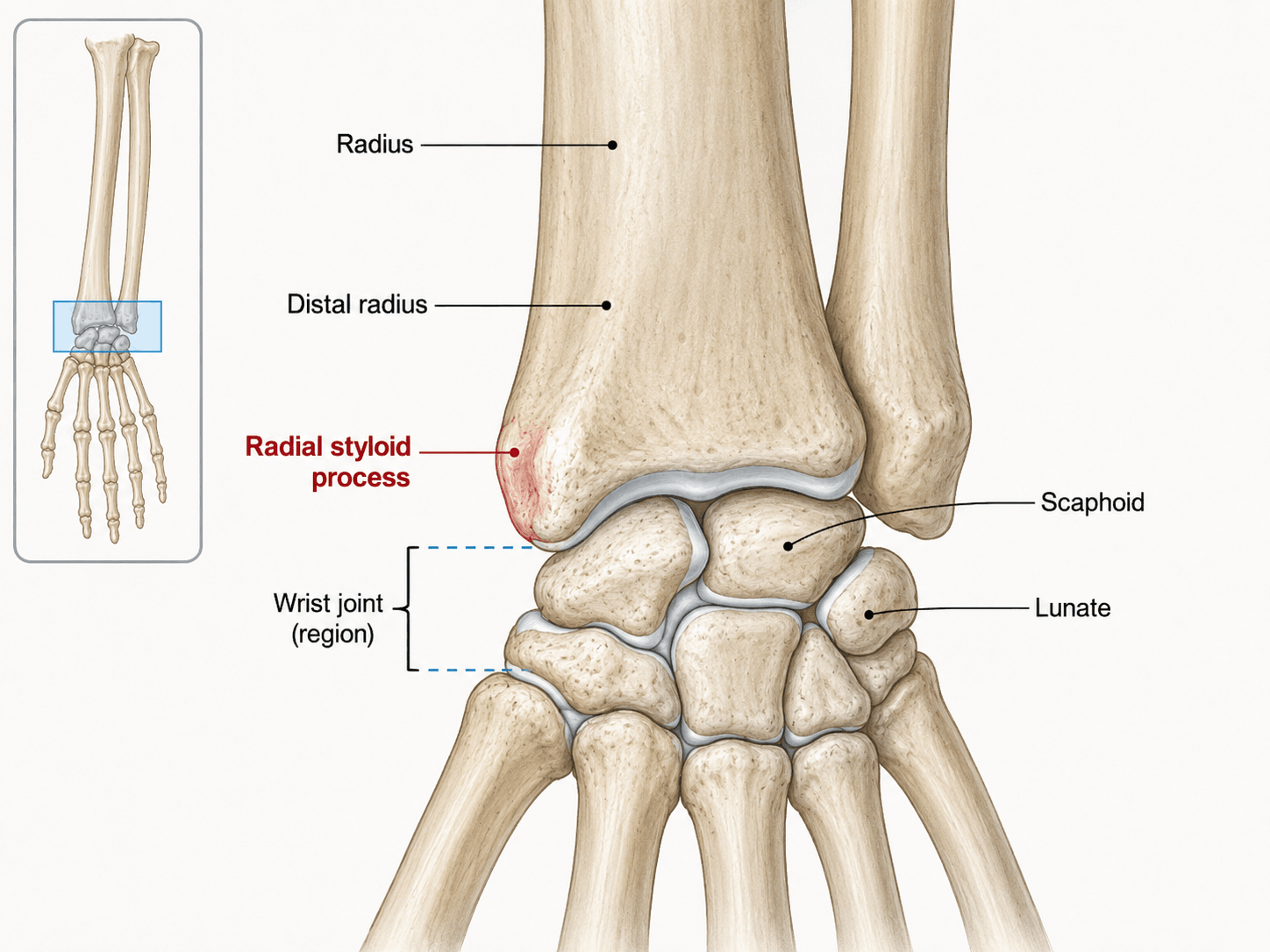
What attaches there. The radioscaphocapitate (RSC) ligament arises from the volar aspect of the styloid and is the most radial of the volar extrinsic ligaments, with the long radiolunate arising just ulnar to it. Together they are the radial anchor of the volar carpal sling, and the RSC in particular resists ulnar translocation of the carpus. That is the mechanical reason a styloid fragment matters - it takes the radial anchor with it - and the reason over-resecting the styloid destabilises the wrist.
Two more attachments. The radial collateral ligament adds lateral stability. The brachioradialis inserts on the lateral surface, and its pull is the deforming force acting on a styloid fragment.
The ligament that does not belong. The radioscapholunate ligament of Testut-Kuentz is often listed as a styloid attachment. It arises more ulnarly, at the interfossal region between the scaphoid and lunate fossae, and it is a vessel-bearing neurovascular conduit to the lunate rather than a mechanical restraint.
Mechanism. Forced ulnar deviation drives the scaphoid against the radial styloid and avulses or shears it off, which is the common pattern in falls, sports injuries and motor vehicle accidents. Direct trauma to the radial wrist fractures the styloid on its own. The third route is the greater arc injury, in which a perilunate force propagates through bone rather than through the scapholunate ligament.
Why the styloid rather than the ligament. The styloid buttresses the scaphoid during ulnar deviation, so when excessive force is applied either the styloid fractures (greater arc) or the scapholunate ligament ruptures (lesser arc). How the load arrives decides the fragment: impact of the scaphoid produces a larger articular shear fragment, while ligament tension pulls off a smaller avulsion.
- Mechanism
- Ligament pull-off
- Fragment
- Small, cortical
- Prognosis
- Good if SL intact
- Mechanism
- Scaphoid impact
- Fragment
- Larger, articular
- Prognosis
- Requires anatomic reduction
- Mechanism
- High energy
- Fragment
- Multiple fragments
- Prognosis
- May need plate fixation
- Mechanism
- Perilunate spectrum
- Fragment
- Variable
- Prognosis
- Depends on overall injury
Classification Systems
Fragment size is the working classification, because it is the one that changes what you do. Measure the fragment and the treatment follows:
- Under 5mm - a cortical avulsion with minimal articular involvement; treated non-operatively, or excised if it is symptomatic and the scapholunate ligament is intact
- 5-15mm - articular involvement with variable stability; ORIF with headless compression screws to restore anatomy
- Over 15mm - a significant piece of articular surface, sometimes comminuted; plate fixation or multiple screws for a stable construct
Greater arc and lesser arc. The perilunate injury spectrum describes how energy dissipates through the carpus during a hyperextension injury, and a chauffeur's fracture sits on the bony side of it.
In a greater arc injury the energy propagates through bone, the fracture pattern following the arc around the lunate: radial styloid (chauffeur's), scaphoid, capitate, triquetral and ulnar styloid fractures. In a lesser arc injury it propagates through ligament, with perilunate dislocation - scapholunate, lunotriquetral and dorsal radiocarpal ligament ruptures - and no fracture occurs at all.
In a chauffeur's fracture the radial styloid breaks instead of the scapholunate ligament rupturing, which is what makes it a greater arc injury component.
Clinical Assessment
History. Establish the mechanism - a fall on the outstretched hand with an ulnar deviation component, a direct blow to the radial wrist, high-energy trauma in a motor vehicle accident or sport, or a twisting injury - and ask about previous wrist injuries or instability symptoms. Patients report radial-sided wrist pain, swelling over the radial styloid, a weak grip and pain on ulnar deviation, and some describe numbness in a median nerve distribution.
Inspection. Localised swelling over the radial styloid is characteristic, and more diffuse swelling suggests associated injuries. Obvious deformity indicates significant displacement or an associated perilunate injury. Ecchymosis over the radial wrist develops within 24-48 hours, and skin integrity is assessed for an open injury, especially after a high-energy mechanism.
Palpation. Direct tenderness over the styloid tip is the hallmark finding. Then palpate systematically: the anatomical snuffbox, where tenderness may indicate the commonly associated scaphoid injury; the scapholunate interval dorsally, where tenderness suggests SL injury; and the distal radioulnar joint (DRUJ) for tenderness and stability.
Special tests. Watson's test - the scaphoid shift test - looks for scapholunate instability: press on the scaphoid tubercle while taking the wrist from ulnar to radial deviation. The ballottement test assesses DRUJ stability with the forearm in neutral rotation. Compare grip strength with the contralateral side, and document flexion, extension, radial and ulnar deviation, supination and pronation.
Never clear a chauffeur's fracture without assessing the scapholunate ligament. The styloid lies immediately radial to the scapholunate interval, so the same force that shears it off loads that ligament. A negative Watson's test does not exclude a partial tear; consider MRI or arthroscopy if any clinical suspicion exists.
- Distinguishing feature
- Intra-articular styloid fragment, snuffbox/styloid tenderness
- Key investigation
- PA + pronated oblique radiograph
- Distinguishing feature
- Snuffbox and scaphoid tubercle tenderness, axial thumb pain
- Key investigation
- Scaphoid views; MRI/CT if occult
- Distinguishing feature
- No fracture; SL gap over 3mm, positive Watson test, DISI
- Key investigation
- Clenched-fist PA, MRI, arthroscopy
- Distinguishing feature
- Disrupted Gilula arcs, lunate malalignment on lateral
- Key investigation
- PA + lateral radiograph, CT
- Distinguishing feature
- Metaphyseal, dorsal/volar tilt, no articular styloid fragment
- Key investigation
- PA + lateral radiograph
- Distinguishing feature
- Chronic, positive Finkelstein, no trauma/fragment
- Key investigation
- Clinical; ultrasound
Investigations
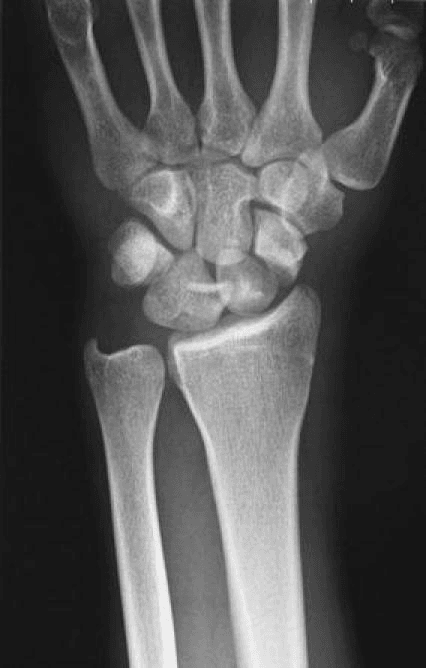
Radiographs. PA, lateral and oblique views are mandatory, and the 45° pronated oblique best profiles the radial styloid. Read the fragment first: size in millimetres on the PA view, distance from the parent bone, articular step-off at the joint surface, single fragment or comminution, and the direction of the fracture line.
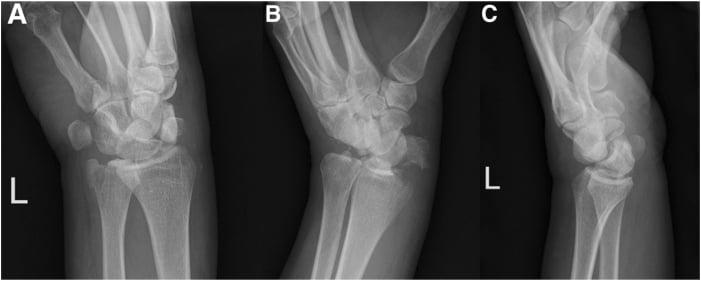
Then read the carpus. The associated findings each have a number or a pattern attached:
- Scapholunate gap over 3mm - the Terry Thomas sign
- Scapholunate angle over 70° - a DISI pattern
- Lunate alignment - a VISI or DISI pattern, and the perilunate injury it belongs to
- Ulnar styloid - an associated fracture is common
- Overall carpal alignment - the greater arc injury pattern
Stress views. A clenched fist PA view loads the interval and exposes dynamic scapholunate instability. Compare with the contralateral side: a gap over 3mm, or more than 2mm difference between sides, is abnormal.
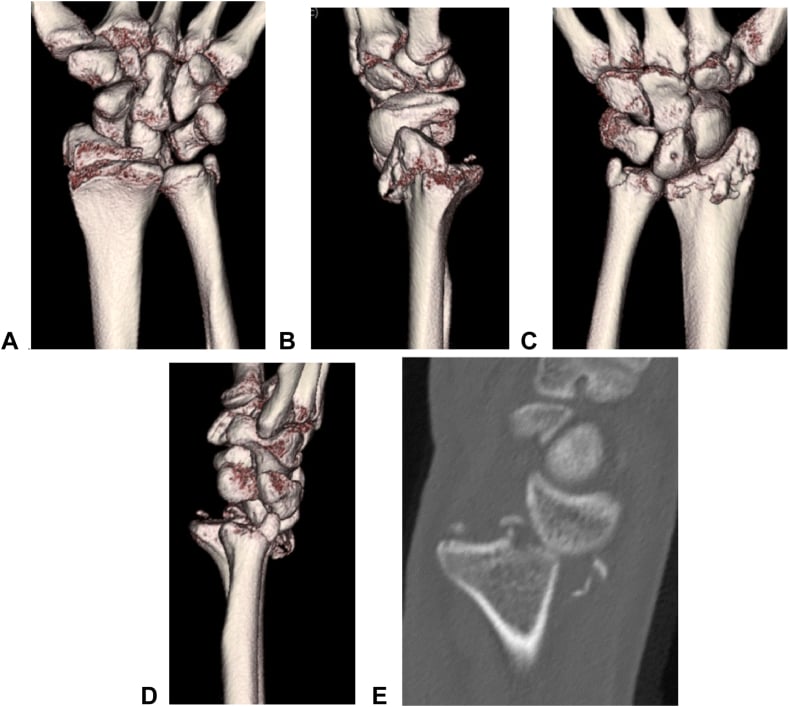
CT is indicated for precise fragment measurement, assessment of articular congruity and surgical planning. Coronal and sagittal reconstructions are helpful, and 3D reconstructions aid understanding of complex patterns.
MRI is the gold standard for scapholunate ligament assessment, and it also evaluates the TFCC, the other intercarpal ligaments and occult fractures. Consider it whenever there is clinical suspicion of ligament injury.
Grade the ligament injury rather than counting it. In 51 arthroscoped displaced distal radius fractures, 20% had a grade-3 (complete) SL tear; the widely quoted "up to 54%" refers to SL injury of ANY grade across distal radius fractures generally, not to complete tears (PMID 17974874). Obtain stress views, or MRI or arthroscopy, if clinical suspicion exists - missing this leads to carpal instability.
SLSL CHECK - Scapholunate Assessment
Hook:SL CHECK reminds you to thoroughly assess for scapholunate injury
Management
The decision. Two questions run in parallel: does this fragment need fixing, and has the scapholunate ligament failed? The first is answered by displacement, articular step-off and fragment size; the second by the examination and imaging already described.
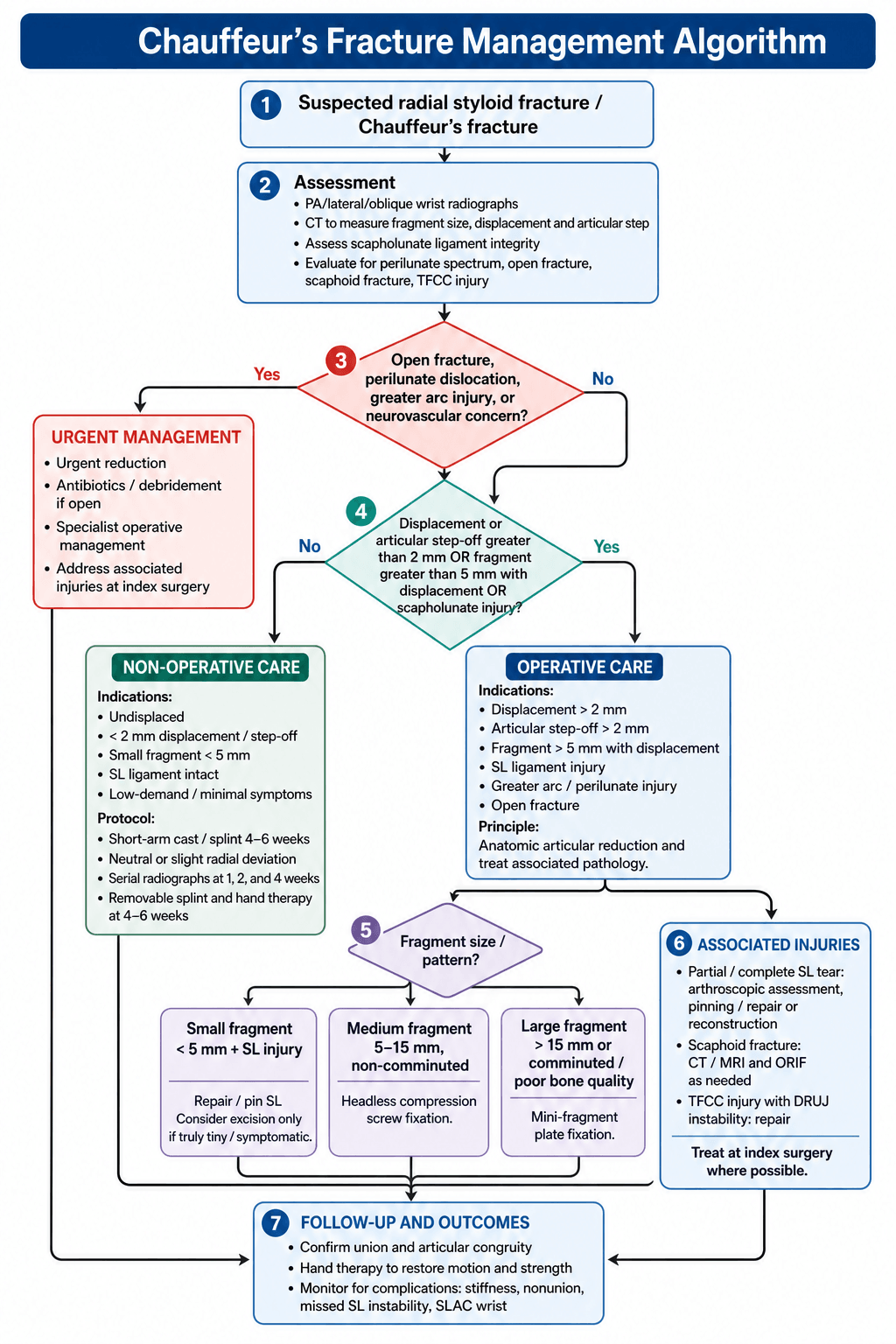
Non-operative treatment is for the undisplaced fracture, and only once the scapholunate ligament is known to be intact. The indications are displacement under 2mm, a small fragment under 5mm without significant articular involvement, an articular step-off under 2mm, a confirmed intact SL ligament on imaging or examination, and a low-demand patient with minimal symptoms.
The protocol depends on surveillance:
- Short arm cast or splint for 4-6 weeks
- Wrist in neutral or slight radial deviation
- Serial radiographs at 1, 2 and 4 weeks to monitor for displacement
- Removable splint and hand therapy at 4-6 weeks
Absolute operative indications. Any one of these is enough:
- Fragment displacement over 2mm
- Articular step-off over 2mm
- Fragment size over 5mm with any displacement
- Associated scapholunate ligament injury
- Greater arc injury or perilunate spectrum
- Open fracture
The construct follows the fragment. A small fragment with an SL injury is treated by fixing the ligament, with excision of the fragment considered only if it is truly small. Medium fragments of 5-15mm take headless compression screws. Large fragments over 15mm, and comminuted ones, need a mini-fragment plate. Whichever is chosen, the principle is anatomic reduction of the articular surface.
Associated injuries. All associated pathology should ideally be addressed at the index surgery for optimal outcomes.
- Partial SL tear - assessed on MRI or arthroscopy; pinning and repair at the same surgery
- Complete SL tear - confirmed arthroscopically; open repair or reconstruction at the index surgery
- Perilunate dislocation - a clinical and radiographic diagnosis; urgent reduction plus K-wire fixation
- Scaphoid fracture - assessed on CT or MRI; ORIF of both scaphoid and styloid
- TFCC injury - assessed on MRI or arthroscopy; repaired if it is causing DRUJ instability, at the same surgery or staged
- Fragment Size
- Under 5mm
- SL Ligament
- Intact
- Management
- Cast immobilisation 4-6 weeks
- Fragment Size
- Under 5mm
- SL Ligament
- Intact
- Management
- Fragment excision if symptomatic
- Fragment Size
- 5-15mm
- SL Ligament
- Intact
- Management
- ORIF with headless screws
- Fragment Size
- Over 15mm
- SL Ligament
- Intact
- Management
- ORIF with plate or multiple screws
- Fragment Size
- Any
- SL Ligament
- Torn/lax
- Management
- ORIF + SL repair or reconstruction
- Fragment Size
- Variable
- SL Ligament
- Disrupted
- Management
- Address perilunate + ORIF styloid
The most important management decision is not whether to operate on the styloid fracture, but whether there is associated scapholunate ligament injury. A well-fixed styloid fracture with a missed SL injury will have poor outcomes. Assess SL integrity before finalising the plan.
Surgical Technique
Planning. Review the CT for precise fragment assessment - size, displacement, articular involvement and the comminution pattern - and the MRI if ligament injury is suspected. On the table: headless compression screws (Herbert, Acutrak) in a range of sizes, a mini-fragment plate of 2.0-2.4mm as backup, K-wires for provisional fixation, fluoroscopy, an arm table and a tourniquet.
The volar (FCR) approach suits most cases. With the patient supine, the arm on a hand table and a tourniquet on the upper arm, make a longitudinal incision over the FCR tendon curving radially at the wrist crease. Incise the sheath and retract the tendon ulnarly, open the floor of the sheath to expose pronator quadratus, then elevate the muscle radially to reach the fracture, extending distally as needed to see the styloid.
Its advantages are that it protects the superficial radial nerve, gives excellent visualisation, and is the approach most surgeons already know.
The dorsal approach trades that protection for access. Positioning is the same; the longitudinal incision runs over the dorsal radius between the first and second extensor compartments, and the interval is developed between EPL (third compartment) and ECRL/ECRB (second compartment) before the capsule is opened onto the radiocarpal joint and styloid.
It gives direct access to dorsal comminution and allows the scapholunate ligament to be inspected. The disadvantages are risk to the superficial radial nerve and extensor tendon irritation from hardware.
A combined approach is reserved for complex greater arc injuries with both a volar styloid component and dorsal ligament pathology: fix the fracture volarly, then add a limited dorsal incision for SL assessment and repair. It maximises visualisation while minimising soft tissue stripping.
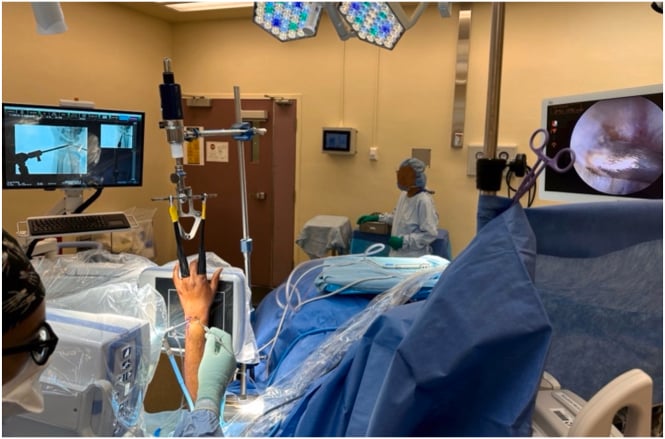
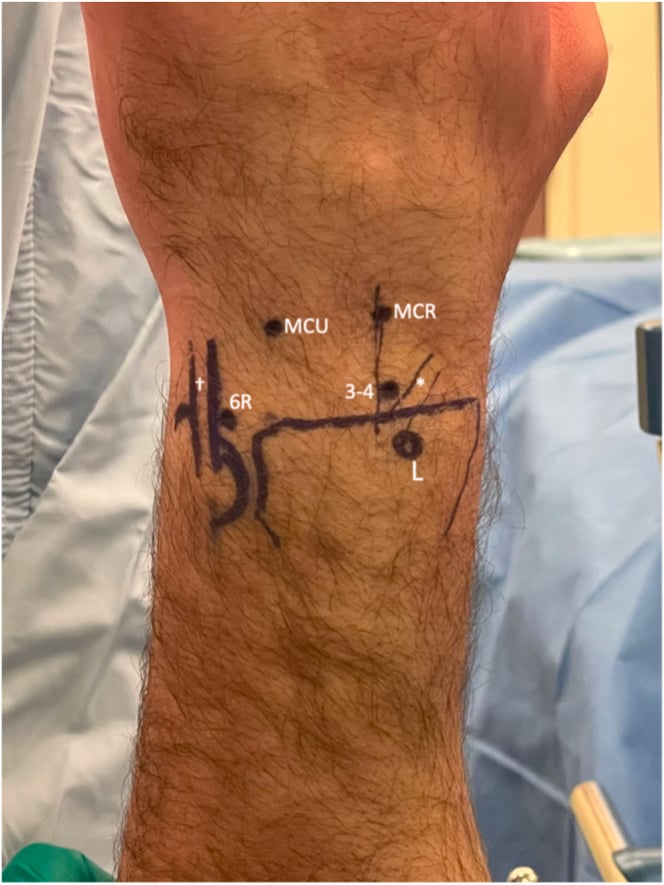
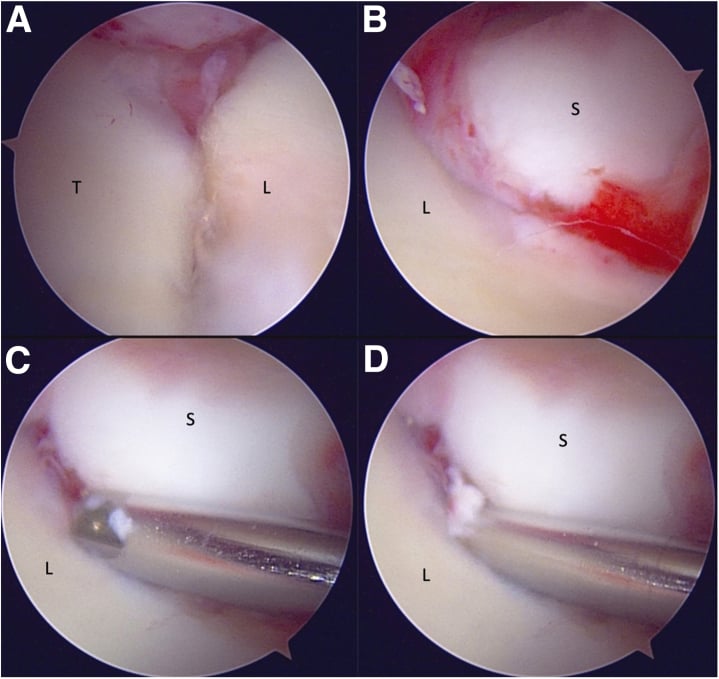
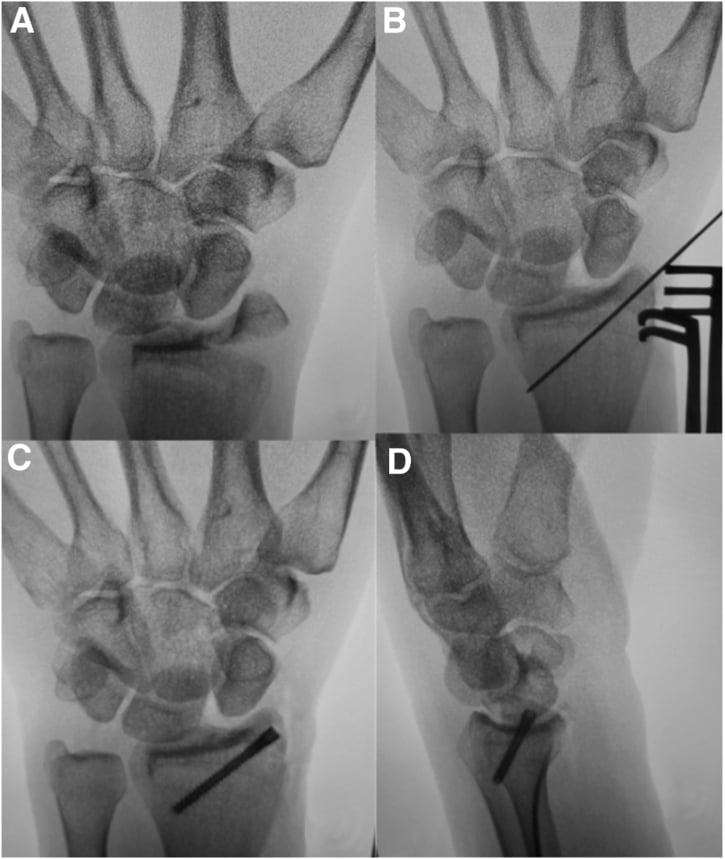
Headless compression screws are used for medium, non-comminuted fragments of 5-15mm.
- Reduce the fragment anatomically under direct vision and hold it with a K-wire
- Insert the guidewire perpendicular to the fracture line
- Measure the screw, typically 18-24mm
- Countersink the head below the articular cartilage and remove the K-wire after final tightening
Use a cannulated system, and bury the head completely to avoid chondral damage. They provide excellent compression with minimal hardware prominence, which is why they are preferred for cosmesis and to avoid extensor tendon irritation.
A percutaneous radial styloid screw is tempting and often appropriate, but the tip of the radial styloid is crowded with structures that a blind percutaneous guidewire or screw can injure:
- The superficial (sensory) branch of the radial nerve crosses the radial styloid subcutaneously - tethered or transfixed by a percutaneous wire it produces a painful neuroma and dorsoradial numbness
- The radial artery passes just volar-radial to the styloid, towards the snuffbox
- The first dorsal extensor compartment (APL and EPB) lies directly over the styloid
So for any percutaneous styloid screw, make a small open incision and bluntly spread down to bone (mini-open), protecting the superficial radial nerve and the first-compartment tendons, before drilling - do not pass the wire through a stab incision blind. Direct the screw perpendicular to the fracture, from the styloid tip proximally and ulnarward into the radial metaphysis, with subchondral but not intra-articular purchase, confirmed on multiple fluoroscopic views.
Exam point: the radial styloid entry endangers the superficial radial nerve, radial artery and first dorsal compartment - use a mini-open, soft-tissue-protected technique for the styloid screw, not a blind percutaneous pass.
Plate fixation is for large fragments over 15mm, comminuted fractures and poor bone quality. Reduce and provisionally fix with K-wires, then apply a 2.0-2.4mm mini-fragment plate on the volar or dorsal surface as the pattern dictates, using locking screws in osteoporotic bone.
Contour the plate to match the anatomy, check that it does not impinge on the radiocarpal joint, and avoid excessive soft tissue stripping to get it to sit.
Fragment excision is a narrow indication: a fragment under 5mm, a scapholunate ligament confirmed intact, and symptoms persisting after a non-operative trial. Expose the fragment, confirm SL integrity, excise it sharply, smooth the remaining styloid edge and repair the capsule and ligament attachments. It is contraindicated by SL ligament injury, a large fragment, and the young high-demand patient.
Whether excising a small fragment or performing a radial styloidectomy, the cardinal rule is limited resection, because the radial styloid is the bony origin of the radioscaphocapitate (RSC) ligament - the key radial extrinsic ligament that tethers the carpus and resists ulnar translocation.
Resect conservatively and stay radial to the scaphoid fossa and the SL ligament origin. An oblique styloidectomy that takes too much bone detaches the RSC origin and can produce ulnar translocation and instability of the carpus, trading a small radial-sided problem for a much worse one. The commonly quoted figure is 4-6 mm, but the biomechanical study behind it is stricter: sequentially cutting 3, 6 and 10 mm from the radial styloid in cadaver wrists produced significant radial translation and ulnar-palmar carpal displacement at 6 mm and beyond, and the authors recommend no more than 3 to 4 mm (Nakamura, PMID 11172373). Take 6 mm as the number to stay below, not to aim for.
The same applies to over-zealous fragment excision in a chauffeur's fracture: take the small avulsion, not a slice of the load-bearing radial column. Conceptually the styloid is the radial column of the Rikli three-column model, a buttress that must be preserved or reconstructed, which is why a sizeable articular styloid fragment is fixed rather than excised.
Exam point: a radial styloidectomy or fragment excision must be limited - the supporting data say 3 to 4 mm, with measurable instability once you reach 6 mm - and kept radial to the scaphoid fossa to preserve the RSC ligament origin and the radial column; over-resection causes ulnar carpal translocation.
Scapholunate repair, when the ligament is torn. Characterise the tear first - partial dorsal, partial volar or complete - and judge the tissue, since acute tears are amenable to repair while chronic ones may need reconstruction.
Determine the tear pattern and assess tissue quality: acute tears are amenable to repair, chronic may require reconstruction.
Reduce the scapholunate interval to anatomic position using K-wires or a reduction clamp, and confirm the reduction fluoroscopically.
Place K-wires from scaphoid to lunate (2 wires) and scaphoid to capitate (1 wire). For acute tears, repair with suture anchors to the dorsal capsule.
K-wires remain for 6-8 weeks - longer immobilisation than an isolated styloid fracture needs.
Complications
Early. Surgical site infection carries the standard risk. The superficial radial nerve and the extensor tendons are at risk with the dorsal approach, hardware prominence follows a screw that was not countersunk, and reduction is lost when fixation is inadequate.
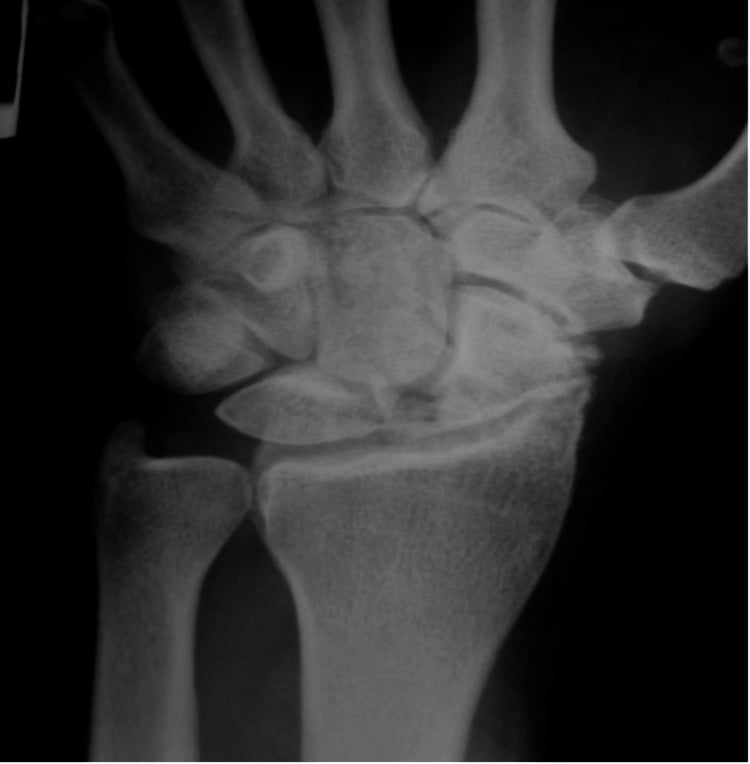
Late. Radiocarpal arthritis follows articular incongruity or chondral damage, and malunion with radial shortening alters carpal kinematics. Nonunion is rare with adequate fixation, and stiffness follows prolonged immobilisation. The most significant complication is carpal instability from a missed or inadequately treated scapholunate injury, which leads in time to a SLAC wrist - arthritis beginning at the styloid-scaphoid articulation and progressing in sequence.
- Pathology
- Styloid-scaphoid arthritis
- Radiographic Finding
- Osteophytes at radial styloid
- Treatment
- Styloidectomy + SL procedure
- Pathology
- Radioscaphoid arthritis
- Radiographic Finding
- Joint space narrowing RS joint
- Treatment
- Scaphoid excision + 4-corner fusion
- Pathology
- Capitolunate arthritis
- Radiographic Finding
- CL joint involvement
- Treatment
- Scaphoid excision + 4-corner fusion
- Pathology
- Pancarpal arthritis
- Radiographic Finding
- Radiolunate involvement
- Treatment
- Wrist fusion or PRC (limited)
Postoperative Care and Rehabilitation
The shape of the recovery. Splint, protect, mobilise, then load, with the timeline stretched when the scapholunate ligament was repaired.
Immobilisation: volar splint or short arm cast, elevation and ice for swelling, and finger range of motion encouraged. Wound check at 10-14 days with suture removal.
Protected mobilisation: removable wrist splint, gentle wrist range of motion, no forceful gripping or loading. If an SL repair was performed, the K-wires and splint stay.
Progressive therapy: K-wire removal if used for SL repair, typically at 6-8 weeks. Progress range of motion, begin strengthening as tolerated and wean from the splint.
Strengthening: progressive grip strengthening, gradual return to activities, sport-specific training where relevant.
Return to activity: full activities once strength reaches 80% of the contralateral side. Contact sports may take longer, and a protective splint is worth considering for high-risk activities.
What you are aiming for is full wrist range of motion, grip strength within 80% of the other side, pain-free activities of daily living, a return to work or sport, and no signs of carpal instability.
Follow-up. Review at 2 weeks for the wound and sutures, at 6 weeks for radiographs and K-wire removal where applicable, at 3 months for clinical and radiographic assessment, and at 6 months for final assessment and discharge if stable - then as required if symptoms recur.
Outcomes and Prognosis
The isolated fracture does well. Union is reliable whether the fracture is cast or fixed, and isolated styloid fractures have excellent outcomes with over 90% patient satisfaction. The single most important prognostic factor is the presence or absence of scapholunate ligament injury: unrecognised, it leads to progressive carpal instability and SLAC wrist, with markedly worse long-term outcomes.
- Union Rate
- Over 95%
- ROM Recovery
- Near full
- Return to Activity
- 6-8 weeks
- Satisfaction
- High
- Union Rate
- Over 95%
- ROM Recovery
- Near full
- Return to Activity
- 8-12 weeks
- Satisfaction
- High
- Union Rate
- Over 95%
- ROM Recovery
- Near full
- Return to Activity
- 10-14 weeks
- Satisfaction
- High
- Union Rate
- Over 90%
- ROM Recovery
- 80-90% of normal
- Return to Activity
- 12-16 weeks
- Satisfaction
- Moderate-High
- Union Rate
- Variable
- ROM Recovery
- Progressive decline
- Return to Activity
- N/A
- Satisfaction
- Poor
What favours a good outcome is an isolated styloid fracture without SL injury, a fragment over 5mm that allows stable fixation, an anatomic reduction, treatment within 2 weeks, and a patient who does the rehabilitation.
What predicts trouble is an associated scapholunate ligament injury or a greater arc perilunate injury, diagnosis delayed beyond 2 weeks, an articular step-off over 2mm, a comminuted pattern, and osteoporotic bone.
Guidelines, Registries & Global Practice
Radial styloid (chauffeur's) fractures sit within the broader distal radius fracture population, the second commonest fracture treated after the proximal femur. The figures below give the candidate a worldwide picture plus the regional guidance differences they may be examined on.
Global Epidemiology
- Incidence
- Distal radius 203/100,000/yr
- Key demographic finding
- Female 323 vs male 93/100,000/yr; sharp rise in women over 50
- Incidence
- 22/10,000/yr (women 34, men 10)
- Key demographic finding
- Incidence fell 24% from 2001 to 2016, driven by patients over 50
- Incidence
- Among most common fractures, 2nd to hip in elderly
- Key demographic finding
- Bimodal: high-energy young adults and fragility falls in elderly
Radial styloid fractures account for roughly 5% of distal radius fractures and show a bimodal pattern: high-energy shear in young adults (sport, motor vehicle, fall on outstretched hand in ulnar deviation) and low-energy fragility avulsions in older, osteoporotic patients. The strong female predominance and the post-menopausal surge seen for distal radius fractures overall apply to the fragility subgroup.
Epidemiology of Distal Forearm Fracture: A Population-Based Study of 5426 Fractures
- Overall distal forearm fracture incidence 207.7/100,000/yr
- Distal radius fracture incidence 203.0/100,000/yr
- Female incidence 323.4 vs male 93.3/100,000/yr
- Most common mechanism a fall from standing height (76%)
Guidelines Side by Side
- Position relevant to radial styloid
- Operative fixation suggested for post-reduction articular step / displacement; weak evidence for any single fixation construct
- Evidence level
- Moderate to limited
- Position relevant to radial styloid
- Senior assessment, CT for intra-articular patterns, fix displaced articular fractures to restore congruity, document neurovascular status
- Evidence level
- Consensus / good practice
- Position relevant to radial styloid
- Anatomic reduction of the articular surface; lag/headless screw for the styloid fragment, plate if comminuted; address carpal ligament injury
- Evidence level
- Expert / technique standard
- Position relevant to radial styloid
- Individualised: tolerate minor displacement in low-demand patients, fix displaced articular fractures in active patients
- Evidence level
- Consensus
Across all bodies the recurring quantitative thresholds are an articular step-off over 2mm and fragment displacement over 2mm as triggers for fixation - the Knirk and Jupiter step-off evidence underpins this internationally.
Registry and Practice Variation
No joint registry tracks isolated radial styloid fractures (registries capture arthroplasty and major fracture-fixation implants rather than wrist trauma), so registry-grade implant survival data are not available for this injury - a point worth stating rather than fabricating. Practice variation instead centres on three areas:
- Fixation choice - headless compression screws dominate in high-resource settings for the small/medium styloid fragment; K-wire fixation remains a valid, lower-cost option and predominates in resource-limited settings.
- Ligament work-up - routine MRI or wrist arthroscopy for scapholunate assessment is common in specialist hand units but selective elsewhere, reflecting access rather than disagreement about the association itself.
- Threshold for surgery - more aggressive operative management of articular fractures in younger, active populations versus acceptance of minor displacement in elderly low-demand patients, consistent across guidelines.
For any board worldwide, candidates should quote the over 2mm articular step / displacement surgical threshold, the graded scapholunate association (20% grade-3, higher for lesser grades), and the principle of addressing carpal ligament injury at the index procedure.
Chauffeur's fractures are NOT just radial styloid fractures - they are markers for potential scapholunate ligament injury - complete (grade-3) tears in about 20% of arthroscoped series, with lesser grades commoner and mostly not requiring treatment. The radial styloid is the RSC (radioscaphocapitate) ligament attachment, so fracture here means the ligament has been stressed. Always obtain stress views or advanced imaging, and be prepared to address ligament pathology at surgery. Missing scapholunate injury leads to SLAC wrist and poor long-term outcomes. Fragment size over 5mm with over 2mm displacement requires ORIF - headless compression screws are preferred. Remember: treat the fracture AND the ligament.
MCQ Practice Points
High-Yield MCQ Topics
- Radial styloid extends 10-12mm beyond ulnar articular margin
- RSC (radioscaphocapitate) and long radiolunate ligaments arise from the volar styloid; the radioscapholunate of Testut is a neurovascular structure arising more ulnarly, not a styloid restraint
- Brachioradialis inserts on lateral styloid
- Scaphoid fossa articulates with scaphoid
- Styloid provides buttress against ulnar deviation
- Small fragment: under 5mm
- Medium fragment: 5-15mm
- Large fragment: over 15mm
- Greater arc: injury through bone
- Lesser arc: injury through ligaments
- Terry Thomas sign: SL gap over 3mm
- DISI pattern: SL angle over 70°
- Articular step-off threshold: 2mm
- Pronated oblique view best profiles styloid
- Clenched fist view for dynamic SL instability
- Surgical threshold: fragment over 5mm with displacement
- Headless screws preferred for most cases
- SL repair: K-wires 6-8 weeks
- Non-op: under 2mm displacement, SL intact
- Fragment excision: only if SL confirmed intact
Key Exam Pearls for MCQs
Q: What percentage of Chauffeur's fractures have associated scapholunate ligament injury? A: Do not answer with a single band - grade it. In the prospective arthroscopic series, 20% had a grade-3 (complete) SL tear; the often-quoted "up to 54%" is SL injury of ANY grade across distal radius fractures generally, and most of those lower grades did not require treatment. The examinable predictor is that an increase in ulnar variance over 2mm carried a FOURFOLD risk of a grade-3 tear (PMID 17974874). This is among the highest rates among distal radius fracture patterns and must be actively assessed in every case.
Q: What fragment sizes guide treatment in Chauffeur's fractures? A: The key numbers are 5mm and 15mm. Under 5mm fragments may be excised if SL is intact. 5-15mm fragments require headless screw fixation. Over 15mm fragments may need plate fixation.
Q: What is the scapholunate gap threshold for diagnosis on plain radiographs? A: The scapholunate gap threshold is 3mm (not 2mm) on PA view. Named after the gap-toothed British comedian. Dynamic widening on clenched fist view is also significant.
Q: What type of perilunate injury is Chauffeur's fracture classified as? A: Chauffeur's fracture is a greater arc injury component where energy travels through bone instead of ligament. Lesser arc injuries are pure ligamentous with perilunate dislocation.
Q: What is the articular step-off threshold for surgical intervention? A: Greater than 2mm of articular step-off is an absolute surgical indication. This threshold is based on studies showing correlation with post-traumatic arthritis.
Q: When should associated SL ligament injury be addressed? A: All associated pathology should be addressed at the index surgery. Staged procedures for SL ligament injury have demonstrably worse outcomes than primary repair.
Common MCQ Traps
- Trap: Assuming isolated styloid fracture without checking SL ligament
- Trap: Treating based on fragment size alone without assessing SL
- Trap: Missing greater arc injury component
- Trap: Using Terry Thomas sign threshold of 2mm (correct is 3mm)
- Trap: Excising fragment without confirming SL integrity
Clinical Decision Scenarios
Practise clinical reasoning and management decisions out loud
“A 32-year-old male presents after a fall while snowboarding. Radiographs show a displaced radial styloid fracture with a 12mm fragment. How would you assess and manage this patient?”
“During surgery for a Chauffeur's fracture, you find the scapholunate ligament is torn. How do you manage this?”
“A patient returns 2 years after a Chauffeur's fracture that was treated non-operatively. They have radial wrist pain with gripping. Radiographs show Stage II SLAC wrist. Discuss the pathophysiology and management options.”
Definition & Mechanism
- Chauffeur's = radial styloid avulsion/shear fracture
- Also known as Hutchinson's fracture
- Historical: hand-crank car starter backfire injury
- Modern: forced ulnar deviation, direct trauma, greater arc injury
- RSC ligament origin at the styloid explains the ligament injury association and the ulnar-translocation risk of over-resection
Critical Associations
- SL injury: 20% grade-3 (complete); lesser grades commoner; ulnar variance over 2mm = fourfold risk of grade-3
- May be part of greater arc perilunate spectrum
- RSC ligament (not the radioscapholunate of Testut) arises at the radial styloid
- ALWAYS assess SL ligament in every case
Surgical Indications
- Fragment over 5mm with displacement
- Articular step-off over 2mm
- Any displacement over 2mm
- Associated scapholunate injury
- Greater arc / perilunate injury
Treatment Options
- Small undisplaced: cast 4-6 weeks
- Small displaced: excision if SL intact
- Medium/large: headless screw ORIF
- Comminuted: plate fixation
- With SL injury: ORIF + SL repair
Key Numbers
- 5mm = fragment size threshold for ORIF
- 2mm = displacement and step-off surgical threshold
- 3mm = SL gap (Terry Thomas sign)
- 70° = SL angle indicating DISI
- SL injury: grade it - 20% grade-3; ulnar variance over 2mm = 4x risk
Complications
- Missed SL injury → SLAC wrist
- SLAC Stage I: styloid-scaphoid arthritis
- SLAC Stage II-III: scaphoid excision + 4-corner fusion
- Hardware prominence with non-countersunk screws
- Radiocarpal arthritis from step-off
Evidence and Guidelines
Intercarpal Ligament Injuries Associated with Fractures of the Distal Part of the Radius
- Prospective arthroscopic study of 51 patients with displaced distal radius fractures
- Grade-3 scapholunate tears in 20% (10/51); SL injury of any grade reported in up to 54%
- Ulnar variance increase over 2mm gave a fourfold risk of grade-3 SL injury
- Radial styloid fractures were predictive of SL injury
- Arthroscopic evaluation recommended for 'at risk' patterns
Intra-articular Fractures of the Distal End of the Radius in Young Adults
- Landmark study on articular congruity
- Accurate restoration of articular surface is critical
- Radiographic post-traumatic arthritis in 28 of 43 fractures (65%) at a mean of 6.7 years
- Of the 24 that healed with residual articular incongruity, 91% developed arthritis; of the 19 that healed congruous, only 11% did
- Restoration of dorsal tilt and radial length did not prove critical EXCEPT where radial shortening was severe - articular congruity mattered more than extra-articular alignment
Perilunate Dislocations and Fracture-Dislocations: A Multicenter Study
- Multicentre series of 166 perilunate dislocations / fracture-dislocations
- Greater arc (transosseous) vs lesser arc (purely ligamentous) classification
- Radial styloid fracture classified as greater arc injury
- 25% of perilunate injuries are missed initially
- Emphasized need for vigilant radiographic assessment
Articular Fractures of the Distal Radius
- Classic classification of 4 parts: shaft, styloid, dorsal medial, volar medial
- Described the 'die-punch' mechanism
- Highlighted the instability of the radial styloid fragment
- Basis for modern fragment-specific fixation