Midfoot Trauma | Lisfranc Association | Restore Columns and Stability
- Cuneiform fractures = midfoot trauma involving medial, intermediate, or lateral cuneiform - often associated with Lisfranc injuries
- Medial cuneiform most common - Often associated with Lisfranc injury, Lisfranc ligament attaches to medial cuneiform
- Treatment is pattern-specific - stability, articular congruity, column length, soft tissue and associated Lisfranc injury matter more than a generic 2 mm rule
- Lisfranc association - a cuneiform fracture should trigger weight-bearing/stress assessment when safe and CT for complex patterns
- Non-operative care suits genuinely stable, acceptably aligned injuries; protect weight bearing and follow healing individually
- “Identify the exact cuneiform and every injured articulation rather than labelling generic midfoot trauma
- “Check first-second ray, intercuneiform and tarsometatarsal stability
- “No validated cuneiform-specific 2 mm ORIF threshold or universal immobilisation duration exists
- “Restore column length, arch and joint congruity when reconstruction is required
Overview and Epidemiology
Cuneiform fractures are rare but important injuries of the medial, intermediate or lateral cuneiform, three of the midfoot bones, which sit between the navicular and the metatarsals and form part of its stability. A displaced fracture is fixed to restore midfoot stability, but stability, articular congruity and column length decide treatment more than a generic 2mm rule does.
How rare. Cuneiform fractures are usually quoted at less than 1% of foot fractures, with a peak at 20-40 years in the trauma population and no clear gender predominance. Those are conventional teaching estimates for midfoot trauma; no cuneiform series exists to measure them, and fewer than 10 isolated medial cuneiform fractures have been reported (Paisan 2017). The sourced demographics on this page belong to the Lisfranc population, which is more frequently male and in the third decade (Mascio 2022).
Mechanism. High-energy midfoot trauma, often by a Lisfranc mechanism, or direct trauma to the midfoot.
The Lisfranc association. The medial cuneiform anchors the medial column and the Lisfranc ligament complex, so a cuneiform fracture suggests midfoot instability. It may be isolated or part of a broader tarsometatarsal or intercuneiform injury, and other midfoot trauma may accompany it. The association is strong but unquantified: no series has measured how often the two coexist, so do not quote a figure, and treat a cuneiform fracture as a Lisfranc injury until proven otherwise.
Anatomy and Pathophysiology
The three bones. Each articulates with the navicular and with its own metatarsal:
- Medial cuneiform - the largest; articulates with the navicular, first metatarsal and intermediate cuneiform
- Intermediate cuneiform - the smallest, recessed in the mortise between the medial and lateral; articulates with the navicular, second metatarsal and both other cuneiforms
- Lateral cuneiform - articulates with the navicular, third metatarsal, intermediate cuneiform and cuboid
The ligaments. The Lisfranc ligament attaches to the medial cuneiform and spans to the second metatarsal, and with the cuneiforms it maintains midfoot alignment. It sits within a ligament network that links the tarsometatarsal, intermetatarsal and intercuneiform joints. A cuneiform fracture can therefore destabilise more than one column or articulation.
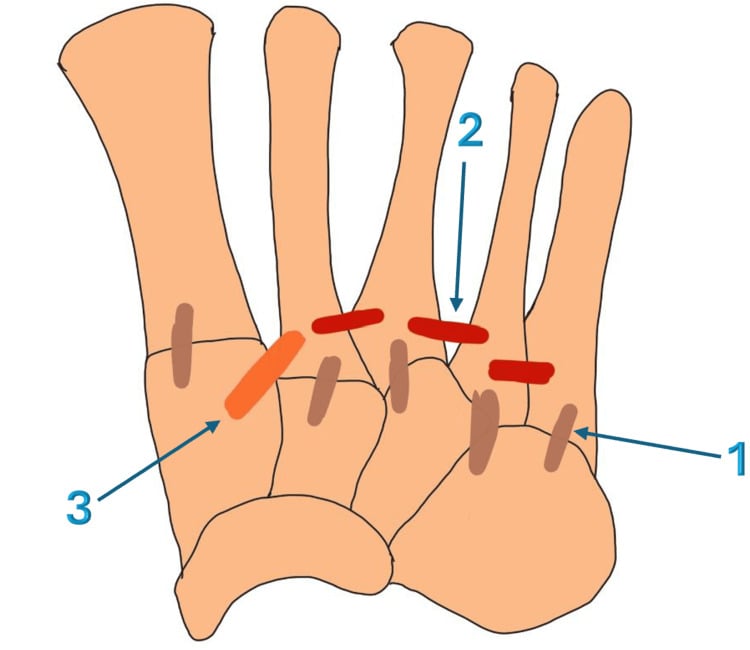
Why displacement matters. Displacement, articular incongruity, column shortening and dynamic instability can lead to collapse or arthritis. Displacement causes midfoot instability, instability causes midfoot collapse, and malunion leads to midfoot arthritis. The medial cuneiform is the keystone of the medial column, so a malunion there shortens or angulates the whole ray.
Classification Systems
Cuneiform fractures are described by the bone involved, by displacement and by whether a Lisfranc injury accompanies them.
By bone. The bone guides the approach and the search for associated injury.
- Frequency
- Most common; strong Lisfranc association
- Treatment
- ORIF if displaced or unstable
- What determines the result
- Anatomical reduction and a stable medial column
- Frequency
- Rare, almost always with a Lisfranc injury
- Treatment
- ORIF as part of the Lisfranc construct
- What determines the result
- Whether the whole tarsometatarsal injury is reduced
- Frequency
- Rare, isolated or with Lisfranc
- Treatment
- ORIF if displaced
- What determines the result
- Lateral column length and any cuboid involvement
An isolated intermediate cuneiform fracture should prompt a search for a Lisfranc injury, and a lateral cuneiform fracture means assessing the cuboid and lateral column at the same time. No comparative outcome data exist for any of the three, so do not quote a success rate by bone.
By displacement. The conventional split is a step-off of less than 2mm (non-displaced, treated conservatively) against more than 2mm (displaced, treated by ORIF). That 2mm is the generic intra-articular convention, extrapolated from Lisfranc and other intra-articular foot injuries; no cuneiform series has tested any cut-off.
What carries across. What the Lisfranc literature does support, and what transfers to the cuneiform, is that instability matters more than the millimetre: a fracture that displaces on weight-bearing or stress views needs fixation whatever the static step-off measures.
By Lisfranc association. An isolated cuneiform fracture receives cuneiform-specific treatment; a cuneiform fracture with a Lisfranc injury needs both injuries addressed.
Clinical Assessment
History. Midfoot pain after high-energy trauma, with swelling localised to the midfoot and pain on weight bearing. A Lisfranc injury mechanism and midfoot instability are the risk factors to establish.
Examination. Look for midfoot swelling, ecchymosis (which may be delayed) and, if the fracture is displaced, deformity from midfoot collapse. The cuneiforms are tender; the Lisfranc joint is tender as well if that injury is associated. Midfoot movement is limited and painful, and inversion and eversion hurt. Three checks complete it:
- Lisfranc stress test - midfoot instability
- Midfoot stress - pain on stress
- Midfoot alignment - collapse
Investigations
Radiographs. Three views, each of which may show the fracture:
- AP - check for a Lisfranc injury
- Lateral - midfoot alignment
- Oblique - may show the fracture better, and is the Lisfranc joint view
When it is safe, weight-bearing or stress comparison views assess the instability that a static CT cannot show.
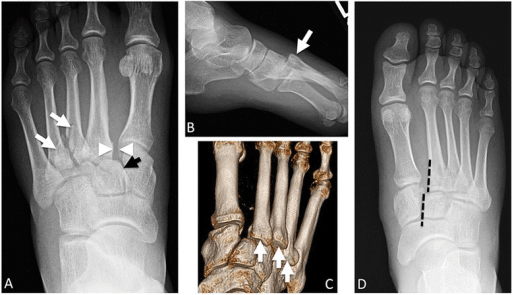
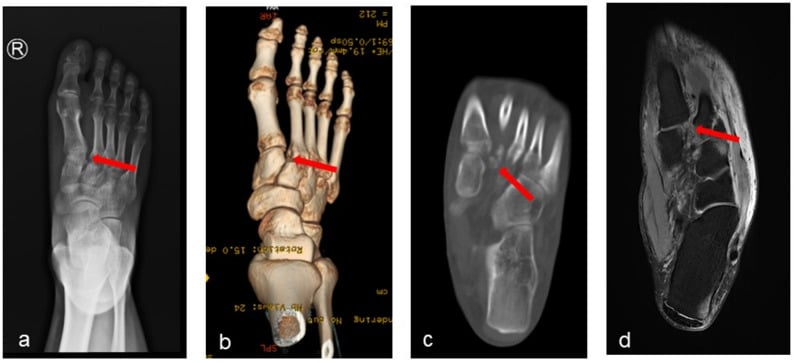
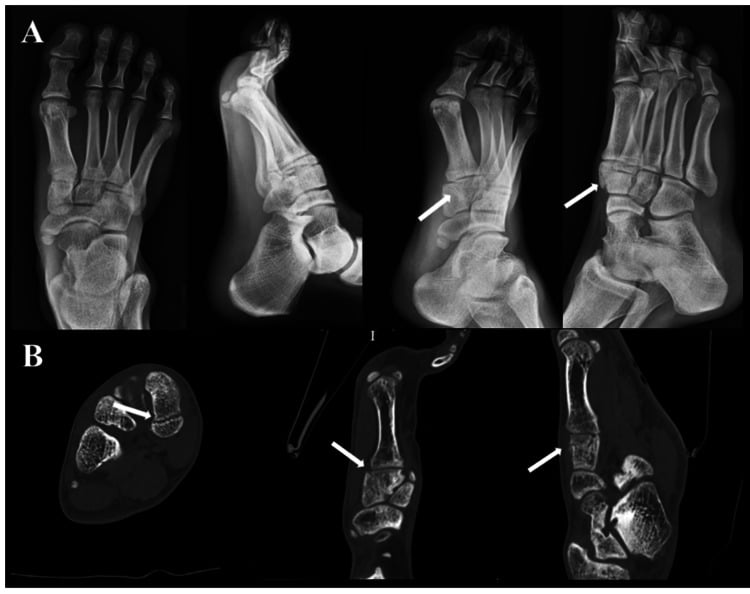
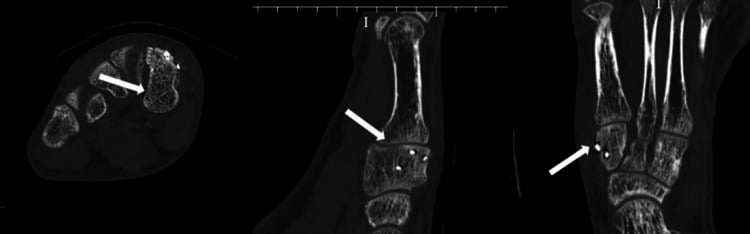
CT. CT is usually required for diagnosis and planning. It is recommended when a cuneiform fracture is suspected, when a Lisfranc injury is associated and when surgery is planned, and it shows the fracture pattern, the displacement (measure the step-off), any Lisfranc injury and the midfoot alignment.
Differential Diagnosis
The painful, swollen midfoot after trauma has a wide differential. The single most important distinction is whether the cuneiform fracture is isolated or a component of a Lisfranc injury, because that decision changes both stability assessment and fixation strategy.
- Key clinical clue
- Focal cuneiform tenderness, normal column alignment
- Best test
- CT (films often normal)
- Distinguishing feature
- No tarsometatarsal diastasis or instability
- Key clinical clue
- Plantar ecchymosis, pain on midfoot stress
- Best test
- Weight-bearing / stress films, CT
- Distinguishing feature
- First-second TMT diastasis, fleck sign, instability
- Key clinical clue
- Tenderness at the N-spot (dorsal navicular)
- Best test
- CT or MRI
- Distinguishing feature
- Fracture proximal to cuneiforms, talonavicular pain
- Key clinical clue
- Lateral midfoot tenderness, lateral column
- Best test
- CT
- Distinguishing feature
- Lateral column shortening, abduction mechanism
- Key clinical clue
- Tenderness at MT bases
- Best test
- AP/oblique films
- Distinguishing feature
- Fracture distal to TMT joints
- Key clinical clue
- Pain but no fracture on imaging
- Best test
- MRI / stress films
- Distinguishing feature
- Ligament signal change, possible dynamic instability
Treating a cuneiform fracture in isolation while missing the associated Lisfranc instability is the classic error. Any cuneiform fracture mandates a deliberate search for tarsometatarsal malalignment with weight-bearing or stress views, and CT if there is any doubt.
Bipartite Medial Cuneiform: the Cuneiform Fracture Mimic
The differential of a "cuneiform fracture" on imaging must include the bipartite medial cuneiform, a congenital normal variant that is the classic mimic and a well-recognised cause of over-diagnosis.
What it is. The bone forms as two ossicles, a dorsal and a plantar half, separated by a cartilaginous synchondrosis. It is uncommon, roughly 1% or fewer of feet, and is often bilateral.
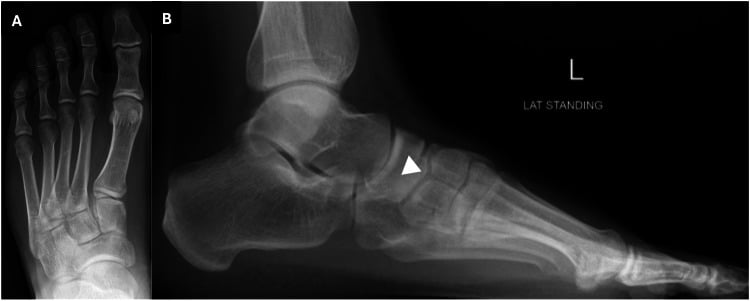
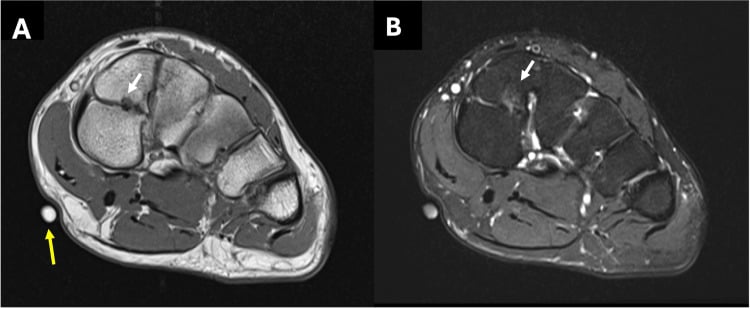
Telling it from a fracture. The dividing line of a bipartite cuneiform is smooth, rounded and corticated on both sides and lies in a consistent plane, usually horizontal, dorsal to plantar. An acute fracture line is sharp, non-corticated and irregular, with adjacent bone-marrow oedema on MRI and a matching mechanism and point tenderness. Bilaterality and corticated margins point to the variant.
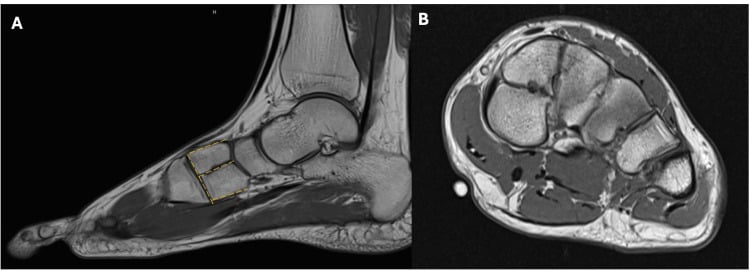
Why it matters. Misreading a bipartite cuneiform as a fracture leads to needless immobilisation or surgery. Conversely, a genuinely symptomatic bipartite cuneiform, a painful synchondrosis, is a separate and uncommon entity. When in doubt, compare the contralateral foot and use MRI: oedema indicates an acute injury or a symptomatic synchondrosis, not an incidental variant.
Management Algorithm
The decision. Determine stability rather than assuming every medial fracture needs fixation. Map the whole midfoot first, with the radiographs, CT and weight-bearing or stress views described above, and identify every involved articulation.
Stable: protect and follow. A closed, isolated, acceptably aligned fracture with no dynamic Lisfranc or intercuneiform instability, no column shortening and no threatened skin can be treated in a boot or short-leg cast, according to comfort and stability. Mobilise with protected or non-weight-bearing loading at first.
Progression. Progress loading from clinical improvement and radiographic healing rather than a universal 6-8-week rule; the duration depends on pain, healing, the fracture pattern and patient factors. Published outcomes are at case-report level, and persistence or loss of alignment requires renewed imaging and reconsideration.
Unstable: reconstruct the pattern. Consider fixation or reconstruction for:
- Open fracture or threatened soft tissue
- Dynamic midfoot instability or associated Lisfranc disruption
- Unacceptable articular incongruity, displacement or column shortening
- Symptomatic nonunion or failed maintenance of alignment
The construct must restore the involved rays and joints, not merely compress one fracture line. Timing follows the soft-tissue condition, urgency, associated injuries and reduction stability; there is no universal two-week window.
Reassess. Follow symptoms, weight-bearing capacity, serial alignment and union. CT is reserved for unresolved pain, occult displacement, nonunion concern or operative planning.
Surgical Technique
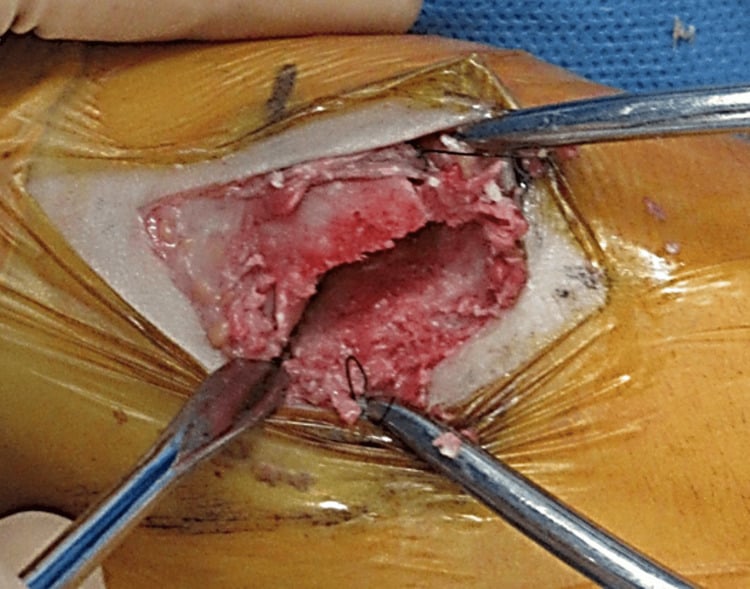
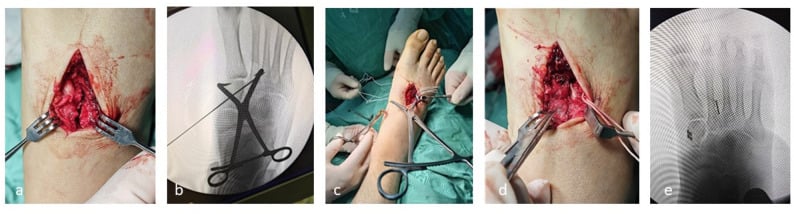
Isolated cuneiform ORIF. Through a dorsal approach, anatomical reduction and fixation restore midfoot stability, prevent collapse and allow early motion.
- Exposure - dorsal approach to the cuneiform; expose the fracture and protect the neurovascular structures
- Reduction - anatomical, to restore midfoot stability
- Fixation - screws (2.7-3.5mm) or a mini-fragment plate (2.0-2.7mm)
- Verification - confirm reduction and hardware position fluoroscopically, and that midfoot stability is restored
The High-Energy Transcuneiform Fracture-Dislocation: Restore Column Length and the Arch
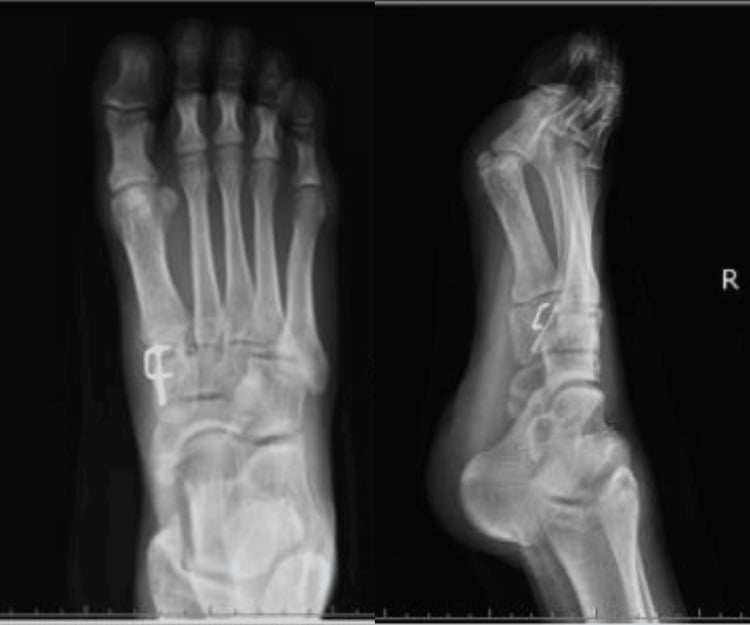
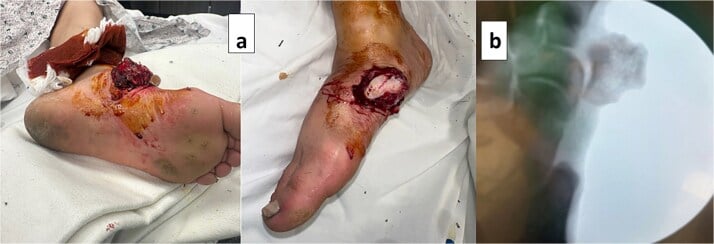
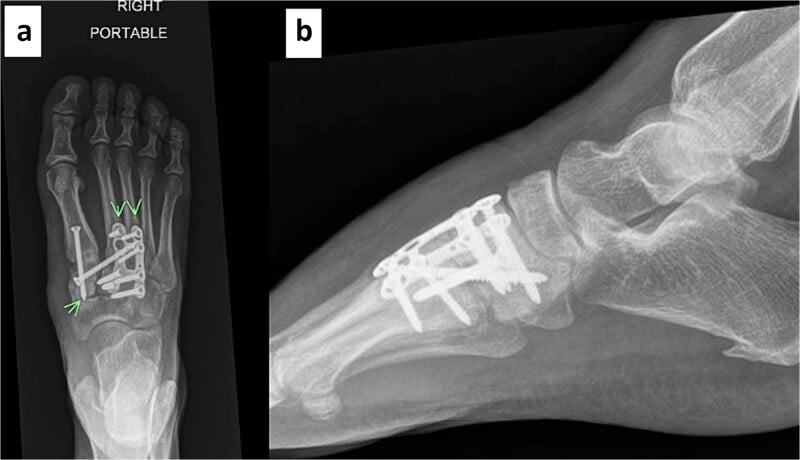
The pattern. A high-energy midfoot injury, from a crush or a road traffic accident, can comminute all three cuneiforms with dislocation of the medial three metatarsals and disruption of the Lisfranc ligament: the transcuneiform fracture-dislocation. CT is essential to map the comminution and plan the reconstruction.
The goal. Reconstruction aims to restore the length and alignment of the medial and middle columns and the longitudinal and transverse (diagonal) arches of the foot. It does not aim to piece together every small cuneiform fragment anatomically; column length is what preserves function.
Approach and fixation. An anterior or dorsal longitudinal approach exposes the cuneiforms and metatarsal bases. K-wires and/or screws across the tarsometatarsal joints, or bridge plating, hold length and alignment while the comminuted bone heals, and primary arthrodesis is considered for irreconstructible articular destruction.
Complications
- Incidence
- 10-15%
- Risk Factors
- Displacement, inadequate reduction
- Prevention/Management
- Anatomic reduction, adequate fixation
- Incidence
- 10-15%
- Risk Factors
- Instability, inadequate fixation
- Prevention/Management
- Restore stability, adequate fixation
- Incidence
- Up to 20% of Lisfranc injuries missed/late (Mascio 2022)
- Risk Factors
- Focus on cuneiform only
- Prevention/Management
- Always check for Lisfranc
- Incidence
- 5-10%
- Risk Factors
- Displacement, inadequate fixation
- Prevention/Management
- Rigid fixation
Reading the numbers. The ranges for instability, collapse and nonunion are conventional teaching figures, not measured rates; no cuneiform fracture series exists to derive them from. The only sourced frequency is the missed-Lisfranc figure (Mascio 2022).
Instability and collapse. An associated Lisfranc injury is a further cause of instability. When either is severe, it is managed by revision ORIF or midfoot fusion.
Postoperative Care
After fixation, union decides when the cast comes off and loading begins, which is the situation in which CT is used to confirm it.
Postoperative Protocol
- Short leg cast, strict non-weight bearing
- Elevation to reduce swelling
- Ankle ROM exercises (if fixation stable)
- CT to confirm healing (union and maintained midfoot alignment)
- Cast removal if healed; transition to walking boot
- Progressive weight bearing
- Full weight bearing in boot, then wean to normal shoes
- Midfoot ROM and strengthening with physiotherapy
- Progressive activity; return to sport at 3-4 months
Outcomes and Prognosis
What the outcome literature contains. No study has reported the outcome of a series of cuneiform fractures. There is no success rate, no return-to-activity figure and no stability rate for any treatment of this bone, and any percentage quoted for "cuneiform fracture outcome" has been carried over from Lisfranc series or invented. The published numbers, in full, are these:
- Population
- medial cuneiform stress fracture, non-operative
- n
- 1
- Outcome reported
- full return at 6 months
- Population
- transcuneiform fracture-dislocation, K-wires
- n
- 1
- Outcome reported
- AOFAS 92 at 6 months
- Population
- ligamentous Lisfranc, no cuneiform fractures
- n
- 41
- Outcome reported
- AOFAS 88 fusion vs 68.6 ORIF at 2 yr
- Population
- Lisfranc, no cuneiform fractures
- n
- 32 analysed
- Outcome reported
- no SF-36/SMFA difference; reoperation 78.6% vs 16.7%
- Population
- protocol
- n
- 0
- Outcome reported
- none - no results published
Counselling. Counsel from mechanism and from the Lisfranc principle, not from a number. An isolated, non-displaced, stable cuneiform fracture is expected to heal and do well. A cuneiform fracture that is part of a tarsometatarsal injury takes the prognosis of that injury, which is materially worse: persistent pain, post-traumatic arthritis and deformity are the recognised outcomes, and anatomical reduction is the single factor consistently associated with doing better.
Tell the patient that, and tell them the evidence for the bone itself is a handful of case reports.
Long-term instability. Progression of midfoot instability is conventionally quoted at 10-15% with proper treatment and 20-30% without, with displacement, Lisfranc injury and delayed treatment as the risk factors. These are teaching figures carried over from the Lisfranc literature, not measurements; the table above shows that no cuneiform cohort exists to derive them from.
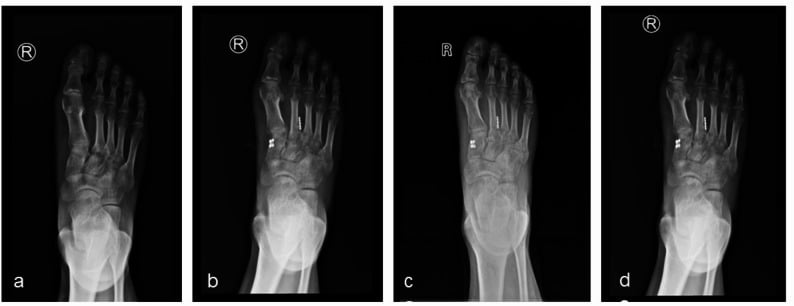
Guidelines, Registries & Global Practice
Global Epidemiology
- Isolated cuneiform fractures are among the rarest foot fractures (the isolated medial cuneiform literature comprises fewer than 10 reported cases worldwide).
- Most cuneiform fractures occur as part of a midfoot/Lisfranc injury complex, which is more common in men in the third decade.
- Up to 20% of Lisfranc injuries are missed or diagnosed late globally, the single biggest driver of poor outcomes regardless of healthcare setting.
Guidance Across Major Bodies
There is no cuneiform-fracture-specific society guideline; practice is extrapolated from Lisfranc and general intra-articular foot fracture principles, which are broadly concordant across regions.
- Diagnosis emphasis
- Weight-bearing/stress views, CT for fracture mapping
- Operative position
- Anatomic reduction and stable fixation of medial/middle columns
- Diagnosis emphasis
- High suspicion; CT for occult injury; stress exam under anaesthesia
- Operative position
- ORIF for fracture patterns; primary arthrodesis for ligamentous
- Diagnosis emphasis
- Senior review of midfoot injuries; cross-sectional imaging if films equivocal
- Operative position
- Restore alignment; refer complex midfoot to foot and ankle service
- Diagnosis emphasis
- MRI gold standard for ligamentous injury; CT for subtle subluxation
- Operative position
- No proven superiority of ORIF vs PA; reduction quality is decisive
Registry and Trial Notes
- Arthroplasty-style joint registries (NJR, AJRR, AOANJRR) do not track cuneiform fractures; the relevant high-level data are the Lisfranc RCTs (Ly & Coetzee 2006; Henning 2009) and the ongoing multicentre BFF trial.
- These consistently show that reduction quality, not the specific implant, determines outcome.
High- vs Limited-Resource Practice
- Well-resourced settings: routine CT for mapping, MRI for occult/ligamentous injury, and a foot-and-ankle subspecialist performing column-based fixation or primary arthrodesis.
- Limited-resource settings: reliance on weight-bearing and stress radiographs with contralateral comparison; closed reduction with percutaneous K-wires or screws is a legitimate strategy when CT and implants are scarce, prioritising anatomic alignment and a stable, plantigrade foot.
Cuneiform fractures are a common viva springboard into the Lisfranc complex. Know that the medial cuneiform is the Lisfranc ligament attachment, that any cuneiform fracture mandates a search for tarsometatarsal instability, that anatomic reduction is the key prognostic factor worldwide, and be ready to cite Ly & Coetzee (AOFAS 88 vs 68.6) on primary arthrodesis versus ORIF.
Controversies and Areas of Uncertainty
Because isolated cuneiform fractures are vanishingly rare, almost every controversy is inherited from the Lisfranc literature that governs the combined injury. The displacement threshold is one; it is dealt with under Classification.
ORIF or primary arthrodesis. For the associated Lisfranc injury, two RCTs (Ly & Coetzee 2006; Henning 2009) favoured primary arthrodesis on AOFAS scores and reoperation rates, particularly for primarily ligamentous patterns. The adequately powered multicentre BFF trial is designed to settle this. Until then, ORIF remains widely used for bony fracture-dislocation patterns where the medial column can be anatomically reconstructed.
Screw or plate. Transarticular screws are simple but damage articular cartilage; dorsal bridge plating spares the joint surface but needs more dissection. No high-level evidence establishes either as superior, and the choice is guided by fracture comminution and surgeon preference.
Hardware removal. Whether to remove transarticular hardware routinely is unresolved. Routine removal inflates the reoperation rate, a major reason arthrodesis looked favourable in Henning 2009, but may relieve symptomatic hardware; many centres now retain or selectively remove.
MCQ Practice Points
Q: Why is medial cuneiform the most common cuneiform fracture? A: Medial cuneiform is attachment site for Lisfranc ligament - Often associated with Lisfranc injuries (association strong but unquantified - no series has measured it). Largest cuneiform. Displacement causes midfoot instability requiring ORIF.
Q: Why are cuneiform fractures often associated with Lisfranc injuries? A: Cuneiform fracture suggests midfoot instability - the association is strong enough that a cuneiform fracture should be treated as a Lisfranc injury until proven otherwise, though no series has measured how often the two coexist, so avoid quoting a percentage. Medial cuneiform is the Lisfranc ligament attachment site. Always check the tarsometatarsal joints on CT and on weight-bearing views.
Q: Why is midfoot stability important in cuneiform fractures? A: Cuneiforms are part of midfoot stability - Displacement causes midfoot instability and arthritis. ORIF required if displaced to restore stability. Anatomical reduction is the variable tied to outcome in the Lisfranc literature; no cuneiform-specific success rate exists.
Q: When is ORIF required for cuneiform fractures? A: Displacement greater than 2mm or part of Lisfranc injury - Prevents midfoot instability and collapse. Screw or plate fixation. Know that 2mm is the generic intra-articular convention rather than a validated cuneiform threshold, and that instability on stress or weight-bearing views outranks the static measurement.
Q: What is the treatment for cuneiform fractures? A: ORIF if displaced (greater than 2mm) or part of Lisfranc injury - Restores midfoot stability and prevents collapse. Conservative treatment for non-displaced isolated fractures, after confirming stability. There is no published success rate for either arm - fewer than ten isolated medial cuneiform fractures have been reported in total.
Exam Viva Scenarios
Practise clinical reasoning and management decisions out loud
“A 30-year-old patient presents with midfoot pain after high-energy trauma. CT shows displaced medial cuneiform fracture with 3mm displacement. No associated Lisfranc injury.”
“A 35-year-old patient has a medial cuneiform fracture as part of a Lisfranc injury. The examiner asks you to explain how you manage both injuries.”
“A 24-year-old runner has persistent dorsomedial midfoot pain and focal tenderness over the medial cuneiform. Two sets of plain radiographs taken over three weeks are reported as normal. The examiner asks how you would proceed.”
Key Concepts
- Medial cuneiform most common (Lisfranc ligament attachment)
- Often associated with Lisfranc injuries (rate unmeasured - no series has quantified it)
- Cuneiforms are part of midfoot stability
- ORIF required if displaced (restores midfoot stability)
Classification
- Medial: Most common, Lisfranc association - ORIF if displaced or unstable
- Intermediate: Rare, almost always with Lisfranc - ORIF within the TMT construct
- Lateral: Rare, isolated or with Lisfranc - ORIF if displaced; check the cuboid
- Key Factor: Pattern dictates approach and Lisfranc evaluation
Treatment
- Non-displaced, isolated: Conservative (cast, NWB 6-8 weeks)
- Displaced, isolated: ORIF - aim for anatomical reduction, the one factor tied to outcome
- Part of Lisfranc: ORIF as part of Lisfranc fixation - the worse prognostic group
- Displacement greater than 2mm: ORIF required
Surgical Technique
- Dorsal approach: Protect neurovascular structures
- Reduction: Anatomic reduction to restore midfoot stability
- Fixation: Screws (2.7-3.5mm) or mini-fragment plate (2.0-2.7mm)
- Verify midfoot stability restored
- Verify reduction fluoroscopically
Complications
- Midfoot instability: 10-15% (prevent with anatomic reduction)
- Midfoot collapse: 10-15% (prevent with adequate fixation)
- Missed Lisfranc: up to 20% of Lisfranc injuries missed or late (Mascio 2022) - always check
- Nonunion: 5-10% (prevent with rigid fixation)
Evidence Base
Isolated cuneiform fractures are too rare to support randomised trials, so the evidence base for the cuneiform itself is built from case reports and series. The high-level evidence sits in the adjacent and frequently coexistent Lisfranc literature, which directly governs how a cuneiform fracture is managed when it forms part of a tarsometatarsal injury.
Be precise about how little that leaves, because it changes what you can say to a patient. Of the six studies below, four contain no cuneiform fracture at all - two are randomised trials of Lisfranc injury, one is a protocol with no patients and no results, and one is a narrative review. The cuneiform-specific evidence on this page is two case reports, one patient each, and Paisan's authors record that fewer than ten isolated medial cuneiform fractures had been reported in the whole literature.
There is therefore no success rate for any treatment of a cuneiform fracture, and none is quoted on this page. What transfers from the Lisfranc literature is a principle rather than a number: anatomical reduction determines outcome, the medial and middle columns must be restored to length and alignment, and a displaced or unstable injury does badly if left. What does not transfer is the arthrodesis-versus- fixation argument, which was settled in patients whose ligaments failed and whose bones were intact.
Ligamentous Lisfranc: Primary Arthrodesis vs ORIF (Landmark RCT)
- AOFAS 88 (arthrodesis) vs 68.6 (ORIF) at 2 years
- Anatomic reduction achieved in nearly all in both arms
- 5/20 ORIF patients required salvage arthrodesis
- Drove the case for primary fusion in ligamentous patterns
ORIF vs Primary Arthrodesis: Reoperation Burden (RCT)
- Secondary surgery 78.6% (ORIF) vs 16.7% (arthrodesis)
- No significant SF-36/SMFA difference between groups
- Difference largely driven by routine hardware removal
- Reframes the debate around reoperation, not function
BFF Study: Multicentre PA vs ORIF Trial (Protocol)
- Powered multicentre RCT (n=112), NCT04519242
- Primary outcome: quality of life
- Includes cost-effectiveness analysis
- Earlier trials were underpowered single-centre studies
Lisfranc Complex Injuries: Diagnosis and Missed Injury Rate (Review)
- Up to 20% of Lisfranc injuries missed/late-diagnosed
- CT for non-displaced fracture and subtle subluxation
- MRI is gold standard for ligamentous injury
- Anatomic reduction is the key determinant of outcome
Isolated Medial Cuneiform Stress Fracture (Case Report)
- Isolated cuneiform fracture is genuinely rare (fewer than 10 reported)
- Plain films were normal twice; MRI made the diagnosis
- Non-displaced fractures heal well non-operatively
- Delayed diagnosis is the main pitfall
Transcuneiform Fracture-Dislocation: Operative Restoration of Arch (Case Report)
- High-energy mechanism injures all three cuneiforms
- CT essential to map the comminution
- Goal is restoration of arch anatomy and column length
- Good outcome achievable with anatomic fixation