L4-5 Slip in the Elderly
- Intact pars is the definition, and it is what separates this from isthmic spondylolisthesis
- L4-5 in about 80%, because those facets are sagittally oriented and the iliolumbar ligaments tether L5
- Get STANDING films - up to 22% of slips reduce and disappear on a supine MRI, so a facet effusion mandates flexion-extension views
- Neurogenic claudication is the dominant symptom; relief comes from FLEXION, not merely from stopping
- Whether to add fusion to decompression is genuinely unsettled - two 2016 NEJM trials in the same issue reached opposite conclusions
- “Look for the facet fluid sign on axial T2 - an effusion over 1.5mm predicts a slip the supine scan is hiding
- “Degenerative = L4-5 in women; isthmic = L5-S1 in men
- “The pars is INTACT in the degenerative type - a defect makes it isthmic
- “Do not say fusion is the settled standard: SLIP favoured it in STABLE grade I slips, SSSS found no benefit, and neither found a difference on ODI
Overview and Epidemiology
What it is. Degenerative spondylolisthesis is a disorder of segmental instability in which a vertebra slips forward on the one below through progressive degeneration of the facet joints and the intervertebral disc, with an intact pars interarticularis. The intact pars is the definition and the whole distinction from isthmic spondylolisthesis, in which the pars is defective; because the neural arch remains intact the condition is sometimes termed "pseudospondylolisthesis". It is a failure of the "three-joint complex", the disc and the two facet joints, to maintain alignment under load, and it rarely exceeds Grade II.
Who. The classic patient is a woman over 50 with a slip at L4-5. In the community-based Framingham cohort imaged with CT, prevalence rose progressively from the fifth through the eighth decades of life (Kalichman 2009); peak incidence is 50-70 years, and the condition is extremely rare under 40. It is reported more frequently in Black women in North American population studies.
Why women. Large population data show a male-to-female ratio of approximately 1:3 (Kalichman 2009), and surgical and clinical series often quote a higher female predominance, up to about 5:1. The difference is attributed to ligamentous laxity, smaller facet joints and post-menopausal hormonal effects on connective tissue.
Where. L4-5 in about 80% of cases, L4 slipping forward on L5: this is the most susceptible level because it sits at the transition between the mobile lumbar spine and the stable lumbosacral junction. L3-4 is the second most common level. L5-S1 is rare, for the reasons given in the anatomy below.
Risk factors. Alongside age and female sex:
- Sagittally oriented facet joints, which permit forward translation
- The post-menopausal state, with its reduced ligamentous restraint
- Diabetes, which accelerates disc and facet degeneration
- A high pelvic incidence, associated with both the presence and the severity of the slip
- Multiple pregnancies, which may contribute through abdominal muscle stretching and hormonal laxity
Anatomy
The facet joint. The zygapophysial joint is a synovial joint formed by the superior articular process of the level below and the inferior articular process of the level above. Its capsule is richly innervated, by the medial branch of the same level and of the level above, which makes it the source of facetogenic pain. Lumbar facets are predominantly sagittal and permit flexion and extension, where thoracic facets are coronal and permit rotation; within the lumbar spine the L5-S1 facets are more coronally oriented and resist anterior shear, whereas the L4-5 facets are more sagittal and susceptible to it.
The ligaments. The iliolumbar ligament runs from the L5 transverse process to the ilium and stabilises L5 on the sacrum. Together with the deep seating of L5 in the pelvis below the intercristal line, that is why degenerative slips at L5-S1 are rare. The ligamentum flavum, the elastic yellow ligament, buckles anteriorly into the canal as the disc collapses and contributes to the stenosis alongside facet hypertrophy.
The roots and the vessels. The L4 root exits below the L4 pedicle; the L5 root traverses the L4-5 disc space and is the root at risk. The aorta and vena cava lie anterior to the disc, and an ALIF at L4-5 risks the iliac bifurcation, which is why PLIF or TLIF is preferred at L4-5.
Pathophysiology
The restraints. The lumbar spine resists anterior shear through three mechanisms:
- The disc: the annulus fibrosus provides tensile restraint against translation
- The facets: a coronal orientation of the joint surfaces provides a bony block to anterior translation
- The ligaments: the iliolumbar and longitudinal ligaments tether the segment
Where it fails. In degenerative spondylolisthesis the failure is primarily at the facet joints. As disc height is lost the axis of rotation shifts posteriorly and loads them, and the process that follows is the Kirkaldy-Willis cascade with a specific vector of anterolisthesis:
- Disc degeneration. Loss of disc height and nucleus turgor reduces resistance to shear and settles the motion segment
- Facet loading. Loss of anterior column height transfers load to the posterior elements: facets normally bear about 20% of load, and with disc degeneration this can rise toward 70%
- Facet remodelling. Chronic loading causes cartilage wear, subluxation and effusion; the facets remodel from coronal, which resists slip, to sagittal, and once sagittal they offer little resistance to anterior shear
- Instability. The incompetent disc and the sagittal facets allow the superior vertebra to translate anteriorly; the iliolumbar ligaments hold L5, making L4 the "victim" level above
- Stenosis. The canal is narrowed anteriorly by disc bulge and osteophytes and posteriorly by hypertrophied facets and buckling ligamentum flavum, the "napkin-ring" effect, producing central stenosis (claudication) and lateral recess stenosis (radiculopathy)
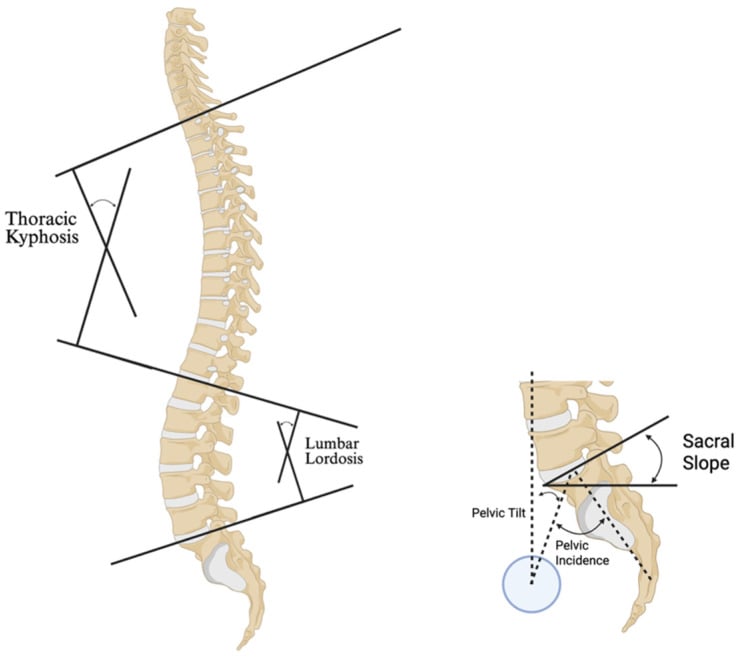
Spinopelvic Parameters and Sagittal Balance
Examiners increasingly expect the formal parameters, the fundamental equation and the PI-LL mismatch that drives modern alignment and fusion decisions.
- Definition
- Angle between a line perpendicular to the sacral endplate at its midpoint and a line from that midpoint to the femoral head axis
- Nature and approximate normal
- FIXED (morphological), constant after skeletal maturity; normal about 50 to 55 degrees
- Definition
- Angle between the vertical and the line from the sacral-endplate midpoint to the femoral head axis
- Nature and approximate normal
- POSITIONAL; normal under about 20 degrees; rises as the pelvis retroverts to compensate
- Definition
- Angle between the sacral endplate and the horizontal
- Nature and approximate normal
- POSITIONAL; normal about 40 degrees
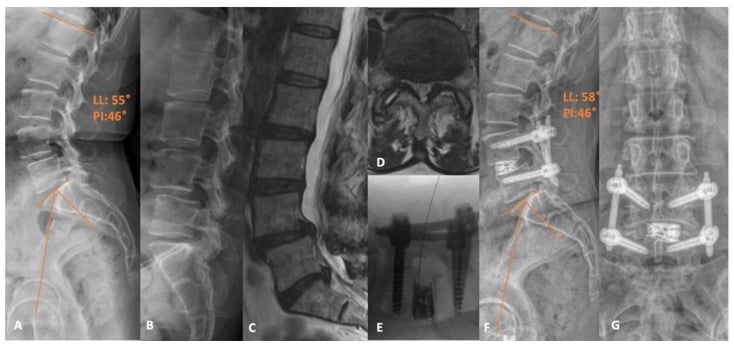
The fundamental equation: PI = PT + SS. Because PI is fixed, any loss of sacral slope, for example with pelvic retroversion, must be matched by a rise in pelvic tilt. That is the geometric basis of the compensation seen as the slip and stenosis develop: the patient retroverts the pelvis, increasing pelvic tilt, and flexes the knees, the simian stance, to remain upright.
Pelvic incidence and lumbar lordosis must match. Lumbar lordosis (LL) should be tuned to the PI. That is also why a high PI predisposes to the slip: it demands a high lumbar lordosis to balance, and that increases the shear at L4-5.
The PI-LL mismatch. A PI-LL mismatch, commonly taken as a difference of more than about 10 degrees, signifies under-correction of lordosis and is associated with sagittal imbalance, worse patient-reported outcomes and a higher rate of adjacent segment disease after fusion. The surgical target after a lumbar fusion is therefore to restore lordosis so that PI minus LL is within about 10 degrees; the SRS-Schwab criteria add pelvic tilt over about 20 degrees and sagittal vertical axis over about 5 cm as the other alignment targets.
Classification
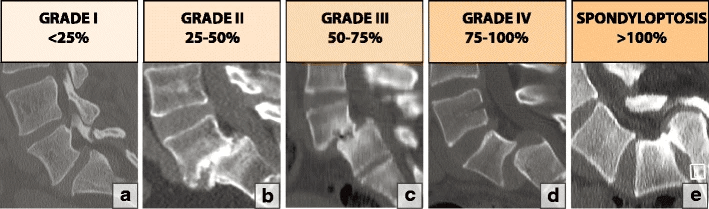
Meyerding grades how far the vertebra has slipped; Wiltse classifies by aetiology.
The grade is the percentage slip of the superior vertebra over the inferior one on the lateral radiograph.
- Slip Percentage
- 0 to 25%
- Note
- Most degenerative cases
- Slip Percentage
- 25 to 50%
- Note
- Maximum typical for degenerative
- Slip Percentage
- 50 to 75%
- Note
- Rare in degenerative (think isthmic)
- Slip Percentage
- 75 to 100%
- Note
- Very rare
- Slip Percentage
- Over 100%
- Note
- Spondyloptosis (vertebra falls off)
Clinical Presentation
Neurogenic claudication is the dominant symptom, in about 90%: heaviness, fatigue or pain in the buttocks and legs on walking, relieved by sitting or leaning forward, the "shopping-cart sign". Flexion opens the canal and relieves venous congestion, which is also why static standing is often worse than walking: sustained extension load and venous engorgement.
Radiculopathy occurs in about 50%, as dermatomal leg pain. An L4-5 slip typically causes an L5 radiculopathy, the L5 root being compressed in the lateral recess.
Back pain is mechanical and lower lumbar, worse with extension (standing and walking) and relieved by flexion. Night pain may reflect instability as the muscles relax during sleep. Always rule out bladder dysfunction (cauda equina).
Examination. Inspection shows a flattened lumbar lordosis, the "flat back", a flexed posture and the simian stance, hips and knees flexed to open the canal. A step-off may be palpable: with an L4 anterior slip the L4 spinous process moves anteriorly and lies deep while L3 remains prominent, so the step is felt between L3 and L4. Extension reproduces the back and leg pain (Kemp's test), and the femoral stretch test may be positive with significant foraminal stenosis.
Neurology is directed at L5:
- Motor: extensor hallucis longus (great-toe extension) and hip abduction (gluteus medius)
- Sensory: dorsum of the foot and the first web space
- Reflexes: the ankle jerk (S1) is usually normal, and there is no reliable L5 reflex
Investigations
Plain radiographs are taken standing:
- Standing AP and lateral: essential, for the slip grade and facet sclerosis
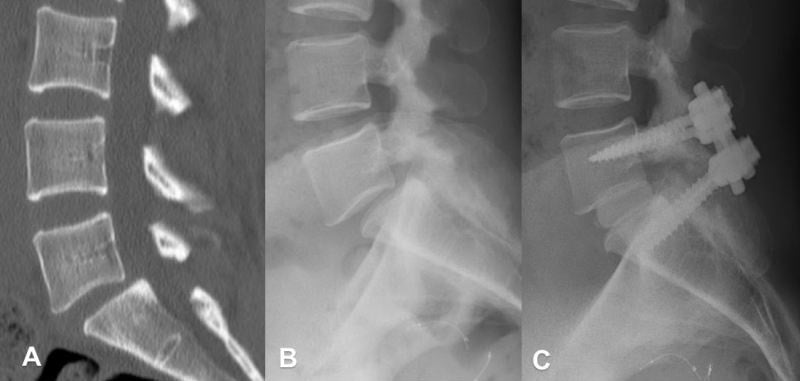
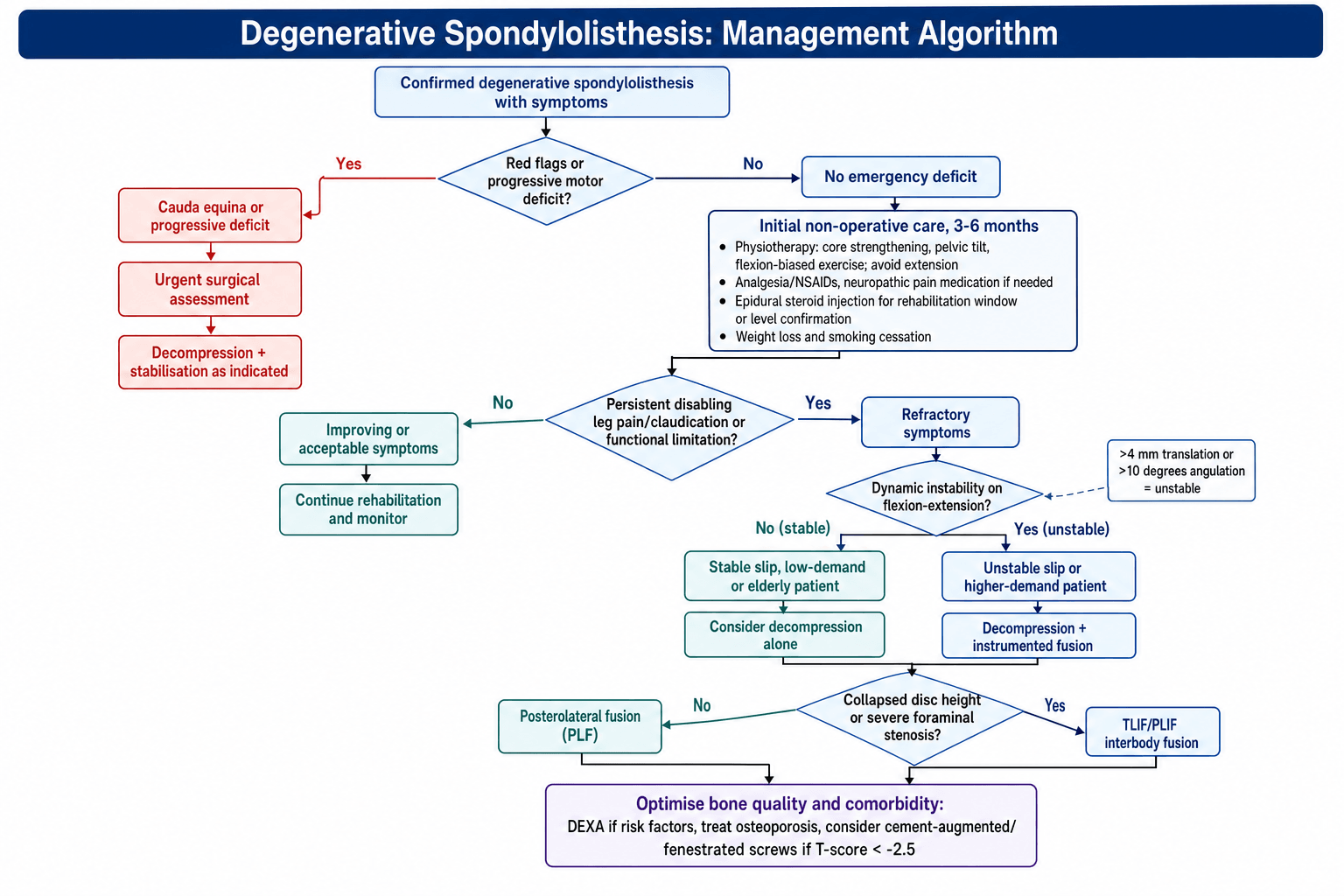
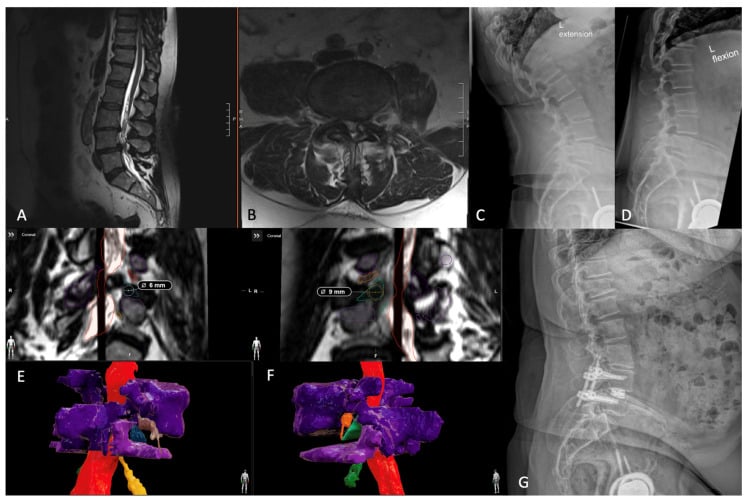
- Flexion-extension views: the stability check. Translation greater than 4mm or angular motion greater than 10 degrees defines instability, and demonstrated instability is the conventional indication to add fusion
- Spinous process view: kissing spines (Baastrup disease)
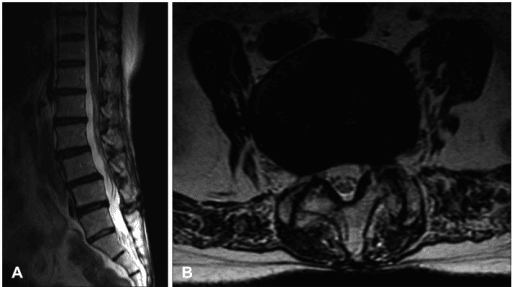
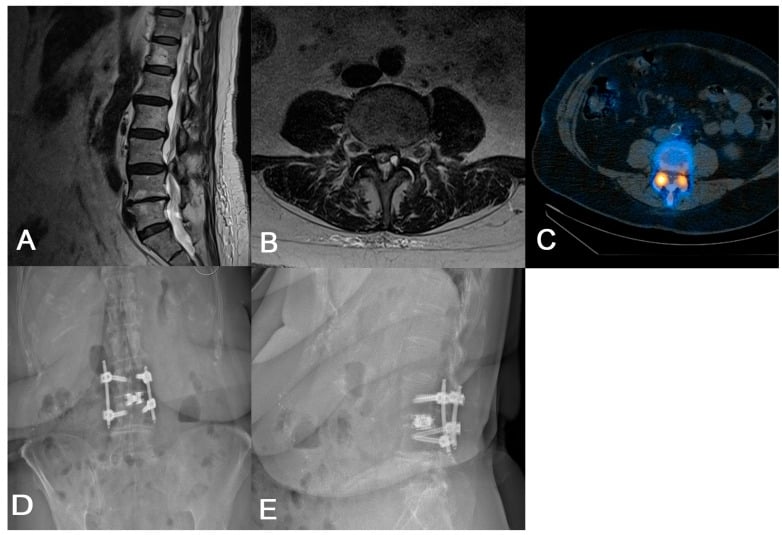
MRI is the gold standard. It measures the central canal area (critical stenosis under 75mm2): with facet hypertrophy and ligamentum flavum buckling the canal loses its normal oval shape and becomes trefoil or omega-shaped, CSF signal around the cauda equina is effaced, and the roots become crowded or redundant (serpiginous) proximal to the block.
The lateral recess is bordered by the posterior vertebral body and disc anteriorly, the pedicle laterally and the superior articular process posteriorly, and loss of perineural fat around the traversing root there signals impingement. MRI also grades the disc (Pfirrmann) and shows the facet effusion.
Fluid Sign: On axial T2-weighted MRI, a large facet joint effusion (greater than 1.5mm) is highly predictive of degenerative spondylolisthesis at L4-5 and indicates dynamic instability — even when the supine MRI shows no measurable slip. Chaput (2007) found that 22% of slips were not visible on supine MRI, so a facet effusion mandates standing flexion-extension films.
CT confirms that the pars is intact, since a defect makes the diagnosis isthmic spondylolisthesis; it plans the pedicle screw trajectory; and it shows facet tropism (asymmetry).
Differential Diagnosis
- Degenerative
- Elderly (over 50)
- Isthmic
- Young (20-40)
- Degenerative
- Female
- Isthmic
- Male
- Degenerative
- L4-5
- Isthmic
- L5-S1
- Degenerative
- INTACT
- Isthmic
- DEFECT (Lysis)
- Degenerative
- Central Stenosis
- Isthmic
- Foraminal Stenosis
- Degenerative
- Low (I/II)
- Isthmic
- High (III+) possible
Neurogenic versus vascular claudication. The leg symptoms are usually neurogenic claudication, but distinguishing this from vascular (arterial) claudication is a classic examiner discriminator. The cleanest discriminators are the relief posture and the pulses.
- Neurogenic (spinal stenosis)
- Standing and walking (lumbar extension)
- Vascular (peripheral arterial disease)
- Any exertion of the muscle (walking)
- Neurogenic (spinal stenosis)
- FLEXION - sitting, leaning forward, squatting (not merely stopping)
- Vascular (peripheral arterial disease)
- Stopping and STANDING STILL (rest), within a few minutes
- Neurogenic (spinal stenosis)
- Variable day to day
- Vascular (peripheral arterial disease)
- Fixed, reproducible claudication distance
- Neurogenic (spinal stenosis)
- Easier UPHILL (trunk flexed)
- Vascular (peripheral arterial disease)
- Worse uphill (higher muscle demand)
- Neurogenic (spinal stenosis)
- Usually pain-free (spine flexed)
- Vascular (peripheral arterial disease)
- Provokes pain (muscle demand)
- Neurogenic (spinal stenosis)
- Normal pulses and skin
- Vascular (peripheral arterial disease)
- Absent/reduced pulses, cool foot, trophic changes, low ABPI
- Neurogenic (spinal stenosis)
- Buttock/thigh/leg heaviness, often bilateral, dermatomal
- Vascular (peripheral arterial disease)
- Cramp in the working muscle (typically calf)
Because the two often coexist in the elderly, check the pulses and the ankle-brachial pressure index before attributing all of the leg pain to the spine.
Management
First line, for 3-6 months. Treatment success is approximately 30-50%, and conservative care should generally be exhausted before surgery unless there is a significant motor deficit.
- Physiotherapy: core strengthening (transversus abdominis), pelvic tilt and flexion-biased (Williams) exercises; avoid extension, which closes the canal
- Medication: short-course NSAIDs for flares; paracetamol; gabapentinoids for claudication symptoms
- Injections: an L4-5 epidural steroid injection can provide a "window of relief" for rehabilitation and has diagnostic value in confirming the level
- Lifestyle: weight loss, which unloads the spine, and smoking cessation, which improves bone health and fusion potential
Surgical Technique
Positioning. Prone on a Wilson frame or Jackson table, arms abducted, pressure points padded, fluoroscopy available.
Approach. A midline posterior incision and subperiosteal dissection to expose the laminae and facets, preserving the facet capsules at the adjacent levels and avoiding excessive violation of the cephalad facet.
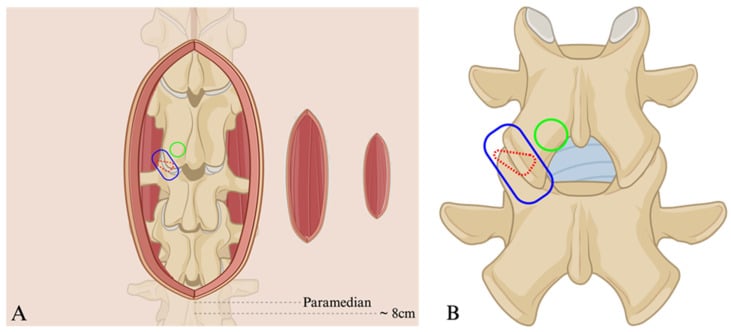
Decompression. Laminectomy at the affected level, bilateral foraminotomy and an undercutting facetectomy for the lateral recess. Preserve enough pars and facet to avoid iatrogenic destabilisation when not fusing.
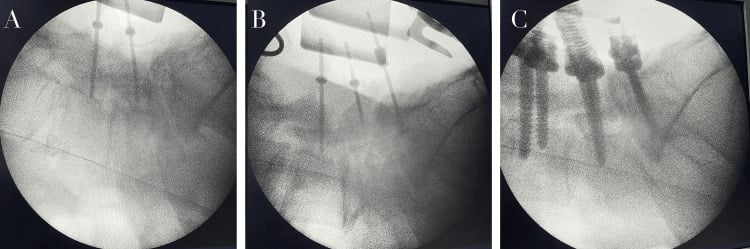
Instrumentation. Pedicle screws at L4 and L5 with contoured rods to maintain lordosis.
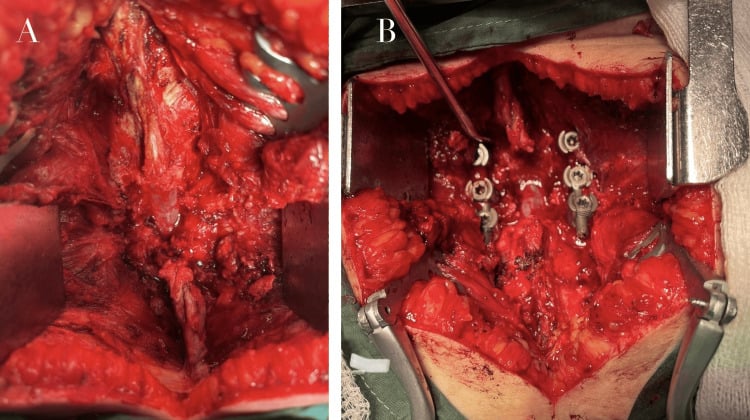
Fusion. Decorticate the transverse processes and lay local autograft from the laminectomy, supplemented with allograft or synthetic graft if needed.
Complications
Dural tear is commoner than in simple stenosis because of adhesions and the slip, at about 5-10%. Repair it primarily and consider flat bed rest for about 24 hours.
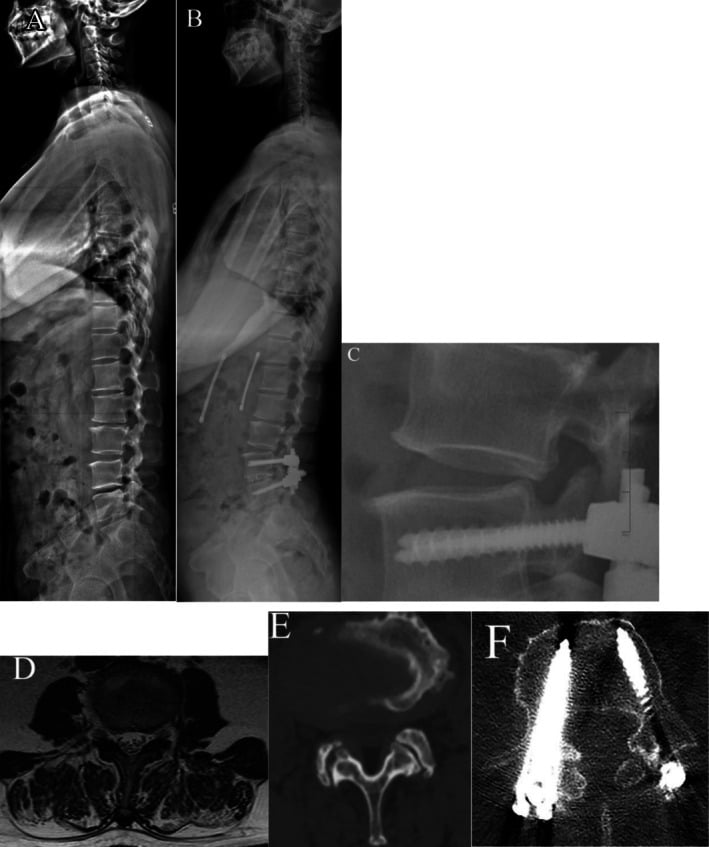
Implant failure, screw loosening or pull-out, is common in osteoporotic bone, which is the reason for the DEXA scan and the augmented screws above.
Adjacent segment disease. Fusion transfers load to the level above, usually L3-4. Symptomatic disease requiring further decompression or fusion runs at roughly 2-3% per year, reaching 16.5% at 5 years and 36.1% at 10 years in Ghiselli's 215-patient series. Radiographic adjacent-level degeneration is far commoner and often asymptomatic, and the two must be kept apart.
Pseudarthrosis, failure to fuse, causes loose hardware and recurrent pain. Smoking doubles the risk; NSAIDs and diabetes are the other risk factors.
Infection runs at about 1-2%, usually Staphylococcus aureus or epidermidis, and requires prompt washout.
Neurological injury. The L5 root is at risk during screw placement or reduction, and foot drop is the classic deficit.
Outcomes
What to promise. Roughly 80% report a good or excellent result in case series, though that figure is soft and undefined. The reliable message, and the one patients should be told, is that leg pain and walking distance respond far better than back pain. Walking tolerance and ODI improve substantially, patient satisfaction runs at about 70-80%, and the instrumented fusion rate is over 90%.
- Pre-op
- 50-60
- Post-op
- 20-30
- Pre-op
- 7-8
- Post-op
- 2-3
- Pre-op
- Limited
- Post-op
- Unlimited in ~70%
Prognosis. Claudication as the primary symptom, single-level disease, no prior surgery and a non-smoker all favour a good result. Predominantly back pain, multi-level disease, obesity or diabetes, and a workers' compensation claim all point the other way.
Guidelines, Registries & Global Practice
Global Epidemiology
- Community-based CT imaging (Framingham, USA) shows DS prevalence rising progressively from the fifth through the eighth decades, with a male-to-female ratio of ~1:3 (Kalichman 2009).
- Surgical case series across regions consistently report L4-5 as the dominant level (~80%) and a female predominance.
Side-by-Side Society Guidance
- Position on DS surgery
- Decompression with fusion suggested for DS with stenosis and instability; decompression alone an option for stable slips.
- Position on DS surgery
- Surgery favoured over nonoperative care for refractory symptomatic DS (SPORT); fusion for demonstrated instability.
- Position on DS surgery
- Decompression for stenotic symptoms; fusion reserved for clear instability or deformity, reflecting SSSS-driven caution about routine fusion.
- Position on DS surgery
- Heterogeneous; growing emphasis on reserving fusion for unstable or deformity cases after SSSS (Försth 2016).
Registry & Trial Signals
- The two 2016 NEJM RCTs (Ghogawala/SLIP and Försth/SSSS) reached opposing conclusions on routine fusion, and the usual bedside reconciliation — fuse the unstable, decompress the stable — is not supported by either trial, because SLIP explicitly enrolled stable grade I slips and still favoured fusion, while SSSS found nothing in its spondylolisthesis stratum. The differences that do separate them are case mix (SLIP was purely grade I DS; 112 of Försth's 247 had no slip at all), size (66 versus 247), and primary outcome (SF-36 physical component versus ODI). Note that on the outcome they share, ODI, neither trial found a significant advantage for fusion. The defensible position is that adding fusion buys, at most, a small quality-of-life gain at the cost of blood loss, hospital stay and money — and that it is a discussion with the patient rather than a rule.
- National spine registries (e.g. Swespine in Sweden, the UK British Spine Registry) track reoperation and patient-reported outcomes and inform the trend away from universal instrumented fusion in stable disease.
High- vs Limited-Resource Variation
- Where MRI and intraoperative navigation/fluoroscopy are limited, reliance on standing radiographs and meticulous clinical examination increases; cost and implant availability shift practice toward decompression or non-instrumented fusion.
- Implant selection (interbody cages, cement augmentation) is influenced by availability and funding, not only biomechanics.
Referral & Red Flags (universal)
- Immediate referral: cauda equina syndrome or progressive severe weakness.
- Surgical candidates: correlating MRI/dynamic-radiograph pathology after a failed 3-6 month active rehabilitation program.
- Plain standing radiographs (including flexion-extension) are the first-line screening tool; CT excludes a pars defect; MRI characterises stenosis and root compression.
MCQ Practice Points
Q: What distinguishes degenerative from isthmic spondylolisthesis? A: Degenerative spondylolisthesis has an INTACT pars interarticularis - the slip occurs through facet and disc degeneration. Isthmic spondylolisthesis has a pars defect (spondylolysis).
Q: What is the most common level for degenerative spondylolisthesis and why? A: L4-5 (~80%). L4-5 has more sagittally oriented facets permitting translation, and L5 is stabilised by the iliolumbar ligaments and deep pelvic seating.
Q: What dynamic measurement indicates surgical fusion is required? A: Greater than 4mm translation (or greater than 10 degrees angulation) on flexion-extension radiographs defines dynamic instability and indicates fusion in addition to decompression.
Q: What is the facet fluid sign and why does it matter? A: A large facet effusion (greater than 1.5mm) on supine T2 MRI is highly predictive of DS at L4-5. Up to 22% of slips reduce when supine, so the fluid sign should prompt standing flexion-extension films (Chaput 2007).
Patient Education
Understanding Your Condition
What is a 'slip'? It is the bone (vertebra) shifting forward, not your spinal cord. This narrows the canal and pinches the nerves, causing the "heavy legs" feeling when walking.
Will it paralyse me? Degenerative spondylolisthesis rarely causes paralysis. Untreated, walking distance may gradually shrink until you are housebound.
Recovery timeline
- Hospital: ~3-5 days.
- Walking: from day 1.
- Driving: ~4-6 weeks.
- Full recovery: 6-12 months for the fusion to knit.
Red flags - go to Emergency if you experience:
- Loss of bowel or bladder control (cauda equina).
- Numbness in the saddle area (groin/buttocks).
- Leg weakness preventing walking.
Clinical Decision Scenarios
Practise clinical reasoning and management decisions out loud
“A 65-year-old female presents with L4-5 Degenerative Spondylolisthesis, Grade I. She has failed physiotherapy. MRI shows severe stenosis. Flexion-Extension X-rays show 6mm of translation.”
“A patient undergoes L4-5 PLF for Spondylolisthesis. 6 months later, she returns with recurrent back pain and new L3 radiculopathy.”
Key Definitions
- Degenerative: Intact pars interarticularis
- Isthmic: Pars defect (lysis)
- Unstable: Translation greater than 4mm
Epidemiology
- Level: L4-5 (~80%)
- Gender: Female predominant
- Age: Over 50 years, rises 5th-8th decade
Surgery Evidence
- SPORT 2007: surgery beats conservative care for symptomatic DS with stenosis
- SLIP (Ghogawala 2016, n=66, STABLE grade I slips): SF-36 physical better with fusion (5.7, CI 0.1-11.3); ODI no different; reoperation 14% vs 34%
- SSSS (Forsth 2016, n=247): NO benefit from adding fusion at 2 or 5 years, same in the DS stratum, reoperation 22% vs 21%
- Same NEJM issue, opposite conclusions - do not quote one without the other
- On ODI, the outcome both trials measured, neither found fusion superior
Evidence Base
- Year
- 1991
- Comparison
- Decompression vs Decompression + Fusion
- Outcome
- Fusion superior (better pain relief)
- Year
- 2007
- Comparison
- Surgery vs conservative care for DS with stenosis
- Outcome
- Surgery superior on pain and function, sustained to 2-4 years
- Year
- 2016
- Comparison
- Decompression vs decompression + fusion in stenosis (135 of 247 with DS)
- Outcome
- No difference in ODI at 2 or 5 years; same in the DS stratum; fusion cost more
- Year
- 2016
- Comparison
- Laminectomy vs laminectomy + fusion in grade I STABLE DS (n=66)
- Outcome
- SF-36 physical score better with fusion (5.7, CI 0.1-11.3); ODI NOT different (P=0.06); reoperation 14% vs 34%
SPORT Trial (Degenerative Spondylolisthesis)
- Randomized and observational cohorts (n=607 total) of surgery vs nonoperative care
- High crossover in the randomized cohort (~40% each direction)
- As-treated analysis: significant surgical advantage in bodily pain and physical function at 2 years
- Treatment effect: +18 bodily pain, +18 physical function, -17 Oswestry vs nonoperative
- Little evidence of harm from either treatment
Ghogawala (SLIP) Trial
- RCT (n=66, mean age 67, 80% women) of laminectomy alone vs laminectomy + posterolateral instrumented fusion for grade I DS
- Enrolled STABLE degenerative spondylolisthesis of 3 to 14 mm - the trial's own wording - so it does not test a dynamic-instability rule
- Primary outcome SF-36 physical component at 2 years: 15.2 vs 9.5, difference 5.7 (95% CI 0.1 to 11.3, P=0.046), sustained at 3 and 4 years
- Secondary outcome ODI showed NO significant difference (-26.3 fusion vs -17.9 decompression alone, P=0.06)
- Cumulative reoperation 14% fusion vs 34% decompression alone (P=0.05); more blood loss and longer stay with fusion
Swedish Spinal Stenosis Study (SSSS)
- RCT (n=247, age 50-80) of decompression alone vs decompression + fusion for stenosis at one or two levels, randomisation STRATIFIED by the presence of DS (135 of 247)
- Primary outcome ODI at 2 years: 27 fusion vs 24 decompression alone (P=0.24) - numerically favouring decompression alone; 6-minute walk 397 m vs 405 m (P=0.72)
- Results were similar with and without spondylolisthesis, and there was no difference at 5 years either
- Fusion: hospital stay 7.4 vs 4.1 days (P less than 0.001), longer operating time, more bleeding, higher cost
- Further lumbar surgery over a mean 6.5 years in 22% (fusion) vs 21% (decompression alone) - no reoperation advantage, unlike SLIP
Herkowitz & Kurz - Decompression vs Decompression + Arthrodesis
- Prospective study (n=50) of decompression alone vs decompression + intertransverse-process arthrodesis
- L4-5 in 41/50; female predominant (36/50)
- Arthrodesis group had significantly better relief of back and lower-limb pain
- Established fusion as standard for DS with stenosis
Facet Fluid Sign and Dynamic Instability
- Retrospective review (n=193) correlating facet effusion on MRI with DS on standing flexion-extension films
- Large facet effusions (greater than 1.5mm) highly predictive of DS at L4-5
- 22% of slips were NOT detectable on supine MRI
- A measurable facet effusion (1mm or more) should prompt standing flexion-extension radiographs
Natural History of Degenerative Spondylolisthesis
- Clinical and radiographic study of natural course in 40 patients
- Progressive slippage in 12 patients (30%)
- No progression once restabilising changes occurred (disc narrowing, spurs, subchondral sclerosis)
- General joint laxity in 65%; no correlation between symptoms and slip progression
Adjacent Segment Disease After Lumbar Fusion
- 215 posterior lumbar arthrodeses followed for a mean of 6.7 years, with further adjacent-level surgery as the endpoint
- 59 patients (27.4%) developed adjacent-level degeneration and underwent further decompression (15) or arthrodesis (44)
- Kaplan-Meier predicted symptomatic adjacent segment disease in 16.5% at 5 years and 36.1% at 10 years
- No correlation with the length of the fusion or with the preoperative arthritic grade of the adjacent segment
References
- Weinstein JN, Lurie JD, Tosteson TD, et al. Surgical versus nonsurgical treatment for lumbar degenerative spondylolisthesis. N Engl J Med. 2007;356(22):2257-2270.
- Ghogawala Z, Dziura J, Butler WE, et al. Laminectomy plus Fusion versus Laminectomy Alone for Lumbar Spondylolisthesis. N Engl J Med. 2016;374(15):1424-1434.
- Försth P, Ólafsson G, Carlsson T, et al. A Randomized, Controlled Trial of Fusion Surgery for Lumbar Spinal Stenosis. N Engl J Med. 2016;374(15):1413-1423.
- Herkowitz HN, Kurz LT. Degenerative lumbar spondylolisthesis with spinal stenosis. A prospective study comparing decompression with decompression and intertransverse process arthrodesis. J Bone Joint Surg Am. 1991;73(6):802-808.
- Chaput C, Padon D, Rush J, et al. The significance of increased fluid signal on magnetic resonance imaging in lumbar facets in relationship to degenerative spondylolisthesis. Spine. 2007;32(17):1883-1887.
- Matsunaga S, Sakou T, Morizono Y, et al. Natural history of degenerative spondylolisthesis. Pathogenesis and natural course of the slippage. Spine. 1990;15(11):1204-1210.
- Kalichman L, Kim DH, Li L, et al. Spondylolysis and spondylolisthesis: prevalence and association with low back pain in the adult community-based population. Spine. 2009;34(2):199-205.
- Meyerding HW. Spondylolisthesis. Surg Gynecol Obstet. 1932;54:371-377.
- Wiltse LL, Newman PH, Macnab I. Classification of spondylolysis and spondylolisthesis. Clin Orthop Relat Res. 1976;(117):23-29.
- Ghiselli G, Wang JC, Bhatia NN, et al. Adjacent segment degeneration in the lumbar spine. J Bone Joint Surg Am. 2004;86(7):1497-1503.