Ipsilateral Femur + Tibia | Fraser Classification | High-Energy Polytrauma
- Fraser Classification: Type I (both extra-articular = best), IIA (tibial articular), IIB (femoral articular), IIC (both = worst)
- Ligamentous injury in 50%+ - often missed initially due to swelling/pain. Always reassess and MRI when stable
- Stabilise BOTH fractures - typically IM nails if extra-articular. Same sitting reduces complications
- Damage control if patient unstable: spanning external fixation of both, definitive fixation when resuscitated
- Vascular injury and compartment syndrome (thigh AND leg) must be assessed
- “Femur first usually preferred - restores limb length, facilitates tibial reduction
- “Type IIC (both articular) has worst prognosis - complex surgical management required
- “Knee stiffness is common complication - early mobilisation essential
- “Open fractures common in this high-energy pattern
Floating Knee Injury
Articular = Bad. Type I (Extra-articular) is best. Type IIC (Both articular) is worst.
Ligaments. Greater than 50% have ACL/PCL tears. Often missed due to swelling/pain.
Compartment Syndrome. Assess BOTH thigh and leg compartments closely.
Overview
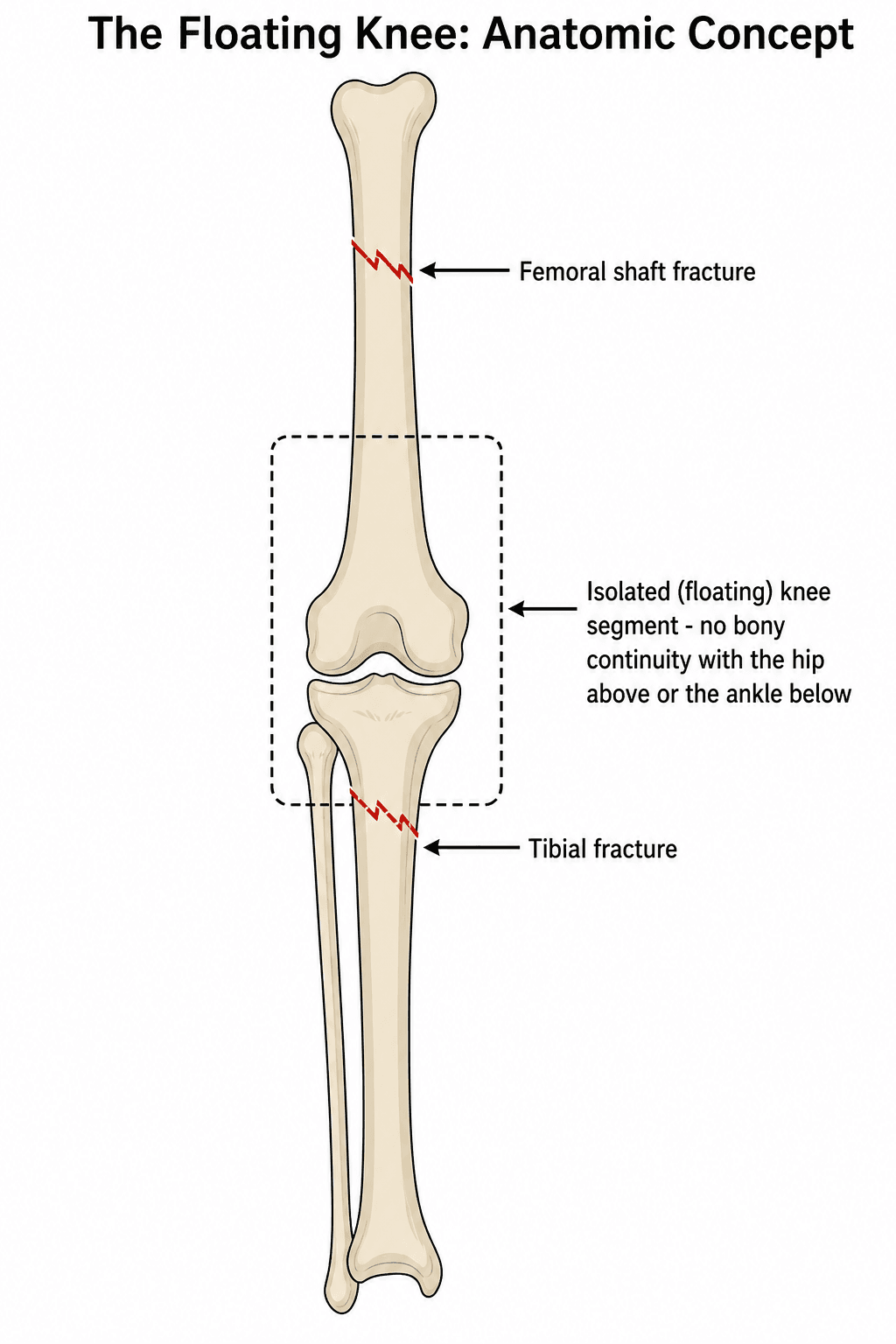
Floating knee injury describes ipsilateral fractures of the femur and tibia, creating an unstable knee segment that is disconnected from the axial skeleton. The term reflects the biomechanical reality that the knee "floats" free between two fracture sites.
Epidemiology
- Incidence: Accounts for 2-4% of lower extremity fractures
- Demographics: Male predominance (3:1), peak age 20-40 years
- Mechanism: High-energy trauma (MVA 70%, motorcycle 20%, pedestrian vs vehicle 5%)
- Polytrauma association: the large majority of patients have significant associated injuries; no source cited on this page gives a population figure, and the proportion depends entirely on the trauma system reporting it
- Mortality: 5-15% (usually from associated injuries)
- Open fracture rate: 30-40%
Associated Injuries
- Incidence
- 50-70%
- Clinical Significance
- Often missed initially, affects rehabilitation
- Incidence
- 5-10%
- Clinical Significance
- Limb-threatening, requires urgent assessment
- Incidence
- 10-20%
- Clinical Significance
- Both thigh and leg at risk
- Incidence
- 15-20%
- Clinical Significance
- Must image entire limb
- Incidence
- 40-60%
- Clinical Significance
- ATLS priorities
Anatomy and Biomechanics
Relevant Anatomy
- The knee joint and surrounding soft tissues become an unstable segment
- Disconnected superiorly by femur fracture and inferiorly by tibia fracture
- Popliteal vessels and nerves traverse this zone
- Popliteal artery: Fixed at adductor hiatus proximally and soleus arch distally
- Tethered position makes it vulnerable to traction injury
- Intimal tears may cause delayed thrombosis
- Quadriceps mechanism spans the femur fracture
- Gastrocnemius origin crosses the knee
- These contribute to deforming forces and stiffness
Biomechanical Considerations
- Femur: Proximal fragment abducted and flexed (iliopsoas, abductors)
- Tibia: Variable depending on fracture level
- Knee tends toward flexion contracture if not mobilized early
- Normal: Axial load through femur → knee → tibia
- Floating knee: Complete loss of axial stability
- Requires fixation of BOTH fractures for weight-bearing
Classification Systems
- Femur
- Shaft (Extra-articular)
- Tibia
- Shaft (Extra-articular)
- Prognosis
- Best (75-85% Excellent)
- Femur
- Shaft
- Tibia
- Articular (Plateau)
- Prognosis
- Moderate (60-70% Good)
- Femur
- Articular (Condyle)
- Tibia
- Shaft
- Prognosis
- Poor (55-65% Good)
- Femur
- Articular (Condyle)
- Tibia
- Articular (Plateau)
- Prognosis
- Worst (45-55% Good)
The Fraser system remains the most widely used classification, but it describes only the bony pattern and has limited prognostic power because it ignores soft-tissue and extensor-mechanism injury (see Controversies).
The Paediatric Floating Knee and the Letts Classification
The differential table and the Meccariello series both invoke a paediatric-specific system, because a child's floating knee is a genuinely different injury governed by the physis, remodelling potential and growth. Fraser (an adult, articular-versus-diaphyseal scheme) does not apply. The standard descriptive system is the Letts classification (Letts, Vincent and Gouw, 1986; sometimes cited in the literature as "Letts-Ran").
Letts classification (five types, in increasing severity):
- Type A — both fractures closed and diaphyseal
- Type B — one fracture open
- Type C — intra-articular (or physeal/epiphyseal) extension of one fracture
- Type D — an open fracture with associated intra-articular involvement
- Type E — both fractures open
Open patterns (Letts D and E) carry the worst prognosis, with type E (both fractures open) the most severe.
Why children differ:
- Physeal injury — the distal femoral and proximal tibial physes may be involved, risking growth arrest, progressive angular deformity and limb-length discrepancy; these must be tracked to skeletal maturity.
- Length changes in both directions — post-fracture overgrowth (physeal stimulation) and shortening (arrest or malunion) are both described, so serial length assessment is essential.
- Remodelling potential allows more diaphyseal fractures to be managed non-operatively than in adults, but Letts' original series showed poor results when BOTH fractures were treated non-operatively — so at least one fracture should be rigidly stabilised.
- Implant choice favours flexible intramedullary (elastic stable) nailing and physeal-sparing fixation over the rigid reamed antegrade nails used in adults, to protect the open physis.
Contemporary paediatric outcome data (Tontanahal et al., 2023) show that a high Injury Severity Score and bone loss greater than 4 cm — not age, open status or comminution alone — are the strongest predictors of poorer sports and transfer/mobility function.
In the skeletally immature floating knee, classify with the Letts system (type A closed diaphyseal through type E both open), not Fraser. The examiner's hooks are the physis (growth arrest, angular deformity, length discrepancy needing follow-up to maturity), the preference for flexible/physeal-sparing fixation, and the rule from Letts' original series that non-operative treatment of BOTH fractures does badly — stabilise at least one.
Clinical Context: Definitive management of the individual paediatric femoral or tibial fracture and Salter-Harris physeal-injury grading are developed in the dedicated paediatric fracture and growth-plate topics; this section covers only the floating-knee-specific principles.
Clinical Assessment
Initial Trauma Evaluation
- High-energy polytrauma focus
- Associated injuries in 80% (Head, Chest, Abdo)
- Hemodynamic stability assessment first
- Obvious deformity and length discrepancy
- Skin integrity (open fractures common)
- Compartment Monitoring: Both thigh (3 compartments) and leg (4 compartments)
- Vascular Exam: Popliteal, DP, PT pulses; ABI if suspicious
- Neurological Exam: Peroneal nerve (most vulnerable)
Assessment of the "floating" segment is secondary to life-saving measures.
Investigations
Radiographic Series
- Full-length femur (AP/Lateral)
- Full-length tibia (AP/Lateral)
- AP Pelvis (check for associated hip fractures)
- Dedicated Knee Series (AP/Lateral/Oblique)
- Identify fracture location (diaphyseal vs articular)
- Assess for comminution
- Check joint congruity
A true lateral of the knee is essential to rule out occult subluxation.
Differential Diagnosis and Mimics
The diagnosis of a floating knee is radiographic (ipsilateral femur AND tibia fracture), so the real "differential" is recognising which adjacent injury patterns can masquerade as, accompany, or be mistaken for it. The table below contrasts the floating knee with the patterns it is most often confused with on initial trauma imaging.
- Distinguishing feature
- Fracture of BOTH ipsilateral femur and tibia
- Why it matters
- Knee segment isolated from axial skeleton
- Key action
- Stabilise both bones
- Distinguishing feature
- Intact tibia on full-length film
- Why it matters
- Knee not isolated; standard nailing
- Key action
- Image whole limb to exclude second fracture
- Distinguishing feature
- Pelvic/acetabular fracture, not tibia
- Why it matters
- Different proximal segment isolated
- Key action
- AP pelvis and CT pelvis
- Distinguishing feature
- Tibiofemoral malalignment, multiligament injury
- Why it matters
- High popliteal artery injury risk even without shaft fracture
- Key action
- Reduce, document pulses, ABI/CT angiogram
- Distinguishing feature
- Physeal involvement, remodelling potential
- Why it matters
- Different classification and growth implications
- Key action
- Use paediatric system; assess physes
- Distinguishing feature
- Both articular but no diaphyseal break
- Why it matters
- Behaves like Fraser IIC for the joint
- Key action
- Anatomic ORIF of both articular surfaces
The single commonest error is under-imaging: an obvious femoral shaft fracture distracts from a subtle proximal tibial or plateau fracture. Always obtain full-length femur AND tibia films plus dedicated knee views before excluding a floating knee.
Management Algorithm
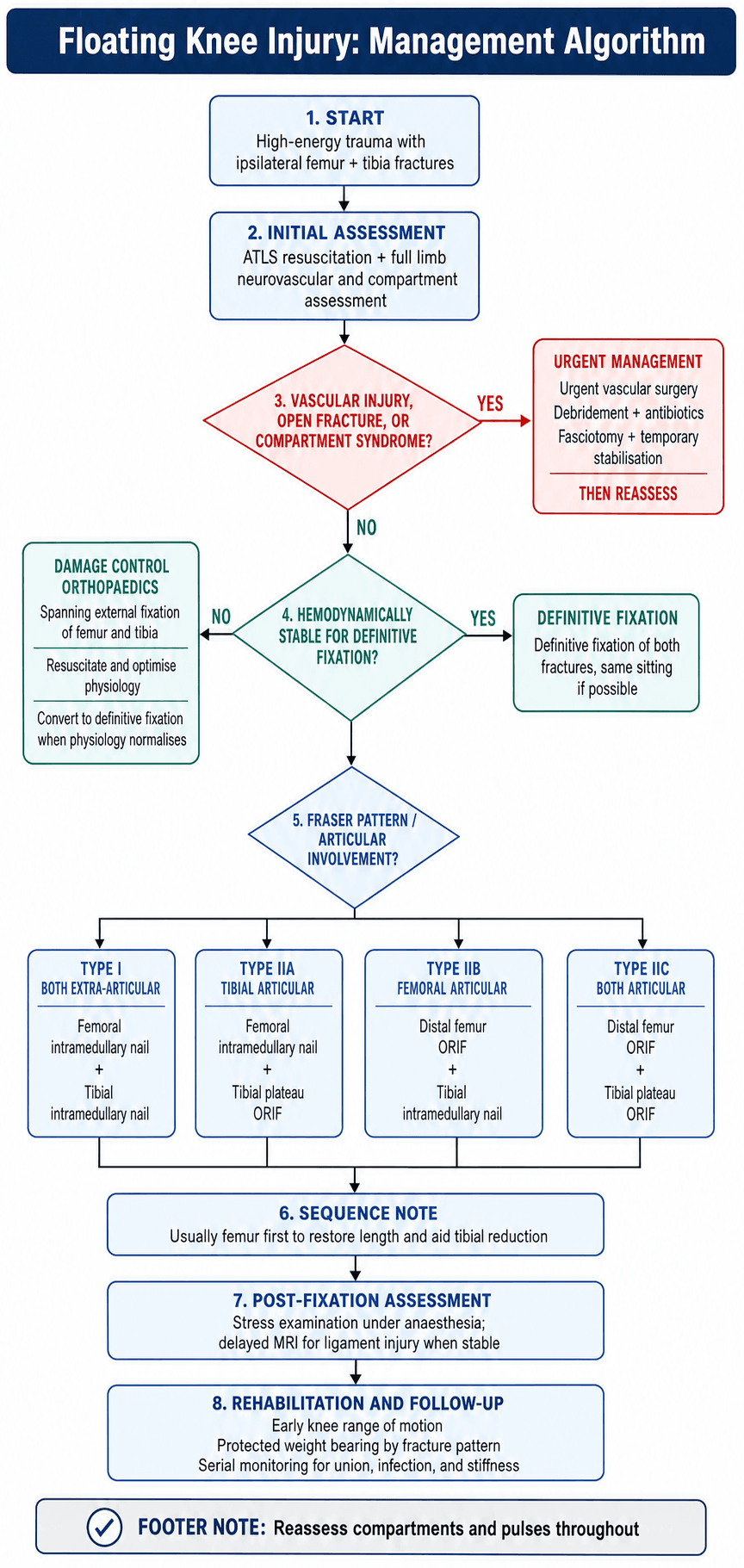
Algorithm should be interpreted in context of overall trauma status.
More than 50% of floating knee injuries have associated knee ligament damage, but this is often occult initially due to swelling and pain. Always assess the knee once fractures are stabilised and obtain MRI when appropriate.
Clinical Context: Ligamentous injury significantly affects rehabilitation and outcomes.
Damage Control vs Definitive
- Spanning external fixation of both femur and tibia
- Temporary stabilisation to allow resuscitation
- Definitive fixation once physiological parameters normalise
- Address both fractures at same sitting if possible
- Reduces hospital stay and allows early motion
- Fraser Type I: Double IM nailing (Antegrade femur + Tibia)
- Fraser Type IIA: Femur nailing + Tibial plateau ORIF
- Fraser Type IIB: Distal femur ORIF + Tibial nailing
- Fraser Type IIC: Dual ORIF (Distal femur + Tibial plateau)
Fixation strategy must be tailored to specific fracture patterns.
Sequence of Fixation
Most surgeons prefer femur first:
- Restores limb length and gross alignment
- Facilitates subsequent tibial reduction
- More ergonomic patient positioning
Tibial fixation follows immediately to finalize the construct stability.
Surgical Technique
Femoral Techniques
- Entry: Piriformis or greater trochanteric
- Reamed nailing preferred for stability
- Interlocking screws to control rotation
- Lateral parapatellar approach
- Anatomic articular reduction first
- Locking plate or retrograde nail depending on complexity
Bone quality and comminution dictate the final implant choice.
Complications
Early Complications
- Affects both thigh AND leg compartments
- Thigh contains 3 compartments (Often overlooked)
- Maintain high index of suspicion with serial evaluations
- Threshold for prophylactic fasciotomy should be low
- Popliteal artery most at risk due to tethered anatomy
- May present delayed due to intimal injury
- Requires immediate revascularization if diagnosed
- Limb viability window: 6-8 hours warm ischemia
- Higher rates than isolated fractures (10-15%)
- Open fractures require debridement and antibiotics per Gustilo protocol
- External fixation pin site infections
Late Complications
- Most common long-term problem
- Due to periarticular scarring and quadriceps adhesions
- Prevention: Early ROM, avoid prolonged immobilization
- Treatment: Aggressive physiotherapy, consider manipulation under anesthesia
- Both fracture sites at risk
- Smoking, diabetes, and infection increase risk
- May require revision fixation or bone grafting
- Particularly prevalent in Fraser Type II injuries
- Articular damage + ligament instability contribute
- May require total knee arthroplasty in the long term
Postoperative Care
Immediate Postoperative
- DVT prophylaxis (LMWH)
- Pain management (multimodal analgesia)
- Neurovascular monitoring
- Wound inspection
- CPM or active-assisted ROM from day 1 if stable fixation
- Quadriceps setting exercises
- Ankle pumps
Weight-Bearing Protocol
- Weight-Bearing Status
- Touch weight-bearing → progressive
- Duration
- 6-12 weeks
- Weight-Bearing Status
- Non-weight-bearing → partial
- Duration
- 8-12 weeks
- Weight-Bearing Status
- Non-weight-bearing
- Duration
- Until definitive fixation
Rehabilitation Phases
- ROM exercises (goal: 0-90° knee flexion)
- Quadriceps strengthening (isometric initially)
- Gait training with assistive devices
- Progressive weight-bearing
- Active ROM to full
- Closed chain exercises
- Aquatic therapy if available
- Full weight-bearing
- Functional training
- Return to activity assessment
- Address remaining ligamentous instability
Outcomes
Functional Recovery
- No source cited on this page reports a return-to-work rate. Kenmegne's series is the closest usable outcome: excellent to good in 61%, acceptable in 6% and fair to poor in 33% by Karlstrom-Olerud at a mean of 51 months
- Meccariello's cohort required an average of six operations, and in some cases as many as 23 - the number patients most need to hear
- Manual laborers typically have worse outcomes
- Knee Society Score
- WOMAC
- SF-36
Type II injuries (articular) carry a significantly higher burden of post-traumatic OA.
Reporting Outcome: the Karlström-Olerud Score
Almost every floating knee series in this topic — including the Hegazy cohort and the contemporary Kenmegne series — reports results as "excellent / good / acceptable / fair / poor," but the underlying instrument is rarely named. That instrument is the Karlström-Olerud functional grading, described by Karlström and Olerud in their original 1977 ipsilateral femur-and-tibia series (the same paper that first showed rigid fixation of both bones gives fewer complications, shorter hospital stay and better return to work).
the score combines patient-reported symptoms and objective limb findings across several domains — pain/symptoms in the thigh and leg, symptoms in the knee and ankle joints, walking ability, ability to return to work or normal activity, angular or rotational deformity, limb shortening, and restriction of knee and ankle motion.
each domain is graded, and the overall category is conventionally set by the least favourable domain, so a single poorly-recovered parameter (for example a stiff knee or a residual malalignment) pulls the whole result down. This makes Karlström-Olerud a deliberately demanding, patient-relevant measure and explains why even technically united floating knees often score only "acceptable" or "fair."
because it captures the knee joint and the whole limb together, it suits an injury that isolates the knee between two fractures — which is why it, rather than a generic hip or knee score, remains the reporting standard in this literature.
If a viva quotes "60% good-to-excellent" after a floating knee, be ready to state that the tool is usually the Karlström-Olerud grade (Karlström and Olerud, 1977) — a composite of thigh/leg symptoms, knee and ankle symptoms, walking, work, deformity, shortening and joint motion, graded by the WORST domain. Generic joint scores (Knee Society Score, WOMAC, KOOS, SF-36) are reported alongside it but were not designed for this two-fracture pattern.
Clinical Context: Newer prognostic schemes (Meccariello, 2024) argue that soft-tissue and extensor-mechanism damage predict these functional scores better than the bony Fraser type does.
Guidelines, Registries & Global Practice
Global Epidemiology
- The floating knee is uncommon, accounting for roughly 2-4% of lower-limb trauma; a contemporary single-centre series reported an incidence of 2.32% of all lower-limb injuries.
- Road traffic and motorcycle trauma dominate the mechanism worldwide; the burden is disproportionately high in low- and middle-income countries with rising motorisation and a young, male-predominant cohort.
- Outcomes are governed less by geography than by soft-tissue status and associated injuries, which are consistent across published series.
Side-by-Side Guideline Framework
- Relevant guidance
- Principles of fracture management; damage control vs early total care
- Practical emphasis
- Choice of IM nail vs articular ORIF by fracture pattern
- Relevant guidance
- Open fracture and severe lower-limb injury standards
- Practical emphasis
- Combined ortho-plastic care, early debridement, soft-tissue cover timing
- Relevant guidance
- Evidence-based polytrauma and femoral shaft guidance
- Practical emphasis
- Timely IM nailing in the physiologically stable patient
- Relevant guidance
- Polytrauma management and timing of fixation
- Practical emphasis
- Physiology-driven (borderline patient) decision-making
Where these differ, the divergence is mainly on timing (early total care versus damage control) and is reconciled by patient physiology rather than by national preference.
Registry and Trauma-System Notes
- National joint replacement registries (NJR, AJRR, AOANJRR, SHAR, NZJR) capture the downstream burden of post-traumatic arthritis requiring arthroplasty after Fraser type II injuries, but no registry tracks the acute floating knee itself.
- Mature trauma systems with rapid pre-hospital retrieval and Level 1 centres favour single-stage early total care in stable patients; the EPOFF biological data underpin damage control where physiology is borderline.
High- vs Limited-Resource Practice Variation
- High-resource settings: combined ortho-plastic teams, CT angiography on demand, IM nailing of both bones in one sitting, and early MRI of the knee.
- Limited-resource settings: greater reliance on external fixation (limited implants, contaminated open injuries, delayed presentation), staged conversion, and clinical rather than imaging-based vascular assessment. The principle of stabilising both bones to permit early knee motion remains universal.
Controversies and Areas of Uncertainty
- Is Fraser still fit for purpose? Fraser describes only the bony pattern. A 2024 multicentre study of 168 floating knees found Fraser severity did not reliably predict function, whereas soft-tissue and extensor-mechanism damage did, and proposed a new prognostic system. Fraser remains the lingua franca for exams and communication, but is increasingly seen as prognostically weak.
- Early total care vs damage control. Single-stage fixation in the stable patient is well supported, but the threshold for damage control in the "borderline" physiology patient is debated. The EPOFF biological data favour temporising external fixation in borderline patients, while some high-performing trauma centres report good results with early total care in carefully selected borderline cases.
- Femur-first vs tibia-first. Femur-first (length and alignment) is the common teaching, but no high-level evidence proves superiority; some surgeons fix the simpler or more accessible fracture first, or fix the tibia first to allow knee extension for femoral nailing.
- Routine MRI of the knee. Occult ligament and meniscal injuries are common (and may dominate long-term disability), but the optimal timing and whether routine MRI changes management in the acute setting is unresolved; many units image selectively once the knee can be examined.
- How "best" is the best subtype? Even Fraser type I (both extra-articular) carries large isokinetic strength deficits and unsatisfactory function in some series, challenging the assumption that extra-articular equals good outcome.
MCQ Practice Points
Q: What is a floating knee injury and what is the Fraser classification?
A: Floating knee: Ipsilateral fractures of the femur and tibia, isolating the knee segment. Fraser classification: Type I: Diaphyseal fractures of both bones (extra-articular). Type IIa: Tibial plateau involvement (intra-articular tibia). Type IIb: Distal femur involvement (intra-articular femur). Type IIc: Both articular surfaces involved. Type II injuries have worse prognosis due to knee joint involvement.
Q: What are the associated injuries to evaluate in floating knee?
A: Vascular injury: Popliteal artery (high risk) - check pulses, ABI, consider CT angiography. Knee ligamentous injury: Up to 50% have ligament damage; Assess after skeletal stabilization. Compartment syndrome: High index of suspicion for both thigh and leg. Soft tissue injury: Open fractures common (30-40%). Systemic trauma: Polytrauma evaluation (head, chest, abdomen) due to high-energy mechanism.
Q: What is the surgical treatment strategy for floating knee injuries?
A: Damage control: Temporizing external fixation if hemodynamically unstable. Definitive fixation: Both fractures fixed when patient optimized. Femur first: Usually IMN for diaphyseal fractures. Tibia: IMN for shaft; Plates for plateau. Same-day fixation of both fractures preferred to allow early knee mobilization. Early motion critical to prevent knee stiffness.
Q: What are the outcomes and complications specific to floating knee injuries?
A: Knee stiffness: Most common complication (20-50%). Malunion/nonunion: Both fracture sites at risk. Infection: Higher rates with open fractures. Vascular injury: Limb-threatening emergency. Long-term outcomes: Return to work only 60-70%. Knee arthrosis: Common in Type II injuries affecting articular surfaces.
Q: When should external fixation be used for floating knee injuries?
A: Indications for temporary external fixation: Damage control orthopaedics - polytrauma, hemodynamic instability; Open fractures with severe contamination awaiting soft tissue healing; Vascular injury requiring restoration of length before vascular repair; Compartment syndrome - provides stability during fasciotomy management; Severe soft tissue swelling precluding safe internal fixation. Conversion to definitive fixation typically within 7-14 days when soft tissue and systemic conditions permit.
At a Glance
Floating knee injury describes ipsilateral femur and tibia fractures creating an unstable knee segment disconnected from the axial skeleton. It results from high-energy trauma (MVA, motorcycle accidents) with associated injuries in the large majority of patients. The Fraser classification is descriptive and orders severity: Type I (both extra-articular), Type IIA (tibial articular), Type IIB (femoral articular), Type IIC (both articular, worst). Read "Type I has the best prognosis" as a relative statement only - Andrade-Silva's type I patients, treated with internal fixation of both bones, still had unsatisfactory Karlstrom and Lysholm scores, a 61% peak-torque deficit in the knee extensors, four nonunions and two chronic osteomyelitides, and Chouhan found that even Fraser IIA scored significantly worse than matched controls for daily activities, sport and quality of life. No subtype returns to normal. Management involves stabilization of both fractures, typically with intramedullary nailing if extra-articular. Critical associated injuries include ligamentous knee injury (common and often missed initially), vascular injury requiring angiography, and compartment syndrome in both thigh and leg.
I-ABCFraser Classification
Hook:I-ABC: I for extra-articular (Individual bones), ABC for articular (A=tibia, B=femur, C=Combined)
CLVNFloating Knee Assessment
Hook:CLVN: Check Limbs, Vessels, Nerves for compartment and vascular safety
F-T-SManagement Sequence
Hook:F-T-S: Femur restores length, Tibia follows, Same sitting for efficiency
Clinical Decision Scenarios
Practise clinical reasoning and management decisions out loud
“A 28-year-old motorcyclist is brought to ED after a high-speed collision. He has obvious deformity of his left thigh and leg. X-rays show a mid-shaft femur fracture and a proximal tibial shaft fracture. He is haemodynamically stable. How do you manage this?”
“A 35-year-old construction worker falls 4 meters from scaffolding landing on his left leg. X-rays show a comminuted distal femur fracture and a bicondylar tibial plateau fracture (Schatzker VI pattern). How would you approach this challenging injury?”
“A 42-year-old presents following a motor vehicle accident with a floating knee injury. His left leg is pale and cool with absent pulses. CT angiography confirms popliteal artery transection. How do you manage this?”
Fraser Classification
- Type I: Both shafts (extra-articular) - best of the four, though still substantial residual disability
- Type IIA: Tibia articular (plateau)
- Type IIB: Femur articular (distal femur)
- Type IIC: Both articular - worst prognosis
Key Assessment
- High-energy polytrauma focus
- Knee ligament injury in 50%+
- Compartment syndrome - thigh AND leg
- Popliteal artery at risk
Fixation Order
- Femur first (restores length/alignment)
- IM nailing preferred for shafts
- Anatomic reduction for articular components
- Damage control if unstable
Complications
- Knee stiffness (most common)
- Ligament instability (often occult)
- Compartment syndrome
- Infection/Nonunion
Evidence Base
Original Fraser Classification (foundational)
- Original description of the floating knee and its type I / type II classification
- Type II (articular) injuries had significantly worse outcomes than type I
- Knee stiffness was the most common complication
- Early mobilisation improved functional results
Ipsilateral Fractures of the Femur and Tibia (57 cases)
- 57 consecutive ipsilateral femur/tibia fractures; 33 limbs were open and 21 patients had life-threatening injuries
- Best results when BOTH fractures were stabilised surgically
- Good or excellent functional result in approximately 80%; mean knee arc 129 degrees
- Complications: 3 deep infections, 4 nonunions, 1 below-knee amputation; fat embolism syndrome in 13%
Surgical Management of the Adult Floating Knee
- 15 adults (Fraser I-IIc) treated by fixation of both fractures; mean follow-up 2.2 years
- Karlstrom outcome: excellent 8, good 4, acceptable 2, poor 1
- Associated injuries and fracture type (open, intra-articular, comminution) were the key prognostic factors
- Intramedullary nailing of both bones plus early rehabilitation gave the best results
Fraser Type I Floating Knee: Function and Occult Ligament Injury
- 21 Fraser type I (both diaphyseal) patients after internal fixation of both bones
- Even this 'best' subtype had unsatisfactory function: large isokinetic deficits (61% knee extensor, 37% flexor peak-torque)
- MRI revealed occult ligament/meniscal injury: 3 partial ACL, 1 PCL, 3 meniscal tears
- Four nonunions and two cases of chronic osteomyelitis at follow-up
References
- Fraser RD, Hunter GA, Waddell JP. Ipsilateral fracture of the femur and tibia. J Bone Joint Surg Br. 1978;60-B(4):510-515.
- Veith RG, Winquist RA, Hansen ST Jr. Ipsilateral fractures of the femur and tibia. J Bone Joint Surg Am. 1984;66(7):991-1002. PMID 6480657.
- Hegazy AM. Surgical management of ipsilateral fracture of the femur and tibia in adults (the floating knee). Clin Orthop Surg. 2011;3(2):133-139. PMID 21629474.
- Andrade-Silva FB, et al. Functional results and isokinetic muscle strength in Fraser type I floating knee. Injury. 2017;48 Suppl 4:S2-S5. PMID 29145963.
- Kenmegne GR, et al. The current issues and challenges in the management of floating knee injury. Front Surg. 2023;10:1164032. PMID 37206352.
- Pape HC, et al. (EPOFF Study Group). Impact of intramedullary instrumentation versus damage control for femoral fractures on immunoinflammatory parameters. J Trauma. 2003;55(1):7-13. PMID 12855874.
- Chouhan D, et al. Comparison of functional outcomes among subtypes of Fraser's type II floating knee. Chin J Traumatol. 2020;24(1):25-29. PMID 33339679.
- Meccariello L, et al. Floating knee: a new prognostic classification. Injury. 2024;55 Suppl 4:111471. PMID 39542575.