ASIA Impairment Scale (Frankel Scale)
- Not testing sacral sparing first. S4-S5 sensation (pinprick/light touch) and voluntary anal contraction decide complete (A) vs incomplete (B+) — test them before anything else; missing them mis-grades the whole injury.
- Declaring AIS A during spinal shock. All reflexes are absent in spinal shock and the injury can look falsely complete — wait for the bulbocavernosus reflex to return before confirming a complete injury.
- Counting from the wrong level. The C-vs-D muscle count is of key muscles below the NEUROLOGICAL level, not the bony injury level.
- Muddling C and D. C = fewer than half of key muscles below the level reach grade 3; D = at least half reach grade 3+.
- Forgetting B is sensory-only. AIS B has sacral sensation but no motor below the level — any motor below the level makes it C/D.
- ZPP confusion. The zone of partial preservation is documented only for complete (AIS A) injuries.
The ASIA Impairment Scale — grades A to E
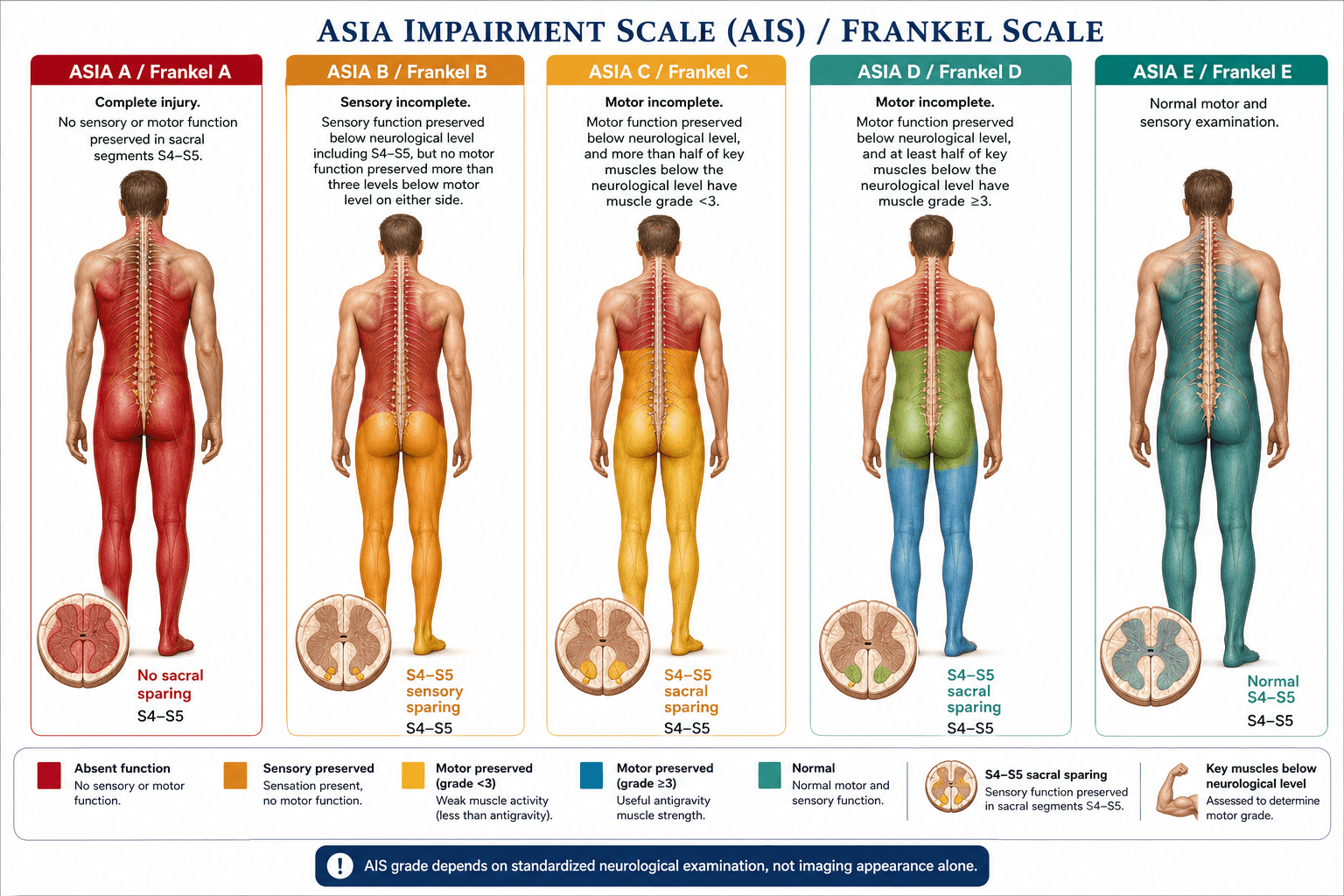
- Category
- Complete
- Definition
- No motor or sensory function preserved in sacral segments S4-S5
- Key discriminator
- No sacral sparing at all
- Category
- Sensory incomplete
- Definition
- Sensory but not motor function preserved below the neurological level, including S4-S5
- Key discriminator
- Sacral sensation present, no motor below the level
- Category
- Motor incomplete
- Definition
- Motor function preserved below the level AND more than half of key muscles below the level grade under 3
- Key discriminator
- Motor incomplete; fewer than half of key muscles reach grade 3
- Category
- Motor incomplete
- Definition
- Motor function preserved below the level AND at least half of key muscles below the level grade 3 or more
- Key discriminator
- At least half of key muscles reach grade 3 or better
- Category
- Normal
- Definition
- Motor and sensory function normal (in a patient with prior deficits)
- Key discriminator
- All myotomes 5/5, all dermatomes intact
A-B-C-D-EAB-CDE: the five grades
Hook:A Absent, B Below-sensory-only, C Crummy motor (under half ≥3), D Decent motor (at least half ≥3), E Excellent (normal).
The single most important step in the ASIA exam is testing sacral sensation (S4-S5 pinprick/light touch) and voluntary anal contraction first. If either is preserved, the injury is automatically incomplete (AIS B or better) — a finding that changes prognosis dramatically. Absent both = complete (AIS A).
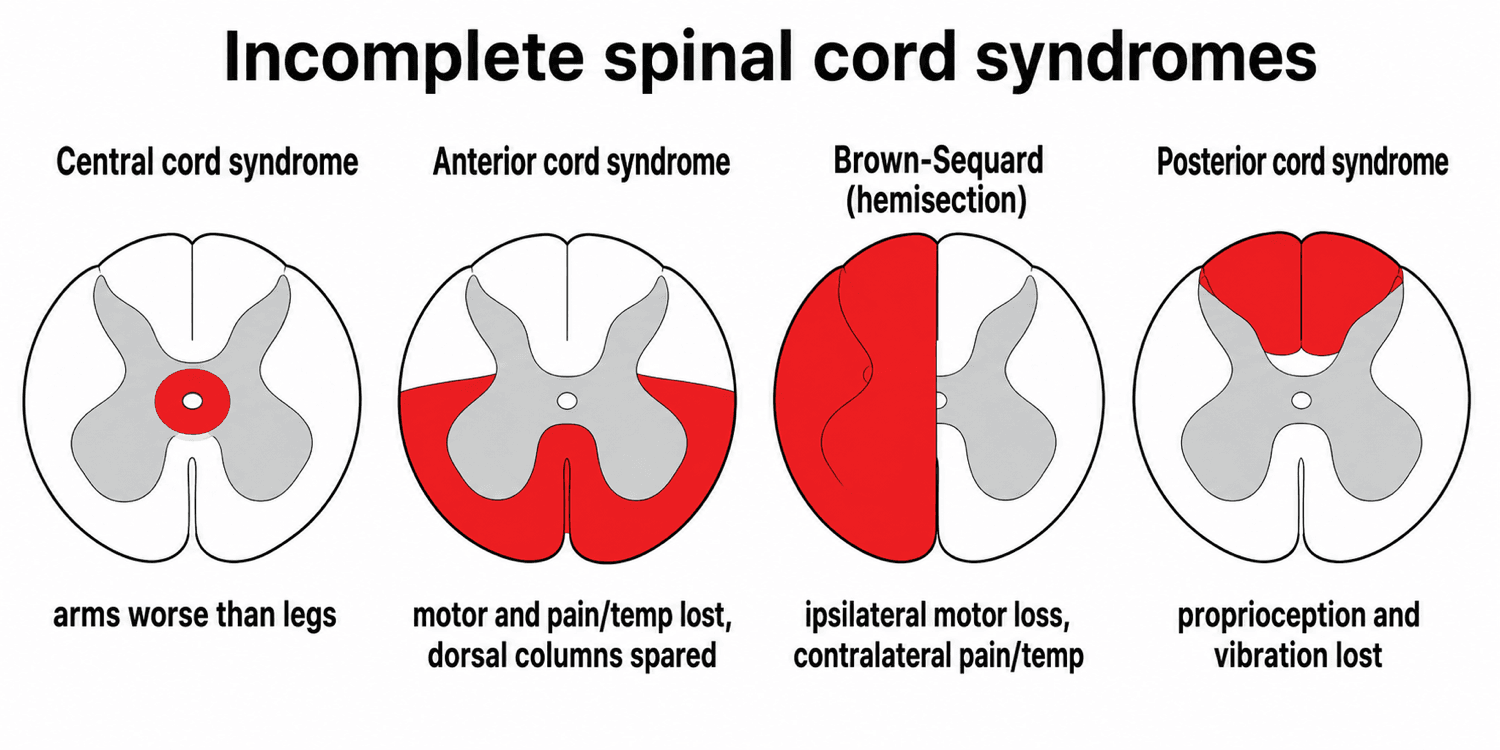
The AIS grades completeness; it does not describe the clinical pattern of an incomplete injury — and the examiner will ask you to recognise the classic syndromes, each with a distinctive deficit and prognosis:
- Central cord syndrome — the commonest incomplete SCI. Typically an older patient with cervical spondylosis who sustains a hyperextension injury (often without fracture), or a younger high-energy injury. Upper limbs are affected more than lower limbs (distal upper-limb/hand weakness worst), with variable sensory loss and bladder dysfunction. Generally a favourable recovery (lower limbs and bladder return before intrinsic hand function). Mechanism: central cord damage where the medially-situated upper-limb corticospinal fibres lie.
- Anterior cord syndrome — anterior two-thirds of the cord (anterior spinal artery territory). Motor (corticospinal) and pain/temperature (spinothalamic) lost below the level, with preserved proprioception, vibration and light touch (dorsal columns). The worst prognosis of the incomplete syndromes.
- Brown-Séquard (cord hemisection) — ipsilateral motor (corticospinal) and dorsal-column (proprioception/vibration) loss, with contralateral pain/temperature loss (spinothalamic decussates) a few levels below. Often penetrating trauma. The best prognosis of the incomplete syndromes — most regain ambulation and bowel/bladder control.
- Posterior cord syndrome — rare; isolated dorsal-column loss (proprioception/vibration) with preserved motor and pain/temperature, producing a sensory ataxia.
- Conus medullaris vs cauda equina — the conus (cord termination, ~T12-L1) gives a mixed UMN + LMN picture with early, symmetric bowel/bladder and sexual dysfunction and saddle anaesthesia; the cauda equina (nerve roots below the conus) is a pure LMN, areflexic, asymmetric lesion with radicular leg pain, saddle anaesthesia and later/variable sphincter involvement — a surgical emergency.
Key muscle groups (myotomes) & motor scoring
The ASIA standard motor examination tests 10 key muscle groups bilaterally, each scored 0–5 on the MRC scale (total motor score 100; 50 per side).
- Muscle
- Elbow flexors (biceps)
- Action tested
- Flex elbow against gravity and resistance
- MRC 0–5
- 0 nil → 5 normal
- Muscle
- Wrist extensors (ECRL/ECRB)
- Action tested
- Extend wrist
- MRC 0–5
- 0 nil → 5 normal
- Muscle
- Elbow extensors (triceps)
- Action tested
- Extend elbow
- MRC 0–5
- 0 nil → 5 normal
- Muscle
- Finger flexors (FDP, middle finger)
- Action tested
- Flex middle finger DIPJ
- MRC 0–5
- 0 nil → 5 normal
- Muscle
- Small finger abductors (ADM)
- Action tested
- Abduct little finger
- MRC 0–5
- 0 nil → 5 normal
- Muscle
- Hip flexors (iliopsoas)
- Action tested
- Flex hip
- MRC 0–5
- 0 nil → 5 normal
- Muscle
- Knee extensors (quadriceps)
- Action tested
- Extend knee
- MRC 0–5
- 0 nil → 5 normal
- Muscle
- Ankle dorsiflexors (tibialis anterior)
- Action tested
- Dorsiflex ankle
- MRC 0–5
- 0 nil → 5 normal
- Muscle
- Long toe extensors (EHL)
- Action tested
- Extend the great toe
- MRC 0–5
- 0 nil → 5 normal
- Muscle
- Ankle plantar flexors (gastrocsoleus)
- Action tested
- Plantarflex ankle
- MRC 0–5
- 0 nil → 5 normal
C5–T1, L2–S1The 10 key myotomes, top to bottom
Hook:Five upper-limb (C5→T1) then five lower-limb (L2→S1), tested both sides, each 0–5. Don't skip L4 (ankle dorsiflexion).
Sensory examination & dermatomes
Each of 28 key sensory points is tested bilaterally for pinprick (sharp/dull) and light touch (cotton wisp), scored 0 (absent), 1 (impaired) or 2 (normal). Total sensory score 112 (56 per side, pinprick and light touch combined).
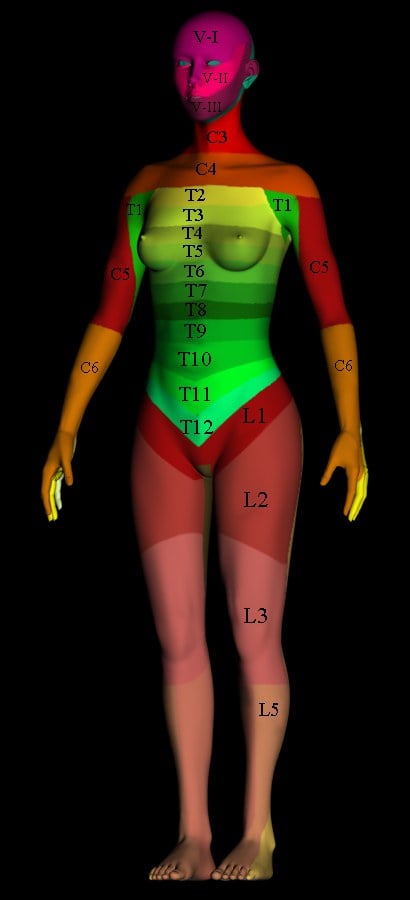
- The S4-S5 dermatome must be tested explicitly — it determines sacral sparing and therefore complete vs incomplete status.
- Anal sensation is recorded separately but contributes to the sacral-sparing assessment.
- The neurological level is the most caudal segment with normal sensation (grade 2) AND antigravity strength (grade 3 or more) on both sides.
Zone of partial preservation & key terminology
- Definition
- Most caudal segment with normal sensation AND motor grade 3 or more on both sides
- Clinical relevance
- May differ left vs right; record the most rostral
- Definition
- Dermatomes/myotomes below the neurological level that remain partially innervated (COMPLETE injuries only)
- Clinical relevance
- Recorded for AIS A; gives prognostic information on potential recovery
- Definition
- Any preserved sensation (pinprick or light touch) at S4-S5 OR voluntary anal contraction
- Clinical relevance
- Present = incomplete; absent = complete — the fundamental discriminator
- Definition
- No sacral sparing; AIS grade A
- Clinical relevance
- ZPP documented; worst prognosis
- Definition
- Sacral sparing present; AIS grade B, C or D
- Clinical relevance
- Potential for further recovery; outcome depends on the 72-hour AIS grade
The ASIA exam should be interpreted after spinal shock has resolved (return of the bulbocavernosus reflex). During spinal shock all reflexes are absent and the injury may falsely appear complete. Serial examinations over the first 48–72 hours are essential — an initial AIS A that converts to an incomplete grade has a fundamentally different prognosis.
The two "shocks" are constantly confused and constantly examined — they are completely different things:
- Spinal shock is a neurological phenomenon — transient loss of all cord function and reflexes (flaccid areflexia, absent bulbocavernosus reflex) below the level immediately after injury, resolving over days to weeks. The bulbocavernosus reflex (S2-S4) is the first to return and marks its end; only then can a complete injury be confirmed.
- Neurogenic shock is a haemodynamic/distributive shock from loss of sympathetic outflow in injuries above ~T6 → hypotension WITH bradycardia (and warm, vasodilated peripheries) — distinct from haemorrhagic shock (which gives tachycardia). Treat with fluids, vasopressors/inotropes, and atropine for symptomatic bradycardia.
AANS/CNS guidance recommends maintaining MAP ~85–90 mmHg for about 5–7 days and avoiding hypotension (systolic under 90 mmHg) to optimise spinal-cord perfusion — alongside early (under 24 h) decompression.
high-dose methylprednisolone is no longer routinely recommended — the NASCIS II/III benefits were marginal/post-hoc and outweighed by complications (pneumonia, sepsis, GI bleeding); current AANS/CNS guidance does not endorse it as a standard of care.
in injuries at or above ~T6, a noxious stimulus below the level (a distended bladder, constipation, pressure sore) triggers a massive sympathetic discharge → severe paroxysmal hypertension, pounding headache, flushing and sweating above the level, with reflex bradycardia. It is an emergency (stroke/seizure risk): sit the patient upright, loosen constrictions, find and remove the trigger (relieve the bladder/disimpact the bowel) and give a short-acting antihypertensive (e.g. GTN, nifedipine) if the blood pressure persists.
Prognostic significance
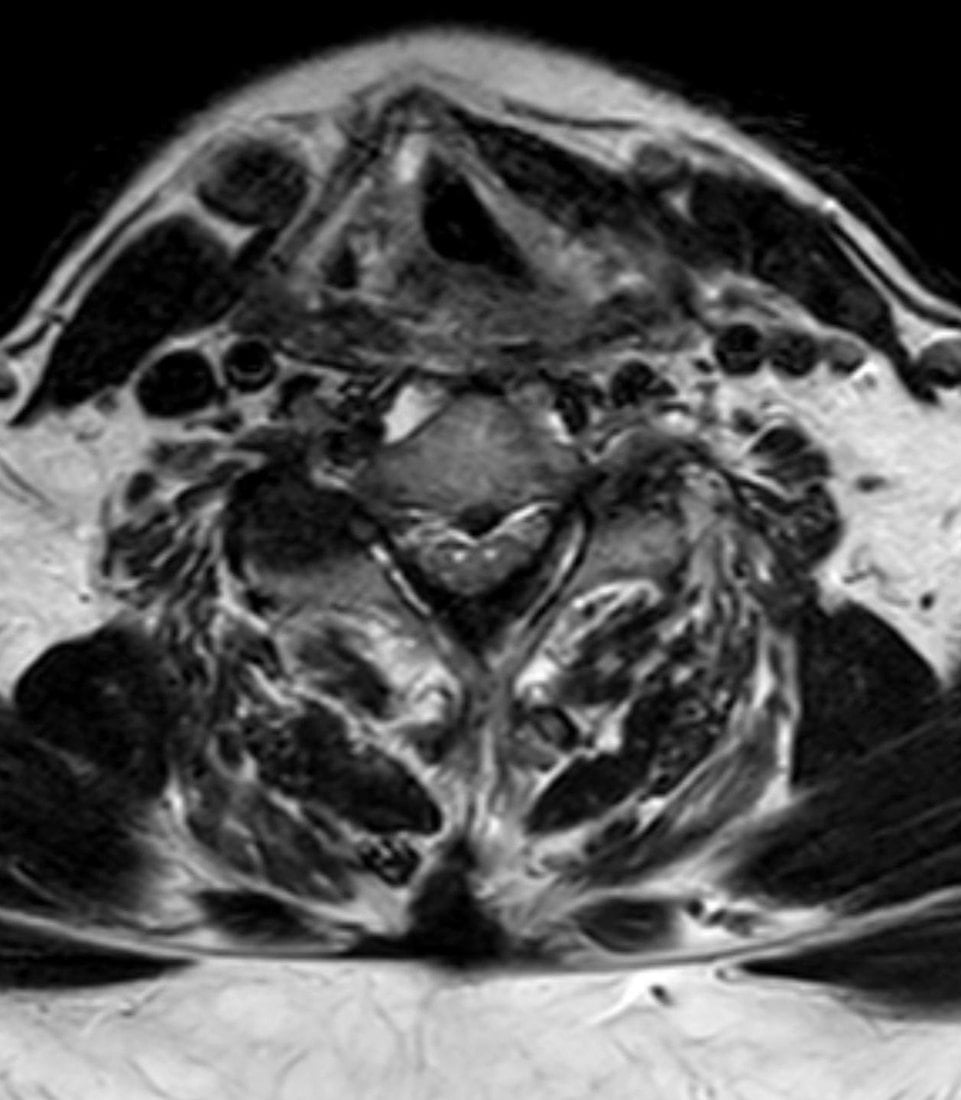
- The AIS grade at 72 hours is the strongest early predictor of outcome. AIS A at 72 hours carries a low probability of functional ambulation; AIS C–D carry a meaningful chance of walking.
- Conversion from AIS A to incomplete occurs in a minority; even limited distal recovery can be functionally significant (e.g. regaining C7 wrist extension enables a tenodesis grip).
- AIS B with sacral PINPRICK preservation (not just light touch) carries a better motor-recovery prognosis than light touch alone.
- AIS D patients are most likely to achieve community ambulation; the lower-limb motor score predicts walking ability.
- Lower cervical injuries (C5–C7) have better functional outcomes than higher cervical levels at the same AIS grade, because preserved proximal upper-limb function enables self-care.
Guidelines, registries & global practice
- Key recommendation on AIS
- Use the AIS (A–E) as the standard classification at admission and 72 hours
- Notes
- Adopted worldwide; free training modules online
- Key recommendation on AIS
- Document the ASIA grade at presentation and at 72 hours; refer to a specialist SCI centre
- Notes
- UK pathway; the classification principle is universal
- Key recommendation on AIS
- Early MRI; AIS grade guides prognosis; decompression within 24 h for SCI
- Notes
- STASCIS-informed; supports early surgery
- Key recommendation on AIS
- Adopted ASIA/ISNCSCI; recommends uniform documentation across sites
- Notes
- Multicentre studies use the AIS as the primary outcome
- Global epidemiology: traumatic SCI incidence is roughly 10–80 per million per year by region; falls (now the leading cause in many high-income countries, overtaking road traffic) and road traffic crashes dominate, with young adult males the peak group.
- Registry evidence: the NSCISC (US), Rick Hansen SCI Registry (Canada) and Australasian networks collect AIS-grade data and consistently confirm the 72-hour AIS grade as the dominant predictor of functional independence.
- Resource variation: the AIS exam needs only a pin and a cotton wisp, making it feasible anywhere — examiners expect you to perform it with minimal equipment even where MRI and urgent decompression are limited.
Viva practice
Exam viva
Practise clinical reasoning and management decisions out loud
“A 28-year-old man is brought to the emergency department after diving into shallow water. He cannot move his arms or legs. On examination, he has no sensation or voluntary movement below the clavicles. Pinprick at the perianal region is absent and he has no voluntary anal contraction. How do you classify this injury and what is the immediate management?”
“A 42-year-old woman falls from a horse and sustains a T12 burst fracture. At 72 hours she has preserved pinprick at S4-S5 on the right, voluntary anal contraction, and her lower-limb key muscles show L2 grade 3, L3 grade 3, L4 grade 2, L5 grade 1, S1 grade 1 on the left and L2 grade 4, L3 grade 4, L4 grade 3, L5 grade 2, S1 grade 1 on the right. What is her AIS grade?”
Exam cheat sheet
- Sacral sparing decides everything — test S4-S5 sensation and voluntary anal contraction first (present = incomplete; absent = complete/AIS A).
- A complete, B sensory-incomplete, C/D motor-incomplete (under vs at-least half of key muscles ≥ grade 3), E normal.
- The C/D threshold counts key muscles below the NEUROLOGICAL level, not the injury level.
- Wait for spinal shock to resolve (bulbocavernosus reflex) before confirming AIS A.
- The 72-hour AIS grade is the strongest early outcome predictor; MRI haemorrhage predicts poor recovery; early (under 24 h) decompression improves AIS conversion.
- ZPP is documented only for complete (AIS A) injuries.
The five AIS grades
- A = Complete: no motor or sensory at S4-S5 (no sacral sparing)
- B = Sensory incomplete: sensation preserved including S4-S5, no motor below the level
- C = Motor incomplete: fewer than half of key muscles below the level reach grade 3
- D = Motor incomplete: at least half of key muscles below the level reach grade 3 or more
- E = Normal: all sensation and motor intact
The examination essentials
- 10 key myotomes (C5–T1, L2–S1) scored MRC 0–5 bilaterally (total 100)
- 28 key dermatomes tested pinprick + light touch, scored 0–2 bilaterally (total 112)
- S4-S5 sacral sensation and voluntary anal contraction — test FIRST, it changes everything
- Neurological level = most caudal segment with normal sensation AND motor grade 3+ both sides
Prognosis & pitfalls
- AIS grade at 72 hours is the best early outcome predictor
- Spinal shock must resolve (bulbocavernosus reflex) before confirming AIS A
- AIS C/D have meaningful ambulation potential; AIS A rarely regain walking
- Early (under 24 h) decompression improves AIS conversion; MRI haemorrhage predicts poor recovery
Evidence Base
Reference for the 2011 revision of the International Standards for Neurological Classification of Spinal Cord Injury
- Details the 2011 ISNCSCI revision — the current AIS grading (A–E) with sacral sparing as the discriminator for complete vs incomplete injury.
- Defines the standard 10-myotome motor examination and 28-dermatome sensory grid used worldwide.
- Clarifies definitions including the neurological level and the zone of partial preservation (complete injuries).
According to PubMed, the current AIS definitions come from Kirshblum et al. 2011 (DOI); the primacy of the clinical examination for prognosis from Kirshblum & O'Connor 1998 (Arch Phys Med Rehabil 1998;79(11):1456-66, PMID 9821910); the ASIA motor score's link to ambulation from Waters et al. 1994 (Arch Phys Med Rehabil 1994;75(7):756-60, PMID 8024420); the prognostic value of MRI haemorrhage/oedema from Flanders et al. 1996 (DOI); and the early-decompression benefit (19.8% vs 8.8% ≥2-grade AIS improvement) from the STASCIS study, Fehlings et al. 2012 (DOI).