Anterosuperior Most Common | Associated with FAI
- Anterosuperior location most common (85%), usually FAI-related
- Labrum seals hip joint and distributes load
- FADIR test reproduces pain (anterior impingement)
- MR arthrogram is gold standard imaging
- Labral repair superior to debridement for outcomes
- “Labrum forms 22% of the articulating surface and increases it by 28% (28.8 to 36.8 cm2)
- “Contains free nerve endings - important for proprioception
- “Cam FAI causes outside-in delamination at labral-chondral junction
- “Address underlying cause (FAI, dysplasia) with labral surgery
Overview
Most hip labral tears are secondary, driven by the shape of the hip, most commonly femoroacetabular impingement (FAI), and most sit anterosuperiorly.
The clinical problem. Diagnosis rests on the FADIR test and an MR arthrogram. The decisions that follow are whether the labrum is the true pain generator, what morphology is driving the tear, and how much cartilage is left. The morphology is treated alongside the labrum: treating the tear in isolation without correcting the bony pathology leads to predictable failure.
Pathophysiology & Anatomy
The structure. The acetabular labrum is a fibrocartilaginous structure attached to the rim of the acetabulum, triangular in cross-section and continuous with the transverse acetabular ligament inferiorly. It extends the coverage of the femoral head.
Blood and nerve supply. Blood arrives from the capsular side, supplying the peripheral third and leaving the inner free margin relatively avascular. That is a key reason peripheral detachments repair more reliably than intrasubstance degeneration. The labrum also contains free nerve endings and contributes to proprioception and nociception.
Function. The labrum creates a suction seal that contains joint fluid and maintains negative intra-articular pressure, and it stabilises the femoral head in the socket. It forms about 22% of the acetabular articulating surface and increases total surface area by 28% (28.8 to 36.8 cm²) and volume by 30%, deepening the socket and contributing to load distribution and joint lubrication. Damage compromises the seal and alters joint mechanics.
Why it tears. The mechanism differs with the morphology driving it:
- Cam FAI. An aspherical femoral head-neck junction (raised alpha angle) is forced into the acetabulum in flexion and internal rotation, shearing the labral-chondral junction from "outside-in". The result is the characteristic anterosuperior chondral delamination and labral detachment.
- Pincer FAI. Focal or global acetabular over-coverage (e.g. retroversion, coxa profunda) makes the femoral neck abut the rim, crushing the labrum and producing intrasubstance degeneration and rim ossification. A contre-coup posteroinferior chondral lesion may develop.
- Dysplasia and instability. Acetabular under-coverage transfers load and shear onto the labrum, causing hypertrophy and then tearing: an instability mechanism, fundamentally different from impingement.
- Trauma and degeneration. Dislocation, axial loading or twisting injuries, and age-related degeneration account for the remainder.
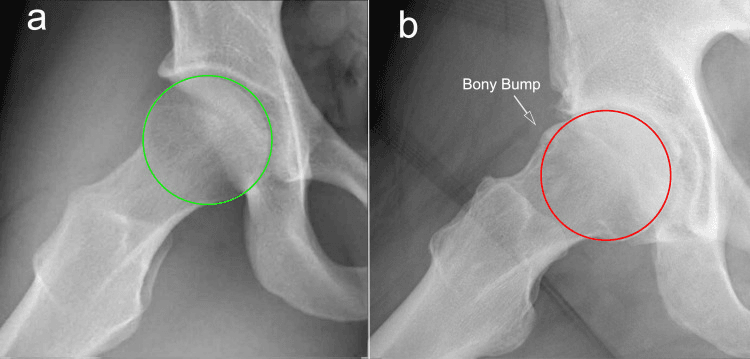
What follows a tear. Once torn, loss of the suction seal increases cartilage consolidation and contact stress, establishing a degenerative cascade toward osteoarthritis.
FAD-TLabral Tear Causes
Hook:FAD-T = FAI, Acetabular dysplasia, Degeneration, Trauma!
Clinical Presentation
History. Groin pain is the most common complaint, though patients may also describe anterior thigh, buttock or lateral hip pain. The pain is typically activity-related and may be accompanied by mechanical symptoms: clicking, catching or locking. Prolonged sitting may aggravate it, and athletes often report difficulty with sport-specific activities.
Examination. The FADIR test (flexion, adduction, internal rotation), the anterior impingement test, reproduces groin pain and is the most sensitive clinical test. The rest of the examination:
- FABER (flexion, abduction, external rotation) may reproduce pain or indicate sacroiliac pathology
- Range of motion may be reduced, particularly internal rotation in flexion if FAI is present
- Log roll may reproduce pain with minimal stress on the hip
- Gait is usually normal unless pain is significant or there is associated pathology
Investigations
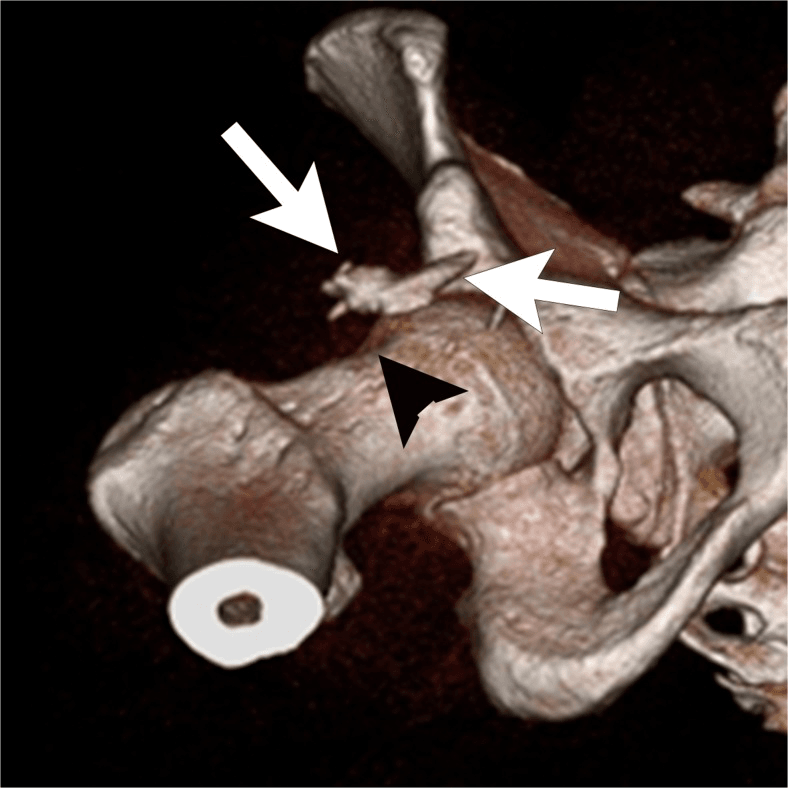
Radiographs. An AP pelvis and a lateral hip assess the underlying morphology: FAI, dysplasia and osteoarthritis. Measure the alpha angle and the lateral centre-edge angle.
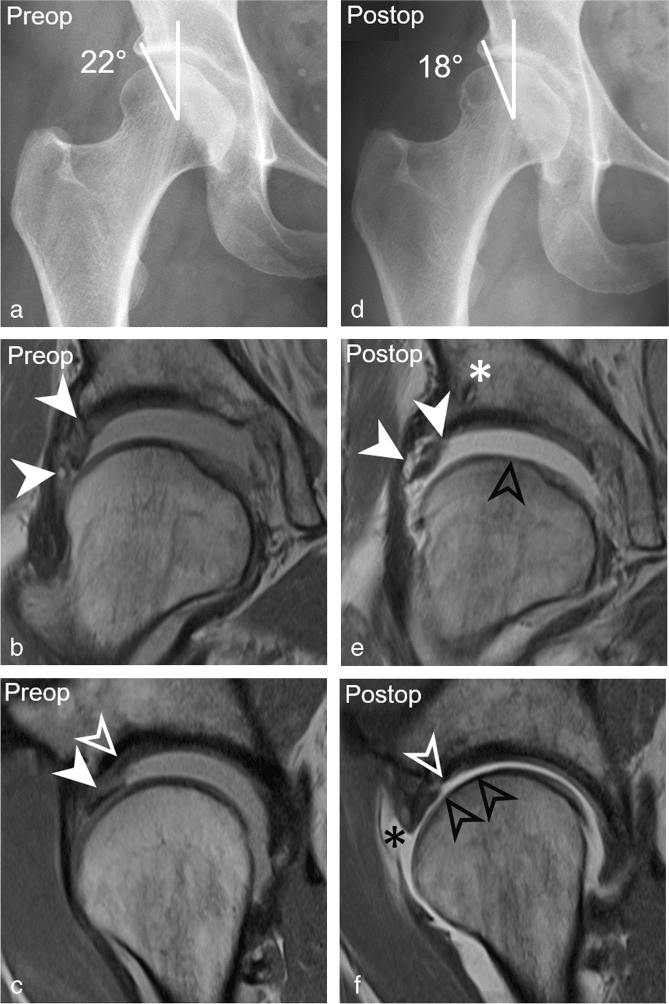
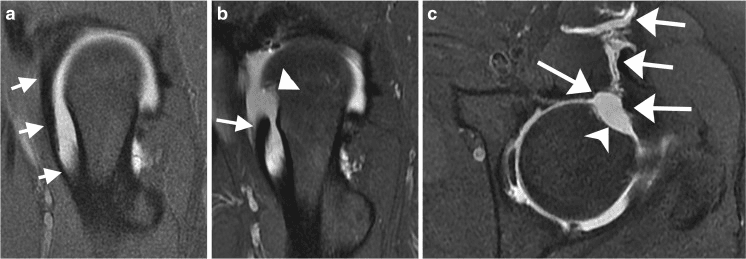
MRI and MR arthrography. Standard MRI shows labral pathology but may miss some tears. Direct MR arthrography is the gold standard: intra-articular gadolinium distends the joint and improves sensitivity and specificity, showing the tear's location and size and the associated cartilage damage. Leg positioning or traction can further open the chondrolabral junction to reveal a subtle tear.
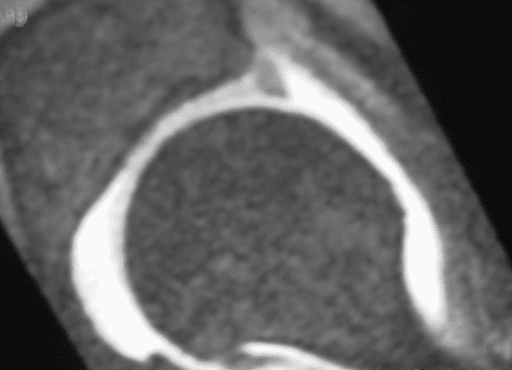
CT gives detailed bony morphology when surgery is planned.
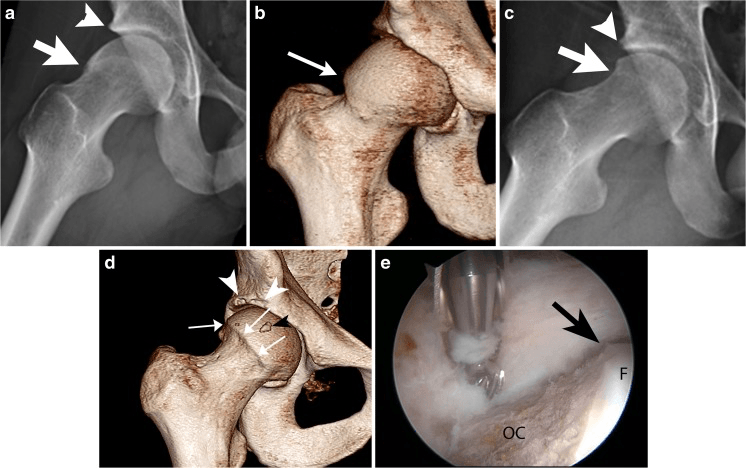
Classification. Tears are described by location, by type (radial, longitudinal, degeneration or detachment) and histologically. Location guides the surgical approach and prognosis:
- Anterosuperior, 85%. Zones 1-2, usually FAI-related. In Seldes' cadaveric series, 74% of tears lay in the anterosuperior quadrant.
- Posterior, 10-15%. Zones 4-5, dysplasia or trauma.
- Circumferential. Extensive damage.
The Seldes classification is histological. Type 1 is detachment at the chondrolabral junction; Type 2 is a cleavage plane within the labral substance.
Imaging Pitfalls: Normal Variants vs True Tears
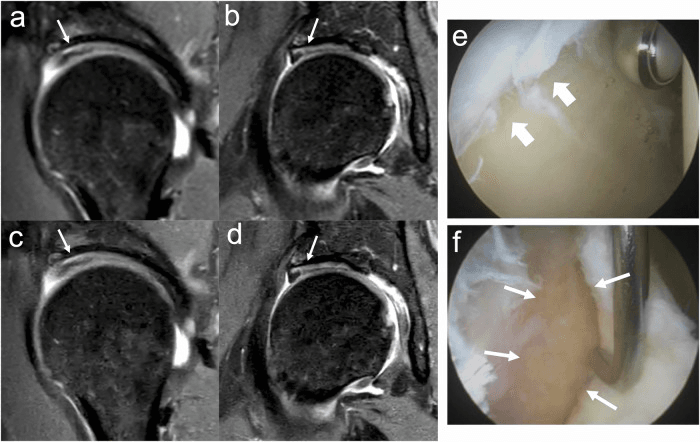
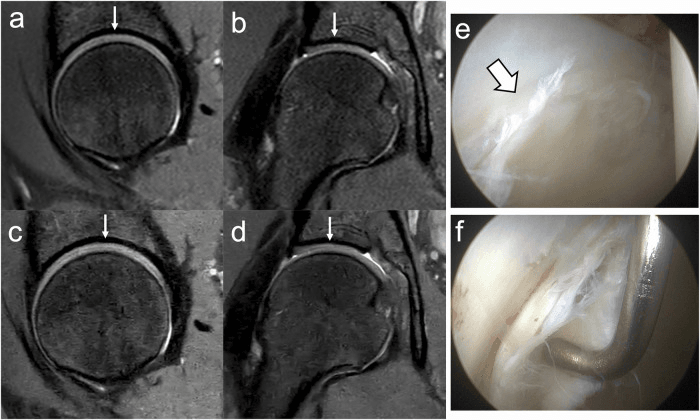
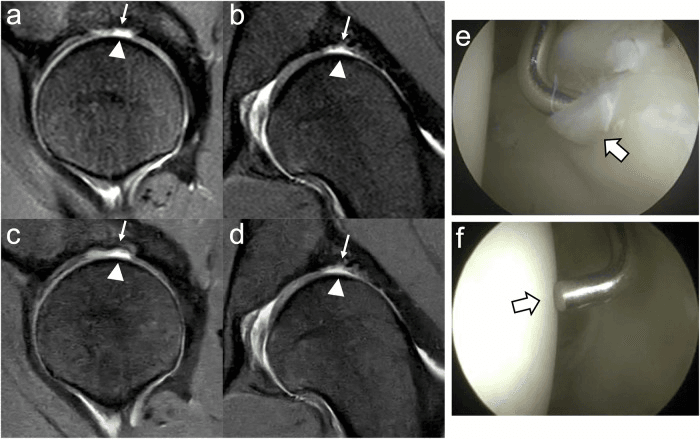
Labral signal change is common in asymptomatic hips, so the single most important interpretive skill is separating a true tear from a normal anatomical variant. Over-calling a variant as a tear is a classic route to an unnecessary operation.
Sublabral sulcus (recess). A smooth, shallow cleft at the labral–chondral junction, described most often anteroinferiorly and posteroinferiorly. Its margins are smooth and the adjacent cartilage is intact, and unlike a tear it does not extend to the free edge of the labrum or fill with contrast in an irregular pattern.
True tear. Contrast or fluid tracks into or through the labral substance; the margins are irregular, and there is usually associated chondral change. A displaced, blunted or absent labrum is a direct sign, and contrast tracking to the labral tip favours a true tear.
Paralabral (perilabral) cyst. A fluid collection beside the acetabular rim, formed when joint fluid decompresses through a full-thickness tear. It is a strong, specific secondary sign of a real tear even when the tear itself is subtle, and it can occasionally compress adjacent neurovascular structures.
Perilabral recess. The normal space between the joint capsule and the outer (capsular) surface of the labrum. It must not be mistaken for a peripheral labral detachment.
The diagnosis must always be concordant with the clinical picture. When the scan and the symptoms disagree, trust the concordant picture and a diagnostic intra-articular anaesthetic block, never the image alone.
Differential Diagnosis
Groin and lateral hip pain in the young adult is a crowded field. The labral tear is frequently the visible lesion on imaging, but it is rarely the whole story — distinguishing the true pain generator (and the driving morphology) is the core clinical skill.
- Typical history
- Activity-related groin pain, mechanical clicking/catching, worse with prolonged sitting
- Key examination / imaging clue
- Positive FADIR; cam/pincer morphology on radiographs; tear on MR arthrogram
- Distinguishing feature
- Anterosuperior tear with cam/pincer; pain abolished by intra-articular anaesthetic
- Typical history
- Instability sensation, deep buttock/posterior pain, worse on uneven ground
- Key examination / imaging clue
- Positive apprehension; LCEA under 25 degrees, Tonnis angle over 10 degrees; posterior tear
- Distinguishing feature
- Undercoverage and shear, NOT impingement; needs coverage correction not just rim work
- Typical history
- Anterior snapping during hip extension from flexion
- Key examination / imaging clue
- Palpable/audible snap; dynamic ultrasound shows tendon flicking over eminence
- Distinguishing feature
- Snap reproducible voluntarily; responds to psoas-targeted physio/injection
- Typical history
- Lateral hip pain, tender over trochanter, pain lying on side
- Key examination / imaging clue
- Point tenderness; positive resisted abduction; gluteal tendinopathy on MRI/USS
- Distinguishing feature
- Pain lateral and superficial, not deep groin
- Typical history
- Older patient, start-up stiffness, progressive deep pain, reduced ROM
- Key examination / imaging clue
- Joint space narrowing, osteophytes, Tonnis grade 2-3
- Distinguishing feature
- Established radiographic OA changes the whole treatment pathway (toward arthroplasty)
- Typical history
- Sport-related lower abdominal/adductor pain, kicking and cutting
- Key examination / imaging clue
- Tender pubic tubercle/adductor origin; normal intra-articular exam
- Distinguishing feature
- Pain extra-articular; FADIR usually negative; coexists with FAI in athletes
- Typical history
- Back-dominant pain, radiation below knee, buttock pain
- Key examination / imaging clue
- Positive neural tension or SI provocation tests; normal hip imaging
- Distinguishing feature
- Pain pattern not reproduced by intra-articular hip block
- Typical history
- Risk factors (load increase, steroids, alcohol); rest and night pain
- Key examination / imaging clue
- MRI marrow oedema (stress #) or crescent sign/subchondral change (AVN)
- Distinguishing feature
- Pain at rest, MRI changes in bone rather than labrum
A diagnostic intra-articular local anaesthetic injection is the single most useful step when intra- versus extra-articular origin is uncertain. Meaningful (greater than 50 percent) pain relief points to the hip joint itself as the pain generator and supports proceeding with labral/FAI surgery.
Management
The decision. The pathway runs in a fixed order: exclude advanced osteoarthritis, give non-operative care a trial, and if symptoms persist choose the operation by the morphology driving the tear rather than by the tear itself.
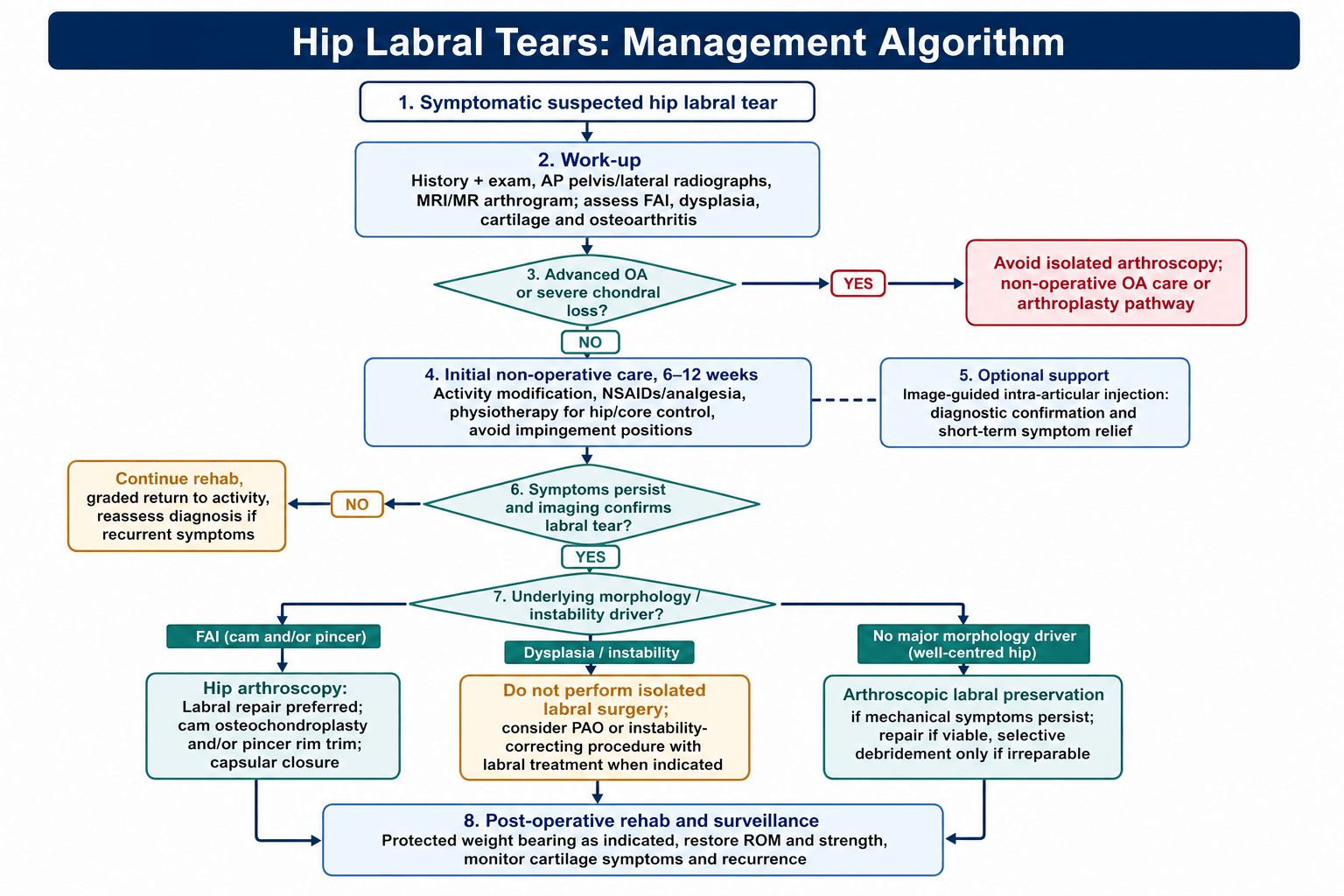
Non-operative care. Conservative treatment may provide symptomatic relief but does not heal labral tears.
- Activity modification: avoid provocative positions and activities
- Physiotherapy: hip stability, core strengthening, range of motion
- Analgesia and NSAIDs for symptomatic relief
- Intra-articular injection of local anaesthetic/corticosteroid: diagnostic, confirming the hip as the source, and therapeutic, giving temporary relief
Surgery or physiotherapy. In UK FASHIoN, arthroscopy for FAI syndrome gave a better iHOT-33 score at 12 months than personalised hip therapy. Both arms improved, and the size of the advantage is uncertain (see the Evidence Base).
Operative indications. A symptomatic tear confirmed on MRA, failed conservative treatment, and an identifiable underlying cause to be addressed. In a well-centred hip with no major morphological driver, the algorithm reserves arthroscopic labral preservation for persistent mechanical symptoms.
Repair, not debridement. Repair is preferred. It preserves labral function and proprioception, and multiple studies show better outcomes than with debridement; the supporting studies in the Evidence Base are level III and IV (Larson and Giveans; Philippon et al.).
The operation. Hip arthroscopy is the most common approach, with access to the central and peripheral compartments. What is done to the labrum depends on the tissue:
- Repair: suture anchors reattach the labrum to the rim
- Debridement: reserved for irreparable tissue
- Reconstruction: a graft for severe damage (below)
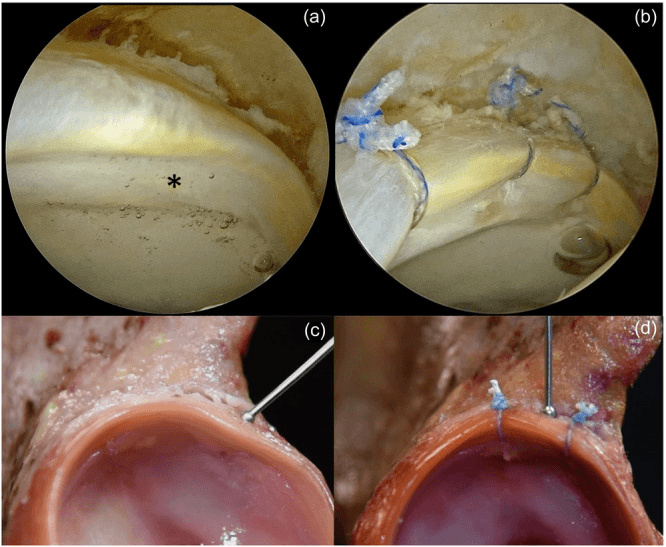
Address the cause. This is essential: femoral osteochondroplasty for cam, rim trimming for pincer, and periacetabular osteotomy for dysplasia.
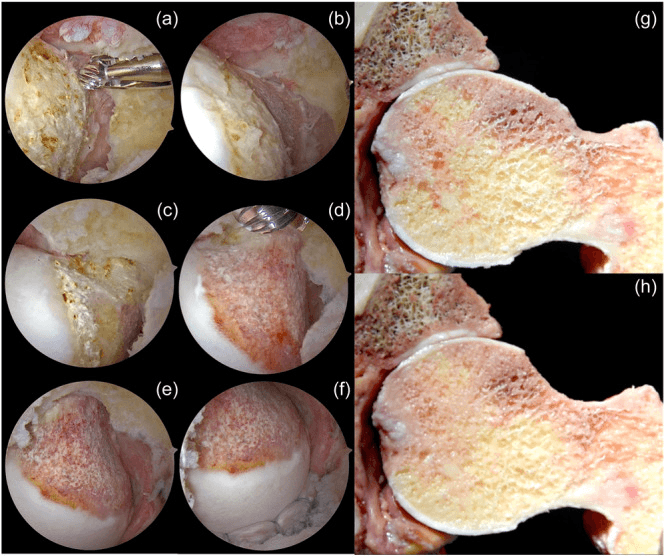
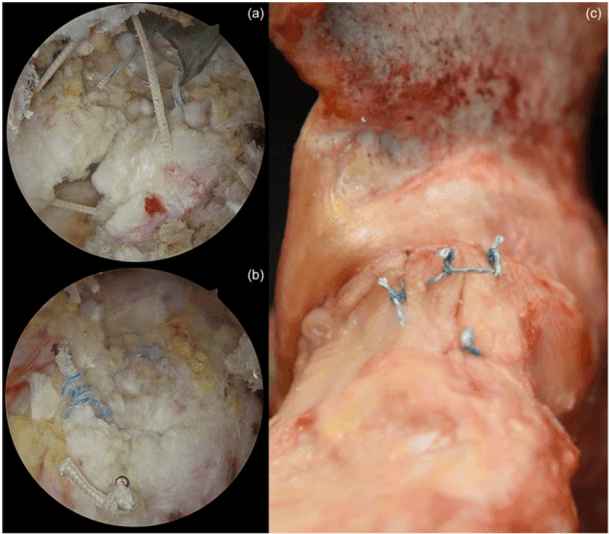
Outcomes. Good to excellent in appropriately selected patients. Poor prognostic factors include advanced cartilage damage and inadequate correction of the morphology.
RACEOperative Principles
Hook:RACE = Repair, Address morphology, Close capsule, Evaluate cartilage!
Labral Reconstruction
When. Reconstruction replaces labral tissue with a graft when the native labrum is irreparable: hypoplastic, ossified or calcified, extensively degenerate, or already deficient after prior debridement. The aim is the same as repair, to restore the suction seal and the fluid-sealing biomechanics that protect the cartilage, rather than simply excising deficient tissue and leaving the joint unsealed.
Graft choice. Autograft or allograft, placed as a segmental graft to rebuild a focal deficient zone or circumferentially for global loss.
- Autograft: iliotibial band, gracilis or semitendinosus. Avoids disease-transmission risk and cost.
- Allograft: tensor fascia lata or tibialis anterior. Avoids donor-site morbidity and shortens operative time.
Technique. The deficient labrum is resected back to a healthy base, and the graft is sized and secured to the acetabular rim with suture anchors. The new rim of tissue re-establishes contact with the femoral head and restores the seal.
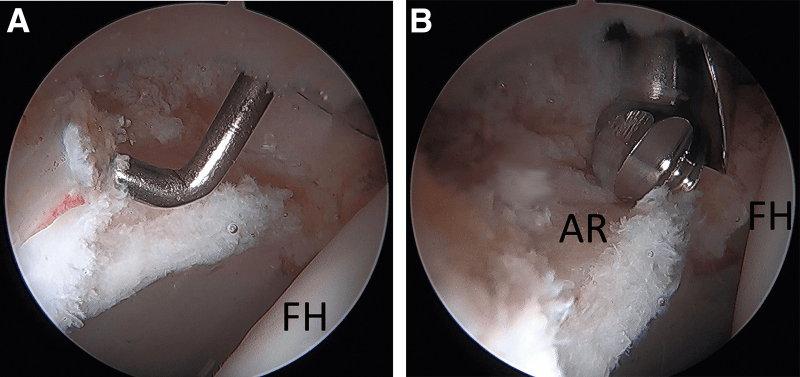
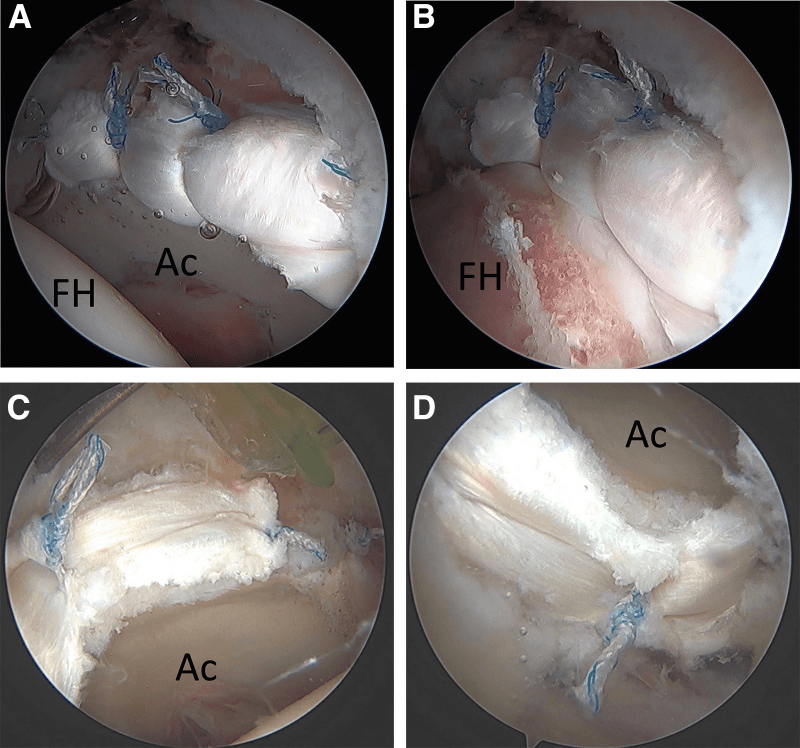
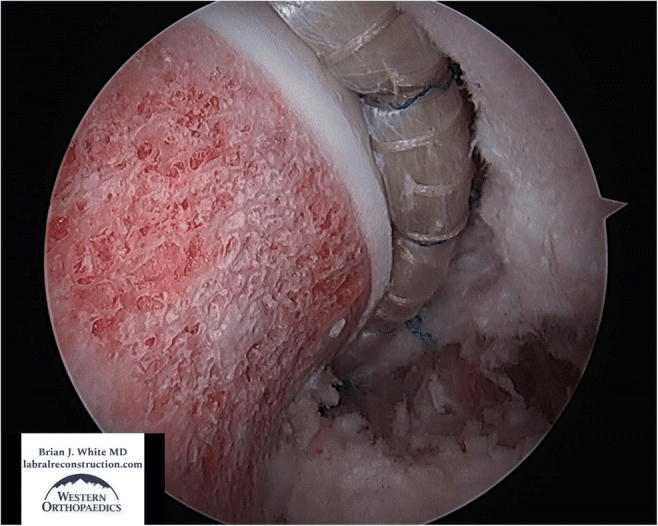
The evidence. In the Elnewishy meta-analysis, reconstruction achieved improvement comparable to repair on most patient-reported outcomes, with a small modified Harris Hip Score advantage in some series. Repair remains first choice whenever the tissue is viable: the native labrum's mechanoreceptors and biology cannot be fully replaced, and repair is associated with a lower rate of conversion to arthroplasty, partly reflecting the more favourable baseline joint status of hips in which the native labrum can be saved.
Preserve and repair native tissue wherever possible. Whichever is chosen, the underlying FAI or dysplasia must still be corrected, and cam or pincer morphology at the same sitting: a graft placed against an uncorrected cam or an undercovered rim will fail exactly as a repair would.
Complications
Complications of the Untreated Tear
Left alone, a tear risks progressive chondral damage and osteoarthritis: loss of the suction seal raises contact stress, and persistent FAI drives the degenerative cascade. It can also leave chronic mechanical symptoms, catching, locking and instability, that limit activity and sport.
Complications of Hip Arthroscopy
Traction. Pudendal and lateral femoral cutaneous nerve neurapraxia, usually transient and from perineal-post traction; perineal or genital pressure injury; and, rarely, sciatic or femoral nerve injury. Limiting traction time and force minimises them.
Iatrogenic bony and chondral injury. Chondral or labral injury on portal placement, and femoral neck fracture from over-aggressive osteochondroplasty. At the other extreme, inadequate correction, a residual cam with the alpha angle remaining over 50 degrees, causes re-tear and failure.
Microinstability. Iatrogenic microinstability follows an unrepaired capsulotomy or rim over-resection in a borderline-dysplastic hip, and is a leading cause of failed arthroscopy.
General and late. Heterotopic ossification (reduced by NSAID prophylaxis), infection, VTE, persistent pain, and conversion to total hip arthroplasty, a risk that rises with age, osteoarthritis and chondral damage.
Guidelines, Registries & Global Practice
Global Epidemiology
- Labral tears are highly prevalent: cadaveric and asymptomatic-volunteer studies show labral abnormalities in the majority of older adult hips and in a large proportion of asymptomatic young athletes, so prevalence figures depend heavily on whether the population is symptomatic.
- The anterosuperior quadrant accounts for the substantial majority of tears across populations; posterior tears are uncommon and should prompt a search for dysplasia or prior trauma/dislocation.
- FAI-related labral pathology presents predominantly in active adults in the second-to-fourth decades; dysplasia-related pathology skews female and younger.
Side-by-Side Guideline / Consensus Positions
- Emphasis
- Requires the triad of symptoms + clinical signs + imaging findings to diagnose FAI syndrome, not imaging alone
- Position on surgery
- Both conservative care and arthroscopic/open surgery are legitimate; decision is shared and symptom-driven
- Emphasis
- Patient selection, exclusion of established OA, structured conservative care first
- Position on surgery
- Arthroscopic FAI surgery accepted for appropriately selected patients without significant OA
- Emphasis
- Confirm intra-articular source, address bony morphology and labrum together
- Position on surgery
- Arthroscopy widely performed; labral preservation favoured over excision
- Emphasis
- Correct the underlying morphology (cam/pincer/dysplasia), not just the labrum
- Position on surgery
- Open surgical dislocation and PAO retained for complex deformity and dysplasia
Registry & High-Volume Cohort Signals
- National and institutional hip-arthroscopy registries (e.g. UK Non-Arthroplasty Hip Registry and large North American databases) consistently report labral repair/preservation overtaking debridement as the dominant technique over the last decade, mirroring the comparative evidence.
- Predictors of conversion to total hip arthroplasty across registries are consistent: older age, pre-existing osteoarthritis/joint space narrowing, and advanced chondral damage — reinforcing careful patient selection.
High- vs Limited-Resource Practice Variation
- Well-resourced settings: MR arthrography and dedicated hip arthroscopy expertise are available; labral repair, capsular closure, and concurrent osteochondroplasty are standard, with PAO offered for dysplasia at specialist centres.
- Limited-resource settings: MR arthrography and arthroscopy may be scarce; diagnosis leans on plain radiographs, clinical tests and diagnostic injection, and management is often weighted toward optimised conservative care, with surgery reserved for, and referred to, specialist hip-preservation units.
Controversies & Areas of Uncertainty
UK FASHIoN and FAIT showed a statistically significant benefit for arthroscopy over structured physiotherapy at 1 year, and in FASHIoN the point estimate (6.8 iHOT-33 points) just exceeded the 6.1-point MCID. Read the interval before treating that as settled: the 95% CI ran from 1.7 to 12.0, so the true effect may be a quarter of the MCID or twice it. Both arms improved substantially, adverse events were commoner after surgery (72% vs 60%), and the role of a genuine, fully delivered conservative programme as first-line in lower-demand patients remains debated, as does long-term durability and cost-effectiveness.
Cam morphology and labral signal change are common in asymptomatic hips and athletes. Imaging findings must never be treated in isolation — a tear on MR arthrogram does not by itself justify surgery without a concordant clinical picture and pain source confirmation.
Repair is preferred for the repairable labrum, but the threshold for primary reconstruction (e.g. hypoplastic, calcified, or extensively degenerate labra) and whether reconstruction should ever be used primarily rather than only for revision/irreparable tissue is unresolved.
In hips with LCEA 20-25 degrees, the choice between isolated arthroscopy (labral repair plus capsular plication) and periacetabular osteotomy is contentious. Over-resection of the rim in an undercovered hip can precipitate iatrogenic instability.
Aggressive capsulotomy without repair, or rim over-resection in a borderline-dysplastic hip, can cause iatrogenic microinstability — an increasingly recognised cause of failed hip arthroscopy. Routine capsular closure/plication is now widely advocated, particularly in women, hypermobile patients, and borderline dysplasia.
MCQ Practice Points
Q: What is the most common location for hip labral tears? A: Anterosuperior (85%). Usually associated with FAI (cam or pincer morphology).
Q: What is the gold standard imaging for hip labral tears? A: MR arthrogram (MRA). Intra-articular gadolinium improves sensitivity and specificity.
Q: Is labral debridement or repair preferred? A: Repair is preferred. Multiple studies show better outcomes with repair. Preserves labral function and proprioception.
Exam Viva Scenarios
Practise clinical reasoning and management decisions out loud
“A 30-year-old woman with groin pain has an anterosuperior labral tear on MR arthrogram. How do you manage her?”
“You are seeing a 24-year-old recreational runner with a 12-month history of deep buttock and posterior hip pain. She describes a sensation of hip instability, particularly when walking on uneven ground, and occasional painful clicking. Her FADIR test is negative, but she has a positive posterior rim impingement test and apprehension with external rotation in extension. Plain X-rays show a lateral center-edge angle (LCEA) of 18° (normal greater than 25°), Tonnis angle 15° (normal less than 10°), and no cam morphology (alpha angle 42°). MR arthrogram demonstrates a posterior labral tear (zone 4-5) with adjacent chondral thinning (Outerbridge grade II) and anterior subluxation of the femoral head on dynamic imaging. How do you counsel this patient about management options?”
“You are seeing a 32-year-old man who underwent right hip arthroscopy with labral repair and cam osteochondroplasty 14 months ago. He initially improved for 4-5 months post-operatively but has had gradual recurrence of groin pain over the past 6 months. He now has similar symptoms to pre-operatively: groin pain with prolonged sitting, FADIR test positive, reduced internal rotation (15° vs 25° on left). You obtain his pre-operative imaging which shows an alpha angle of 72° with an anterosuperior labral tear. His new plain X-rays show the joint space is preserved (3mm), no progression of osteoarthritis (Tonnis 0), but the post-operative alpha angle measures 58° (inadequate correction - should be less than 50°). A new MR arthrogram shows re-tear of the repaired labrum at the same anterosuperior location with contrast extravasation, and Outerbridge grade II cartilage in the anterosuperior acetabulum (unchanged from pre-op). The patient is frustrated and asking about revision surgery. How do you assess this patient and what are the management options?”
Labral Function
- Seal (suction seal)
- Stabilize femoral head
- Surface area increase (28%)
- Forms 22% of the articulating surface
Key Facts
- Anterosuperior 85% (FAI-related)
- FADIR test positive
- MR arthrogram gold standard
- Repair preferred over debridement
Causes (FAD-T)
- FAI (cam/pincer)
- Acetabular dysplasia
- Degeneration
- Trauma
Treatment Principles
- Address underlying morphology
- Repair if possible
- Debridement for irreparable tissue
- Incomplete correction leads to failure
Evidence Base
Ferguson et al. — Acetabular labral seal (in vitro)
- Six cadaveric hips loaded before and after total labral resection
- Initial cartilage consolidation rate 22% greater after resection (p=0.02)
- Final consolidation displacement 21% greater after resection (p=0.02)
- Intra-articular fluid pressurisation fell from ~541 to ~216 kPa once labrum removed
Seldes et al. — Anatomy, histology and tear classification
- 67 cadaveric hips; labral tears present in 96% (53 of 55 embalmed)
- 74% of tears located in the anterosuperior quadrant
- Two histological tear patterns defined: Type 1 chondrolabral-junction detachment, Type 2 intrasubstance cleavage
- Labrum contiguous with articular cartilage via a 1-2 mm transition zone
Tan, Seldes et al. — Labral contribution to surface area
- 55 cadaveric hips with standardised measurement
- Acetabular surface area 28.8 cm2 without labrum vs 36.8 cm2 with labrum (p less than 0.0001)
- Acetabular volume 31.5 vs 41.1 cm3 (p less than 0.0001)
- Labrum widest anteriorly and superiorly