Medial Column Keystone | AVN Risk | Sangeorzan Classification | Athletes at Risk
- Precarious blood supply - central third is watershed zone (AVN risk)
- CT scan essential for body fractures - assess articular displacement
- Stress fractures - often missed initially, high index of suspicion in athletes
- Medial column length must be restored - avoid shortening
- 6-8 weeks non-weight-bearing minimum for stress fractures
- “Blood supply: dorsal and plantar arteries, central zone relatively avascular
- “Sangeorzan Type 2 most common body fracture pattern
- “Stress fractures: central third, sagittal orientation, bone scan/MRI to diagnose
- “Associated injuries: cuboid, cuneiforms, tarsometatarsal joint
- “Malunion leads to planovalgus deformity and midfoot arthritis
Overview
The tarsal navicular is the keystone of the medial longitudinal arch, and its fractures run from a minor dorsal avulsion to a comminuted body fracture with significant displacement and associated injuries. They are rare, 3-5% of all foot fractures, and they matter out of proportion to their number because of what a shortened medial column or a dead central third costs the foot.
Mechanism and who. Avulsion fractures are low-energy injuries, a capsule or ligament pulling off a fragment, and occur at any age. Body fractures are often the product of high-energy axial loading through the foot, with a male predominance and a peak age of 20-40 years. Tuberosity fractures come from avulsion by the posterior tibial tendon or a direct blow, in older patients or after trauma. Stress fractures belong to the athlete under repetitive load: track and field, basketball and football.
The four types. Frequency, imaging, treatment and prognosis differ enough that each type is handled as its own injury on the rest of this page.
- Avulsion
- 47% (most common)
- Body
- 26%
- Stress
- 3%
- Tuberosity
- 24%
- Avulsion
- X-rays sufficient
- Body
- CT essential for planning
- Stress
- MRI gold standard
- Tuberosity
- X-rays, CT if large
- Avulsion
- Conservative if small
- Body
- ORIF if displaced over 1mm
- Stress
- NWB 6-8 weeks
- Tuberosity
- ORIF if large/displaced
- Avulsion
- Very low
- Body
- 25% (high)
- Stress
- Variable (central worse)
- Tuberosity
- Low
- Avulsion
- Rare
- Body
- Moderate
- Stress
- High (central location)
- Tuberosity
- Low
- Avulsion
- 6-8 weeks
- Body
- 4-6 months
- Stress
- 4-6 months
- Tuberosity
- 8-12 weeks
- Avulsion
- Excellent
- Body
- Good-Fair (type dependent)
- Stress
- Good if early treatment
- Tuberosity
- Good
The navicular stress fracture, the insidious, high-risk, slow-healing injury of the running and jumping athlete, is a distinct entity with its own mechanism, imaging threshold and non-weight-bearing-first management, and is covered in depth on the Navicular Stress Fracture page. It appears here alongside the acute traumatic fractures wherever the anatomy and the reasoning are shared.
Anatomy and Blood Supply
The bone. Boat-shaped (Latin navicula, a little boat), the navicular articulates with the talus proximally, the three cuneiforms distally and the cuboid laterally. The posterior tibial tendon inserts on its tuberosity and is the major dynamic support of the arch; the spring ligament supports its plantar surface. With the talus it forms the talonavicular joint, part of the Chopart (transverse tarsal) joint and critical for hindfoot motion.
The medial column. Talus, navicular, medial cuneiform and first metatarsal make up the medial column, and the navicular is its cornerstone, maintaining the height of the longitudinal arch. Shorten it and the foot falls into planovalgus, which is why restoring medial column length is the recurring goal of treatment.
The talonavicular joint. It provides 80% of hindfoot inversion and eversion, the movement that lets the foot adapt to uneven ground. Losing that motion significantly affects function.
The blood supply. Dorsal branches of the dorsalis pedis artery and plantar branches of the medial plantar artery enter the bone from its periphery, medially and laterally. Neither reliably reaches the central third of the body, which is left as a watershed zone, relatively avascular: the same tenuous arrangement as the scaphoid in the wrist, and the same susceptibility to AVN.
Why it matters. Because the centre depends on vessels that arrive from the edges:
- Central stress fractures sit in the watershed, which is why they have a high nonunion rate
- A displaced body fracture disrupts the peripheral supply, which is the anatomical reason for the AVN rate given under Complications
- Open reduction should preserve the soft-tissue attachments that carry what supply there is
Classification Systems
The Sangeorzan classification (1989) categorises body fractures by fracture pattern and degree of displacement. Higher type means worse prognosis, every type needs CT before surgery, and in Sangeorzan's own series the accuracy of reduction correlated with outcome as directly as the type did, which is why articular congruity has to be restored and a non-anatomic reduction leads to arthritis.
- Fracture line
- Coronal (transverse) line with a dorsal fragment; talonavicular joint intact
- Forefoot
- No forefoot angulation
- Treatment
- ORIF if displaced
- Prognosis
- Good if reduced
- Fracture line
- Oblique, dorsolateral to plantar-medial; the most common pattern
- Forefoot
- Major fragment and forefoot displaced medially; medial column shortened
- Treatment
- ORIF essential, restoring medial column length
- Prognosis
- Moderate; AVN risk
- Fracture line
- Comminuted, central or lateral, in the sagittal plane; severe articular damage; often high energy with associated injuries
- Forefoot
- Forefoot displaced laterally
- Treatment
- ORIF with bone graft
- Prognosis
- Poor; high AVN and arthritis
Clinical Assessment
History. A body fracture announces itself: a high-energy mechanism such as a motor vehicle accident or fall from height, axial loading through the foot, immediate inability to weight-bear, and associated injuries in 25%. A stress fracture does the opposite. Midfoot pain of insidious onset, worse with activity and better with rest, presentation delayed by weeks to months, and an athlete who has recently increased training intensity; some recall the specific incident when the "stress" became "complete".
Examination. Look for swelling over the dorsum of the midfoot and ecchymosis after a body fracture, remembering that a stress fracture may leave the foot looking grossly normal, and assess overall foot alignment. Palpate the navicular body dorsally, medially and plantarly, the tuberosity at the posterior tibial tendon insertion, and the talonavicular and cuneonavicular joints alongside it. Then the tests:
- Single-leg hop test, which reproduces stress-fracture pain
- Navicular compression test
- Posterior tibial tendon function
- Hindfoot alignment
The N spot is focal tenderness over the proximal dorsal navicular at the junction of the proximal and middle thirds, the site of the stress fracture in the watershed zone. It is 81% sensitive and 100% specific. N-spot tenderness in an athlete with activity-related midfoot pain means advanced imaging, even with negative X-rays.
Investigations
Radiographs. A standard foot series of AP, lateral and oblique views. Body fractures are usually visible. Stress fractures are negative on the first films in up to 70%, so look for a subtle cortical break or sclerosis.
CT is essential for body fractures and is the study the operation is planned from. It shows the articular displacement and lets the step-off be measured, defines the comminution pattern and the medial column length, identifies adjacent injuries, and confirms the Sangeorzan type.
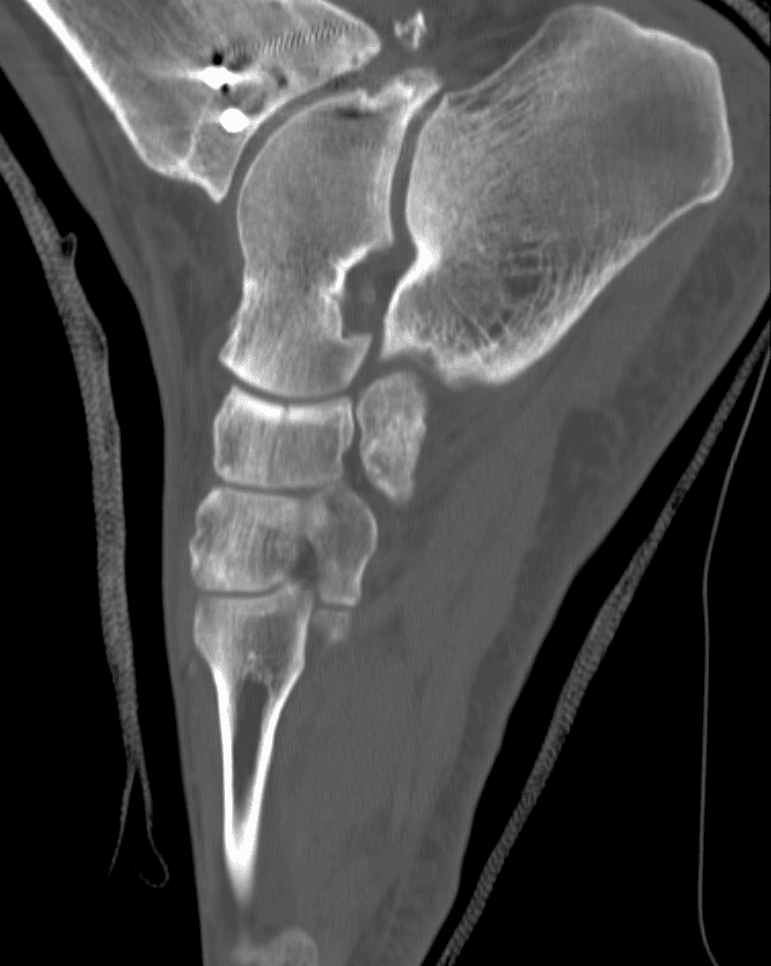
MRI is the gold standard for stress fractures, 97% sensitive, showing T2 bone marrow oedema before any cortical break and the soft-tissue injury around it. The fracture line is low signal on T1 and the marrow oedema high signal on T2 and STIR; the line lies in the central third in the sagittal plane, and MRI shows whether it is partial or complete. Both CT and MRI may be needed for a complete evaluation.
Bone scan is the alternative for a stress fracture: highly sensitive because uptake is early, less specific than MRI, since the navicular is "hot" in stress fracture and stress reaction alike.
Management Algorithm
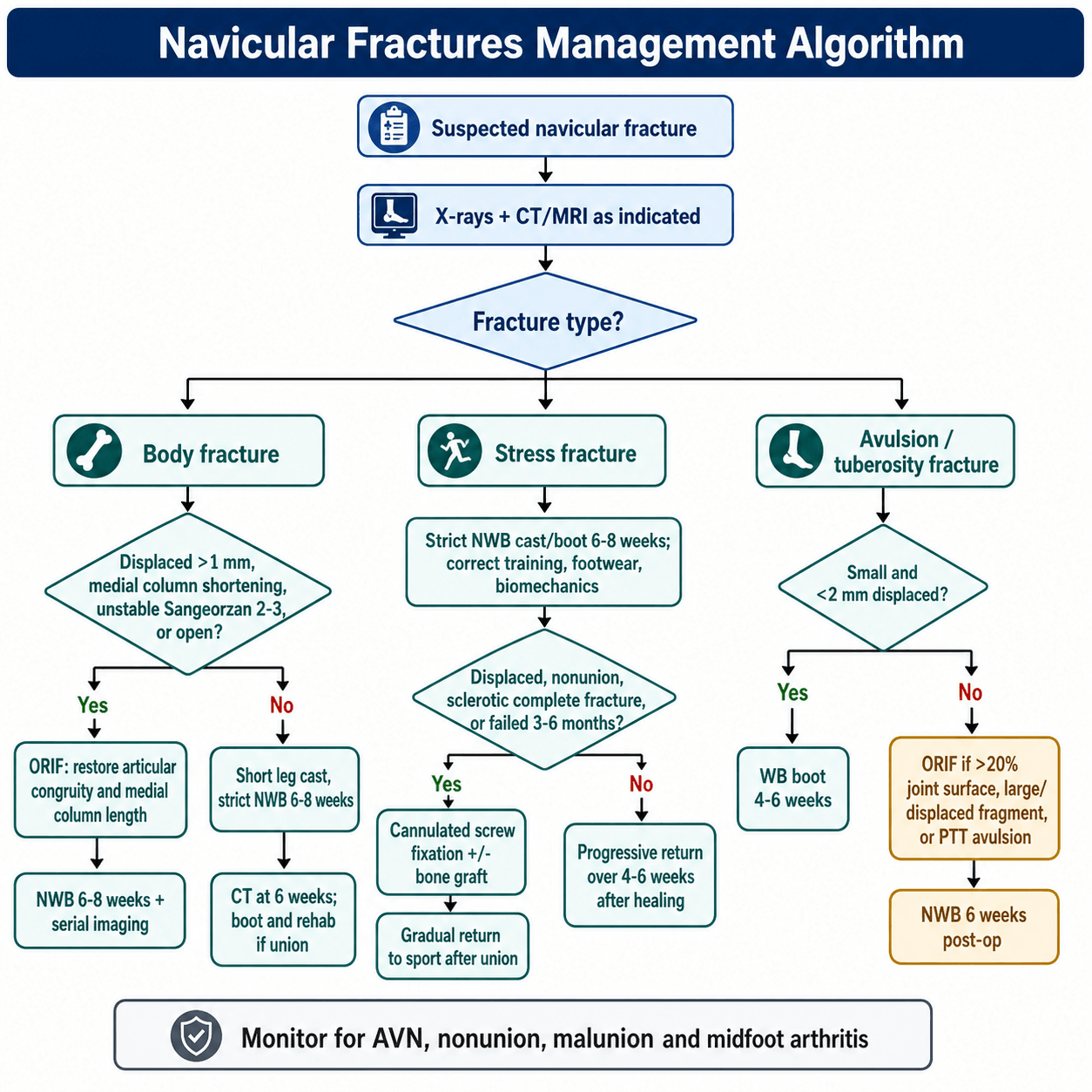
Non-operative. A body fracture can be treated closed when the articular step-off is less than 1 mm, the medial column is not shortened, the pattern is stable and the patient can comply with the restrictions. The protocol:
- Short leg cast, non-weight-bearing for 6-8 weeks
- X-rays at 2, 4 and 6 weeks to assess alignment
- CT at 6 weeks to confirm union
- Weight-bearing boot from 8-10 weeks, then progressive rehabilitation
Operative. The absolute indications:
- Articular step-off greater than 1 mm
- Medial column shortening
- Unstable pattern (Sangeorzan 2 and 3)
- Open fracture
The relative indications are associated midfoot injuries that need surgery anyway, a high-demand patient, and inability to comply with non-weight-bearing. Fixation is chosen by pattern and degree of comminution: lag screws for simple patterns, mini-fragment or bridge plating for comminution, and external fixation for the severely comminuted fracture with a compromised soft-tissue envelope, all set out under Surgical Technique.
Surgical Technique
Planning. Review the CT for the fracture pattern and comminution, assess the soft-tissue envelope, which may mean staged surgery, plan the approach by fracture location, and have bone graft available if there is comminution.
Positioning. Supine with a bump under the ipsilateral hip, a thigh tourniquet, and the image intensifier positioned for AP and lateral views.
Complications
Early. Wound dehiscence, infection, hardware prominence and neurovascular injury. The late complications are the subject of the rest of this section: AVN, nonunion, malunion with planovalgus, and the post-traumatic arthritis and chronic pain quantified under Outcomes.
Avascular necrosis. AVN follows about 25% of body fractures (reported range 16-25%), the direct consequence of the watershed supply. The risk rises with:
- Sangeorzan Type 2 and 3 fractures
- Delayed treatment
- Open reduction with extensive soft-tissue stripping
- Associated injuries that disrupt the blood supply
It presents as persistent pain despite apparent healing, then progressive collapse on imaging, sclerosis followed by fragmentation. It develops within the first 2 years of injury and may revascularise in 30% of cases, but progresses to collapse in 50-70% when severe and often ends in a salvage fusion. Early AVN is managed with protected weight-bearing, which may allow revascularisation. Established AVN with collapse needs bone grafting, vascularised or non-vascularised, talonavicular fusion, or a triple arthrodesis in severe cases.
Nonunion. The risk factors are central stress fractures in the watershed zone, inadequate immobilisation, smoking, delayed diagnosis and poor blood supply. Treatment runs from a bone stimulator, electrical or ultrasound, through surgical fixation with bone grafting, to a vascularised bone graft for resistant cases.
Malunion. A short medial column malunites into the planovalgus deformity described under Anatomy, with talonavicular arthritis, altered gait mechanics and chronic midfoot pain. Osteotomy and bone grafting are rarely successful; malunion typically requires talonavicular fusion, and severe deformity may need a triple arthrodesis.
Postoperative Care
0-2 weeks. In hospital: posterior splint, strict elevation above the heart, non-weight-bearing with crutches, ice and analgesia, neurovascular checks, and DVT prophylaxis if high risk. The patient goes home to maintain non-weight-bearing, keep the splint dry and clean, elevate as much as possible, and watch for excessive pain, swelling or numbness.
2-6 weeks. At 2 weeks the wound is checked and the sutures removed, the splint converted to a short leg cast or CAM boot, non-weight-bearing continues strictly, and ankle pumps and toe exercises begin. At 4 weeks, X-rays assess alignment and, if stable, gentle ankle range of motion in the boot may start. At 6 weeks, X-rays assess early healing, with CT if healing is questionable, and non-weight-bearing continues until bridging callus is seen.
6-12 weeks. At 8 weeks, if healing is progressing, progressive weight-bearing begins, as tolerated in the boot, with physiotherapy for range of motion and proprioception and pool therapy if available. From 10-12 weeks the patient transitions to a supportive shoe, continues progressive weight-bearing, advances strengthening and has any gait abnormality addressed.
3-6 months. Months 3-4 bring full weight-bearing in supportive footwear and the start of sport-specific rehabilitation, with impact activities still avoided. Months 4-6 bring a gradual return to running for the athlete, sport-specific drills, and full return to sport once pain-free with a full range of motion; hardware is removed if prominent, which is rarely needed.
- Persistent pain despite adequate healing time - consider AVN
- Loss of reduction on serial X-rays - may need revision
- No progression of healing at 12 weeks - nonunion risk
- Wound complications - infection risk
- Progressive collapse on imaging - AVN developing
Return to sport. Clearance requires all of the following:
- Pain-free weight-bearing and walking
- Full or near-full range of motion compared with the contralateral side
- Radiographic union, bridging callus on CT
- Successful completion of sport-specific drills
- Single-leg hop test equal to the contralateral side
- Psychological readiness
Outcomes and Prognosis
Body fractures after ORIF. Good-to-excellent outcomes in 70-85% overall, falling with type: Type 1 (coronal) 85-90%, Type 2 (oblique) 70-80%, Type 3 (comminuted) 50-60%.
Stress fractures. Union in 86-95% with early treatment: 95% for partial fractures, 85-90% for complete non-displaced fractures, and a higher nonunion rate for the central location. 80-90% of athletes return to sport, and the recurrence rate is 10-15%.
The classic viva scenarios:
- High-energy midfoot trauma - systematic assessment of Chopart/Lisfranc complex
- Athlete with vague midfoot pain - navicular stress fracture until proven otherwise
- Displaced navicular body fracture - surgical approach and fixation options
- Post-operative AVN - recognition and salvage options
- Malunion with planovalgus - reconstructive options
Never say:
- "X-rays are sufficient for surgical planning"
- "Weight-bear as tolerated for stress fractures"
- "Accept any displacement of navicular body fractures"
- "The navicular has good blood supply like other tarsal bones"
Guidelines, Registries & Global Practice
Global Epidemiology
Navicular fractures are uncommon. Across published series the navicular accounts for only a small fraction of foot fractures, with body fractures usually following high-energy axial loading and stress fractures clustering in running and jumping athletes. There is no dedicated international registry for navicular fractures (unlike arthroplasty), so the evidence base is built from case series and a single meta-analysis rather than registry data.
- Figure
- 86% vs 26% for weight-bearing
- Source (PubMed)
- Khan 1992 (PMID 1456359)
- Figure
- 96% vs 82% (NS; WB inferior)
- Source (PubMed)
- Torg 2010 (PMID 20197494)
- Figure
- 67% / 19% / 14%
- Source (PubMed)
- Sangeorzan 1989 (PMID 2592390)
- Figure
- 100% union, 4% avascular collapse
- Source (PubMed)
- Evans 2011 (PMID 21733456)
- Figure
- Type I/II ~3.7 mo, Type III ~6.8 mo
- Source (PubMed)
- Saxena 2000/2006 (PMID 10789100, 17144953)
Guideline & Society Positions
No single national body publishes a stand-alone navicular-fracture guideline; recommendations are drawn from foot-and-ankle society consensus, AO principles and the sports-medicine literature. The table below summarises the practical position of the major bodies.
- Position
- Restore medial column length and articular congruity; lag screws for simple patterns, bridge/minifragment plating for comminution
- Evidence level
- Expert consensus / Level IV-V
- Position
- CT for surgical planning of body fractures; ORIF for displacement greater than 1-2mm or medial column shortening
- Evidence level
- Expert opinion
- Position
- Open midfoot injuries follow BOAST open-fracture and dislocated/deformed-limb standards (early reduction, prompt senior review)
- Evidence level
- Standard of care
- Position
- CT mandatory for body fractures; medial-column preservation is the key prognostic target
- Evidence level
- Expert consensus
- Position
- Non-weight-bearing immobilisation is standard of care for stress fractures; surgery for Type III / failed conservative
- Evidence level
- Level III meta-analysis (Torg 2010)
Registry & Practice Variation
- No arthroplasty-style registry captures navicular fractures, so practice variation is large and outcome data come from single-centre series.
- Stress-fracture management has converged internationally on strict non-weight-bearing immobilisation following Khan 1992 and the Torg 2010 meta-analysis; however, real-world audits (e.g. Burne 2005, PMID 16157855) show many patients still do not receive guideline non-weight-bearing treatment, and only about half of those return to their previous sporting level.
- Body-fracture fixation varies between independent lag screws and minifragment/bridge plating depending on comminution and surgeon preference; both achieve high union when medial column length is restored.
- Return-to-running and bone health are integral to stress-fracture care worldwide: once imaging confirms union, athletes progress through structured, graded load-progression (return-to-running) protocols, and recurrent stress fractures prompt systematic bone-health screening (energy availability, vitamin D and menstrual function) to correct underlying risk factors before return to full loading.
Viva Scenarios
Clinical Decision Scenarios
Practise clinical reasoning and management decisions out loud
“A 25-year-old track athlete presents with 6 weeks of worsening midfoot pain during running. The pain localizes to the dorsum of the foot over the navicular. X-rays appear normal.”
“A 35-year-old man is brought to ED after a motorcycle accident. He has a swollen, deformed midfoot. X-rays show a displaced navicular body fracture with associated cuboid fracture. CT shows a Sangeorzan Type 2 pattern with 5mm of medial column shortening.”
“A 30-year-old athlete is 4 months post-operatively from navicular body fracture ORIF. She has persistent midfoot pain. X-rays show sclerosis and partial collapse of the navicular. What is your diagnosis and management?”
MCQ Practice Points
High-Yield Facts for MCQs
Q: A young athlete has vague midfoot pain but normal X-rays. What is the next step? A: MRI - X-rays are negative in 70% of early stress fractures. MRI is the gold standard (97% sensitive) showing bone marrow edema before a cortical break appears.
Q: What is the 'N-Spot' and what does it signify? A: Dorsal Navicular Tenderness - Located at the junction of the proximal and middle thirds. It is 81% sensitive and 100% specific for navicular stress fractures.
Q: Why do central navicular fractures have a high nonunion rate? A: Poor Vascularity - The central third is a watershed zone between the dorsalis pedis and medial plantar arterial supplies. This tenuous blood supply impairs healing.
Q: Which Sangeorzan type is the most common? A: Type 2 - The fracture line runs from dorsolateral to plantar-medial. It results in forefoot medialization and dorsal displacement, requiring ORIF to restore length.
Q: What is the critical management principle for navicular stress fractures? A: Variables: Strict NWB vs Surgery - Conservative management requires 6-8 weeks of strict non-weight-bearing in a cast. Weight-bearing leads to nonunion or recurrence.
Q: When is surgery indicated for a navicular body fracture? A: Greater than 1mm Displacement - Any articular step-off greater than 1mm or loss of medial column length warrants ORIF to prevent post-traumatic arthritis and deformity.
Evidence Base
Sangeorzan Classification of Navicular Body Fractures (1989)
- 21 displaced body fractures treated with ORIF over 1980-1987, classified into 3 types by fracture-line direction and forefoot displacement (Type 1 coronal, no forefoot angulation; Type 2 dorsal-lateral to plantar-medial with medial forefoot displacement; Type 3 sagittal comminution with lateral forefoot displacement). Satisfactory reduction achieved in 100% of Type 1, 67% of Type 2 and 50% of Type 3. Good result in 67%, fair in 19%, poor in 14%. Fracture type and accuracy of reduction both correlated directly with outcome.
Conservative vs Surgical Management of Navicular Stress Fractures (Khan, 1992)
- 82 athletes with 86 CT-confirmed navicular stress fractures. 19 of 22 (86%) treated with at least 6 weeks of non-weight-bearing cast immobilisation returned to sport, versus only 9 of 34 (26%) who continued weight-bearing with activity restriction (p less than 0.001). CT appearance of healing did not reliably mirror clinical union.
NWB vs Surgery for Navicular Stress Fracture - Meta-analysis (Torg, 2010)
- Systematic review and mixed-model meta-analysis comparing three strategies. Non-weight-bearing conservative treatment gave 96% successful outcomes versus 82% for surgery, with no statistically significant difference (p=0.64) but a trend favouring NWB. Weight-bearing conservative treatment was significantly inferior to both NWB (p=0.0001) and surgery (p less than 0.0003).
CT-Based Classification of Navicular Stress Fractures (Saxena, 2000)
- 22 navicular stress fractures with a proposed frontal-plane CT classification: Type I dorsal cortical break, Type II propagation into the body, Type III propagation through a second cortex. Type III took significantly longer to return to activity (mean 6.8 months) than Type I (3.0) or Type II (3.6). Operative cases returned faster than conservative (3.1 vs 4.3 months, p=0.02). Modifiers A (avascular necrosis), C (cystic change) and S (sclerosis) were added; sclerosis was the commonest and clustered in the persistently symptomatic. TWO conservatively treated fractures RE-FRACTURED during treatment, taking 5 and 8 months to return.
Prospective Study of Navicular Stress Fractures (Saxena, 2006)
- Prospective series of 19 athletes compared with the author's own 22 historical controls from 1994-1998. Mean return to activity was 4.0 months for the whole group, with no meaningful difference between Type I (3.8, n=4), Type II (3.7, n=8) and Type III (4.2, n=7) when treated per protocol - non-operative for Type I, ORIF for Types II and III. 15 of 16 competitive athletes returned to full competition, including all who had ORIF.
- THE COMPARISON WITH THE EARLIER SERIES IS THE INTERESTING RESULT: Type III return fell from 6.8 months in the 2000 retrospective cohort to 4.2 months here, once Type III fractures were operated by protocol rather than selectively.
Bridge Plating of the Medial Column in Midfoot Injuries (Schildhauer, 2003)
- Describes temporary internal bridge plating of the medial column with an 8-10 hole 2.7mm reconstruction plate spanning the talar neck to the first metatarsal for severe comminuted midfoot (cuneiform/navicular) crush injuries, maintaining medial column length and alignment until union, as an alternative to spanning external fixation.
Minifragment Plate Fixation of High-Energy Navicular Body Fractures (Evans, 2011)
- 24 navicular body fractures treated with minifragment plate ORIF at a Level I trauma centre over 6 years. All fractures united, with no loss of reduction and no deep infection.
- Only 1 patient (4%) developed radiographic avascular collapse, at 6 months, treated with plate removal and an orthosis; 4 (17%) developed talonavicular arthrosis and 4 (17%) needed removal of prominent hardware.
- Isolated broken screws occurred in 3 patients (12.5%), with no plate breakage and no failure by pullout.
Tarsal Navicular Stress Fractures - Original Series (Torg, 1982)
- Foundational retrospective review of 21 tarsal navicular stress fractures in athletes. Established that the diagnosis is frequently delayed because routine radiographs are often normal, that the fracture characteristically lies in the central third in a sagittal plane, and that immobilisation with non-weight-bearing was more reliable than continued activity.