High-Risk Tarsal Stress Injury | Central Third Watershed | Athlete Foot Pain
- Navicular stress fracture is a high-risk stress fracture with delayed/nonunion potential
- Central third is a vascular watershed - medial and lateral blood supplies meet but do not anastomose robustly
- X-ray is frequently normal; MRI is the most sensitive first test, CT confirms and grades
- Tenderness on the 'N-spot' (dorsal proximal navicular) is the key clinical sign
- Treatment hinges on NWB immobilisation for incomplete fractures, headless compression screw for complete/displaced
- “Most common tarsal stress fracture; most common cause of midfoot pain in athletes with normal X-ray
- “Vague, insidious midfoot pain is the rule - high index of suspicion needed
- “Single-leg hop reproduces pain in nearly all cases
- “Screw trajectory: lateral-to-medial across the fracture in the proximal-distal plane
- “Nonunion risk is driven by the watershed biology and by weight-bearing during healing
Overview and Epidemiology
The navicular is the most common tarsal bone to sustain a stress fracture, and navicular stress fractures represent approximately 15-35 percent of all stress fractures in athletes. It is an insidious, high-risk, slow-healing injury, and because the initial X-ray is normal in the majority of cases the diagnosis is missed in up to 80 percent of patients at first presentation. The typical delay from symptom onset is 4-7 months, and that delay is the most common cause of a poor outcome.
Who. The highest incidence is in track and field: sprinters, hurdlers and middle-distance runners. Jumpers (basketball, netball, ballet, gymnastics), cutting-sport athletes (football, soccer, rugby) and military recruits under the high volume of repetitive impact loading of basic training follow. In a large military cohort, navicular stress fractures accounted for the longest average time to return to duty of any lower-extremity stress fracture.
What it costs. Return to sport takes 4-6 months even with optimal care. Career impact is documented in elite athletes, and the injury may end a professional career if mismanaged.
The high-risk family. The aggressive treatment of the navicular only makes sense within the high-risk versus low-risk stress-fracture framework. High-risk stress fractures occur on the tension side or in a watershed, poorly vascularised zone, so they tend to progress, displace, go to nonunion or AVN, and need aggressive treatment: strict non-weight-bearing and/or internal fixation, with imaging-confirmed union before return. Low-risk stress fractures are compression-side and well-vascularised, and usually heal with relative rest and activity modification.
- High-risk: tarsal navicular, femoral neck (tension/superior side), anterior tibial cortex ("dreaded black line"), medial malleolus, proximal fifth metatarsal (Jones, zone 2), great-toe (hallux) sesamoid, talar neck/body
- Low-risk: femoral-neck compression side, posteromedial tibial shaft, metatarsal shafts 2-4, calcaneus, distal fibula
The navicular is one of the four classic high-risk stress fractures, alongside the femoral neck tension side, the anterior tibial cortex and the fifth metatarsal metaphyseal-diaphyseal junction, and it sits there because of its central-third watershed. Risk here means a propensity to delayed union, nonunion or complete fracture when missed, which is exactly why a "minor" incomplete dorsal-cortex fracture is treated like a true fracture, with the high-risk protocol from the outset.
Scope. This page covers the stress fracture of the tarsal navicular. Acute traumatic navicular fractures (high-energy body fractures, tuberosity avulsions, the Sangeorzan classification and their operative management) are a different entity covered on the Navicular Fractures page. The two share the bone and the watershed anatomy but differ in mechanism, imaging threshold and treatment.
Pathophysiology
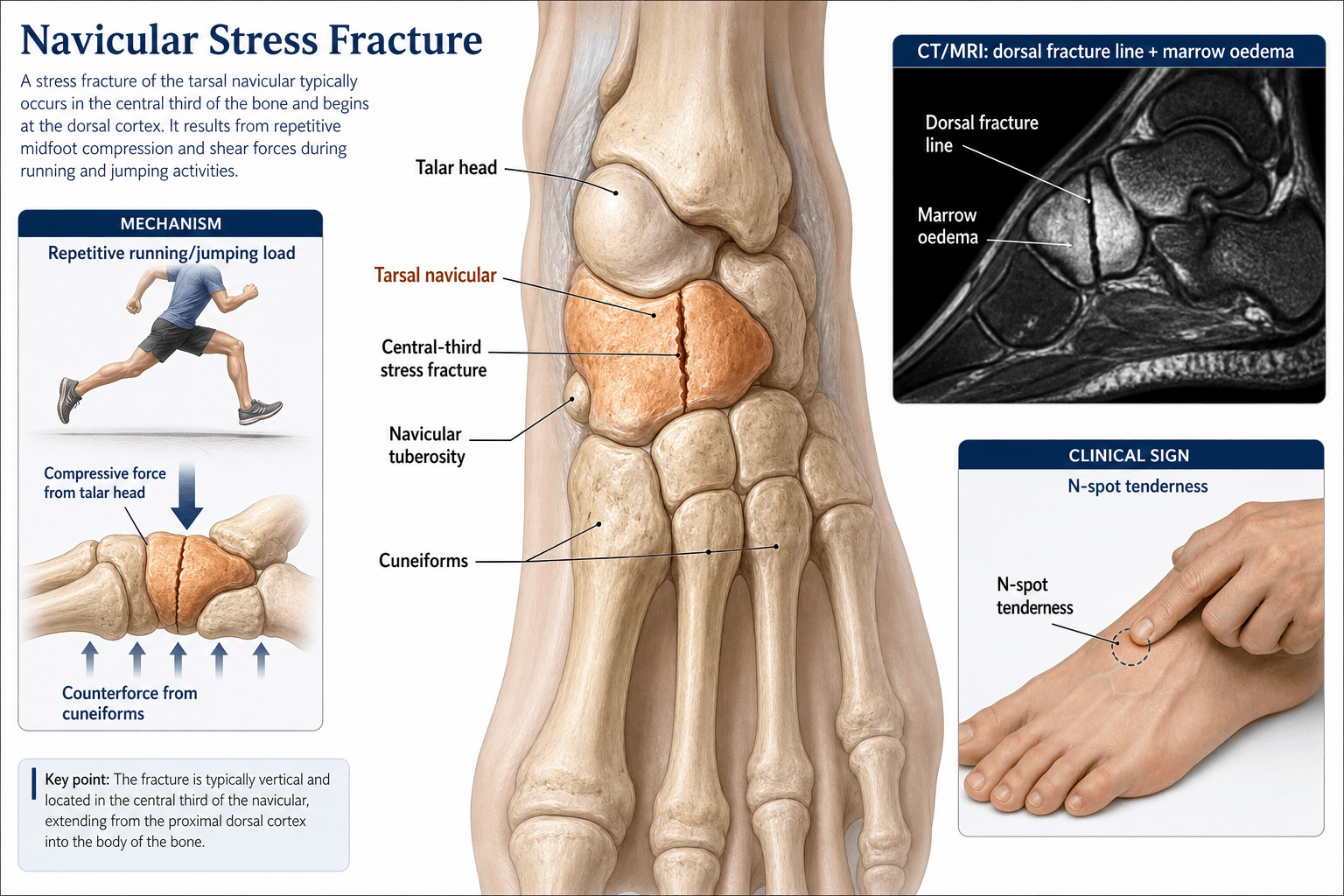
The watershed. The central third of the navicular is a vascular watershed. The medial side is perfused by branches of the posterior tibial artery and the lateral side by branches of the dorsalis pedis artery; the two systems converge at the central third but do not form a rich anastomotic network, so the central third has the lowest vascular density in the bone. The medial third, which articulates with the medial cuneiform and takes the tibialis anterior insertion, and the lateral third, which articulates with the lateral cuneiform and contributes to cuboid stability, both have robust healing potential. The central third bears the compressive load at the apex of the medial longitudinal arch, and it is where the stress fracture, and the delayed union or nonunion, occur.
What the anatomy actually shows. The dorsal-central watershed geography is real, but McKeon's cadaveric injection study found a frankly avascular central third in only 11.8% of specimens; most had a dense intraosseous supply throughout, and the authors concluded that biomechanical factors, the high compressive load at the watershed during sprinting and jumping, may matter more than avascularity. Manage the central-third fracture as high-risk because of the load and the fracture pattern, not on an assumption of universal avascularity.
The load. The navicular is the keystone of the medial longitudinal arch and the central third is the apex of bending: the compressive force transmitted through the talar head meets the counterforce from the cuneiforms during running and jumping. Ground reaction force is 2-3 times body weight in running and higher in jumping, and it is the cumulative impact cycles of running, jumping and cutting that do the damage. A cavovarus foot overloads the lateral column and concentrates stress at the navicular.
Why repair loses. Repetitive impaction of this hypovascular zone outstrips repair. The dorsal cortex is thinner than the plantar in many specimens, intramedullary pressure is relatively low, which limits endosteal healing, and cortical bone mounts only a limited periosteal callus. Microdamage accumulates, and because the biology of repair is limited even a recognised fracture heals slowly, while unrecognised fractures progress to complete or displaced patterns.
The fracture pattern. The fracture begins on the dorsal cortex, the compression side of the bending moment, and runs in the sagittal plane, propagating from proximal to distal across the central third; the sagittal direction reflects the orientation of the watershed zone. A short, dorsal, partial fracture is the hallmark of an early stress injury.
Classification and Types
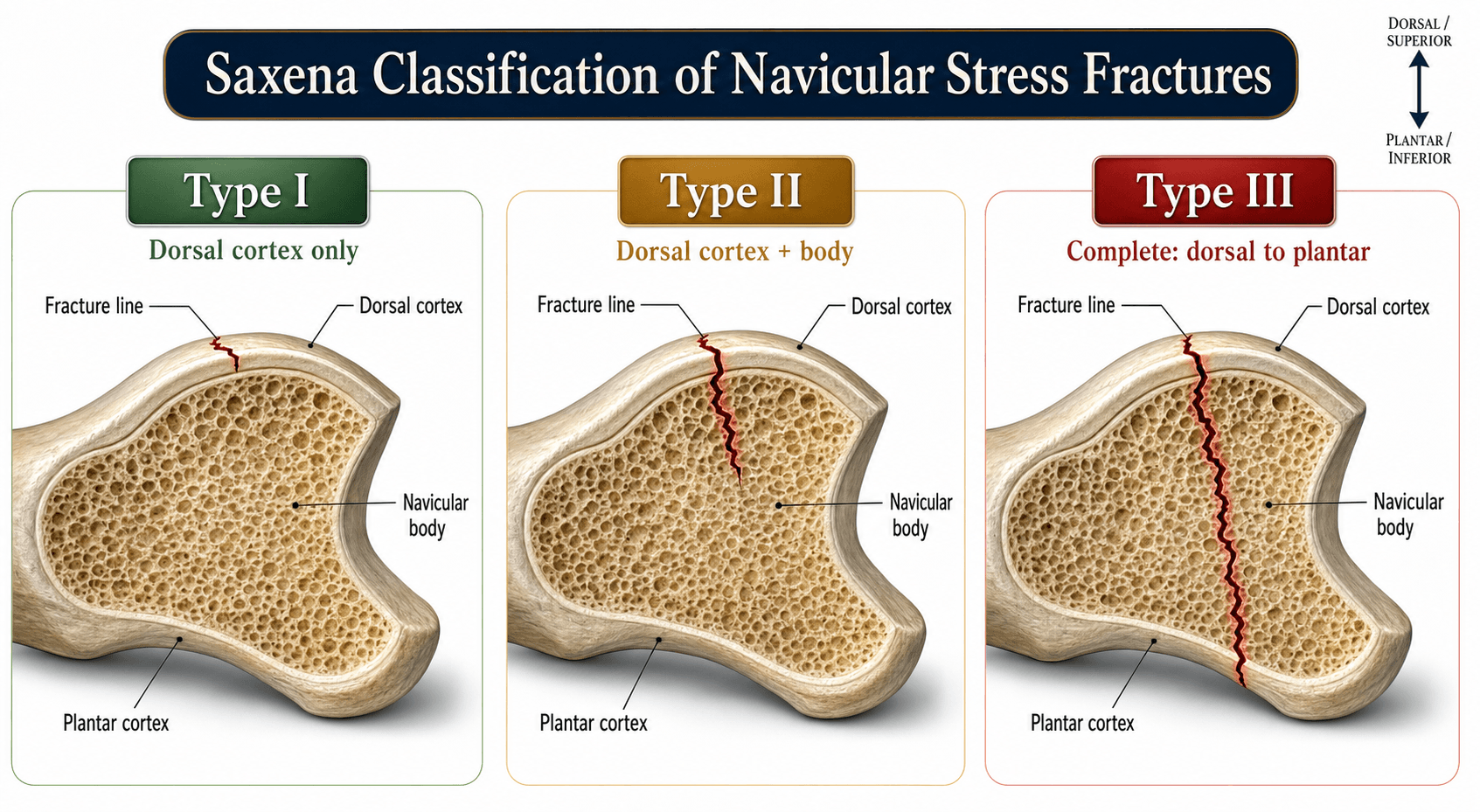
Saxena's classification is based on CT appearance and is the most useful treatment-stratification tool. Both feet are usually scanned, and the contralateral side is often used to plan screw length. MRI grading and clinical staging complement it: the athlete who can no longer train, runs with a limp, or has pain at rest has crossed from a stress reaction into an established or complete fracture.
- Fracture pattern
- Dorsal cortex fracture only, incomplete
- Treatment
- NWB cast 6-8 weeks
- Healing prognosis
- High union rate with offloading
- Fracture pattern
- Fracture extends into navicular body
- Treatment
- Operative fixation recommended
- Healing prognosis
- Good union with surgery
- Fracture pattern
- Fracture into opposite (plantar) cortex, displaced or comminuted
- Treatment
- ORIF, possible bone graft
- Healing prognosis
- Variable, depends on displacement and graft use
Clinical Assessment
Vague, activity-related midfoot pain in a running, jumping or cutting athlete must prompt an N-spot examination, a hop test and MRI even when the X-ray looks normal.
History. The onset is insidious and gradual, often weeks to months before presentation. The pain is a vague midfoot or dorsal midfoot ache, worse with push-off, that settles with rest and recurs when training resumes. Ask about the sport and the training load (sprinting, jumping, cutting, a sudden increase in mileage) and about prior treatment: many have already had physiotherapy, orthotics or imaging.
The N-spot. The dorsal aspect of the proximal navicular, palpated with the thumb between the tibialis anterior and extensor hallucis longus tendons. Tenderness here is positive in almost all cases, and firm thumb pressure reproduces the patient's pain in the majority. Tenderness is occasionally bilateral, so compare with the contralateral side.
Provocation. The single-leg hop test, hopping in place on the affected foot, reproduces the pain in nearly every symptomatic athlete and is the most useful provocative bedside test. Standing on tiptoe also reproduces the pain. In established cases the gait is antalgic or the push-off shortened, and foot posture should be assessed for cavovarus, planovalgus and limb-length discrepancy.
Investigations
The standard sequence in a high-performance athlete with vague midfoot pain is X-ray, then MRI if the X-ray is normal, then CT if the MRI is positive. Skipping the CT leaves the fracture ungraded and the need for fixation uncertain; skipping the MRI in a high-risk scenario (a high-performance sprinter, persistent pain despite non-weight-bearing) risks missing the diagnosis entirely.
Radiographs. AP, lateral and oblique views of the foot. Look for a sclerotic line in the central third, a cortical break on the dorsal aspect, cyst formation and, in chronic cases, a dorsal exostosis. Films are cheap and available and detect the established fracture, but they miss over 80 percent of early fractures: they are often normal for the first 4-6 weeks and normal in 70-80 percent of acute navicular stress fractures, so never rely on a normal X-ray to exclude the diagnosis.
MRI. The first imaging study of choice in a symptomatic athlete with normal X-rays. Fat-suppressed T2 or STIR sequences detect marrow oedema and T1 detects the fracture line; the findings are marrow oedema in the central third and a sagittal-plane fracture line on T1. Sensitivity approaches 100 percent for stress fracture and MRI detects the bone stress reaction, but it cannot always depict the full extent of the fracture, so a positive MRI is always followed by CT to classify by Saxena and plan management.
CT. Fine-cut (1 mm) CT in the plane of the navicular body with coronal and sagittal reformats. It shows the dorsal-cortex break, the extent of the fracture, displacement, sclerosis at the margins (nonunion) and cyst formation, and it is the best study for fracture morphology and for union. It cannot show oedema and it carries a radiation dose; its job is to grade the fracture and drive the decision between non-operative and operative management.
Other modalities. Ultrasound shows peritendinous oedema and the tibialis posterior tendon but has limited value for the navicular itself, an adjunct rather than a primary test. Bone scan is highly sensitive but poorly specific with no anatomic detail, and has largely been replaced by MRI.
Bone health. Recurrent stress fractures, features of the female athlete triad or a low BMI call for a DEXA scan, vitamin D, calcium, parathyroid hormone, oestradiol and a menstrual history, to identify and address the systemic component of the stress injury.
Differential Diagnosis
Activity-related midfoot or medial arch pain in an athlete has a broad differential, and the navicular stress fracture is the diagnosis not to miss. The named alternatives each have their own page where relevant: Accessory Navicular, Lisfranc injuries, Tarsal Coalition and Kohler Disease.
- Pain location and key features
- Dorsal proximal midfoot, the 'N-spot'; insidious pain, often normal early X-ray
- Discriminating finding and confirmatory test
- N-spot tender, hop test positive; sagittal central-body line on MRI (oedema) and CT (fracture line); high-risk for nonunion
- Pain location and key features
- Medial ankle and arch; pain and swelling along the tendon, progressive flatfoot
- Discriminating finding and confirmatory test
- Pain on resisted inversion, weak single-heel rise, arch collapse; tenderness along the tendon, not focal over the navicular; ultrasound or MRI of the tendon
- Pain location and key features
- Medial midfoot, between navicular and sustentaculum
- Discriminating finding and confirmatory test
- Medial arch collapse, valgus heel; MRI with attention to the ligament
- Pain location and key features
- Medial navicular tuberosity; medial prominence, often bilateral
- Discriminating finding and confirmatory test
- Bony prominence, tender over the accessory ossicle; ossicle at the medial tuberosity on plain X-ray, MRI for oedema; chronic, not a sagittal body line
- Pain location and key features
- Dorsal midfoot, multiple joints; older or post-injury
- Discriminating finding and confirmatory test
- Stiffness, crepitus, prior injury; joint-space narrowing and osteophytes on weight-bearing X-ray, CT
- Pain location and key features
- Tarsometatarsal region
- Discriminating finding and confirmatory test
- Pain on stress testing, swelling, inability to hop; weight-bearing X-ray, MRI
- Pain location and key features
- Rigid flatfoot, peroneal spasm
- Discriminating finding and confirmatory test
- Restricted subtalar motion, pes planus; CT or MRI of the hindfoot
- Pain location and key features
- Child with limp and medial midfoot pain
- Discriminating finding and confirmatory test
- Sclerotic, flattened navicular in a child; self-limiting osteochondrosis
- Pain location and key features
- Activity-related forefoot or midfoot pain
- Discriminating finding and confirmatory test
- Localising tenderness and MRI/CT site differ
A subtle Lisfranc injury can mimic a navicular stress fracture. Both cause midfoot pain, both can present after a low-energy twisting episode, and both can produce pain on single-leg hop. Weight-bearing X-rays (or a weight-bearing CT) and a careful examination of the tarsometatarsal joints are essential to avoid a missed Lisfranc.
Management Algorithm
The algorithm. Treatment is stratified by Saxena type on CT. A Type I incomplete dorsal-cortex fracture is treated with a non-weight-bearing cast for 6-8 weeks; Type II and III fractures go to headless compression screw fixation from lateral to medial, often with bone graft; and return to sport is 4-6 months either way. That reflects widespread practice, but it is not a demonstrated superiority, and the strongest synthesis available points the other way.
What the evidence actually shows. Torg's meta-analysis (Am J Sports Med 2010;38(5):1048-53, PMID 20197494) pooled the published series into three strategies and found no statistically significant difference between non-weight-bearing conservative treatment and surgery (P = 0.6441), with a trend favouring NWB: 96% successful outcomes against 82% for surgery. Its stated conclusion is that non-weight-bearing management is the standard of care for both partial and complete stress fractures. What the same analysis establishes beyond doubt is that weight-bearing "rest" is inferior to both (P = 0.0001 versus NWB; P less than 0.0003 versus surgery), and that is the real error to avoid.
Saxena's own prospective series reported a return to activity of 4.0 months overall, with Type III at 4.2 months, and concluded that these fractures can take four months to heal with nonoperative or operative treatment, a null result on treatment. The earlier retrospective figure of 3.1 months for surgery against 4.3 for conservative care came from nine versus thirteen patients in whom fracture type and treatment were inseparable, because Type I fractures were significantly more likely to be managed conservatively.
The defensible position. Strict non-weight-bearing immobilisation is the default for every type, including complete fractures. Fixation is a reasonable option, not an obligation, for the Type III or sclerotic fracture, the established non-union, and the athlete who has already failed conservative treatment or for whom the certainty of a construct is worth the operative risk. Present it as a choice with no proven outcome advantage, not as the required treatment.
- Diagnosis
- MRI oedema, CT confirms dorsal-cortex fracture
- Treatment
- NWB cast 6-8 weeks for Type I incomplete
- Key Pearl
- X-ray often normal - do not be falsely reassured
- Diagnosis
- CT shows fracture extending into body (Type II)
- Treatment
- Headless compression screw, percutaneous
- Key Pearl
- Screw from lateral to medial, central in both planes
- Diagnosis
- CT or MRI shows fracture into opposite cortex (Type III)
- Treatment
- ORIF with screw and bone graft, NWB post-op
- Key Pearl
- Address cavovarus or limb-length risk factors
Goal. Offload the watershed zone, allow biological union and prevent progression to a complete fracture. This is the treatment of the Type I incomplete dorsal-cortex fracture, and under Torg's analysis the default for every type.
Treatment Protocol
A below-knee cast in neutral, or a removable boot, which many surgeons use for hygiene, with crutches and strict non-weight-bearing for a minimum of 2 weeks in cast. Paracetamol for analgesia; avoid NSAIDs in early healing for their theoretical effect on bone healing. Explain the watershed biology, the high-risk status and the 6-8 week offloading requirement.
Continue the non-weight-bearing cast to a total of 6-8 weeks, with CT at 6 weeks to assess union before allowing weight-bearing. Optimise calcium, vitamin D and protein, and investigate relative energy deficiency in sport (RED-S) in thin athletes. Review the cavovarus assessment, training errors and footwear.
Repeat CT looking for bridging callus across the fracture. If united, return gradually to weight-bearing in a boot and then to activity. If not, consider a bone stimulator, prolonged casting, or conversion to operative fixation.
Weight-bearing through an incomplete dorsal-cortex fracture propagates the fracture line, and the most common reason for nonunion is a partially compliant athlete who bears weight in the boot. Treat Type I fractures with the same respect as Type II: non-weight-bearing cast for 6-8 weeks and confirm union with CT before any return to running.
Return to sport. Once the cast is off, cast-treated and fixed fractures follow the same graded progression, and the same gate applies to both:
- Weeks 8-12: protected weight-bearing, low-impact cross-training (swimming, cycling); after fixation, intrinsic foot, calf and tibialis posterior strengthening begin here
- Weeks 12-16: walk-jog progression on flat ground; after cast treatment, intrinsic foot strengthening begins here
- Weeks 16-24: graduated return to running, sport-specific drills
- Full sport at 4-6 months: pain-free hop, no N-spot tenderness, CT-confirmed union
A navicular stress fracture is a biomechanical and metabolic warning sign, and fixing the bone without finding the cause invites recurrence, and a fracture on the other foot. The high-performance sprinter with a normal training load and a normal foot still has the diagnosis; but if the load is excessive, the foot is cavus, the oestradiol is low or the vitamin D is depleted, the next fracture is already on its way. Work it up on two axes before any return-to-sport plan:
- Mechanical / structural: examine for a cavovarus foot, hindfoot varus, a plantarflexed first ray, equinus, and limited subtalar/midfoot motion that overload the medial column and navicular; assess footwear and prescribe orthotics to offload, and consider deformity correction for a true cavovarus foot. A cavovarus foot should also prompt a peripheral-neuropathy screen (Charcot-Marie-Tooth).
- Metabolic / load: screen for relative energy deficiency in sport (RED-S) / the athlete triad (low energy availability, menstrual dysfunction, low BMD), check vitamin D and calcium, and review training-load error (rapid increase, hard surfaces); these drive both the index fracture and the recurrence.
- Bilateral and recurrence: these fractures are frequently bilateral and recurrent, so have a low threshold to image the contralateral foot and to counsel the athlete that return must be graded and cause-corrected.
Surgical Technique
Approach. A limited open or percutaneous lateral incision over the lateral navicular. For a complete fracture without nonunion, percutaneous fixation is reasonable; an established nonunion or sclerosis usually requires open debridement and grafting. The open cases, a comminuted fracture, a nonunion requiring debridement or a failed percutaneous fixation, are exposed through a medial or dorsomedial approach.
Preparation and reduction. Curette the fibrous tissue at the fracture site and debride sclerotic margins back to bleeding bone, then reduce anatomically under direct vision and fluoroscopy before any drilling.
The screw. Pass the guidewire from lateral to medial across the central third along its long axis, perpendicular to the fracture and central in both planes, and confirm its position on AP, lateral and oblique views. Medial-to-lateral is avoided because of the risk to tibialis anterior and the saphenous nerve. Over the wire goes a cannulated headless compression screw of 3.0 to 4.5 mm (commonly 4.0-4.5 mm) with the threads crossing the fracture, compressing it by lag technique or with a partially threaded screw; single or double, the double screw increasingly used for rotational control; in the open case a mini-fragment plate is the alternative. Plan the length from the contralateral foot, foot length being reasonably symmetric, but confirm it on CT or fluoroscopy rather than assume.
A headless compression screw is buried beneath the articular cartilage of the lateral navicular. A headed screw can impinge on the talar head during dorsiflexion and produce pain or cartilage damage. Headless designs allow later hardware removal only if symptomatic, which is uncommon.
Graft. Cancellous autograft from the distal tibia or calcaneus for an established nonunion, for sclerotic or cystic margins, or to fill a defect; do not rely on the screw alone in an established nonunion.
Before closing. Confirm the reduction and the hardware position fluoroscopically, and check that no screw penetrates a joint.
Complications
- Incidence
- 10-30 percent with non-operative care, lower with surgery
- Risk Factors
- Watershed biology, weight-bearing during healing, delayed diagnosis
- Management
- Compression screw with bone graft for atrophic nonunion
- Incidence
- 5-10 percent in high-level athletes
- Risk Factors
- Early return to sport, unaddressed biomechanics, RED-S
- Management
- Repeat NWB cast or surgery; correct risk factors
- Incidence
- 5-10 percent with screw fixation
- Risk Factors
- Lateral screw head prominence, low-profile not used
- Management
- Hardware removal after union confirmed
- Incidence
- Rare, more in neglected complete fractures
- Risk Factors
- Disruption of central-third watershed supply
- Management
- Arthrodesis for advanced collapse
- Incidence
- Variable, long-term
- Risk Factors
- Intra-articular fracture, prolonged immobilisation, residual deformity
- Management
- Orthotic support, arthrodesis if symptomatic
- Incidence
- 5-15 percent
- Risk Factors
- Cavovarus foot, RED-S, coexisting midfoot pathology
- Management
- Address foot posture, nutrition, training load
Outcomes and Prognosis
- Setting
- Type I incomplete dorsal fracture
- Union rate
- 85-100 percent
- Return to sport
- 4-6 months from injury
- Setting
- Complete fracture without displacement
- Union rate
- 90-100 percent
- Return to sport
- 4-6 months post-op
- Setting
- Displaced or chronic nonunion
- Union rate
- 80-95 percent
- Return to sport
- 6-9 months post-op
- Setting
- Late presentation, partial weight-bearing
- Union rate
- 30-60 percent
- Return to sport
- Often converts to surgery
- Better outcome
- Under 3 months from symptom onset
- Worse outcome
- Over 6 months - established nonunion
- Better outcome
- Type I (incomplete dorsal)
- Worse outcome
- Type III (displaced into opposite cortex)
- Better outcome
- Strict NWB for 6-8 weeks
- Worse outcome
- Partial weight-bearing during healing
- Better outcome
- None, normal foot posture, balanced nutrition
- Worse outcome
- Cavovarus, RED-S, training error, vitamin D deficiency
The single most powerful predictor of union is the time from symptom onset to definitive management. Athletes managed within 3 months of symptom onset have a high union rate with appropriate care, while those presenting after 6 months face a substantial nonunion rate regardless of the technique used. Treat the clock as well as the bone.
Guidelines, Registries & Global Practice
- Navicular stress fracture is the most common tarsal stress fracture and accounts for 15-35 percent of all stress fractures in athletic cohorts
- Highest incidence in elite sprinters, hurdlers, middle-distance runners, jumpers, and dancers; also well documented in military recruits undergoing basic training
- Mean age of presentation is in the second and third decades, with no consistent sex predominance once exposure is controlled
- Bilateral stress reaction is present in up to 25 percent of cases, often subclinical, and warrants bilateral imaging in a high-risk athlete
- High-resource centres: MRI within 24-48 hours, CT for grading, headless compression screw sets, dedicated foot and ankle surgery, athlete-specific rehabilitation
- Limited-resource settings: X-ray plus clinical examination may be the only available tools; treat on clinical suspicion with NWB cast and refer if nonunion develops
- Universal principle: outcome depends on time to diagnosis and strict NWB compliance, not on the cost of the implant
- Telemedicine and image-sharing now allow rural or overseas athletes to share MRI and CT with specialist centres for triage
- Diagnostic emphasis
- High index of suspicion in athletes; N-spot and hop test as bedside tests
- Treatment emphasis
- Stratify by CT (Saxena); NWB cast for Type I, surgery for Type II and III
- Return-to-sport gate
- CT-confirmed union, full pain-free hop, graduated running
- Diagnostic emphasis
- MRI as the imaging test of choice after normal X-ray
- Treatment emphasis
- Surgical fixation recommended for complete fractures in athletes
- Return-to-sport gate
- Symptom-free plus CT or MRI union
- Diagnostic emphasis
- MRI for early diagnosis; CT for surgical planning
- Treatment emphasis
- Operative fixation with headless compression screw and bone graft as needed
- Return-to-sport gate
- Pain-free function plus imaging-confirmed union
- Diagnostic emphasis
- Mandatory evaluation of vague midfoot pain in elite and military athletes
- Treatment emphasis
- Surgical fixation increasingly favoured for complete fractures in high-demand athletes
- Return-to-sport gate
- Graduated return with bone-strain monitoring where available
There is no dedicated registry for navicular stress fracture in the way there is for arthroplasty (NJR, AJRR, AOANJRR). The evidence base is built on retrospective series, the Saxena classification cohort, systematic reviews, and a small number of prospective diagnostic-accuracy studies. Registries of stress injuries in elite athletes and military populations (such as the Australian Defence Force and US Army bone-health programmes) increasingly inform return-to-duty decisions.
Record in every suspected navicular stress fracture:
- Mechanism (sport, training load, recent change) and time from symptom onset
- N-spot and single-leg hop test findings
- Imaging performed: X-ray, MRI (oedema, fracture line), CT (Saxena type)
- Treatment chosen: NWB cast versus surgery, with rationale linked to Saxena type
- Plan for return to sport gated on CT-confirmed union and pain-free function
- Screening for systemic drivers (vitamin D, RED-S, training error, foot posture)
A missed navicular stress fracture that progresses to nonunion is a recurring source of complaints and claims in elite and recreational sport worldwide. Document the index of suspicion, the imaging pathway, and the shared return-to-sport decision.
Controversies & Areas of Uncertainty
Some centres still attempt NWB cast immobilisation for selected Type II fractures, particularly in low-demand or skeletally immature patients. High-demand athletes increasingly receive surgical fixation because union rates are higher and return to sport is faster. The decision remains patient-centred and surgeon-dependent.
Autograft remains the standard for atrophic nonunion. The role of bone morphogenetic protein, platelet-rich plasma, and pulsed electromagnetic bone stimulators in navicular stress fracture is not defined by high-quality trials. Their use is a surgeon-and-patient decision and not the standard of care.
Most guidelines now require CT-confirmed union in addition to pain-free function before return. Some clinicians rely on symptoms and MRI alone. The imaging-confirmed union standard is more conservative and probably safer, but it is not validated by a single randomised trial.
Routine hardware removal is not required, but lateral prominence, irritation of the tibialis anterior tendon, and symptomatic hardware are indications. The threshold varies between surgeons and patients. There is no consensus on prophylactic removal in elite athletes.
MCQ Practice Points
Q: Why is the central third of the navicular prone to stress fracture? A: The central third is a vascular watershed. The medial half is perfused by the posterior tibial artery and the lateral half by the dorsalis pedis artery. These two systems converge at the central third without forming a rich collateral network, so the zone has limited biological reserve to repair repetitive microdamage.
Q: A 24-year-old sprinter has 6 weeks of vague midfoot pain and a normal X-ray. What is the next investigation? A: MRI. Plain X-ray is normal in 70-80 percent of acute navicular stress fractures, and MRI is the most sensitive test. Once MRI confirms the injury, CT is required to grade by Saxena and plan management.
Q: How does the Saxena classification influence management? A: Type I (incomplete dorsal-cortex fracture) is managed with a non-weight-bearing cast for 6-8 weeks. Type II (fracture extending into the body) and Type III (fracture into the opposite cortex or displaced) are managed with operative fixation, typically a headless compression screw placed from lateral to medial, often with bone graft in chronic cases.
Q: Describe the screw trajectory and implant choice for navicular stress fracture fixation. A: A 3.0 to 4.5 mm headless compression screw placed from lateral to medial, through the central third of the navicular, perpendicular to the fracture line. The headless design allows burial beneath the lateral cartilage and avoids impingement on the talar head.
Q: What is the strongest predictor of outcome in navicular stress fracture? A: Time from symptom onset to definitive management. Athletes treated within 3 months of symptom onset have a high union rate, while those presenting after 6 months face a substantial nonunion rate regardless of technique. Diagnostic delay is the single biggest modifiable cause of poor outcome.
Q: When is return to full sport safe after a navicular stress fracture? A: When the patient is pain-free, has no N-spot tenderness, has a negative single-leg hop test, and has CT-confirmed bridging callus across the fracture. The average return to full sport is 4-6 months from injury, longer in established nonunion or with re-fracture.
Exam Viva Scenarios
Practise clinical reasoning and management decisions out loud
“A 22-year-old elite 400 m sprinter presents with 8 weeks of vague dorsal midfoot pain. Pain comes on with training and eases with rest, but has not settled. He has been running through the pain for the national championships. X-rays taken by his team doctor 6 weeks ago were reported as normal. On examination, the foot looks normal, but firm thumb pressure over the dorsal proximal navicular reproduces his pain. Single-leg hop on the affected side reproduces the pain; contralateral side is comfortable. How do you proceed?”
“A 35-year-old recreational runner presents with 9 months of dorsal midfoot pain. He was treated with an elastic bandage and activity modification by his primary care physician. Pain has progressed and he now has pain at rest and a mild limp. CT shows a complete sagittal fracture of the central third with sclerotic margins and a small cyst at the proximal fragment. What is your diagnosis and how do you manage this?”
Evidence Base and Key Trials
Intraosseous and extraosseous arterial anatomy of the adult navicular
- Cadaveric injection study mapped the extraosseous and intraosseous blood supply of the navicular
- Central third receives contributions from medial (posterior tibial) and lateral (dorsalis pedis) sources that converge but do not anastomose freely
- Dorsal-central region identified as the most consistent watershed zone, explaining the sagittal orientation of the typical fracture
- But a FRANK avascular zone in the central third was present in only 11.8% of specimens - most had a dense intraosseous supply throughout, so avascularity alone does not explain the slow healing
The non-surgical and surgical treatment of tarsal navicular stress fractures
- Comprehensive review of non-operative and operative strategies for navicular stress fractures
- Non-weight-bearing cast immobilisation remains first-line for incomplete dorsal-cortex fractures
- Surgical fixation with compression screw recommended for complete fractures in athletes
- Return to sport timelines and nonunion risk stratified by fracture completeness
Results of treatment of 22 navicular stress fractures and a new proposed radiographic classification system
- Three-type radiographic classification proposed that underpins the modern Saxena CT system
- Type I (dorsal cortex) treated successfully with non-weight-bearing cast
- Type II and III fractures showed improved outcomes with operative fixation
- Established the principle that fracture extent on imaging drives treatment choice
Overuse injuries in sport: the foot
- Early description of navicular stress fracture patterns in athletes by the group that defined the entity
- Highlighted the central-third location and diagnostic difficulty on plain films
- Advocated non-weight-bearing for incomplete injuries and surgical consideration for complete ones
- Established the clinical framework still referenced in modern high-risk stress fracture protocols