HGD Deficiency | Homogentisic Acid | Ochronotic Pigment | Spine-First Arthropathy
- Autosomal recessive deficiency of homogentisate 1,2-dioxygenase (HGD) in the tyrosine pathway
- Homogentisic acid (HGA) accumulates, polymerises and binds collagen as a dark ochronotic pigment
- Black urine from birth, but arthropathy and pigment (ochronosis) appear only in the 4th decade
- Spine is affected first: disc calcification and narrowing precede peripheral joint disease
- Nitisinone (a HPPD inhibitor) lowers HGA by ~99% but causes tyrosinaemia/keratopathy
- “Classic triad: dark urine, ochronotic pigmentation, ochronotic arthropathy
- “Diagnosis confirmed by elevated urinary homogentisic acid
- “Disc calcification with vacuum phenomena is the hallmark spine radiograph
- “Differentiate from ankylosing spondylitis: AKU spares sacroiliac joints early and is HLA-B27 negative
Overview
Alkaptonuria (AKU) is a rare autosomal recessive inborn error of tyrosine metabolism. The connective-tissue disease it causes downstream is ochronosis, and the joint disease that results is ochronotic arthropathy. Examiners expect the defining triad recited: dark urine, ochronotic pigmentation of connective tissue, and a progressive arthropathy.
The time course. The enzyme block is present from birth, so the urine darkens on standing from infancy. The pigment that damages tissue takes decades to accumulate, and ochronosis and arthropathy are usually silent until the fourth decade of life. Patients therefore often reach orthopaedics with "early, severe, spine-dominant osteoarthritis" long before the metabolic diagnosis is made.
Why it is examined. A single enzyme defect leads to a recognisable arthropathy, a classic spine radiograph, a named disease-modifying drug (nitisinone) and several spot-diagnosis signs: scleral and ear pigment, black urine, and dark cartilage seen intra-operatively. The topic rewards the candidate who can move smoothly from biochemistry to imaging to management.
Endogenous vs Exogenous Ochronosis
This page uses "ochronosis" as a synonym for alkaptonuria, but the word actually describes the blue-black tissue pigmentation itself, which has two quite different causes. An examiner who asks "is all ochronosis alkaptonuria?" wants this distinction.
Endogenous (metabolic) ochronosis is alkaptonuria: a systemic, autosomal recessive HGD deficiency in which homogentisic acid polymerises and deposits in cartilage, discs, sclera, valves and tendons, producing the systemic ochronotic arthropathy.
Exogenous (acquired) ochronosis is a localised, skin-limited pigmentation with normal HGA and no arthropathy. It is caused by chronic external exposure to certain chemicals, most importantly long-term topical hydroquinone in skin-lightening or bleaching creams, and historically phenol, resorcinol, picric acid and some antimalarials. The chemical inhibits local homogentisic acid oxidase in the dermis, so HGA polymerises and deposits as identical-looking pigment, but only in the treated skin.
- Endogenous (alkaptonuria)
- Inherited HGD deficiency (systemic)
- Exogenous (acquired)
- Chronic topical hydroquinone (or phenol/resorcinol)
- Endogenous (alkaptonuria)
- Markedly raised; urine blackens
- Exogenous (acquired)
- Normal; urine normal
- Endogenous (alkaptonuria)
- Systemic: cartilage, discs, sclera, valves, tendons
- Exogenous (acquired)
- Localised to the skin exposed to the agent (e.g. face)
- Endogenous (alkaptonuria)
- Yes - the defining orthopaedic burden
- Exogenous (acquired)
- No
- Endogenous (alkaptonuria)
- Nitisinone + supportive/arthroplasty
- Exogenous (acquired)
- Stop the offending agent; cosmetic/dermatological
For the orthopaedic surgeon the practical point runs the other way. The systemic, arthropathy-causing ochronosis met at the operating table is essentially always the endogenous, alkaptonuric form, but knowing that a skin-limited, HGA-negative exogenous variant exists is the higher-mark answer.
Mechanism, Pathophysiology and Core Concepts
The tyrosine degradation pathway. Phenylalanine and tyrosine are catabolised through a sequential enzymatic pathway, and ochronosis is caused by a block at a single step:
- Phenylalanine to tyrosine (phenylalanine hydroxylase)
- Tyrosine to 4-hydroxyphenylpyruvate (tyrosine aminotransferase)
- 4-hydroxyphenylpyruvate to homogentisic acid, HGA (4-hydroxyphenylpyruvate dioxygenase, HPPD)
- HGA to maleylacetoacetate (homogentisate 1,2-dioxygenase, HGD) - the step blocked in AKU
- Maleylacetoacetate eventually to fumarate and acetoacetate
The defect. The deficient enzyme is HGD, on chromosome 3q13, and the defect is autosomal recessive. With HGD absent, HGA cannot be opened to maleylacetoacetate and accumulates massively. HPPD, which makes HGA one step upstream, is still active, and this pathway logic is what makes nitisinone rational therapy.
- Reaction
- Makes HGA (upstream)
- Status in AKU
- Active
- Therapeutic Relevance
- Target of nitisinone - block it to reduce HGA
- Reaction
- Breaks down HGA
- Status in AKU
- Deficient - the primary defect
- Therapeutic Relevance
- The missing enzyme
Classification and Patterns of Involvement
There is no single named classification of ochronosis. Examiners expect you to organise the disease by system involvement and by the typical sequence in which sites are affected.
- Typical Finding
- Disc calcification, narrowing, vacuum phenomena, ankylosis
- Timing
- Earliest
- Clinical Note
- Most disabling; precedes peripheral disease
- Typical Finding
- Ochronotic OA of knee greater than hip greater than shoulder
- Timing
- After spine
- Clinical Note
- Black cartilage seen at arthroplasty
- Typical Finding
- Relatively spared early
- Timing
- Late
- Clinical Note
- Helps distinguish from ankylosing spondylitis
- Typical Finding
- Aortic valve pigment, calcification, stenosis
- Timing
- Mid-late
- Clinical Note
- Needs echocardiographic surveillance
- Typical Finding
- Embrittlement, spontaneous rupture (e.g. Achilles)
- Timing
- Variable
- Clinical Note
- Pigmented tissue at repair
- Typical Finding
- Blue-grey ochronotic pigment
- Timing
- From 4th decade
- Clinical Note
- Visible spot-diagnosis signs
- Typical Finding
- Stones (HGA-related)
- Timing
- Variable
- Clinical Note
- Can be the presenting feature
Clinical Presentation
In childhood. Dark-staining urine, noticed on nappies and underwear, is often the only sign and is frequently missed.
From the fourth decade. The axial features are insidious, chronic low back pain and stiffness, reduced spinal mobility, loss of lumbar lordosis and progressive stiffening towards ankylosis. Progressive large-joint pain follows as osteoarthritis sets in, the knee most commonly, with effusions and mechanical symptoms from cartilage fragments. Embrittled tendons can rupture spontaneously, classically the Achilles.
Spot signs. Look for the pigment in four places:
- Sclera - slate-blue pigment between the cornea and the canthus
- Pinna - blue-grey, thickened, leathery ear cartilage, with dark cerumen
- Skin - blue-grey discolouration over sweat-gland-rich areas
- Articular cartilage - jet-black at arthroplasty
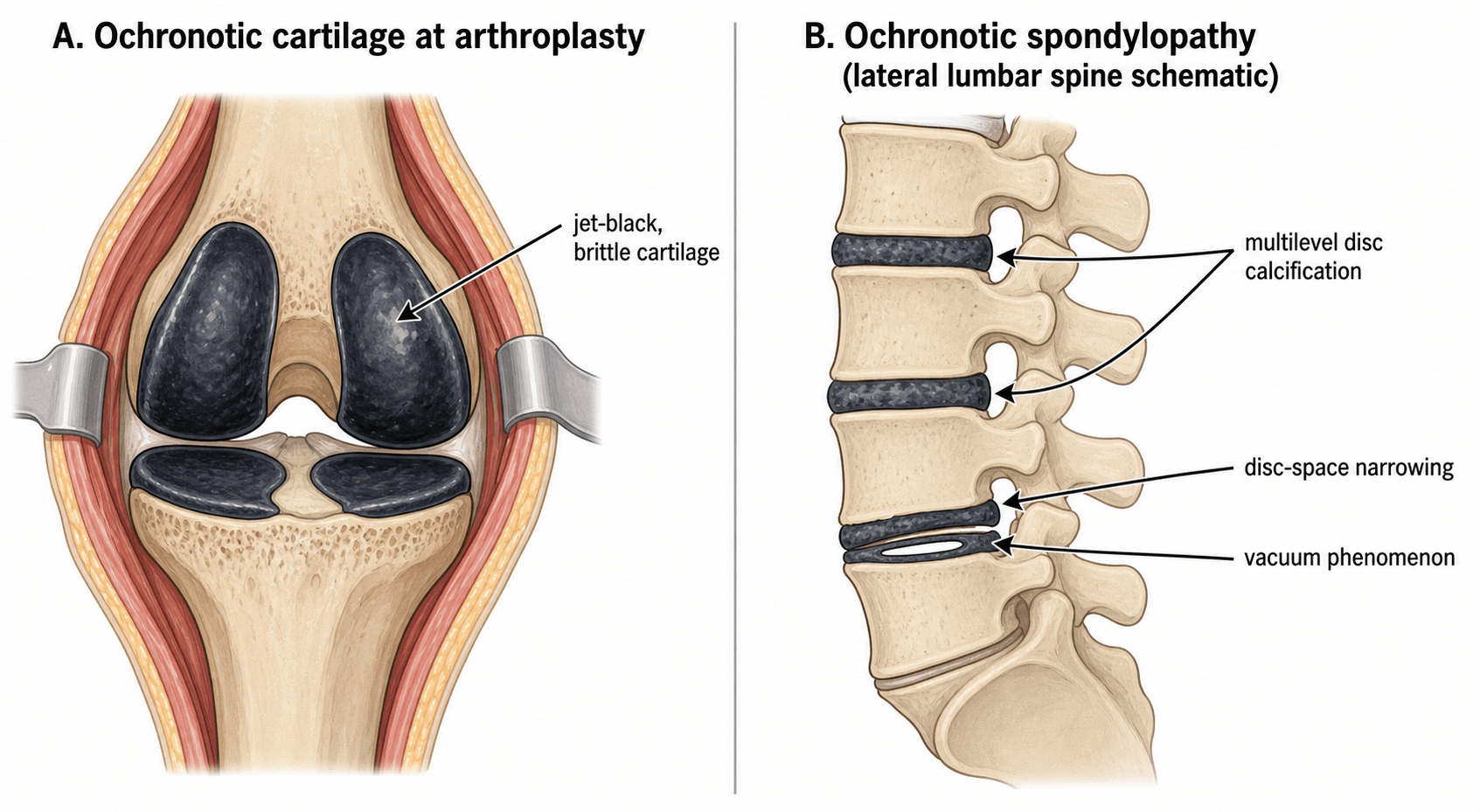
Beyond the joint. The heart shows aortic valve pigmentation and stenosis, aortic root involvement, and coronary and valvular calcification. Renal and prostatic calculi are the genitourinary manifestation.
A patient presenting with severe, early, spine-dominant osteoarthritis plus a heart murmur or renal stones should prompt consideration of ochronosis. The aortic valve disease can be clinically important and warrants echocardiographic assessment.
Investigations
Confirming the diagnosis. The diagnosis is biochemical, not radiological, and centres on demonstrating homogentisic acid. Elevated urinary HGA, quantified by gas chromatography-mass spectrometry, is the definitive test. Urine that turns black on standing or on alkalinisation, as its HGA oxidises, is the classic bedside clue: a memorable demonstration, but not the definitive test.
Supporting tests. Serum HGA and tyrosine are measurable, and tyrosine becomes especially relevant when monitoring nitisinone therapy. HGD gene analysis confirms the autosomal recessive defect; many pathogenic variants have been described worldwide.
Differential Diagnosis
Do not stop at "not ankylosing spondylitis". Each cardinal sign has its own differential, and the unifying discriminator for ochronosis is a raised urinary homogentisic acid: everything else fails that test.
- Differential to consider
- CPPD (chondrocalcinosis), haemochromatosis arthropathy, DISH, ankylosing spondylitis, prior discitis
- Discriminator
- Ochronosis = HGA-positive + black urine; CPPD = calcium pyrophosphate crystals (see pseudogout-cppd-disease); haemochromatosis = iron studies, hook osteophytes 2nd/3rd MCP (see haemochromatosis-arthropathy); DISH = flowing anterior ossification, preserved discs
- Differential to consider
- Alkaptonuria, porphyria, haematuria, myoglobinuria, melanuria (metastatic melanoma), bile pigment, drugs/food (rifampicin, methyldopa, metronidazole, levodopa, beetroot)
- Discriminator
- Alkaptonuria darkens slowly on standing/alkali and is HGA-positive; myoglobin/haemoglobin are dipstick-positive for blood; porphyria darkens on light exposure
- Differential to consider
- Ochronosis, argyria (silver), minocycline pigmentation, amiodarone, chrysiasis (gold), Addison's, haemochromatosis
- Discriminator
- Ochronosis pigments the conjunctiva-free sclera in a wedge between cornea and canthus and the ear cartilage; drug causes follow exposure history; Addison's = mucosal/palmar-crease pigment with low cortisol
- Differential to consider
- Ochronosis, haemochromatosis, CPPD, acromegaly, avascular necrosis, post-traumatic OA
- Discriminator
- Look for the systemic clues (urine, pigment, iron studies, growth features) - 'OA too young, too severe, too symmetric' is the trigger to look deeper
Both can cause a stiff, fused spine, but the mechanisms differ. AKU: HLA-B27 negative, dense disc calcification, early sparing of the sacroiliac joints, black urine. Ankylosing spondylitis: HLA-B27 associated, syndesmophytes/bamboo spine, early bilateral sacroiliitis, no urinary colour change.
Management
Management has two arms: disease-modifying metabolic therapy to reduce HGA, and supportive and orthopaedic care for the connective-tissue damage that pigment has already caused.
Nitisinone. Nitisinone inhibits 4-hydroxyphenylpyruvate dioxygenase (HPPD), the enzyme upstream of the block, and by preventing HGA formation it dramatically reduces the substrate that drives ochronosis. AKU is a teaching example of rational drug design for this reason: the defect is loss of a downstream enzyme, so blocking the upstream enzyme reduces the toxic intermediate.
The trials. SONIA 1 showed a clear dose-dependent fall in urinary HGA across 1-8 mg, with ~99% reduction at 8 mg. In the SONIA 2 randomised trial, 10 mg daily reduced 24-h urinary HGA by ~99.7% at 12 months and slowed clinical disease progression, with a lower cAKUSSI score at 48 months than no treatment.
The trade-off. Blocking HPPD raises tyrosine in serum and tissues, an acquired tyrosinosis that risks corneal keratopathy, potentially sight-threatening. The drug treats the cause but introduces a new metabolic problem to manage, which illustrates the principle that re-routing a metabolic pathway shifts, rather than abolishes, the metabolic burden.
Patients on nitisinone require tyrosine monitoring, ophthalmic vigilance for keratopathy, and often dietary protein modification to mitigate the tyrosine rise.
Complications
The disease accumulates complications across the spine, joints, heart, tendons and urinary tract, and its treatment adds one of its own:
- Axial disability - progressive disc calcification, narrowing and ankylosis cause chronic back pain, loss of spinal mobility and, rarely, neurological compromise
- Peripheral arthropathy - premature, severe osteoarthritis of the knee, hip and shoulder, often requiring multiple arthroplasties
- Cardiac disease - aortic valve and root involvement, with valvular and vascular calcification needing surveillance and sometimes valve replacement
- Tendon rupture - classically the Achilles
- Stone disease - renal and prostatic calculi related to HGA, occasionally the presenting feature
- Treatment-related - nitisinone-induced hypertyrosinaemia can cause corneal keratopathy and, with very high tyrosine, neurocognitive concerns, hence monitoring
Guidelines, Registries & Global Practice
Ochronosis is a rare disease, so practice is shaped by specialist centres and rare-disease frameworks rather than mainstream arthroplasty guidelines. The biology is universal; access to diagnosis and to nitisinone is not.
Global Epidemiology
- Alkaptonuria is rare worldwide, with an estimated birth prevalence of roughly 1 in 250,000 to 1 in 1,000,000 in most populations.
- Geographic clusters of much higher prevalence exist, notably in Slovakia and parts of the Dominican Republic, reflecting founder effects in the HGD gene.
- Many distinct pathogenic HGD variants have been catalogued internationally (for example, large variant cohorts described in Russia), underpinning genetic confirmation and family screening.
Therapy Access and Regulatory Status
- Position
- Nitisinone lowers HGA by ~99% (SONIA trials)
- Practical Implication
- Mainstay where available; needs metabolic supervision
- Position
- Dedicated AKU services (e.g. UK National Alkaptonuria Centre)
- Practical Implication
- Concentrate expertise, monitoring and dietetics
- Position
- Tyrosine, ophthalmology, dietetics
- Practical Implication
- Mandatory alongside nitisinone
- Position
- Standard arthroplasty principles apply
- Practical Implication
- Plan for multi-joint disease and poor tissue quality
There is broad consensus that HGA-lowering with nitisinone plus structured monitoring is the rational disease-modifying approach, and that end-stage arthropathy is treated with arthroplasty using conventional principles adapted for stiff joints and friable tissue.
Registries & Surveillance
- No large arthroplasty registry isolates ochronotic arthropathy, but national joint registries (NJR, AJRR, AOANJRR, SHAR, NZJR) capture implant survival data that inform implant choice when these patients require replacement.
- Rare-disease registries and dedicated AKU cohorts (linked to the SONIA programme and patient organisations such as the AKU Society) are the principal source of natural-history and treatment-outcome data.
High- vs Limited-Resource Practice Variation
- High-resource settings: access to genetic confirmation, nitisinone with tyrosine/ophthalmic monitoring, dietetics and elective multi-joint arthroplasty.
- Limited-resource settings: diagnosis is often delayed to the arthroplasty table; management relies on analgesia, physiotherapy and replacement when feasible, with limited access to nitisinone.
Related pages: Degenerative Disc Disease for the disc calcification and early spondylosis that ochronosis mimics decades too early, and Ankylosing Spondylitis and Seronegative Spondyloarthropathy for the inflammatory spinal diseases the radiographs are most often mistaken for — note that ochronosis spares the sacroiliac joints; Osteoarthritis Pathophysiology for the cartilage failure the pigment accelerates; and Total Hip Arthroplasty Indications for the end-stage operation these patients usually need in more than one joint.
MCQ Practice Points
Q: Which enzyme is deficient in alkaptonuria? A: Homogentisate 1,2-dioxygenase (HGD) - an autosomal recessive defect causing accumulation of homogentisic acid.
Q: What is the definitive diagnostic test for alkaptonuria? A: Elevated urinary homogentisic acid - the urine also classically turns black on standing or alkalinisation.
Q: What is the hallmark spine radiographic finding in ochronosis? A: Multilevel intervertebral disc calcification with disc-space narrowing and vacuum phenomena.
Q: What is the mechanism of nitisinone in alkaptonuria? A: Inhibition of 4-hydroxyphenylpyruvate dioxygenase (HPPD), the upstream enzyme, reducing production of homogentisic acid.
Q: Which feature distinguishes ochronotic spondylopathy from ankylosing spondylitis? A: Dense disc calcification with early sacroiliac sparing and HLA-B27 negativity (versus syndesmophytes and early sacroiliitis in AS).
Q: What is the main metabolic side effect of nitisinone therapy? A: Hypertyrosinaemia (acquired tyrosinosis), which can cause sight-threatening corneal keratopathy and requires monitoring.
Exam Viva Scenarios
Practise clinical reasoning and management decisions out loud
“During a total knee replacement for presumed primary osteoarthritis you encounter jet-black, brittle articular cartilage. The examiner asks how you interpret and act on this.”
“A 45-year-old presents with chronic back pain and a stiff spine. Radiographs show dense calcification of multiple intervertebral discs. The examiner asks you to characterise and differentiate the findings.”
“An examiner asks you to explain, from biochemistry to clinical trial, how alkaptonuria can be disease-modified and why the treatment is not without cost.”
Biochemistry
- Defect: HGD deficiency (autosomal recessive)
- Accumulates: Homogentisic acid (HGA)
- Pigment: HGA polymer binds collagen (ochronosis)
Clinical / Imaging
- Triad: dark urine, pigmentation, arthropathy
- Spine first: disc calcification + vacuum sign
- Spot signs: scleral/ear pigment, black cartilage
Management
- Diagnose: urinary HGA (definitive)
- Disease-modify: nitisinone (inhibits HPPD)
- Caveat: tyrosinaemia/keratopathy; arthroplasty for end-stage
Evidence Base
SONIA 2: Nitisinone Reduces HGA and Slows Progression
- 138 patients aged 25+ randomised 1:1 to nitisinone 10 mg daily or no treatment over 4 years
- Urinary HGA at 12 months fell by 99.7% with nitisinone versus control
- cAKUSSI clinical severity score rose significantly less with nitisinone at 48 months (adjusted difference -8.6 points)
- Well tolerated with no treatment-related deaths; supports nitisinone as a disease-modifying therapy
SONIA 1: Dose-Dependent HGA Lowering by Nitisinone
- 40 patients randomised to no treatment or nitisinone 1, 2, 4 or 8 mg daily for 4 weeks
- Clear dose-response: 24-h urinary HGA fell progressively across doses
- The 8 mg dose reduced urinary HGA by ~98.8% from baseline
- Tyrosine rose at all doses but no serious adverse events over 4 weeks
References
-
Ranganath LR, Psarelli EE, Arnoux JB, et al. Efficacy and safety of once-daily nitisinone for patients with alkaptonuria (SONIA 2): an international, multicentre, open-label, randomised controlled trial. Lancet Diabetes Endocrinol. 2020. PMID 32822600.
-
Ranganath LR, Milan AM, Hughes AT, et al. Suitability Of Nitisinone In Alkaptonuria 1 (SONIA 1): a randomised, open-label, dose-response study. Ann Rheum Dis. 2016;75(2):362-7. PMID 25475116.
-
Rajkumar N, Soundarrajan D, Dhanasekararaja P, Rajasekaran S. Clinical and radiological outcomes of total joint arthroplasty in patients with ochronotic arthropathy. Eur J Orthop Surg Traumatol. 2020. PMID 32172376.
-
Khedr M, Cooper MS, Hughes AT, et al. Nitisinone causes acquired tyrosinosis in alkaptonuria. J Inherit Metab Dis. 2020. PMID 32083330.
-
Mistry JB, Bukhari M, Taylor AM. Alkaptonuria. Rare Dis. 2013. PMID 25003018.
-
Grosicka A, Kucharz EJ. Alkaptonuria. Wiad Lek. 2009. PMID 20229718.
-
Soltysova A, Kuzin A, Samarkina E, Zatkova A. Alkaptonuria in Russia. Eur J Hum Genet. 2021. PMID 34504318.