Mechanosensing Cells | Lacunocanalicular Network | Wolff's Law | Sclerostin Regulation
- Osteocytes are terminally differentiated osteoblasts embedded in bone matrix
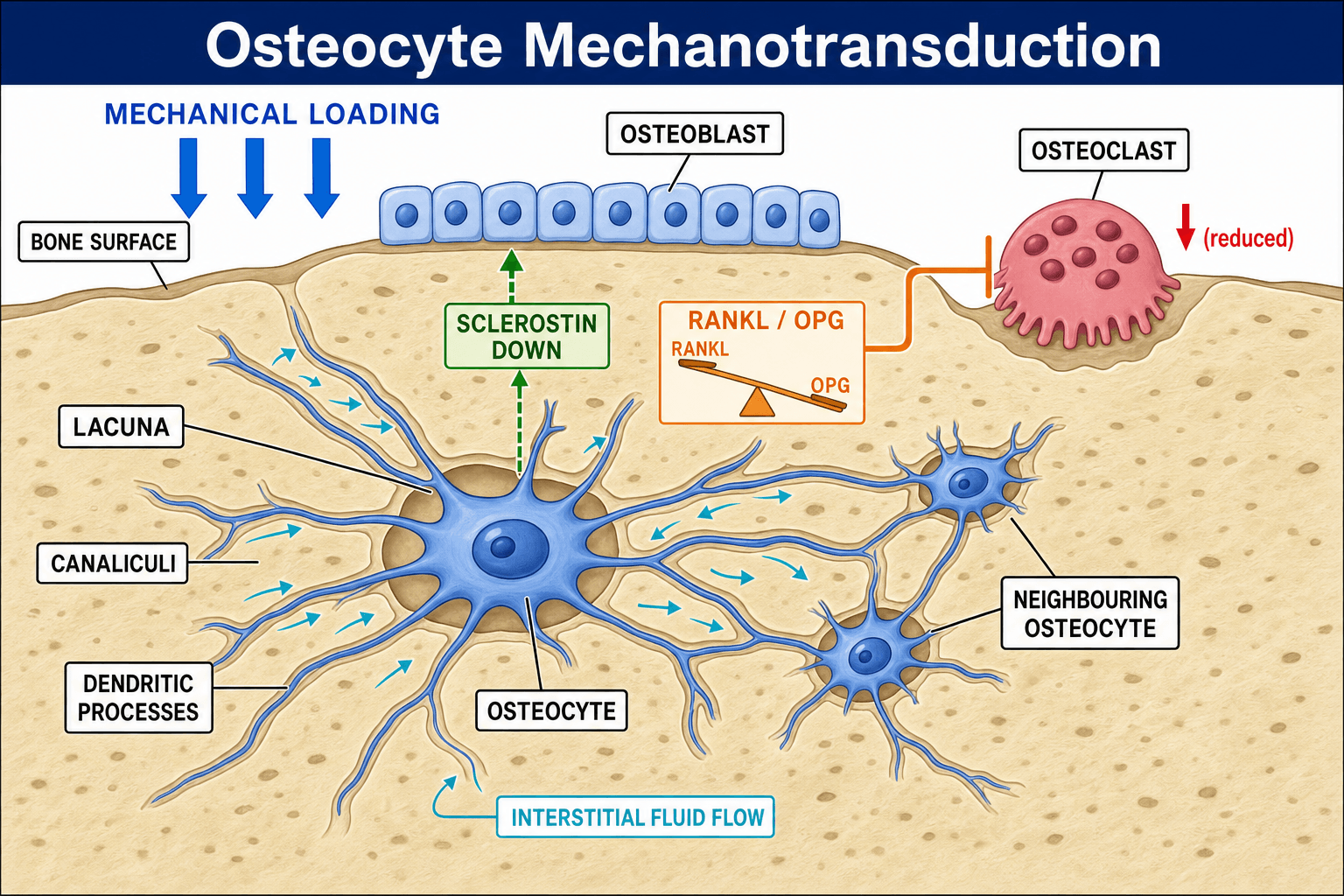
- Lacunocanalicular network allows fluid flow and cell communication
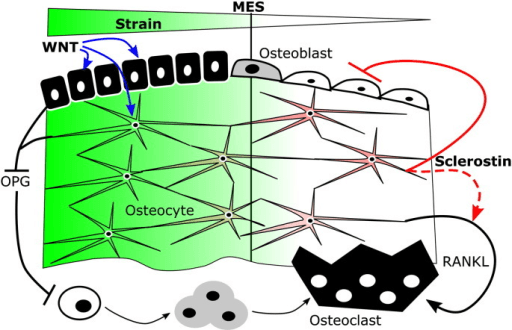
- Mechanical loading induces fluid shear stress on osteocyte dendrites
- Sclerostin inhibition is the key anabolic response to loading
- Osteocyte apoptosis signals targeted remodelling via RANKL upregulation
- “Wolff's Law is mediated by osteocyte mechanosensing
- “Disuse osteoporosis occurs via increased sclerostin production
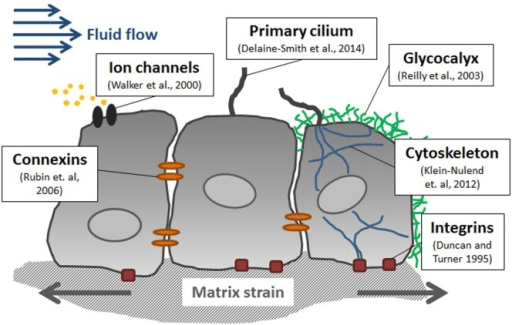
- “Primary cilium acts as flow sensor - bending activates calcium channels
- “Gap junctions propagate signals through lacunocanalicular network
Overview and Introduction
The cell. Osteocytes are the most abundant cells in bone, 90-95% of all bone cells despite their small volume fraction. They arise from osteoblasts that become entombed in the matrix during bone formation, and as terminally differentiated cells they are the primary mechanosensors of the skeleton, orchestrating remodelling in response to mechanical stimuli through mechanotransduction.
The transformation. Becoming an osteocyte involves dramatic morphological change. The cell develops extensive dendritic processes, loses its secretory organelles, and establishes gap junction connections with neighbouring osteocytes and surface bone cells.
A cell that lasts. An osteocyte lives for decades, possibly the entire lifespan. Embedded in mineralised matrix, it maintains its viability through the lacunocanalicular network.
Wolff's Law at the cellular level. Wolff's Law states that bone adapts its structure to the mechanical demands placed upon it. Osteocytes are the cellular mediators of the principle, converting mechanical loading into biochemical signals that regulate bone formation and resorption.
Osteocyte mechanotransduction explains stress fractures (inadequate adaptation), disuse osteoporosis (reduced loading stimulus) and heterotopic ossification (ectopic mechanical signals). It also guides rehabilitation protocols that emphasise early weight-bearing, which promotes fracture healing through mechanotransduction.
Lacunocanalicular Network
The substrate. The lacunocanalicular network is the anatomical substrate for mechanotransduction. Each osteocyte cell body resides in a lacuna, and its dendritic processes extend through canaliculi to contact neighbouring cells and surface lining cells, connecting each osteocyte to 10-12 neighbouring osteocytes. Gap junctions at those contacts couple the cells electrically and chemically.
- Dimensions
- 10-20 micrometres
- Function
- Houses osteocyte cell body
- Key Feature
- Separated from matrix by pericellular space
- Dimensions
- 250-300 nm diameter
- Function
- Channels for dendrites
- Key Feature
- Permits fluid flow around processes
- Dimensions
- 100-500 nm thick
- Function
- Mechanosensory antenna
- Key Feature
- 40-100 per osteocyte
- Dimensions
- 50-100 nm
- Function
- Fluid-filled gap
- Key Feature
- Site of fluid shear stress
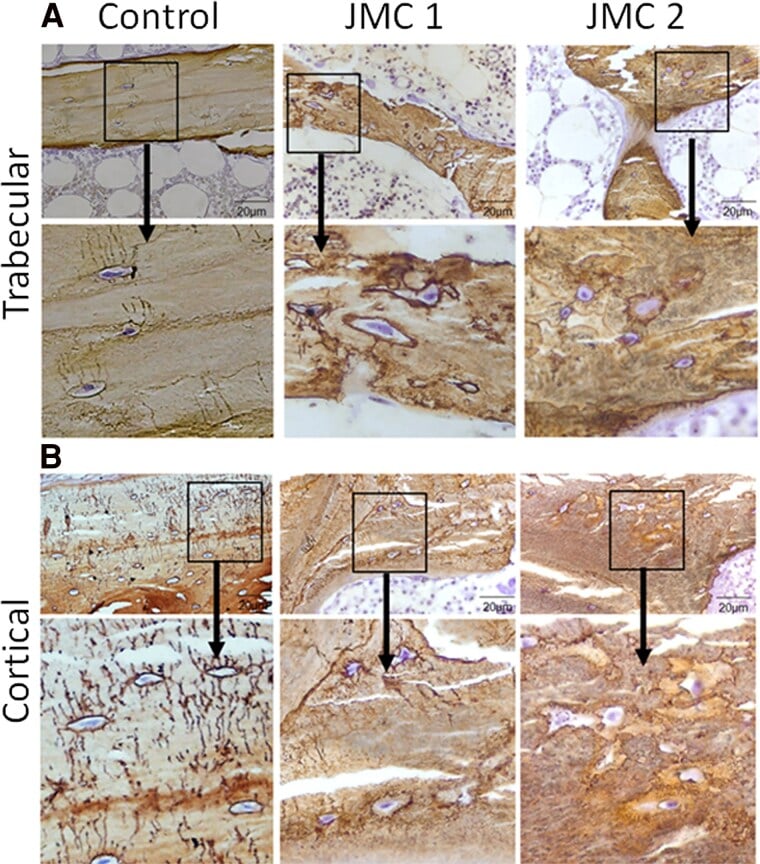
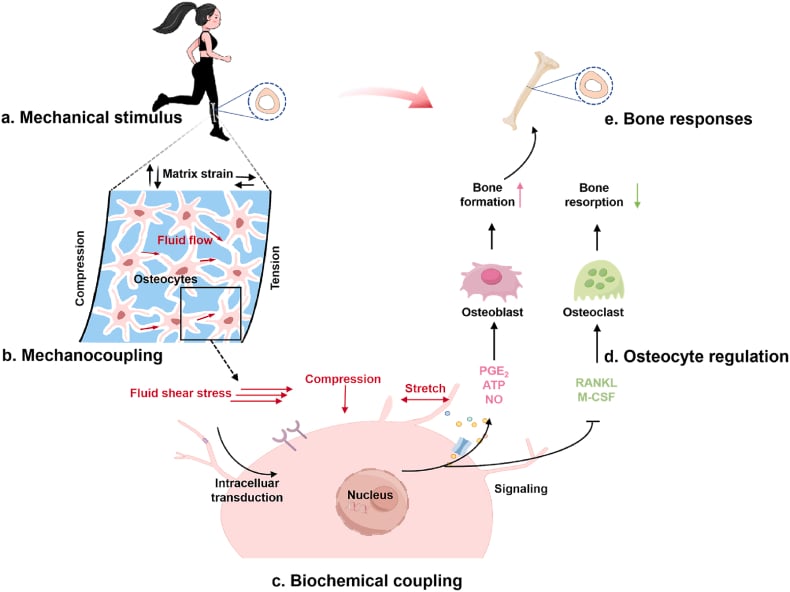
Fluid flow. Mechanical loading of bone creates pressure gradients that drive interstitial fluid flow through the lacunocanalicular system. The narrow pericellular space amplifies the shear stress on osteocyte dendrites 10-100 fold compared with the loading magnitude.
Mechanical Loading to Fluid Flow
External mechanical load causes bone matrix strain (typically 1000-3000 microstrain). Matrix deformation compresses lacunae and canaliculi, creating pressure gradients.
Differential pressures between compressed and tensioned regions drive fluid movement through the lacunocanalicular network. Flow follows pressure gradients.
Fluid flowing past osteocyte dendrites in the narrow pericellular space creates shear stress (1-3 Pascal). The primary cilium and membrane receptors detect flow.
The stimulus is amplified at cellular level, so small matrix strains produce significant cellular deformation and receptor activation.
Mechanotransduction Mechanisms
Osteocytes employ several mechanosensory systems to detect and respond to mechanical stimuli: flow sensors, strain sensors and chemical sensors. Fluid shear stress activates both the primary cilium and the integrins.
A flow sensor. The primary cilium is a solitary, non-motile, microtubule-based organelle projecting from the osteocyte membrane into the pericellular space. It bends with fluid flow, the bending activates mechanosensitive ion channels, and calcium influx initiates intracellular signalling. The deflection correlates with loading magnitude.
Clinical relevance. Defects in primary cilia (ciliopathies) cause skeletal dysplasias through impaired mechanosensing. Loading exercise has to be of sufficient magnitude to bend the cilia.
Q: What is the minimum fluid flow required to activate osteocyte mechanotransduction? A: 50-100 nanometres of cilium deflection, corresponding to approximately 1000-3000 microstrain at tissue level or 1-3 Pascal shear stress at cellular level.
Piezo1 and Mechanosensitive Ion Channels
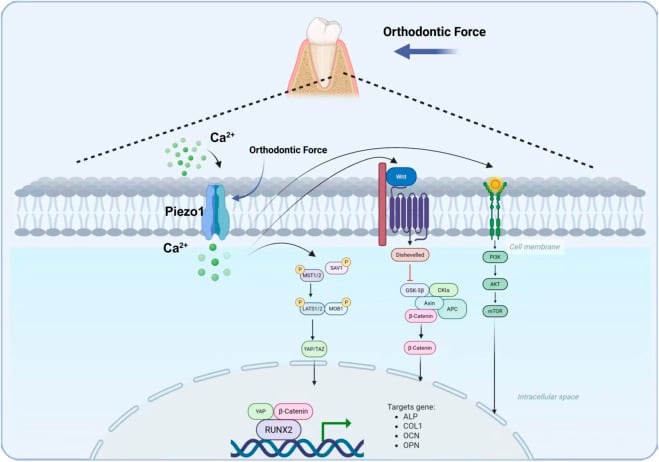
The force-gated channel. Piezo1 is a large mechanically gated cation channel that opens directly in response to membrane tension and fluid shear, admitting calcium, the same intracellular signal on which the other sensors converge. In the osteocyte and osteoblast lineage it is now regarded as a principal transducer of mechanical load into the anabolic response, and arguably the dominant proximate sensor, though which sensor dominates is still debated (see Controversies).
The evidence. Osteocyte- and osteoblast-lineage Piezo1 knockout mice have low bone mass and fail to add bone in response to loading, phenocopying disuse. Conversely, the Piezo1 agonist Yoda1 reproduces load-like anabolic signalling. Piezo1 sits upstream of the Wnt/sclerostin axis, linking membrane deformation to SOST downregulation.
TRPV4. A second mechanosensitive and osmosensitive calcium channel, TRPV4, contributes to the fluid-flow response.
Why it matters. Piezo1 reframes mechanotransduction as, at its core, a calcium-influx event through a directly force-gated channel. It also makes Piezo1 an attractive future drug target to mimic loading, the same therapeutic logic that produced the anti-sclerostin antibodies.
Molecular Responses to Loading
Sclerostin. Sclerostin, encoded by the SOST gene, is a Wnt signalling antagonist secreted by osteocytes. Mechanical loading rapidly suppresses its production and so disinhibits Wnt signalling in osteoblasts, which is the key anabolic response to loading. Disuse does the reverse and increases sclerostin.
Sclerostin Response Timeline
Mechanical loading triggers intracellular signalling cascades in osteocytes. Calcium influx and MAPK activation occur within minutes of loading onset.
SOST gene transcription decreases. Sclerostin protein production falls. Existing sclerostin continues to inhibit Wnt signalling during this transition period.
Sclerostin protein levels decrease in the lacunocanalicular network. Wnt signalling in osteoblasts begins to increase. Early anabolic gene expression starts.
With continued loading, sclerostin remains suppressed. Osteoblast proliferation and matrix synthesis increase. The bone formation response becomes measurable.
Clinical translation. Anti-sclerostin antibodies (romosozumab) mimic the anabolic effect of mechanical loading by blocking sclerostin function, which shows the clinical relevance of the mechanotransduction pathways.
RANKL and OPG. Osteocytes regulate osteoclast recruitment through the RANKL/OPG system. Mechanical loading decreases RANKL expression and increases OPG, reducing osteoclast formation.
Osteocyte apoptosis. Osteocyte death from microdamage or immobilisation upregulates RANKL, recruiting osteoclasts for targeted remodelling of the sites that need repair. This occurs within 72 hours of apoptosis.
- RANKL
- Decreased
- OPG
- Increased
- Bone Remodelling Effect
- Reduced resorption, increased formation
- RANKL
- Baseline
- OPG
- Baseline
- Bone Remodelling Effect
- Balanced remodelling
- RANKL
- Increased
- OPG
- Decreased
- Bone Remodelling Effect
- Increased resorption
- RANKL
- Markedly increased
- OPG
- Decreased
- Bone Remodelling Effect
- Targeted remodelling at damage
SCRAPOsteocyte Response to Loading
Hook:Loading causes osteocytes to SCRAP the bone resorption program and switch to formation!
Clinical Relevance and Applications
Adaptation in practice. Tennis players develop 30-40% greater cortical thickness in the dominant arm, and weight-bearing exercise increases bone density in the loaded regions. Both are Wolff's Law at work, mediated by osteocyte mechanosensing.
Disuse osteoporosis. Without mechanical loading bone is lost through several mechanisms, all initiated by changes in osteocyte signalling:
- Increased sclerostin inhibits bone formation
- An increased RANKL/OPG ratio promotes resorption
- Reduced anabolic signals, as PGE2 and NO decrease
- Osteocyte apoptosis loses the mechanosensory network
Where disuse is seen. Prolonged bed rest causes measurable bone loss within 2 weeks and loses 1-2% of bone per month. Astronauts lose 1-2% of bone mass per month in microgravity. Spinal cord injury produces rapid bone loss below the level of injury, and immobilisation in a cast produces local bone loss.
Stress fractures. A stress fracture occurs when bone adaptation cannot keep pace with repetitive loading, a failure of mechanotransduction to maintain structural integrity.
Why repair falls behind. Repetitive loading without adequate rest prevents targeted remodelling from completing, so microdamage accumulates faster than it is repaired and creates stress risers. Osteocyte apoptosis signals remodelling, but there is insufficient time for it to finish, and the bone is temporarily weak.
Prevention requires understanding the remodelling timeline: a complete BMU cycle takes 3-4 months.
Telling the bone cells apart. A common viva trap is confusing the four bone cell types and their distinct roles in load sensing and remodelling.
- Origin
- Embedded osteoblast
- Mechano Role
- Primary mechanosensor
- Key Signal
- Sclerostin (off with load); RANKL
- Distinguishing Feature
- 90-95% of bone cells; dendritic, in lacunae
- Origin
- Mesenchymal stem cell
- Mechano Role
- Effector of formation
- Key Signal
- Responds to Wnt; lays osteoid
- Distinguishing Feature
- Cuboidal, on bone surface, synthesises matrix
- Origin
- Quiescent osteoblast
- Mechano Role
- Surface barrier / canopy
- Key Signal
- Gates BMU access
- Distinguishing Feature
- Flat, inactive surface cell
- Origin
- Haematopoietic (monocyte)
- Mechano Role
- Effector of resorption
- Key Signal
- Activated by RANKL; inhibited by OPG
- Distinguishing Feature
- Multinucleate; ruffled border, Howship lacuna
How You Load Matters: Osteogenic Loading Parameters
Wolff's Law is not simply "load builds bone". The osteocyte network responds to specific features of the mechanical signal, and those features decide how osteogenic a load is.
Dynamic, not static. Bone responds to changing (dynamic) strain. A sustained static load produces little or no osteogenic response, because once the interstitial fluid equilibrates there is no ongoing flow to sense.
Rate and magnitude. A higher strain magnitude and especially a high strain rate (rapid loading) are more osteogenic. Impact and jumping beat slow walking.
Few cycles, then saturation. The response saturates quickly. A small number of loading cycles captures most of the benefit, and many more monotonous cycles add little, because osteocytes desensitise (accommodate) to a repeated stimulus.
Rest re-sensitises the network. Brief rest between cycles or between bouts lets the desensitised osteocytes recover their mechanosensitivity. The same number of cycles delivered in short bouts separated by rest is therefore markedly more osteogenic than the same cycles delivered continuously.
Novel strain. Loading the bone in an unaccustomed direction is the most osteogenic, because the network responds to strain that departs from its customary pattern. This is the basis of Frost's mechanostat and the concept of a minimum effective strain.
The prescription. The most bone-building programme is short bouts of high-impact, varied, intermittent loading with rest between them, such as jumping or hopping programmes. It is far more osteogenic than prolonged monotonous exercise such as steady walking, and the same principles explain the dominant-arm cortical hypertrophy of racquet athletes. How to dose it in humans is not settled (see Controversies).
Guidelines, Registries & Global Practice
Global Epidemiology and Clinical Burden
- Osteoporosis affects an estimated 500 million people worldwide; one in three women and one in five men over 50 will sustain a fragility fracture.
- Disuse-related bone loss is a universal problem: prolonged bed rest, spinal cord injury and microgravity all produce bone loss on the order of 1-2% per month at weight-bearing sites, all initiated by altered osteocyte signalling.
- Sclerostin biology underpins a now-global drug class (romosozumab), approved by the FDA, EMA and many national agencies for high fracture-risk osteoporosis.
Anti-Sclerostin Therapy: Side-by-Side Guidance
- Position on romosozumab (anti-sclerostin)
- Recommended for patients at very high fracture risk; avoid in those with recent MI/stroke
- Position on romosozumab (anti-sclerostin)
- Option for severe osteoporosis with high fracture risk; followed by an antiresorptive
- Position on romosozumab (anti-sclerostin)
- Recommended for severe postmenopausal osteoporosis at very high fracture risk after prior fracture
- Position on romosozumab (anti-sclerostin)
- Anabolic-first sequencing for very high risk; mandatory transition to antiresorptive afterwards
Convergent principle: all guidelines agree on two points derived directly from osteocyte mechanobiology - sclerostin blockade is anabolic, and its effect must be "locked in" with a subsequent antiresorptive because bone loss resumes on cessation.
Exam Relevance
- Osteocyte mechanotransduction and Wolff's Law are core basic-science viva and MCQ topics across all major fellowship exams.
- High-yield: lacunocanalicular fluid-flow mechanics, primary cilium vs integrin sensing, connexin 43 gap junctions/hemichannels, and sclerostin (SOST/Wnt-Lrp5) regulation.
- Examiners expect candidates to link the cell biology to clinical phenomena - disuse osteoporosis, stress fractures, and the mechanism of romosozumab.
Resource-Setting Practice Variation
- High-resource settings: anti-sclerostin and anabolic agents available; spinal-cord-injury units use standing frames and functional electrical stimulation to limit sublesional bone loss; early supervised weight-bearing after fracture.
- Limited-resource settings: emphasis shifts to low-cost, evidence-based loading - progressive weight-bearing, resistance and impact exercise, and falls-prevention programmes (e.g. Otago-type) - which exploit the same mechanotransduction pathway without pharmacotherapy.
Related pages: Osteoblasts and Bone Formation for the cell osteocytes descend from, and Osteoclasts and Bone Resorption for the cell they recruit — note that page attributes RANKL to osteoblasts and stromal cells, which is true but incomplete: Nakashima's conditional knockout, carded here, shows osteocytes are the major source in physiological remodelling; Bone Remodeling for the cycle this network orchestrates and Fracture Healing for what happens when the network is disrupted; Osteoporosis for the disease romosozumab treats and Bisphosphonates for the antiresorptive comparator in ARCH; Osteopetrosis for the mirror-image failure of resorption; and Metatarsal Stress Fractures for the clinical consequence when microdamage accumulates faster than targeted remodelling can repair it.
Controversies and Areas of Uncertainty
The proximate mechanosensor. Whether the primary cilium, integrin-tethered dendrites, the pericellular matrix and glycocalyx, or membrane ion channels such as Piezo1 and TRPV4 is the dominant sensor remains debated. Piezo1 has emerged as a strong candidate in recent murine work, and the relative contribution of each likely varies with stimulus type.
The loading prescription. The ideal magnitude, strain rate, cycle number and, importantly, rest-insertion between bouts to maximise the anabolic response in humans are not standardised. Few cycles of high-rate loading with rest periods appear more osteogenic than many monotonous cycles, but human dosing is unresolved.
Anabolic versus resorptive osteocyte RANKL. Osteocytes are the major RANKL source, yet how a single cell network coordinately suppresses RANKL under load while raising it around microdamage and in disuse is incompletely understood.
Romosozumab and the cardiovascular signal. The ARCH trial raised a cardiovascular safety signal not seen in FRAME. Whether this reflects sclerostin's extra-skeletal (vascular) roles or chance remains contested, and it shapes prescribing in patients at cardiovascular risk.
MCQ Practice Points
Q: What percentage of bone cells are osteocytes? A: 90-95% - Despite their small volume fraction in bone, osteocytes vastly outnumber osteoblasts and osteoclasts, reflecting their role as the mechanosensory network.
Q: What is the primary mechanosensor for detecting fluid flow in osteocytes? A: Primary cilium - This solitary non-motile organelle projects into the pericellular space and bends with fluid flow, activating mechanosensitive ion channels when deflected 50-100 nanometers.
Q: How does mechanical loading affect sclerostin expression? A: Loading suppresses sclerostin - SOST gene expression decreases within 1-6 hours of mechanical loading, reducing sclerostin protein levels and disinhibiting Wnt signaling in osteoblasts to promote bone formation.
Q: Which connexin protein is critical for osteocyte mechanotransduction? A: Connexin 43 (Cx43) - Forms gap junctions between osteocytes, enabling calcium wave propagation and coordinated responses to mechanical stimuli. Mutations cause skeletal abnormalities.
Q: What signal does osteocyte apoptosis send for targeted remodeling? A: Increased RANKL expression - Dying osteocytes upregulate RANKL in surrounding viable cells within 24-72 hours, recruiting osteoclasts to remove damaged bone at specific locations.
Exam Viva Scenarios
Practise clinical reasoning and management decisions out loud
“Examiner asks: Explain how mechanical loading of bone is sensed by osteocytes and converted into a cellular response.”
“A patient with spinal cord injury develops rapid bone loss below the level of injury. Explain the cellular mechanism and potential therapeutic interventions based on mechanotransduction principles.”
“A military recruit develops a tibial stress fracture during basic training. Using mechanotransduction and osteocyte biology, explain why this occurred and how bone normally protects itself from fatigue damage.”
Key Cellular Architecture
- Osteocytes = 90-95% of all bone cells (most abundant)
- 40-100 dendritic processes per cell through canaliculi
- Lacunocanalicular network enables fluid flow
- Pericellular space = 50-100 nm (site of shear stress)
Mechanosensors
- Primary Cilium = flow sensor (bends with 50-100 nm displacement)
- Integrins = strain sensor (matrix attachment)
- Connexin 43 Gap Junctions = cell-cell communication
- Hemichannels = ATP/PGE2 release (paracrine signaling)
Molecular Responses to Loading
- Sclerostin DECREASES (SOST gene suppressed)
- RANKL/OPG ratio DECREASES (less resorption)
- PGE2 and NO release INCREASES (anabolic)
- Calcium waves propagate through network
Clinical Applications
- Wolff's Law = structural adaptation via mechanotransduction
- Disuse osteoporosis = increased sclerostin, increased RANKL
- Stress fractures = inadequate remodeling response
- Anti-sclerostin drugs (romosozumab) mimic loading
Timelines
- 0-1 hour: SOST gene transcription decreases
- 6-24 hours: Sclerostin protein levels fall
- 24-72 hours: Osteocyte apoptosis triggers RANKL
- Weeks: Measurable bone formation response
Evidence Base
Mechanical Loading Reduces Sost/Sclerostin Expression In Vivo
- Ulnar loading in rats dramatically reduced Sost transcripts and sclerostin protein in osteocytes
- Effect was strain-dependent: higher-strain cortical regions showed greater loss of sclerostin-positive osteocytes
- Hindlimb unloading conversely increased Sost expression in the tibia
- Sclerostin antagonises Lrp5/Wnt signalling, the key skeletal mechanotransduction pathway
Osteocytes Are the Major Source of RANKL in Bone Remodeling
- Purified osteocytes express far higher RANKL and support more osteoclastogenesis than osteoblasts or stromal cells
- Mice lacking RANKL specifically in osteocytes develop a severe osteopetrotic phenotype
- Establishes osteocytes - not surface osteoblasts - as the dominant in vivo RANKL source
- Repositions the osteocyte network as the master regulator of both formation and resorption
Targeted Ablation of Osteocytes Causes Fragile Bone and Defective Mechanotransduction
- Diphtheria-toxin ablation killed 70-80% of osteocytes without killing osteoblasts
- Osteocyte-ablated mice developed intracortical porosity, microfractures and trabecular bone loss resembling the aging skeleton
- Critically, osteocyte-less mice were resistant to unloading-induced bone loss
- Provides direct in vivo proof that osteocytes are the cells mediating mechanotransduction