Same-Day Joint Replacement & Enhanced Recovery
- Outpatient (same-day) and rapid-recovery arthroplasty mean discharging hip and knee replacement patients on the DAY of surgery (or within 23 hours), enabled by ENHANCED RECOVERY AFTER SURGERY (ERAS) protocols and driven by improved peri-operative care, patient demand and financial incentives (a shift toward ambulatory surgery centres).
- The ERAS / rapid-recovery BUNDLE includes: pre-operative PATIENT EDUCATION and expectation-setting; SPINAL or REGIONAL anaesthesia in preference to general; MULTIMODAL, OPIOID-SPARING analgesia with PERIARTICULAR injection; TRANEXAMIC ACID to reduce blood loss; PONV prophylaxis; minimisation of DRAINS and URINARY CATHETERS; and EARLY same-day MOBILISATION/physiotherapy.
- PATIENT SELECTION is the cornerstone of safety: appropriate candidates are generally YOUNGER, HEALTHIER (ASA I-II), MOTIVATED, with good SOCIAL SUPPORT at home and without significant cardiopulmonary disease, severe obesity or obstructive sleep apnoea.
- In carefully selected patients at experienced centres, outcomes are GOOD: systematic-review data show about 95% achieve same-day discharge as planned, with LOW reoperation (~2%) and readmission/ER (~2%) rates within 90 days, no deaths and very few major complications, and high patient satisfaction (most would choose outpatient surgery again).
- The commonest causes of SAME-DAY-DISCHARGE FAILURE are ORTHOSTATIC HYPOTENSION (the leading cause), inadequate physical condition, NAUSEA/VOMITING, PAIN, and URINARY RETENTION.
- Risk factors for SDD failure include FEMALE sex, higher ASA class (III-IV), more drug ALLERGIES, SMOKING, and GENERAL anaesthesia - whereas SPINAL anaesthesia is PROTECTIVE; addressing these (and the protocol) improves success.
- “Rapid recovery rests on an ERAS bundle: spinal/regional anaesthesia, multimodal opioid-sparing analgesia + periarticular injection, tranexamic acid, no drains/catheters, early mobilisation - plus patient education and selection.
- “Patient SELECTION (ASA I-II, motivated, social support, no major cardiorespiratory disease) is what makes it safe - ~95% same-day discharge with low complications in selected patients.
- “Orthostatic hypotension is the #1 cause of same-day-discharge failure; general anaesthesia, female sex and ASA III-IV are risk factors (spinal anaesthesia is protective).
The bundle - spinal/regional anaesthesia, multimodal opioid-sparing analgesia with periarticular injection, tranexamic acid, no drains/catheters, PONV prophylaxis, and same-day mobilisation - controls the things that otherwise keep patients in hospital (pain, nausea, bleeding, immobility).
Patient selection is decisive: ASA I-II, motivated, with home support and without major cardiopulmonary disease. In selected patients at experienced centres it is safe; applied indiscriminately it is not.
What It Is & Why It Has Grown
Length of stay for hip and knee arthroplasty has fallen dramatically, and outpatient (same-day) and rapid-recovery arthroplasty - discharge on the day of surgery or within ~23 hours - is now an established option. The drivers are advances in peri-operative and intra-operative management (especially anaesthesia, analgesia and blood management), patient demand, and financial/system incentives, with a shift of selected cases to ambulatory surgery centres. The whole approach is built on enhanced recovery after surgery (ERAS) principles.
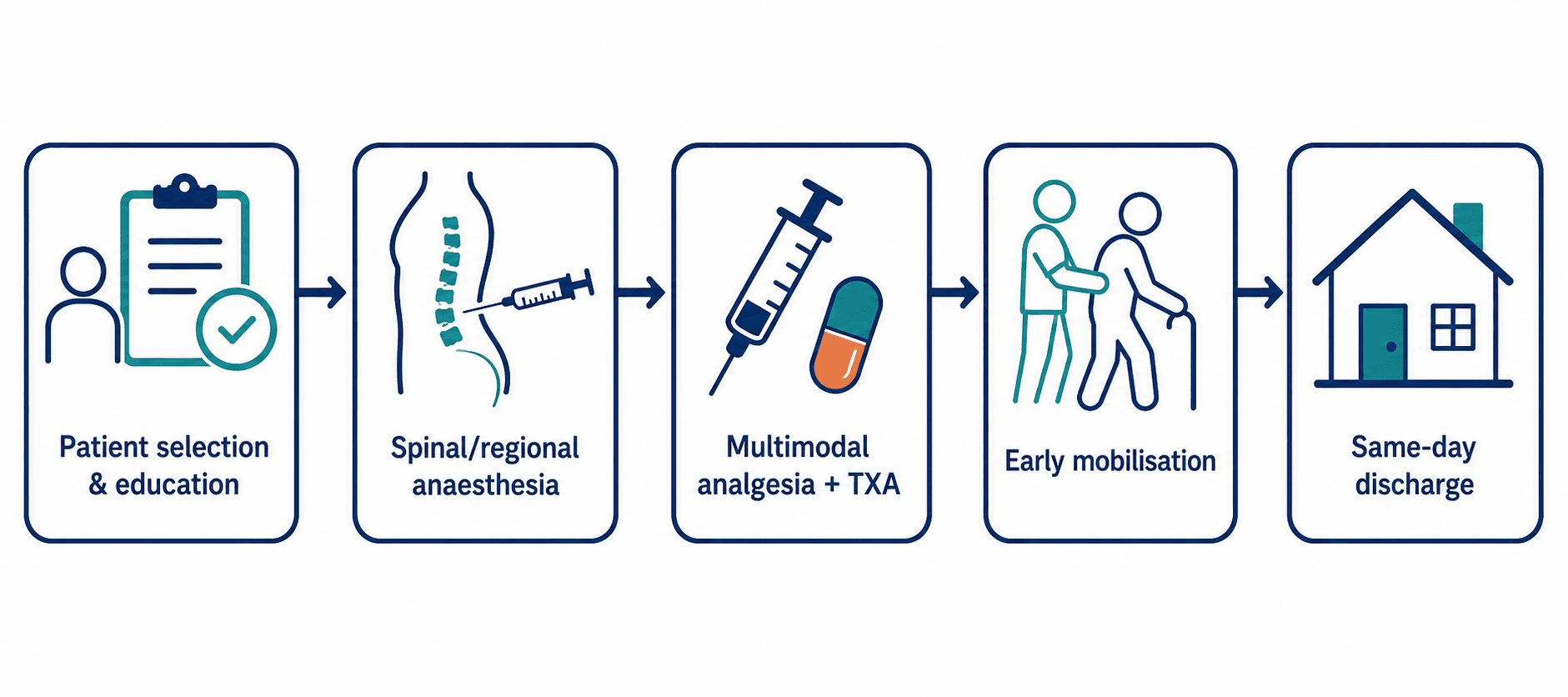
The ERAS / Rapid-Recovery Bundle
- Key elements
- Patient education + expectation-setting; optimise comorbidities/anaemia; selection; carbohydrate loading / reduced fasting
- Key elements
- SPINAL / regional anaesthesia in preference to general; PONV prophylaxis
- Key elements
- MULTIMODAL, OPIOID-SPARING (paracetamol, NSAIDs, gabapentinoids selectively) + PERIARTICULAR local infiltration / nerve blocks
- Key elements
- TRANEXAMIC ACID; euvolaemia; avoid drains and routine urinary catheters
- Key elements
- EARLY same-day mobilisation/physiotherapy; clear discharge criteria
Each bundle element removes a barrier to early discharge: spinal anaesthesia and multimodal/periarticular analgesia control pain with less opioid (so less nausea/sedation); tranexamic acid limits blood loss and the need for transfusion; avoiding drains/catheters and PONV prophylaxis remove tethers and sickness; and early mobilisation confirms the patient is safe to go home. The result is that the patient can meet discharge criteria (mobile, pain and nausea controlled, voiding, observations stable) on the day of surgery.
The bundle above lists multimodal analgesia, but for the knee one choice does more work than the rest combined, and it is a choice about which nerves you are willing to switch off.
A femoral nerve block gives excellent analgesia and paralyses quadriceps. A patient who cannot extend the knee against gravity cannot stand safely, cannot climb stairs and is at real risk of falling - so the block that controls the pain also prevents the discharge. This is why early attempts at rapid-recovery knee replacement stalled.
The adductor canal block is the answer. Sited in the mid-thigh, it targets the saphenous nerve and the sensory articular branches while largely sparing the motor supply to quadriceps, so it delivers comparable analgesia with preserved extensor strength - the patient can weight-bear and mobilise on the day of surgery. It is normally combined with local infiltration analgesia around the capsule and posterior structures, which the block does not reach.
The principle generalises beyond the knee: in a same-day pathway, an analgesic technique is only useful if it leaves the patient able to walk out. Judge every element of the bundle against that test - which is also the reason spinal anaesthesia has to be dosed for early recovery of motor function, not simply for duration.
Patient Selection & Safety
- Younger, healthier - ASA I-II
- Motivated, understands the pathway, with good social/home support
- No significant cardiopulmonary disease; acceptable BMI; no untreated OSA
- Lives within reasonable distance of the centre
- ASA III-IV, significant comorbidity, frailty
- Poor social support / lives far away
- History suggesting high risk of the failure modes (orthostatic hypotension, PONV, retention)
- Patient or surgeon/centre inexperience with the pathway
In carefully selected patients operated on by experienced surgeons in major centres, outpatient arthroplasty is safe and effective: a systematic review of ~1000 patients found ~95% were discharged the same day as planned, with no deaths, only one major complication, and reoperation and readmission/ER rates of ~2% each within 90 days; the great majority of patients said they would choose outpatient surgery again. The crucial caveats are selection bias and the need for an experienced team and protocol - the data do not justify outpatient surgery for unselected patients.
Same-Day-Discharge Failure
When same-day discharge fails, the commonest cause is ORTHOSTATIC HYPOTENSION, followed by inadequate physical condition, nausea/vomiting, pain, and urinary retention - which is exactly why the ERAS bundle targets fluid status, opioid-sparing analgesia and PONV. Risk factors for failure (from meta-analysis) include FEMALE sex (especially for THA), ASA class III-IV, more than two allergies, smoking, and GENERAL anaesthesia - whereas SPINAL anaesthesia is PROTECTIVE. Anticipating and managing these (optimise fluids, use spinal anaesthesia, minimise opioids, manage PONV and voiding) improves same-day-discharge success.
- Findings
- Orthostatic hypotension (1st); inadequate physical condition; nausea/vomiting; pain; urinary retention
- Findings
- Female sex; ASA III-IV; more than 2 allergies; smoking; general anaesthesia
- Findings
- Spinal anaesthesia
- Findings
- Direct anterior vs posterior approach (THA)
Operationalising Selection: OARA & RAPT
- OARA score (Outpatient Arthroplasty Risk Assessment): a comorbidity-based score that weights medical conditions across multiple organ systems and has been shown to predict safe same-day discharge more accurately than ASA class or age alone - it is far more granular than the blunt ASA grade, and a lower OARA total identifies appropriate outpatient candidates.
- RAPT (Risk Assessment and Prediction Tool): a short pre-operative questionnaire (age, sex, walking distance, use of gait aids, and community/home support) that predicts the likely discharge destination and the need for inpatient rehabilitation - flagging patients who will not go straight home.
The principle is that ASA class alone is too blunt: combine a structured score (OARA / RAPT) with a targeted look at the specific failure-mode risks - untreated obstructive sleep apnoea, cardiopulmonary disease, a history of orthostatic hypotension, PONV or urinary retention, frailty, and poor home support. (General pre-operative optimisation is covered in our Arthroplasty Pre-operative Optimization topic; the point here is the same-day-discharge selection score.)
Operationalise selection with validated tools - the OARA score (comorbidity-weighted, predicts safe SDD better than ASA/age) and the RAPT (predicts discharge destination / rehab need) - plus a targeted check for the specific failure-mode risks (OSA, cardiopulmonary disease, orthostatic-hypotension history, poor home support). ASA class alone is too blunt.
Discharge Criteria & the Safety Net
Same-day discharge requires meeting objective criteria, confirmed before the patient leaves, with a defined safety net behind the quoted readmission rate:
- Independent, safe mobilisation and transfers (and stairs if needed) with physiotherapy sign-off.
- Pain controlled on oral analgesia; no or controlled PONV; able to void (or a clear plan for retention).
- Stable observations with no orthostatic hypotension on standing; tolerating oral intake.
- A responsible adult at home - often formalised with a discharge-scoring system (e.g. a modified post-anaesthetic discharge scoring system).
Equally important is the post-discharge safety net, because the patient leaves before the window in which an early complication (bleeding, VTE, infection, a fall, retention) would otherwise have been caught in hospital: written instructions and VTE prophylaxis, a same-day/next-day follow-up call or remote/virtual monitoring, clear escalation pathways with 24-hour contact, and rapid readmission access - all aimed at preventing failure to rescue.
Discharge only on objective criteria - independent mobilisation/stairs (physio sign-off), pain controlled on oral analgesia, no/controlled PONV, voiding, no orthostatic hypotension, a responsible adult at home - and wrap it in a post-discharge safety net (next-day call / remote monitoring, 24-hour escalation, rapid readmission) to prevent failure to rescue.
Mnemonics & Memory Aids
RAPID
Hook:RAPID recovery: regional anaesthesia, analgesia multimodal, patient selection, TXA, discharge same-day.
FAIL
Hook:Same-day discharge can FAIL: falling BP, ASA/risk factors, ill (PONV/pain), leaking (retention).
Clinical Decision Scenarios
Practise clinical reasoning and management decisions out loud
“What is rapid-recovery / outpatient arthroplasty, what does the enhanced-recovery bundle involve, and who is a suitable candidate?”
“What are the common reasons same-day discharge fails, and which patients are at higher risk? How would you reduce failure?”
What it is
- Same-day (or within 23h) discharge for hip/knee arthroplasty
- Enabled by ERAS; driven by better peri-op care, demand, incentives
- Often in ambulatory surgery centres
The bundle
- Education + selection; spinal/regional anaesthesia (not GA)
- Multimodal opioid-sparing analgesia + periarticular injection; PONV prophylaxis
- Tranexamic acid; avoid drains/catheters; early same-day mobilisation
Selection & safety
- Ideal: ASA I-II, motivated, social support, no major cardiopulmonary disease
- ~95% same-day discharge; ~2% reoperation/readmission; high satisfaction (selected patients)
- Needs experienced team/centre - not for unselected patients
SDD failure
- Causes: orthostatic hypotension (1st), inadequate condition, nausea/vomiting, pain, urinary retention
- Risk factors: female, ASA III-IV, more than 2 allergies, smoking, general anaesthesia
- Spinal anaesthesia protective; approach (anterior vs posterior) not significant
Evidence & Key Studies
The shift to same-day outpatient joint arthroplasty: a systematic review
- Across 10 studies (1009 patients), 94.7% were discharged the same day as planned; failures were mainly due to pain, hypotension and nausea.
- There were no deaths and only 1 major complication; reoperation and readmission/ER visits within 90 days were each ~2%.
- For carefully selected patients with experienced surgeons in major centres, outpatient arthroplasty may be safe and effective; further study is needed.
Causes and risk factors for same-day discharge failure after total hip and knee arthroplasty: a meta-analysis
- Across 8 studies (3492 patients), the most common cause of same-day-discharge failure was orthostatic hypotension, then inadequate physical condition, nausea/vomiting, pain and urinary retention.
- Risk factors for failure: female sex, ASA III and IV, more than two allergies, smoking, and general anaesthesia; spinal anaesthesia was protective.
- Direct anterior and posterior approaches showed no significant difference in same-day-discharge failure.
The same-day-discharge success and complication/readmission figures come from the cited Hoffmann systematic review, and the causes and risk factors for same-day-discharge failure (orthostatic hypotension foremost; female sex/ASA III-IV/smoking/general anaesthesia as risks; spinal anaesthesia protective) from the cited Lamo-Espinosa meta-analysis. The ERAS bundle components and selection principles are standard, well-established enhanced-recovery practice. (See also our Arthroplasty Pre-operative Optimization, PMMA Bone Cement and Tranexamic Acid material.)