Largest Sesamoid | Tension Band Principle | Extension is Key
- Extensor mechanism function is key - can patient actively extend knee against gravity?
- Operative indications: articular STEP-OFF over 2mm, fragment DISPLACEMENT/gap over 2-3mm, or loss of active extension. Keep the two numbers attached to the right measurement - the step is the intra-articular one and carries the lower threshold, because it is the surface the femur articulates against
- Tension band principle: converts tensile force to compression at articular surface
- Tension band wiring (TBW) is classic, but screw fixation increasingly preferred for transverse
- Hardware removal common (50%) due to prominence - counsel patients preoperatively
- “50% of patients need hardware removal - wire prominence is main reason
- “Check active extension BEFORE giving analgesia - critical exam finding
- “Vertical fractures often stable (patella wide in sagittal plane)
- “Inferior pole excision + tendon repair = satisfactory if under 30% pole
Overview and Epidemiology
Patella fractures make up about 1% of all fractures. They test your understanding of the extensor mechanism, the tension band principle, and the decision between fixation and partial patellectomy. The examiner wants to hear you discuss biomechanics and early motion.
Who. The distribution is bimodal: young patients injured by high energy, and the elderly after falls. Males outnumber females 2:1, with a peak age of 20-50 years, and a direct blow often produces an isolated injury.
Mechanism. Three patterns of loading break the patella:
- Direct blow - a dashboard injury or a fall on the knee
- Indirect - a forceful eccentric quadriceps contraction, as in landing
- Combined - a direct blow with muscle contraction, the most common
Anatomy and Biomechanics
The bone. The patella is the largest sesamoid in the body: triangular, apex inferior, 3-7cm long and 2-3cm thick. The articular surface has a larger lateral facet, a medial facet, and an odd facet on the far medial edge. It provides smooth gliding and carries the thickest articular cartilage in the body, 5-7mm at the centre.
The attachments. The quadriceps tendon inserts on the superior pole and the patellar tendon arises from the inferior pole. On either side run the retinacula: medially the VMO and MPFL, laterally the vastus lateralis and fibres of the iliotibial band.
The blood supply. The superior and inferior genicular arteries form an extraosseous anastomotic ring. Vessels enter mainly on the anterior surface and at the inferior pole, which is why the anterior surgical approach is safe.
What the patella does. Sitting in the extensor mechanism, it moves the extensor axis anteriorly and lengthens the lever arm, increasing the extensor moment by 30-50% and improving quadriceps efficiency. It also:
- Increases the contact area, distributing force and reducing patellofemoral stress; the contact area changes with flexion
- Covers the trochlea, protecting the femoral condyles from direct trauma
- Gains medial and lateral support from retinacular tension
Patellofemoral contact forces reach 3-7 times body weight during stair descent, the eccentric loading of stairs and slopes.
The tension band principle. When the quadriceps pulls, the anterior surface of the patella is the tension side, pulled apart, and the articular surface is the compression side. A wire placed anteriorly, on the tension side, converts those tensile forces into compressive forces at the articular surface during knee flexion, closing the fracture gap and promoting healing: the AO/Pauwels principle. Two consequences follow:
- Motion increases the compression, so the construct is dynamic and early range of motion is encouraged
- It works only if the cortex on the compression side, the articular cortex, is intact
Classification Systems
By pattern. Each pattern carries its own treatment.
- Frequency
- 50%
- Characteristics
- Central fracture, usually 2 fragments
- Treatment
- TBW or screws if displaced
- Frequency
- 30%
- Characteristics
- Multiple fragments, high-energy
- Treatment
- Reconstruct if possible, partial patellectomy if not
- Frequency
- 10%
- Characteristics
- Avulsion by patellar tendon
- Treatment
- Excision + repair if small, ORIF if large
- Frequency
- Rare
- Characteristics
- Avulsion by quads tendon
- Treatment
- ORIF or excision + repair
- Frequency
- 5%
- Characteristics
- Sagittal plane, often undisplaced
- Treatment
- Usually stable, conservative
- Frequency
- Rare
- Characteristics
- With patellar dislocation
- Treatment
- Fragment removal or fixation
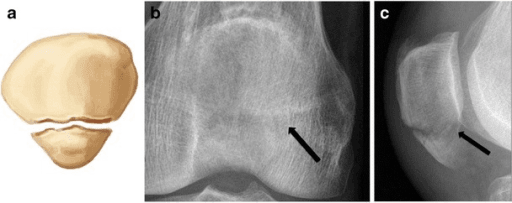
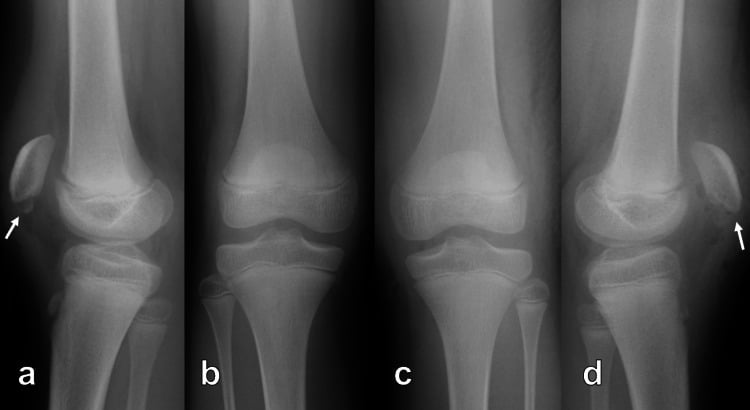
By the AO/OTA system. The type follows the extent of articular involvement.
- Description
- Extra-articular
- Subtype Examples
- A1: Avulsion, A2: Transverse extra-articular
- Description
- Partial articular
- Subtype Examples
- B1: Vertical, B2: Transverse marginal
- Description
- Complete articular
- Subtype Examples
- C1: Transverse, C2: Transverse + 2nd fragment, C3: Comminuted
A growing, distinct entity as knee arthroplasty numbers rise. The patella fracture after total knee replacement is managed by a different algorithm from the native fracture, and is classified (Goldberg / Ortiguera-Berry) by extensor-mechanism integrity and patellar-component fixation:
- Type I - extensor mechanism intact AND patellar component well-fixed: by far the commonest; treated non-operatively (brace, activity modification)
- Type II - extensor mechanism disrupted (regardless of component): needs ORIF / extensor-mechanism repair or reconstruction - the indication is the lost extension, exactly as in the native patella
- Type III - loose/failed patellar component (IIIA reasonable bone stock, IIIB poor stock): requires component removal +/- revision, patelloplasty, or resection - fixing around a loose button does not work
The resurfaced patella is thin and devascularised, especially after a lateral release, so periprosthetic fractures heal poorly and fixation has a high failure rate. Hence the strong default to non-operative care for the common extensor-intact pattern, with revision or extensor reconstruction only when function or the implant demands it.
Clinical Assessment
History. The questions that shape management:
- Mechanism - direct blow, fall, dashboard
- Ability to walk after the injury
- Knee swelling - a haemarthrosis if the fracture is intra-articular
- Previous knee surgery or patellar problems
- Occupation and sport, for the return to activity
Examination. A palpable gap at the patella indicates displacement, and a tense effusion is the haemarthrosis. Check the skin, as the fracture may be open, and whether the retinacula are intact: can the patient extend despite the fracture?
Active straight leg raise is the key clinical test. Perform it before giving analgesia: pain inhibits accurate assessment, and it cannot be assessed after. A failed SLR means a disrupted extensor mechanism and is an operative indication regardless of displacement, and any doubt about extension means operative management.
Some patients with patella fractures can still extend the knee via intact retinacula (the medial and lateral expansions). This does not mean the fracture is stable - the X-ray and the gap on examination still determine treatment.
- Distinguishing Features
- Palpable gap, hemarthrosis, failed SLR, sharp fracture margins
- Key Investigation
- Lateral radiograph
- Pitfall
- Confirm extension before analgesia
- Distinguishing Features
- No trauma or trivial injury, rounded sclerotic margins, often superolateral and bilateral
- Key Investigation
- AP radiograph plus contralateral comparison
- Pitfall
- Mistaking smooth corticated fragment for acute fracture
- Distinguishing Features
- Palpable infrapatellar gap, patella alta, failed SLR, no bony fracture line
- Key Investigation
- Lateral radiograph (patella alta), ultrasound or MRI
- Pitfall
- Attributing failed SLR to fracture when tendon is torn
- Distinguishing Features
- Suprapatellar gap, patella baja, failed SLR, often over 40 years
- Key Investigation
- Ultrasound or MRI
- Pitfall
- Missed in obese or swollen knee
- Distinguishing Features
- Lateral instability, MPFL tenderness, possible osteochondral fragment
- Key Investigation
- Skyline view, MRI for osteochondral injury
- Pitfall
- Overlooking osteochondral loose body
- Distinguishing Features
- Diffuse tenderness, intact SLR, no fracture line
- Key Investigation
- Radiograph (normal)
- Pitfall
- Over-treating a simple contusion
Investigations
Radiographs. AP and lateral are first line, taken with the knee fully extended for accurate assessment:
- Lateral - the most important view: displacement (the gap between fragments), articular step-off at the patellofemoral joint, and sometimes the haemarthrosis as a joint effusion
- AP - the pattern (transverse, vertical or comminuted), the width of the patella, a bipartite patella, and osteochondral fragments after a dislocation
- Skyline (Merchant) - the patellofemoral articular surface, helpful for vertical fractures and chondral injury, though it may be difficult acutely because of pain
Bipartite patella. Present in 1-2% of the population, usually as a superolateral fragment. Rounded margins, no haemarthrosis and comparison with the other knee, where it is often present too, separate it from a fracture. It is occasionally symptomatic without trauma.
CT. Used when the radiographs leave doubt and to plan a reconstruction, with 3D reconstructions helpful for operative planning:
- Comminuted fracture - reconstruction versus partial patellectomy
- Articular depression - assesses step-off better than a radiograph
- Pre-operative planning - fragment size, number and position, and the integrity of the posterior cortex
- High-energy mechanism - an associated tibial plateau injury
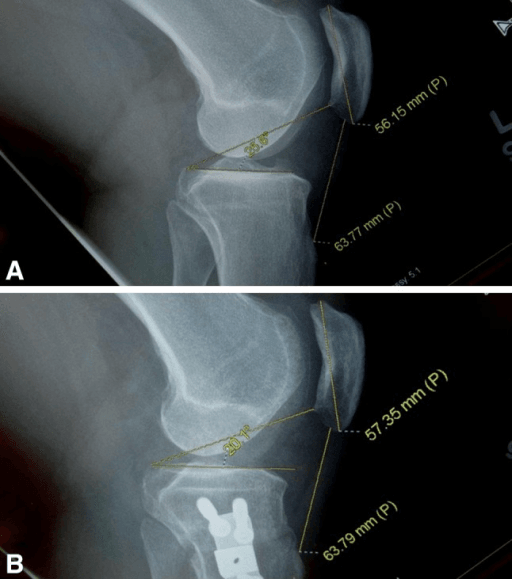
Patellar height. "Restore patellar height" is a hollow instruction unless you can measure it, and it is the number that tells you whether a comminuted-pole repair, a partial patellectomy or a healed tendon has left a functionally normal extensor mechanism. Three classic lateral-radiograph ratios measure it:
- Insall-Salvati - patellar tendon length divided by patellar bone (pole-to-pole) length. Normal is roughly 0.8 to 1.2; a high ratio is patella alta, a low ratio patella baja (infera). It is independent of knee flexion angle, but because it uses the patella's own length as the denominator it is unreliable after a fracture that shortens the patella or after a partial patellectomy
- Blackburne-Peel and Caton-Deschamps - reference the articular surface to the tibial plateau instead of patellar length, so they are the better choice once the patella has been altered by injury or excision
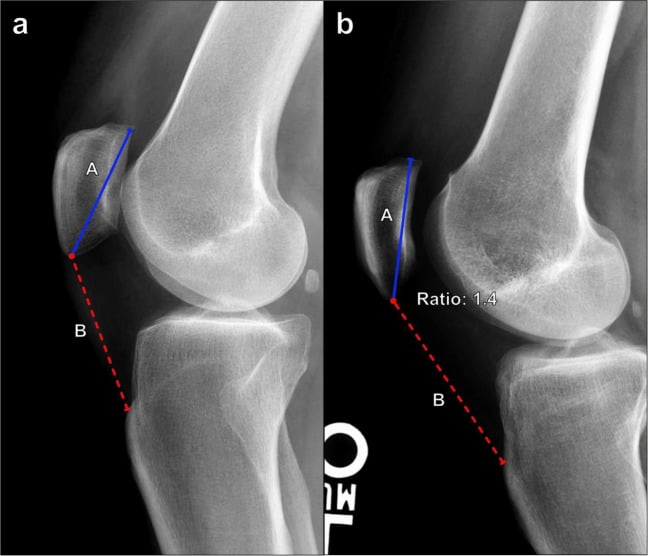
Using it in theatre. When you perform a partial patellectomy or repair a comminuted inferior pole, advance and repair the patellar tendon so the operated patella sits at the same height as the uninjured contralateral side, compared on a template or contralateral film. Over-tightening creates an iatrogenic patella baja, with stiffness, anterior knee pain and loss of flexion; under-tensioning leaves an extensor lag.
Using it afterwards. A new patella alta after fixation signals patellar tendon rupture or fixation pull-out. Progressive baja signals over-shortening or contracture.
Management Algorithm
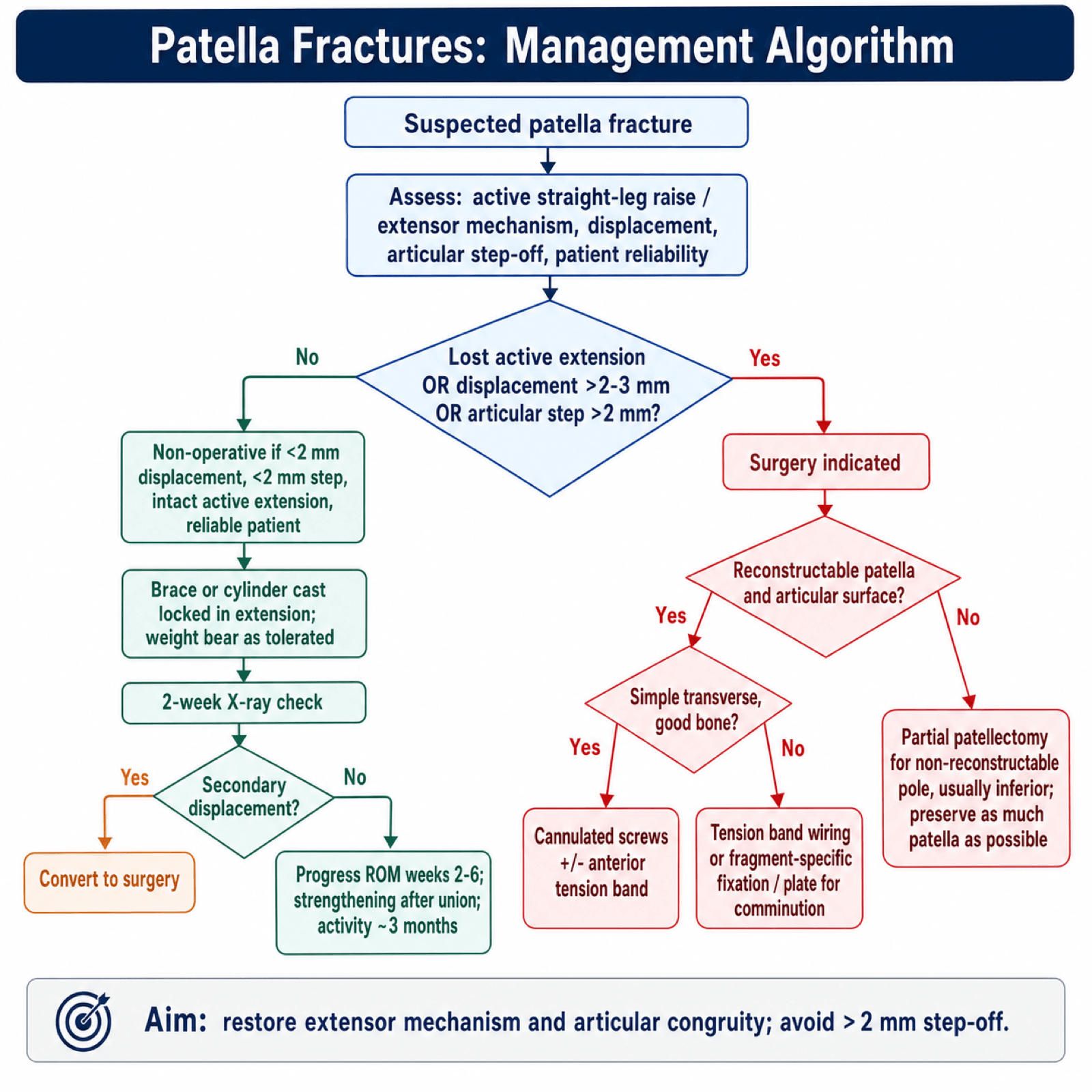
The decision. The extensor mechanism comes first, then the radiograph. Any one of these is an operative indication:
- Loss of active extension - a failed straight leg raise, regardless of displacement
- Displacement (gap) over 2-3mm
- Articular step over 2mm
Non-operative treatment is reserved for the fracture with displacement under 2mm, an articular step under 2mm and intact active extension, in a reliable patient who will attend for weekly radiographs initially, because secondary displacement occurs. Whatever the treatment, the aim is to restore the extensor mechanism and articular congruity and to avoid a step-off greater than 2mm.
- Key Assessment
- Can actively extend
- Treatment
- Cylinder cast/brace 4-6 weeks
- Pearl
- Weekly X-rays first 2 weeks
- Key Assessment
- Gap or step-off visible
- Treatment
- ORIF - TBW or cannulated screws
- Pearl
- Tension band principle applies
- Key Assessment
- Major fragments identifiable
- Treatment
- ORIF with multiple techniques
- Pearl
- Cerclage + TBW or basket plate
- Key Assessment
- Multiple small fragments
- Treatment
- Partial patellectomy + repair
- Pearl
- Preserve as much as possible
- Key Assessment
- Small pole, intact mechanism
- Treatment
- Excision + tendon repair
- Pearl
- Under 30% pole excised OK
Non-Operative Protocol
Cylinder cast or hinged knee brace locked in extension. Weight bearing as tolerated with brace.
Repeat X-ray to confirm no displacement. If displaced now, conversion to surgery.
If stable at 2 weeks, begin ROM exercises. Unlock brace gradually. Continue cylinder for walking.
Discard brace if X-ray shows healing. Quadriceps strengthening. Return to activity by 3 months.
Surgical Technique
Set-up. Supine on a radiolucent table with a tourniquet, the knee flexed over a bolster or triangle, and full fluoroscopy access.
Approach. A longitudinal anterior midline incision, preserving the prepatellar bursa if possible. Evacuate the haematoma and debris and inspect the articular surface.
Reduction. Reduce the fracture with pointed reduction clamps, with the knee extended. Assess articular congruity by palpation and fluoroscopy, and accept no more than 2mm of step-off.
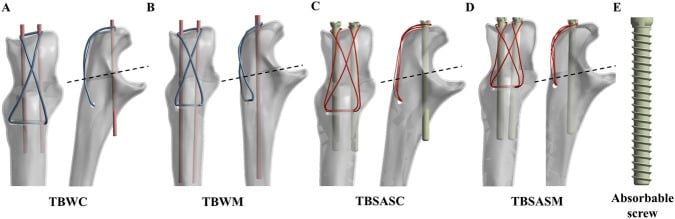
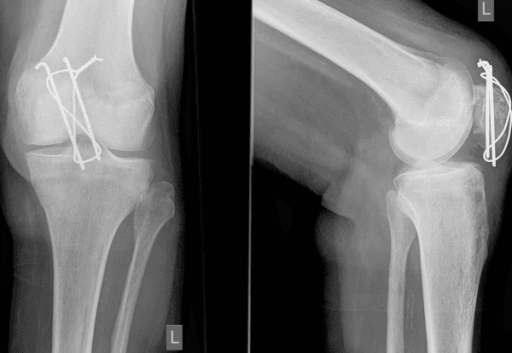
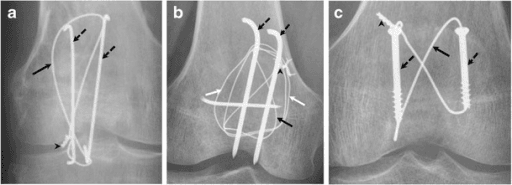
The construct. Proper technique is what makes the wire compress the fracture as the knee flexes:
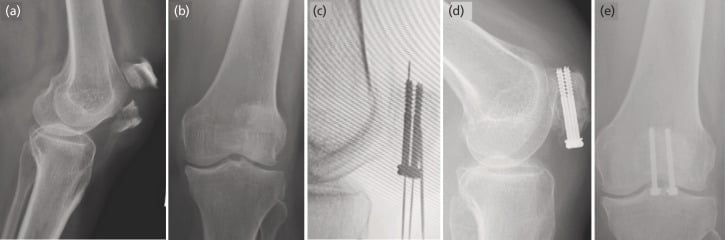
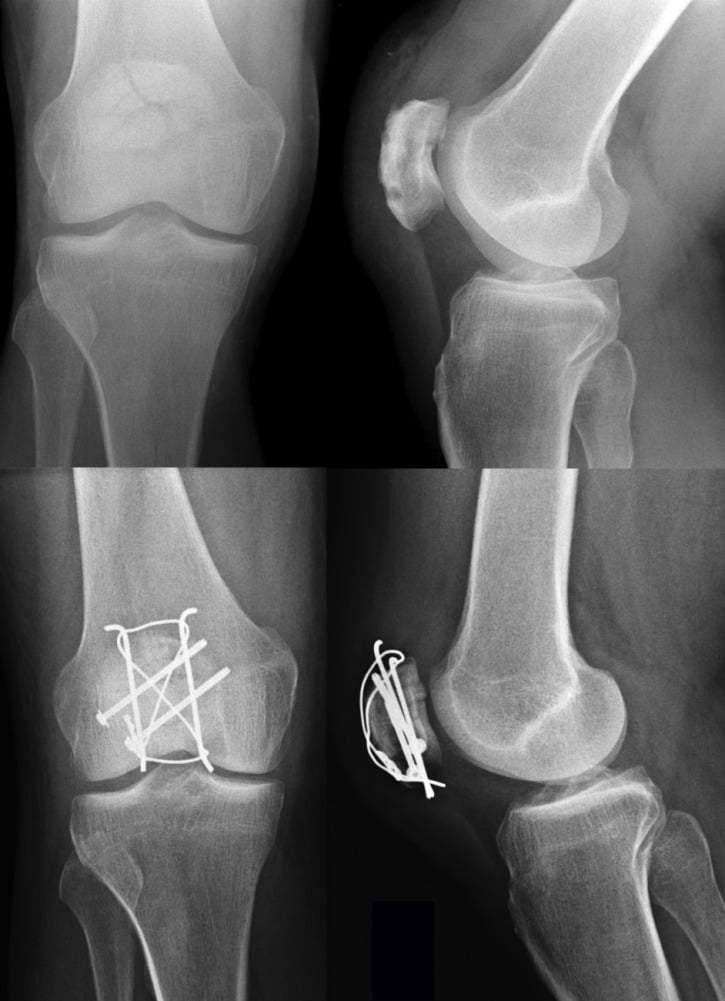
- K-wires - two parallel 1.6-2.0mm wires, passed from the inferior to the superior pole, or entering through the superior pole and exiting the inferior pole. They must be parallel and intraosseous, staying in bone centrally without penetrating the articular surface, and medial-lateral to avoid impingement
- Figure-of-eight wire - a 1.2-1.25mm or 18-gauge cerclage wire placed anterior to the K-wires, around their ends, passing through the quadriceps and patellar tendons or bone tunnels. It passes through the anterior cortex, not intramedullary
- Tensioning - twist the knots anteriorly, on both sides equally, to compress the fracture. Check the articular surface is reduced; the knee should flex to 90° without the gap opening
- Finishing - bend the K-wire ends and bury them beneath the quadriceps tendon into bone, to prevent migration. Cut the excess wire, close the retinaculum if torn, and assess range of motion on the table
Complications
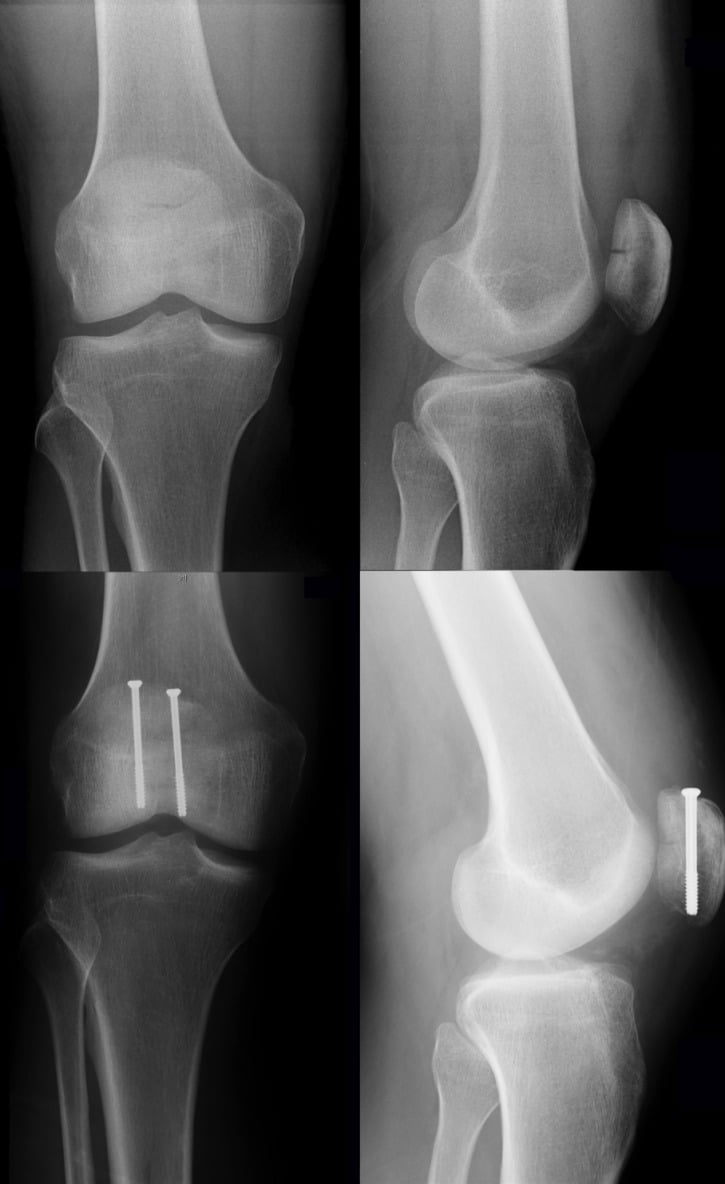
Hardware removal is the most common early complication of tension band wiring: up to 50% of patients require removal, mainly for K-wire prominence. Counsel them before surgery about a likely second operation. Screw fixation may have a lower removal rate.
- Incidence
- Up to 50%
- Risk Factors
- TBW, thin soft tissue
- Management
- Planned second surgery counselling
- Incidence
- 10-20%
- Risk Factors
- Prolonged immobilisation, poor rehab
- Management
- Early ROM, aggressive physio
- Incidence
- 40-50% by 10-20 years
- Risk Factors
- Articular damage, malreduction
- Management
- Activity modification, ?later arthroplasty
- Incidence
- 2-5%
- Risk Factors
- Poor fixation, comminution, infection
- Management
- Revision fixation or partial patellectomy
- Incidence
- 5-10%
- Risk Factors
- Poor fixation technique, early loading
- Management
- Revision ORIF
- Incidence
- 5-10%
- Risk Factors
- Lengthening of mechanism
- Management
- Quadriceps strengthening, rarely requires revision
- Incidence
- 1-2%
- Risk Factors
- Open fracture, multiple surgeries
- Management
- Washout, antibiotics, hardware removal if needed
Postoperative Care and Rehabilitation
Tension band fixation is designed for early active motion, and prolonged immobilisation leads to stiffness and poor outcomes.
Post-ORIF Rehabilitation
Hinged knee brace. Immediate ROM exercises (tension band allows motion). Brace locked for walking. Heel slides, SLR with brace.
Increase ROM goal to 90° by week 4. Weight bearing as tolerated in brace. Pool therapy if available.
Discard brace as strength improves. Quadriceps strengthening progresses. Stationary biking.
Return to normal activity if X-ray shows union. Running at 3-4 months. Sport-specific by 4-6 months.
Outcomes and Prognosis
Most patients achieve satisfactory outcomes with proper treatment, and modern fixation generally preserves extensor function well.
- Union Rate
- 95-98%
- Good Function
- 85-90%
- Key Issues
- Hardware removal common (50%)
- Union Rate
- 95-98%
- Good Function
- 85-90%
- Key Issues
- Lower removal rate (10%)
- Union Rate
- 85-95%
- Good Function
- 70-80%
- Key Issues
- Depends on articular restoration
- Union Rate
- N/A
- Good Function
- 70-80%
- Key Issues
- Up to 30% excision well tolerated
- Union Rate
- 95%+
- Good Function
- 85-90%
- Key Issues
- For undisplaced, intact mechanism
Prognostic factors. A simple transverse pattern, minimal articular comminution, an anatomic reduction, early range-of-motion rehabilitation and a compliant patient favour a good result. A comminuted pattern, significant articular damage, malreduction with a step-off over 2mm, prolonged immobilisation, and an open fracture or infection count against it.
The long term. Patellofemoral osteoarthritis is the main long-term problem, and total knee arthroplasty may eventually be required for severe post-traumatic arthritis.
Guidelines, Registries & Global Practice
- Account for approximately 1% of all skeletal fractures
- Bimodal: young adults from high-energy direct trauma (road traffic, falls from height, sport) and older adults from low-energy falls
- Male predominance in young cohorts; rising proportion in older women with osteoporosis
- Increasing periprosthetic patella fractures with the global growth in knee arthroplasty
- No dedicated international patella-fracture registry; evidence comes from trauma series and meta-analyses
- Pooled data favour cannulated-screw constructs over K-wire TBW for ROM, function and reoperation
- Implant-removal remains the dominant secondary procedure, driven by K-wire/cerclage prominence
- Periprosthetic patella fractures are captured indirectly via arthroplasty registries (NJR, AOANJRR, AJRR)
- Operative Threshold Emphasis
- Displacement over 2-3mm, articular step over 2mm, or extensor lag
- Preferred Construct Trend
- Tension band; screws + tension band for biomechanical superiority
- Distinctive Point
- Early active motion central to the tension band concept
- Operative Threshold Emphasis
- Loss of active extension or significant displacement
- Preferred Construct Trend
- Stable construct allowing early rehabilitation
- Distinctive Point
- Soft-tissue assessment and open-fracture pathways prioritised
- Operative Threshold Emphasis
- Extensor mechanism disruption or displacement over 2-3mm
- Preferred Construct Trend
- Shift toward low-profile screw / suture constructs
- Distinctive Point
- Strong emphasis on counselling re hardware removal
- Operative Threshold Emphasis
- Same displacement/step thresholds; individualise by bone quality
- Preferred Construct Trend
- Angular-stable plates for comminution
- Distinctive Point
- Plating gaining favour for multifragmentary patterns
- Cannulated-screw and screw-plus-tension-band constructs increasingly default for transverse patterns
- Angular-stable/mesh plates and suture-based fixation available for comminution and osteoporotic bone
- CT and 3D planning routine for complex patterns
- K-wire tension band wiring remains the workhorse - cheap, available, effective
- Implant cost and supply may dictate technique over biomechanical ideal
- Higher burden of neglected fractures and aseptic nonunion presenting late
Key documentation (globally applicable): (1) Active extension tested BEFORE analgesia given, (2) Displacement and articular step measured on a good-quality lateral radiograph, (3) Informed consent including the high hardware-removal likelihood, particularly for K-wire TBW, (4) A defined serial-radiograph protocol for non-operative management. Missed secondary displacement in non-operative cases is a recognised source of litigation worldwide.
Controversies and Areas of Uncertainty
K-wire tension band wiring is being displaced by cannulated-screw constructs in the literature, yet TBW remains widespread because it is cheap and familiar. The debate is how strongly to recommend screws given largely retrospective comparative data.
Whether symptomatic-only or routine removal is best after TBW is unsettled. Removal rates up to half of TBW cases drive interest in lower-profile constructs, but elective removal carries its own morbidity.
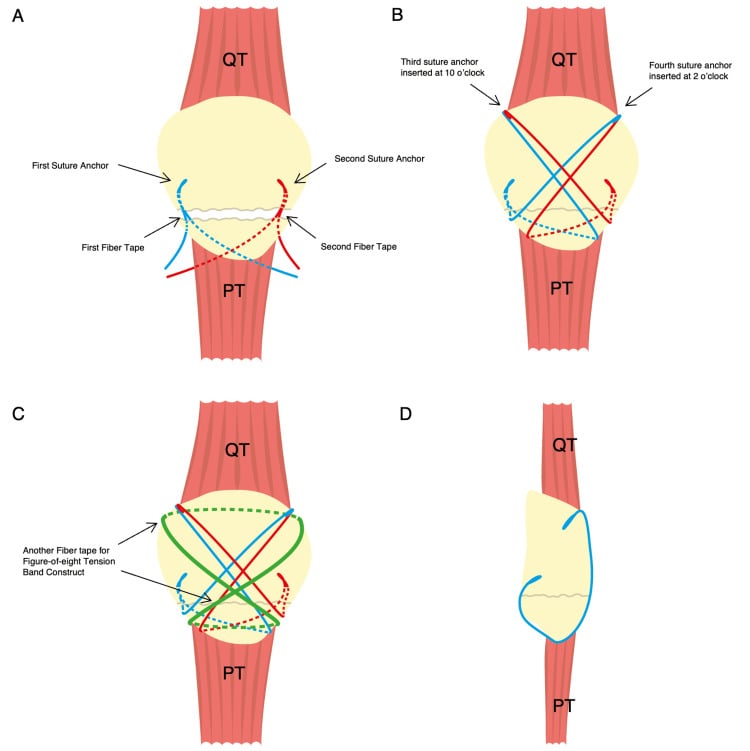
For comminuted inferior pole fractures, separate vertical wiring / suture anchor reconstruction preserves patellar height, whereas partial patellectomy is simpler. Long-term data support both, and the threshold for excision varies between surgeons.
All-suture and suture-anchor constructs avoid metalwork irritation and show promising early results, but high-level comparative evidence on union and re-displacement is still limited.
MCQ Practice Points
Q: By how much does the patella increase the extensor mechanism moment arm? A: 30-50%. The patella acts as a lever (sesamoid) that increases the quadriceps moment arm, improving efficiency. Patellectomy significantly weakens extension.
Q: What displacement threshold indicates need for surgical fixation of patella fractures? A: Greater than 2-3mm fracture displacement or greater than 2mm articular step. Loss of active extension is also an absolute indication regardless of displacement.
Q: What is the principle behind tension band wiring? A: The wire is placed on the tension side (anterior) of the patella. During knee flexion, the tensile forces are converted to compressive forces at the articular surface, promoting healing.
Q: What percentage of patients require hardware removal after TBW? A: Up to 50%. This is mainly due to K-wire prominence causing anterior knee pain. Cannulated screw fixation has lower removal rates due to lower profile.
Q: What percentage of the patella can be safely excised without significant functional loss? A: Up to 30% of the inferior pole. Beyond 50% excision, extensor strength is significantly compromised. Total patellectomy results in 30% strength loss.
Q: What is the most common patella fracture pattern? A: Transverse fracture (50%). This is followed by comminuted (30%), polar fractures (10-15%), and vertical (5%). Transverse fractures are typically fixed with TBW or screws.
Exam Viva Scenarios
Practise clinical reasoning and management decisions out loud
“A 35-year-old man falls off a ladder onto his knee. He cannot straighten his leg. X-ray shows a transverse patella fracture with 5mm of displacement. He is otherwise healthy. What is your management?”
“A 50-year-old woman trips and falls onto her knee. X-ray shows a comminuted inferior pole patella fracture with multiple small fragments (largest 1cm). She cannot actively extend. CT confirms 4 small fragments making up the inferior 25% of the patella. How would you manage this?”
“A 65-year-old diabetic woman presents after tripping on a rug. She has painful knee swelling but can actively extend her knee (demonstrated straight leg raise in ED before analgesia was given). X-ray shows a transverse patella fracture with approximately 1-2mm of displacement. How would you manage this?”
Key Anatomy
- Largest sesamoid bone
- Increases extensor moment arm by 30-50%
- Blood supply: genicular arteries, anterior
- Thickest articular cartilage (5-7mm)
Operative Indications
- Gap over 2-3mm displacement
- Active extension lost (failed SLR)
- Patellofemoral step over 2mm
- Surgery for any of the above
Tension Band Principle
- Wire placed ANTERIOR to fracture
- Converts tensile to compressive force
- Allows early ROM (motion = compression)
- Only works if posterior cortex intact
Fixation Options
- TBW: K-wires + figure-8 wire (classic)
- Cannulated screws: lower profile, less removal
- Basket plates: for comminuted fractures
- Partial patellectomy: non-reconstructable poles
Complications
- Hardware removal: 50% for TBW
- Patellofemoral OA: 40-50% long-term
- Stiffness: if immobilized too long
- Extensor lag: if lengthened mechanism
Important Numbers
- 2-3mm: displacement threshold for surgery
- 2mm: step-off threshold for surgery
- 30%: pole excision acceptable
- 50%: hardware removal rate TBW
Evidence Base and Key Trials
The modern literature has shifted decisively: multiple 2025-2026 meta-analyses now show cannulated screw constructs (with or without a tension band) outperform K-wire tension band wiring on knee ROM, functional scores, complications and reoperation. Quote a meta-analysis plus the Carpenter biomechanical rationale and you cover both the "what" and the "why".
Cannulated Screw vs K-wire Tension Band - Meta-Analysis
- Systematic review and meta-analysis of 11 studies, 1,358 patients
- No difference in operative time, healing time or VAS pain
- Cannulated screw tension band gave superior knee ROM (MD 7.16 degrees) and Lysholm scores (MD 4.80)
- COMPLICATIONS - and state the direction explicitly, because the published odds ratios are expressed K-WIRE VERSUS SCREW: K-wire tension band carried about FIVE-FOLD higher odds of reoperation (OR 5.14, 95% CI 2.66-9.93) and FOURTEEN-FOLD higher odds of overall complication (OR 14.19, 95% CI 4.85-41.56) than cannulated-screw tension band
Cannulated Screws +/- Tension Band vs TBW - Meta-Analysis
- 14 studies comparing TBW, cannulated screws (CS) and CS + tension band wire (CSTBW)
- CSTBW gave better 3-month flexion (SMD 0.92) and 3-month VAS (SMD -1.27) than TBW
- 12-month Lysholm favoured CSTBW (SMD 0.80)
- Complications and implant removal more frequent with TBW
Biomechanics of Patella Fixation Techniques
- Cadaveric RCT comparing modified tension band, parallel lag screws, and screws plus tension band
- Modified tension band displaced significantly more in simulated extension than either screw construct
- Screws plus tension band failed at highest load (mean 732 N) vs screws alone (554 N) and TBW (395 N)
- Cannulated screws allow simple, reliable addition of a tension band