Medial + Posterior Oblique Ligament Failure | Anteromedial Rotatory Instability | Often with ACL
- Superficial MCL (sMCL) is the primary restraint to valgus at 30 degrees flexion
- Posterior oblique ligament (POL) resists internal rotation and is the key to AMRI
- Semimembranosus has 5-6 insertional arms - main dynamic stabiliser of the PMC
- Isolated PMC injury is uncommon - always assess for ACL, PCL, meniscus
- AMRI is the hallmark instability pattern when PMC is deficient
- Acute repair within 3 weeks gives better results than chronic reconstruction
- “Valgus opening at 0 degrees = PMC plus cruciate injury, not isolated MCL
- “Anterior drawer in external rotation tests the POL and PMC
- “Slocum test with foot in external rotation exposes AMRI from PMC loss
- “MRI shows sMCL oedema, dMCL thickening, POL stripping, semimembranosus oedema
Overview and Epidemiology
The posteromedial corner (PMC) is frequently under-recognised in acute knee trauma. Isolated PMC injury is uncommon: up to 70% of PMC injuries occur as part of a multi-ligament knee injury, so an isolated grade III sMCL tear should always prompt a careful search for an associated ACL tear (the most common), PCL tear or meniscal lesion.
Mechanism. The injury follows a valgus force, external rotation, the two combined with axial load, or high-energy trauma:
- Valgus force - a lateral blow to the knee, or a fixed foot under valgus load (football, rugby)
- External rotation - the foot planted while the body rotates medially (skiing, pivoting sports)
- Combined valgus, external rotation and axial load - the classic mechanism for PMC plus ACL injury
- High-energy trauma - motor vehicle collision or fall from height, with multi-ligament injury
Why it matters. The injury gives medial pain and swelling localised to the sMCL and POL, and limits cutting, pivoting and stair descent. Missed, it leaves persistent anteromedial rotatory instability (AMRI), valgus collapse and accelerated medial compartment osteoarthritis.
Anatomy and Pathophysiology
The PMC is a layered complex of static and dynamic stabilisers on the medial side of the knee. The sMCL and POL are the primary static stabilisers and divide the work: the sMCL is the primary restraint to valgus at 30° of flexion, and the POL is the primary restraint to internal rotation of the tibia at all flexion angles (the Hughston axis). The deep MCL, a thickening of the medial capsule attached to the meniscus, is a secondary valgus restraint, and the semimembranosus is the main dynamic stabiliser.
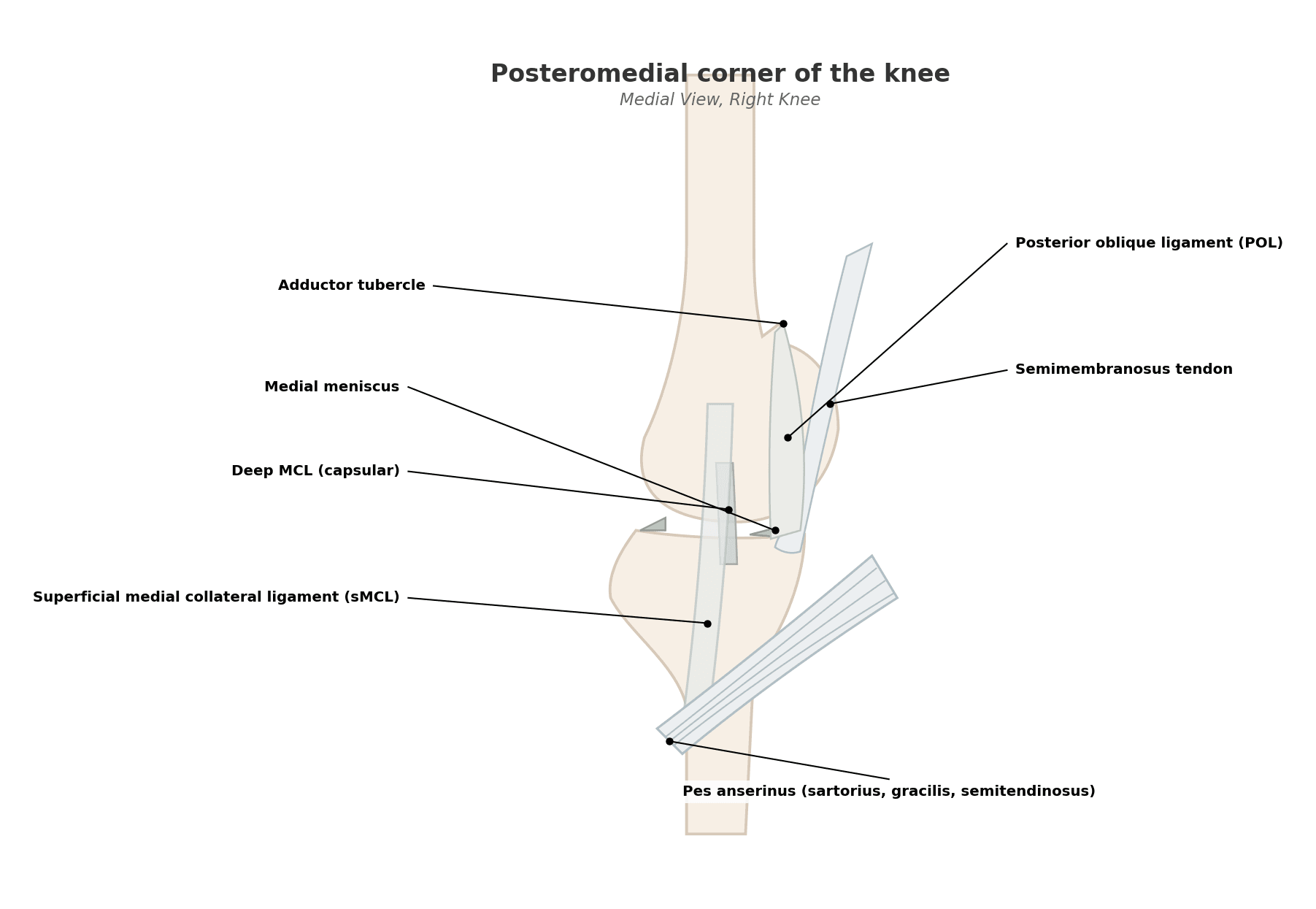
- Origin / Insertion
- Medial femoral epicondyle to 5-7 cm below the joint line
- Function
- Primary restraint to valgus at 30 deg
- When Injured
- Valgus laxity, medial pain, opens at 30 deg
- Origin / Insertion
- Thickening of the medial capsule, femur to tibia, attached to the meniscus
- Function
- Secondary valgus restraint, meniscal anchor
- When Injured
- Capsular sign, meniscal tear association
- Origin / Insertion
- Adductor tubercle, blending with the posteromedial capsule, to the posteromedial tibia
- Function
- Resists internal rotation of tibia
- When Injured
- Internal rotation laxity; AMRI when the sMCL is also lost
- Origin / Insertion
- Ischial tuberosity; 5-6 insertional arms onto the POL, oblique popliteal ligament and posterior capsule
- Function
- Primary dynamic PMC stabiliser, posterior drawer
- When Injured
- Loss of dynamic restraint, posteromedial pain
How AMRI arises. In the intact knee the sMCL, POL and semimembranosus together restrain anteromedial subluxation of the tibia. Loss of the sMCL alone produces valgus laxity, and loss of the POL alone internal rotation laxity. Lose both, and combined valgus and external rotation load subluxes the tibial plateau anteromedially: AMRI, the hallmark instability of PMC deficiency.
Why multi-ligament injury is so common. A single blow combining valgus, external rotation and axial load disrupts the ACL, sMCL and POL together, and hyperextension disrupts the PMC, ACL and PCL in sequence from posterior to anterior. The posterolateral corner and the PMC share the semimembranosus and the oblique popliteal ligament. In a high-energy knee dislocation all four corners may be involved.
Classification and Types
PMC injuries are classified by the structures torn, by the grade of the sMCL injury and by time from injury. The anatomical pattern dictates the surgical plan: isolated sMCL injury is treated non-operatively, a complete PMC injury needs repair or reconstruction, and PMC plus cruciate injury requires combined ligament surgery.
- Structures Injured
- sMCL fibres only
- Examination Finding
- Valgus opening at 30 deg only
- Treatment
- Hinged brace 4-6 weeks
- Structures Injured
- Capsular disruption plus meniscus attachment
- Examination Finding
- Valgus opening at 30 deg, meniscal sign
- Treatment
- Bracing, assess meniscus on MRI
- Structures Injured
- sMCL + dMCL + POL + semimembranosus
- Examination Finding
- Valgus at 30 deg (at 0 deg as well once a cruciate is torn), AMRI, increased ER at 30 and 90 deg
- Treatment
- Repair (acute) or reconstruction (chronic)
- Structures Injured
- PMC plus ACL or PCL
- Examination Finding
- Pivot, posterior sag, gross laxity
- Treatment
- Cruciate reconstruction plus PMC repair or recon
Tear location. Beyond grade and timing, where the sMCL tears predicts healing. Proximal (femoral-sided) tears heal reliably with bracing because the ends stay apposed. Distal (tibial-sided) tears heal less predictably and are more likely to leave residual valgus laxity.
The Stener-like lesion. The avulsed distal sMCL retracts and flips superficial to the pes anserinus (sartorius, gracilis, semitendinosus), which crosses to the anteromedial tibia. The ligament end no longer contacts its tibial footprint and cannot heal with bracing; the analogy is the thumb UCL Stener lesion, displaced over the adductor aponeurosis. MRI showing the distal sMCL stump lying superficial to the pes tendons is the radiographic clue. A distal tear that is displaced or entrapped, or one with a large bony tibial avulsion, therefore favours acute surgical repair over a non-operative trial.
Clinical Assessment
History. Pain over the medial joint line, the posteromedial corner or the proximal tibia after a valgus or external rotation injury, in contact sport or a motor vehicle collision. The knee gives way into valgus, especially with pivoting. Bruising is localised and medial, and the swelling is often less than the haemarthrosis of an ACL injury.
Examination. Look for medial ecchymosis, effusion, deformity, and watch the gait. Palpate the sMCL at its femoral and tibial attachments, the POL at the adductor tubercle, and the semimembranosus. Range of motion is often preserved unless a displaced meniscus blocks extension. Check the peroneal nerve and the popliteal vessels, always before and after any reduction.
The bedside tests. Valgus stress at 30° is the primary test of the sMCL and grades it. Valgus stress in full extension asks whether more than the sMCL has gone. The anterior drawer in external rotation and the Slocum test look for AMRI.
- Technique
- Knee flexed 30 deg, apply valgus force
- Positive Finding
- Greater than 3 mm side-to-side difference
- What it Tests
- Superficial MCL integrity
- Technique
- Knee in full extension, apply valgus force
- Positive Finding
- Medial opening with knee straight
- What it Tests
- PMC plus cruciate injury (not isolated sMCL)
- Technique
- Foot externally rotated 15 deg, draw tibia forward
- Positive Finding
- Increased anterior translation compared with the uninvolved knee
- What it Tests
- POL and PMC integrity
- Technique
- Knee at 90 deg, foot fixed in ER, tibia allowed to rotate back into neutral
- Positive Finding
- Lateral plateau reduces from anterior subluxation
- What it Tests
- AMRI - pathognomonic for PMC deficiency
Opening in full extension. An isolated sMCL injury does not open at 0°, because the cruciates and posterior capsule act as secondary restraints. Valgus opening with the knee straight is therefore never an isolated sMCL injury: it means the PMC and the cruciate ligaments are both injured.
In any patient with a grade III sMCL tear, perform the Lachman, posterior drawer, pivot shift, dial test and reverse pivot shift to exclude associated cruciate or posterolateral injury. Missing a concurrent ACL rupture is the most common reason for failed conservative treatment of an apparently isolated MCL injury.
- Key Finding
- Valgus opening at 30 deg, AMRI
- Discriminating Sign
- Increased ER, Slocum test positive
- Imaging
- MRI sMCL oedema, POL stripping
- Key Finding
- Joint line tenderness, locking, catching
- Discriminating Sign
- McMurray positive, pain on flexion
- Imaging
- MRI meniscal signal extending to surface
- Key Finding
- Pain 5 cm below joint line, medial tibia
- Discriminating Sign
- No laxity, tenderness localised to bursa
- Imaging
- MRI localised fluid in pes bursa
- Key Finding
- Pivot shift, giving way, haemarthrosis
- Discriminating Sign
- Lachman positive, anterior drawer positive
- Imaging
- MRI ACL discontinuity, lateral femoral condyle bone bruise
- Key Finding
- Lateral or medial plateau depression
- Discriminating Sign
- Tenderness over plateau, possible valgus laxity
- Imaging
- CT or MRI confirms fracture
- Key Finding
- Medial patellar instability, lateral patellar tilt
- Discriminating Sign
- Patellar apprehension, lateral translation
- Imaging
- MRI MPFL oedema, patellar tilt
Investigations
The diagnosis of PMC injury is clinical and MRI-confirmed. Plain radiographs exclude a bony avulsion and a tibial plateau fracture; MRI with corner-specific sequences is the gold standard for surgical planning.
Radiographs. AP, lateral, skyline and tunnel views of the knee. Look for avulsion of the medial femoral epicondyle (sMCL origin) or the adductor tubercle (POL origin), a Segond equivalent, and a tibial plateau fracture. Pellegrini-Stieda ossification along the proximal sMCL is a chronic finding: think chronic MCL insufficiency.
Bilateral valgus stress radiographs quantify side-to-side medial opening in millimetres and are useful in assessing a grade III injury.
MRI. Indicated in all suspected PMC injuries, especially when multi-ligament involvement is suspected. Each plane has its structures:
- Coronal - the sMCL origin, midsubstance and insertion: periligamentous oedema, fibre discontinuity, a wavy or stripped ligament
- Axial - the POL at the adductor tubercle, the semimembranosus tendon and its 5-6 arms, the posteromedial capsule
- Sagittal - the cruciate ligaments, menisci and posterior capsule
A bone marrow oedema pattern of medial femoral condyle and lateral tibial plateau bruising suggests combined ACL and PMC injury.
Before surgery. CT assesses bony avulsions and tibial plateau depression and measures fragment size for ORIF planning. Stress radiographs under anaesthesia quantify valgus opening and external rotation before surgical planning. A CT angiogram or ankle-brachial index is mandatory in any multi-ligament or high-energy knee injury to exclude popliteal artery injury.
Management Algorithm
The decision. Grade, pattern and timing decide treatment, weighed against the patient's demands. An isolated low-grade sMCL injury heals well and is braced. An isolated grade III injury is braced in the low-demand patient and repaired acutely in the high-demand one. The combined injury depends on whether it is an ACL tear with a medial injury that can be left to heal, or a multi-ligament knee in which every injured ligament is addressed.
Isolated grade I-II. The goals are to protect the healing sMCL, restore range of motion and prevent stiffness. Hinged bracing does not need to lock the knee in extension full-time: protected early motion (0-90°) prevents arthrofibrosis and is the modern standard. The sMCL heals by secondary intention and benefits from controlled motion to align its collagen fibres.
Non-operative Protocol
Hinged knee brace locked in extension for ambulation, unlocked for passive ROM 0-90 degrees. Weight-bearing as tolerated with crutches, the brace locked in extension. Ice, elevation and NSAIDs reduce swelling and pain, and isometrics begin: quadriceps sets, hamstring sets and straight leg raises.
The brace continues for ambulation and is weaned when stable. The aim is full extension and 90 degrees of flexion. Strengthening is with closed chain quadriceps work, hamstring curls and hip abductors, and proprioception with single-leg balance and a wobble board.
The brace is discontinued by 6 weeks if asymptomatic, and strengthening progresses to sport-specific drills. Linear running at 6 weeks if ROM and strength are full. Return to sport at 8-12 weeks for non-pivoting and 12-16 weeks for pivoting sport.
Isolated grade III. The goal is to restore valgus stability while protecting the POL, and outcomes are generally good with non-operative care in the absence of multi-ligament injury. The sMCL has excellent healing potential even in complete tears, and bracing for 6-8 weeks may restore valgus stability in low-demand patients. The choice lies between three routes:
- Bracing trial - for sedentary or low-demand patients, comorbidities precluding surgery, or patient preference. Hinged brace for 6-8 weeks, protected weight-bearing for 4 weeks, progressive ROM, then functional rehabilitation; 80-90% return to function in well-selected patients
- Acute repair, under 3 weeks - for a bony avulsion, the high-demand athlete, a failed bracing trial, a displaced distal (Stener-like) tear, or a multi-ligament pattern
- Chronic reconstruction, over 6 weeks - for failed bracing, persistent valgus laxity, AMRI, or the high-demand patient
ACL with a grade III MCL. The everyday combined injury, an ACL tear with a grade III sMCL/PMC tear, is distinct from the gross knee-dislocation pattern and has a characteristic staged approach that examiners look for. Because the medial side heals well, the usual sequence is to treat the MCL first in a hinged brace, regain full range of motion and let the medial side heal, then reconstruct the ACL at around 6 weeks once the knee is supple. Reconstructing the ACL acutely alongside a healing medial side risks arthrofibrosis and stiffness, and many grade III MCLs that are clinically stable at 6 weeks need no medial surgery at all.
The principle is to restore the central pivot (ACL) but let a healing medial side declare itself first. The exceptions that justify acute medial repair or reconstruction at the time of ACL surgery are:
- Persistent gross valgus laxity after a brace trial
- A distal or displaced (Stener-like) tear
- A large bony avulsion
- Valgus opening in full extension
- A true multi-ligament or dislocation pattern
PMC plus cruciate in the multi-ligament knee. Here the goal is to restore every injured ligament for a functional, stable knee. The cruciate is the cornerstone and PMC repair or reconstruction is added to it. Acute injuries (under 3 weeks) have all ligaments addressed in one setting; chronic injuries are staged if there is severe stiffness or fixed deformity. Neglecting the PMC component is a common cause of residual AMRI after ACL reconstruction.
Surgical Technique
Acute repair (under 3 weeks). Through a longitudinal incision over the medial femoral epicondyle, extended distally along the sMCL:
- Identify the sMCL origin and insertion, the dMCL, the POL at the adductor tubercle and the semimembranosus expansion
- Reattach a proximal (femoral) avulsion with 2-3 suture anchors at the medial epicondyle
- Fix a distal (tibial) avulsion with a staple or screw-and-washer
- Tighten the POL by advancing it onto the adductor tubercle with suture anchors
- Re-tension the 5-6 insertional arms of the semimembranosus if torn
After repair: hinged brace for 6 weeks, protected weight-bearing, progressive ROM, and return to sport at 6-9 months.
Chronic reconstruction (over 6 weeks). Both the sMCL and the POL are reconstructed:
- sMCL reconstruction with hamstring autograft or allograft through anatomic femoral and tibial tunnels
- POL reconstruction with a separate limb of graft, advanced onto the adductor tubercle
- Posteromedial capsule plication to address AMRI
- Augmentation with an internal brace or suture tape reinforcement, which is increasingly used
Multi-ligament reconstruction. The cruciates go first because they set the central pivot.
Surgical Protocol
MRI of all four corners, CT for bony avulsions, and vascular studies if the knee has dislocated. Consent covers stiffness, failure, revision, donor site morbidity (autograft), infection and neurovascular injury. Have an arthroscopy tower, fluoroscopy, ligament-specific instruments and allograft available.
- Examination under anaesthesia to confirm the instability pattern and side-to-side laxity
- Arthroscopy to address meniscal pathology and chondral lesions and confirm cruciate status
- Cruciate reconstruction, ACL or PCL
- PMC repair or reconstruction through an open medial approach: repair avulsions, reconstruct the sMCL and POL
- Posterolateral or lateral injury addressed as needed
- Repeat examination under anaesthesia and document final laxity
Hinged knee brace for 6 weeks, locked in extension for ambulation, with toe-touch weight-bearing for 4 weeks and then progressive loading. Passive ROM 0-90 degrees from week 2, avoiding external rotation stretch. Quadriceps activation, hamstring sets and calf pumps.
Wean to a functional brace for pivoting sports. Closed chain strengthening from week 6 and open chain from week 12. Linear running at 4 months, pivoting at 6-9 months, and return to sport at 9-12 months for combined reconstructions.
Complications
- Incidence
- 10-20 percent after repair
- Risk Factors
- Chronic injury, poor tissue quality, missed POL
- Management
- Bracing trial, revision reconstruction
- Incidence
- 10-15 percent after isolated sMCL repair
- Risk Factors
- Untreated POL injury, missed associated cruciate
- Management
- POL reconstruction, address cruciate if missed
- Incidence
- 15-25 percent after multi-ligament surgery
- Risk Factors
- Prolonged immobilisation, combined procedures
- Management
- MUA, arthroscopic release, aggressive rehab
- Incidence
- Rare in isolated PMC, more in dislocation
- Risk Factors
- High-energy mechanism, missed vascular injury
- Management
- CT angiogram, vascular surgery consult
- Incidence
- Less than 5 percent
- Risk Factors
- Multi-ligament injury, varus component
- Management
- Ankle-foot orthosis, nerve recovery 3-6 months
- Incidence
- 5-10 percent with medial approach
- Risk Factors
- Direct injury or traction during exposure
- Management
- Neuropathic pain management, neuroma excision
- Incidence
- 5-10 percent after reconstruction
- Risk Factors
- Early return to sport, poor tunnel placement
- Management
- Revision reconstruction, prolonged rehab
Any knee with PMC plus another ligament injury, or any high-energy mechanism, requires formal vascular assessment. Ankle-brachial index under 0.9, expanding haematoma, absent pulses, or limb ischaemia mandates immediate CT angiogram and vascular surgery consultation. A missed popliteal artery injury can cost the limb.
Outcomes and Prognosis
- Indication
- Isolated low-grade sMCL
- Expected Outcome
- Over 95 percent return to sport at 3 months
- Long-term Function
- Excellent, no residual laxity
- Indication
- Low-demand patient, no multi-ligament
- Expected Outcome
- 80-90 percent stable, mild residual laxity common
- Long-term Function
- Good for ADL, may struggle with pivoting sport
- Indication
- Bony avulsion, midsubstance tear, athlete
- Expected Outcome
- 85-95 percent good-to-excellent
- Long-term Function
- Best long-term stability, fastest return
- Indication
- Failed bracing, chronic AMRI, high demand
- Expected Outcome
- 80-90 percent good-to-excellent, lower than acute repair
- Long-term Function
- Good stability, slower return, graft donor morbidity
- Indication
- Multi-ligament knee
- Expected Outcome
- 75-90 percent good-to-excellent
- Long-term Function
- Good, but stiffness and residual laxity common
Combined ACL plus PMC reconstruction gives 80-90% good-to-excellent results in the hands of an experienced knee surgeon. The 3-week threshold from injury is the one to remember: outcomes decline significantly after it.
Best prognosis. Acute presentation under 3 weeks, an isolated injury with no associated cruciate, a compliant patient, and hamstring autograft or primary repair.
Poor prognosis. Chronic injury over 6 weeks, a multi-ligament pattern or knee dislocation, severe chondral damage seen at arthroscopy, prior surgery, smoking, diabetes and obesity.
Guidelines, Registries & Global Practice
- Isolated grade III sMCL tears are uncommon as surgical cases - the majority of MCL injuries worldwide are low-grade and managed non-operatively
- PMC plus cruciate injuries dominate operative practice, especially in high-energy sport and road traffic collisions
- High-volume centres report multi-ligament knee injuries at 0.02 to 0.2 percent of all orthopaedic trauma admissions globally
- Male predominance in the third and fourth decades, reflecting contact sport and motor vehicle exposure
- High-resource: dedicated knee ligament surgeons, anatomic reconstruction techniques, allograft availability, structured multi-ligament rehabilitation pathways
- Limited-resource: bracing-first approach for most PMC injuries, primary repair of avulsions where feasible, delayed reconstruction reserved for high-demand patients
- Universal principle: the sMCL heals well with non-operative care in isolated injuries; the surgical decision is driven by multi-ligament involvement and patient demand
- Rehabilitation access: outcomes depend on supervised physiotherapy, which is unevenly available across regions
- Diagnosis emphasis
- Lachman, pivot shift, valgus stress, MRI
- Isolated MCL
- Brace and rehab for grade I-II, repair for grade III in athletes
- Multi-ligament PMC
- Single-stage reconstruction of all injured ligaments
- Diagnosis emphasis
- MRI-based classification, anatomic reconstruction
- Isolated MCL
- Functional bracing, structured rehab
- Multi-ligament PMC
- Anatomic sMCL and POL reconstruction, anatomic tunnels
- Diagnosis emphasis
- Clinical examination, MRI, vascular assessment in dislocation
- Isolated MCL
- Brace and rehab as first line for isolated injuries
- Multi-ligament PMC
- Multi-ligament reconstruction in specialist centres
- Diagnosis emphasis
- Multiligament knee classification, treatment algorithm
- Isolated MCL
- Brace-led for isolated low-grade, repair for avulsion
- Multi-ligament PMC
- Single or staged multi-ligament reconstruction, anatomic principles
There is no dedicated PMC injury registry. Multi-ligament knee registries exist in some regions (including the UK and the US) and provide the best population-level data on outcomes, but PMC-specific outcome data is largely from case series and systematic reviews. Surgical decision-making is therefore guided by anatomic and biomechanical principles (LaPrade, Sims, Hughston) and the patient's functional demand.
Record in every PMC injury:
- Valgus opening in millimetres at 0 and 30 degrees
- Anterior drawer in external rotation (side-to-side comparison)
- Lachman, posterior drawer, pivot shift, dial test (to exclude multi-ligament)
- Vascular examination: pulses, capillary refill, ankle-brachial index
- Peroneal nerve and saphenous nerve function
- MRI findings for sMCL, dMCL, POL, semimembranosus, and cruciates
A missed popliteal artery injury is the most catastrophic complication of multi-ligament knee injury. Always document vascular status before and after any reduction.
Controversies & Areas of Uncertainty
Modern series suggest that bracing can restore valgus stability in 80-90 percent of isolated grade III sMCL injuries, with return to sport comparable to surgical repair in non-elite patients. Acute repair is favoured for elite pivoting athletes, but the evidence for universal operative treatment is weak.
Anatomic reconstruction (LaPrade) restores the sMCL to its native femoral and tibial footprints and gives reliable valgus stability. Isometric reconstruction places the femoral tunnel slightly anterior to the anatomic centre to reduce graft length change through range of motion. The two techniques have not been directly compared in a randomised trial.
The original Lind and LaPrade techniques used a single hamstring graft with sMCL and POL limbs. Some surgeons add an internal brace or suture tape augmentation. There is no high-quality trial showing that one construct is superior for AMRI control.
Most surgeons operate within 3 weeks of injury to allow primary repair and to avoid the stiff, fibrotic knee of delayed surgery. Some recent series report acceptable outcomes with delayed (3-6 weeks) reconstruction after initial spanning external fixation. The optimal window remains debated.
MCQ Practice Points
Q: Name the four core static stabilisers of the posteromedial corner. A: Superficial MCL (sMCL), deep MCL (dMCL), posterior oblique ligament (POL), and posteromedial capsule, with the semimembranosus expansion acting as the dynamic stabiliser. The sMCL is the primary restraint to valgus at 30 degrees flexion, while the POL is the primary restraint to internal rotation of the tibia.
Q: What examination finding confirms anteromedial rotatory instability (AMRI)? A: The Slocum test (or Hughston anterior drawer in external rotation). With the knee flexed to 90 degrees and the foot fixed in 15 degrees of external rotation, the tibia is allowed to rotate back into neutral. The lateral tibial plateau reduces from an anteriorly subluxed position - this reduction is pathognomonic for AMRI from PMC deficiency.
Q: A patient has valgus opening at 0 degrees (full extension). What does this tell you? A: It is not isolated sMCL injury. Valgus opening in full extension implies the PMC plus the cruciate ligaments (typically ACL) are both injured, because the cruciates and posterior capsule act as secondary valgus restraints in extension. Always examine the ACL, PCL, and posterolateral corner when there is medial opening in full extension.
Q: What is the optimal management of an isolated grade II sMCL injury? A: Hinged knee brace for 4-6 weeks with early protected range of motion. The sMCL has excellent healing potential. Weight-bearing as tolerated, progressive ROM, and a structured rehabilitation programme. Return to sport at 8-12 weeks for non-pivoting activities and 12-16 weeks for pivoting. Surgery is rarely required.
Q: What is the optimal window for acute primary repair of the PMC? A: Within 3 weeks of injury. After this window, the sMCL and POL retract, become scarred, and the tissue quality is too poor for primary repair - staged or chronic reconstruction with autograft or allograft is then required. Outcomes after acute repair are consistently superior to outcomes after delayed reconstruction.
Q: A chronic PMC deficiency with AMRI is being reconstructed. What two structures must be addressed? A: The sMCL and the POL. The sMCL limb controls valgus; a separate POL limb (often a second limb of the same hamstring graft) controls internal rotation and AMRI. Reconstructing the sMCL alone leaves residual AMRI - this is the most common technical error in PMC reconstruction.
Exam Viva Scenarios
Practise clinical reasoning and management decisions out loud
“A 24-year-old professional footballer presents 2 days after a valgus injury to his right knee during a tackle. On examination, he has medial pain, 8 mm of valgus opening at 30 degrees with a soft endpoint, and a positive anterior drawer in external rotation. Lachman and pivot shift are normal. MRI shows isolated sMCL rupture with periligamentous oedema and oedema at the POL insertion. How would you manage this?”
“A 35-year-old motorcyclist presents 5 days after a high-speed collision. He has gross medial laxity with valgus opening at 0 and 30 degrees, increased external rotation at 30 and 90 degrees, a 3+ Lachman, and a positive posterior drawer. CT angiogram is normal. MRI confirms complete sMCL and POL rupture, ACL rupture, and a high-grade partial PCL injury. How do you stage and perform the surgery?”
Key Anatomy
- sMCL = primary valgus restraint at 30 deg, inserts 5-7 cm below joint line on tibia
- POL = primary restraint to internal rotation, arises from adductor tubercle
- Semimembranosus = dynamic PMC stabiliser, 5-6 insertional arms onto POL and capsule
- Deep MCL = capsular thickening, attaches to meniscus (secondary restraint)
Diagnosis
- Valgus stress at 30 deg grades sMCL injury (0 mm = grade 0, 3-5 mm = I, 5-10 mm = II, greater than 10 mm = III)
- Valgus opening at 0 deg = PMC plus cruciate injury, not isolated sMCL
- Anterior drawer in external rotation (Hughston) and Slocum test detect AMRI
- Always examine ACL, PCL, meniscus, LCL - 70 percent of PMC injuries are multi-ligament
Imaging
- MRI with corner-specific sequences is the gold standard for surgical planning
- Coronal views for sMCL, axial for POL and semimembranosus
- CT angiogram or ankle-brachial index mandatory in any multi-ligament knee
- Pellegrini-Stieda ossification on plain film = chronic sMCL injury
Treatment Algorithm
- Isolated grade I-II = hinged brace 4-6 weeks with protected early ROM
- Isolated grade III = brace trial in low-demand patients, repair in athletes under 3 weeks
- PMC plus cruciate = single-stage multi-ligament reconstruction within 3 weeks
- Chronic PMC deficiency = anatomic sMCL plus POL reconstruction, autograft or allograft
Complications
- Residual valgus laxity 10-20 percent, persistent AMRI if POL not addressed
- Stiffness / arthrofibrosis 15-25 percent after multi-ligament reconstruction
- Popliteal artery injury is the most catastrophic - always obtain vascular studies
- Peroneal and saphenous nerve injury with medial approach (5-10 percent)
Evidence Base and Key Trials
Classification of knee ligament instabilities. Part I. The medial compartment and cruciate ligaments
- Original description of anteromedial rotatory instability (AMRI) and its link to the medial and posteromedial structures
- Established the importance of the posterior oblique ligament as a distinct restraint to internal rotation
- Anterior drawer in external rotation (the Hughston test) introduced as the bedside test for AMRI
- Anatomic and biomechanical basis for treating AMRI by addressing the PMC plus cruciate as a unit
The anatomy of the medial part of the knee
- Quantitative anatomic study of the sMCL, POL, and posteromedial capsule in cadaveric knees
- sMCL femoral insertion 3.2 mm proximal and 4.8 mm posterior to the medial epicondyle
- sMCL tibial insertion 6 cm distal to the joint line, on the posteromedial tibia
- POL origin at the adductor tubercle, blending with the posteromedial capsule and semimembranosus expansion
The posteromedial corner of the knee: medial-sided injury patterns revisited
- Review of the three medial structures: sMCL, dMCL (middle third capsular ligament), and POL
- POL and semimembranosus expansion are the prime restraints to internal rotation, not the sMCL
- Failure to address the POL at the time of sMCL repair is a common cause of residual AMRI
- Combined sMCL plus POL reconstruction gives superior rotational stability to sMCL alone
Surgical treatment of acute medial collateral ligament and posteromedial corner injuries of the knee
- Acute grade III PMC injuries treated with primary repair of the sMCL, POL, and semimembranosus expansion
- Cruciate reconstruction (ACL, PCL) performed in the same sitting for multi-ligament knees
- Mean side-to-side medial opening on valgus stress restored to within 2 mm of the contralateral knee
- Over 80 percent of multi-ligament patients returned to pre-injury activity level
Surgical techniques for the reconstruction of medial collateral ligament and posteromedial corner injuries of the knee: a systematic review
- Systematic review of PMC reconstruction techniques in chronic and multi-ligament settings
- Anatomic sMCL reconstruction restores valgus stability but does not consistently control AMRI
- Adding a dedicated POL reconstruction limb reduces residual internal rotation and AMRI
- No consensus on the ideal graft choice (hamstring autograft, tibialis anterior or peroneus allograft)