Definition | Risk Factors | Prevention | Management
- PJK definition: PJA at least 10° AND at least 10° greater than baseline, UIV to UIV+2
- Risk factors: Age, osteoporosis, over-correction, thoracic UIV
- Most occur 3-18 months postoperatively
- Prevention: Appropriate alignment targets, cement augmentation, soft tissue preservation
- Revision indications: Progressive deformity, neurological symptoms, significant pain
- “Not all PJK requires surgery - distinguish PJK from PJF
- “Over-correction of sagittal alignment increases PJK risk
- “Cement augmentation at UIV reduces PJK in osteoporotic patients
- “Upper thoracic UIV has higher PJK risk than thoracolumbar
Overview and Epidemiology
Proximal junctional kyphosis (PJK) is one of the most common mechanical complications of long-segment spinal fusion, particularly after correction of adult spinal deformity (ASD). It is excessive kyphosis developing at the transition zone between the fused and the unfused spine, and most cases appear 3-18 months after surgery.
PJK and PJF. PJK is a radiographic finding: it may be stable, it is often asymptomatic, and it is usually observed. Proximal junctional failure (PJF) is a clinical and radiographic diagnosis, a vertebral fracture, ligament rupture or implant failure at the UIV that presents with pain, deformity or neurology and often requires revision surgery, with a 40% revision rate. Not all PJK progresses to PJF, and many cases can be observed if they are stable and asymptomatic.
Why it matters. PJK may be asymptomatic or cause significant morbidity, and healthcare costs are substantially increased with PJK and PJF. Incidence varies with the population operated on:
- PJK Incidence
- 20-40%
- PJF Incidence
- 1.4-5.6%
- PJK Incidence
- 10-20%
- PJF Incidence
- Less than 2%
- PJK Incidence
- Up to 50%
- PJF Incidence
- 5-10%
- PJK Incidence
- 30-50%
- PJF Incidence
- 5-10%
Pathophysiology and Anatomy
The mismatch. PJK results from a mismatch between the mechanical demands at the proximal junction and the capacity of the adjacent tissues to withstand them. A rigid fused construct meets the mobile unfused spine, and that abrupt stiffness transition concentrates stress at the junctional level. Sagittal imbalance adds to it, because a forward trunk shift increases the moment arm at the UIV; when bone, ligament or disc cannot withstand the new loads, the junction gives way.
Where the stress comes from. The junctional zone is loaded by the transition from fused to mobile segments, by the lever arm of a long construct, and by the loss of shock absorption from the fused discs.
What fails. Each tissue at the junction has its own failure pattern:
- Bone - UIV vertebral body compression, UIV+1 vertebral body fracture, superior endplate failure
- Soft tissue - the posterior ligamentous complex (PLC), the interspinous and supraspinous ligaments, and the paraspinal musculature
- Disc - UIV/UIV+1 disc degeneration and accelerated adjacent segment disease
Bone quality. Osteoporotic bone cannot resist vertebral compression, gives UIV screws reduced pull-out strength, and fractures more readily because the cortex is thin.
Compensation. Once PJK develops, the body attempts to compensate with cervical hyperlordosis, pelvic retroversion and knee flexion.
Classification Systems
Two criteria, both required. PJK is present when:
- The proximal junctional angle (PJA) is at least 10°, an absolute threshold, and
- The PJA has increased by at least 10° from the baseline film.
Either criterion alone is not PJK. A patient whose junction measures 15° but was 12° at baseline has a large angle and a trivial change; a patient who moves from 2° to 9° has neither. Requiring both is what stops the definition labelling pre-existing kyphosis or measurement noise as a complication.
Why published rates disagree. The systematic review of 359 studies (Akosman, PMID 39028103) found the dual criterion in 56% of the literature, the majority but far from unanimity, and follow-up windows vary from 1 to 9 years. The 20-40% incidence range is therefore soft: much of the spread between papers is definitional rather than biological, so state your criteria and your baseline film before quoting a rate.
Which baseline? Glattes compared against the preoperative film; most subsequent work compares against the first erect postoperative radiograph, which is the more useful comparator because it isolates change caused by the construct rather than change caused by the operation. The two give different numbers on the same patient, so say which you are using.
Measuring it.
- Identify the upper instrumented vertebra (UIV)
- Measure the angle between the inferior endplate of the UIV and the superior endplate of UIV+2, two levels above - the vertebra pair used in 74% of studies
- Compare with the chosen baseline film
- Apply both criteria
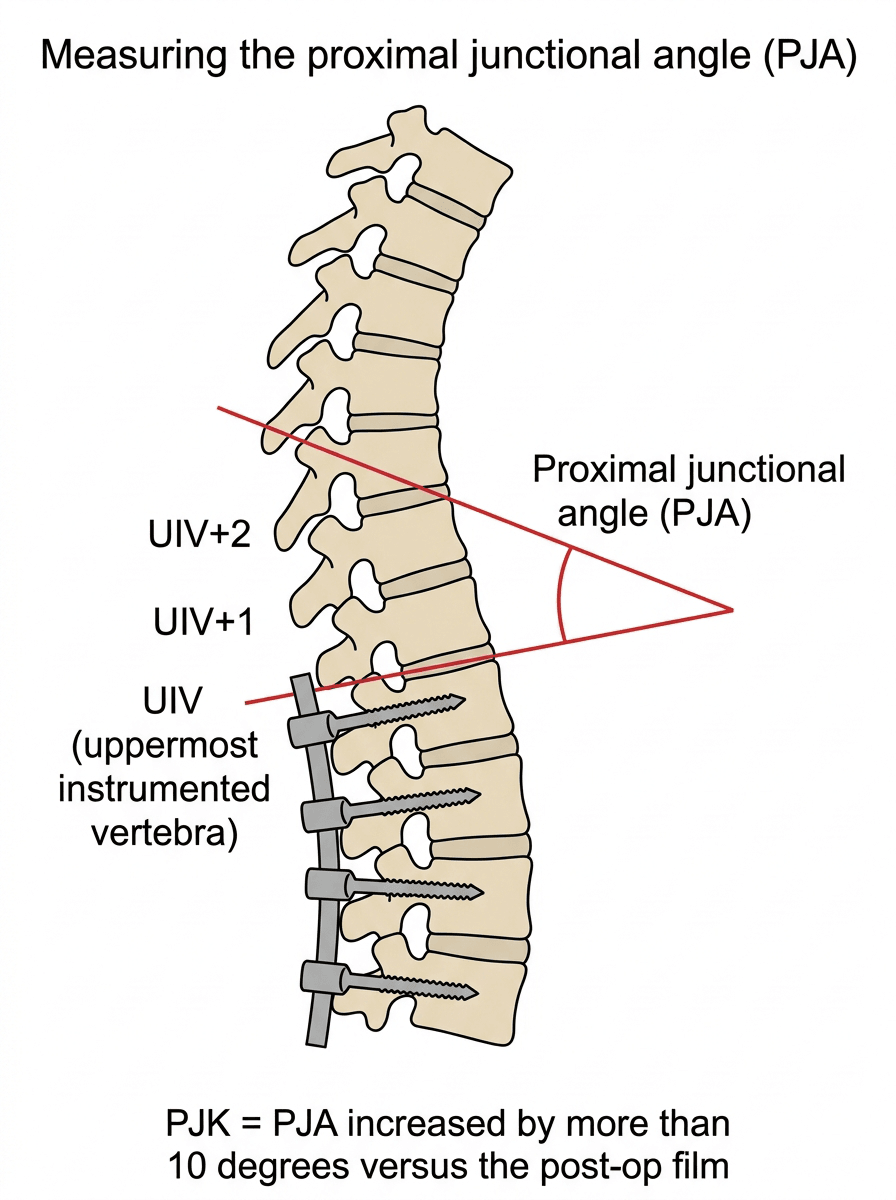
Severity. Grading by the change in PJA standardises reporting and helps guide treatment:
- PJA Change
- 10-20°
- Clinical Significance
- Often asymptomatic, observe
- PJA Change
- 20-30°
- Clinical Significance
- May be symptomatic
- PJA Change
- More than 30°
- Clinical Significance
- Usually requires intervention
Clinical Assessment
History. Establish when the index operation was, then ask about:
- New or worsening back pain - character, location, severity
- Change in posture or balance
- Neurological symptoms - weakness, numbness, bowel or bladder
- Functional limitation - walking tolerance, activities of daily living
Red flags for PJF. Any of these raises the possibility of failure:
- Acute pain after minor trauma, or sudden onset
- New neurological deficit
- A visible or palpable step-off at the end of the fusion
- Rapidly progressive kyphosis
Look and feel. Standing, the patient shows increased thoracic kyphosis and a forward trunk lean, with compensatory cervical hyperlordosis and a visible prominence at the UIV level. Palpation finds tenderness over the UIV, a step-off or prominence at the junctional level, and muscle spasm.
Neurology and flexibility. Examine motor power in full, especially if PJF is suspected, along with sensation, reflexes and gait. Check whether the kyphosis corrects with prone positioning, and look for a hip flexion contracture with the Thomas test.
New onset myelopathy or progressive neurological deficit in a patient with PJK/PJF requires urgent evaluation. Cord compression from kyphotic collapse or subluxation may necessitate emergent surgical intervention.
Differential diagnosis. New pain or kyphosis above a fusion is not always mechanical PJK, and the alternatives must be considered and excluded.
- Distinguishing Feature
- Gradual angular change: PJA at least 10 deg and at least 10 deg above baseline, often asymptomatic
- Key Investigation
- Standing long-cassette radiographs
- Distinguishing Feature
- UIV/UIV+1 fracture, ligamentous rupture or implant failure, acute pain
- Key Investigation
- CT (fracture/implant), MRI (cord/soft tissue)
- Distinguishing Feature
- Disc/facet degeneration above UIV without acute collapse
- Key Investigation
- MRI
- Distinguishing Feature
- Fracture remote from instrumentation, low-energy
- Key Investigation
- Radiograph/CT, DEXA
- Distinguishing Feature
- Pain, raised CRP/ESR, wound issues, sometimes loosening
- Key Investigation
- Inflammatory markers, MRI, aspiration
- Distinguishing Feature
- Failure at the caudal end of the construct
- Key Investigation
- Standing radiographs of whole construct
- Distinguishing Feature
- Constitutional symptoms, lytic lesion at junction
- Key Investigation
- MRI whole spine, staging
Investigations
Standing full-length radiographs first. Compare them with the immediate postoperative films and measure the PJA from UIV to UIV+2. Assess global sagittal alignment, the SVA (C7 plumb line to S1) and PI-LL, evaluate the hardware position, and document the exact UIV level. If instability is suspected, flexion-extension lateral radiographs assess motion at the UIV segment and document any subluxation.
CT, if indicated. CT detects a vertebral fracture at the UIV or UIV+1, assesses the fusion mass for pseudarthrosis, evaluates the hardware for loosening or breakage, and measures bone quality in Hounsfield units.
MRI, if there are neurological symptoms. It assesses cord compression, soft-tissue change, disc pathology and the integrity of the posterior elements.
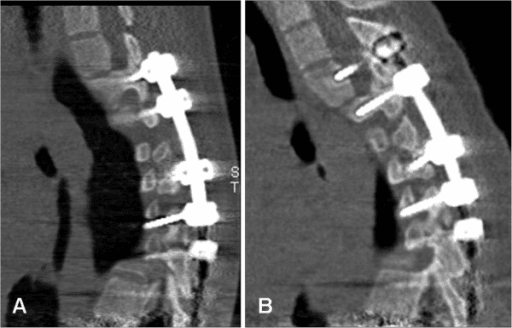
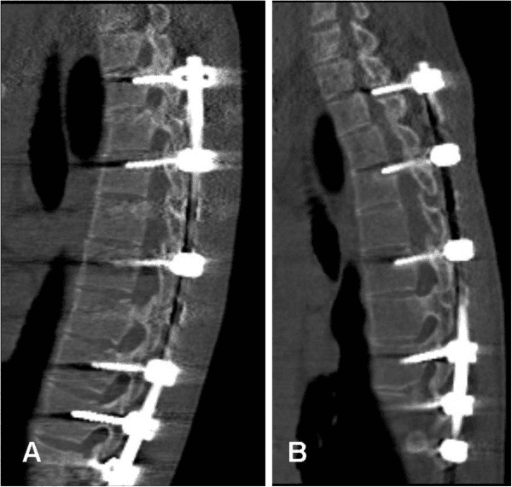
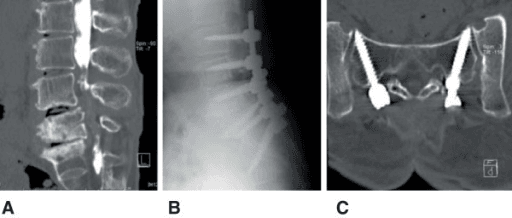
Bone density. DEXA gives a baseline T-score and is repeated if osteoporosis treatment is started. On CT, the density of the UIV and UIV+1 vertebral bodies adds to it: less than 110 HU suggests osteoporosis and guides the need for cement augmentation at revision.
Because over-correction of sagittal alignment is the key modifiable driver of PJK, the spinopelvic parameters must be understood. Pelvic incidence (PI) is a fixed morphological constant: PI = pelvic tilt (PT) + sacral slope (SS). The classic Schwab/SRS correction goals are a PI-LL mismatch within about 10 degrees, an SVA (sagittal vertical axis) under 5 cm, and a pelvic tilt under about 20 to 25 degrees (the T1 pelvic angle, TPA, combines trunk and pelvic malalignment in a single measure). The crucial PJK lesson (Lafage) is that these "ideal" young-adult numbers should be age-adjusted: older patients normally stand with a larger PI-LL mismatch, a more positive SVA and a higher pelvic tilt, so correcting an elderly patient to a young-adult profile is functional over-correction and the single most avoidable cause of PJK. Plan to a proportioned, age-appropriate target (the GAP score operationalises this proportionality, albeit with inconsistent external validation) rather than to fixed absolute values.
Management
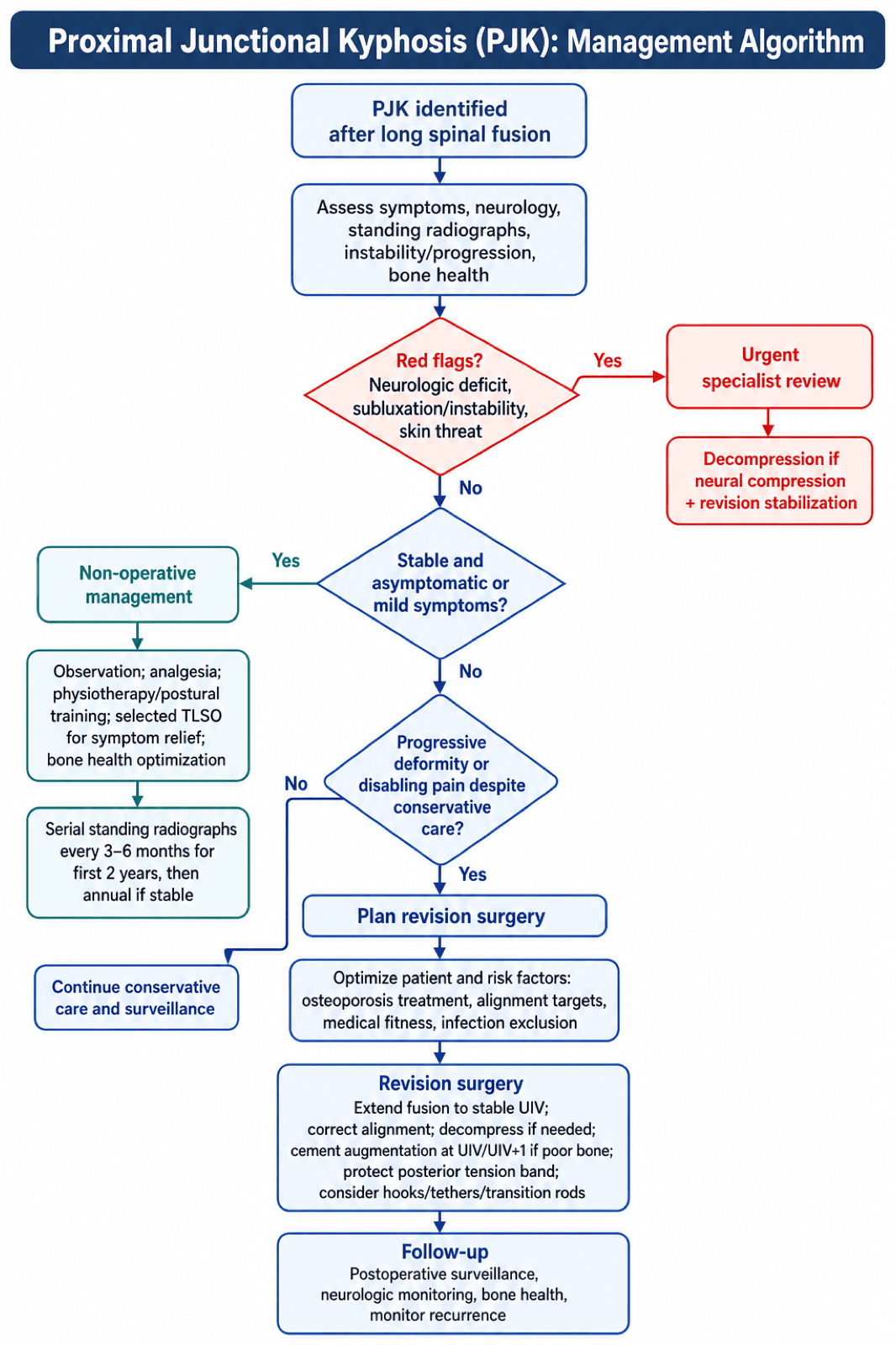
Who. Non-operative care suits:
- Stable PJK that is not progressing
- The asymptomatic or minimally symptomatic patient
- Patient preference
- High surgical risk
Observation. Standing radiographs every 3-6 months for the first 2 years detect progression and are read alongside the symptoms. Stable PJK can then move to annual surveillance.
Symptom control. Analgesics (paracetamol, NSAIDs), neuropathic agents if there is radicular pain, and activity modification. Physiotherapy concentrates on core strengthening and postural training while maintaining mobility.
Bracing. The evidence for efficacy is limited. A brace may provide symptom relief, and a TLSO may be considered for stabilisation.
Bone health. Treat the osteoporosis, as set out under Postoperative Care, and add fall prevention.
Surgical Technique
Level selection. Extend to a stable, horizontal vertebra, which typically means adding 2-4 levels proximally. Recurrent PJK calls for upper thoracic extension (T4 or higher), and cervical extension may be considered in severe cases. Ensure the bone quality at the new UIV is adequate, and remove all posterior elements below the UIV before extending.
Protecting the new junction. The adjuncts used at the index operation (next tab) apply again at the new UIV. Prophylactic cement augmentation (vertebroplasty) of the new UIV and UIV+1 improves screw purchase in osteoporotic bone and reduces fracture risk. Preserve the interspinous and supraspinous ligaments at the new UIV, consider hooks or sublaminar bands in place of screws there, and consider tethers or ligament augmentation. Cobalt chrome or transition rods give flexibility at the junction and reduce the stiffness gradient.
Anterior support. If the disc space at the UIV level has collapsed, an interbody cage restores anterior column support and improves fusion potential.
Preventing recurrence. Address every risk factor for recurrence at the revision: cement augmentation in osteoporotic patients, age-adjusted alignment goals, and no over-correction.
Complications
Complications of PJK and PJF. Each frequency below is per case of PJF or of PJK, as marked:
- Incidence
- 5-10% of PJF
- Management
- Urgent decompression
- Incidence
- 50-70% of PJF
- Management
- Revision surgery
- Incidence
- 30-50% of PJK
- Management
- Monitoring/revision
- Incidence
- Rare
- Management
- Revision if threatened
Complications of revision. Early, the risks are neurological injury (1-5%), dural tear (5-10%), wound infection (5-10%) and significant blood loss. Late, they are recurrent PJK (20-30%), pseudarthrosis (10-20%), adjacent segment disease and chronic pain.
Why it recurs. Advanced age, poor bone quality and a long fusion cannot be changed at revision. Over-correction of alignment, inadequate proximal extension, failure to address osteoporosis and poor soft-tissue preservation can, which is why prevention during primary surgery matters and why every modifiable factor is addressed at revision.
PJK has a mirror image at the bottom of the construct — distal junctional kyphosis (DJK) and distal junctional failure (DJF) at or below the lowest instrumented vertebra (LIV). It is the analogous problem of a rigid construct meeting mobile distal segments, and is most relevant when a long fusion stops in the lower lumbar spine rather than extending to the pelvis. The key preventive principle is LIV selection: a construct that must span the thoracolumbar and lumbar spine for adult deformity is generally extended to the pelvis (using S2-alar-iliac or iliac screws) rather than ending at L4, L5 or S1, because stopping short leaves a high lumbosacral stress riser prone to distal failure and L5-S1 pseudarthrosis. Sacropelvic fixation protects the distal junction but, as the meta-analyses show, simultaneously raises proximal junctional risk — so a long fusion to the pelvis must pair distal pelvic fixation with proximal junction protection above.
Postoperative Care and Rehabilitation
The early phase. Mobilise early under supervision once the construct is judged stable. A thoracolumbosacral orthosis (TLSO) may be used for comfort, though high-level evidence for brace prevention of PJK is lacking. Observe neurology regularly, especially after revision for PJF or after deformity correction, and use multimodal analgesia, expecting a settling period after a revision extension.
Bone health optimisation. Low bone mineral density is an independent predictor of proximal junctional failure (Yagi et al., pmid 28902106), so bone health is a core part of postoperative and perioperative care:
- DEXA assessment and treatment of osteoporosis (bisphosphonates or denosumab)
- Calcium and vitamin D repletion
- In elective primary surgery, consider deferring 3-6 months for anabolic or antiresorptive optimisation in severe osteoporosis
- Anabolic agents (e.g. teriparatide) are of particular interest where bone quality is the limiting factor, though their specific role in PJK prevention remains under study
Surveillance. The first 3-6 months are the peak-risk window for acute failure (mean time to acute PJF 11.4 weeks; Hostin et al., pmid 22986834), so surveillance should be most intensive early:
- Imaging
- Standing long-cassette radiographs
- Purpose
- Baseline post-op alignment, detect early failure
- Imaging
- Standing radiographs
- Purpose
- Detect PJK/PJF during peak-risk window
- Imaging
- Standing radiographs
- Purpose
- Confirm stability, assess fusion
- Imaging
- Standing radiographs
- Purpose
- Long-term surveillance
Counsel patients to avoid heavy lifting and high-impact loading in the early postoperative period, and to report new junctional pain, a palpable step or new neurological symptoms promptly, as these may herald proximal junctional failure.
Outcomes and Prognosis
Untreated PJK. Many cases remain stable, the progression rate is approximately 20-30%, and some patients' symptoms improve.
Untreated PJF. PJF is generally progressive, carries a neurological risk if the cord is involved, and gives poor quality-of-life outcomes.
After revision. Radiographic and clinical results of revision surgery:
- Rate
- 70-80%
- Rate
- 60-70%
- Rate
- 80-90%
- Rate
- 60-70%
- Rate
- 50-70%
- Rate
- 60-75%
- Rate
- 20-30%
Prognosis. Outcomes are better in younger patients with good bone quality, at a first revision, after successful alignment correction and without neurological deficit. Multiple prior revisions, severe osteoporosis, persistent sagittal imbalance, neurological complications and medical comorbidities predict a worse result.
The best management of PJK is prevention during primary surgery. Once established, revision surgery has significant morbidity and recurrence risk. Emphasis should be on proper patient selection, appropriate alignment targets, and addressing bone quality in the primary procedure.
Guidelines, Registries & Global Practice
Global Epidemiology
Adult spinal deformity surgery is increasing worldwide as populations age, and PJK is consistently the most common mechanical complication of long-segment fusion across health systems. Reported incidence is broadly consistent internationally: radiographic PJK occurs in roughly a quarter to a half of patients fused to the pelvis (26% in the original Glattes series, 45.1% in a 679-patient multicentre cohort), while acute proximal junctional failure occurs in around 5-6% within the first 6 months (Hostin et al.). Female sex, advanced age and osteoporosis are recurrent risk factors in cohorts from North America, Europe and Asia, and large meta-analyses pooling these international series confirm osteoporosis (OR 1.58) and pelvic fixation (OR 2.08) as drivers.
Society and Guideline Guidance
There is no single randomised-trial-based clinical practice guideline that dictates PJK prevention; guidance is largely consensus and registry-informed:
- Guidance / Output
- Standardised PJK/PJF definitions and outcome reporting; the SRS-Schwab classification underpins sagittal modifiers used in alignment planning
- Evidence base
- Expert consensus / observational
- Guidance / Output
- Multicentre deformity datasets and educational consensus on UIV selection, junctional protection and alignment targets
- Evidence base
- Observational cohorts, consensus
- Guidance / Output
- Source of much of the age-adjusted alignment and GAP-related evidence used globally
- Evidence base
- Prospective multicentre cohorts
- Guidance / Output
- No PJK-specific guideline; deformity surgery is delivered through specialist spinal networks with MDT governance
- Evidence base
- Service standards / consensus
- Guidance / Output
- DEXA screening and treatment thresholds inform preoperative bone optimisation
- Evidence base
- Guideline (osteoporosis)
Key practice principles with the strongest evidence are: individualised, age-adjusted alignment targets (avoid over-correction), proportional correction (GAP concept, acknowledging inconsistent external validation), proximal junction protection (ligamentous augmentation/hooks) and bone optimisation in osteoporotic patients.
Registry and Multicentre Evidence
Most high-quality PJK evidence comes from prospective multicentre deformity databases (e.g. the International Spine Study Group and European multicentre series) rather than national arthroplasty-style registries, because deformity volumes are comparatively low and constructs are heterogeneous. These collaboratives have produced the predictive models (Yagi), proportional scores (GAP) and age-adjusted target work that now guide practice globally. The lack of a dedicated high-volume PJK registry is itself a recognised gap.
Practice Variation
Practice varies internationally in the routine use of preventive adjuncts: prophylactic vertebroplasty/cement augmentation, transverse-process hooks and ligamentous "topping-off" devices are used selectively rather than universally, reflecting cost, availability and the absence of definitive randomised evidence. Thresholds for revising radiographic PJK also differ, with most centres reserving surgery for progressive deformity, intractable pain, instability or neurological compromise. Across health systems, complex deformity and PJK revision surgery is concentrated in tertiary specialist spine units with intraoperative neuromonitoring, advanced imaging and intensive care, with patients from regional or lower-resource settings typically transferred for complex revision.
MCQ Practice Points
Q: What is the radiographic definition of proximal junctional kyphosis?
A: PJK requires both criteria: a proximal junction angle (UIV inferior endplate to UIV+2 superior endplate) of at least 10 degrees and an increase of at least 10 degrees from the baseline radiograph. Quoting only the change - or only the absolute angle - is the commonest error in vivas, and it is also why published incidence ranges from roughly 20% to 40%: a systematic review of 359 studies found only 56% use both criteria.
Q: What distinguishes proximal junctional failure (PJF) from PJK?
A: PJF is defined as PJA more than 28 degrees OR change more than 22 degrees, associated with vertebral fracture, ligament failure, or implant failure. PJF typically requires revision surgery, while PJK may be observed if stable and asymptomatic.
Q: What is the reported incidence of PJK after adult spinal deformity surgery?
A: PJK occurs in 20-40% of patients after ASD surgery. The incidence is lower in adolescent idiopathic scoliosis (10-20%) and higher in ankylosing spondylitis (up to 50%) and revision surgery (30-50%).
Q: What are the major risk factors for developing PJK?
A: Major risk factors include: age more than 55 years, osteoporosis, fusion to sacrum/pelvis, upper thoracic UIV, over-correction of sagittal alignment, and combined anterior-posterior approach. Many of these can be addressed with prevention strategies.
Q: What is the role of cement augmentation in PJK prevention?
A: Prophylactic cement augmentation at UIV and UIV+1 reduces PJK risk in osteoporotic patients by improving screw purchase and reducing vertebral compression fracture risk. It is a cost-effective prevention strategy supported by Level II evidence.
Clinical Decision Scenarios
Practise clinical reasoning and management decisions out loud
“A 68-year-old woman underwent T10-pelvis fusion for adult spinal deformity 8 months ago. She presents with new thoracic pain and difficulty standing upright. Radiographs show 22 degrees of kyphosis at T9-10 compared to immediate postoperative films where this was 5 degrees.”
“A 72-year-old man with ankylosing spondylitis underwent T4-pelvis fusion 6 months ago. He presents after a fall with severe back pain and new bilateral leg weakness (4/5 strength). Radiographs show 35 degrees of kyphosis at T3-4 with apparent fracture of T4 vertebral body.”
“You are planning T10-pelvis fusion for a 70-year-old woman with adult spinal deformity. Her DEXA shows T-score of -2.8 at the hip. PI is 60 degrees, current LL is 20 degrees. SVA is 10cm positive.”
Definitions
- PJK: PJA at least 10° AND at least 10° greater than baseline (UIV to UIV+2)
- PJF: PJA more than 28° OR change more than 22° OR fracture/failure
- Incidence: 20-40% PJK, 1.4-5.6% PJF
- Peak occurrence: 3-18 months postoperatively
Risk Factors
- Poor bone quality - osteoporosis (T-score less than -2.5)
- Junctional level - upper thoracic UIV
- Kyphosis - baseline segmental kyphosis at UIV
- Rigid constructs - all pedicle screw systems
- Improper alignment - over-correction of sagittal balance
- Soft tissue destruction - disruption at UIV
Prevention
- Pedicle screws with cement augmentation
- Rod flexibility - transition rods, cobalt chrome
- End point selection - avoid kyphotic segment
- Vertebroplasty at UIV prophylactic
- Elderly - age-adjusted targets
- No over-correction - accept more SVA in elderly
Management
- Stable PJK: Observation, serial imaging, conservative
- Progressive PJK: Consider revision
- PJF: Usually requires revision surgery
- Neurological deficit: Urgent surgical decompression
Revision Surgery
- Extend to stable horizontal vertebra (add 2-4 levels)
- Cement augmentation at new UIV and UIV+1
- Age-adjusted alignment targets
- Address osteoporosis - continue bone treatment
- Recurrence rate 20-30%
Evidence and Guidelines
Glattes - Original Description of PJK
- Defining study: PJK present when proximal junctional angle exceeds 10 degrees versus immediate postoperative film
- Incidence of PJK was 26% in 81 adult deformity patients with mean 5.3-year follow-up
- PJK was more common when the UIV was in the upper thoracic spine (T3)
- SRS-24 outcome scores were NOT significantly worse in patients with PJK, and the C7 sagittal plumb was not more positive
Akosman - Heterogeneity in PJK and PJF Definitions ('A Tower of Babel')
- Systematic review of 359 studies that specified a definition of PJK and/or PJF. Only 56% used the dual criterion of PJA greater than 10 degrees AND a change from baseline greater than 10 degrees; the remainder varied in both the angle threshold and the required change. UIV/UIV+2 was the vertebral pair in 74%. Minimum follow-up was two years in 60%, but mean follow-up within a single minimum-follow-up stratum ranged from 2.1 to 8.9 years. PJF definitions were structural in 58% and revision-based in 48%, with angular thresholds used in only 23%.
Hostin - Incidence, Mode and Location of Acute Proximal Junctional Failure
- Acute PJF occurred in 5.6% of 1218 consecutive ASD surgeries across 10 centres (mean age 63)
- Mean time to failure was 11.4 weeks, with all failures within 28 weeks
- Fracture was the commonest failure mode (47%), followed by soft-tissue failure (44%)
- 66% of failures were thoracolumbar (fracture predominant) and 34% upper thoracic (soft-tissue predominant)
Zhao - Meta-analysis of PJK Risk Factors and Preventive Devices
- Osteoporosis increased PJK risk (OR 1.58) and female sex increased risk (OR 1.56)
- Fusion to S1 or pelvis significantly increased PJK risk (OR 2.08)
- Ligament augmentation reduced PJK risk (OR 0.34), more effectively than laminar hooks (OR 0.46)
- Higher preoperative SVA and lower lumbar lordosis were associated with PJK
Yagi - Predictive Model for Proximal Junctional Failure (BMD)
- PJF defined as 20-degree or greater increase in proximal junctional angle with deterioration of an SRS-Schwab modifier, or any PJK needing revision
- PJF incidence was 20% in surgically treated ASD patients over 50 years
- Strongest predictors in order were pelvic tilt, bone mineral density, LIV at pelvis and lower-thoracic UIV
- Adding BMD to the predictive model improved accuracy
Lafage - Age-Adjusted Alignment Goals Reduce PJK
- Overall PJK incidence was 45.1% in 679 ASD patients fused to the pelvis
- PJK incidence rose with age: 17.9% (under 40), 43.8% (40-65), 50.2% (over 65)
- Patients who developed PJK were OVER-corrected relative to age-adjusted alignment targets (smaller PI-LL mismatch)
- Individualised, age-specific alignment targets reduce the risk of over-correction
Yilgor - GAP Score for Mechanical Complications
- The Global Alignment and Proportion (GAP) score uses pelvic-incidence-based proportional parameters plus an age factor
- A proportioned postoperative GAP state had a 6% mechanical complication rate versus 47% (moderately) and 95% (severely) disproportioned
- Mechanical complications include PJK/PJF, distal junctional failure and rod breakage
- AUC for predicting mechanical complications was 0.92 in the validation cohort
Kwan - External Validation of the GAP Score (Controversy)
- Independent external validation in the Scoli-RISK-1 cohort (159 patients)
- A higher GAP score was NOT associated with increased mechanical complications (AUC 0.60)
- GAP score alone did not predict revision for mechanical complications (AUC 0.66)
- Parameters beyond the original GAP score are needed to explain mechanical failure