Clinical diagnosis | Pressure support | Complete release | Regional traps | Wound care
- Compartment syndrome is a regional diagnosis. Each region has different compartments, nerves, passive-stretch manoeuvres and release strategies.
- Pain out of proportion and pain with passive stretch are early clues. Pallor, paralysis and pulselessness are late and unreliable.
- Pressure measurement helps when the examination is unreliable or equivocal. It does not replace urgent fasciotomy when the clinical picture is clear.
- Complete release matters more than the incision count. The failure is leaving an involved compartment closed.
- Reperfusion, crush and vascular repair lower the threshold. The limb can deteriorate after flow returns.
- Post-fasciotomy care is active treatment. Second look, debridement, closure planning, renal monitoring and rehabilitation determine outcome.
- “Forearm volar fasciotomy usually includes carpal tunnel release because swelling extends distally and median nerve compression can coexist.
- “Foot compartment syndrome is uncommon, but high-energy midfoot and calcaneal trauma can produce severe long-term morbidity if missed.
- “Gluteal compartment syndrome commonly presents with buttock swelling, sciatic symptoms, high creatine kinase and rhabdomyolysis rather than an obvious fracture.
- “A single normal pressure or one-time pressure reading is weak evidence if the patient keeps getting worse.
Overview and Epidemiology
Acute compartment syndrome is a time-critical failure of tissue perfusion inside a closed fascial space. The diagnosis is usually clinical, but the practical problem is regional: a leg, forearm, hand, foot, thigh and buttock do not fail in the same way, and they are not decompressed in the same way.
Beyond "pain out of proportion". The common teaching phrase is useful, but incomplete. A treating surgeon also needs to know which compartment is at risk, which nerve is threatened, which passive movement stretches the involved muscles, when pressure measurement adds value, and whether the planned fasciotomy actually releases the threatened compartment.
A generic fasciotomy answer can still fail the patient if the wrong compartment is left closed. The deep posterior leg compartment, carpal tunnel, intrinsic hand compartments, calcaneal foot compartment and gluteal compartments are common places where incomplete thinking leads to poor outcome.
Anatomy and Pathophysiology by Region
One mechanism everywhere. Swelling, bleeding, external compression or reperfusion raises compartment pressure. Venous outflow fails first, capillary perfusion falls, tissue oedema increases, and muscle and nerve ischaemia accelerates. The regional anatomy determines what fails first and how it must be released.
The high-risk injuries are tibial shaft, tibial plateau, distal tibia and high-energy ankle trauma, crush injury, reperfusion and vascular repair.
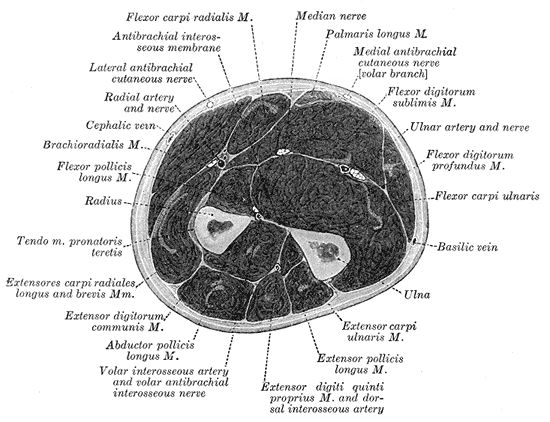
The leg has four clinically important compartments:
- Anterior - tibialis anterior, extensor hallucis longus, extensor digitorum longus, the deep peroneal nerve and the anterior tibial vessels
- Lateral - peroneus longus and brevis with the superficial peroneal nerve
- Superficial posterior - gastrocnemius, soleus and plantaris
- Deep posterior - tibialis posterior, flexor hallucis longus, flexor digitorum longus, the tibial nerve and the posterior tibial vessels
Classification Systems and Regional Patterns
Classification in compartment syndrome is less about named eponyms and more about risk stratification. The useful classifications are clinical: by region, by timing, and by diagnostic certainty, which decides the next step and so is set out under Management.
- Regions
- Leg and forearm
- Main Risk
- Fracture-related swelling and bleeding inside defined compartments
- Regions
- Hand and foot
- Main Risk
- Subtle presentation, many small spaces, long-term stiffness and deformity
- Regions
- Thigh and gluteal
- Main Risk
- Massive muscle necrosis, rhabdomyolysis, sciatic or femoral nerve injury
- Regions
- Any limb after vascular injury or prolonged compression
- Main Risk
- Swelling accelerates after flow returns; pressure threshold may be lower
Chronic exertional compartment syndrome. Everything above is acute compartment syndrome, a surgical emergency. Its examinable counterpart, chronic exertional compartment syndrome (CECS), is a reversible, exercise-induced rise in compartment pressure, classically in the anterior or deep posterior leg of young runners and military trainees.
The story is the opposite of ACS. Cramping, aching or tightness comes on at a predictable point in exercise, sometimes with transient foot drop or paraesthesia, and resolves within minutes of stopping; the patient is normal at rest. Diagnosis is by dynamic intracompartmental pressure testing against the Pedowitz criteria, any one of:
- resting pressure 15 mmHg or more
- 1-minute post-exercise pressure 30 mmHg or more
- 5-minute post-exercise pressure 20 mmHg or more
Differentials and treatment. The key differentials are medial tibial stress syndrome, a tibial stress fracture, and popliteal artery entrapment for exertional calf symptoms. Management is activity modification, gait retraining and relative rest first, then elective fasciotomy for refractory cases, never the emergency two-incision release of ACS. Confusing the two is a classic trap.
Clinical Assessment
The examination is structured, repeated and documented. The question it answers is whether this region is behaving like a threatened closed compartment, not whether the patient has all six Ps.
History. Record the time, mechanism and energy of the injury, and whether there was a fracture, dislocation, crush, burn, injection, extravasation or vascular injury. Follow the pain trajectory and analgesia escalation: an increasing opioid need after fracture, casting or fixation is suspicious. Ask about casts, splints, dressings, tourniquets and positioning, anticoagulation, a bleeding disorder or reperfusion risk, and the time since vascular repair or reduction.
Examination. Inspect for swelling, skin tension, blisters and wounds, and palpate the specific region without relying on palpation alone. Test passive stretch of the muscles in the suspected compartment, a key early clue, and document sensory and motor function by nerve distribution, because paraesthesia and weakness indicate threatened nerve perfusion. Check pulses and Doppler, then repeat the whole examination with the times recorded.
Compartment syndrome compromises microvascular perfusion before major arterial inflow is lost. A warm foot or palpable pulse can coexist with threatened muscle and nerve.
- Passive Stretch or Nerve Clue
- Pain with passive plantarflexion of ankle or toes; first web space paraesthesia
- Do Not Miss
- Deep peroneal nerve symptoms may be early
- Passive Stretch or Nerve Clue
- Pain with passive dorsiflexion; tibial nerve symptoms
- Do Not Miss
- The deep posterior compartment is the classic missed release
- Passive Stretch or Nerve Clue
- Pain with passive finger extension (the classic volar stretch sign) or wrist movement; median, ulnar or AIN symptoms
- Do Not Miss
- Carpal tunnel compression may coexist
- Passive Stretch or Nerve Clue
- Tense intrinsic spaces, pain between metacarpals, painful intrinsic stretch
- Do Not Miss
- Normal pulses do not reassure in intrinsic compartment disease
- Passive Stretch or Nerve Clue
- Severe pain, tense plantar swelling and sensory disturbance; toe motion pain may be subtle
- Do Not Miss
- Clinical signs are less reliable than in the leg; pressure measurement often helps
- Passive Stretch or Nerve Clue
- Buttock swelling, sciatic pain or weakness, high CK
- Do Not Miss
- Can present as rhabdomyolysis or sciatic neuropathy rather than fracture pain
Differential diagnosis. Several conditions mimic compartment syndrome, and missing the real diagnosis in either direction is dangerous: an unnecessary fasciotomy is a large open wound, while a missed compartment syndrome costs the limb.
- Discriminating Features
- Pain out of proportion, pain with passive stretch, tense compartment, escalating analgesia, rising delta pressure
- Why It Is Confused with ACS
- The reference diagnosis; treat when the picture fits
- Discriminating Features
- Absent pulses, cool pale limb, abnormal ankle-brachial index, hard signs of vascular injury
- Why It Is Confused with ACS
- Both cause severe pain; but ACS usually has present pulses and arterial injury can also trigger reperfusion ACS
- Discriminating Features
- Diffuse swelling, calf tenderness, risk factors, raised D-dimer, confirmatory ultrasound
- Why It Is Confused with ACS
- Painful swollen calf, but no pain with passive stretch and no compartment tension
- Discriminating Features
- Fever, erythema, systemic sepsis, crepitus or skin changes, raised inflammatory markers
- Why It Is Confused with ACS
- Necrotising fasciitis is also a surgical emergency and may coexist
- Discriminating Features
- Pain proportionate to injury, settles with analgesia, no passive-stretch pain
- Why It Is Confused with ACS
- Postoperative or fracture pain can mask early ACS; the trend is the key
- Discriminating Features
- Sensory or motor deficit without compartment tension or escalating pain
- Why It Is Confused with ACS
- Overlapping neurological signs, but no rising pressure or stretch pain
Investigations and Pressure Measurement
Imaging. Compartment syndrome is not diagnosed by X-ray, CT or MRI. Imaging is used to define fractures, dislocations and vascular injury, but it should not delay decompression when clinical ACS is clear.
When to measure. Pressure measurement is most useful when the examination cannot answer the question:
- the examination is unreliable, for any of the reasons in the diagnostic-certainty table under Management
- the examination is equivocal but the injury is high risk
- there is vascular repair, reperfusion, crush injury or prolonged compression
- small compartments of the foot or hand are suspected and clinical signs are subtle
Reading the numbers. Commonly used thresholds include:
- How to Interpret
- A high pressure is concerning, but the exact critical number is imperfect
- Clinical Meaning
- Use with clinical picture and blood pressure
- How to Interpret
- Diastolic blood pressure minus compartment pressure
- Clinical Meaning
- The validated trigger is a delta pressure under 30 mmHg sustained for more than 2 hours - the number is incomplete without its duration (McQueen and Duckworth: sensitivity 94%, specificity 98% at that threshold)
- How to Interpret
- Worsening pain, rising pressure, falling delta pressure or new nerve signs
- Clinical Meaning
- More important than a single isolated reading
- How to Interpret
- Creates false positives and false reassurance in roughly equal measure
- Clinical Meaning
- In 48 tibial shaft fractures NOT clinically suspected of compartment syndrome, a single delta under 30 mmHg labelled 35% as positive and none developed the syndrome (Whitney, PMID 24458053). Never let one number start - or stop - an operation on its own
The most dangerous use of pressure monitoring is to create false reassurance. If the examination is worsening, the limb is high risk and the clinical story fits, treat the patient rather than the number.
Management Algorithm
First actions. In a high-risk injury with escalating regional pain, do not wait for pulselessness:
- Assess the patient and mechanism.
- Remove splints, casts, circumferential dressings and constriction.
- Keep the limb at heart level.
- Give analgesia, but do not let pain relief hide serial deterioration.
- Document the regional examination: swelling, passive stretch, sensory, motor, pulses, Doppler.
- Call for senior review.
- Reduce dislocations and stabilise grossly unstable fractures when needed.
Diagnostic certainty then decides the next step, and each category carries its own action.
- Features
- High-risk mechanism, convincing escalating regional pain, pain with passive stretch, tense compartment, evolving paraesthesia or motor weakness
- Action
- Proceed to urgent fasciotomy without delaying for pressure measurement
- Features
- Pain or swelling present but examination inconsistent or early
- Action
- Serial examination plus pressure measurement, repeated frequently; escalate if trend worsens
- Features
- Obtunded, sedated, intoxicated or ventilated patient; paediatric age or distress; communication problems; regional anaesthesia
- Action
- Lower threshold for pressure monitoring or fasciotomy depending mechanism
- Features
- Vascular repair, prolonged ischaemia, crush, high CK, major swelling
- Action
- Low threshold for prophylactic or therapeutic fasciotomy and metabolic monitoring
Operate now. Beyond clear clinical ACS, operate without delaying for pressure measurement when there is:
- vascular injury or repair with reperfusion swelling
- an obtunded high-risk patient with concerning pressure findings
- failed improvement after removing external compression
Observe safely. Observation is active surveillance with documented repeat checks, never a vague "wait and see" plan. It is only safe when:
- the mechanism is lower risk or the clinical picture is not convincing
- the examination is reliable and repeatable
- pressures are reassuring if measured
- there is a clear plan for timed reassessment
- staff know exactly what deterioration should trigger escalation
Special regions and patients. Four settings deserve their own note:
- Hand and foot - involve hand or foot and ankle expertise early when available
- Thigh and gluteal - prepare for rhabdomyolysis, renal monitoring and possible repeated debridement
- Vascular repair - coordinate with vascular surgery; unstable bone and reperfusion swelling both threaten the limb
- Paediatric patient - anxiety, increasing analgesic requirement and agitation may be more useful than a classic adult verbal pain description
Surgical Technique and Regional Fasciotomy Principles
The principle. Release every involved compartment completely, assess muscle viability and leave the wounds open. Colour, contractility, consistency and capacity to bleed guide debridement. The technique varies by region.
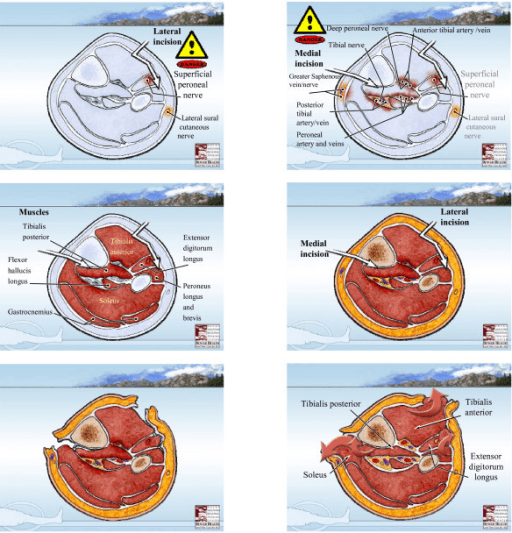
Standard teaching is the two-incision four-compartment fasciotomy:
- the lateral incision releases the anterior and lateral compartments
- the medial incision releases the superficial and deep posterior compartments
- identify and protect the superficial peroneal nerve laterally
- avoid missing the deep posterior fascia medially
- extend the releases enough to decompress the full compartment length
Complications
The worst complication is missed or incomplete decompression. After that, morbidity comes from muscle necrosis, nerve injury, wound problems and systemic effects.
- Complication
- Persistent compartment syndrome after incomplete release
- Practical Meaning
- Recurrent pain, rising pressure or CK after fasciotomy needs urgent reassessment
- Complication
- Rhabdomyolysis, hyperkalaemia, renal injury
- Practical Meaning
- Especially thigh, gluteal, crush and reperfusion injuries
- Complication
- Wound infection, skin necrosis, bleeding
- Practical Meaning
- Fasciotomy wounds are open injuries requiring active wound planning
- Complication
- Nerve deficit, stiffness, contracture
- Practical Meaning
- Hand, forearm and foot morbidity can be function-limiting even with limb survival
- Complication
- Volkmann contracture, claw toes, chronic pain, amputation
- Practical Meaning
- Usually reflects delayed diagnosis, severe injury or incomplete release
Volkmann ischaemic contracture. This is the chronic sequela of a missed or incompletely released forearm ACS: ischaemic necrosis and fibrosis of the deep flexor mass, FDP and FPL first, as they lie deepest and furthest from inflow. It produces the classic flexed, pronated claw hand that worsens on wrist extension (a positive wrist-extension/Volkmann test). The Tsuge classification grades it:
- Mild - a few digits, little or no sensory loss
- Moderate - all fingers and thumb, with intrinsic and sensory involvement
- Severe - all flexors and extensors, fixed deformity, severe sensory and intrinsic loss
Reconstruction is staged by severity. Mild-to-moderate disease is treated with splinting and dynamic therapy with excision of the fibrotic infarct, flexor slide or tendon lengthening. Severe established contracture is treated with tendon transfers, neurolysis or free functioning muscle transfer (e.g. gracilis). The exam point is that the contracture is preventable: it represents a failure to recognise and completely decompress acute forearm compartment syndrome, including the carpal tunnel, in time.
Postoperative Care and Rehabilitation
Fasciotomy is the start of treatment, not the end. After release, the goals are to confirm decompression, prevent systemic complications, keep viable tissue alive and close the wound safely. Immediate care:
- leave fasciotomy wounds open
- use non-adherent dressings or negative pressure therapy according to local practice
- repeat the neurovascular and compartment examination
- monitor CK, potassium, creatinine, urine output and acidosis in large muscle injuries
- return to theatre around 24 to 48 hours for a second look when indicated
- debride clearly non-viable muscle
- close only when swelling allows and never under tension, using delayed primary closure, gradual approximation or split-skin grafting
- splint safely and involve therapy early, especially for the hand and forearm
Outcomes and Prognosis
Outcome depends on time to diagnosis, mechanism, region, completeness of release, muscle viability, nerve injury and wound management. Limb survival is not the same as functional recovery.
Better outcomes are associated with:
- early recognition and decompression
- reliable serial examinations in high-risk patients
- complete release of all involved compartments
- coordinated vascular and orthopaedic management in reperfusion injuries
- early second look and debridement when muscle viability is uncertain
- early oedema control and rehabilitation
Poor prognostic patterns include:
- delayed presentation with neurological deficit
- thigh or gluteal syndrome with very high CK and renal injury
- compartment syndrome after prolonged compression or substance-related immobilisation
- missed foot or hand syndrome leading to chronic pain, stiffness and deformity
- incomplete fasciotomy requiring delayed revision
Controversies and Areas of Uncertainty
Several questions remain genuinely unresolved, and examiners reward candidates who can discuss them without overstating the evidence:
- The exact pressure threshold. Delta pressure under 30 mmHg is the most validated trigger, but the optimal cut-off and duration are debated, and one-time readings overcall the diagnosis. Some advocate continuous monitoring or higher delta thresholds to reduce unnecessary fasciotomy.
- Continuous monitoring versus serial clinical examination. Continuous monitoring helps in unreliable patients but is not universally available and can generate false positives; serial examination remains central where the patient is alert.
- Foot compartment release. The number of foot compartments, whether to decompress, and the surgical approach are all contested; some surgeons favour non-operative management given uncertain functional benefit and high wound morbidity.
- Gluteal compartment syndrome management. Recent evidence suggests neurologically intact patients may be managed medically with close surveillance, whereas those with an established deficit benefit from fasciotomy.
- Emerging diagnostics. Near-infrared spectroscopy, biomarkers and ultrasound elastography are investigational and not yet a substitute for clinical judgement and pressure measurement.
Guidelines, Registries & Global Practice
Acute compartment syndrome is a worldwide emergency, and the core principles are consistent across examination systems: early senior review, repeat documented examination, rapid theatre access, multidisciplinary coordination with vascular, plastic, hand and foot-and-ankle and critical-care teams, and local antimicrobial and perioperative protocols for open wounds. Reported incidence is heavily skewed toward young men with tibial diaphyseal fractures (around 2 to 3 percent of tibial shaft fractures, much higher in high-energy or multiply-injured patients).
- Diagnostic Emphasis
- Serial clinical examination is primary; continuous pressure monitoring for unreliable or obtunded patients
- Decompression Trigger
- Clear clinical ACS or sustained delta pressure under 30 mmHg
- Diagnostic Emphasis
- Documented serial neurovascular checks; escalating analgesia is a red flag; theatre within target timeframe
- Decompression Trigger
- Clinical diagnosis prompts immediate fasciotomy; do not await all six Ps
- Diagnostic Emphasis
- Combine clinical signs with intracompartmental pressure when examination is unreliable
- Decompression Trigger
- Delta pressure under 30 mmHg or convincing clinical picture
- Diagnostic Emphasis
- Highlights limited evidence base; favours serial assessment plus monitoring in high-risk groups
- Decompression Trigger
- Low threshold for fasciotomy in reperfusion, crush and sedated patients
There is no dedicated international registry for acute compartment syndrome; trauma registries (for example TARN in the UK and the German DGU TraumaRegister) capture it as a complication of fractures and crush injury rather than as a standalone dataset. The validated postfasciotomy classification (Bouklouch and Duckworth) is an emerging tool for standardised outcome reporting and audit.
High- versus limited-resource practice variation: where continuous pressure monitoring and rapid theatre access are available, equivocal cases can be monitored safely; where they are not, the threshold for clinical fasciotomy is appropriately lower, and delayed presentation after prolonged transport or compression is more common. The principle of releasing every threatened compartment completely does not change with resource setting.
Practical documentation should include:
- time of injury and time of first concern
- analgesia escalation and serial examination findings
- passive-stretch findings by region
- sensory and motor status by nerve distribution
- pressure readings if measured, with blood pressure and time recorded
- timing of fasciotomy, compartments released and muscle viability
- plan for second look, renal monitoring, closure and rehabilitation
Compartment syndrome is dynamic. A single note saying "neurovascularly intact" is weak documentation. Timed repeat findings are safer for the patient and clearer for the treating team.
MCQ Practice Points
Q: Do palpable pulses exclude compartment syndrome? A: No. Pulses are often present because the problem is microvascular perfusion inside the compartment, not necessarily large-vessel occlusion.
Q: What pressure finding commonly supports fasciotomy? A: A differential (delta) pressure below 30 mmHg sustained for more than 2 hours - quote the duration, because a threshold with no time attached is only half the rule (McQueen & Duckworth). Clear clinical compartment syndrome should not wait for measurement at all.
Q: What is usually included with volar forearm fasciotomy? A: Carpal tunnel release is usually included; dorsal or mobile-wad release is added when those compartments are involved or uncertain.
Q: Why is foot compartment syndrome easy to miss? A: It can follow calcaneus, Lisfranc or crush injury, and clinical signs may be less reliable than in the leg.
Q: What clues suggest gluteal compartment syndrome? A: Prolonged compression, buttock swelling, rhabdomyolysis and sciatic neuropathy. It may not present with an obvious fracture.
Clinical Decision Scenarios
Practise clinical reasoning and management decisions out loud
“A 26-year-old man is six hours after tibial nailing. He has increasing analgesic requirement, severe pain with passive toe movement and first web space paraesthesia. Pulses are present.”
“A 68-year-old anticoagulated patient has a displaced distal radius fracture reduced in a tight splint. Pain worsens despite opioids. Passive finger extension is very painful.”
“A 42-year-old man is found after prolonged immobilisation. He has buttock swelling, sciatic distribution paraesthesia, creatine kinase over 50,000 and rising creatinine.”
Recognise
- High-risk injury plus escalating regional pain.
- Pain with passive stretch of the involved muscles.
- Paresthesia or motor change is a danger sign.
- Pulses are often present.
- Remove constriction and reassess immediately.
Measure
- Measure when the examination is equivocal or unreliable.
- Use delta pressure with the clinical picture.
- One-time readings can mislead.
- Obtunded, sedated, regional anaesthesia and vascular repair lower the threshold.
- Trend matters more than a single number.
Release
- Release every involved compartment completely.
- Leg: anterior, lateral, superficial posterior and deep posterior.
- Forearm: volar plus carpal tunnel; add dorsal or mobile wad if involved.
- Hand and foot: targeted small-compartment release.
- Thigh and gluteal: expect large muscle injury and debridement planning.
Aftercare
- Leave wounds open.
- Second look around 24 to 48 hours when indicated.
- Monitor CK, potassium, creatinine and urine output in crush, thigh, gluteal or reperfusion injuries.
- Delayed closure, gradual approximation or split-skin graft when swelling permits.
- Start region-specific rehabilitation early when safe.
Evidence Base
The Diagnosis of Acute Compartment Syndrome: A Review
- Clinical findings alone have poor sensitivity (13 to 64 percent) for acute compartment syndrome compared with continuous intracompartmental pressure monitoring (94 percent).
- A differential (delta) pressure of under 30 mmHg for more than 2 hours is the recommended trigger for decompression.
- Delayed diagnosis is a primary cause of poor outcome, and high-risk patients should undergo pressure monitoring.
Postfasciotomy Classification System for Acute Compartment Syndrome of the Leg
- An international expert panel developed and validated a grading system describing the consequences of leg acute compartment syndrome found at fasciotomy.
- Interrater agreement was strong (Fleiss kappa 0.711) and intrarater consistency was high across 32 clinical cases.
- The system standardises communication about muscle damage severity and the need for further surgery after fasciotomy.