The Largest Nerve in the Body
- Strictly speaking, it is two nerves (Tibial + Common Peroneal) wrapped in one sheath
- Exits pelvis below the Piriformis muscle (roughly 85% of people; 83-94% across series)
- Supplies all hamstring muscles and all muscles below the knee
- Common Peroneal division is lateral and more vulnerable to stretch injury
- Injection Safe Zone: Upper Outer Quadrant of the buttock
- “The component to the Short Head of Biceps is the first branch of the Common Peroneal division
- “Sensory supply is entire foot/leg EXCEPT medial calf (Saphenous - Femoral)
- “Foot Drop is the classic sign of high Sciatic injury (Peroneal fibers are lateral)
- “Surgical approach: Posterior approach to hip puts it at risk (External Rotators protect it)
Overview
The sciatic nerve is the largest nerve in the body, roughly the width of an adult thumb and around 2 cm across at its origin. It is derived from the ventral rami of L4-S3 through the sacral plexus and is the primary conduit for motor and sensory signals to the lower limb.
Two nerves in one sheath. Functionally it is a medial tibial division and a lateral common peroneal (fibular) division, bound by a common epineurium but anatomically and clinically distinct from their origin to the popliteal fossa, where they formally separate. This duality explains nearly every examination point on the topic.
Why the peroneal division fails first. It is lateral and smaller, has fewer and larger fascicles with less protective connective tissue, and is tethered at the sciatic notch and the fibular neck, so a given limb elongation concentrates more strain on it. It is therefore selectively vulnerable to stretch, compression and ischaemia, and a "sciatic" injury often masquerades as an isolated foot drop.
Why the gluteal course matters. The nerve's relations in the gluteal region, resting on the bed of short external rotators and exiting beneath piriformis in most people, are critical for the posterior approach to the hip, acetabular fracture surgery and intramuscular injection safety.
Anatomy: Formation, Course and Branches
Formation. The sacral plexus lies on the anterior surface of piriformis on the pelvic side wall. The descending L4 and L5 ventral rami unite as the lumbosacral trunk, which crosses the pelvic brim to join the S1-S3 (and part of S4) ventral rami and build the plexus. The sciatic nerve is the terminal continuation of the plexus and carries L4-S3.
The two divisions. Within the plexus the ventral (anterior) divisions coalesce into the tibial component and the dorsal (posterior) divisions into the common peroneal component. The two are physically separate within the epineurium from the origin, which is the anatomical basis of the two-nerves-in-one rule.
Plexus neighbours. These branches leave the plexus alongside the sciatic nerve and explain the combined deficits of a plexopathy:
- Superior gluteal nerve (L4-S1), above piriformis
- Inferior gluteal nerve (L5-S2), below piriformis
- Pudendal nerve (S2-S4)
- Posterior cutaneous nerve of the thigh (S1-S3)
The localising rule. The glutei are supplied by the gluteal nerves before the sciatic nerve forms, so gluteal weakness localises a lesion to the plexus or roots, not to the sciatic nerve. It is the single most useful localising rule.
Exit from the pelvis. The nerve leaves the pelvis through the greater sciatic foramen, usually inferior to piriformis.
P-I-N- P-I-N-SGreater Sciatic Foramen Contents
Hook:PIN the PINS in the Foramen.
The gluteal course. The nerve descends deep to gluteus maximus with piriformis as its roof, and rests on a bed formed by the deep external rotators: superior gemellus, obturator internus, inferior gemellus and quadratus femoris. Its relations here:
- Deep (anterior): ischium, gemelli, obturator internus, quadratus femoris, adductor magnus
- Superficial (posterior): piriformis, gluteus maximus, long head of biceps
- Medial: inferior gluteal artery and nerve
- Lateral: greater trochanter
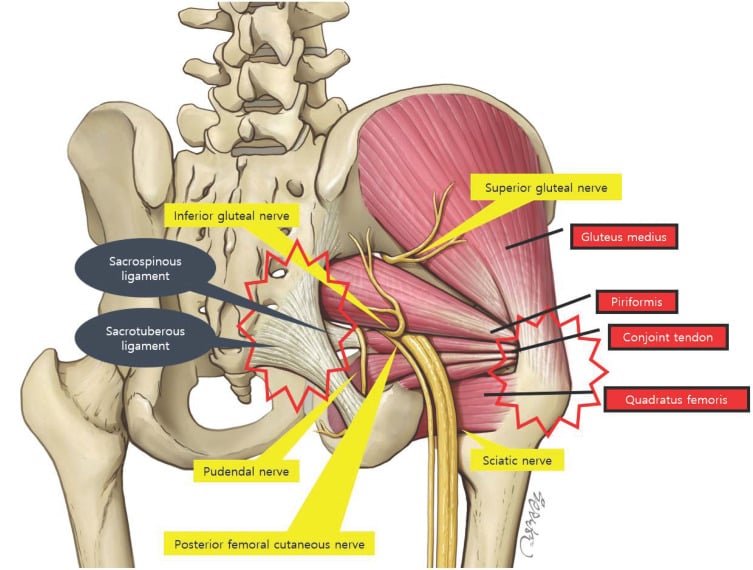
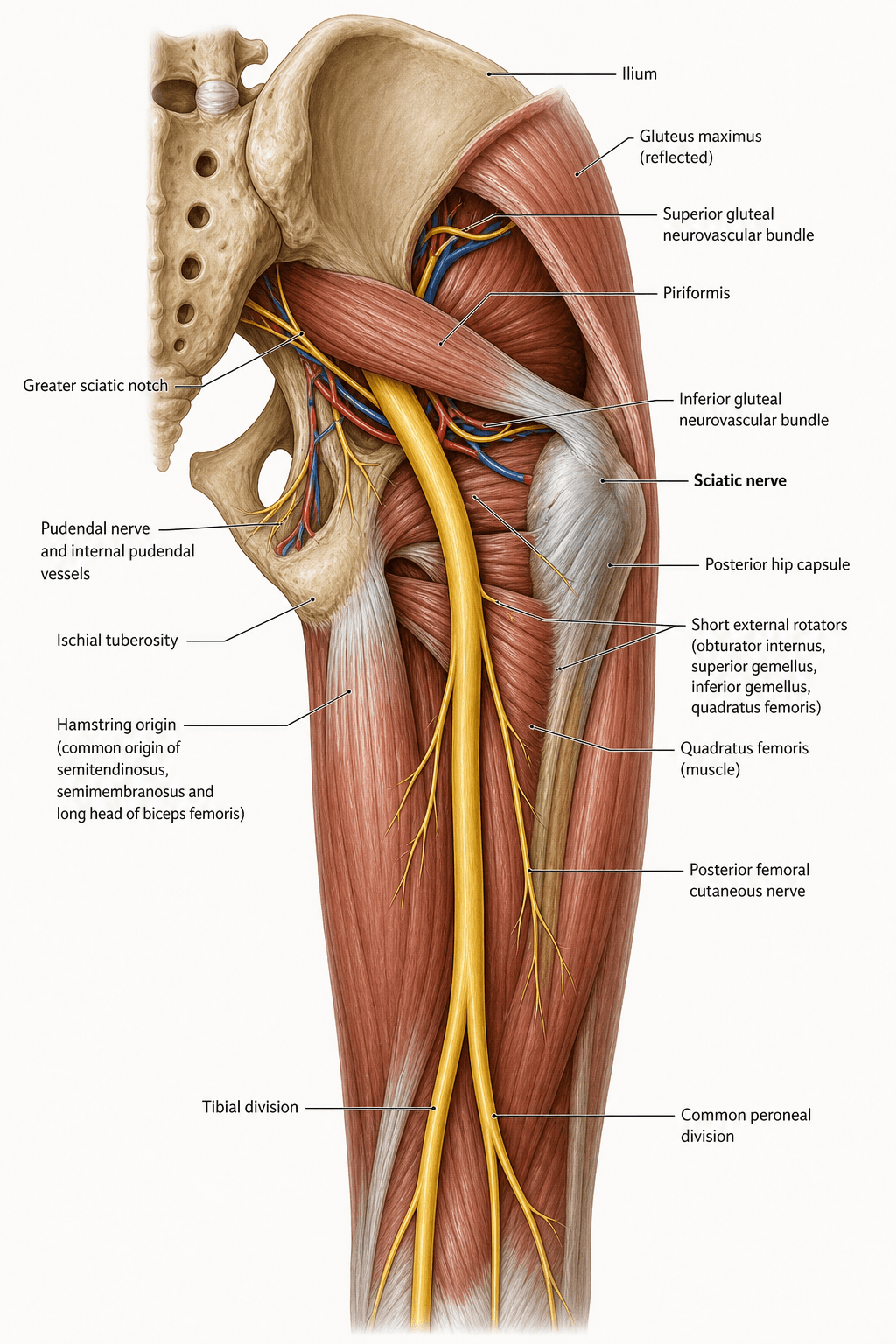
The thigh. The nerve enters the posterior thigh deep to the long head of biceps and divides into the tibial and common peroneal nerves at the apex of the popliteal fossa, though the level is variable.
Articular branch. A fine twig supplies the posterior hip capsule (Hilton's law: a nerve crossing a joint supplies it). It is the anatomical basis for posterior hip pathology referring pain down the limb.
Muscular branches. The sciatic nerve supplies all the hamstrings, the hamstring (ischiocondylar) part of adductor magnus and all the muscles below the knee; it does not supply the glutei. In the thigh the long head of biceps, semitendinosus, semimembranosus and adductor magnus are tibial-division branches. The short head of biceps femoris is the only thigh muscle supplied by the common peroneal division, and its branch is the first from that division. It is the single most-tested motor discriminator for a high (proximal) lesion.
- Component
- Tibial
- Action
- Knee Flex / Hip Ext
- Innervation
- L5, S1, S2
- Component
- Tibial
- Action
- Knee Flex / Hip Ext
- Innervation
- L5, S1, S2
- Component
- Tibial
- Action
- Knee Flex / Hip Ext
- Innervation
- S1, S2, S3
- Component
- Com Peroneal
- Action
- Knee Flexion
- Innervation
- L5, S1, S2
- Component
- Tibial
- Action
- Hip Extension
- Innervation
- L4, L5, S1
Cutaneous supply. The nerve gives no cutaneous branch in the thigh: posterior thigh skin belongs to the posterior cutaneous nerve of the thigh (S1-S3), a separate sacral-plexus branch. Below the knee it supplies the whole leg and foot except the medial calf and medial malleolus, which belong to the saphenous nerve from the femoral nerve.
Terminal branches.
- Tibial division: muscular branches to the calf, the sural nerve (with a peroneal communicating contribution), and the medial and lateral plantar and medial calcaneal nerves
- Common peroneal division: the superficial peroneal nerve (evertors and dorsal foot sensation), the deep peroneal nerve (dorsiflexors and the first web space) and the lateral sural cutaneous nerve
The sural nerve as a graft. Its predictable course, posterolateral in the calf and behind the lateral malleolus, and its small, well-tolerated lateral-foot sensory donor deficit make it the standard nerve autograft, with about 30-40 cm available. It is a classic viva fact.
Surface Anatomy
In the buttock. The ischial tuberosity is the medial landmark and the greater trochanter the lateral one, and the nerve emerges at the midpoint of a line joining them. The sciatic notch lies midway between the posterior superior iliac spine (PSIS) and the greater trochanter.
In the thigh. The surface marking joins that midpoint to the apex of the popliteal fossa: the nerve runs vertically down the midline of the posterior thigh, covered by the long head of biceps femoris. Palpation is difficult through the muscle bulk and rarely diagnostic, although the nerve can be tender in the sciatic notch.
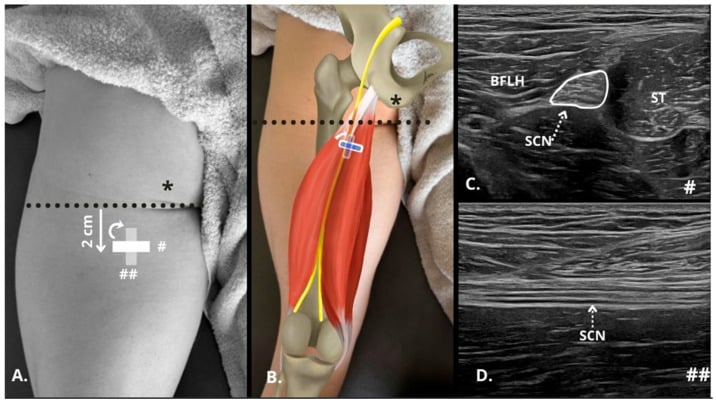
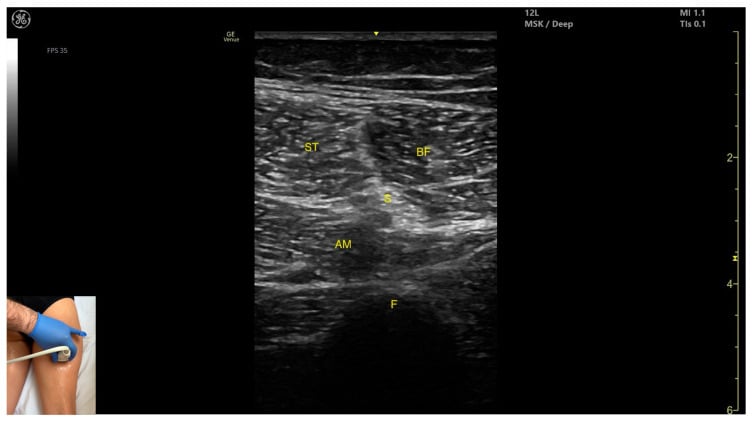
On ultrasound. The posterior-thigh relationship is reproducible in cross-section and is used for distal localisation and block planning.
Variations and the Beaton and Anson Classification
Sciatic nerve and piriformis. Their relationship is the most examined anatomical variant in the body. The undivided nerve passes below piriformis in roughly 85% of limbs, with 83-94% reported across cadaveric series (93.6% in Natsis 2014, the "typical" pattern). A pooled meta-analysis of over 6,000 cadavers found an anomalous relationship in 16.9% of the population (Smoll 2010).
High division. In a high division the tibial and common peroneal nerves separate within the pelvis or at piriformis rather than at the popliteal fossa. The peroneal part may then pierce the muscle or pass above it (Beaton type B or C).
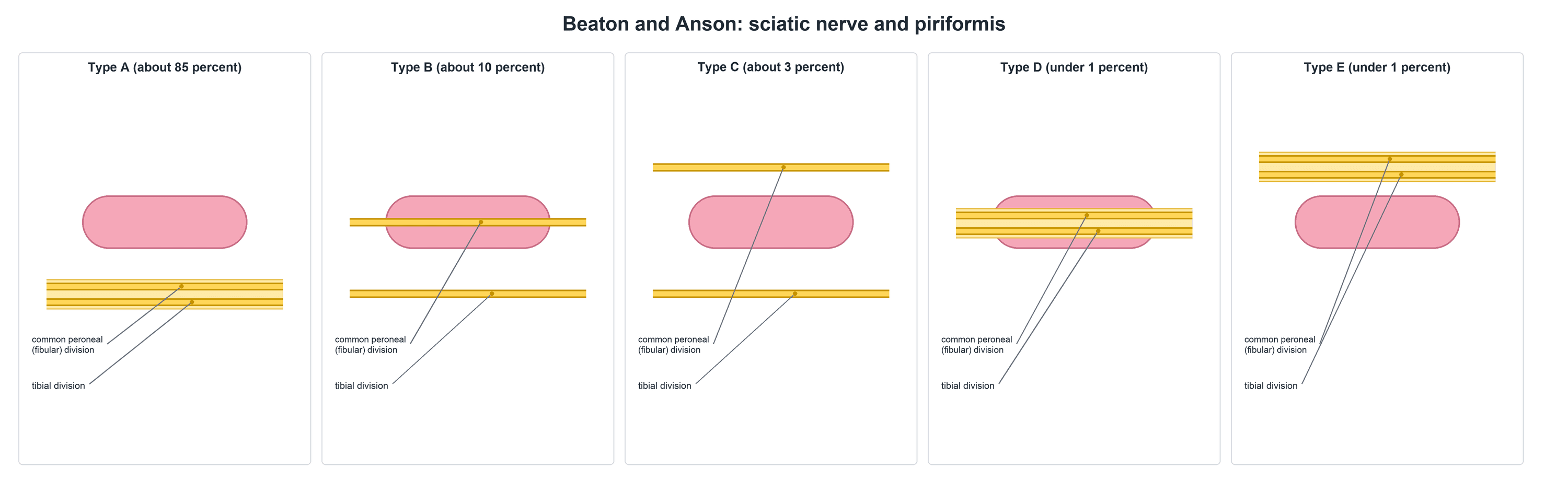
The types. Beaton and Anson describe the nerve's relationship to piriformis:
- Type A (roughly 85%, reported 83-94% across series): undivided nerve passes below piriformis
- Type B (10%): common peroneal division passes through piriformis, tibial below
- Type C (3%): common peroneal passes above piriformis, tibial below
- Type D (under 1%): entire nerve passes through piriformis
- Type E (under 1%): entire nerve passes above piriformis
- Type F (under 1%): undivided nerve passes below, but there is an accessory piriformis
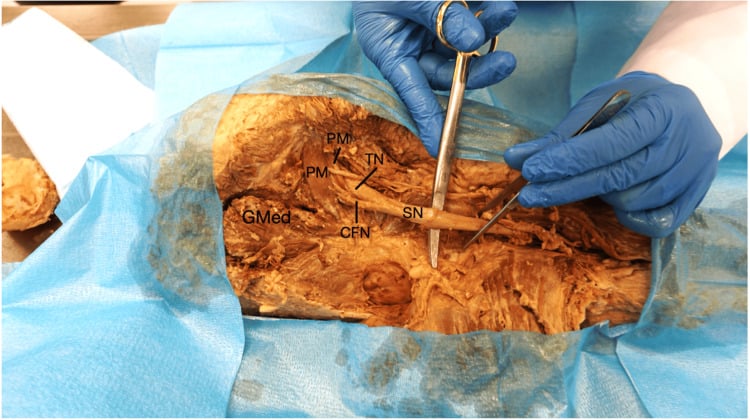
Type B and piriformis syndrome. Type B is the variant most often invoked in piriformis or deep gluteal syndrome, on the reasoning that the common peroneal division is compressed as it pierces the muscle. Be careful with that reasoning in a viva: the prevalence of the variant is not significantly higher in piriformis-syndrome patients than in the general population (Smoll 2010), so an anatomical anomaly alone does not explain symptoms and should not be over-relied upon. Describe it as the variant of greatest surgical importance, the one that changes what you expect to find when dissecting the deep gluteal space, rather than a proven cause of symptoms.
At operation. During deep gluteal decompression, look for a second (doubled) piriformis tendon, between which the peroneal division may run. A surgeon who assumes one undivided trunk can injure a split nerve.
Clinical Assessment
The foot drop trap. Foot drop is not always at the knee. A high sciatic lesion often presents as an isolated foot drop because the common peroneal fibres are lateral and superficial, so examine the hamstrings, the short head of biceps in particular, and the glutei before attributing it to the knee.
- High Sciatic
- Weak/Paralysed
- Common Peroneal (Knee)
- Normal
- High Sciatic
- Normal (Plexus intact)
- Common Peroneal (Knee)
- Normal
- High Sciatic
- Weak
- Common Peroneal (Knee)
- Weak
- High Sciatic
- Weak
- Common Peroneal (Knee)
- Normal
The differential of "sciatica" and foot drop. Buttock-to-leg pain or foot drop has several causes that must be separated, because management differs completely. The most useful discriminators are the short head of biceps femoris (peroneal-division marker), the glutei (plexus or root marker) and the paraspinals (root marker).
- Distinguishing Feature
- Paraspinals involved; SLR positive; dermatomal
- Key Test
- MRI lumbar spine; H-reflex / EMG
- Distinguishing Feature
- Glutei AND sciatic muscles weak
- Key Test
- EMG (paraspinals spared); pelvic MRI
- Distinguishing Feature
- Glutei spared; short head biceps weak
- Key Test
- EMG; MR neurography
- Distinguishing Feature
- Short head biceps & hamstrings normal
- Key Test
- EMG localises block at fibular head
- Distinguishing Feature
- Deep buttock pain; normal spine MRI
- Key Test
- FAIR test; diagnostic block; MR neurography
- Distinguishing Feature
- Knee extension weak; ankle jerk preserved
- Key Test
- EMG; quadriceps wasting pattern
Straight leg raise (Lasègue's sign). The leg is elevated passively with the knee extended, and the test is positive when it produces radicular (L5/S1) pain below the knee at 30-70 degrees. Dorsiflexion increases the pain (Bragard's sign), and internal rotation sensitises the test by stretching the nerve.
The bowstring sign. It confirms a radicular origin:
- Flex the knee to relieve the pain, relaxing the bowstring.
- Apply firm pressure in the popliteal fossa over the nerve.
- The sign is positive if the pain returns, confirming nerve tension or irritation.
Reflexes. The ankle jerk (S1) is lost in tibial or sciatic lesions and the hamstring reflex is often diminished. The knee jerk (L3/4) is preserved, because it runs through the femoral nerve.
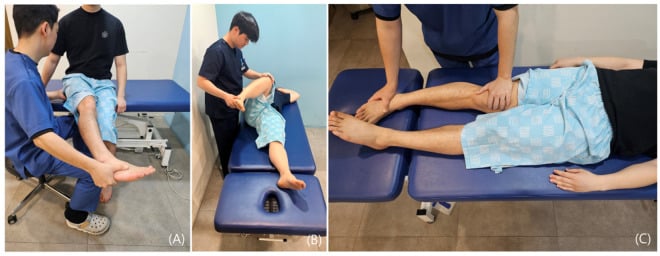
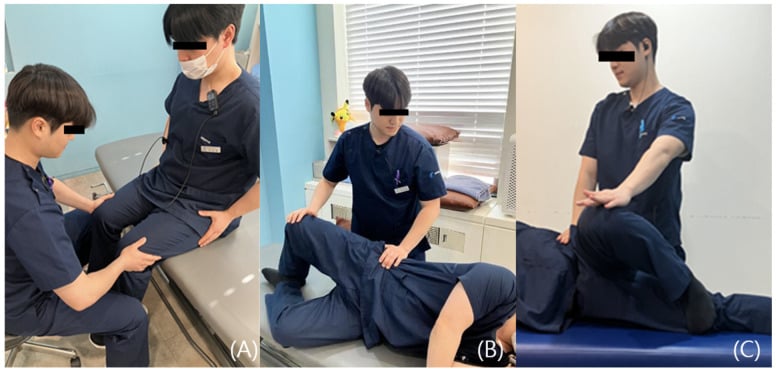
Deep gluteal provocation. These tests support deep-gluteal localisation but do not replace lumbar, hip and neurological examination. Concordant buttock-to-leg pain is more meaningful than isolated gluteal discomfort.
- Seated piriformis stretch: hip flexion, adduction and internal rotation while the sciatic notch is palpated
- FAIR: compresses the nerve in the same direction
- Freiberg: passive internal rotation with the hip extended
- Pace and active piriformis tests: resisted abduction and external rotation reproduce buttock pain or weakness when the deep external rotators are symptomatic
Investigations
MRI of the lumbar spine is mandatory to rule out radiculopathy from disc herniation or stenosis, the most common cause of "sciatica".
MRI of the pelvis assesses the course of the nerve through the sciatic notch. Look for:
- Mass lesions (haematoma, tumour)
- Piriformis hypertrophy or asymmetry
- Signal change (T2 hyperintensity) within the nerve, indicating neuritis or compression
MR neurography uses specialised fluid-sensitive sequences to track the nerve fascicles. It is highly sensitive for extraspinal sciatica and particularly useful for identifying non-compressive aetiologies such as neuritis. Read it structure by structure: identify each sciatic component, its relation to piriformis, its calibre and signal, then compare with the opposite side. A split course is an anatomical finding; enlargement or T2 hyperintensity plus concordant symptoms makes it clinically persuasive.
Extraspinal lesions. A proximal lesion outside the spine can injure the nerve, whether by scarring after a hamstring-origin tear or as a non-compressive tumour such as a neurofibroma.
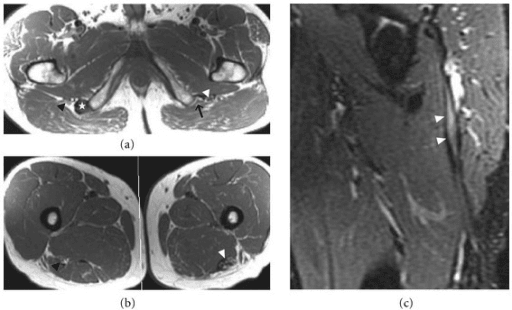
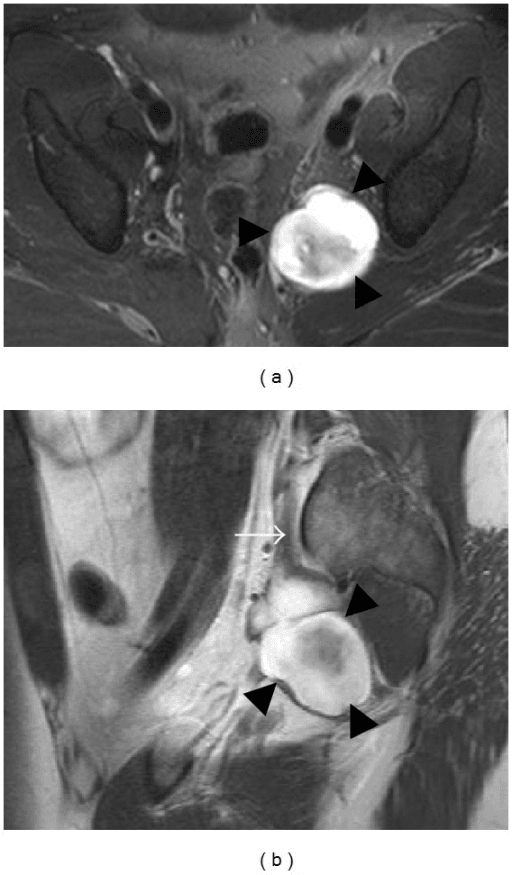
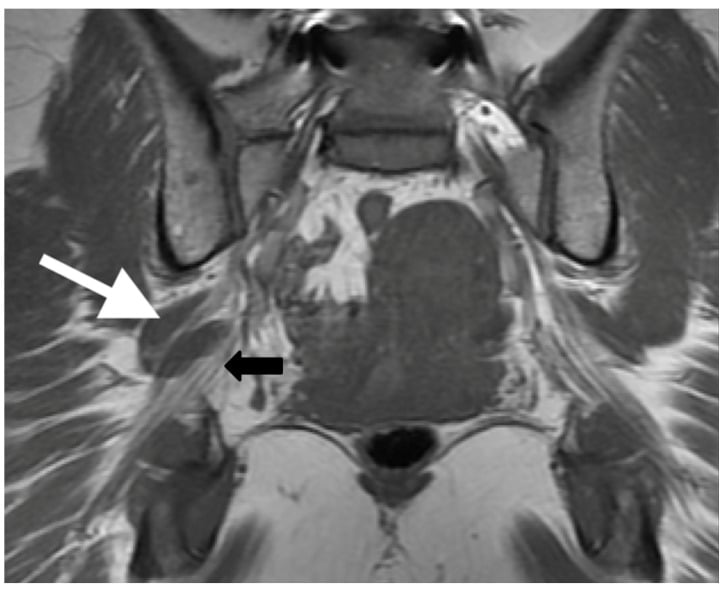
Neurophysiology. EMG and nerve conduction studies differentiate plexus, root and peripheral nerve. Needle EMG localises by pattern:
- Gluteal sparing indicates a lesion distal to the plexus (sciatic)
- Short head of biceps involvement indicates a high lesion (thigh or pelvis) rather than one at the knee
- Paraspinal involvement indicates a root-level lesion
A prolonged H-reflex latency indicates S1 radiculopathy (or a sciatic lesion), and F-waves assess proximal conduction. Nerve conduction shows slowed velocity across the segment of compression if the lesion is demyelinating, or reduced amplitude if there is axonal loss.
Surgical Technique
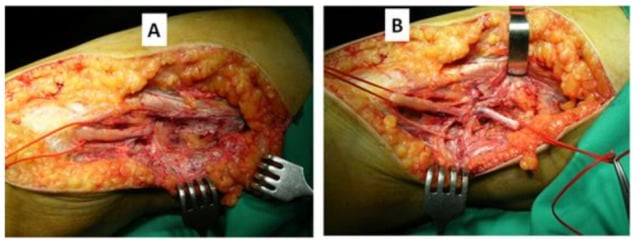
Posterior exposure in the thigh. Always identify the nerve in normal tissue, distally or proximally, before dissecting the scarred zone.
- Midline posterior thigh incision.
- Deep to the fascia, split gluteus maximus proximally.
- Find the nerve deep to the long head of biceps, which guides you to it.
- Neurolysis: release adhesions from the hamstring origin or quadratus femoris.
Protection in posterior-approach hip arthroplasty. The external rotators are detached to expose the joint, and the nerve lies protected behind them.
- Identify the nerve before placing retractors
- Keep the hip extended and the knee flexed to relax the nerve
- Place retractors on bone (acetabular rim), not in the soft tissue where the nerve lies
- Palpate nerve tension during reduction
The "safe zone" for retractor placement or screws is the posterosuperior quadrant of the acetabulum, away from the nerve.
Nerve strain. The stretch-injury, positioning and lengthening points all reduce to the strain tolerance of peripheral nerve. Intraneural blood flow falls and conduction is impaired at around 6-8% strain, with structural (fascicular) failure at roughly 15%; beyond the ischaemic threshold, sustained tension causes a stretch or traction palsy even without laceration. Keeping the hip extended and the knee flexed slackens the sciatic nerve across both joints, which is why it is the protective position during reduction and retraction, and restoring length in hip arthroplasty loads the nerve.
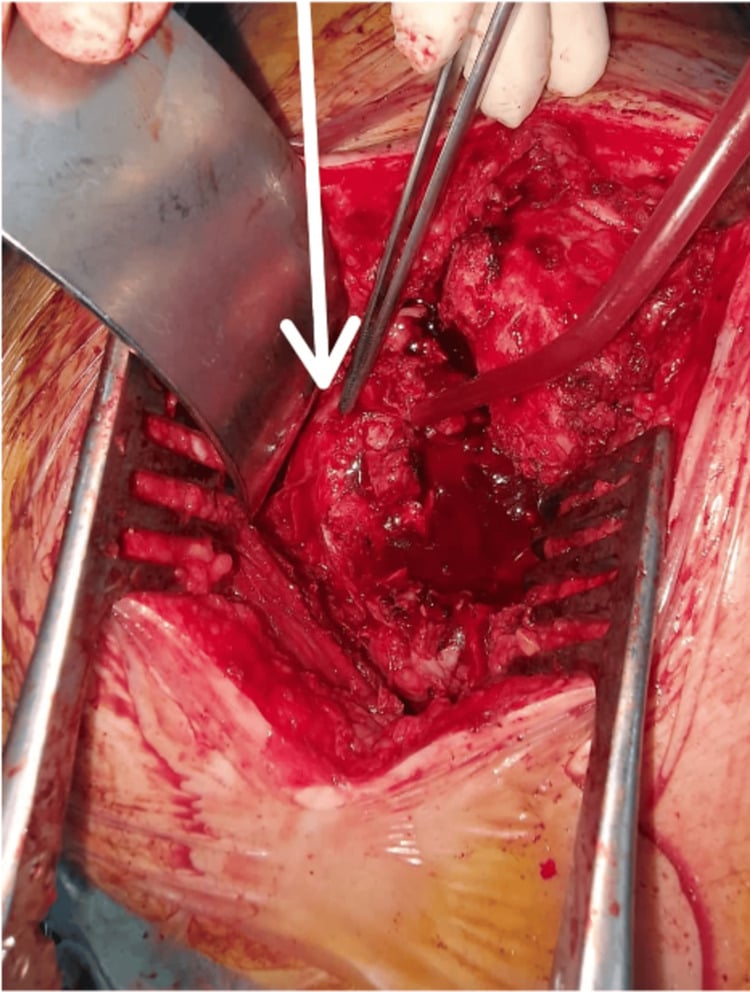
Complications
Foot drop is the most common manifestation of injury and requires an ankle-foot orthosis (AFO); without splinting, an equinus contracture develops. Neuropathic pain is often severe (type II CRPS), and the insensate foot and heel are at risk of pressure sores.
Rehabilitation Protocol
- Splinting: anti-drop foot splint (AFO) immediately
- Range of motion: passive ankle dorsiflexion to prevent contracture
- Strengthening: hamstrings and glutes
- Nerve glides: sciatic sliders and flossing techniques
- Return to sport: dependent on motor recovery, which is variable
Prognosis
By mechanism. A stretch injury has a good prognosis (neuropraxia), and an injection injury a poor one (chemical neurolysis). A laceration is guarded: regeneration proceeds at 1 mm/day, but the distance from a proximal lesion to the foot is so long that the motor endplates die before the nerve arrives.
By division. The common peroneal division paradoxically carries a worse prognosis than the tibial division, being less vascular and more tethered.
Clinical Relevance
- Management
- NSAIDS, Physio, Time
- Indication for Surgery
- Cauda Equina / Motor Deficit
- Management
- Reduction, splint in ext
- Indication for Surgery
- Nerve entrapment in joint
- Management
- Stretch, Injection
- Indication for Surgery
- Failure of conservative
- Management
- Observe, EMG
- Indication for Surgery
- Pain/No recovery over 3m
Hip dislocation. Prompt reduction is the primary treatment for the nerve, addressing its ischaemia.
Neurolysis is indicated for tethering or persistent compression, such as scarring after trauma. It should be performed with magnification to avoid disrupting the epineural blood supply.
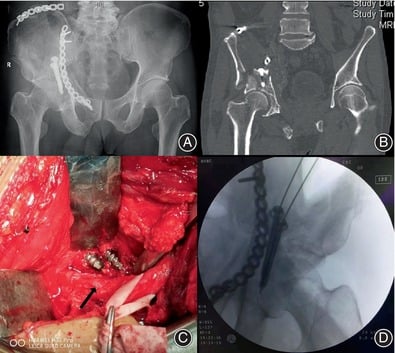
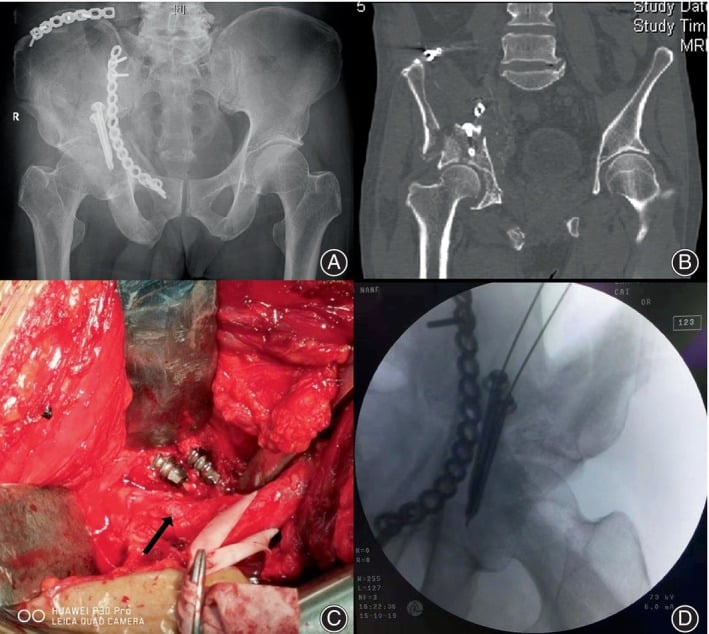
Acetabular fixation. New neuropathic pain or weakness after fixation requires immediate imaging rather than prolonged observation. Hardware that looks safe on the radiograph may still be unsafe in three dimensions, so review the axial CT and the posterior cortex.
Injection injury. The safe zone for intragluteal injection is the upper outer quadrant of the buttock. Any other quadrant risks the sciatic nerve (lower medial or lateral) or the superior gluteal nerve (upper inner or middle), and in thin patients the nerve is surprisingly superficial. If an injection injures the nerve:
- Immediately, stop the injection and document the drug and volume.
- In the acute phase, give analgesia (neuropathic agents) and obtain an MRI to look for a compressive haematoma.
- In the chronic phase, follow with serial EMG. If there is no recovery at 3-6 months, consider exploration and neurolysis; the prognosis is poor if intrafascicular injection occurred.
Guidelines, Registries & Global Practice
Global Epidemiology
- Traumatic hip dislocation: Sciatic nerve injury complicates roughly 10% of adult posterior hip dislocations/fracture-dislocations and about 5% of paediatric cases worldwide, the peroneal division being most often affected (Cornwall & Radomisli, 2000).
- Total hip arthroplasty (THA): Pooled prevalence of nerve palsy is approximately 1%, rising to 3-5% in revision and developmental dysplasia of the hip (DDH) (Schmalzried 1991, 1997).
- Injection injury: Iatrogenic sciatic neuritis from dorsogluteal intramuscular injection remains a global problem, disproportionately affecting children and limited-resource/rural settings where ventrogluteal technique is under-used.
- Anatomical variant: A piriformis–sciatic anatomical anomaly is present in approximately 17% of the population (Smoll, 2010).
Side-by-Side Society Guidance
- Domain
- Hip / acetabular surgery
- Key Recommendation
- Protect nerve via short-rotator cuff; hip extended + knee flexed; retractors on bone
- Domain
- THA / DDH
- Key Recommendation
- Identify lengthening and palsy risk; avoid overlengthening; document pre-op neurology
- Domain
- Open fractures / trauma
- Key Recommendation
- Document distal neurovascular status before and after every reduction
- Domain
- IM injection
- Key Recommendation
- Prefer ventrogluteal over dorsogluteal site to avoid the nerve
Registry Evidence
- Arthroplasty registries (NJR England & Wales, AJRR USA, AOANJRR Australia, Swedish SHAR) do not record nerve palsy as a primary endpoint, but capture the DDH and revision case-mix that drives higher palsy rates, and track leg-length restoration, the principal modifiable risk factor.
- Registry-level rises in revision and complex primary volume translate into a higher absolute burden of nerve injury even when the per-case rate is stable.
High- vs Limited-Resource Practice Variation
- High-resource: MR neurography, intra-operative neuromonitoring, and early EMG are available; ventrogluteal injection and ultrasound-guided blocks are standard.
- Limited-resource: Diagnosis rests on clinical examination; dorsogluteal injection persists and is a leading preventable cause of paediatric foot drop. Prevention (correct injection site, prompt reduction of dislocations) carries the greatest yield where reconstructive nerve surgery is scarce.
Controversies & Areas of Uncertainty
Does piriformis syndrome exist as a distinct entity? The variant anatomy is no commoner in symptomatic patients (Smoll 2010), and many authorities prefer the broader term deep gluteal syndrome. It remains a diagnosis of exclusion with no universally accepted diagnostic criterion.
Timing and role of exploration after injection injury. There is no high-level evidence that early surgical washout or neurolysis changes outcome, and most chemical injuries are established at the moment of injection. Management is therefore largely supportive, with exploration reserved for a compressive haematoma or non-recovery on serial EMG.
Acute exploration after THA palsy. Whether to re-operate for an immediate post-operative palsy is debated; most are observed unless imaging shows a correctable compressive cause (haematoma) or gross overlengthening. Return of any motor function within two weeks predicts good recovery (Schmalzried 1997).
Maximum "safe" lengthening in THA. A ceiling of around 4 cm is widely quoted, but the threshold is patient-specific. Nerve tension, not an absolute number, is the determinant, and palsy occurs at lower lengthening in dysplasia, where the nerve is already short and scarred.
Tendon transfer or orthotic for established foot drop. The choice between a permanent AFO and a reconstructive transfer (e.g. tibialis posterior) depends on the prognosis for spontaneous recovery, which is itself uncertain for high lesions.
MCQ Practice Points
Q: Where is the safe zone for intragluteal injection? A: Upper Outer Quadrant. This avoids the Sciatic Nerve (Lower Medial/Lateral) and Superior Gluteal Nerve (Upper Medial).
Q: Why is the Common Peroneal division more susceptible to injury? A: It is lateral, more superficial, and has fewer fascicles with less connective tissue. It is also tethered at the fibular head, reducing its ability to glide during stretch.
Q: Which hamstring muscle is NOT supplied by the Tibial division? A: Short Head of Biceps Femoris. It is supplied by the Common Peroneal division. This is a key differentiator for high vs low lesions.
Q: What is the innervation of the 'Hamstring portion' of Adductor Magnus? A: Tibial Division of Sciatic Nerve. The adductor portion is supplied by the Obturator Nerve.
Q: What are the root values of the Sciatic Nerve? A: L4, L5, S1, S2, S3. It is the largest branch of the sacral plexus.
Q: Which sensory branch of the sciatic system is the standard nerve autograft donor, and what is the donor deficit? A: The sural nerve (tibial division + peroneal communicating branch). It yields ≈30-40 cm of graft with only a small, well-tolerated patch of lateral foot/heel numbness — the workhorse for bridging peripheral nerve gaps.
Q: The sciatic nerve supplies the skin of the posterior thigh — true or false? A: False. The sciatic gives no cutaneous branch in the thigh; posterior thigh skin is the posterior cutaneous nerve of the thigh (S1-S3), a separate sacral-plexus branch.
Viva Scenarios
Practise clinical reasoning and management decisions out loud
“You perform a posterior approach THR. In recovery, the patient has a foot drop. Take me through your management.”
“A nurse calls you. A patient complained of immediate burning pain down the leg during an IM injection. What do you do?”
“A cyclist complains of deep buttock pain and sciatica. MRI spine is normal. How do you assess for Piriformis Syndrome?”
Anatomy
- Roots: L4-S3
- Exit: Greater Sciatic Foramen
- Relation: Inf to Piriformis
- Divisions: Tibial (Med), CP (Lat)
Clinical
- Sign: SLR (Lasègue)
- Motor: Hamstrings + All below knee
- Reflex: Ankle (S1), Hamstring
- Safe Zone: Upper Outer Quadrant
Pathology
- Hip Dislocation: 10% Palsy
- THR: Traction/Retractor injury
- Injection: Chemical neuritis
- Piriformis: Compression
Evidence Base
Nerve Injury in Traumatic Hip Dislocation
- Sciatic nerve injury complicates approximately 10% of adult hip dislocations and 5% in children
- The peroneal branch is the division most often involved
- At least partial recovery occurs in 60-70% of patients
- No clear correlation between recovery and injury type or treatment chosen
MR Neurography & Surgery for Piriformis Syndrome
- 239 consecutive patients with sciatica refractory to standard treatment
- Piriformis syndrome was the rediagnosis in 67.8% once MR neurography was applied
- Piriformis asymmetry plus sciatic hyperintensity at the notch: 93% specificity, 64% sensitivity
- Piriformis surgery gave excellent or good outcome in over 80% of selected cases
Piriformis–Sciatic Variation: Meta-Analysis
- Meta-analysis of 18 studies pooling 6,062 cadavers
- Anomalous piriformis–sciatic relationship present in 16.9% (95% CI 16.0-17.9%)
- Prevalence in piriformis-syndrome surgical series (16.2%) was not significantly different from the general population
- Suggests the anatomical variant is not the dominant driver of piriformis syndrome
Beaton & Anson Variants in 294 Limbs
- 147 cadavers (294 limbs) dissected and classified by Beaton & Anson
- Typical pattern (undivided nerve below piriformis) in 93.6% of limbs
- Common peroneal through a doubled piriformis with tibial below in 4.1% (Beaton type B)
- All other classified variants (common peroneal above with tibial below; both nerves through; both nerves above) each occurred in only 0.3% of limbs, and a further 4 limbs (1.4%) showed variations that fit no Beaton and Anson category
- Overall, an anatomical variation of any kind was present in 6.4% of limbs
Nerve Palsy After THA: Risk Factors & Prognosis
- 53 of 3,126 hip replacements (1.7% overall, 1.3% of primaries) developed neuropathy
- Prevalence rose to 5.2% in dysplasia/congenital dislocation and 3.2% in revisions (both significant risk factors)
- The sciatic nerve was involved in all but five extremities
- Cause was unclear in 57%; prognosis tracked the degree of nerve damage and all full recoveries occurred by 21 months
Update on Nerve Palsy After THA (Prognosis)
- Overall prevalence of nerve palsy after THA approximately 1%
- Sciatic nerve (usually the peroneal division) involved in nearly 80% of cases
- Complete/near-complete recovery in approximately 41%, mild residual deficit in 44%, poor outcome in approximately 15%
- Some motor function within 2 weeks predicts good recovery; female sex, dysplasia and revision increase risk
AO Foundation / Surgical Exposure Principles
- In the posterior (Kocher–Langenbeck / Moore) approach the short external rotators are mobilised to protect the sciatic nerve
- Keep the hip extended and the knee flexed during reduction to minimise nerve tension
- Retractors must be seated on bone (acetabular rim), never blindly in the posterior soft tissues
- The nerve should be identified and palpated when posterior fixation or release is planned