Spinal Cord Injury Without Radiographic Abnormality | Paediatric Spine Trauma
- Definition: Clinical symptoms of traumatic spinal cord injury with NORMAL plain radiographs and CT scans.
- Mechanism: Hyperflexion/Hyperextension. The paediatric spine is elastic (cartilage/ligaments) and can stretch 2 inches; the cord tears after 1/4 inch.
- Presentation: Range from transient paraesthesia ('stingers') to complete quadriplegia. Recall bias: 50% have delayed onset of neuro deficits.
- Investigation: MRI is MANDATORY for any child with transient neuro symptoms or persistent neck pain after trauma.
- Steroids: The use of High Dose Methylprednisolone (NASCIS) is CONTROVERSIAL and generally NOT recommended in current guidelines (AANS/CNS).
- “The spine stretches more than the spinal cord (Leventhal's Rule).
- “Normal X-ray/CT DOES NOT rule out spinal cord injury in a child.
- “Recurrent symptoms? Think instability or missed breakdown.
- “Immobilisation is the main treatment - but it is targeted, not universal: Pang stopped bracing the 60% with a transient deficit and normal MRI and SSEPs.
Overview and Epidemiology
Definition. SCIWORA is spinal cord injury without radiographic abnormality: objective signs of myelopathy with normal plain radiographs and CT. Pang and Wilberger coined the term in 1982, when the imaging that had to be normal was plain films and tomography. MRI now often shows the "abnormality" in the soft tissues, but the term persists.
Who. Predominantly children under 8. The elasticity of the spine decreases with age, so true SCIWORA becomes rarer in adolescents. It accounts for 20-30% of paediatric spinal cord injuries and is the most common pattern of cord injury in young children; series that count all paediatric spinal injuries, not only cord injuries, put it at 6-19% (see the evidence below).
Where. The cervical spine is most commonly involved: the upper cervical spine in the very young, the lower cervical spine in older children. Thoracic SCIWORA is rare and often associated with high-velocity distraction (lap-belt injury).
Why the original series mattered. Pang and Wilberger shifted the focus from fractures to neurology. Before them, many children with normal X-rays were dismissed as malingerers or "hysterical". They found that 52% of these children had a delayed onset of severe paralysis, typically between 30 minutes and 4 days after injury, and from that came the cardinal rule: treat the symptoms, not the X-ray.
- SCIWORA
- Typically less than 8 years
- Fracture-Dislocation
- Adolescents (greater than 12)
- SCIWORA
- Hyperflexion/Distraction
- Fracture-Dislocation
- Axial Load / Direct Blow
- SCIWORA
- Ligamentous stretch, Cord injury
- Fracture-Dislocation
- Bony failure, Ligament rupture
- SCIWORA
- Normal
- Fracture-Dislocation
- Abnormal (Fracture/Subluxation)
- SCIWORA
- Collar (90%)
- Fracture-Dislocation
- Surgery (50%)
- SCIWORA
- Neuromuscular Scoliosis
- Fracture-Dislocation
- Kyphosis / Arthritis
Pathophysiology and Mechanisms
The mismatch (Leventhal). The spinal column can be distracted up to 2 inches without structural failure, because its ligaments and discs are elastic, but the spinal cord ruptures after only 1/4 inch. Hyperextension or distraction stretches the column and tractions the cord to failure, and the column then recoils to normal alignment. The cord is injured; the X-ray and CT look perfect.
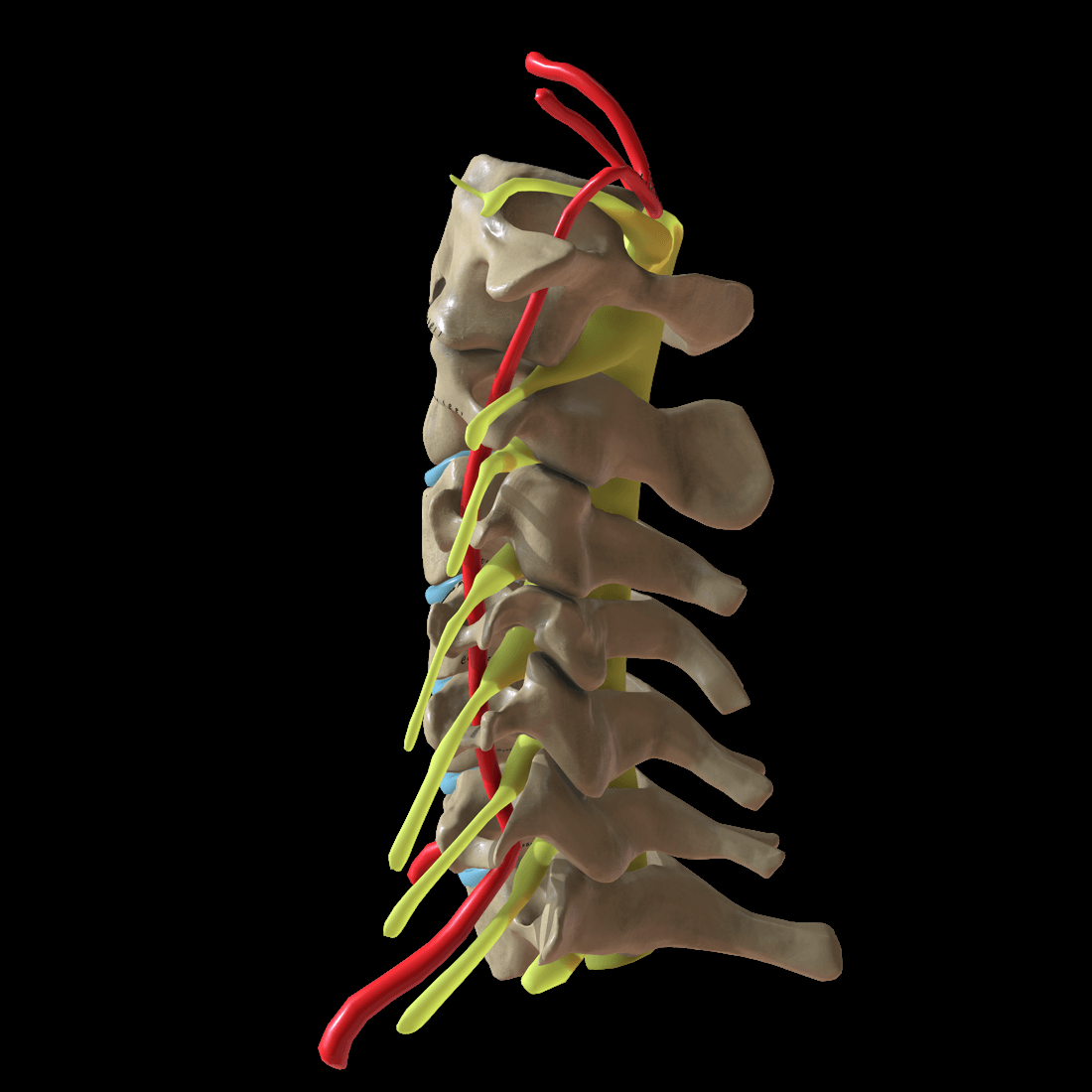
Why the child's spine. The paediatric cervical spine has biomechanical properties that predispose to SCIWORA:
- Ligamentous laxity - generalised joint hypermobility allows excessive intersegmental motion
- Horizontal facet joints - flatter than the vertical adult facets, so they allow significant AP translation (sliding) without fracture or dislocation
- Large head-to-body ratio - the head is disproportionately large and heavy, and in young children the fulcrum of motion is at C1-C2 rather than the adult C5-C6, which puts the upper cervical cord at highest risk in toddlers
- Undeveloped uncinate processes - the joints of Luschka are flat until they ossify and heighten by age 10, and without these bony side-walls there is less resistance to lateral and rotational forces
- Anterior wedging of the vertebral bodies, which facilitates hyperflexion
- Incomplete ossification of the odontoid
- Cartilaginous endplates, which allow deformation
The cord's blood supply. It is tenuous, particularly the anterior spinal artery. Watershed zones (T4-T8) are vulnerable, but in cervical SCIWORA the mechanism is often traction injury to the penetrating vessels. The vampire bite sign, tiny paired hyperintensities on axial MRI, represents disruption of the central sulcal arteries and specifically predicts poor motor recovery (LMN injury).
Patterns of cord injury. The injury to the cord itself takes one of these patterns:
- Concussion - transient dysfunction, rapid recovery
- Contusion and oedema - structural change, variable recovery
- Infarction - the vampire bite sign (vascular disruption)
- Transection - complete loss
- Paediatric (SCIWORA)
- Normal (By definition)
- Adult SCI
- Fracture/Dislocation common
- Paediatric (SCIWORA)
- Distraction / Hyperflexion
- Adult SCI
- Axial Load / Burst
- Paediatric (SCIWORA)
- Ligamentous Laxity + Large Head
- Adult SCI
- Stiff Spine + Degeneration
- Paediatric (SCIWORA)
- Long segment oedema (Pencil line)
- Adult SCI
- Focal contusion
Classification
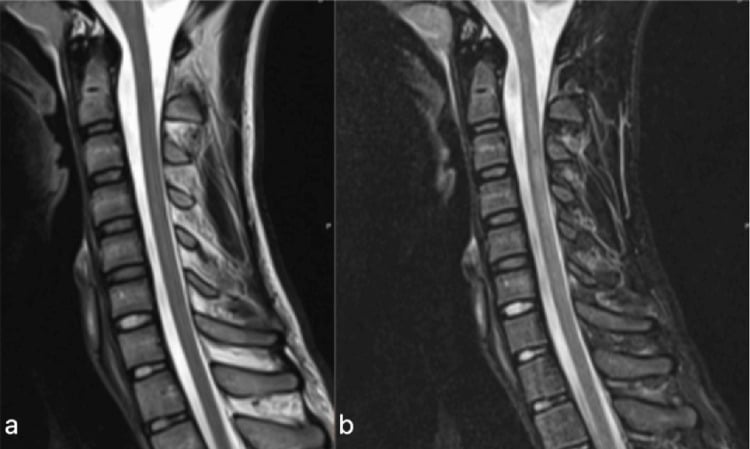
Pang's MRI classes (2004). Reviewing two decades of data, Pang described five classes of cord finding on MRI, and they are highly predictive of outcome, which is why MRI is the single most useful prognostic test in SCIWORA. The gradient turns on blood in the cord: oedema alone is compatible with near-complete recovery, while major haemorrhage or transection essentially fixes the deficit.
- Outcome in Pang's series
- All made a complete recovery
- Long term
- Full return to activity potential
- Outcome in Pang's series
- 75% reached mild grades; 25% became normal
- Long term
- Most walk independently
- Outcome in Pang's series
- 40% improved to mild grades
- Long term
- Variable, often a residual deficit
- Outcome in Pang's series
- Profoundly poor
- Long term
- Permanent deficit likely
- Outcome in Pang's series
- Profoundly poor; no recovery
- Long term
- Permanent complete injury
Extraneural injury matters separately. MRI in SCIWORA frequently shows damage to the non-bony supporting structures, and these findings are the structural basis for the occult instability that justifies bracing and delayed dynamic films:
- Anterior and posterior longitudinal ligament rupture
- Disc disruption
- Interspinous and muscular tears
- Tectorial membrane rupture
- Shearing of the subepiphyseal growth zone of the vertebral endplates
ASIA Impairment Scale and Neurological Classification
The ASIA Impairment Scale (AIS) is the standardised grading of spinal cord injury severity, used to communicate completeness and prognosis. It rests on the International Standards for Neurological Classification of Spinal Cord Injury (ISNCSCI): 10 key muscles and 28 dermatomes (light touch and pin-prick) tested on each side, plus voluntary anal contraction and S4-S5 sensation.
- Definition
- No motor or sensory function in the sacral segments S4-S5
- Significance
- Complete injury; worst prognosis
- Definition
- Sensory but no motor function preserved below the level, including S4-S5
- Significance
- Incomplete; sacral sparing present
- Definition
- Motor preserved below the level; more than half of key muscles below are grade under 3
- Significance
- Incomplete, weak
- Definition
- Motor preserved below the level; at least half of key muscles below are grade 3 or more
- Significance
- Incomplete, functional
- Definition
- Motor and sensory normal in a patient with a prior documented deficit
- Significance
- Recovered
The single most important distinction is complete (AIS A) versus incomplete. Test S4-S5: any voluntary anal contraction, perianal sensation or deep anal pressure means sacral sparing and an incomplete injury, which carries a far better prognosis. Assess this only after spinal shock has resolved (return of the bulbocavernosus reflex).
Incomplete Spinal Cord Syndromes
When the injury is incomplete, the pattern of deficit localises the damage within the cord and predicts recovery. The anterior cord pattern, with motor and pain/temperature lost and the dorsal columns spared, is the clinical face of the anterior spinal artery (vampire-bite) injury seen in SCIWORA.
- Deficit pattern
- Upper limbs weaker than lower limbs (distal worst), variable sensory and bladder involvement
- Prognosis / note
- Commonest; hyperextension; generally good but incomplete recovery
- Deficit pattern
- Loss of motor and pain/temperature below the lesion; dorsal columns (proprioception/vibration) preserved
- Prognosis / note
- Anterior spinal artery territory; worst prognosis of the incomplete syndromes
- Deficit pattern
- Ipsilateral motor and proprioception/vibration loss; contralateral pain/temperature loss
- Prognosis / note
- Best prognosis; often penetrating or rotational injury
- Deficit pattern
- Loss of proprioception and vibration with preserved power and pain/temperature
- Prognosis / note
- Rare; produces sensory ataxia
Clinical Assessment
History. The mechanism is a motor vehicle collision, a fall or sport. Ask about transient symptoms: "stingers", burning hands, electric shocks (Lhermitte's). Ask specifically about the time between injury and the onset of weakness; the lucid interval between trauma and paralysis runs from hours to 4 days, and its warning signs are paraesthesia and Lhermitte's. Any child with neck pain and a normal X-ray requires careful clearance; do not dismiss transient symptoms.
Examination. Neurology is the key, classified on the ASIA examination (below):
- Motor: weakness, often bilateral
- Sensory: a level to pin-prick and light touch
- Reflexes: hyperreflexia (upper motor neuron) or absent (spinal shock)
- Tone: flaccid initially (shock), then spasticity later
- Autonomic: priapism, bradycardia (neurogenic shock, hypotension)
Spinal shock and neurogenic shock often coexist in severe SCIWORA, and it is vital to distinguish them. Spinal shock is physiological: a loss of all cord function caudal to the level of injury, with flaccid paralysis and areflexia. It is transient, usually 24-48 hours, and recovery is heralded by the return of the bulbocavernosus reflex.
Neurogenic shock is haemodynamic, the result of loss of sympathetic tone with injuries at T6 and above. The triad is hypotension, bradycardia and peripheral vasodilatation (warm peripheries). Treat with fluids and inotropes (noradrenaline or dopamine) to maintain perfusion, and atropine for severe bradycardia.
Differential diagnosis. Other causes of acute weakness to distinguish from SCIWORA:
- Transverse myelitis - often a viral prodrome, slower onset (hours to days), fever; MRI shows enhancement
- Guillain-Barré syndrome - ascending paralysis, areflexia, normal MRI spine; lumbar puncture shows albuminocytologic dissociation
- Spinal cord tumour - insidious onset, night pain
- Conversion disorder - inconsistent examination, positive Hoover's sign; a diagnosis of exclusion
- Brachial plexus injury - unilateral, lower motor neuron signs only (root level)
Non-accidental injury. Red flags:
- An inconsistent history
- Delayed presentation (parents waited days)
- Multiple fractures or bruises in different stages of healing
- SCIWORA in a non-ambulatory infant (e.g. "fell from couch")
Investigations
Radiographs. AP, lateral and odontoid views, which are often normal. Look for:
- Prevertebral soft-tissue swelling (greater than 6mm at C2)
- ADI widening
- Subtle kyphosis
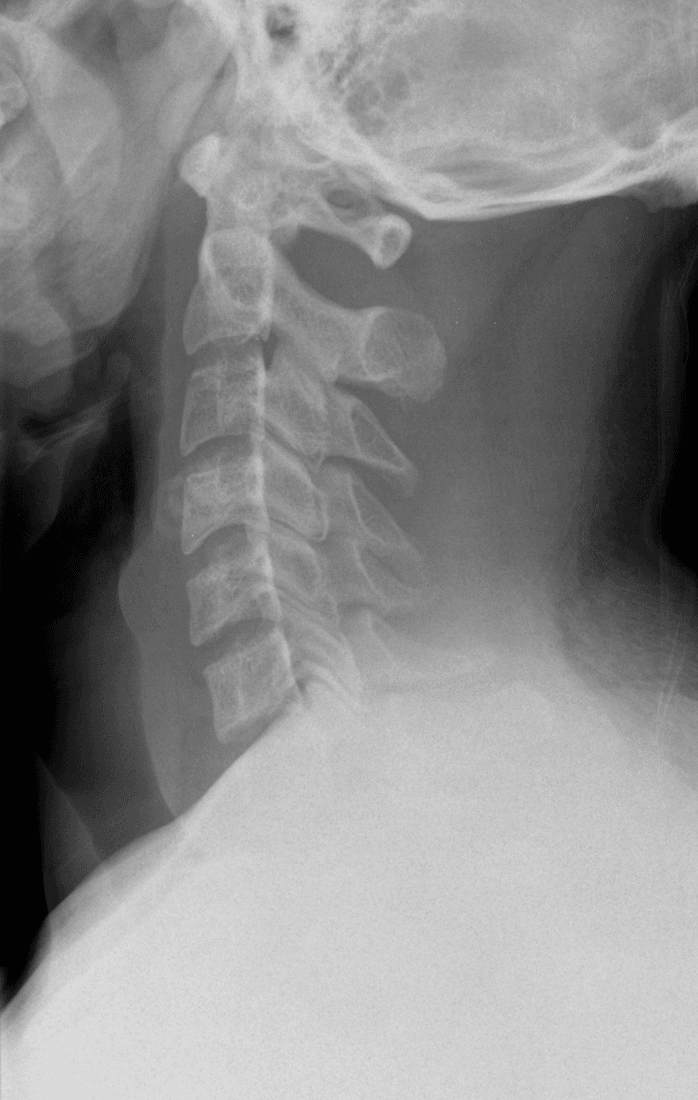
CT. CT rules out an occult fracture and is usually normal in SCIWORA; it is indicated if the plain films are inadequate or suspicion of bony injury is high. A normal CT is false reassurance: CT shows only bone, and in children the injury is often purely ligamentous or discal, or a direct cord contusion without fracture.
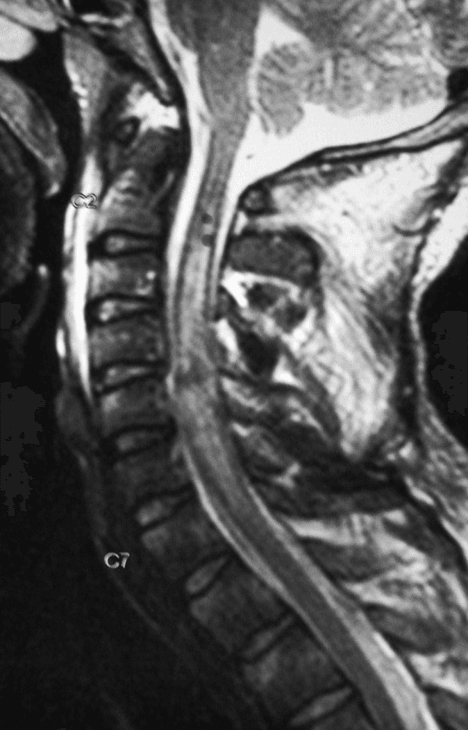
MRI. The gold standard, and mandatory for any child with transient neurological symptoms or persistent neck pain after trauma. It must be performed urgently, within 24-48 hours, to detect signal changes. Its findings are extraneural (ligament disruption, disc herniation, epidural haematoma) or intraneural (oedema, haemorrhage, transection). The sequences:
- T2-weighted - best for oedema and ligament disruption
- STIR - highlights oedema in the soft tissues
- Gradient echo (GRE) - detects haemorrhage
- DWI - early infarction
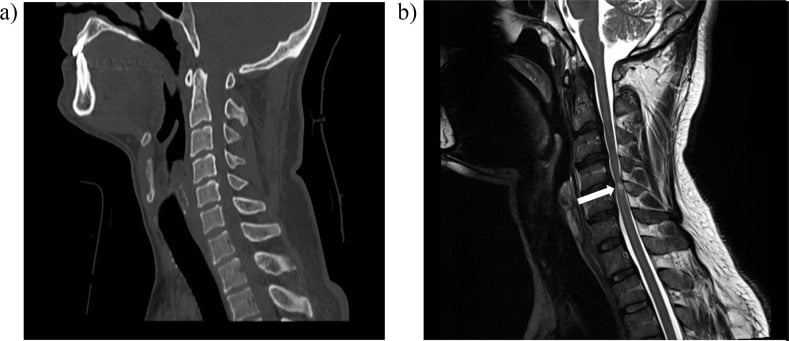
Other tests. Blood tests are usually normal; consider a metabolic work-up if the aetiology is weak (for example, with transverse myelitis in the differential). Electrophysiology (SSEP/MEP) is mandatory if surgery is planned and can help prognosticate in comatose patients. Diffusion tensor imaging is an emerging research tool that may show tract disruption even when T2 is normal, and fMRI evaluates cortical reorganisation in chronic cases.
Management Algorithm
Immediate, then targeted. A rigid collar goes on at once. Its purpose is to prevent a second injury through a segment made occultly unstable by ligamentous, discal and endplate damage that plain films cannot show. That is a reason to brace the children who have such damage, not every child who presents.
Pang braced everyone in 1982. He stopped, and said so in 2004 (PMID 15574214), once MRI and somatosensory evoked potentials could identify who was actually at risk. The current stratification:
- MRI / SSEP
- Abnormal
- Brace?
- Yes - 3 months
- MRI / SSEP
- Both normal (12-15% of this group)
- Brace?
- Yes - 3 months. The clinical syndrome makes the diagnosis; normal imaging does not unmake it
- MRI / SSEP
- Abnormal MRI and/or SSEP
- Brace?
- Yes
- MRI / SSEP
- Both normal (60% of this group)
- Brace?
- No - these children were not braced
The brace. A rigid collar (Miami J or Aspen) for 3 months where indicated, with flexion/extension radiographs before it is cleared, to exclude late instability. Compliance is the biggest challenge in this age group, another reason to reserve the collar for the children whose risk justifies it.
The trap in both directions. Bracing every child with a stinger over-treats a large group who never needed it. Clearing a child with persistent myelopathy because the MRI reads normal is the dangerous error: the 12-15% of children with definite, persistent myelopathy who have a normal MRI and normal SSEPs were all braced by Pang on the clinical syndrome alone.
Surgical Technique
Surgery is rarely the first line for SCIWORA unless mechanical instability is proven.
Halo-thoracic vest. For unstable injuries in young children where collars fail.
- More pins (6-8) to distribute the load
- Lower torque: 2-4 in-lbs in toddlers, against 8 in-lbs in adults, and pins hand-tightened only to avoid penetration
- Avoid the temporal fossa, where the squamous bone is paper thin
- A custom-fit vest, checked for skin breakdown
Small anatomy. Pedicles in children under 8 are minuscule, often less than 3-4mm, which makes screw fixation risky.
Growth. Fusing the spine arrests vertical growth. Fusing C1-C2 loses very little height, and subaxial fusion loses 0.07mm per segment per year, which is negligible. A posterior-only fusion in growing scoliosis induces the crankshaft phenomenon, which is less relevant here.
Healing. Healing potential is massive: nonunion is rare, but overgrowth can occur.
Complications
Recurrence. A "second hit" within 2 weeks is often more severe than the first, and preventing it is the entire purpose of bracing. That makes the collar non-negotiable in the children who meet the bracing criteria (Management) and unnecessary in those who do not.
Neuromuscular scoliosis. 98% of children with SCI before skeletal maturity will develop neuromuscular scoliosis, and they require 6-monthly spine X-rays until maturity.
Mortality. High in upper cervical transections, from respiratory arrest.
Postoperative Care
The recovery protocol below is for the child who is immobilised.
Recovery Protocol
- ICU admission (monitor respiratory status if high C-spine).
- Maintain the MAP target for cord perfusion (below).
- Rigid immobilisation.
- Mobilise in collar.
- Aggressive physiotherapy (ROM, strengthening).
- Bowel/bladder regimen if affected.
- No sports: minimum 3 months.
- Dynamic X-rays (flexion/extension).
- Repeat MRI (resolution of oedema?).
- Wean collar if stable.
- Contraindicated: If persistent deficit or instability.
- Allowed: If full recovery, stable spine, and normal MRI.
Acute nursing care. Strict spinal precautions with log rolling until the spine is cleared. Avoid hypotension: maintain a MAP greater than 85mmHg (adult targets) or an age-appropriate equivalent (e.g. greater than 70-75mmHg) to ensure cord perfusion. Intermittent catheterisation if there is retention.
The collar and the skin. Regular collar care, changing the liners, prevents occipital and mandibular pressure ulcers, a high risk in children with thin skin.
Long-term rehabilitation. Spasticity is managed with baclofen, and Botox injections for contractures. PTSD is common in both the child and the parents (guilt), and both need psychological support.
Outcomes
The MRI class predicts recovery (see the table under Classification). Three points sit outside the table.
Normal cord signal is a prognosis for the cord, not a discharge instruction. A child with persistent myelopathy and a normal MRI is still braced.
Oedema varies by length. Short-segment oedema recovers well; long-segment oedema does poorly.
Minor haemorrhage is not major haemorrhage. Do not write these children off with the major-haemorrhage group; for major haemorrhage or complete transection, recovery is not expected.
Guidelines, Registries & Global Practice
Global epidemiology:
- SCIWORA accounts for roughly 6-19% of paediatric and 9-14% of adult spinal injuries across reported series (Szwedowski 2014), and is the predominant cord-injury pattern in young children.
- The cervical spine dominates (around 46% of cases in nationwide US data), with upper cervical injury concentrated in children under 8 and lower cervical/sport-related injury in adolescents (Knox 2016).
- Mechanism shifts with age and region: motor vehicle collisions predominate in young children, contact sport in adolescents, and diving, falls and road trauma are leading causes in many limited-resource settings.
Side-by-side guidance:
- Imaging stance
- MRI for the obtunded child or persistent symptoms with normal CT; CT not sufficient to clear
- Steroids in SCI
- Recommend AGAINST routine high-dose methylprednisolone
- Imaging stance
- Maintain collar until reliable exam or MRI clearance in obtunded patients
- Steroids in SCI
- Steroids not endorsed as standard of care
- Imaging stance
- Low threshold for MRI in children; minimise unnecessary CT radiation
- Steroids in SCI
- No routine steroids; supportive cord-perfusion focus
- Imaging stance
- MRI is the reference standard for cord and ligamentous assessment
- Steroids in SCI
- Decision individualised; routine use discouraged
- There is no dedicated implant registry for SCIWORA (it is largely a non-operative, soft-tissue diagnosis). Evidence is therefore driven by national trauma and paediatric admission databases (e.g. US HCUP-KID) and specialist paediatric spinal unit series rather than arthroplasty-style registries.
- Neuromuscular scoliosis surveillance to skeletal maturity is the key longitudinal data point: a high proportion of children injured before maturity develop progressive deformity and need indefinite follow-up.
- High-resource settings: urgent MRI, paediatric ICU cord-perfusion targets, and management within a specialist paediatric spinal unit are standard.
- Limited-resource settings: where urgent MRI is unavailable, the safe default is to maintain rigid immobilisation and transfer to a centre with MRI; the collar must never be cleared on a normal CT alone. Clinical vigilance for delayed deterioration substitutes for advanced imaging.
- Transport: stabilisation and rigid immobilisation before transfer are mandatory worldwide; retrieval delay should never prompt premature collar removal.
Prevention Strategies
- Child restraints: appropriate car seats with rear-facing use kept as long as the seat allows markedly reduce cervical distraction forces in crashes — the single most effective prevention in young children.
- Sport: contact and collision sports (rugby codes, American football, wrestling, diving) demand strict "no return to play" after any transient cord symptom ('stinger', burning hands) until cleared; neck-strengthening and safe-tackle programmes reduce risk.
- Recreational hazards: trampolines and diving into shallow water are recurrent causes of severe cervical trauma in children; supervision and age-appropriate restrictions are advised.
Controversies and Areas of Uncertainty
Is SCIWORA still a valid term? With universal MRI, most "SCIWORA" now has visible cord or ligamentous signal change. Some authors argue the term is obsolete and propose SCIWORET (without radiographic evidence of trauma) or simply MRI-based grading. Examiners may probe whether you understand that the concept (normal X-ray/CT, abnormal cord) still matters even if the label is debated.
How long to brace. The 12-week collar comes from Pang's 1982 instability concerns, and there is no high-level evidence for the exact duration. Who to brace is settled published practice from the syndrome's own author; only how long remains genuinely uncertain. Many units shorten immobilisation further when the MRI is normal and the spine is dynamically stable, balancing recurrence risk against skin breakdown and deconditioning.
MRI timing and DTI. The ideal window for prognostic MRI (24-72 hours, to capture peak oedema and haemorrhage) and the added value of diffusion tensor imaging over standard T2/GRE remain research questions rather than settled practice.
Viva Scenarios
Clinical Decision Scenarios
Practise clinical reasoning and management decisions out loud
“A 6-year-old is intubated after a high-speed MVC. GCS 3T. Polytrauma. CT Cervical Spine is reported as normal by the registrar.”
Clinical Decision Scenarios
Practise clinical reasoning and management decisions out loud
“A 7-year-old boy tackled in rugby. Had 'burning hands' for 5 minutes. Now asymptomatic. X-rays normal.”
“Child fell from slide 2 days ago. Neck pain. Now presents with arm weakness and stumbling.”
“Parents of a child with SCIWORA ask if he will walk again. MRI shows a dark spot in the cord.”
MCQ Practice Points
Q: How much can the pediatric spinal column stretch before injury? A: Up to 2 inches. The cord ruptures at 1/4 inch. This specific mismatch causes SCIWORA.
Q: What MRI finding carries the worst prognosis in SCIWORA? A: Intramedullary Hemorrhage (and Transection). Associated with permanent complete injury.
Q: What is the current recommendation for Steroids (Methylprednisolone) in pediatric SCI? A: Not recommended/Optional. Level 1 evidence suggests risks (infection/GI bleed) outweigh benefits.
Q: Which level is most commonly affected in young children (less than 8)? A: Upper Cervical (C1-C2). Large head, fulcrum is higher. In older children (greater than 8), it moves to Lower Cervical.
Q: What percentage of patients with SCIWORA present with delayed symptoms? A: Up to 50%. This can be up to 4 days post-injury.
Definition
- Spinal Cord Injury
- Without Radiographic Abnormality
- Normal X-ray / CT
- MRI findings common (Edema)
Pathophysiology
- Elastic Column (2 inches)
- Brittle Cord (1/4 inch)
- Hyperextension / Distraction
- Recoil Injury
Pang MRI Classes
- Five classes, prognosis follows them
- Normal cord signal: all recovered fully
- Oedema only: 75% mild grades, 25% normal
- Minor haemorrhage: 40% improve
- Major haemorrhage or transection: profoundly poor
Management Rules
- Rigid collar 3 months - but ONLY if persistent myelopathy, or a transient deficit with abnormal MRI/SSEP. Transient deficit with both normal is not braced
- MRI Mandatory for symptoms
- No Steroids (Usually)
- Avoid Sports (3-6 Months)
- Treat symptoms not X-ray
Key Stats
- Age: Less than 8 (Peak)
- Delayed Onset: 50% cases
- Recurrence: High Risk
- Region: Upper C-Spine
- Triad: Hypotension, Bradycardia, Warm
Evidence Base
Defining SCIWORA (Original Description)
- Coined the term SCIWORA — traumatic myelopathy with normal plain films and tomography, attributed to flexion, hyperextension, longitudinal distraction and ischaemia.
- Children younger than 8 years sustained more serious neurological damage and a larger proportion of upper cervical cord lesions than older children.
- 52% of children had delayed onset of paralysis up to 4 days after injury, most recalling transient paraesthesia, numbness or subjective paralysis.
- Recommended cervical immobilisation plus delayed dynamic films to exclude late instability; long-term prognosis was grim for complete and severe lesions.
Delayed Deterioration and Warning Symptoms
- 55 children with SCIWORA: 10 upper cervical, 33 lower cervical, 12 thoracic injuries; 22 complete or severe and 33 mild lesions.
- All but one of the 22 children with profound deficits were younger than 8 years; younger children were more likely to have severe upper cervical lesions.
- 15 children had delayed onset of deficit; 9 of these had transient warning symptoms (paraesthesia, subjective paralysis, Lhermitte phenomenon) 30 minutes to 4 days before deterioration.
- 8 children sustained a second SCIWORA 3 days to 10 weeks after the first, implying incipient instability from the index injury.