Lateral Tibial Plateau Avulsion | Anterolateral Ligament | Pathognomonic for ACL Tear
- Pathognomonic for ACL tear - Segond fracture = small avulsion lateral tibial plateau = anterolateral ligament avulsion
- 75-100% association with ACL injury - if you see Segond fracture, look for ACL tear on MRI
- Anterolateral ligament (ALL) avulses from lateral tibial plateau - this is the Segond fracture
- High-grade pivot shift - Segond fracture associated with more severe rotational instability
- Treatment: Focus on underlying ACL injury - Segond fracture itself rarely needs fixation
- “Segond fracture = pathognomonic for ACL tear - small avulsion lateral tibial plateau
- “Anterolateral ligament (ALL) avulses from lateral tibial plateau - this creates the Segond fracture
- “75-100% of Segond fractures have associated ACL tears - always order MRI
- “Reverse Segond fracture (medial) = MCL avulsion = associated with PCL injury
Overview and Epidemiology
A Segond fracture is a small avulsion fracture of the lateral tibial plateau, the anterolateral ligament (ALL) pulling off its tibial insertion. The fragment is small and non-articular and rarely needs fixation. What matters is what it announces: an ACL tear, with a 75-100% association, and significant rotational instability.
Segond fracture = pathognomonic for ACL tear. If you see a Segond fracture on X-ray, always order MRI to assess the ACL.
Mechanism. The mechanism is that of the ACL injury, non-contact or contact:
- Non-contact - cutting or pivoting on a planted foot with the knee near extension, and valgus collapse
- Contact - a direct blow causing valgus or hyperextension
Internal rotation combines with the valgus and extension, and force peaks near full extension.
Who. Young athletes: the peak age is 20-30 years, males outnumber females by approximately 2:1, and skiing mechanisms are over-represented. The injury is usually unilateral.
How often. A Segond fracture is seen on the injury radiographs in roughly 7-9% of ACL tears, and in up to about 15% when healed lesions are included (Slagstad et al, AJSM 2020).
Anatomy and Pathophysiology
The anterolateral ligament. A distinct ligament that runs an oblique course, anterior to the LCL, from the lateral femoral epicondyle to the anterolateral aspect of the lateral tibial plateau, about 5mm below the joint line. Accounts of its femoral origin differ: proximal and posterior to the LCL origin in one, slightly anterior to it in Claes' dissections (see the Evidence Base). It is a secondary stabiliser to internal rotation and works with the ACL to resist rotational instability.
A late re-description. Segond described the fracture in 1879, but the ligament was long thought to be part of the iliotibial band. It was re-described as a discrete structure in 2013 (Claes).
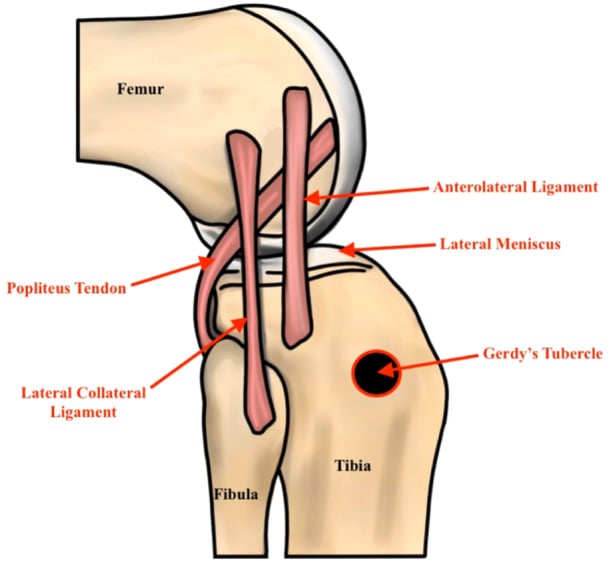
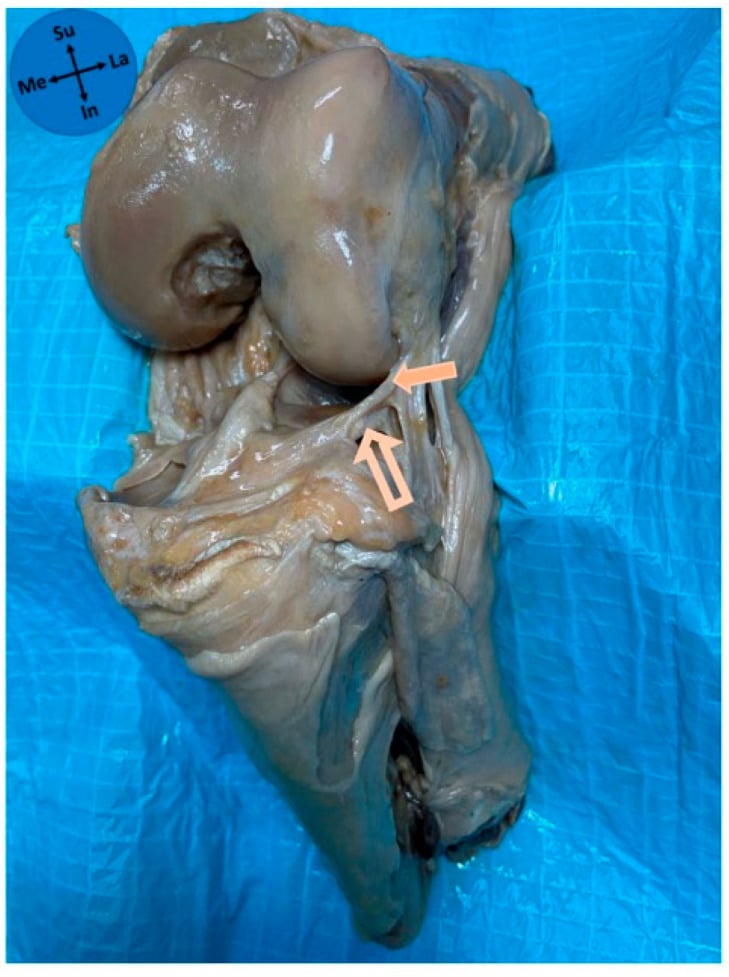
Why it avulses. Valgus, internal rotation and extension tear the ACL first, since it is the primary restraint. The ALL, weaker than the ACL, then takes excessive internal rotation force and avulses at its insertion on the lateral tibial plateau: the Segond fracture.
Why it matters. Because the ALL and the wider anterolateral complex are secondary restraints to internal tibial rotation, their bony avulsion means the knee has lost its secondary rotational restraint as well as its primary one. The result is a higher-grade pivot shift than an isolated ACL tear. Exactly which structure the fleck comes from is still debated (see Controversies).
Classification Systems
The lesion is sorted three ways, and each one points at a decision.
By location. The classic Segond is lateral: an ALL avulsion from the lateral tibial plateau, associated with ACL tear, and the most common type. Location determines which ligament is involved and which cruciate injury to expect.
Reverse Segond fracture (medial tibial plateau avulsion) = MCL avulsion = associated with PCL injury, not ACL. It is the less common, opposite pattern (quoted at 5-10% of Segond fractures, although no series gives the lesion a denominator; see Bedeir in the Evidence Base): a medial avulsion indicates a PCL tear with MCL involvement.
By ACL association. A Segond fracture with an ACL tear is the most common pattern and is treated by ACL reconstruction. An isolated Segond fracture without ACL tear is rare, less than 5%; it may represent an isolated ALL injury, is usually stable, and is treated conservatively if stable. ACL association determines treatment and prognosis.
By pivot shift grade. A Segond fracture with an ACL tear means more severe rotational instability, a high-grade pivot shift that may benefit from lateral extra-articular tenodesis (LET) alongside the reconstruction. An ACL tear without a Segond fracture carries standard rotational instability and is treated by ACL reconstruction alone.
Clinical Assessment
History. The story is the ACL injury: cutting or pivoting on a planted foot with the knee near extension and valgus collapse, a "pop" or "snap", immediate pain and swelling, and inability to continue the activity. The patient then reports the knee giving way, inability to bear weight, and locking if the meniscus is injured.
Examination. Expect an effusion (haemarthrosis), an antalgic gait and a knee held in slight flexion, with flexion and extension both limited by pain and effusion. Tenderness over the lateral tibial plateau marks the fracture site; joint-line tenderness suggests a meniscal injury and MCL tenderness an MCL injury. The ligament tests:
- Lachman test - positive (anterior translation)
- Anterior drawer - positive (anterior translation)
- Pivot shift - positive (rotational instability), and high-grade with a Segond fracture
- Valgus stress - may be positive if the MCL is injured
Associated injuries. The ACL tear is the most common, and the rest must be looked for on MRI:
- Lateral meniscal tear - 30-40%, posterolateral
- MCL injury - 20-30%
- Bone bruises - posterolateral tibial plateau and lateral femoral condyle (kissing contusion)
- Cartilage injury - lateral femoral condyle (30-40%)
Grading the Pivot Shift: What 'High-Grade' Means
What the test reproduces. The pivot shift reproduces the anterior subluxation, then reduction, of the lateral tibial plateau as the knee moves from extension into flexion. The iliotibial band, converting from an extensor to a flexor at roughly 20-30 degrees, snaps the subluxated plateau back. The IKDC grading is:
- Grade 0: no pivot (equal to the normal contralateral knee)
- Grade I (glide): a smooth, subtle reduction — low-grade
- Grade II (clunk): a distinct jerk or clunk as the plateau reduces — high-grade
- Grade III (gross): a gross clunk with momentary impingement or transient locking of the plateau — high-grade
Why the grade matters. "High-grade" means grade II (clunk) or grade III (gross). The STABILITY randomised trial used a grade 2 pivot shift or greater as one of its enrolment criteria for adding LET, and this is precisely the population a Segond fracture tends to identify.
The acute knee. Guarding and pain make the pivot shift unreliable in the acute, awake knee, so a low-grade or absent pivot shift on the day of injury does not exclude high-grade instability. The examination under anaesthesia at the time of surgery is the definitive grading, and the Segond fragment on the plain film is your early warning of what you will find.
Investigations
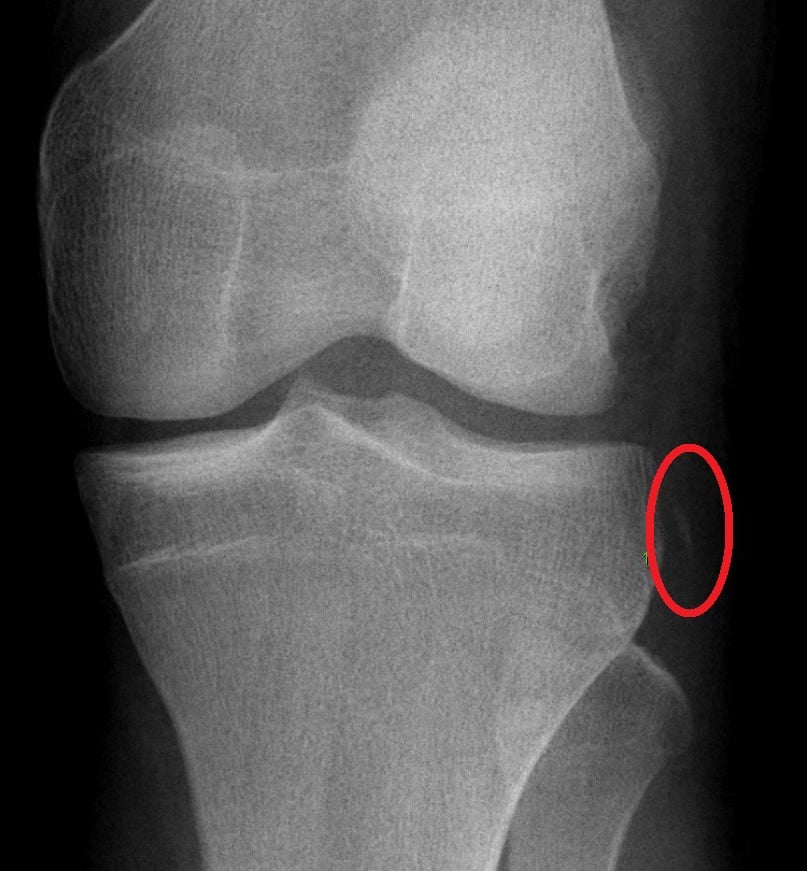
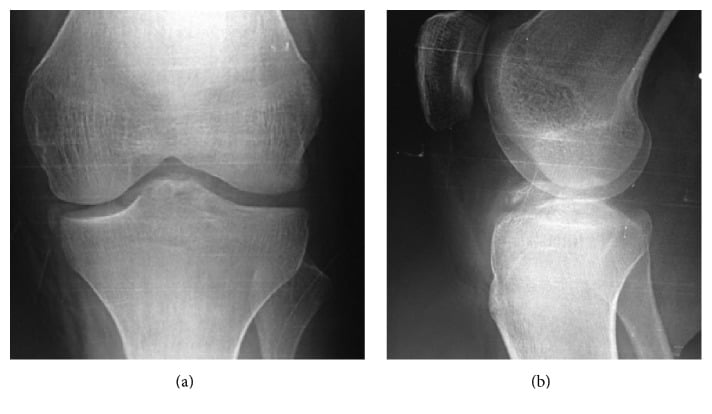
Radiographs. AP and lateral views of the knee. The Segond fracture is a small avulsion from the anterolateral aspect of the lateral tibial plateau, usually 5-10mm and non-articular. The lateral view may show the fragment, but the AP view is diagnostic. Read the same films for a deep lateral femoral notch (below) and, in children, a tibial spine fracture.
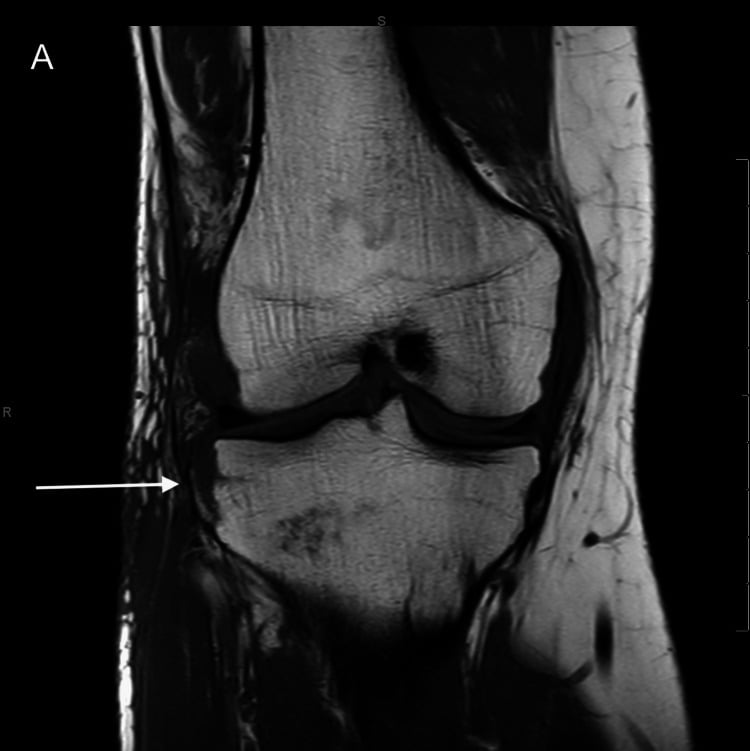
MRI. Always order MRI once a Segond fracture is seen: it is essential for diagnosis and treatment planning. It assesses the ACL (fibre discontinuity, abnormal signal, an empty notch), shows the ALL avulsion itself, maps the kissing-contusion bone bruises of the posterolateral tibial plateau and lateral femoral condyle, and evaluates the meniscus, MCL and cartilage.
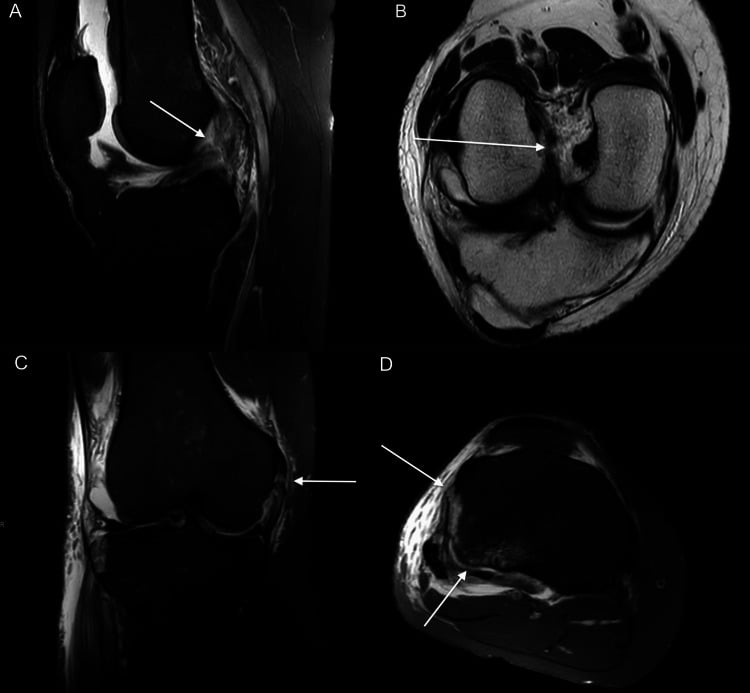
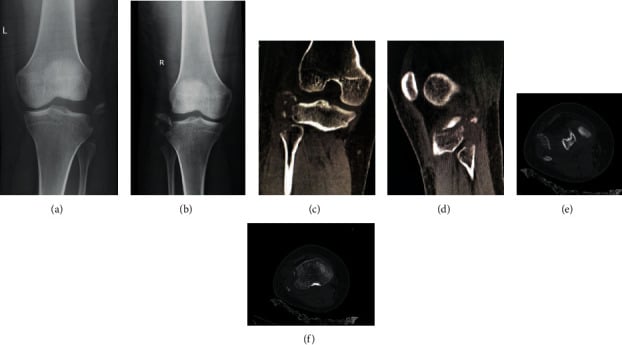
CT. Rarely needed, and usually not required, since MRI is sufficient for diagnosis and treatment planning. Use it to assess fragment size and displacement if fixation is being considered, to evaluate associated fractures and to plan the surgical approach.
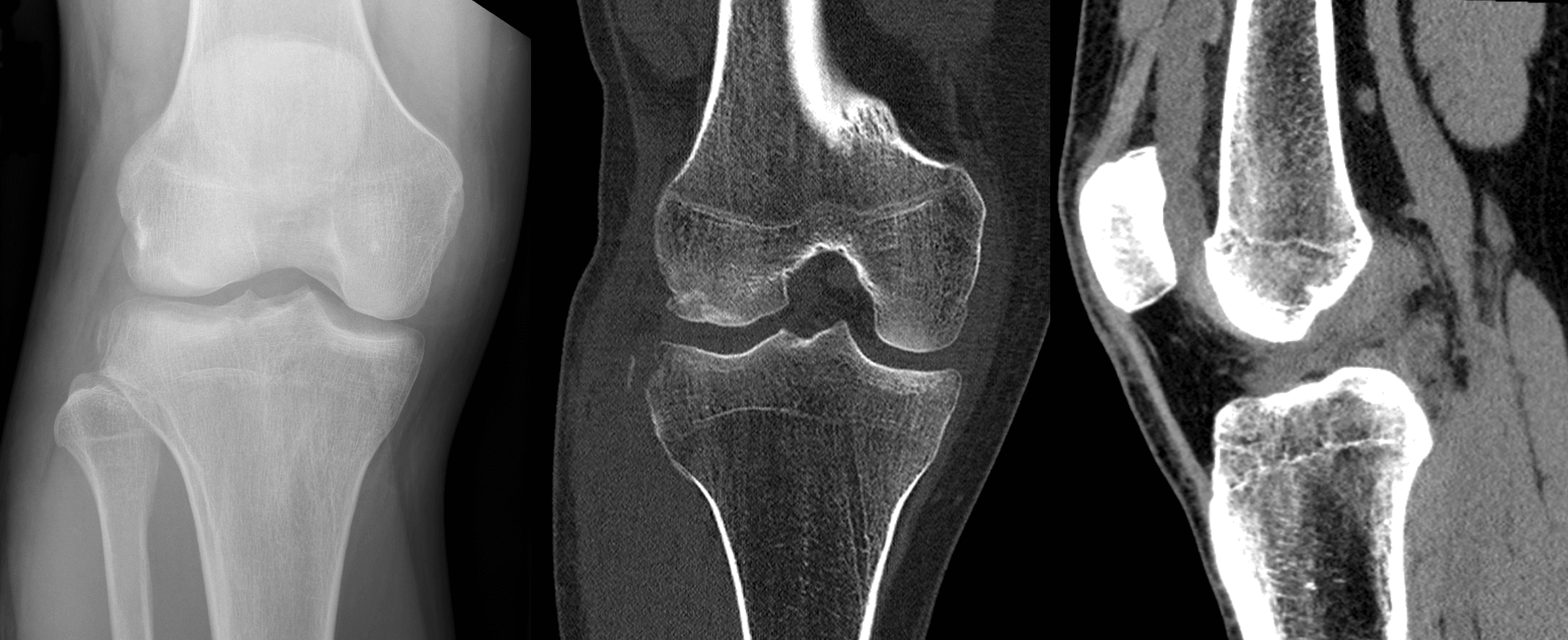
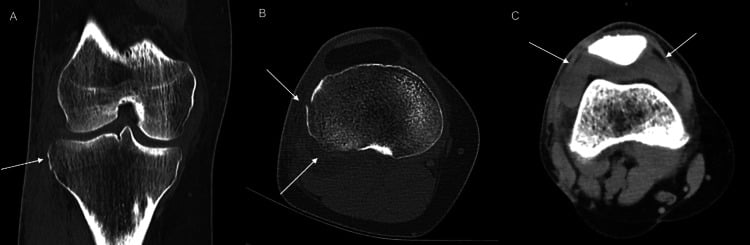
The Deep Lateral Femoral Notch Sign: A Companion Bony Marker of ACL Rupture
The deep lateral femoral notch sign is the other bony surrogate of ACL rupture you can read off the very same plain radiograph as a Segond fragment. Unlike the Segond fleck, it sits on the femur, not the tibia.
The sign. The lateral femoral condyle normally carries a shallow groove, the condylopatellar sulcus (sulcus terminalis), separating its patellar and tibiofemoral articular surfaces and seen end-on as a small notch on a true lateral radiograph. During the pivot-shift subluxation of an ACL rupture the lateral femoral condyle impacts against the posterolateral tibial plateau, and the osteochondral impaction deepens the sulcus. A depth greater than 1.5mm (some authors use a 2mm threshold) is abnormal, an indirect sign of a torn ACL.
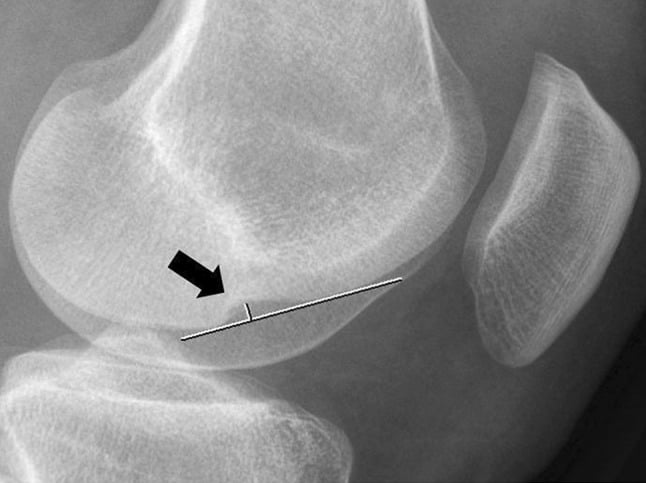
Why it matters alongside the Segond fragment.
- Two bony clues, one mechanism. Both are skeletal footprints of the same rotatory subluxation event; finding either on plain films should trigger dedicated ACL assessment on MRI.
- The notch localises the bone bruise. The impaction that deepens the notch is the femoral half of the kissing contusion, and a clue to associated lateral meniscal and chondral injury.
- Look on the lateral, not just the AP. The Segond fleck is an AP-view finding and the deep notch is best seen on the true lateral, so a complete plain-film read for suspected ACL injury interrogates both projections.
Specific, not sensitive. The absence of the notch does not exclude an ACL tear. Its presence, like a Segond fracture, is a high-value pointer that saves you from missing the cruciate injury while cross-sectional imaging is awaited.
Differential Diagnosis of a Proximal Tibial Avulsion
A small fleck of bone around the proximal tibia is the radiographic crux. Each fleck points to a different ligament and a different associated injury, so localising it precisely is the exam-winning step.
- Fragment location
- Anterolateral tibial rim, just below joint line
- Structure avulsed
- Anterolateral ligament / capsule
- Key association
- ACL tear + anterolateral rotatory instability
- Discriminator
- Lateral fleck + positive Lachman/pivot shift
- Fragment location
- Medial tibial rim
- Structure avulsed
- Deep MCL tibial attachment
- Key association
- PCL / posteromedial corner injury
- Discriminator
- Medial fleck + posterior sag
- Fragment location
- Fibular styloid / head
- Structure avulsed
- Arcuate complex (PLC)
- Key association
- Posterolateral corner, common peroneal nerve
- Discriminator
- Fibular fleck + varus/dial test positive
- Fragment location
- Intercondylar eminence (central)
- Structure avulsed
- ACL tibial insertion (bony)
- Key association
- ACL functional disruption (paediatric/adolescent)
- Discriminator
- Central fragment, often a child after a fall from bike
- Fragment location
- Anterolateral tibia at Gerdy tubercle
- Structure avulsed
- Iliotibial band insertion
- Key association
- Direct ITB traction; not pathognomonic for ACL
- Discriminator
- More anterior/lateral, at the ITB footprint
- Fragment location
- Lateral plateau, articular
- Structure avulsed
- Bony - articular surface
- Key association
- Valgus/axial load; bumper fracture
- Discriminator
- Larger, intra-articular, joint depression on CT
Management Algorithm
The decision. Recognise the fracture on X-ray, order MRI to assess the ACL and associated injuries, then classify the knee as with ACL tear or isolated. The Segond fracture is a marker of severity; the treatment is the treatment of the ligament injury behind it.
- Location
- Lateral tibial plateau
- Associated Injury
- ACL tear (75-100%)
- Treatment
- ACL reconstruction
- Location
- Medial tibial plateau
- Associated Injury
- PCL tear (MCL avulsion)
- Treatment
- PCL reconstruction
- Location
- Lateral tibial plateau
- Associated Injury
- No ACL tear (less than 5%)
- Treatment
- Conservative if stable
- Location
- Lateral tibial plateau
- Associated Injury
- ACL tear + high-grade pivot shift
- Treatment
- ACL reconstruction + LET consideration
With an ACL tear. ACL reconstruction is the primary treatment, indicated by the ACL tear itself, by instability symptoms and in the high-demand patient. It follows standard timing, 4-12 weeks after injury. Consider LET for a high-grade pivot shift (see Surgical Technique).
Isolated. If the knee is stable, with no ACL tear and no instability, treat conservatively with a brace and rehabilitation, and monitor for instability.
Associated injuries. Each is addressed in its own right: meniscal repair if indicated, MCL treatment if needed, and cartilage management.
The fragment. Fixation is rarely indicated. The fragment is small and non-articular, and in most knees it heals or remains asymptomatic without fixation, so most surgeons do not fix it and focus on the ACL reconstruction. The rare indications:
- Large fragment (over 1cm)
- Displaced into the joint
- Symptomatic nonunion
- Surgeon preference, combined with ACL reconstruction
SEGONDSegond Fracture Features
Hook:SEGOND: Small avulsion, Examine ACL (75-100%), Grade pivot shift high, Order MRI, Non-articular fragment, Don't fix - treat ACL!
Surgical Technique
The graft. The Segond fracture does not change the choice:
- BTB autograft - gold standard, bone-to-bone healing
- Hamstring autograft - good outcomes, less morbidity
- Allograft - older patients and revision cases
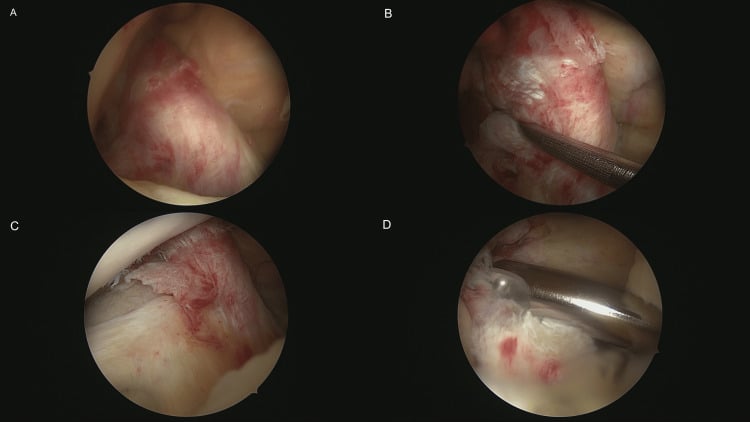
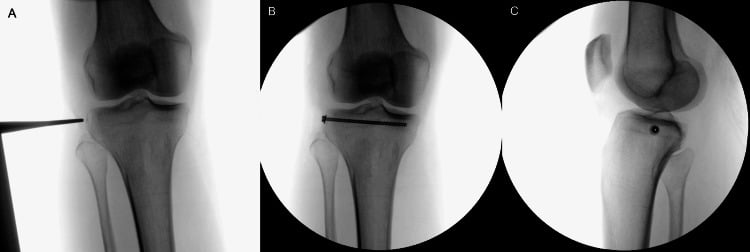
The tunnels. A standard anatomic ACL reconstruction through an anteromedial portal, keeping clear of the Segond fracture site on the lateral tibial plateau. Otherwise the fracture does not change the technique; address meniscal tears, and the MCL if needed, alongside the reconstruction.
Complications
- Incidence
- 4-11% at 2y (STABILITY)
- Risk Factors
- High-grade pivot shift, young age, return to pivoting sport, inadequate reconstruction
- Prevention/Management
- Consider LET in young high-risk patients (rupture 11% to 4% with LET), anatomic ACL reconstruction; revision ACL reconstruction with LET
- Incidence
- 10-15%
- Risk Factors
- Inadequate ACL reconstruction, no LET for high-grade pivot shift
- Prevention/Management
- Anatomic ACL reconstruction, consider LET; revision ACL reconstruction with LET if symptomatic
- Incidence
- Less than 5%
- Risk Factors
- Large fragment, displacement, inadequate fixation
- Prevention/Management
- Fixation if large fragment or symptomatic (rare)
- Incidence
- 10-20%
- Risk Factors
- Untreated meniscal tear
- Prevention/Management
- Repair meniscal tears at time of ACL reconstruction
- Incidence
- 5-10%
- Risk Factors
- Early surgery, delayed ROM
- Prevention/Management
- Wait for ROM recovery, early ROM postoperatively
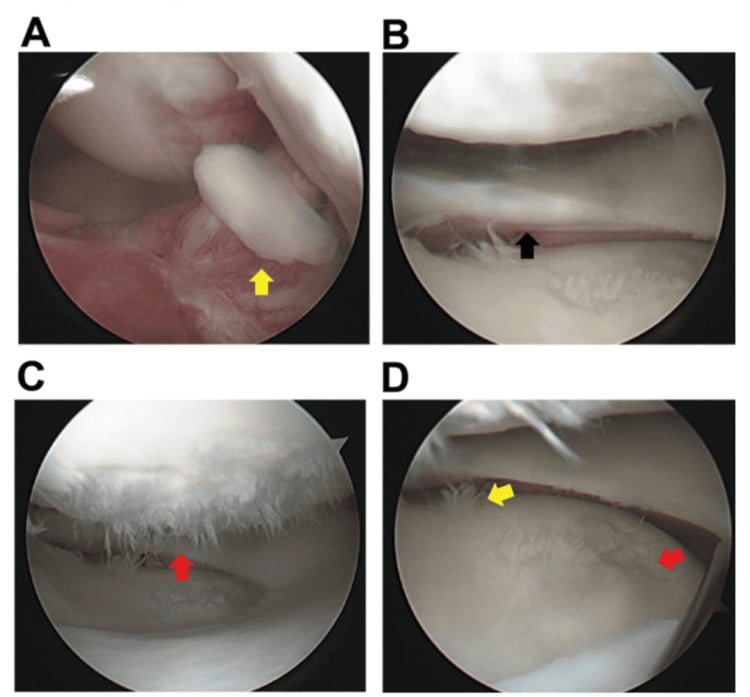
Reading the graft-failure figures. Quote the STABILITY figures rather than a generic range, and note that both are 2-year rates in young high-risk patients aged 25 or under, so they overstate the risk for an older recreational athlete; the 11% is after isolated hamstring ACL reconstruction. The number needed to treat with LET to prevent one graft rupture was 14.3, and composite clinical failure (rupture or residual rotatory laxity) was 40% against 25%, favouring LET.
Postoperative Care
The first weeks. The knee sits in a hinged brace locked in extension for 2-4 weeks and is non-weight bearing initially, for 2-3 weeks. Passive ROM begins at 2-4 weeks, when the brace is unlocked.
- Quadriceps sets and straight leg raises, immediately
- Ice and elevation
- Passive ROM in the unlocked brace (0-90 degrees)
- Progressive weight bearing (partial to full)
- Stationary bike when ROM allows
- Continue quadriceps strengthening
- Full ROM and full weight bearing
- Progressive strengthening
- Balance and proprioception
- Sport-specific training
- Physiotherapy continues for 3-6 months
Outcomes and Prognosis
After reconstruction. The ACL reconstruction does as well as a standard one: a success rate of 85-90%, 80-85% return to pre-injury level, and complications in 10-15% (graft failure, residual pivot shift). Whether the patient returns depends on age, sport level, rehabilitation compliance and LET use.
The fragment. Segond fracture nonunion is quoted at less than 5%, rare and usually asymptomatic, and fixation is rarely needed. Do not confuse that with radiographic healing at reconstruction: in Slagstad's cohort only about a third of fragments had healed between injury and surgery, and a Segond fracture still did not independently raise the risk of revision (Slagstad et al, AJSM 2020). It flags the high-risk phenotype rather than causing failure.
Residual rotatory laxity. Persistent anterolateral rotatory laxity correlates with poorer outcomes and graft failure. Adding LET reduces the composite failure that includes residual rotatory laxity.
What moves the result. Outcomes are better with an anatomic ACL reconstruction, LET for a high-grade pivot shift, complete rehabilitation and early ROM (2-4 weeks). They are worse with a high-grade pivot shift left without LET, an inadequate reconstruction, incomplete rehabilitation and an early return to sport.
Prevention and Return to Sport
Primary prevention. Proper landing technique (knee flexion, not hyperextension), strength training of the quadriceps and hamstrings, balance and proprioception training, and sport-specific conditioning.
After injury. Complete rehabilitation before return to sport, and continued strength and conditioning. Bracing is controversial and may not prevent reinjury.
Return to sport. Usually at 6-9 months postoperatively, depending on sport and level, and only when the criteria are met:
- Full ROM, equal to the contralateral knee
- Quadriceps strength greater than 90% of the contralateral side
- No effusion
- No instability (negative Lachman and pivot shift)
- Single-leg hop test greater than 90% of the contralateral side
- Agility testing passed and sport-specific drills completed
Guidelines, Registries & Global Practice
Global Epidemiology
- Segond fracture is seen on injury radiographs in roughly 7-9% of ACL tears; including healed lesions the figure rises to about 15% (Slagstad et al, AJSM 2020).
- Demographics mirror ACL injury: young, athletic, pivoting/cutting sports and skiing; the Segond subgroup is associated with downhill skiing mechanisms.
- The lesion is a radiographic surrogate, not a separate disease - so there is no dedicated guideline for "Segond fracture"; guidance is embedded within ACL and anterolateral-complex recommendations.
Side-by-Side Guidance (ACL / Anterolateral Complex)
- Position on the Segond / anterolateral lesion
- Segond fracture supports a clinical diagnosis of ACL tear; MRI confirms ligamentous injury
- Position on lateral augmentation (LET/ALL)
- Acknowledges anterolateral procedures as an adjunct; reserved for selected high-risk knees
- Position on the Segond / anterolateral lesion
- Treat the ACL injury, not the small avulsion; image to define associated injury
- Position on lateral augmentation (LET/ALL)
- Lateral augmentation considered in revision and high-grade rotatory laxity
- Position on the Segond / anterolateral lesion
- Anterolateral injury (incl. Segond) marks rotatory instability
- Position on lateral augmentation (LET/ALL)
- Recommends lateral augmentation for young, high-risk, pivoting, revision, high-grade pivot shift
- Position on the Segond / anterolateral lesion
- Fragment is extra-articular and rarely needs fixation
- Position on lateral augmentation (LET/ALL)
- Focus on cruciate and associated structures
Registry & Trial Evidence
- High-quality randomised data (STABILITY, Getgood et al 2020) and the SANTI group series (Sonnery-Cottet) underpin lateral augmentation in young high-risk patients; this is the population a Segond fracture identifies.
- ACL-reconstruction registries (e.g. the Scandinavian Knee Ligament registries - Norwegian, Swedish, Danish - and the UK NLR) track graft survival and revision but do not separately code the Segond fragment; revision risk is driven by age, graft choice, and rotatory laxity rather than the avulsion itself.
High- vs Limited-Resource Practice
- Well-resourced settings: routine MRI, arthroscopic anatomic ACL reconstruction, selective LET/ALL reconstruction for high-risk knees.
- Limited-resource settings: the plain radiograph alone is a powerful clue - a Segond sign should trigger referral and ACL-focused management even where MRI is delayed or unavailable; structured rehabilitation remains the default first step and may be definitive in low-demand patients.
Segond fractures are a common viva topic. Know that Segond fracture = pathognomonic for ACL tear (75-100% association), represents anterolateral ligament (ALL) avulsion, indicates high-grade pivot shift, and treatment focuses on ACL reconstruction (not fixing the Segond fracture). Be prepared to discuss LET for high-grade pivot shift and the STABILITY trial.
Related pages: ACL Injuries is the injury a Segond fracture announces - the fragment itself needs nothing, and everything on this page is really about how the ACL is reconstructed; Anterolateral Ligament Injury for the soft-tissue equivalent of this avulsion and the unsettled question of whether that structure is a discrete ligament at all; PCL Injuries and MCL Injuries for the reverse Segond, where a medial tibial rim avulsion should send you looking posteriorly and medially rather than at the ACL; Posterolateral Corner Injuries for the other lateral-sided structures injured by the same varus and rotatory mechanism, and the ones that actually change the operation if missed; Tibial Plateau Fractures and Tibial Spine Fractures for the two periarticular avulsions this must be distinguished from on the injury film; and Paediatric ACL Injury for the skeletally immature knee, in which the tibial spine avulses before the ligament fails.
Controversies and Areas of Uncertainty
What exactly avulses? The Segond fragment has been attributed to the anterolateral ligament, the mid-third lateral capsular ligament, the iliotibial band's capsulo-osseous layer, and the anterior arm of the short head of biceps. The ALL re-description (Claes 2013) is the dominant modern view, but the precise soft-tissue origin of the fleck remains debated.
How strong is the ACL association? "Pathognomonic" is the classic teaching, but pooled radiographic series show the lesion in only roughly 7-9% of ACL tears, and rare isolated Segond fractures without ACL rupture exist. The defensible statement is that a Segond fracture is highly specific for, and strongly suggestive of, ACL injury, and should be treated as an ACL tear until proven otherwise - not that the association is universal.
Should the fragment ever be fixed? Most surgeons leave it: it is small and extra-articular, and a Segond fracture does not raise revision risk (see Outcomes). Whether fixing or reconstructing the anterolateral structure adds value beyond standard ACL reconstruction is unsettled.
LET versus ALL reconstruction, and for whom? STABILITY supports adding a lateral procedure in young, high-risk patients, but the optimal technique (modified Lemaire LET versus anatomic ALL reconstruction), the graft and the exact indication thresholds are still being defined. So is whether routine LET over-constrains the lateral compartment in the long term.
MCQ Practice Points
Q: What does a Segond fracture indicate? A: ACL tear (pathognomonic) - Segond fracture = small avulsion lateral tibial plateau = anterolateral ligament avulsion. 75-100% of Segond fractures have associated ACL tears.
Q: What ligament avulses to create a Segond fracture? A: Anterolateral ligament (ALL) - The ALL avulses from the lateral tibial plateau, creating the Segond fracture. The ALL is a secondary stabilizer to internal rotation.
Q: What percentage of Segond fractures have associated ACL tears? A: 75-100% - Segond fracture is pathognomonic for ACL tear. Always order MRI if Segond fracture seen on X-ray to assess ACL integrity.
Q: What does Segond fracture indicate about pivot shift severity? A: High-grade pivot shift - Segond fracture indicates more severe rotational instability than isolated ACL tears. This may influence decision for lateral extra-articular tenodesis (LET).
Q: What is the primary treatment for Segond fracture? A: ACL reconstruction - Segond fracture itself rarely needs fixation (fragment is small and non-articular). Focus on treating the underlying ACL injury. Consider LET for high-grade pivot shift.
Q: What does a reverse Segond fracture (medial tibial plateau avulsion) indicate? A: PCL injury - Reverse Segond fracture = MCL avulsion = associated with PCL injury, not ACL. This is the opposite pattern.
Exam Viva Scenarios
Practise clinical reasoning and management decisions out loud
“A 25-year-old athlete presents to ED after a non-contact knee injury during a soccer game. He felt a 'pop' and cannot continue playing. X-ray shows a small avulsion fracture of the lateral tibial plateau. He has a swollen, painful knee and cannot bear weight.”
“A 22-year-old elite athlete presents 6 weeks after ACL injury with Segond fracture. He has persistent instability and cannot return to sport. Examination shows positive Lachman and high-grade pivot shift. MRI confirms ACL tear and shows the Segond fracture (anterolateral ligament avulsion).”
“A 30-year-old is brought in after a high-energy road traffic accident with a hyperextension knee injury. Radiograph shows a small avulsion fragment off the MEDIAL tibial rim, not the lateral side. The knee is grossly swollen with a positive posterior sag sign.”
Key Anatomy
- Anterolateral ligament (ALL): Secondary stabilizer to internal rotation
- ALL origin: Lateral femoral epicondyle
- ALL insertion: Lateral tibial plateau (anterolateral, 5mm below joint line)
- ALL avulsion from tibia = Segond fracture
Classification
- Classic Segond: Lateral tibial plateau avulsion = ACL tear (75-100%)
- Reverse Segond: Medial tibial plateau avulsion = PCL injury (MCL avulsion)
- With ACL tear: Most common (75-100%)
- Isolated: Rare (less than 5%)
Treatment Algorithm
- Segond fracture seen on X-ray: Always order MRI
- With ACL tear (75-100%): ACL reconstruction
- High-grade pivot shift: Consider LET (STABILITY trial)
- Segond fracture itself: Rarely needs fixation (small, non-articular)
Surgical Pearls
- Focus on ACL reconstruction - Segond fracture rarely needs fixation
- High-grade pivot shift: Consider LET (reduces failure rate)
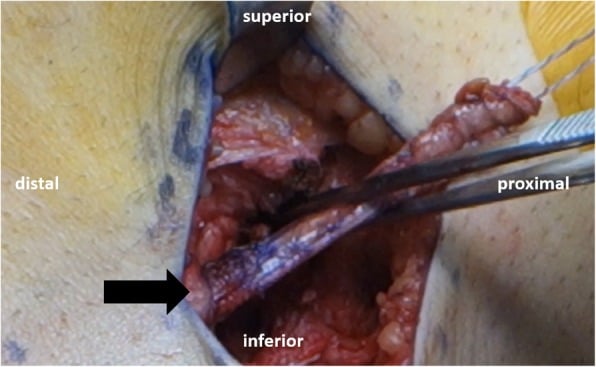
- LET technique: ITB strip, attach to lateral femur, tension in 30° flexion
- Standard ACL reconstruction timing: 4-12 weeks post-injury
Complications
- ACL graft rupture: 11% isolated vs 4% with LET at 2y (STABILITY, young high-risk)
- Residual rotatory laxity reduced by LET (composite failure 40% to 25%)
- Segond fracture nonunion: Less than 5% (rare, usually asymptomatic)
- Meniscal tear progression: 10-20% (repair at time of ACL reconstruction)
Evidence Base
Anatomy of the Anterolateral Ligament (Modern Re-description)
- ALL identified as a discrete ligament in 40 of 41 cadaveric knees (97%)
- Origin at the lateral femoral epicondyle (slightly anterior to LCL); tibial insertion midway between Gerdy's tubercle and the fibular head, separate from the iliotibial band
- Explicitly linked to Segond's 1879 'pearly band' and the eponymous Segond fracture; hypothesised to control internal tibial rotation (pivot shift)
Incidence and Prognostic Significance of Segond Fractures in ACL Reconstruction
- In 1364 ACL-reconstruction patients, acute Segond fracture incidence was 7.4%; including healed fractures, 15.2% showed the lesion
- Spontaneous radiographic healing rate from injury to surgery was only 35.6% (so most are NOT fixed yet do not need fixation)
- Presence of a Segond fracture did NOT increase the risk of revision ACL surgery; associated with downhill skiing and shorter injury-to-surgery interval
Anterolateral Ligament: Diagnosis, Indications, Technique, Outcomes
- Segond fracture on radiograph is listed as a clinical marker of combined ALL injury alongside a positive pivot shift
- ALL controls internal tibial rotation, predominantly at knee flexion over 35 degrees
- Established indications for lateral augmentation: ACL revision, high-grade pivot shift, chronic rupture, young patients, pivoting sports, concomitant medial meniscus repair
STABILITY Trial - LET in Hamstring ACL Reconstruction
- 618 high-risk patients aged 25 or under randomised to hamstring ACLR with or without LET (iliotibial band strip)
- Composite clinical failure 40% (ACLR) vs 25% (ACLR+LET); graft rupture 11% vs 4% at 2 years
- Number needed to treat with LET to prevent one graft rupture was 14.3 over 2 years
Reverse Segond Fracture - Medial Avulsion Pattern
- Reverse Segond fracture is an avulsion of the tibial attachment of the deep medial collateral ligament (medial tibial rim)
- Classically described in association with PCL and posteromedial corner injury, though combinations vary
- Recognising the medial-sided pattern directs MRI assessment toward PCL and medial structures