Scapulothoracic Bursitis | Painful Crepitus | Osseous vs Soft-Tissue Causes | Arthroscopic Bursectomy
- Crepitus is not always pathological - painless snapping in many people is normal and needs no treatment
- Scapulothoracic articulation glides over ribs 2-7; the superomedial angle is the key trouble spot
- Osteochondroma is the most common osseous cause - always exclude a bony lesion with CT
- Non-operative care first - therapy, posture, scapular stabilisation succeed in most patients
- Arthroscopic bursectomy with superomedial angle resection is the surgery of choice when conservative care fails
- “Distinguish painful crepitus (a problem) from painless snapping (usually normal)
- “A loud thumping/grinding sound suggests an osseous cause - get a CT
- “The dorsal scapular nerve and artery and the suprascapular nerve are at risk during surgery
- “Avoid resecting too much superomedial bone - risks detaching levator scapulae and serratus anterior
Overview
Snapping scapula syndrome is painful crepitus of the scapulothoracic articulation, the soft-tissue junction where the front (costal) surface of the scapula glides over the back of the rib cage. The patient feels, and often hears, a snapping, grinding or thumping as the shoulder blade moves, with pain typically over its superomedial corner.
Crepitus alone is not a disease. Painless scapular snapping is common, found in a large proportion of normal people, usually benign, and needs no treatment. The syndrome exists only when the crepitus is symptomatic, meaning painful or functionally limiting, so it is defined by pain plus crepitus. Do not investigate or operate on an asymptomatic snap; this is the distinction to recognise first.
How much is known. The condition is relatively uncommon and probably underdiagnosed. The largest critical review of the literature found an evidence base dominated by small case series and technique papers, with no high-level trials, so much of management rests on anatomical understanding and expert consensus rather than randomised data.
Two overlapping terms. Both can coexist, and both fall under the umbrella of snapping scapula syndrome.
- Scapulothoracic bursitis - inflammation or fibrosis of a bursa in the scapulothoracic space, usually producing pain with a softer grating sensation
- Scapulothoracic crepitus - the audible or palpable grinding, popping or thumping, which when loud is more suggestive of an underlying bony lesion
Pathophysiology & Anatomy
The articulation. The scapulothoracic "joint" is not a true synovial joint. It is a musculofascial gliding interface between the concave costal surface of the scapula and the convex posterior chest wall, spanning ribs 2 to 7. Smooth motion here matters because scapulothoracic rhythm contributes roughly one-third of total shoulder elevation, positioning the glenoid to optimise glenohumeral function.
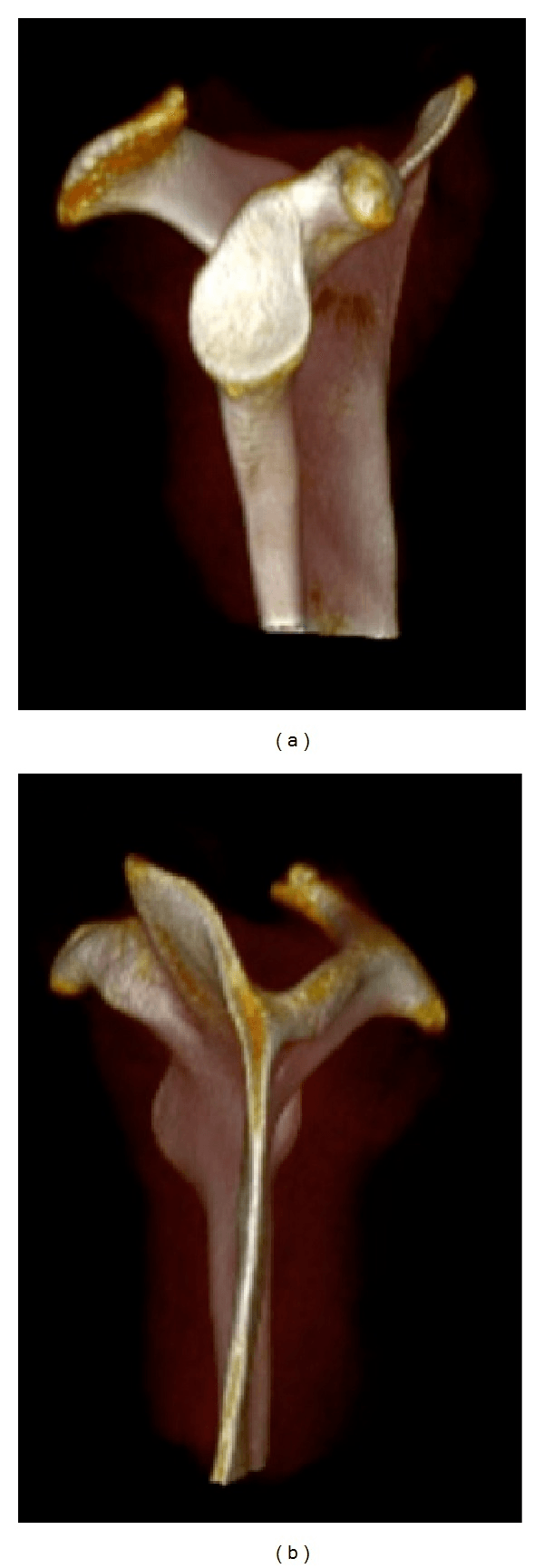
The bursae. Anatomical studies describe two consistent major (anatomic) bursae and several inconstant minor (adventitial) bursae.
- Infraserratus bursa - between the serratus anterior and the chest wall
- Supraserratus bursa - between the subscapularis and the serratus anterior
- Adventitial bursae - variable, often at the superomedial and inferior angles of the scapula; they develop in response to friction and are frequently the symptomatic ones
The superomedial angle. This is the single most important location. The levator scapulae inserts here, adventitial bursae commonly form here, and bony abnormalities most often cause mechanical catching here.
How symptoms arise. The space between scapula and ribs is normally cushioned by muscle (subscapularis and serratus anterior) and by the bursae. Pathology develops when that cushioning fails or when the surfaces no longer glide smoothly:
- Reduced soft-tissue cushioning - muscle atrophy or fibrosis (for example after disuse, denervation or trauma) brings bone closer to bone
- Bursal inflammation or fibrosis - repetitive overhead activity inflames a bursa, which then thickens and becomes painful and noisy
- A mechanical block - an osseous lesion (most commonly an osteochondroma), a malunited rib or scapular fracture, a prominent Luschka tubercle (a bony prominence at the superomedial angle), or an abnormally curved or hooked scapula physically obstructs gliding
- Altered scapular mechanics - scapular dyskinesis, postural rounding (thoracic kyphosis) and weakness of the scapular stabilisers change the contact pressures and provoke symptoms
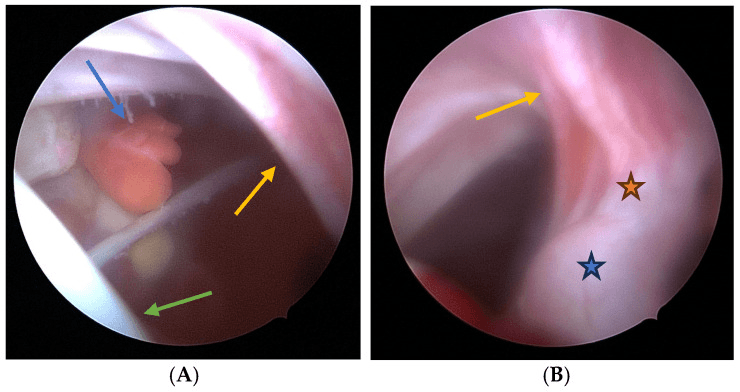
Classification
There is no single universally accepted formal classification. The useful way to organise the causes, and the way examiners expect you to think, is by whether the cause is soft-tissue or osseous, because that directs the treatment.
- Soft-Tissue (Bursal) Cause
- Soft grating, rubbing, snapping
- Osseous Cause
- Loud thumping, clunking, grinding
- Soft-Tissue (Bursal) Cause
- Inflamed/fibrotic bursa, muscle atrophy or fibrosis, overuse
- Osseous Cause
- Osteochondroma (most common), malunited rib/scapula fracture, Luschka tubercle, abnormal scapular curvature
- Soft-Tissue (Bursal) Cause
- Diagnostic and therapeutic into the bursa
- Osseous Cause
- Less useful - lesion is structural
- Soft-Tissue (Bursal) Cause
- Therapy and injection first; arthroscopic bursectomy +/- superomedial angle resection if refractory
- Osseous Cause
- Identify on CT and resect the offending bony lesion
- Soft-Tissue (Bursal) Cause
- Good relief, low recurrence
- Osseous Cause
- Excellent once mechanical block removed
Idiopathic and functional causes. A third group has no structural lesion at all: scapular dyskinesis and postural causes such as thoracic kyphosis and rounded shoulders. These are treated with a scapular stabilisation and posture programme.
The character of the noise. A complementary descriptive approach grades severity by the sound. A soft rubbing or grating sensation is usually bursal; a loud thumping, clunking or grinding is more typical of an osseous cause and should always prompt cross-sectional imaging.
SNAPSNAP - Causes of Snapping Scapula
Hook:If the scapula goes SNAP, think soft-tissue first, then bone.
Clinical Presentation
History. The complaint is symptomatic crepitus, a snapping, grinding, popping or thumping with shoulder and scapular movement, particularly overhead. Pain is the feature that defines the syndrome, and it sits over the superomedial angle, the classic site of pain and adventitial bursae, and sometimes over the inferior angle.
- Triggers - repetitive overhead work or sport: throwers, swimmers, painters, manual and military load-bearing tasks. The condition has been highlighted in military populations because of heavy upper-limb load-bearing.
- Onset after trauma - raises suspicion of a malunited rib or scapular fracture
Examination. Four things are looked for:
- Reproduce the crepitus - palpate over the superomedial angle while the patient circumducts the arm; feel and listen for the snap and localise the tenderness
- Scapular motion - winging, asymmetry of scapular rhythm, and posture (thoracic kyphosis, rounded shoulders)
- A mass - a discrete hard, fixed lump suggests an osteochondroma or other bony lesion
- The whole shoulder and the cervical spine - to exclude glenohumeral and referred causes of pain
The injection as a test. A bursal injection of local anaesthetic and steroid is both therapeutic and diagnostic. If infiltrating local anaesthetic into the scapulothoracic bursa abolishes the pain, the bursa is confirmed as the source and the patient is likely to respond to bursectomy; good temporary relief predicts a better surgical outcome. A poor response should make you reconsider the diagnosis before operating.
Investigations
The diagnosis is primarily clinical. Imaging is used to exclude an osseous cause and to plan treatment.
- Role
- First-line; AP, lateral (Y) and tangential scapular views
- Key Point
- May show osteochondroma or malunion but commonly normal; costal-surface lesions are easily missed
- Role
- Investigation of choice for bony causes
- Key Point
- Best defines osteochondroma, scapular shape, Luschka tubercle and malunion for surgical planning
- Role
- Assesses the bursa and soft tissues
- Key Point
- Shows bursal fluid/thickening and excludes soft-tissue tumour; complements CT
- Role
- Dynamic assessment and injection guidance
- Key Point
- Can image the bursa in real time and guide accurate bursal injection
- Role
- Confirms pain source
- Key Point
- Relief after bursal local anaesthetic confirms the diagnosis and predicts surgical success
A loud mechanical noise, a palpable hard mass, or symptoms after trauma should never be dismissed as simple bursitis. Normal plain films do not exclude a costal-surface osteochondroma, so obtain a CT to exclude an osteochondroma, malunited fracture or other bony prominence - missing one means non-operative treatment and even bursectomy will fail.
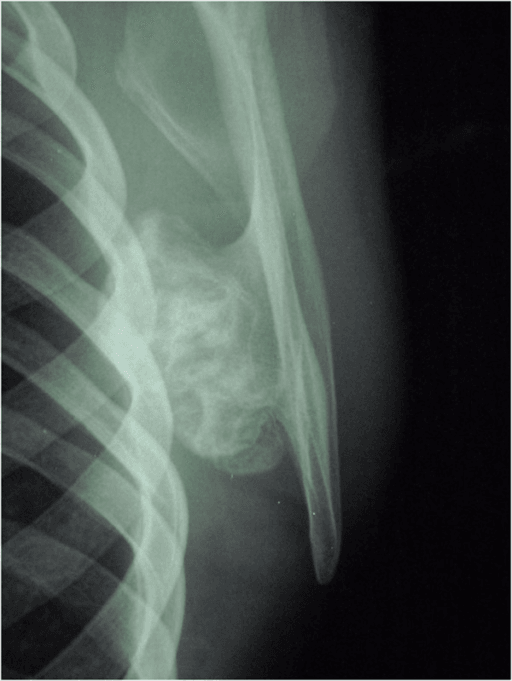
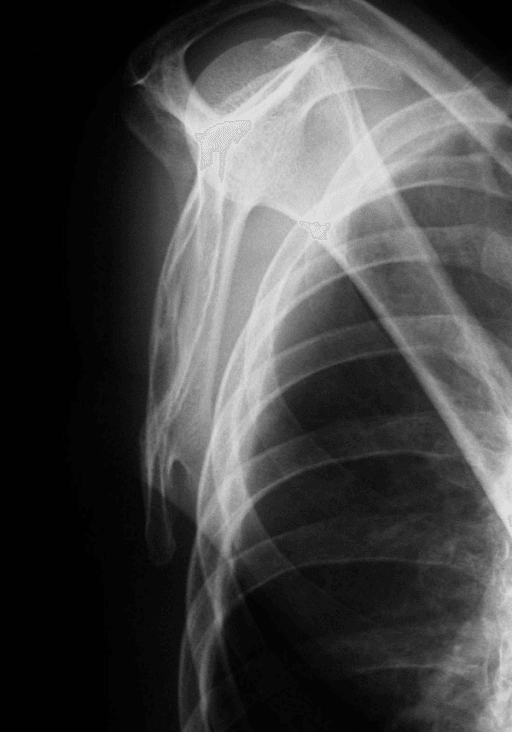
Radiographs. The two films below show osteochondromas large enough to see on a plain radiograph.
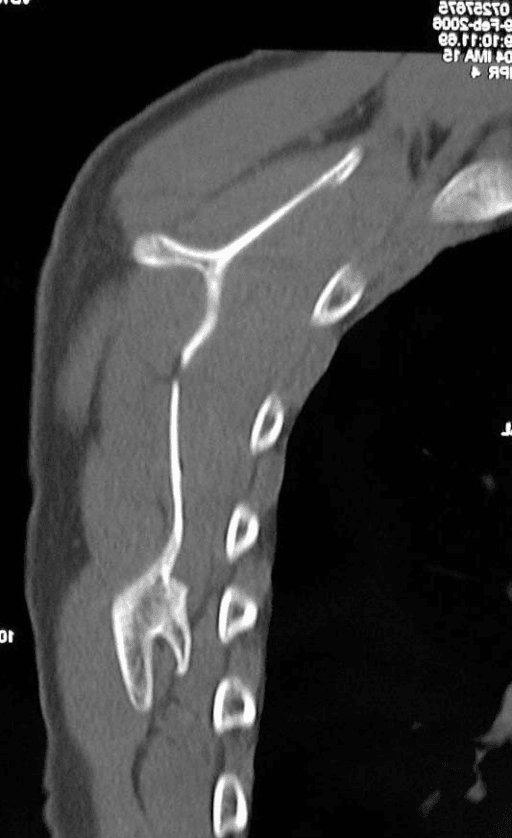
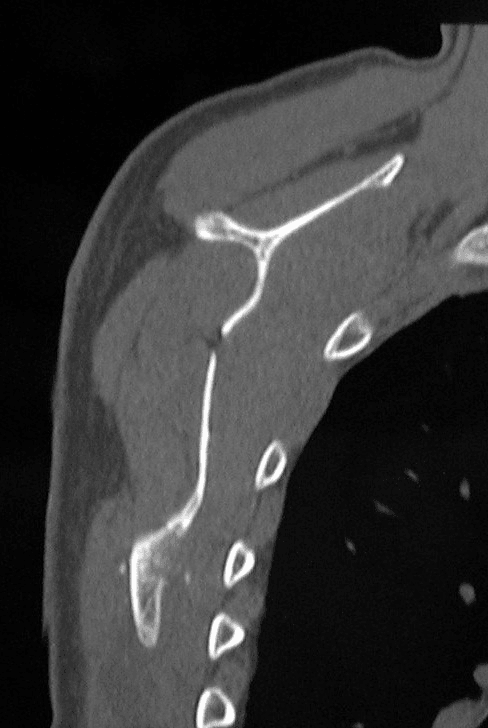
CT. Cross-sectional imaging defines the lesion's base and the remaining scapulothoracic clearance before resection.
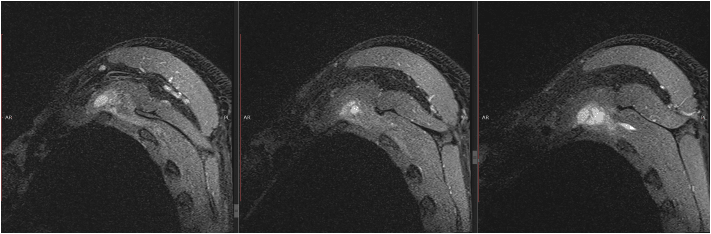
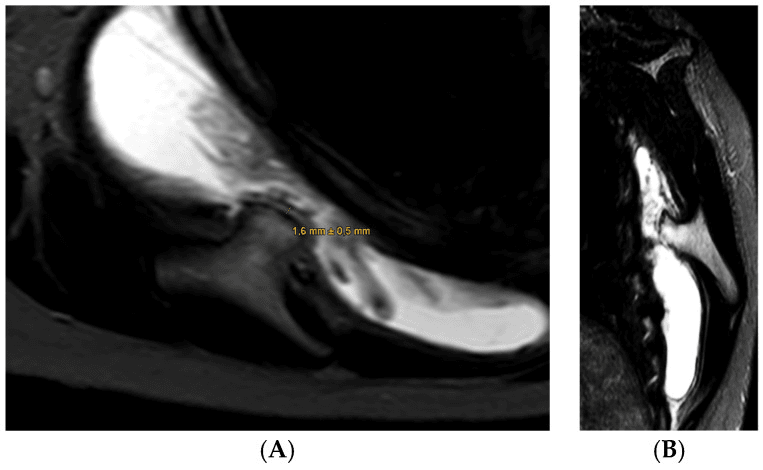
MRI. MRI complements CT when the suspected pain generator is the bursa or another soft-tissue lesion, and it measures the cartilage cap of an exostosis.
Differential Diagnosis of Periscapular Pain and Snapping
Before labelling a painful scapula "snapping scapula syndrome", exclude the mimics. The wall push-up, a neck and neurological examination, and cross-sectional imaging sort these out.
- Scapular winging (the key mimicking mechanical scapular disorder) - long thoracic nerve / serratus anterior palsy (medial winging) or spinal accessory nerve / trapezius palsy (lateral winging); confirm with a wall push-up (developed in the scapular-winging topic)
- Cervical spine - C5-C6 radiculopathy and facet pathology refer pain to the medial scapular border (dorsal scapular pain); always examine the neck and upper-limb neurology
- Glenohumeral / subacromial referral - rotator cuff disease, subacromial impingement and glenohumeral instability can produce periscapular pain and an audible clunk
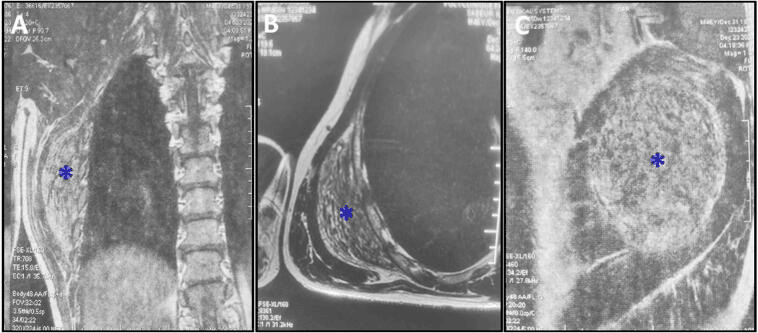
- Other structural scapular/rib lesions - a scapular or rib tumour (osteochondroma the commonest), a rib or scapular stress or malunited fracture, and elastofibroma dorsi, a soft-tissue mass at the inferomedial scapula that can itself cause snapping
- Myofascial / postural - periscapular myofascial trigger points and scapular dyskinesis from thoracic kyphosis (developed in the scapular-dyskinesis topic)
Management
The cardinal principle is non-operative treatment first for soft-tissue causes, reserving surgery for refractory cases, while osseous causes are treated by resecting the lesion. The pathway runs in order:
- Confirm it is symptomatic - painful crepitus, not incidental painless snapping; reassure and discharge if asymptomatic.
- Exclude an osseous cause - examine for a mass; obtain plain films and CT if there is any suspicion of a bony lesion or the symptoms followed trauma.
- Treat osseous lesions structurally - for an osteochondroma, malunion or Luschka tubercle, plan resection of the offending bony lesion; surgery is indicated up front when a discrete bony lesion is the cause.
- Non-operative care for soft-tissue causes - for 3-6 months, as below.
- Diagnostic and therapeutic bursal injection - local anaesthetic plus steroid into the bursa confirms the source and may give lasting relief.
- Surgery if conservative care fails - arthroscopic bursectomy +/- superomedial angle resection for symptomatic patients who fail at least 6 months of compliant non-operative treatment.
Non-operative management. Activity modification and NSAIDs control symptoms. Structured physiotherapy is the cornerstone, focused on scapular stabilisation, periscapular strengthening, postural correction and addressing scapular dyskinesis. Published reviews report that non-operative care succeeds in a high proportion of patients, commonly quoted as up to around 80%.
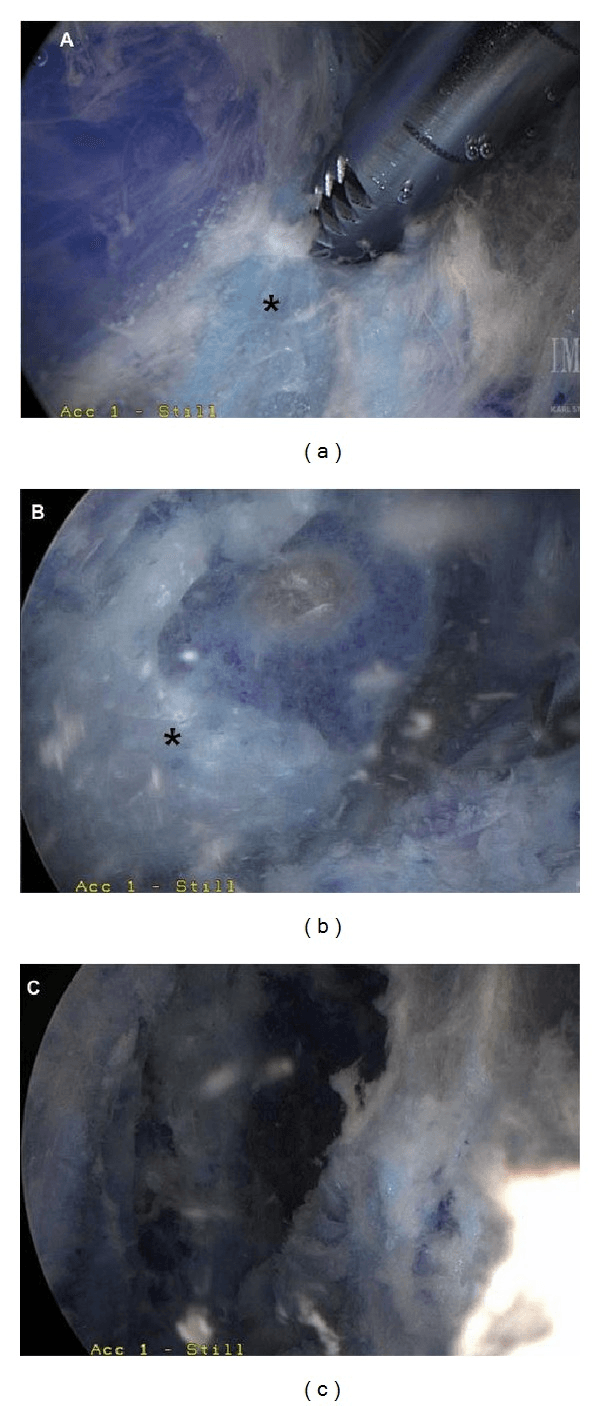
Arthroscopic bursectomy. This is the preferred approach for refractory soft-tissue disease. The patient lies prone with the arm behind the back, the "chicken-wing" position, which lifts the medial border of the scapula off the chest wall. Portals are placed medial to the medial border, typically about 3cm medial, at and below the level of the scapular spine: staying medial avoids the suprascapular nerve laterally, and working in the safe interval protects the dorsal scapular neurovascular bundle.
The inflamed bursa is then debrided. Compared with open surgery, the arthroscopic route offers less morbidity, better cosmesis and earlier return to activity.
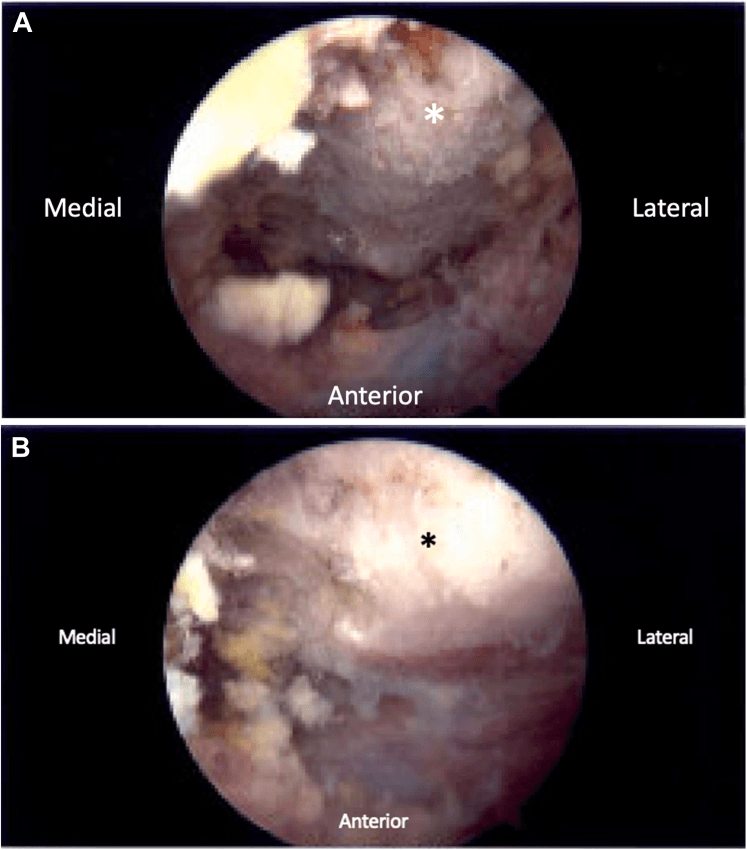
Superomedial angle resection. Often combined with bursectomy, this removes a limited portion of the superomedial angle of the scapula, commonly cited as around 2-3cm, taking away the bony corner that catches and excising the symptomatic adventitial bursa. The resection must be limited: taking too much risks detaching the levator scapulae and serratus anterior and destabilising the scapula. The best surgical outcomes are reported when bursectomy is combined with partial scapulectomy.
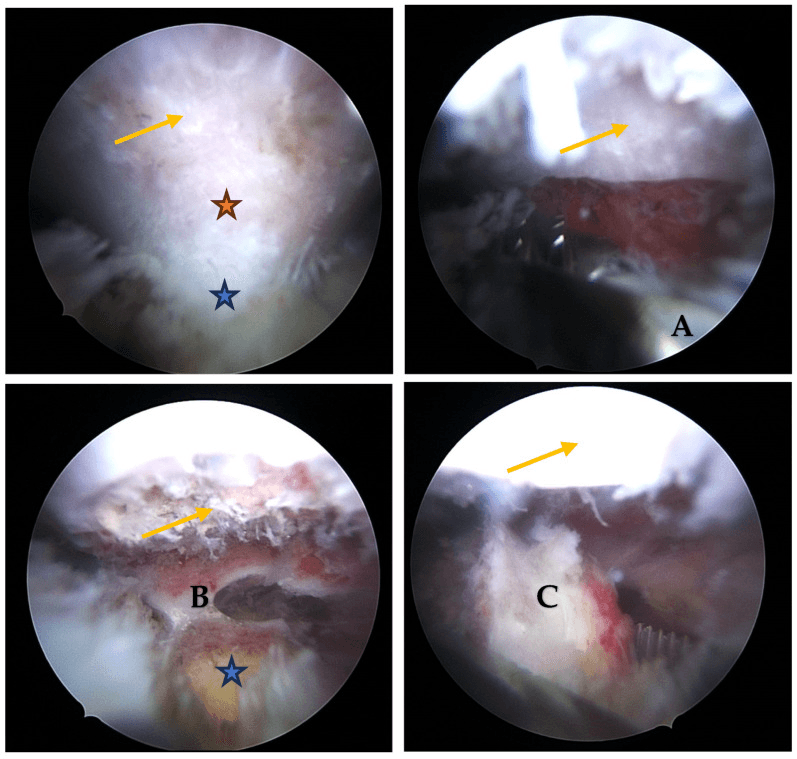
Excising a bony lesion. For an osteochondroma or other discrete bony prominence, the treatment is complete excision of the lesion, open or arthroscopically or endoscopically assisted. Removing the mechanical block restores smooth gliding and typically gives excellent, durable relief. A malunited rib or scapular fracture causing a prominence is addressed in the same way, by removing the offending bone.
Negative prognostic factors for surgery reported in the literature include older age, longer duration of symptoms and lower preoperative psychological scores. Careful patient selection, including a good response to diagnostic injection, matters as much as technique.
Scapular Osteochondroma: When to Worry About Malignant Transformation
Osteochondroma is the commonest osseous cause of snapping scapula, and the natural viva follow-up is what would raise concern for malignant change.
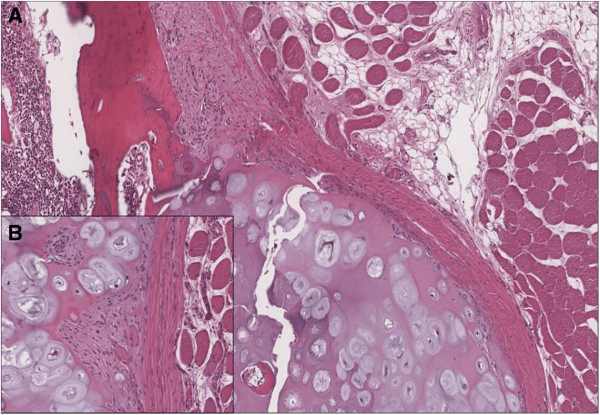
Why the scapula matters. Osteochondromas are common and usually benign, but transformation to a secondary chondrosarcoma is more likely in flat and axial bones (scapula, pelvis, ribs) than in the long bones. The risk is also higher in multiple hereditary exostoses (MHE), so a scapular lesion warrants particular attention.
Red flags. Four features point towards transformation:
- A thick cartilage cap - greater than about 1.5-2cm in an adult on MRI or CT is the key alarm feature
- Growth of the lesion after skeletal maturity
- New or increasing pain not explained by mechanical snapping
- Indistinct margins, a soft-tissue mass, or scattered or irregular calcification on cross-sectional imaging
What to do. Image with MRI, which is best for the cartilage cap, plus CT. If any red flag is present, treat the lesion as a possible low-grade chondrosarcoma and refer to a sarcoma unit rather than performing a simple shave excision.
Excision principle. When excising a benign scapular osteochondroma, remove the entire cartilage cap and overlying perichondrium to prevent local recurrence. General osteochondroma management is developed in the osteochondroma topic.
Complications
Neurovascular injury. Three nerves, one with its artery, are at risk. Careful portal placement and limited, subperiosteal resection protect them.
- Dorsal scapular nerve and artery - run along the medial border; keep the resection limited and subperiosteal
- Suprascapular nerve - at the scapular and spinoglenoid notch; keep portals medial and avoid over-resecting laterally
- Spinal accessory nerve - innervates trapezius near the superomedial region; avoid wide dissection
Pneumothorax. The chest wall lies immediately deep to the working space. Staying subperiosteal on the costal surface and controlling fluid pressure reduces the risk of pleural breach.
Persistent or recurrent symptoms. A meaningful minority continue to have pain after surgery, many patients report ongoing shoulder disability even after operation, and a small number need revision. That reflects how often the precise pain source is uncertain, and it tempers the good relief and low recurrence quoted for bursectomy.
Scapular instability and winging. Over-resection of the superomedial angle can detach the levator scapulae and serratus anterior, producing winging and a destabilised scapula.
Guidelines, Registries & Global Practice
There are no formal national guidelines or arthroplasty-registry data for snapping scapula syndrome - it is an uncommon condition managed on the basis of small case series, technique papers and expert consensus. The points below summarise the consistent themes from the global literature.
- Consensus Position
- Treat only painful crepitus; painless snapping is usually normal
- Evidence Strength
- Strong consensus
- Consensus Position
- Non-operative care (scapular stabilisation, posture, injection) for at least 6 months
- Evidence Strength
- Consensus, up to ~80% success quoted
- Consensus Position
- CT is the investigation of choice to exclude/characterise osseous lesions
- Evidence Strength
- Strong consensus
- Consensus Position
- Arthroscopic bursectomy +/- partial (superomedial angle) scapulectomy
- Evidence Strength
- Low-level (Level IV) evidence, consistent results
- Consensus Position
- Excise the offending lesion (e.g. osteochondroma)
- Evidence Strength
- Case-series consensus
- Consensus Position
- No randomised trials exist; all recommendations are low-level
- Evidence Strength
- Acknowledged limitation
Global practice variation: the condition features in military and heavy-labour populations worldwide because of repetitive upper-limb load-bearing. Open surgery remains an option where arthroscopic scapulothoracic expertise or equipment is limited, but the international trend - reported from North American, European, Brazilian and Asian series - favours the arthroscopic approach for its lower morbidity, better cosmesis and earlier return to activity.
Related pages: Scapular Dyskinesis is the altered scapulothoracic motion that frequently accompanies this and is treated first - note that page's own caution that the causal role of dyskinesis is not clearly defined; Scapular Winging for the neurological differential, where a palsy rather than a bursa or a bony prominence is the problem and the treatment is entirely different; Serratus Anterior and Trapezius Anatomy for the muscles that suspend the scapula and whose dysfunction alters the thoracic contact this syndrome depends on; Long Thoracic Nerve Anatomy for the nerve to test before attributing periscapular symptoms to a bursa; Osteochondroma for the commonest bony cause of loud mechanical snapping and for the malignant-transformation question this page's own section addresses; Thoracic Outlet Syndrome for the neurovascular mimic of periscapular and arm symptoms; and Rib Stress Fracture for the chest-wall cause of localised scapulothoracic pain in an overhead athlete.
Exam Viva Scenarios
Practise clinical reasoning and management decisions out loud
“A 26-year-old competitive swimmer presents with 8 months of pain over the upper inner border of the right shoulder blade, with a grating sensation when she reaches overhead. She can demonstrate a soft snapping by circumducting the arm. There is tenderness over the superomedial angle of the scapula and no palpable mass. Plain radiographs are normal.”
“An 18-year-old man has a loud thumping snap from the left shoulder blade for two years and notices a hard lump under the inner border. There is a firm fixed mass at the medial scapula. He has no neurological symptoms.”
“A 40-year-old painter has had painful scapulothoracic crepitus for over a year. He has completed nine months of supervised physiotherapy and had two bursal injections that each gave several weeks of complete relief. CT shows no bony lesion. He wants definitive treatment. How will you proceed?”
Definition & Anatomy
- Painful crepitus of the scapulothoracic articulation (painless snapping is usually normal)
- Scapula glides over ribs 2-7; superomedial angle is the key trouble spot
- Major bursae: infraserratus and supraserratus; adventitial bursae at the angles
- Scapulothoracic rhythm contributes ~1/3 of shoulder elevation
Causes (SNAP)
- Soft-tissue: bursitis, muscle atrophy/fibrosis, overuse
- Osteochondroma - most common osseous cause
- Anatomy: Luschka tubercle, abnormal scapular curvature
- Prior fracture malunion (rib or scapula)
Investigations
- Plain films first (often normal; costal lesions easily missed)
- CT with 3D reconstruction = investigation of choice for bony causes
- MRI for bursa/soft tissue; ultrasound for dynamic assessment and injection
- Diagnostic bursal injection confirms the pain source
Management
- Non-operative first: scapular stabilisation, posture, NSAIDs, injection (up to ~80% success)
- At least 6 months conservative trial before surgery
- Surgery of choice: arthroscopic bursectomy +/- superomedial angle resection
- Osseous cause: excise the lesion (e.g. osteochondroma)
Surgical Safety
- At risk: dorsal scapular nerve/artery, suprascapular nerve, spinal accessory nerve
- Stay subperiosteal to avoid pneumothorax
- Limit superomedial resection (~2-3cm) to protect levator scapulae/serratus anterior
- Good injection response predicts better surgical outcome
Evidence Base
Critical Review of the Evidence Base (Landmark)
- 81 relevant articles, all low-level evidence (no RCTs)
- Likely an underdiagnosed condition
- Bursectomy +/- partial scapulectomy is the most effective surgery
- Continued disability after surgery is common
Arthroscopic Bursectomy - Mid-Term Outcomes
- 20 patients / 24 scapulae, mean 44-month follow-up
- VAS pain fell from 4.95 to 2.27 (significant)
- Mean ASES 79, subjective shoulder value 83
- Low recurrence; 2 patients required revision
Arthroscopic Debridement + Medial Scapulectomy with MRI Bony Parameters
- 8 patients, minimum 2-year follow-up, no complications
- Significant improvement in OSS, UCLA, Constant and VAS
- 5 of 8 needed additional medial scapulectomy
- Introduced MRI bony parameters for surgical planning
Predictors of Outcome After Arthroscopic Treatment
- Response to diagnostic injection guides patient selection
- Bursectomy + partial scapulectomy gives the best outcomes
- Negative predictors: older age, longer symptom duration
- Lower preoperative psychological score predicts worse results