The medial triceps head dislocates over the medial epicondyle | Often snaps the ulnar nerve with it | Dynamic ultrasound is the key diagnostic test | Surgery when conservative care fails
- What it is: the medial head of the triceps (or an accessory anconeus epitrochlearis muscle) dislocates over the medial epicondyle during elbow flexion, producing a painful snap
- Ulnar nerve involvement is common: the dislocating muscle often carries the ulnar nerve with it, so patients may have both mechanical snapping and ulnar neuropathy symptoms (numbness in the little and ring fingers, weakness of the intrinsics)
- Dynamic ultrasound is the diagnostic gold standard: real-time imaging during active flexion and extension shows the muscle or nerve moving over the epicondyle — plain films and static MRI can miss it
- Conservative first: activity modification, avoiding provocative positions, NSAIDs, and night splinting; surgery (resection of the snapping portion of triceps, with ulnar nerve decompression or transposition if needed) for failed conservative care
- Think of it in overhead athletes: pitchers, javelin throwers, weightlifters, and gymnasts — anyone who repetitively loads the medial elbow in flexion
- “Feel for the snap yourself — place your fingers over the medial epicondyle and ask the patient to flex and extend the elbow actively; the snap is often palpable and audible
- “Always test for ulnar nerve symptoms — the presence or absence of neuropathy changes management (isolated resection versus resection plus nerve transposition)
- “Dynamic ultrasound beats MRI because the pathology is positional — a static scan in extension may look completely normal
- “Distinguish snapping triceps from isolated ulnar nerve subluxation and from medial collateral ligament injury — the history and examination are different
Overview
Snapping triceps syndrome is a cause of painful mechanical snapping over the medial elbow. The medial head of the triceps, or an accessory muscle band (the anconeus epitrochlearis), dislocates over the medial epicondyle as the elbow flexes and often snaps back into place on extension. The snap is frequently accompanied by subluxation of the ulnar nerve, which lies in the cubital tunnel directly behind the epicondyle.
Who gets it. The syndrome is uncommon but well described, particularly in overhead throwing athletes such as baseball pitchers and javelin throwers, in weightlifters and in gymnasts: anyone who repetitively loads the medial elbow in deep flexion. These athletes place repetitive valgus and flexion stress on the medial elbow, so in them think of snapping triceps alongside ulnar collateral ligament injury and valgus extension overload.
How it presents. It can be unilateral or bilateral. Some patients have mechanical symptoms alone; others have mechanical snapping and ulnar neuropathy together.
The task. Recognise the condition, distinguish it from isolated ulnar nerve subluxation and the other causes of medial elbow pain, and confirm it with dynamic ultrasound. Treatment starts conservatively; surgery, resecting the snapping structure with or without ulnar nerve transposition, is reserved for persistent symptoms.
Anatomy and Pathophysiology
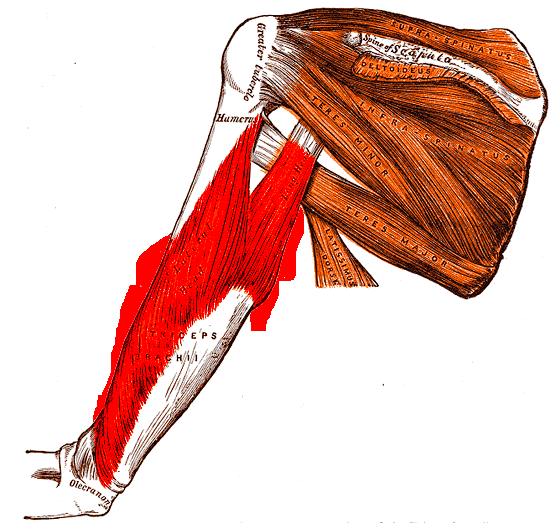
The medial triceps and its variants. The medial head of the triceps brachii arises from the posterior humerus distal to the radial groove and inserts onto the olecranon. In some people an accessory band, the anconeus epitrochlearis, arises from the medial head, crosses the cubital tunnel and inserts onto the olecranon or the fascia over the medial epicondyle. It is present in approximately 10 to 25% of the population and is the anatomic substrate for snapping triceps in many cases.
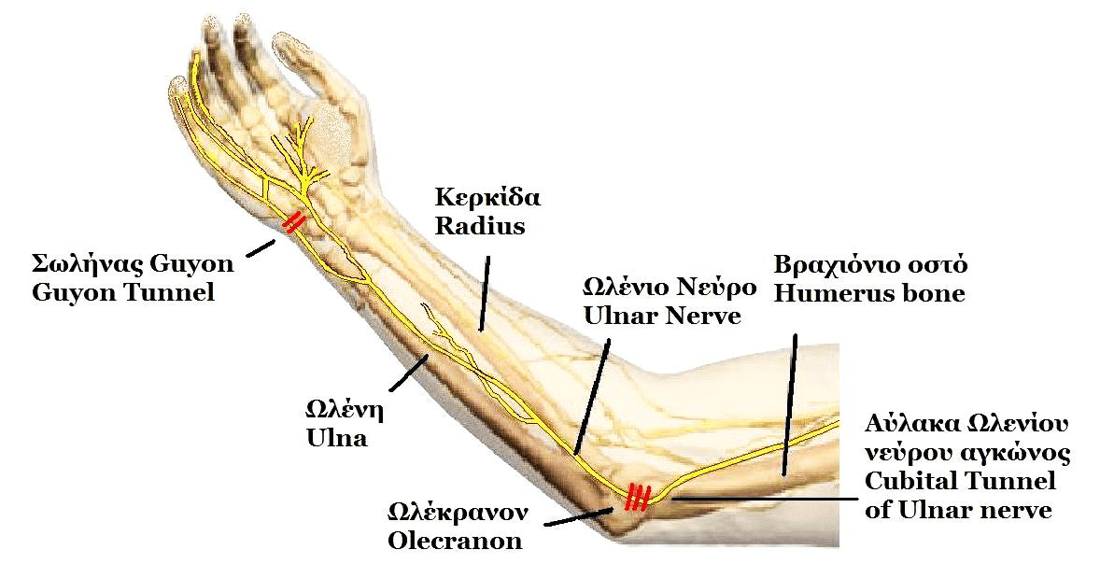
The cubital tunnel. The ulnar nerve passes through the cubital tunnel, a fibro-osseous canal bounded by the medial epicondyle anteriorly, the olecranon posteriorly and, distally, the Osborne ligament, a fascial band between the two heads of flexor carpi ulnaris. A fibrous arcade forms the roof. As the elbow flexes the tunnel narrows, and the nerve normally glides slightly.
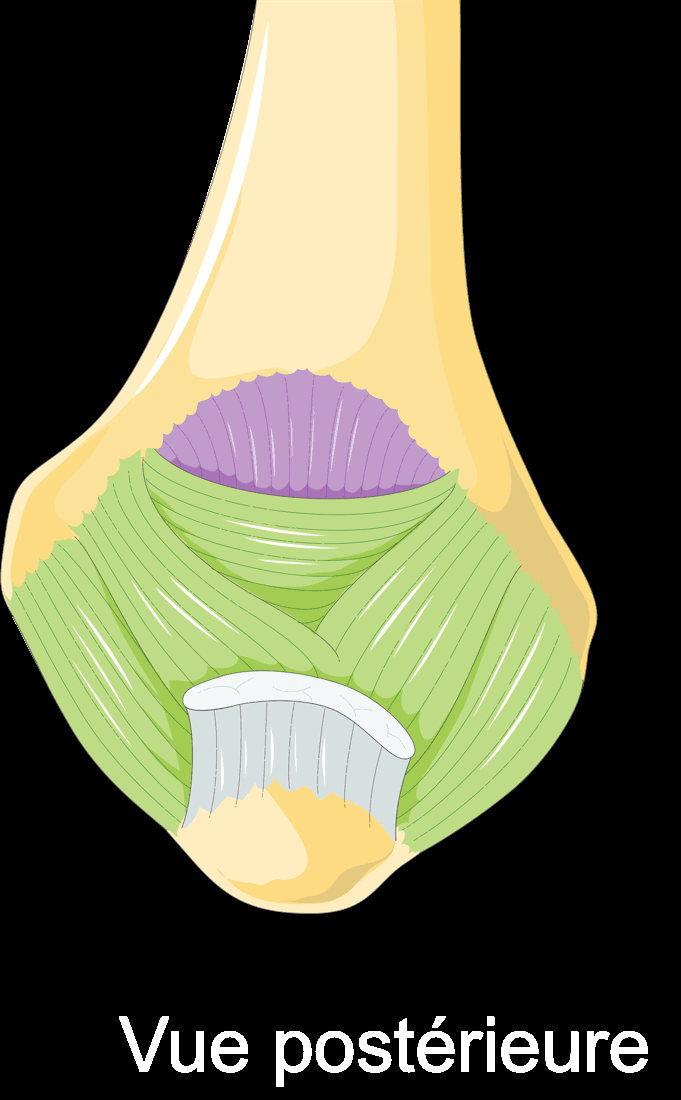
The conflict. The fundamental problem is mechanical: a mobile structure, the medial triceps tendon or an accessory band, meets a fixed bony prominence, the medial epicondyle. During elbow flexion:
- The triceps tendon or accessory band moves anteriorly relative to the humerus.
- It meets the medial epicondyle and is forced to dislocate over it.
- The ulnar nerve, if it lies next to the dislocating structure, is carried with it.
- On extension, the structure snaps back into its normal position.
What the nerve suffers. The dislocating tendon or band pushes the ulnar nerve anteriorly over the epicondyle, producing both the mechanical snap and neural compression. Repeated dislocation subjects the nerve to repetitive traction and compression, leading to focal demyelination, inflammation and, in chronic cases, axonal loss. The snapping tendon itself can become irritated and inflamed, and causes localised pain.
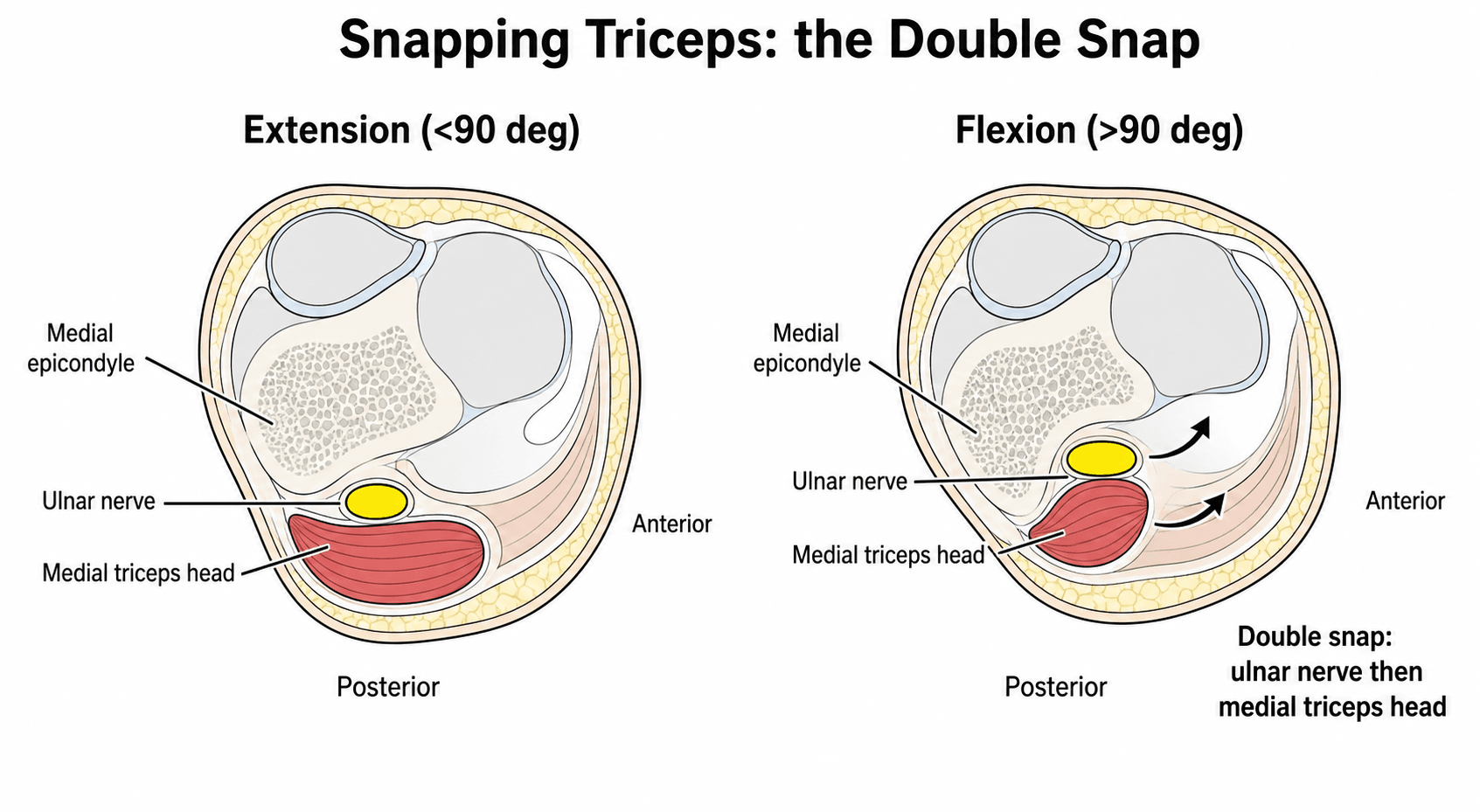
The anconeus epitrochlearis is the classic anatomic variant, but any thickened or bifurcated medial triceps tendon can produce the same effect. The key concept is a mobile soft-tissue structure crossing a bony pulley. The technique paper by Chan and colleagues in the evidence section describes the subluxing structure as the medial triceps muscle belly, riding over the medial distal humeral ridge and condyle.
Classification
Snapping elbow is classified by the structure involved and by whether the ulnar nerve is symptomatic, and the classification guides management.
- Structure involved
- Medial triceps head or accessory muscle band dislocates over medial epicondyle
- Ulnar nerve
- No neuropathy
- Management
- Conservative first; resection of snapping portion if symptoms persist
- Structure involved
- Dislocating triceps carries the ulnar nerve over the medial epicondyle
- Ulnar nerve
- Neuropathy present (sensory and/or motor)
- Management
- Resection of snapping portion plus ulnar nerve decompression or anterior transposition
- Structure involved
- Ulnar nerve subluxates alone without a clear triceps component
- Ulnar nerve
- Neuropathy usually present
- Management
- Cubital tunnel release with or without anterior transposition
Type II is the common one. It is the most common presentation in clinical practice, because patients with a painless mechanical snap (Type I) often do not seek medical attention. The dislocating triceps carries the ulnar nerve with it, so surgery has to deal with both: resection of the snapping structure plus protection of the nerve, usually by transposition.
The nerve is the branch point. The presence or absence of ulnar neuropathy is what changes the operation, from isolated resection to resection plus nerve decompression or transposition. That is why sensation in the little finger and interosseous strength are documented in every patient.
Grading Ulnar Neuropathy: The McGowan Classification
Because the ulnar nerve drives management, the examiner expects you to grade the neuropathy, not just note its presence. The McGowan classification is the standard severity grade for cubital tunnel or ulnar neuropathy at the elbow.
- Findings
- Intermittent paraesthesia and subjective sensory symptoms; NO motor weakness or wasting
- Implication
- Often responds to conservative care
- Findings
- Measurable sensory loss and/or weakness of the intrinsics; little or no wasting
- Implication
- Surgery usually indicated; good recovery potential
- Findings
- Marked intrinsic wasting, persistent weakness and sensory loss (axonal loss)
- Implication
- Decompression still worthwhile but recovery is often incomplete
The modified system. The modified (Goldberg) McGowan system subdivides grade II into IIA (no muscle atrophy) and IIB (atrophy present), because atrophy worsens the prognosis. Dellon's mild, moderate and severe system is an alternative.
What the grade changes. A higher grade and visible wasting push you towards earlier, more definitive surgery and more guarded counselling.
Clinical Presentation
History. Patients typically report a painful snapping or clicking over the medial elbow that occurs with flexion and resolves on extension. The snap may be audible and is often visible, and everyday activities such as lifting, throwing or push-ups often reproduce it.
Pain and activity. The pain is aching or sharp, localised to the medial epicondyle and worse after activity. Ask about overhead throwing, weightlifting, gymnastics, and occupations requiring repetitive elbow flexion under load.
Nerve symptoms. Numbness or tingling in the little and ring fingers is worse at night or with prolonged elbow flexion. In chronic cases there is weakness of the interossei (difficulty spreading the fingers) and of thumb adduction (Froment sign).
Inspection. There may be visible snapping over the medial epicondyle during active flexion and extension. If ulnar neuropathy is chronic, look for wasting of the interossei and the hypothenar eminence.
Palpation. Place your fingertips over the medial epicondyle and cubital tunnel and ask the patient to flex and extend the elbow actively; tenderness over both is common. Count the snaps, the single most useful thing your hand can tell you. Beyond roughly 90 degrees of flexion both the ulnar nerve and the medial triceps head can dislocate anteriorly over the tip of the epicondyle, and they do so sequentially: the nerve usually flicks first, with the triceps following at deeper flexion.
The double snap. Two distinct, palpable and often audible snaps mean that both structures are dislocating (Type II). A single snap suggests isolated ulnar nerve instability (Type III) or isolated triceps snapping (Type I). Flex and extend slowly: a fast sweep merges the two events into one and is the commonest reason the second snap is missed.
Special tests. These examine the nerve:
- Ulnar nerve Tinel test: percussion over the cubital tunnel reproduces tingling in the ulnar distribution, positive if neuropathy is present
- Elbow flexion test: holding the elbow in maximal flexion for 60 seconds reproduces ulnar nerve symptoms, positive in cubital tunnel syndrome or ulnar nerve subluxation
- Froment sign: the patient pinches a piece of paper between thumb and index finger; weakness of adductor pollicis (ulnar nerve) causes flexion of the thumb interphalangeal joint, compensation by flexor pollicis longus (median nerve)
- Wartenberg sign: the little finger drifts into abduction at rest because of weakness of the palmar interossei
Neurovascular examination. Document sensation in the ulnar distribution (the dorsal and palmar aspects of the little finger and the ulnar half of the ring finger) and the strength of the intrinsic hand muscles. If neuropathy is suspected, document two-point discrimination as well.
The most reliable finding is the reproducible snap with active flexion felt by your fingers over the medial epicondyle. If you can feel it yourself, you have made the diagnosis clinically. Always pair it with a full ulnar nerve examination.
Differential diagnosis. Do not assume every snapping medial elbow is triceps-related. The alternatives:
- Isolated ulnar nerve subluxation: a snap with flexion but no palpable muscle band, and no triceps involvement
- Medial collateral ligament injury: valgus instability in throwers, a different mechanism with a different treatment
- Cubital tunnel syndrome: static compression without subluxation, so no mechanical snap
- Synovial plica: a fold of synovium that can snap within the elbow joint
- Loose body: an intra-articular fragment causing catching or locking
- Medial epicondylitis: pain but not a mechanical snap
Investigations
Dynamic ultrasound. Dynamic musculoskeletal ultrasound is the first-line and most valuable imaging test. The transducer is placed over the medial epicondyle in a transverse orientation while the patient actively flexes and extends the elbow. The palpable snap makes the diagnosis clinically, and Chan and colleagues treat ultrasound as a non-invasive aid to that examination; real-time imaging then demonstrates:
- Dislocation of the medial triceps tendon or an accessory muscle band over the medial epicondyle
- Concomitant subluxation of the ulnar nerve
- The relationship between the snapping structure and the nerve
- Any anatomic variant, such as a bifurcated medial triceps head or an anconeus epitrochlearis
On the scan. From extension through mid-flexion to full flexion, the ulnar nerve crosses the medial epicondyle first and flattens; the medial triceps head then follows until both lie anterior to the epicondyle at the palpable double snap. On a normal elbow the nerve and the medial triceps head remain posterior to the epicondyle in both extension and full flexion.
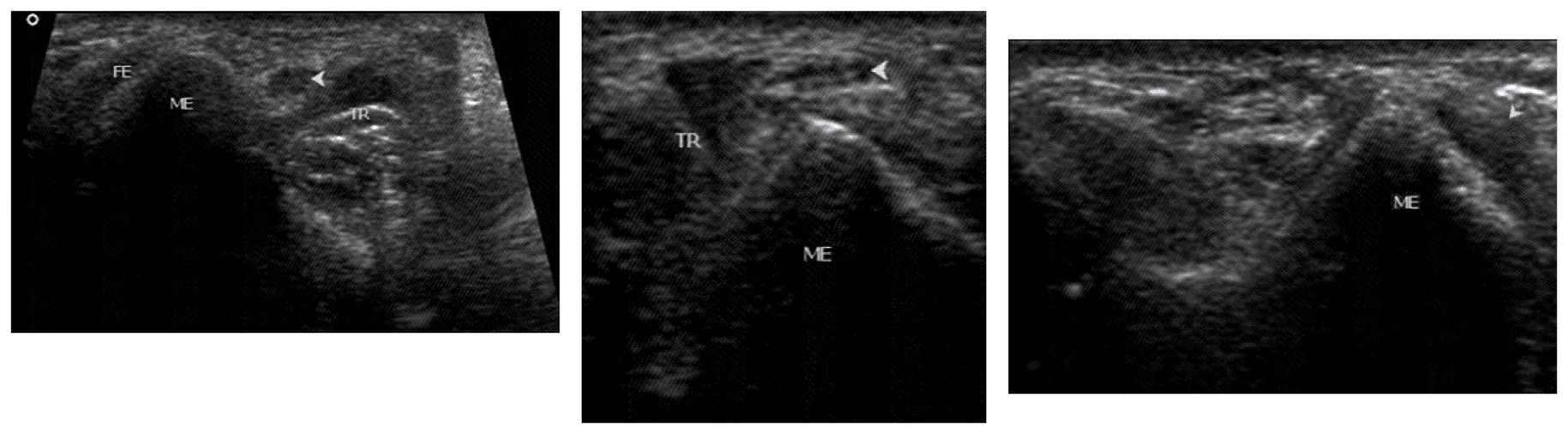
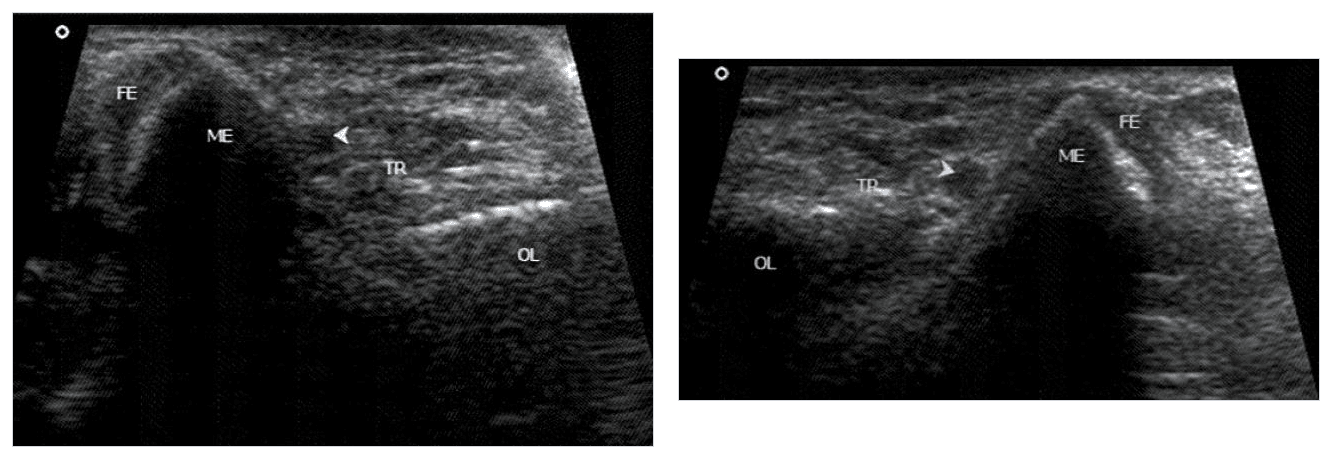
MRI. MRI is useful for associated pathology, but it is a static test and may miss the dynamic dislocation. With a classic history and examination, a normal static MRI should not reassure you. It can show:
- Enlargement and increased signal of the ulnar nerve on T2-weighted or fat-suppressed sequences
- Fluid in the cubital tunnel
- An accessory muscle band or bifurcated triceps tendon
- Thickening or signal change in the triceps tendon
Radiographs. Plain films are usually normal but should be obtained to exclude bony pathology such as an avulsion fracture, osteophyte or loose body.
Neurophysiology. Electromyography and nerve conduction studies are indicated if ulnar neuropathy is suspected, and assess its severity. Findings may include:
- Slowing of ulnar nerve conduction velocity across the elbow
- Prolonged distal motor latency
- Denervation changes in the ulnar-innervated intrinsic hand muscles (positive sharp waves, fibrillation potentials, reduced recruitment)
Management
Conservative treatment is the first-line approach for all patients, particularly those without significant ulnar neuropathy. It includes:
- Activity modification: avoiding provocative activities such as overhead throwing, deep elbow flexion and heavy lifting
- Night splinting: a thermoplastic splint holding the elbow in 30 to 45 degrees of flexion prevents extreme flexion during sleep and reduces ulnar nerve compression
- NSAIDs: for pain relief and to reduce peritendinous inflammation
- Physical therapy: stretching of the triceps and flexor-pronator mass, strengthening of the periscapular and rotator cuff musculature (in throwers), and technique modification
- Nerve gliding exercises: if mild ulnar neuropathy is present, neural mobilisation may reduce symptoms
Conservative management has variable success. Patients with an identifiable mechanical snap and mild symptoms may improve with activity modification alone, and those with persistent symptoms after 3 to 6 months of conservative care are candidates for surgery.
Failing to transpose an unstable nerve is one error. The commoner and more damaging error runs the other way: treating the nerve and forgetting the muscle. In the largest pooled series the snapping triceps had gone unrecognised at a prior index elbow operation in 44.2% of operated patients, nearly half. A nerve transposition that leaves a dislocating medial triceps head behind will not abolish the snap, and the patient returns. Before closing, examine every dislocating structure through a passive range of motion, and use myoelectrical stimulation if there is any doubt, to confirm that nothing still subluxates.
Ulnar Nerve: Decompression and Transposition Options
When neuropathy or an unstable nerve accompanies the snapping triceps, you must choose how to handle the ulnar nerve, and the examiner will ask you to compare the options. They run from least to most disruptive: in-situ decompression, subcutaneous transposition, submuscular transposition, medial epicondylectomy.
- What it does
- Release the Osborne ligament and cubital-tunnel roof; nerve left in its groove
- Notes / role in snapping triceps
- Least disruptive and preserves blood supply, but inadequate alone when the nerve subluxates - generally insufficient for snapping triceps
- What it does
- Nerve moved anterior to the epicondyle, held by a fascial sling in the subcutaneous plane
- Notes / role in snapping triceps
- Simple, removes the epicondyle as a pulley; works well in thin patients; risk of re-subluxation if poorly secured
- What it does
- Nerve placed deep to the flexor-pronator mass (Learmonth)
- Notes / role in snapping triceps
- Best padding and protection; favoured in throwers, revisions and thin patients; more dissection and longer recovery
- What it does
- Removes the bony pulley so the nerve no longer catches over it
- Notes / role in snapping triceps
- Avoids formal transposition but risks valgus instability (MCL origin) and flexor-pronator weakness
Why decompression alone falls short. In snapping triceps the nerve is unstable: it subluxes with the muscle, so an in-situ decompression alone leaves it catching on the epicondyle and risks persistent symptoms. Anterior transposition, subcutaneous or submuscular, is therefore preferred once the snapping portion is resected. Where the nerve subluxes with the triceps and the patient has neuropathy, transposition is usually recommended to prevent ongoing traction and compression.
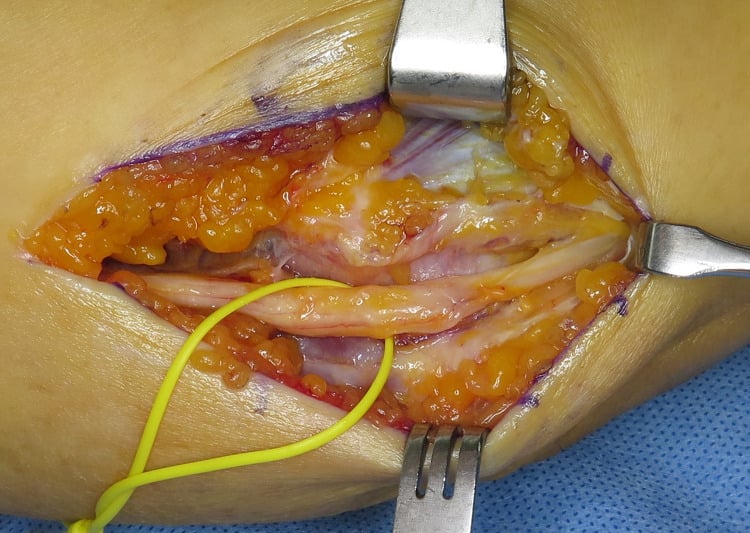
The final check. After transposition the nerve must glide without kinking, compression or recurrent posterior subluxation throughout elbow flexion and extension.
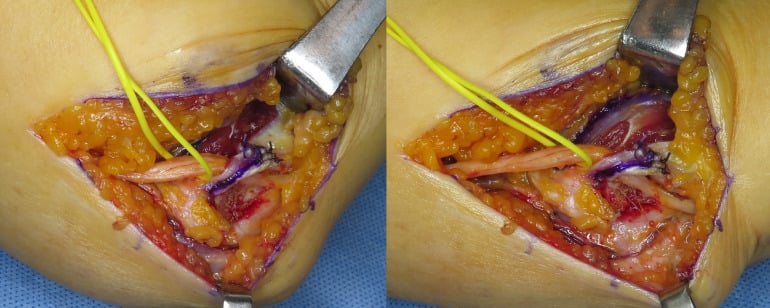
Complications
- Context
- Inadequate resection of the snapping structure
- Key point
- Ensure complete resection of the accessory band or dislocating tendon at index surgery
- Context
- Surgical traction or inadequate transposition
- Key point
- Handle the nerve delicately; transpose if unstable to prevent postoperative neuropathy
- Context
- Any elbow surgery
- Key point
- Early controlled mobilisation; avoid prolonged immobilisation
- Context
- Any open surgery
- Key point
- Standard perioperative antibiotics and sterile technique
- Context
- Rare; excessive bone removal or avulsion
- Key point
- Preserve the medial epicondyle and flexor-pronator origin
- Context
- Chronic compression with axonal loss
- Key point
- Set realistic expectations; recovery may take months and may be incomplete if denervation is advanced
Clinical Relevance
Snapping triceps tests your understanding of dynamic elbow pathology, ulnar nerve anatomy, and the interface between sports medicine and peripheral nerve surgery. Examiners may present it as a sports-medicine case in an overhead athlete with medial elbow pain and snapping, a peripheral nerve viva on ulnar neuropathy at the elbow with an unstable nerve, an imaging question showing dynamic ultrasound or MRI of the cubital tunnel, or a surgical technique question on managing a patient with both snapping and neuropathy.
The condition also illustrates broader principles: dynamic imaging for positional pathology, the need to assess nerve function in every case, and the fact that an anatomic variant such as the anconeus epitrochlearis can produce clinically significant pathology.
Guidelines, Registries and Global Practice
- Diagnosis: Dynamic musculoskeletal ultrasound is the consensus first-line imaging test across orthopaedic and radiology literature worldwide. Static MRI and plain radiographs play supporting roles. There is no society guideline specific to snapping triceps, but the approach is consistent in sports-medicine and upper-extremity surgery literature from North America, Europe, and Asia.
- Conservative management: Activity modification, night splinting, and physiotherapy are universally accepted as first-line treatment. The duration of conservative trial varies (typically 3 to 6 months) depending on symptom severity and functional demands.
- Surgical approach: Resection of the snapping tendon or accessory muscle band is the standard operative treatment. The addition of ulnar nerve transposition when neuropathy is present is supported by case series and expert consensus, though no randomised trials compare in-situ decompression versus transposition specifically for snapping triceps.
- Athlete populations: Baseball pitchers (USA, Japan, Latin America), javelin throwers (Europe, Africa, Asia), and gymnasts (global) are the most frequently reported populations. Management principles are the same regardless of geographic setting, though access to dynamic musculoskeletal ultrasound and specialist hand/upper-extremity surgeons may vary by region.
- Prognosis: Most patients who undergo appropriate surgery (resection with or without nerve transposition) experience resolution of snapping and improvement in ulnar nerve symptoms. Recovery of chronic neuropathy may be incomplete if axonal loss is advanced.
Exam Viva Scenarios
Practise clinical reasoning and management decisions out loud
“A 22-year-old baseball pitcher presents with a 6-month history of painful snapping over the medial elbow when throwing. He also reports intermittent numbness in his little finger. The examiner asks you to take a history, examine him, and discuss your management.”
“A 30-year-old weightlifter has failed 6 months of conservative management for snapping triceps syndrome. He has moderate ulnar neuropathy with numbness in the little finger, positive Tinel and flexion tests, and EMG showing slowing across the elbow. The examiner asks you to describe your operative plan.”
“A 25-year-old gymnast reports a snap over the medial elbow with flexion. The examiner asks you to list the differential diagnosis and explain how you would distinguish between them.”
What It Is
- Medial triceps head or accessory band dislocates over medial epicondyle
- Often carries the ulnar nerve with it
- Painful snap with elbow flexion; may be audible and palpable
- Common in overhead throwers, weightlifters, gymnasts
Examination
- Feel the snap yourself over the medial epicondyle during active flexion
- Full ulnar nerve examination: Tinel, flexion test, Froment, Wartenberg
- Look for intrinsic hand wasting if chronic neuropathy
- Distinguish from isolated nerve subluxation and MCL injury
Investigations
- Dynamic ultrasound: first-line, shows real-time dislocation
- MRI: static assessment of nerve and soft tissues; may appear normal
- X-ray: exclude loose body or bony pathology
- EMG/NCS: quantify ulnar neuropathy if present
Management
- Conservative first: activity modification, night splint, NSAIDs, physiotherapy
- Surgery for failed conservative care or progressive neuropathy
- Type I (no neuropathy): resection of snapping portion alone
- Type II (neuropathy): resection plus ulnar nerve decompression/transposition
Operative Pearls
- Medial approach; identify and protect ulnar nerve throughout
- Resect the accessory band or dislocating tendon; preserve triceps function
- Transpose the nerve if unstable or neuropathy is moderate to severe
- Early mobilisation to prevent stiffness; return to sport at 3 to 6 months
Evidence
Snapping Triceps Syndrome: Review and Proposed Operative Treatment Algorithm
- Literature review of 24 studies (64 patients) with snapping triceps syndrome
- 90.6% (58/64) had coexisting ulnar nerve instability and 64.1% (41/64) had symptoms of ulnar neuropathy - so the two almost always travel together ('double snapping')
- Surgery was performed in 67.2%; strikingly, the snapping triceps had been unrecognised at a prior index elbow operation in 44.2% of operated patients
- Proposed an operative algorithm driven by ulnar nerve subluxation/neuropathy, with dynamic ultrasound as the key diagnostic test
- Its intraoperative instruction is the antidote to that 44.2%: confirm full resolution by examining EVERY dislocating structure through passive elbow motion and/or myoelectrical stimulation before closing, rather than assuming the nerve was the only offender
Snapping Triceps Syndrome: Surgical Technique
- Detailed step-by-step surgical technique for resection of the snapping medial triceps head
- Described a medial approach with identification and protection of the ulnar nerve
- Defines the lesion precisely: subluxation and triggering of the medial TRICIPITAL MUSCLE BELLY over the medial distal humeral ridge and condyle - a muscle belly, not a tendon or accessory band
- States that diagnosis rests largely on CLINICAL examination, with dynamic ultrasonography as a non-invasive aid rather than the primary test
- Its central warning: correct recognition is crucial to avoid surgical misadventure and revision surgery - the same failure the review above quantifies at 44.2%
Ultrasonographic Differential Diagnosis of Medial Elbow Pain
- Review of ultrasound findings in medial elbow pain including ulnar collateral ligament injury, ulnar neuropathy, and snapping triceps
- Described dynamic ultrasound technique for identifying ulnar nerve subluxation and snapping triceps
- Highlighted the utility of real-time imaging to distinguish between soft-tissue and neural causes of snapping
- Provided imaging criteria for cubital tunnel syndrome versus ulnar nerve instability
- Sets the differential in proportion: medial EPICONDYLITIS is the predominant cause of medial elbow pain, with ulnar neuropathy, snapping triceps, ulnar collateral ligament injury, MEDIAL ANTEBRACHIAL CUTANEOUS NEUROPATHY and intra-articular disease the alternatives to exclude
Bilateral Snapping Triceps Syndrome: A Case Report
- Case report of bilateral snapping triceps syndrome in a 23-year-old active man presenting with painful snapping on the medial side of both elbows during push-ups
- Two distinct, palpable and audible snaps per elbow ('double snapping') - the clinical hallmark of combined ulnar nerve and medial triceps head dislocation
- Dynamic ultrasonography showed BOTH the ulnar nerve and the medial head of the triceps dislocating anteriorly over the medial epicondyle during flexion
- Treated surgically with staged anterior subcutaneous ulnar nerve transposition plus partial resection of the snapping triceps portion; pain and snapping resolved and he was asymptomatic by 3 months