316L and Orthopaedic Applications
- Definition: Iron-based alloy containing at least 10.5% chromium (for passivation); the most common medical grade is 316L
- Composition: 316L: Iron (~60%), Chromium (17-20% - passivates), Nickel (12-14% - stabilises austenite), Molybdenum (2-4% - resists pitting corrosion), Carbon (under 0.03% 'Low' - prevents sensitisation)
- Processing: Cold working (increases strength but reduces ductility) or annealing
- “Young's modulus ~200 GPa - very stiff
- “Prone to crevice corrosion and fretting corrosion
- “Beware nickel allergy (10-15% of females, 2% of males)
Stainless Steel
Overview
Stainless steel is an iron-based alloy containing at least 10.5% chromium, the minimum needed for passivation. The medical grade is 316L, and it is the most common implant material for fracture fixation.
The trade-off. It is stiff, ductile enough to contour in theatre, and cheaper than titanium. Against that, it is the most corrosion-susceptible of the modern orthopaedic alloys, its stiffness causes stress shielding, and its nickel is an allergen.
Composition and the 316L Grade
The alloy. Iron is the base metal, about 60% of 316L, and each addition has a job:
- Chromium 17-20% forms the surface oxide layer (Cr₂O₃) that passivates the steel and gives it its corrosion resistance
- Nickel 12-14% stabilises the austenitic (FCC) phase at room temperature, which is what makes the steel ductile; it is also the allergen
- Molybdenum 2-4% resists pitting corrosion
- Carbon under 0.03%, the "low" in 316L, minimises carbide precipitation and so prevents sensitisation
Why the carbon is kept low. With more than 0.03% carbon, chromium carbides precipitate at the grain boundaries. The boundaries are depleted of chromium and the steel corrodes along them, intergranular corrosion. This process is sensitisation.
The crystal structure. 316L is austenitic, face-centred cubic (FCC). It is non-magnetic, ductile enough to be contoured or bent intraoperatively, and it work-hardens, getting stronger as you bend and shape it. It cannot be heat-treated for hardening.
- 300 series: austenitic stainless steel
- 16: approximately 16% chromium
- L: low carbon, under 0.03%
Stainless steel is face-centred cubic: remember "space filling" (ductile).
Microstructure and the Passive Layer
Three crystal phases. Austenite is the stable phase in 316L at room temperature. Ferrite is present in ferritic steels, not in 316L, and martensite in hardened steels. Duplex steels are a mix of austenite and ferrite. The phase decides both the properties and the use:
- Crystal structure
- FCC (face-centred cubic)
- Examples
- 316L, 304
- Properties
- Ductile, non-magnetic, work-hardenable
- Orthopaedic use
- Plates, screws, nails: most orthopaedic implants
- Crystal structure
- BCT (body-centred tetragonal)
- Examples
- 420, 440C
- Properties
- Hard, brittle, heat-treatable
- Orthopaedic use
- Hardened surgical instruments, blades, scalpels
- Crystal structure
- BCC (body-centred cubic)
- Examples
- 430
- Properties
- Magnetic, less ductile, less corrosion resistant
- Orthopaedic use
- Not used (magnetic)
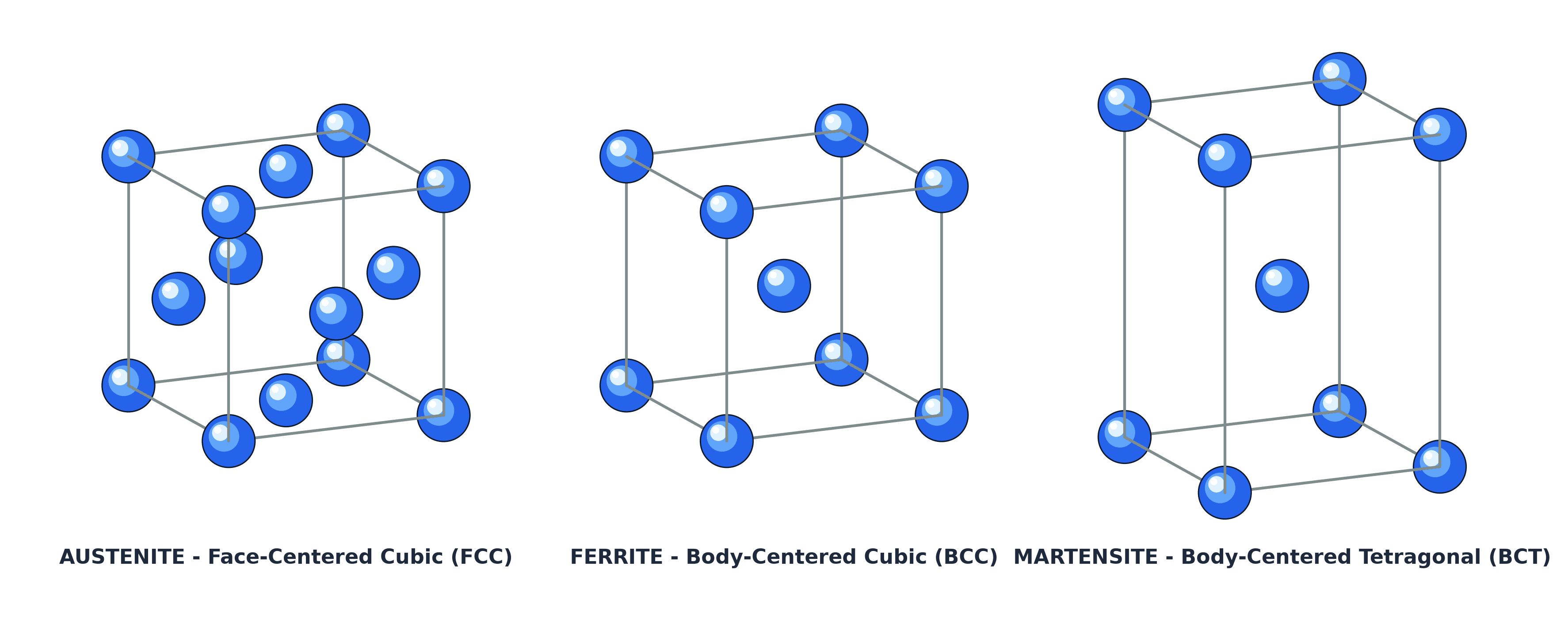
The passive layer. Chromium oxide (Cr₂O₃) forms spontaneously on the surface, 1-5 nanometres thick, and it is self-healing in an oxygen-rich environment. It is disrupted in low-oxygen crevices such as those under screw heads, which is where crevice corrosion (below) begins.
Weak points. Grain boundaries are potential corrosion sites, and inclusions (impurities) concentrate stress.
Grades and Standards
Implant-grade 316L is defined by ASTM and ISO specifications, which govern what the alloy contains and how it is processed.
- ASTM F138: wrought 316L bar and wire for surgical implants, with both annealed and cold-worked (strain-hardened) mechanical property classes
- ASTM F139: 316L sheet and strip
- ASTM F621: stainless steel forgings for surgical implants
- Implant grade must specify "vacuum melted"
Standards for Implant-Grade Stainless Steel
- ASTM F138/F139 specify wrought 316L (low-carbon) stainless steel bar/wire and sheet/strip for surgical implants
- ISO 5832-1 is the international standard for wrought stainless steel for surgical implants
- Carbon is restricted to under 0.03% (the 'L' grade) to prevent sensitisation and intergranular corrosion
- Higher-nitrogen, low-nickel grades (ASTM F1586, ISO 5832-9) offer improved strength and reduced nickel content
Mechanical Properties and Processing
Stiffness and stress shielding. Young's modulus is about 200 GPa, against 15-20 GPa for bone. That stiffness is good for rigid fixation, but the implant carries the load instead of the bone, and by Wolff's law unloaded bone resorbs. The result is stress shielding, and a risk of refracture after the plate is removed.
Parametric Modelling of Screw-Plate Fixation, Stiffness and Stress Shielding
- Higher plate stiffness improves construct stability but increases the stress-shielding effect on underlying bone
- Interfragmentary strain between 2% and 10% is required for callus formation
- Plate material and design are key variables for balancing fixation stability against stress shielding
- Lower-modulus implant materials reduce load transfer away from healing bone
Strength depends on processing. Ductility is high, which is what allows plate bending, and fatigue strength is moderate. Yield strength depends on how the steel was made:
- Cold working deforms the steel at room temperature: yield strength rises to about 1000 MPa and ductility falls. Surgical implants are typically cold-worked for strength.
- Annealing is heat treatment: the steel is softer and more ductile, with a yield strength of about 200 MPa. Annealed stock is used for intraoperative bending.
Corrosion
Stainless steel is the most susceptible of the modern orthopaedic alloys to corrosion, and four mechanisms threaten it.
Crevice corrosion happens under screw heads, and it runs in sequence:
- Oxygen is low in the crevice under the screw head
- The Cr₂O₃ passive layer breaks down and the chromium cannot re-passivate
- The crevice environment acidifies
- Metal dissolution accelerates
- Cr, Ni and Mo ions are released, producing metallosis
Fretting corrosion. Micromotion between plate and screw mechanically disrupts the passive film. Rigid fixation is the prevention.
Galvanic corrosion. Dissimilar metals in contact form a cell. Coupled with titanium, stainless steel is the anode (active) and corrodes, while titanium is the cathode (noble). Never mix metals.
Pitting corrosion. Chloride breaks down the passive film locally; the molybdenum in 316L resists it.
Prevention. Four measures reduce the risk:
- Never mix metals
- Minimise crevices at the screw-plate interface
- Use an electropolished surface, which enhances the passive layer, reduces surface roughness and improves corrosion resistance
- Avoid scratching the implant surface
Mechanisms of Corrosion in Orthopaedic Metals
- Identifies 10 corrosion mechanisms: pitting, crevice, mechanically-assisted crevice corrosion, fretting, fretting-initiated crevice corrosion, taper corrosion, galvanic, stress/tension, fatigue and inflammatory-cell-induced corrosion
- Position on the galvanic series and the ability to maintain a passive oxide film determine implant longevity
- Bio-tribocorrosion disrupts the passive layer and initiates pitting at micromotion interfaces
- Corrosion proceeds by oxidative metal dissolution releasing cations, current flow to the cathode, then deposition of metal oxides/hydroxides
Choosing Stainless Steel or Titanium
- Stainless Steel
- 200 GPa (stiff)
- Titanium Alloy
- 110 GPa (less stiff)
- Stainless Steel
- Good for rigid fixation, high stress shielding
- Titanium Alloy
- Closer to bone, less stress shielding
- Stainless Steel
- Excellent
- Titanium Alloy
- Notching risk
- Stainless Steel
- Higher
- Titanium Alloy
- Lower
- Stainless Steel
- Avoid
- Titanium Alloy
- Preferred
- Stainless Steel
- Significant artefact
- Titanium Alloy
- Minimal artefact
- Stainless Steel
- Low
- Titanium Alloy
- High
Before choosing. Ask about nickel allergy (a rash from cheap jewellery), Type IV metal hypersensitivity and previous implant reactions, and whether the patient will need MRI.
Indications. Stainless steel suits:
- Fracture fixation with plates, screws and nails, and other temporary fixation devices
- Cost-sensitive settings
- Plates that need contouring intraoperatively
- Patients without a nickel allergy
When to avoid it. Choose another material for:
- Known nickel allergy
- A permanent implant, where titanium is preferred
- An existing titanium implant, because of galvanic corrosion
- A need for MRI follow-up
How firm is the nickel rule? Skin allergy does not strongly predict an implant reaction, and the Siljander knee arthroplasty cohort (below) found no revision difference between CoCr and nickel-free implants in nickel-allergic patients. In practice, take the history and consider titanium when it is severe.
Metal Hypersensitivity
Mechanism and prevalence. Nickel hypersensitivity is a Type IV (delayed) reaction. Nickel allergy affects 10-15% of females and 2% of males, but symptomatic metal hypersensitivity to an implant is less than 1%. The European and US figures on the evidence cards below are rates of skin sensitisation in the general population, not of implant reaction.
Signs after implantation. Dermatitis overlying the implant, chronic unexplained pain and a persistent effusion.
Patch test or LTT. Patch testing detects cutaneous hypersensitivity and has poor predictive value for deep implants. The lymphocyte transformation test (LTT) detects systemic sensitisation and is more specific for implant reactions, although, as the controversies section notes, it is not widely validated or available.
Management. Remove the implant after fracture union, replace it with titanium if needed, and debride any metallosis tissue.
Pathophysiology of Hypersensitivity to Metallic Implants
- Metal ions (Ni, Cr, Co) act as haptens and drive a delayed (Type IV), T-cell-mediated hypersensitivity response
- European skin sensitisation rates: nickel ~20%, chromium ~4%, cobalt ~7%
- United States skin sensitisation rates: nickel ~14%, chromium ~4%, cobalt ~9%
- Cross-reactivity occurs between metal allergens, relevant when choosing alternative alloys
Nickel Allergy: Epidemiology and Clinical Review
- Nickel is the most frequent cause of contact allergy worldwide
- European general-population prevalence ~8-19% in adults, 8-10% in children/adolescents, with strong female predominance
- Jewellery and metal in clothing remain the main exposure sources; EU nickel regulation reduced prevalence and severity
- Allergic nickel dermatitis may be localized to the exposure site, widespread, or present as hand eczema
Nickel Allergy and TKA Outcomes: CoCr vs Nickel-Free
- Retrospective review of 20,324 primary TKAs; 282 patients had documented preoperative nickel allergy
- 243 received a nickel-free implant and 39 received a standard cobalt-chromium implant
- No significant difference in revision rate (survivorship 98% nickel-free vs 94% CoCr, P=0.9)
- No difference in KOOS-JR, VAS, LEAS, PROMIS or VR-12 scores between groups at 6 weeks or 1 year
Investigating the Symptomatic Implant
Imaging. Plain radiographs assess implant position and loosening, with no difficulty from stainless steel. CT has metal artefact but can still assess fixation. The steel is non-magnetic, so MRI is possible, but it gives significant artefact for soft-tissue assessment, where titanium gives minimal artefact.
Blood and fluid. Each test answers a different question:
- Serum metal ions (Cr, Ni, Mo) when metallosis is suspected; they are elevated in corrosion
- CRP and ESR if infection is suspected
- Aspiration if there is an effusion
The failed implant. A removed implant and its tissue can be analysed:
- Sonication for biofilm bacteria
- Histology to distinguish metallosis from infection
- ICP-MS to quantify metal ions
Differential Diagnosis: The Painful Stainless Steel Implant
A patient with a painful, swollen, or draining stainless steel implant has a narrow but high-stakes differential. The cardinal task is to exclude infection before attributing symptoms to metal.
- Key Features
- Pain, warmth, sinus, late presentation
- Aspirate / Markers
- Neutrophil-predominant; CRP/ESR often raised; cultures may be negative
- Discriminator
- Extended 14-day culture, sonication, histology (acute PMNs)
- Key Features
- Dermatitis over implant, chronic pain
- Aspirate / Markers
- Lymphocyte-predominant; CRP/ESR normal-mild
- Discriminator
- Rash overlying implant; positive patch test / LTT; aseptic
- Key Features
- Pain, effusion, tissue staining, osteolysis
- Aspirate / Markers
- Metal particles; elevated serum Cr/Ni ions
- Discriminator
- Black/grey debris; ICP-MS; often mixed-metal or fretting source
- Key Features
- Mechanical pain on loading, lucency
- Aspirate / Markers
- Non-inflammatory; markers normal
- Discriminator
- No sinus/erythema; progressive radiographic lucency
- Key Features
- Asymptomatic bone thinning under plate
- Aspirate / Markers
- Normal
- Discriminator
- Cortical osteopenia beneath rigid plate; refracture risk post-removal
Surgical Technique
Contouring. Stainless steel is ductile and can be bent intraoperatively, and work hardening strengthens the bent area with each bend. Avoid excessive bending because of notch sensitivity.
Screw insertion. Match the screw type to the plate system, avoid cross-threading and maintain a uniform torque.
Complications and Outcomes
Complications. Corrosion-related problems occur in 1-5%, and stress shielding is variable. Metallosis shows as tissue staining and osteolysis.
Why it remains the trauma standard. Union rates are equivalent to titanium's, at a significant cost advantage. The steel contours on the table, performs reliably as a temporary implant that can be removed after healing, and most patients tolerate its nickel without issue.
Why its use is declining. Titanium is preferred for permanent implants, and MRI compatibility is driving titanium adoption. Newer nickel-free stainless steels are in development; the nitrogen-strengthened grades are described below.
Follow-up and Implant Removal
Routine follow-up. Serial radiographs track fracture healing and implant loosening, and the patient is watched for signs of a metal reaction.
- Possible Cause
- Nickel allergy
- Action
- Consider removal
- Possible Cause
- Metallosis/loosening
- Action
- Investigate, consider removal
- Possible Cause
- Corrosion/osteolysis
- Action
- Metal ions, removal if progressive
Removal is optional once the fracture has healed, and it reduces long-term corrosion exposure. The indications:
- Symptomatic metal hypersensitivity, including nickel sensitivity that develops
- Prominent hardware
- Infection
- A healed fracture in a young patient
- Refracture risk from stress shielding
Timing. Wait at least 12-18 months after ORIF for full remodelling, protect for 6-8 weeks after removal, and counsel the patient on refracture risk.
Nitrogen-Strengthened, Low-Nickel Stainless Steels
The standards card, guidelines and controversies all name a "higher-nitrogen, low-nickel" or "nickel-free" grade (ASTM F1586 / ISO 5832-9) as an alternative, and a viva mentions using nitrogen or manganese to stabilise the austenite - but what these steels are and why they exist is never explained.
- Why they were developed. Conventional 316L relies on nickel to hold the austenitic (FCC) phase, but nickel is the commonest contact allergen and only a modest strengthener. Adding nitrogen (an interstitial element) does both jobs better: it is a strong austenite stabiliser (so nickel can be cut or removed) AND a potent solid-solution strengthener.
- The two families. (1) High-nitrogen, reduced-nickel wrought grades (ASTM F1586 / ISO 5832-9; e.g. "REX 734") keep some nickel but add roughly 0.3-0.9% nitrogen for markedly higher yield and fatigue strength than 316L. (2) Essentially nickel-free, high-manganese/high-nitrogen austenitic steels (e.g. "BioDur 108") use manganese plus nitrogen to hold the austenite with almost no nickel, for the genuinely nickel-sensitive patient.
- What you gain. Higher yield and fatigue strength (allowing thinner, stronger implants), better pitting and crevice-corrosion resistance (nitrogen stabilises the passive film), and lower nickel content and ion release.
- The caveats. They are more expensive, less universally stocked, and - as the controversies note - have limited long-term clinical outcome data, so they are not yet standard of care; most nickel-allergic patients are still served well by titanium or even standard alloys.
Q: What is a nitrogen-strengthened, low-nickel stainless steel and why use one? A: A high-nitrogen austenitic stainless steel (ASTM F1586 / ISO 5832-9, e.g. REX 734; or the nearly nickel-free high-manganese BioDur 108) in which nitrogen replaces much or all of the nickel as the austenite stabiliser. Nitrogen is also a strong interstitial solid-solution strengthener, so these steels have higher yield and fatigue strength and better pitting/crevice resistance than 316L, with much less nickel. Downsides: cost, limited availability and limited long-term clinical data - so they are not yet standard of care.
Cold Working, Work Hardening and Annealing
- Work hardening (the mechanism). Plastic deformation occurs by the movement of dislocations (line defects) through the crystal lattice. Deforming the metal multiplies dislocations and tangles them, so they increasingly obstruct one another's motion; more stress is then needed to keep deforming - the metal becomes stronger (higher yield) but less ductile. This is why bending a plate strengthens the bent zone, and why over-bending or repeated re-bending embrittles it.
- Cold working. Deforming (rolling, drawing, forging) below the recrystallisation temperature work-hardens the steel throughout, raising yield strength toward ~1000 MPa at the cost of ductility. Implants are supplied cold-worked when strength matters.
- Annealing. Heating above the recrystallisation temperature lets new strain-free grains nucleate and grow (recrystallisation), dissolving the tangled dislocations - the steel returns to a soft, ductile state (yield ~200 MPa). Annealed stock is chosen when the surgeon needs to contour the implant on the table.
- The trade-off in theatre. Ductility lets you contour a plate, but every bend work-hardens and locally embrittles it; contour smoothly, avoid sharp bends over screw holes, and never bend-then-reverse - the accumulated cold work plus a stress-concentrating notch is a classic site for fatigue failure.
Q: What is the difference between cold working and annealing in stainless steel, and by what mechanism? A: Plastic deformation moves dislocations; cold working (deforming below the recrystallisation temperature) multiplies and tangles dislocations so they impede each other - the steel becomes stronger (yield toward ~1000 MPa) but less ductile (work hardening). Annealing (heating above the recrystallisation temperature) grows new strain-free grains (recrystallisation) that erase the dislocation tangles, returning the steel to a soft, ductile state (yield ~200 MPa). Implants are cold-worked for strength; annealed stock is used for intraoperative contouring - but every bend work-hardens and notches the plate, a fatigue-failure risk.
Guidelines, Registries & Global Practice
Standards & Global Epidemiology
- ASTM F138/F139 and ISO 5832-1 define implant-grade wrought 316L stainless steel
- ASTM F1586 / ISO 5832-9: nitrogen-strengthened, low-nickel high-strength grades
- Carbon kept under 0.03% ("L") to prevent sensitisation/intergranular corrosion
- Nickel is the commonest contact allergen worldwide
- Adult prevalence ~8-19% (Europe), ~14% (US), with strong female predominance
- Symptomatic deep-implant hypersensitivity is uncommon and difficult to prove
- Detail
- SS markedly cheaper than titanium
- Relevance
- Dominant in cost- and resource-limited trauma care worldwide
- Detail
- Universally stocked; simple manufacture
- Relevance
- Workhorse for fracture fixation globally
- Detail
- Ductile, easily bent intraoperatively
- Relevance
- Valued where pre-contoured anatomic plates are unavailable
Related pages: Titanium Alloys is the direct comparator throughout this page - lower modulus, better biocompatibility, no nickel, but poorer notch sensitivity and a different failure mode; Cobalt-Chrome Alloys for the third structural alloy, and for the point the hypersensitivity cards make - cobalt-chrome is NOT a reliable nickel-free alternative, because it contains residual nickel and cross-reacts; Corrosion Mechanisms for the electrochemistry in full, including the crevice and galvanic processes that dominate plate-and-screw constructs rather than the trunnion corrosion the Ude review describes; Trunnionosis and Taper Corrosion for the modular-junction problem that review is actually about; Implant Fracture Biomechanics and Screw Biomechanics for fatigue failure, stress concentration and why a stiff construct fails where it does; Ceramics and Polyethylene (UHMWPE and XLPE) for the non-metallic bearing materials that avoid ion release entirely.
Controversies & Areas of Uncertainty
- Cutaneous allergy vs deep implant failure: Whether a positive skin patch test predicts symptomatic peri-implant hypersensitivity remains unresolved. Most nickel-allergic patients tolerate stainless steel and CoCr implants; the Siljander 2023 TKA cohort found no difference in revision between CoCr and nickel-free implants in nickel-allergic patients. Routine use of costly nickel-free implants for skin allergy alone is not strongly supported.
- Best test for implant metal allergy: Patch testing reflects skin sensitisation, not necessarily deep-tissue reactivity; the lymphocyte transformation test (LTT) may be more specific but is not widely validated or available. No gold-standard diagnostic test exists.
- Routine implant removal after union: Whether to remove stainless steel hardware after fracture healing (to reduce long-term corrosion exposure and stress shielding, balanced against refracture and re-operation risk) is debated and largely driven by symptoms and patient factors rather than firm evidence.
- Stainless steel vs titanium for trauma: No high-quality RCT demonstrates a difference in union rates; choice is driven by cost, MRI needs, intraoperative contourability and allergy rather than proven outcome superiority.
- Nitrogen-strengthened low-/nickel-free steels: Higher-strength, reduced-nickel austenitic grades exist but have limited long-term clinical outcome data and are not yet standard of care.
MANIAWhen to Choose Titanium over Stainless Steel
Hook:Titanium for the MANIA cases — Situations favouring titanium instead of stainless steel
MCQ Practice Points
Q: What is the composition and significance of 316L stainless steel used in orthopaedic implants?
A: 316L contains: Iron (~60% base), Chromium (17-20% for passivation via Cr₂O₃ oxide layer), Nickel (12-14% to stabilize austenite), Molybdenum (2-4% for pitting corrosion resistance). The "L" designates low carbon (less than 0.03%). Low carbon prevents chromium carbide precipitation at grain boundaries, which would deplete chromium and cause intergranular corrosion (sensitization).
Q: Why is stainless steel austenitic (FCC) structure and what properties does this confer?
A: Nickel stabilizes the Face-Centered Cubic (austenitic) phase at room temperature. Properties: (1) Non-magnetic - allows MRI imaging (though creates artifact), (2) Ductile - can be contoured intraoperatively, (3) Work-hardenable - becomes stronger when cold-worked/bent. Cannot be heat-treated for hardening unlike martensitic steel.
Q: What are the types of corrosion affecting stainless steel implants and their mechanisms?
A: (1) Crevice corrosion: Under screw heads where low oxygen prevents re-passivation of the chromium oxide layer. (2) Fretting corrosion: Micro-motion between plate and screw disrupts oxide layer. (3) Galvanic corrosion: When mixed with more noble metals (titanium), SS becomes the anode and corrodes. (4) Pitting corrosion: Localized breakdown of passive layer, resisted by molybdenum content.
Q: What is the clinical significance of nickel in stainless steel implants?
A: Nickel allergy (Type IV hypersensitivity) affects 10-15% of females and 2% of males. Clinical presentations include: dermatitis over implant, chronic pain, aseptic loosening. While cutaneous patch test positivity does not strongly predict implant failure, patients with severe nickel allergy (cheap jewelry rash) should receive titanium implants instead. Titanium is nickel-free.
Q: How does stainless steel compare to titanium for fracture fixation implants?
A: Stainless steel: Higher modulus (200 GPa) provides rigid fixation but causes more stress shielding; lower cost; significant MRI artifact; ductile (can be bent intraoperatively); contains nickel allergen. Titanium: Lower modulus (110 GPa) closer to bone, less stress shielding; higher cost; minimal MRI artifact; excellent biocompatibility; no nickel. SS preferred for temporary fixation, Ti for permanent implants or nickel-allergic patients.
Exam Viva Scenarios
Practise clinical reasoning and management decisions out loud
“You are consenting a patient for an ORIF of a distal radius fracture. She tells you she gets a rash from cheap earrings. What are the implications for your implant choice?”
“A 55-year-old patient underwent ORIF of a distal femoral fracture 18 months ago. The original surgery used a stainless steel locking plate. He subsequently fell and sustained a proximal femoral shaft fracture above the plate. The on-call registrar added a retrograde femoral nail (titanium alloy) to stabilize the proximal fracture, overlapping with the existing stainless steel plate. Six months later, the patient presents with persistent thigh pain, swelling, and a draining sinus over the distal femur. X-rays show periosteal reaction and loosening of the distal screws. Aspiration of the sinus shows no bacterial growth on cultures, but analysis reveals metallic debris with elevated titanium and chromium ions. What is your diagnosis, what went wrong, and how do you manage this patient?”
“A 42-year-old woman underwent ORIF of a tibia-fibula fracture with a stainless steel plate and screws 2 years ago. She now presents with chronic pain, swelling, and occasional drainage from the surgical scar. She also mentions she has developed a rash on her skin overlying the plate. Examination shows warmth, erythema, and fluctuance over the plate. Aspiration shows turbid fluid with WBC 15,000 (predominantly lymphocytes), but routine bacterial cultures are negative at 5 days. Serum inflammatory markers are mildly elevated (CRP 25 mg/L, ESR 35 mm/h). X-rays show periosteal reaction and mild screw lucency but no fracture. The patient is frustrated and demands answers. What is your differential diagnosis, how do you investigate this systematically, and what is your management approach?”
Composition
- Iron (Base)
- Chromium (greater than 10.5% - Passivation)
- Nickel (Austenite)
- Molybdenum (Pitting)
Properties
- Modulus: 200 GPa (Stiff)
- Structure: FCC (Austenite)
- Processing: Cold Worked
Evidence Base
Key Evidence
- Ude/Laurencin (2023): galvanic-series position and passive-film integrity govern corrosion susceptibility
- Chung (2017): higher plate stiffness improves stability but increases stress shielding; IFS 2-10% needed for callus
- Ahlström/Thyssen (2019): nickel allergy ~8-19% of European adults, female predominant
- Siljander (2023): no difference in TKA revision between CoCr and nickel-free implants in nickel-allergic patients
- Finding
- Nickel allergy 8-19% adults, female predominant
- Implication
- Take a jewellery-allergy history before SS implant
- Finding
- No revision difference CoCr vs nickel-free in TKA
- Implication
- Skin allergy alone does not mandate nickel-free implant
- Finding
- Galvanic position + passive film drive corrosion
- Implication
- Explains SS crevice/fretting susceptibility
References
- Ahlström MG, Thyssen JP, Wennervaldt M, Menné T, Johansen JD. Nickel allergy and allergic contact dermatitis: a clinical review of immunology, epidemiology, exposure, and treatment. Contact Dermatitis. 2019;81(4):227-241. PMID: 31140194. doi:10.1111/cod.13327
- Siljander BR, Chandi SK, Debbi EM, McLawhorn AS, Sculco PK, Chalmers BP. A comparison of clinical outcomes after total knee arthroplasty in patients with preoperative nickel allergy receiving cobalt chromium or nickel-free implant. J Arthroplasty. 2023;38(7 Suppl 2):S194-S198. PMID: 37100098. doi:10.1016/j.arth.2023.04.048
- Ude CC, Dzidotor GK, Iloeje K, Nair LS, Laurencin CT. Corrosion of metals during use in arthroplasty. ACS Appl Bio Mater. 2023;6(6):2029-2042. PMID: 37261398. doi:10.1021/acsabm.2c01082
- Chung CY. A simplified application (APP) for the parametric design of screw-plate fixation of bone fractures. J Mech Behav Biomed Mater. 2017;77:642-648. PMID: 29101896. doi:10.1016/j.jmbbm.2017.10.025
- Kounis NG, Koniari I. Hypersensitivity to metallic implants: pathophysiologic and diagnostic considerations. Acta Biomed. 2018;89(3):428-429. PMID: 30333472. doi:10.23750/abm.v89i3.6718
- ASTM F138/F139; ISO 5832-1 / ISO 5832-9. Standard specifications for wrought 316L and nitrogen-strengthened stainless steel for surgical implants.