Posterior = Emergency | Airway Compromise | Mediastinal Structures at Risk
- Posterior dislocation is an EMERGENCY - can compress trachea, oesophagus, great vessels
- SC joint ligaments are exceptionally strong - stronger than the medial clavicular physis (physeal injury more common than dislocation under 25)
- Serendipity view (40 degree cephalic tilt) best plain film for diagnosis
- CT with contrast is gold standard - assess vascular compression
- Most dislocations are treated conservatively - recurrence well tolerated
- “Posterior dislocation: Dysphagia, dyspnoea, venous congestion in arm/neck
- “Under 25 years - likely physeal injury (SH I/II), not true dislocation
- “Do NOT reduce posterior dislocation without thoracic surgery backup
- “Figure-of-8 reconstruction with hamstring/fascia lata for chronic instability
Overview and Epidemiology
Sternoclavicular joint injuries make up 3% of all shoulder girdle injuries. Anterior dislocations are 25 times more common than posterior ones, but it is the posterior dislocation, driven back towards the mediastinum, that makes this joint an emergency.
Who. Incidence peaks in young adults aged 15-25, injured in sport or motor vehicle accidents, with a second peak in the elderly after falls. Males are affected twice as often as females (2:1).
Anterior dislocation. An indirect force, lateral compression of the shoulder with the arm forward, displaces the medial clavicle anteriorly: it lifts up and forward. A direct blow to the anteromedial clavicle is a rare cause.
Posterior dislocation. A high-energy mechanism, such as a motor vehicle accident or a rugby tackle. A direct blow to the anterolateral clavicle, or lateral compression of the shoulder with the arm back and down, displaces the medial clavicle posteriorly into the mediastinum.
Anatomy and Biomechanics
The joint. The SC joint is the only true articulation between the upper limb and the axial skeleton. It is a saddle-type synovial joint with incongruous surfaces, divided by a fibrocartilaginous intra-articular disc. The clavicle acts as a strut, transmitting forces from the upper limb to the axial skeleton, and the joint permits 35° of elevation, 35° of anterior-posterior movement and 50° of rotation.
The physis. The medial clavicular epiphysis is the last physis in the body to close, at 22-25 years. The SC ligaments are exceptionally strong, stronger than the physis, so in a patient under 25 the physis gives way first: expect a Salter-Harris I or II physeal fracture rather than a true dislocation. True dislocation requires high energy to overcome those very strong ligaments.
The stabilisers. The costoclavicular ligament, running from the first rib to the clavicle, is the primary restraint to elevation. The posterior capsule is the primary restraint to anterior and posterior translation.
- Function
- Primary restraint to elevation (superior displacement)
- Clinical Significance
- Short and very strong - origin of the physeal injury concept
- Function
- Primary restraint to anterior and posterior translation; resists anterior displacement
- Clinical Significance
- Disrupted in anterior dislocation
- Function
- Resists posterior displacement
- Clinical Significance
- Must be disrupted for posterior dislocation
- Function
- Connects medial clavicles across sternum
- Clinical Significance
- Limits excessive clavicular depression
- Function
- Intra-articular shock absorber
- Clinical Significance
- Can tear with subluxation
What lies behind. The direction of dislocation matters because of what sits directly behind the joint.
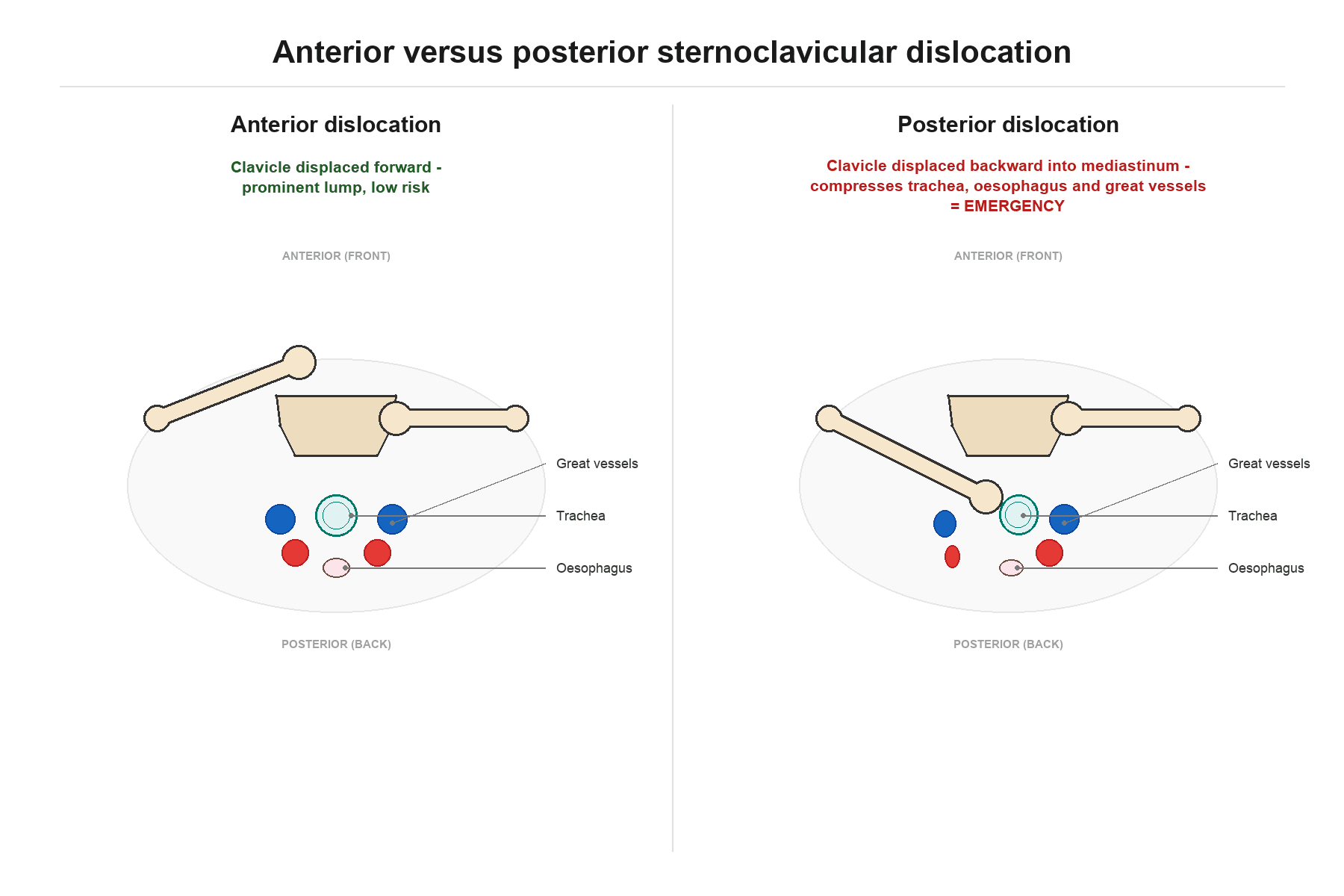
These structures lie only 1-2 cm behind the SC joint:
- Trachea (directly posterior)
- Oesophagus
- Subclavian artery and vein
- Carotid artery
- Internal jugular vein
- Innominate (brachiocephalic) artery and vein
- Brachial plexus
- Lung apex
A posterior dislocation can compress, lacerate or thrombose any of them, which makes it a surgical emergency.
Classification Systems
The most commonly used system, based on direction and severity.
- Description
- Sprain
- Pathology
- Ligaments intact, microscopic tears
- Treatment
- Sling, ice, conservative
- Description
- Subluxation
- Pathology
- Capsule torn, costoclavicular intact
- Treatment
- Sling 4-6 weeks
- Description
- Anterior dislocation
- Pathology
- Complete ligament rupture, anterior displacement
- Treatment
- Usually conservative
- Description
- Posterior dislocation
- Pathology
- Complete ligament rupture, posterior displacement
- Treatment
- Urgent reduction required
Types I-III are generally managed conservatively with good outcomes. Type IV, the posterior dislocation, is the only true emergency, requiring urgent intervention.
The physeal injury. In the under-25 patient who looks "dislocated", the epiphysis stays reduced against the manubrium, held by the intact sternoclavicular ligaments, while the metaphysis and clavicular shaft displace anteriorly or posteriorly.
Posterior displacement is still an emergency. The displaced metaphysis can compress the mediastinum just as a true posterior dislocation does, so a posteriorly displaced physeal injury is reduced urgently with the same precautions: closed reduction, cardiothoracic cover and CT angiography.
Otherwise it heals. This is a fracture through bone in a patient with enormous remodelling potential, so it heals reliably and rarely needs internal fixation. An anteriorly displaced or successfully reduced physeal injury is generally managed non-operatively, with fixation (soft-tissue, never metal) reserved for the irreducible posterior injury. That better prognosis is why distinguishing a physeal injury from a true ligamentous dislocation on CT matters.
Clinical Assessment
History. Establish the mechanism: the energy involved (motor vehicle accident, sports collision, fall onto the shoulder), a direct blow or indirect lateral compression of the shoulder, and the position of the arm at the time of injury. Then ask directly about dyspnoea, dysphagia and arm swelling, the symptoms of vascular or airway compromise.
Anterior dislocation. The medial clavicle is prominent and palpable anteriorly, with swelling at the joint and pain on arm movement, especially cross-body. Full shoulder range of motion is typically preserved, and the cosmetic deformity is the main concern.
Posterior dislocation. The medial clavicle is less prominent, or the joint hollow, where the clavicle is depressed posteriorly. The findings that matter come from the structures behind it:
- Dyspnoea or stridor (tracheal compression), or respiratory distress
- Dysphagia (oesophageal compression) or odynophagia
- Venous congestion or engorgement in the neck, face or ipsilateral arm
- Diminished or absent upper limb pulses (subclavian compression)
- Hoarseness (recurrent laryngeal nerve)
- Brachial plexus symptoms or neurological deficit (rare)
- Supraclavicular haematoma
Examine every SC joint injury for these findings. If any is present, treat the injury as a posterior dislocation until proven otherwise.
Bedside tests. Compare the radial pulses on both sides and look at the jugular and arm veins for distension. The Adson test may assess subclavian artery compression.
- Distinguishing Features
- Skeletally immature patient, mechanism as for dislocation
- Key Discriminator
- CT/MRI shows physeal separation with metaphysis displaced; epiphysis stays reduced to manubrium
- Distinguishing Features
- Bony tenderness lateral to joint line, crepitus
- Key Discriminator
- Fracture line on CT distinct from joint; far more common than SCJD
- Distinguishing Features
- Older patient, gradual onset, no acute trauma
- Key Discriminator
- Osteophytes and joint-space loss on CT; symmetrical, activity-related ache
- Distinguishing Features
- Fever, warmth, raised inflammatory markers, IV drug use or immunocompromise
- Key Discriminator
- Joint aspirate and MRI; may extend to mediastinal abscess
- Distinguishing Features
- Painful bony swelling, palmoplantar pustulosis, bilateral
- Key Discriminator
- Sclerosis and hyperostosis on CT; bone scan 'bullhead' sign
- Distinguishing Features
- Young patient, atraumatic localised swelling
- Key Discriminator
- Fragmentation/sclerosis of sternal epiphysis, self-limiting
- Distinguishing Features
- Non-mechanical swelling, systemic symptoms
- Key Discriminator
- Cross-sectional imaging; not related to joint or trauma
Not all SC instability is traumatic. Atraumatic spontaneous subluxation is a distinct entity, typically in young patients (often women) with generalised ligamentous laxity, occasionally a connective-tissue disorder such as Ehlers-Danlos. The medial clavicle subluxes anteriorly on arm elevation and reduces when the arm is lowered; it is frequently bilateral, and usually painless or only mildly symptomatic.
The cardinal rule mirrors atraumatic and voluntary shoulder instability: management is non-operative (reassurance, activity modification, and physiotherapy for scapular and periscapular control), and surgical stabilisation should be avoided. It has poor results and high recurrence, and the SC joint's mediastinal-hardware hazards make a failed reconstruction especially undesirable. Distinguish it from a fixed traumatic dislocation, which does not spontaneously reduce.
Investigations
Plain radiographs. A standard AP film is often inconclusive because the structures overlap, and serves only as an initial screen.
The serendipity view. The classic exam view, and good for the direction of displacement. The patient lies supine and the beam is angled 40° cephalad, centred on the sternum, so that both SC joints are compared on the same film. In an anterior dislocation the affected clavicle projects above the normal side; in a posterior dislocation it projects below.
CT. The gold standard for assessing fracture and dislocation, indicated in every suspected dislocation. It is definitive for the direction of displacement and identifies associated fractures, and with contrast it assesses vascular compression or injury.
All posterior SC dislocations require CT angiography to assess for vascular compression or injury. Even after successful reduction, delayed vascular complications can occur.
MRI. Shows the soft tissues and the physeal injury in young patients, and is used in subacute and chronic cases.
Management Algorithm
Every injury is first assessed for a posterior dislocation or mediastinal symptoms; the rest of the algorithm follows from that answer.
- Findings
- Joint tender, stable
- Urgency
- Non-urgent
- Treatment
- Sling, ice, NSAIDs
- Findings
- Clavicle prominent anteriorly
- Urgency
- Non-urgent
- Treatment
- Closed reduction (optional), sling 6 weeks
- Findings
- Clavicle depressed, venous distension
- Urgency
- Urgent
- Treatment
- CT angiogram, closed reduction in OR, thoracic standby
- Findings
- Stridor, hypoxia, arm ischaemia
- Urgency
- EMERGENCY
- Treatment
- Immediate reduction, airway management, thoracic surgery
- Findings
- Recurrent subluxation, pain with activity
- Urgency
- Elective
- Treatment
- Figure-of-8 reconstruction with graft
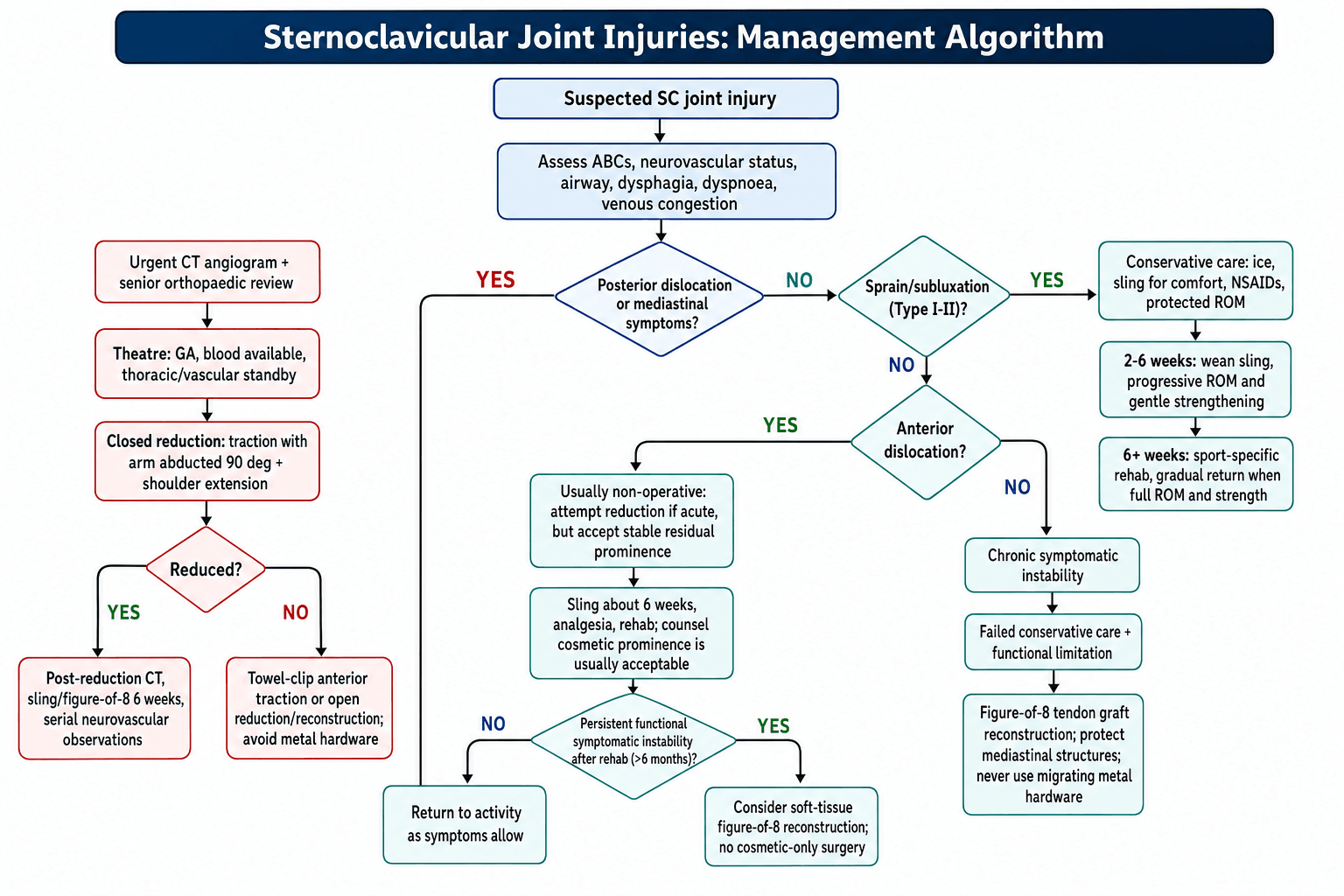
Sprains and subluxations are treated conservatively.
Treatment Protocol
- Ice, sling for comfort
- NSAIDs for pain and inflammation
- Avoid aggravating activities
- Protected range of motion
- Wean from sling as pain allows
- Progressive ROM exercises
- Gentle strengthening
- Avoid contact sports/heavy lifting
- Full ROM should be achieved
- Sport-specific rehabilitation
- Gradual return to full activity
The prognosis is excellent, with near 100% return to full function.
Surgical Technique
Indications. Reconstruction is for chronic symptomatic instability, anterior or posterior, that affects function after failed conservative management, including recurrent dislocation affecting function.
Smooth pins, K-wires and Steinmann pins are absolutely contraindicated at the SC joint. They migrate, with fatal outcomes, and the reported destinations are the mediastinum, pericardium, heart and great vessels. In one published case a broken Kirschner wire migrated from the sternoclavicular joint into the anterior mediastinum, perforated the pericardium and punctured the main trunk of the pulmonary artery, causing tamponade. Migration also occurs after the pin has broken, so a retained fragment is never benign.
Plates and screws are a separate question, and the honest answer is not "never". In the systematic review of 108 surgically managed posterior dislocations (Kendal, in the evidence section), favourable outcomes were reported for all five categories of stabilisation, including open reduction and internal fixation, at an overall complication rate of 16%. The price is that ORIF required a second operation for implant removal in 80% of cases, while tendon-graft ligament reconstruction had the lowest recurrent instability and the lowest complication rate.
Carry the ranking, not a blanket prohibition, into the exam and the consent discussion. Soft-tissue figure-of-eight reconstruction comes first; plate fixation is acceptable where reconstruction is not feasible, provided the patient is consented for planned removal; pins and wires never.
Contraindications. Active infection, and SC joint arthritis, for which resection should be considered instead.
Graft. Semitendinosus autograft, fascia lata or Achilles allograft, or palmaris longus for a small joint.
The steps:
- Positioning and approach - supine with a bump under the shoulders, a transverse skin incision over the SC joint, protecting the supraclavicular nerves, to expose the SC joint and medial clavicle
- Tunnel preparation - a 5-6 mm tunnel through the medial clavicle (anterior to posterior) and a 5-6 mm tunnel through the manubrium or first rib, protecting the mediastinal structures with retraction and a finger guard
- Graft passage - the doubled graft passes through the clavicular tunnel, crosses in a figure-of-8 pattern, passes through the sternal or rib tunnel and returns to the clavicular tunnel
- Tensioning and fixation - reduce the SC joint anatomically, tension the graft with the arm in neutral, secure it with an interference screw or suture over a bone bridge, and confirm stability with stress
The result is a stable reconstruction without metal hardware.
Complications
- Anterior Dislocation
- Rare
- Posterior Dislocation
- Common - subclavian/innominate compression or laceration
- Anterior Dislocation
- No
- Posterior Dislocation
- Yes - tracheal compression can be fatal
- Anterior Dislocation
- No
- Posterior Dislocation
- Yes - oesophageal compression
- Anterior Dislocation
- No
- Posterior Dislocation
- Risk with open reduction
- Anterior Dislocation
- Common (usually cosmetic)
- Posterior Dislocation
- Rare if adequately reduced
- Anterior Dislocation
- 5-10%
- Posterior Dislocation
- 5-10%
Hardware migration. Multiple case reports document fatal migration of pins, screws and plates from the SC joint into the heart (cardiac tamponade), the aorta (haemorrhage), the pulmonary vessels and the subclavian vessels. Migration can occur months to years after surgery.
Managing complications. A vascular injury needs immediate thoracic or vascular surgery. Chronic instability is treated with figure-of-8 reconstruction, and arthritis, rarely, with medial clavicle resection.
Postoperative Care
After closed reduction. CT confirms the reduction and serial radiographs confirm that it is maintained. A figure-of-8 brace or sling is worn for 6 weeks, because strict immobilisation is required for soft-tissue healing, with NSAIDs for pain and ice to reduce swelling, followed by progressive range of motion. Serial neurovascular examinations continue, watching for delayed vascular complications.
After figure-of-8 reconstruction. The protocol runs from sling protection to functional testing before return to sport.
Rehabilitation Protocol
- Sling immobilisation
- Elbow, wrist, hand ROM maintained
- Pendulum exercises at 2 weeks
- No lifting, pushing, or pulling
- Wean from sling
- Active-assisted shoulder ROM
- Gentle isometric strengthening
- No resistance exercises
- Progressive resistance exercises
- Full ROM should be achieved
- Return to light activities
- Sport-specific training
- Gradual return to contact (if applicable)
- Functional testing before clearance
Outcomes and Prognosis
Natural history. Most SC injuries have excellent outcomes with conservative treatment, and even with residual deformity function is typically normal. Posterior dislocations require intervention, but outcomes are good if they are treated promptly.
- Treatment
- Conservative
- Good/Excellent Outcome
- 95-100%
- Return to Full Activity
- 4-6 weeks
- Treatment
- Conservative
- Good/Excellent Outcome
- 85-95%
- Return to Full Activity
- 6-12 weeks
- Treatment
- Closed reduction
- Good/Excellent Outcome
- 80-90%
- Return to Full Activity
- 6-12 weeks
- Treatment
- Figure-of-8 reconstruction
- Good/Excellent Outcome
- 75-85%
- Return to Full Activity
- 4-6 months
The percentages above are illustrative conventional estimates from the case-series literature, not measurements from a single cohort; the sourced anchors are Groh 2011 (18 of 21 good or excellent after posterior dislocation treatment) and Kendal 2018 (favourable outcomes across all five stabilisation categories, 16% overall complications).
Prognostic factors. These influence the outcome:
- Time to treatment, especially in posterior dislocation
- Age (younger patients do better)
- Associated injuries
- Compliance with rehabilitation
Guidelines, Registries & Global Practice
Global Epidemiology:
- Figure
- Less than 3%
- Source
- Groh & Wirth, JAAOS 2011 (PMID 21205762)
- Figure
- 0.6%
- Source
- Bakir et al, Eur J Trauma Emerg Surg 2021 (PMID 31960070)
- Figure
- Posterior far less common than anterior
- Source
- Groh & Wirth, JAAOS 2011
- Figure
- Bimodal peaks at approximately 20 and 50 years, male predominance
- Source
- Bakir et al 2021
- Figure
- Most 'dislocations' are medial physeal injuries
- Source
- Webb & Suchey 1985; Groh & Wirth 2011
Guidance Across Major Bodies:
There is no dedicated AAOS, NICE or BOAST guideline specific to SC joint dislocation; this is a rare injury where practice is driven by case series, systematic reviews and trauma-system principles rather than formal society guidelines. The consensus positions below are drawn from the indexed evidence base.
- Prevailing Position
- Treat as an emergency; attempt prompt closed reduction, ideally within 10 days
- Evidence Level / Source
- Level IV - Groh et al, JSES 2011 (PMID 20579908)
- Prevailing Position
- Strongly recommended to be available; evidence does not mandate physical presence
- Evidence Level / Source
- Level IV meta-analysis - Sernandez & Riehl 2019 (PMID 30844956)
- Prevailing Position
- Largely non-operative; accept residual prominence
- Evidence Level / Source
- Level IV - Sernandez & Riehl 2019
- Prevailing Position
- Soft-tissue (tendon-graft) reconstruction over metal fixation
- Evidence Level / Source
- Level IV/V - Spencer & Kuhn 2004 (PMID 14711951); Kendal et al 2018 (PMID 30399119)
- Prevailing Position
- Contraindicated - risk of fatal migration
- Evidence Level / Source
- Level V - Janssens de Varebeke 1993 (PMID 8140842)
Registry and Practice Variation:
- No national joint registry (NJR, AJRR, AOANJRR, SHAR) captures SC joint dislocation as a tracked procedure, reflecting its rarity and the absence of an implanted prosthesis; the best population-level data come from national administrative datasets such as the German big-data analysis above.
- Practice variation is driven chiefly by access to cross-sectional imaging and cardiothoracic surgery rather than by regional guideline differences: in well-resourced settings CT angiography and on-site thoracic cover are standard before reducing a posterior dislocation, whereas in limited-resource settings prompt closed reduction may proceed with whatever surgical backup is available, accepting higher risk.
- The single global constant across all settings is the absolute avoidance of trans-articular metalwork.
- Complete neurovascular examination before and after any intervention (document pulses, sensation, motor function)
- Imaging confirming direction of dislocation before reduction
- Documented thoracic surgery consultation for posterior dislocations
- Informed consent discussing hardware migration risk if any fixation planned
- CT post-reduction to confirm anatomic position
- Delayed diagnosis of posterior dislocation leading to vascular injury
- Vascular injury during reduction without surgical backup
- Hardware migration causing cardiac/vascular injury
- Inadequate documentation of neurovascular status
Viva Scenarios
Clinical Decision Scenarios
Practise clinical reasoning and management decisions out loud
“A 28-year-old male presents to the emergency department after a motorcycle accident. He complains of difficulty swallowing and shortness of breath. You note venous engorgement in his right neck and arm. The right medial clavicle appears less prominent than the left.”
“A 22-year-old rugby player presents with a prominent lump over his right sternoclavicular joint following a tackle. He has full range of motion of the shoulder but pain with overhead activities. Plain X-rays are inconclusive. What is your assessment and management?”
“A 35-year-old female office worker presents with chronic pain at her right SC joint. She had an anterior dislocation 2 years ago treated conservatively. Now she has a prominent medial clavicle that subluxes with arm elevation and causes pain affecting her work. She requests surgical treatment.”
MCQ Practice Points
Q: What is the last epiphyseal plate to close in the human body?
A: The medial clavicular physis closes at age 22-25 years. This is clinically important because in patients under 25, SC joint injuries often represent Salter-Harris physeal fractures rather than true ligamentous dislocations, with better healing potential.
Q: On a serendipity view, how does an anterior SC dislocation appear compared to the contralateral normal side?
A: The affected medial clavicle projects ABOVE the normal side in anterior dislocation. In posterior dislocation, it projects BELOW. The serendipity view is obtained with a 40-degree cephalic tilt X-ray beam centered on the sternum.
Q: A patient with a posterior SC dislocation presents with stridor and dysphagia. What mediastinal structures are being compressed?
A: Trachea (causing stridor) and esophagus (causing dysphagia). Other structures at risk include the subclavian vessels, innominate artery/vein, carotid artery, internal jugular vein, and brachial plexus. This constitutes a surgical emergency.
Q: What is the primary concern if metal hardware (plates/screws) is used for SC joint fixation?
A: Migration into the mediastinum. Hardware can migrate into the heart, great vessels, or lungs, causing fatal complications including cardiac tamponade and hemorrhage. Only soft tissue reconstruction (figure-of-8 with tendon graft) should be used for SC joint stabilization.
Q: Which ligament is the primary stabilizer of the SC joint?
A: The posterior capsular ligament is the primary stabilizer against anterior and posterior translation; the costoclavicular ligament is the primary restraint to superior displacement. It runs from the first rib/costal cartilage to the inferior medial clavicle and limits elevation, anterior translation, and posterior translation of the clavicle.
Q: In the Rockwood classification of SC joint injuries, which type requires emergent treatment?
A: Type IV (posterior dislocation) requires urgent/emergent reduction due to risk of mediastinal structure compression. Types I-III (sprains and anterior dislocation) are generally managed conservatively.
Key Statistics
- 3% of all shoulder girdle injuries
- Anterior : Posterior ratio = 25:1
- Medial clavicular physis closes at 22-25 years (LAST physis)
- Under 25 = likely physeal injury, not true dislocation
Rockwood Classification
- Type I: Sprain - ligaments intact - conservative
- Type II: Subluxation - capsule torn - conservative
- Type III: Anterior dislocation - usually conservative
- Type IV: Posterior dislocation = EMERGENCY
Posterior Dislocation Signs
- Subclavian vessel compression
- Trachea compression (stridor/dyspnea)
- Artery (carotid) compression
- Vein (jugular) engorgement
- Esophagus compression (dysphagia)
Management Principles
- Anterior: Conservative - sling 6 weeks, accept prominence
- Posterior: URGENT reduction - thoracic surgery standby
- Chronic: Figure-of-8 reconstruction with tendon graft
- NEVER use metal hardware - migration into mediastinum
Key Imaging
- Serendipity view: 40 degree cephalic tilt
- Anterior = clavicle projects ABOVE normal
- Posterior = clavicle projects BELOW normal
- CT/CTA mandatory for posterior (assess vascular)
Must Know for Exam
- Posterior SC dislocation is a surgical emergency
- Thoracic surgery backup mandatory for reduction
- No metal hardware at SC joint (fatal migration)
- Costoclavicular ligament resists elevation; posterior capsule resists translation
- Last physis to close = medial clavicle (22-25y)
Evidence Base
Medial Clavicular Physeal Closure Age (defining anatomical reference)
- Known-age skeletal study of 605 males and 254 females aged 11-40 years; staged epiphyseal union of the medial clavicle (and anterior iliac crest)
- The medial clavicular epiphysis is among the last to unite, with partial-to-complete union spanning the late teens into the mid-twenties
- Broader age ranges for each union stage than earlier studies; male and female ranges similar or differing by only 1-2 years
- Underpins the clinical teaching that the medial clavicular physis is the last in the body to fuse
Closed Reduction of Traumatic Posterior SC Dislocation (largest single-centre series)
- Twenty-one patients with traumatic posterior SC injury; all underwent a trial of closed reduction, definitive in 8 (38%)
- Closed reduction was significantly more likely to succeed when performed within 10 days of injury
- The remaining 13 patients had open reduction and SC reconstruction; 18 of 21 overall rated good or excellent on the UCLA scale
- Successful early closed reduction obviated the risks of surgery; failed reductions did well with costoclavicular ligament reconstruction
Epidemiology of Medial Clavicle and SC Joint Injuries (nationwide data)
- Nationwide German registry analysis (ICD-10) identified 14,264 medial clavicle injuries between 2012 and 2014
- SC joint dislocation accounted for only 0.6% of clavicle-related shoulder-girdle injuries (medial clavicle fracture 11.6%) - confirming these are genuinely rare
- Bimodal age distribution with peaks around 20 and 50 years, with overall male predominance
- Females showed proportionally more injuries beyond 70 years; no significant sex difference under 16 years
Natural History and Indications - Systematic Review and Meta-analysis
- Meta-analysis of 92 acute (under 3 weeks) SC dislocations in patients 16 years and older addressing untreated outcome and reduction indications
- Anterior dislocations frequently do well managed non-operatively even when reduction is not maintained
- For posterior dislocations the evidence supports attempting closed reduction acutely, with open treatment when closed reduction fails
- The literature did not demonstrate that a cardiothoracic surgeon must be physically present, although availability remains widely recommended given catastrophic potential complications
Biomechanics of SC Joint Reconstruction (defining graft-construct study)
- Cadaveric biomechanical comparison (36 specimens) of intramedullary ligament, subclavius tendon, and figure-of-eight semitendinosus reconstructions
- Figure-of-eight semitendinosus graft through clavicular and manubrial tunnels was significantly stiffer than the other two constructs in both directions
- Peak load to failure for the semitendinosus figure-of-eight was approximately 230 N anteriorly and 241 N posteriorly, roughly three times the alternatives
- Provided the biomechanical rationale for figure-of-eight tendon-graft reconstruction now used clinically
Fatal Hardware Migration from the SC Joint (sentinel case + literature review)
- Spontaneous migration of a broken Kirschner pin from the right SC joint into the anterior mediastinum, perforating the pericardium and main pulmonary artery and causing cardiac tamponade
- Literature review emphasised the high risk of migration when pins or wires are used about the shoulder girdle, sometimes life-threatening
- Recommends mandatory removal of all metal once united, especially if broken or with local bone resorption
- Highlights the medicolegal consequences of neglected follow-up of such implants
Surgical Management of Posterior Dislocation - Systematic Review
- PRISMA systematic review of 40 studies (108 cases) of traumatic posterior SC dislocation managed surgically
- Favourable outcomes across all five stabilisation categories; overall complication rate 16% including 4 cases of recurrent instability
- Tendon-graft ligament reconstruction had the lowest recurrent instability and complication rates
- Open reduction and internal fixation required a second operation for implant removal in 80% of cases