Peritalar Injury | TN + TC Joints | Medial 85% | Urgent Reduction | AVN Risk
- Two joints involved: Talonavicular AND talocalcaneal (tibiotalar intact)
- Medial most common (85%): Foot inverted and adducted = 'acquired clubfoot'
- Urgent reduction: Skin tension causes necrosis within hours
- Associated fractures: CT after reduction - occult injuries are the rule (pooled osseous injury ~60%)
- AVN risk: Talus has tenuous blood supply - prolonged dislocation increases risk
- “Named by direction of FOOT relative to talus (medial = foot goes medial)
- “Medial dislocation = adducted/inverted = 'acquired clubfoot' appearance
- “Lateral dislocation = abducted/everted = 'acquired flatfoot' appearance
- “CT mandatory after reduction to detect associated fractures
- “Open dislocations have significantly worse outcomes
Overview
A subtalar dislocation is the simultaneous dislocation of the talonavicular and talocalcaneal joints with the tibiotalar joint left intact. It is also called a peritalar dislocation, because the dislocation occurs around the talus, which stays in the ankle mortise. The injury is rare but dramatic, and it needs urgent reduction to prevent skin necrosis and long-term complications.
How common. Subtalar dislocation is quoted at approximately 1% of all dislocations and 1-2% of major joint dislocations; the Prada-Cañizares review gives 1% of traumatic foot injuries and 1-2% of all dislocations. Most patients are young men (70-80% male), most often aged 20-40, and the injury is associated with an active lifestyle and sport; it is rare in children and the elderly.
Mechanism. The energy is usually high:
- Motor vehicle accidents (40%)
- Falls from height (30%)
- Sports injuries (20%), such as basketball and football
- Direct trauma (10%)
Anatomy and Pathophysiology
The joints. Two joints dislocate together: the talonavicular joint, a ball and socket, and the talocalcaneal joint, the subtalar joint proper. The tibiotalar joint is not involved, and the talus stays in the mortise while the foot dislocates beneath it.
The blood supply. The talus is supplied by:
- Posterior tibial artery - the main supply, through the artery of the tarsal canal
- Anterior tibial artery - the talar neck and head, dorsally
- Peroneal artery - through the artery of the tarsal sinus
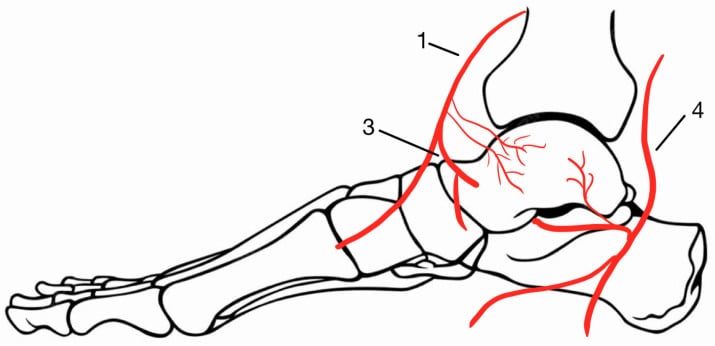
Why it matters. About 60% of the talus is covered by articular cartilage, which carries no periosteal vessels, and the bone has no muscle attachments. It therefore depends on a tenuous, retrograde intraosseous supply through the tarsal canal and sinus. A prolonged dislocation stretches and can compromise those vessels, which significantly increases the risk of AVN, especially when reduction is delayed.
The blocks to reduction. The block sits on the side opposite the direction of displacement, because that side is stretched taut across the prominent talar head. Get this right and the operative approach follows: approach the side of the block, not the side of the deformity. Get it wrong and you open the wrong side of the foot.
A medial dislocation leaves the talar head prominent dorsolaterally, so it is blocked by dorsolateral structures:
- The talar head buttonholes through the extensor digitorum brevis (EDB) - the classic and best-described block
- The talar head is entrapped in the extensor retinaculum
- Talonavicular capsule and ligament interposition, and talonavicular impaction
- The peroneal tendons may wrap around the talar neck
A lateral dislocation leaves the talar head prominent medially, so it is blocked by medial structures:
- The posterior tibial tendon - the characteristic block, and the reason a lateral dislocation more often needs open reduction
- Flexor hallucis longus and flexor digitorum longus may also obstruct
- Talonavicular capsule interposition
The posterior tibial tendon is therefore not the block in a medial dislocation, and the peroneal tendons and extensor retinaculum are not the block in a lateral one: each obstructs the foot displaced away from it.
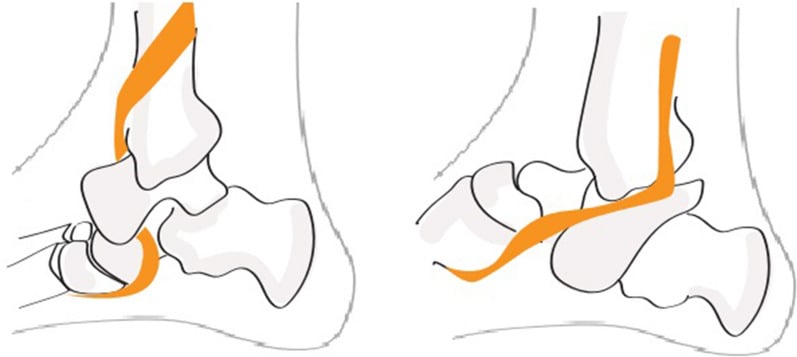
Classification
Subtalar dislocations are named by the direction the foot goes relative to the talus: medial, lateral, anterior or posterior. The classic figures are 85% medial and 15% lateral; pooled modern reviews put the medial share nearer 68-72%.
Medial dislocation. A high-energy inversion force drives the foot into plantarflexion and inversion, in falls, motor vehicle accidents and sport (basketball, hence "basketball foot"), and the calcaneus, navicular and forefoot displace medially under the talus. The talar head is palpable and visible dorsolaterally, with the skin tense over it. Medial is the most common type, has the better prognosis, a lower complication rate and is easier to reduce.
Lateral dislocation. The less common type. A high-energy eversion force drives the foot into dorsiflexion and eversion, and it usually requires greater force than a medial dislocation. The talar head is prominent dorsomedially with the skin tense medially. Open injuries and fractures are more often associated, the complication rate (AVN, arthritis) is higher, and the outcomes are significantly worse.
- Medial Dislocation (85%)
- Adducted and inverted
- Lateral Dislocation (15%)
- Abducted and everted
- Medial Dislocation (85%)
- Acquired clubfoot
- Lateral Dislocation (15%)
- Acquired flatfoot
- Medial Dislocation (85%)
- Inversion force (most common)
- Lateral Dislocation (15%)
- Eversion force
- Medial Dislocation (85%)
- Traction + EVERSION
- Lateral Dislocation (15%)
- Traction + INVERSION
- Medial Dislocation (85%)
- Lower
- Lateral Dislocation (15%)
- Higher (worse prognosis)
Anterior and posterior dislocations. Both are very rare and less well described in the literature.
- Anterior - forced dorsiflexion or a direct anterior force on the heel displaces the foot anteriorly relative to the talus, the forefoot forward. Reduce with longitudinal traction, plantarflex to disengage, then reduce.
- Posterior - forced plantarflexion or a direct posterior force displaces the foot posteriorly, the forefoot backward. Reduce with longitudinal traction, dorsiflex to disengage, then reduce.
Pure dislocation or fracture-dislocation. A pure dislocation, without associated fracture, has the better prognosis, lower complication rates and follows the standard closed reduction protocol. Associated fractures are found in about 60% in pooled series, and they change the prognosis significantly, with higher AVN and post-traumatic arthritis rates. The sites:
- Talar dome and neck (most common)
- Talar body
- Posterior process of the talus
- Sustentaculum tali
- Anterior process of the calcaneus
- Navicular
- Cuboid
- Medial or lateral malleolus
Open or closed. Open injuries are more common with lateral dislocations, need urgent surgical debridement and carry a significantly worse prognosis.
- Closed
- Better (40-90% good)
- Open
- Poor (high complication rate)
- Closed
- Low
- Open
- High - requires debridement
- Closed
- Lower
- Open
- Higher
- Closed
- Lower
- Open
- Higher
- Closed
- Medial type
- Open
- Lateral type
Clinical Assessment
The deformity. The deformity is obvious, with significant swelling and severe pain, and the patient is unable to bear weight. In a medial dislocation the foot is adducted and inverted with the heel in varus; in a lateral dislocation it is abducted and everted with the heel in valgus. Look at the skin over the talar head, which may be tented, and check carefully for open wounds, including between the toes.
Skin tension over the talar head is an emergency. The prominent talar head causes extreme skin tension that can lead to necrosis within hours, full-thickness skin loss, conversion of a closed injury to an open one, and infection. Immediate reduction is mandatory to relieve it.
Neurovascular examination. Examine and document before reduction, then again after it, recording any change in vascular status, any sensory change, and motor function once pain is controlled:
- Dorsalis pedis pulse (may be displaced)
- Posterior tibial pulse
- Capillary refill
- Sensation, if the patient can cooperate: superficial peroneal (dorsum of foot), deep peroneal (first web space), tibial (plantar foot) and sural (lateral foot)
Associated injuries. Locally, look for associated fractures (malleoli, talus, calcaneus, navicular, cuboid) and check the integrity of the ankle mortise. The mechanism is high energy, so assess for polytrauma: spine injuries, other extremity injuries and head injury.
Differential diagnosis. The deformed, swollen hindfoot has several mimics. The single most discriminating step is establishing whether the tibiotalar (ankle) mortise is intact and which articulations have lost congruity.
- Distinguishing feature
- TN + TC joints dislocated, tibiotalar INTACT
- Key discriminator
- Talus stays in mortise; foot displaced under talus
- Distinguishing feature
- Talus dislocated from tibiotalar AND subtalar joints
- Key discriminator
- Talus extruded/rotated out of mortise; very high AVN and infection risk
- Distinguishing feature
- Talus displaced relative to tibia/fibula; mortise disrupted
- Key discriminator
- Malleolar fractures and incongruent mortise on AP/mortise view
- Distinguishing feature
- Fracture line through talar neck, joints may be congruent
- Key discriminator
- Cortical break at talar neck rather than pure joint malalignment
- Distinguishing feature
- TN +/- calcaneocuboid disruption, talocalcaneal INTACT
- Key discriminator
- Subtalar joint congruent; dislocation is distal to talus only
- Distinguishing feature
- Broadened, shortened heel after axial load
- Key discriminator
- Boehler angle change on lateral; subtalar congruity often preserved
Total talar dislocation is the catastrophic end of the peritalar spectrum and a favourite exam contrast. In a subtalar dislocation the talus stays in the ankle mortise while the foot dislocates beneath it. In a total talar dislocation the talus is extruded from all three of its articulations (tibiotalar, talocalcaneal and talonavicular), commonly rotated and often pushed out through a wound; the great majority are open.
The already tenuous talar blood supply is essentially completely stripped, so AVN is near-universal, and because most are open, deep infection is the dominant early threat.
Treat it as an open-fracture emergency: early IV antibiotics and urgent, thorough irrigation and debridement. The long-standing teaching to discard the extruded talus (talectomy) has largely shifted toward reimplantation of the talus, even when fully extruded and after meticulous cleaning, because primary talectomy gives poor function and reimplantation can succeed despite AVN. Primary fusion (tibiocalcaneal/Blair) or delayed reconstruction is reserved for the unsalvageable or infected talus. Counsel for a guarded outcome: AVN, infection and post-traumatic arthritis are the rule rather than the exception.
Investigations
Before reduction. Plain radiographs confirm the diagnosis and the direction:
- AP foot
- Lateral foot
- AP ankle
- Lateral ankle
Read them for four things: the talonavicular and talocalcaneal joints disrupted, the tibiotalar joint intact, any obvious fracture, and the direction of dislocation. Do not delay reduction for perfect films: if the skin is compromised, reduce emergently on the clinical findings and whatever imaging is immediately available.
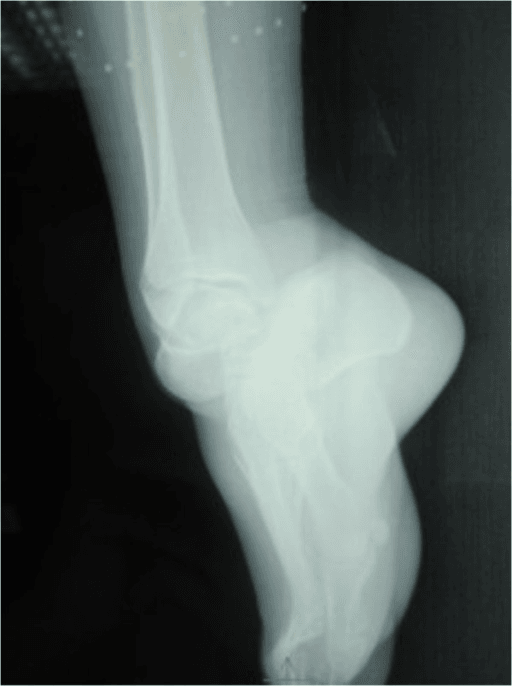
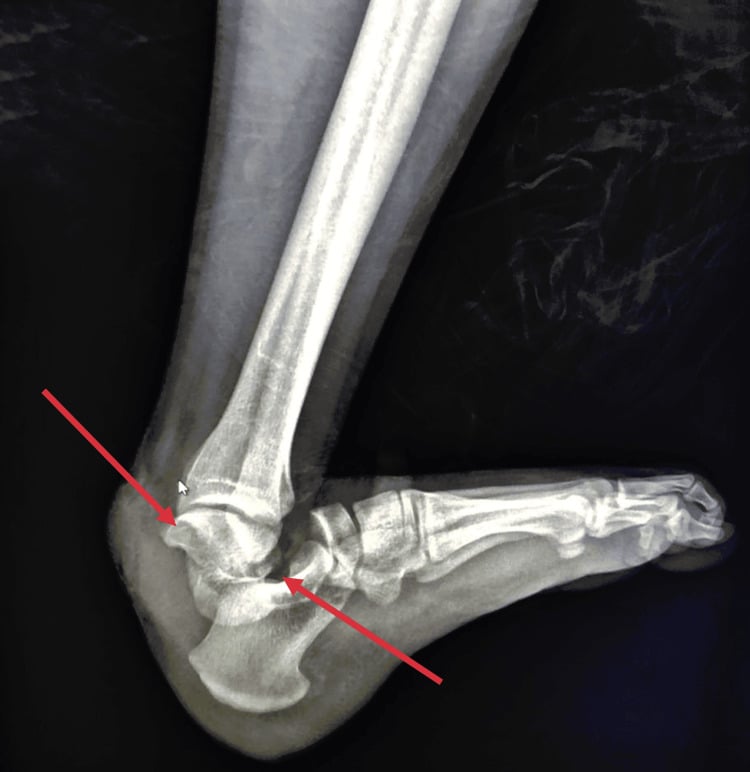
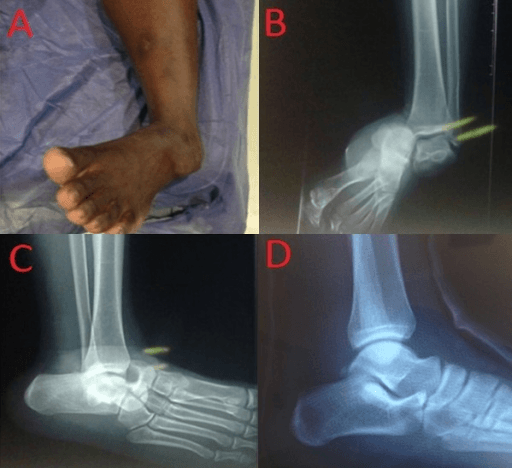
After reduction. Radiographs confirm a congruent reduction of the talonavicular and talocalcaneal joints, check the alignment of the ankle mortise, and show any fracture now visible.
CT is mandatory after every reduction. Associated injuries are found in the great majority: the pooled osseous injury rate is about 60%, and in the Bibbo series CT found additional injuries missed on plain films in all 9 cases and changed management in 44%. Many of these injuries are occult on plain radiographs, and a large fragment may change management. CT is usually performed within 24-48 hours of reduction and looks for:
- Talar dome and neck fractures
- Posterior process fractures
- Calcaneal fractures (sustentaculum, anterior process)
- Navicular and cuboid fractures
- Loose bodies
- Congruency of the reduction
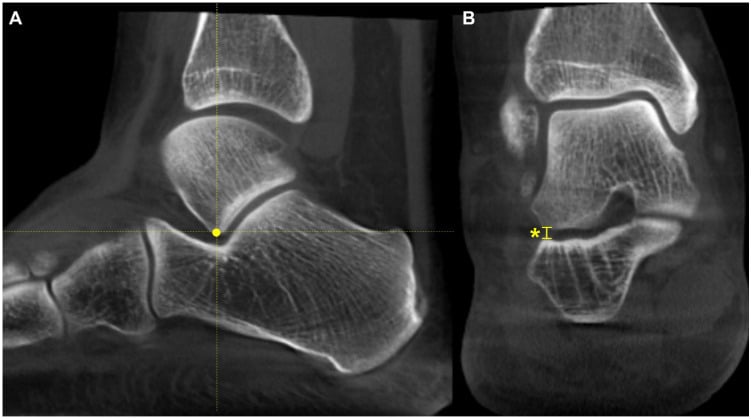
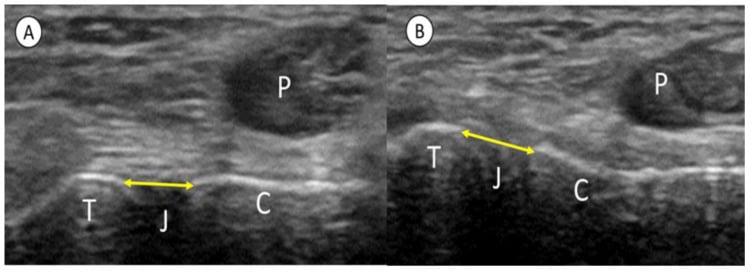
MRI is rarely indicated acutely and is usually a delayed investigation. Its potential indications:
- Suspected chondral injury
- Soft tissue interposition preventing reduction
- Late presentation with concern for AVN
Management
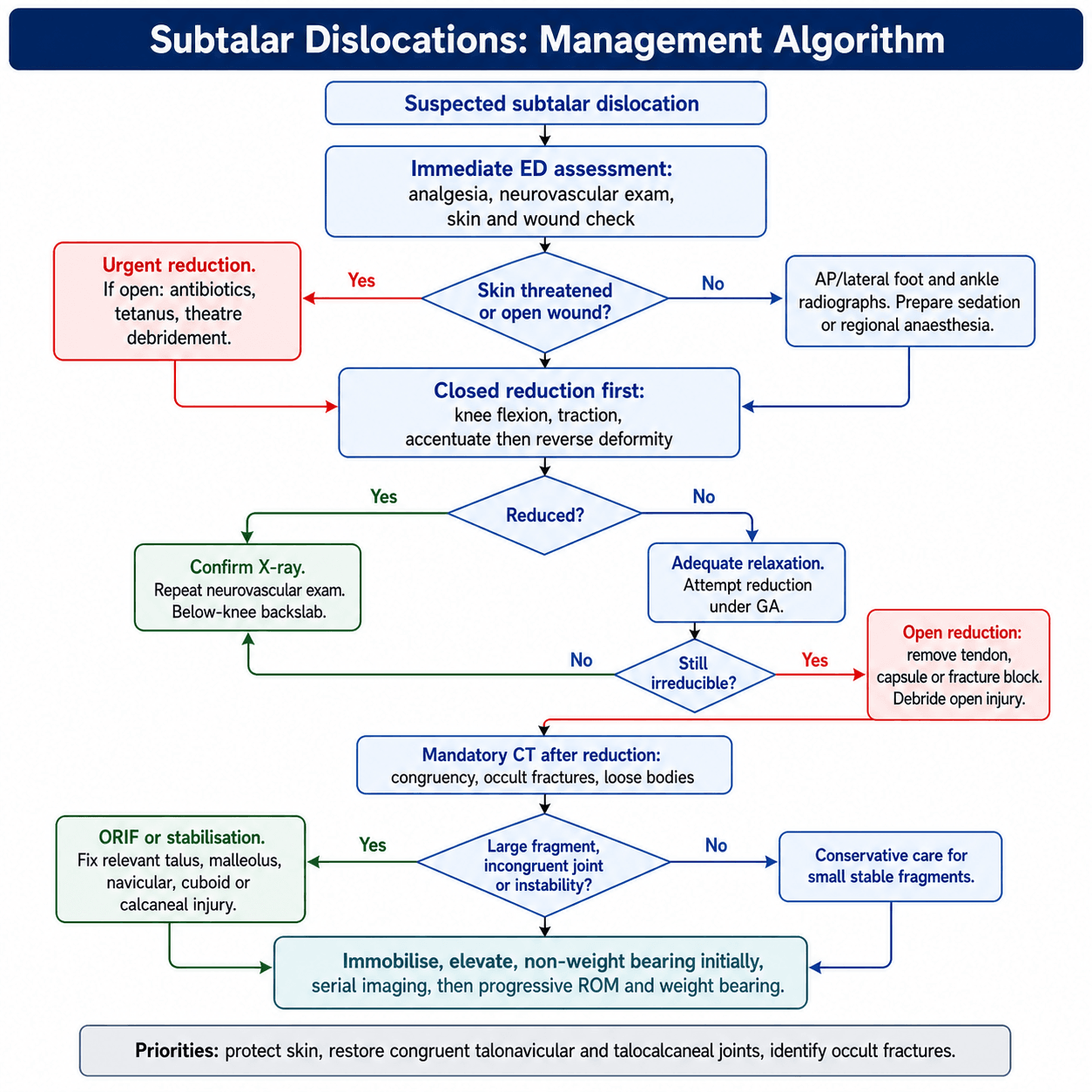
In the emergency department. Examine and document the neurovascular status, assess the skin and look for open wounds, and control the pain. Skin tension is the primary driver of urgency. Set up with the patient supine under procedural sedation or regional anaesthesia, with an assistant for counter-traction; fluoroscopy is helpful but not mandatory.
Closed reduction. The principles are the same for every direction:
- Flex the knee to relax the gastrocnemius
- Apply longitudinal traction
- Accentuate the deformity first, which unlocks the dislocation
- Reverse the deformity to reduce
For a medial dislocation, momentarily increase plantarflexion and inversion, then, maintaining traction, evert and dorsiflex the foot; direct dorsal pressure on the talar head may assist. For a lateral dislocation, momentarily increase eversion, then, maintaining traction, invert the foot, with direct pressure on the talar head. An audible or palpable "clunk" usually accompanies successful reduction.
Closed reduction succeeds in 80-90%, more often for medial than lateral dislocations, and needs adequate sedation or muscle relaxation. Afterwards, confirm the reduction on radiographs, apply a below-knee backslab, reassess the neurovascular status and schedule the CT.
When it will not reduce. Closed reduction fails because of:
- Soft tissue interposition (tendons, capsule), the cause of most failures
- A buttonholed extensor retinaculum
- Associated fracture fragments blocking reduction
- Inadequate analgesia or muscle relaxation
Consider general anaesthesia with complete muscle relaxation and try again; if that fails, proceed to open reduction, which is required in 10-20% of cases. A medial dislocation is approached anterolaterally, which gives direct access to release the buttonholed talar head; a lateral dislocation is approached anteromedially, and may need dual incisions (see Surgical Technique).
Associated fractures. Fragment size decides management. Small fragments (under 25% of the joint surface) usually do not affect stability and are managed conservatively with serial radiographs; they may be excised if a loose body causes symptoms. Large fragments (over 25%) are considered for ORIF, particularly if they affect joint congruency or stability.
- Talar neck and body fractures often require ORIF, with screws from anterior to posterior, following Hawkins classification principles; the AVN risk is higher
- Malleolar fractures are fixed if the ankle mortise is unstable, by standard ORIF techniques
- Calcaneal fractures of the sustentaculum or anterior process are usually treated conservatively unless large
- Navicular and cuboid fractures may need fixation if large; small fragments are often treated conservatively
Is the reduction stable? After any reduction, closed or open, confirm a concentric reduction of both the talonavicular and talocalcaneal joints on fluoroscopy, then stress the hindfoot under the image intensifier through the arc that produced the injury (inversion and eversion, dorsiflexion and plantarflexion). A pure dislocation that reduces with a clear clunk is usually intrinsically stable once the capsuloligamentous sleeve is back in place, and a simple below-knee cast or backslab suffices.
Instability that warrants supplementary fixation is the exception, and it clusters in predictable settings:
- Associated fractures that remain displaced or leave a joint incongruent after reduction (such as talar neck, large talar head or navicular fragments); fix the fracture and the dislocation usually becomes stable
- Re-dislocation or gross subluxation on stress despite a concentric reduction
- Open reduction that has extensively disrupted the stabilising capsule, retinaculum and ligaments, or an open injury with severe soft-tissue loss
When it is unstable, use temporary percutaneous K-wire transfixion across the unstable joint (talonavicular, subtalar or both), removed at about 4 to 6 weeks before the subtalar joint is mobilised. A spanning external fixator suits the grossly unstable, highly comminuted, soft-tissue-compromised or open injury, and allows wound access. Do not prolong immobilisation unnecessarily: the original DeLee and Curtis teaching is that prolonged casting worsens subtalar stiffness, so remove temporary fixation and begin motion as soon as stability allows.
Surgical Technique
Most subtalar dislocations reduce with proper technique and adequate analgesia or muscle relaxation. Open reduction is kept for the injury that will not, or that needs debridement or fixation.
Absolute indications. Open reduction is needed for:
- Irreducible by closed means (soft tissue interposition)
- Open dislocation requiring debridement
- Large displaced fracture-dislocation requiring fixation
Relative indications. Open reduction is relatively indicated for:
- Failed closed reduction under GA with complete muscle relaxation
- Associated fractures requiring ORIF
- Persistent instability after closed reduction (rare)
Interposed soft tissue confirmed on imaging is a further indication.
Whatever the approach, the sequence is the same: identify the blocking structure (usually a tendon or the retinaculum), release or retract it, reduce the talonavicular joint under direct vision and then the talocalcaneal joint, confirm a congruent reduction, repair the soft tissues where possible, and address associated fractures if needed. K-wire stabilisation is added if the reduction is unstable, which is rare.
Complications
Skin necrosis. The most urgent acute complication. It follows a prolonged dislocation with the skin tented over the talar head, can develop within 6-12 hours, may progress to full-thickness loss and can convert a closed injury to an open one. Urgent reduction prevents it.
Neurovascular injury. Seen in 5-10% of cases. The nerve injuries are usually neurapraxia from stretch and most recover with time:
- Superficial peroneal nerve (most common)
- Deep peroneal nerve
- Tibial nerve
Injury to the dorsalis pedis or posterior tibial artery is rare.
Compartment syndrome. Very rare but possible, after high-energy injuries, with associated fractures or after a prolonged dislocation. Keep a high index of suspicion and monitor closely for the first 48 hours.
Post-traumatic arthritis. The most common long-term complication. Its incidence by injury type:
- Pure closed medial dislocation: 30-40%
- Fracture-dislocation: 50-70%
- Open or lateral dislocation: 60-80%
It may take 5-10 years to develop, with progressive symptoms, subtalar crepitus and pain, and joint space narrowing on radiographs. Treat it with activity modification, orthotics and supportive footwear, NSAIDs and corticosteroid injections, and subtalar fusion if severe. Fusion gives reliable pain relief at the cost of further loss of inversion and eversion, which is often well tolerated.
Avascular necrosis. Its incidence by injury type:
- Pure dislocation: 5-10%
- Fracture-dislocation: 15-20%
- Open injury, and lateral or open dislocations: 20-30%
The risk is higher with delayed reduction (over 6 hours), a high-energy mechanism, an associated talar neck fracture, an open injury and the need for open reduction. AVN is initially asymptomatic; pain develops as collapse occurs, followed by progressive deformity and eventually arthritis, and the peak incidence is 12-24 months after injury. Look for the Hawkins sign at 6-8 weeks: subchondral lucency means a good blood supply, and its absence may indicate AVN. MRI, requested if clinical suspicion is high, is the most sensitive test for early detection; radiographic sclerosis and collapse come later. Protected weight bearing is used if AVN is detected early; core decompression is rarely beneficial, and symptomatic AVN usually progresses to fusion, which may need to be talonavicular or triple.
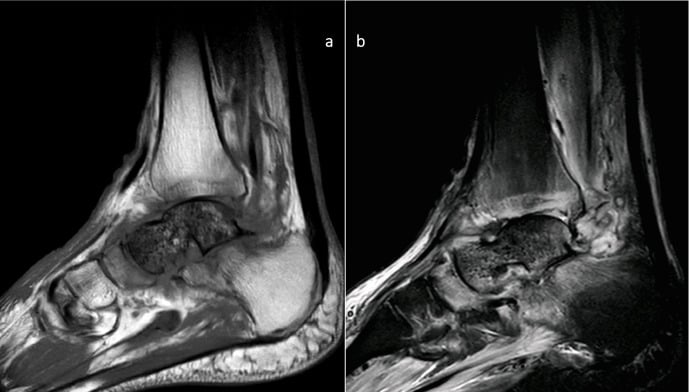
Subtalar stiffness. Universal to some degree. Normal subtalar motion is 20-30 degrees of inversion and 10-20 degrees of eversion, and a 50-70% loss is typical after this injury, inversion more than eversion. The ankle and midfoot often compensate well, and the stiffness may protect against arthritis pain. Walking on flat ground is usually normal; uneven terrain, slopes, inclines and stairs are harder, and some patients need orthotic support. Treat with aggressive physiotherapy for range of motion, orthotic devices and, if severe, an ankle-foot orthosis; most patients adapt well.
Chronic pain. Its incidence is quoted at 10-40% depending on injury severity, although the lateral or open group in Outcomes reaches 40-60%. Its sources are post-traumatic arthritis, subtalar stiffness, nerve injury (neuroma, dysaesthesia) and, rarely, complex regional pain syndrome. Treat it with multimodal pain management, physiotherapy, psychological support and orthotics, and surgery if there is a structural cause.
Malunion and nonunion of associated fractures. A talar malunion alters hindfoot alignment and accelerates arthritis, and may need osteotomy or fusion. Nonunion is rare with adequate immobilisation, may occur with talar neck fractures, and usually requires surgical fixation.
Prevention. Early reduction is the single most important factor, with a target of reduction within 6 hours: it reduces the risk of skin necrosis and AVN and improves overall outcomes. Post-reduction CT allows appropriate fixation, prevents displacement during healing and improves long-term outcomes. Adequate immobilisation, typically for 4-6 weeks, prevents redislocation; non-weight bearing is essential, followed by progressive loading with serial radiographs. Aggressive rehabilitation afterwards (range of motion, strengthening, proprioception and a return-to-activity programme) optimises function.
Postoperative Care
The same protocol follows closed and open reduction, with the additions below for an open reduction.
Weeks 0-2. A below-knee backslab or cast, strictly non-weight bearing on crutches or a knee scooter, with elevation, ice and DVT prophylaxis (rivaroxaban or enoxaparin). Monitor for compartment syndrome over the first 48 hours.
Weeks 2-6. Change to a CAM boot or short leg cast and stay non-weight bearing. Begin ankle range of motion, gentle active dorsiflexion and plantarflexion, if the tibiotalar joint is stable, but do not invert or evert: the subtalar joint is healing.
Weeks 6-8. Radiographs confirm healing. Begin partial weight bearing (25-50%) in the CAM boot, increasing as pain allows, continue ankle motion and begin gentle subtalar motion.
Weeks 8-12. Progress to full weight bearing and wean from the boot to a supportive shoe, with physiotherapy two to three times a week for proprioception, balance and strengthening.
Months 3-6. Full weight bearing in regular shoes, progressive strengthening, balance and proprioception work, and sport-specific training where it applies. From months 4-6 the patient returns to full activity and to sport as its impact allows (see Outcomes); persistent subtalar stiffness is possible, and signs of post-traumatic arthritis are watched for.
After open reduction. Add neurovascular checks every 2 hours for 24 hours, a wound check at 2 weeks and suture removal at 2-3 weeks, with the CAM boot at 2-3 weeks. Non-weight bearing typically lasts 6 weeks, and full weight bearing is reached by 8-10 weeks, with gait retraining added to the rehabilitation. The complication risk is higher than after closed reduction, so watch closely for infection, AVN and arthritis; rehabilitation may be prolonged and the immobilisation period may be slightly longer.
How long to immobilise. DeLee and Curtis found that immobilisation beyond three weeks produced poor results, several series report good results with shorter immobilisation and early subtalar motion, and the optimal duration is not well defined (see Evidence Base and Practice Variation).
Follow-up. Radiographs after reduction, at 2 weeks and at 6 weeks; clinic review at 6 weeks, 12 weeks, 6 months and 12 months, then as needed if symptomatic. At each visit assess pain, range of motion (subtalar inversion and eversion above all), gait, return to work or sport, and radiographic change of arthritis or AVN. For arthritis, take serial radiographs if symptomatic, and consider subtalar fusion if symptomatic arthritis develops.
Outcomes and Prognosis
Prognostic factors. The factors below separate better from worse outcomes.
- Better outcome
- Medial
- Worse outcome
- Lateral (much worse than medial)
- Better outcome
- Closed
- Worse outcome
- Open (infection, AVN and arthritis rates all higher)
- Better outcome
- Pure dislocation
- Worse outcome
- Associated fractures (fracture-dislocation)
- Better outcome
- Early reduction (within 6 hours)
- Worse outcome
- Delayed reduction (over 6 hours)
- Better outcome
- Successful closed reduction
- Worse outcome
- Need for open reduction
- Better outcome
- Worse outcome
- High-energy mechanism
- Better outcome
- Younger (under 40), active before injury, non-smoker, healthy BMI
- Worse outcome
Outcomes by injury type. The subgroup percentages below are conventional estimates from the case-series literature, not measurements from a single cohort. The pooled all-comer anchor is Hoexum 2014 (528 cases: 52.3% good, 25.2% fair, 22.5% poor), with open injury and associated fracture driving the poor results. Arthritis and AVN rates by group are given under Complications.
- Good-excellent
- 60-90%
- Other outcomes
- Chronic pain 10-20%; persistent stiffness common, often well tolerated or asymptomatic
- Good-excellent
- 40-60%
- Other outcomes
- Persistent pain 30-40%; depends on fracture size and location, quality of reduction and successful fixation if needed
- Good-excellent
- 20-40%
- Other outcomes
- Chronic pain 40-60%; infection (open injuries) 10-30%; salvage needed in 20-40%
Salvage is by subtalar fusion (most common), triple arthrodesis, or below-knee amputation in severe cases.
Return to work and sport. After a pure closed medial dislocation most return to work, sedentary work at 2-3 months and manual labour at 4-6 months, and many return to sport, which may be delayed; contact sport takes 6-9 months, and full subtalar motion may never return. Across injuries, the typical return to sport is:
- Low impact (walking, cycling): 3-4 months
- Moderate impact (running): 6-9 months
- High impact (basketball, football): 9-12 months
- Elite athletes may not return to their pre-injury level
Guidelines, Registries & Global Practice
Global Epidemiology
Subtalar dislocation is rare worldwide, accounting for approximately 1% of all traumatic foot injuries and 1-2% of all dislocations, almost always from high-energy trauma (Prada-Cañizares et al, 2016). Pooled data from large systematic reviews give a consistent demographic and directional profile:
- Hoexum 2014 (n=528)
- 76%
- Lugani 2022 (n=389)
- Male predominant
- Hoexum 2014 (n=528)
- 33.8 years
- Lugani 2022 (n=389)
- Young, active adults
- Hoexum 2014 (n=528)
- 71.5%
- Lugani 2022 (n=389)
- 68.1%
- Hoexum 2014 (n=528)
- 26.0%
- Lugani 2022 (n=389)
- 27.7%
- Hoexum 2014 (n=528)
- 22.5%
- Lugani 2022 (n=389)
- Bone exposure 44.5% (lateral-heavy)
- Hoexum 2014 (n=528)
- 61.4%
- Lugani 2022 (n=389)
- Associated lesions 44.5%
- Hoexum 2014 (n=528)
- 14.0%
- Lugani 2022 (n=389)
- Open reduction 48.2% (lateral-heavy)
- Hoexum 2014 (n=528)
- 52.3%
- Lugani 2022 (n=389)
- Lateral subgroup worst
The classic teaching of "medial 85%" derives from small historical series (e.g. DeLee and Curtis, 1982). Modern pooled reviews of several hundred cases place the medial proportion nearer 68-72%. Both figures are defensible in a viva; cite the modern systematic-review denominators if pressed for precision.
Guidelines and Society Guidance
No high-level (Level I/II) guideline or randomised evidence exists for this rare injury - management rests on consistent narrative/systematic reviews and expert consensus. The table summarises how the major bodies frame hindfoot trauma principles relevant to subtalar dislocation.
- Relevant principle
- Emergent reduction of dislocations to protect skin and neurovascular status; post-reduction CT for hindfoot trauma
- Evidence level
- Expert consensus (Level V)
- Relevant principle
- Open dislocations follow open-fracture pathway: early IV antibiotics, combined ortho-plastics, debridement and early coverage
- Evidence level
- Consensus standard
- Relevant principle
- Senior decision-making, CT for complex foot/hindfoot trauma, early definitive care in specialist centres
- Evidence level
- Guideline (consensus-based)
- Relevant principle
- Direction-based reduction manoeuvre, accentuate-then-reverse technique, CT to define associated fractures
- Evidence level
- Expert/teaching consensus
- Relevant principle
- Recognises subtalar dislocation as high-energy injury needing urgent reduction and associated-injury work-up
- Evidence level
- Narrative consensus
Registry Evidence
There is no dedicated joint registry for subtalar dislocation; national arthroplasty registries (AOANJRR, NJR, AJRR) do not capture this injury. Where late post-traumatic subtalar arthritis proceeds to subtalar or triple arthrodesis, those fusion procedures are captured only indirectly in some national trauma/procedure datasets, and outcome evidence remains limited to single-centre series.
Practice Variation
Reported management varies chiefly in three areas with no consensus standard (Byrd et al, 2013): adjunctive percutaneous K-wire fixation (used selectively for residual instability vs not at all), immobilisation type (below-knee cast vs CAM boot), and duration of immobilisation (under 4 weeks vs around 6 weeks). Several series report good results with shorter immobilisation and early subtalar range of motion, consistent with DeLee and Curtis's original recommendation against prolonged casting.
Viva Scenarios
Clinical Decision Scenarios
Practise clinical reasoning and management decisions out loud
“A 25-year-old basketball player presents after a fall landing on an inverted foot. The foot is markedly deformed with an adducted and inverted position. The skin is tented over a prominent bony structure dorsolaterally. How would you manage this?”
“You are unable to reduce a subtalar dislocation despite adequate sedation. What would you do next?”
“Post-reduction CT of a subtalar dislocation shows a talar neck fracture involving 30% of the joint surface. How does this change your management?”
MCQ Practice Points
High-Yield Exam Facts
Q: What defines a subtalar dislocation? A: Simultaneous dislocation of the Talonavicular and Talocalcaneal joints, while the Tibiotalar joint remains intact.
Q: Which type is most common? A: Medial (85%) - caused by inversion (basketball foot), foot displaced medially ("acquired clubfoot").
Q: Why is skin tension an emergency? A: Tented skin over the talar head can necrose within hours. Immediate reduction is mandatory before imaging if skin is compromised.
Q: What is the reduction maneuver? A: Knee flexed (relax gastroc), Traction, Accentuate Deformity, then Reverse Deformity. Medial needs Eversion; Lateral needs Inversion.
Q: What is the critical imaging step after reduction? A: CT Scan is MANDATORY. 40% of cases have occult fractures not visible on X-ray, which may change management.
Q: What is the most common long-term complication? A: Post-traumatic arthritis (30-40% in pure dislocations, higher in fracture-dislocations).
Q: Which factors predict a worse outcome? A: Lateral dislocation, Open injury, Associated fractures, and Delayed reduction.
Q: What structure commonly blocks reduction in medial dislocations? A: The extensor digitorum brevis, through which the talar head buttonholes, or the extensor retinaculum. Both are dorsolateral - and that is the point, because a medially displaced foot is blocked by the structures on its lateral side. The posterior tibial tendon is the answer for a LATERAL dislocation, not this one.
Q: How do you distinguish Subtalar from Total Talar dislocation? A: In Subtalar, the Tibiotalar joint is intact. In Total Talar, the talus is dislocated from the tibia as well (extruded).
DEFINITION
- Dislocation of BOTH talonavicular AND talocalcaneal joints
- Tibiotalar joint remains INTACT
- Also called 'peritalar dislocation'
- Named by direction of FOOT relative to talus
TYPES
- MEDIAL (85%): Foot medial = acquired clubfoot
- LATERAL (15%): Foot lateral = acquired flatfoot
- Anterior and posterior are rare
- Medial has better prognosis than lateral
EMERGENCY
- Tented skin = URGENT reduction needed
- Skin necrosis within hours if unreduced
- Do NOT delay for imaging if skin compromised
- Document neurovascular status before and after
REDUCTION TECHNIQUE
- Flex knee (relax gastrocnemius)
- Longitudinal traction
- ACCENTUATE deformity first
- REVERSE: Medial = evert; Lateral = invert
CT MANDATORY
- Occult associated injuries on CT are the rule (pooled ~60%)
- Plain X-rays miss many injuries
- CT changed management in 44% (Bibbo)
- Always scan after successful reduction
Evidence Base
Key Studies and Evidence
Long-Term Outcomes of Subtalar Dislocation
- Retrospective review of 39 subtalar dislocations over a 10-year period, mean follow-up 5.5 years (range 2-10). Medial dislocations predominated (74%) and a large proportion were open (41%); associated fractures were frequent (64%). Using Hardcastle's scoring system, results were 11 good, 7 fair and 21 poor - associated fractures and open injuries were strongly related to poor results, while good results correlated with accurate reduction.
- Key point: only 11 of 39 (28%) achieved a good result; open injuries and associated fractures drove poor outcomes
Role of CT in Subtalar Dislocation
- Retrospective review of nine subtalar joint dislocations over three years. Plain films diagnosed the dislocation in every patient, but post-reduction CT identified additional injuries missed on plain radiographs in 100% of patients, and in 44% the new information dictated a change in treatment.
- Key point: CT is mandatory after reduction - it detected occult associated injuries in all cases and changed management in 44%
Subtalar Dislocation of the Foot (Classic Series)
- Classic series of 17 subtalar dislocations (1 anterior, 12 medial, 4 lateral); 14 closed and 3 open, with 2 of the 4 lateral dislocations being open. Associated talocalcaneal or talonavicular fractures occurred in 8 feet (some seen only on post-reduction polytomography). Associated articular fractures, open dislocations, and the need for immobilisation beyond three weeks produced poor results, with lateral dislocations particularly prone to poor outcomes.
- Key point: lateral dislocations fare worst because of their high open-injury and associated-fracture burden; early range of motion after short immobilisation is favoured
Systematic Review of 528 Subtalar Dislocations (25 years)
- Systematic review of 76 articles reporting 528 cases (1988-2012). Males (76%) and the right foot (61%) predominated; mean age 33.8 years. Mechanism was a traffic accident in 43.7%, a fall in 32.9% and sport in 13.9%. Direction was medial in 71.5%, lateral in 26.0%, posterior in 1.6% and anterior in 0.8%. Open injury occurred in 22.5% and an associated osseous injury in 61.4%. Closed reduction failed (requiring immediate open reduction) in 14.0%. Pooled outcomes were good in 52.3%, fair in 25.2% and poor in 22.5%.
- Key point: the largest pooled dataset confirms medial dominance (~72%), a substantial open-injury rate (~23%), and that roughly one in seven dislocations is irreducible closed
Narrative Review: Subtalar Dislocation Characteristics and Pitfalls
- Narrative review of 47 articles (389 cases) over thirty years. Medial dislocations (68.1%) outnumbered lateral (27.7%). Bone exposure (44.5%), associated lesions (44.5%) and the need for surgical (open) reduction (48.2%) were far more frequent in lateral dislocations than in other directions. Post-reduction CT is recommended in all cases.
- Key point: lateral dislocations concentrate the difficulty - open wounds, associated injuries and irreducibility cluster in this subgroup
Management and Prognosis Review
- Up-to-date review confirming subtalar dislocation represents approximately 1% of all traumatic foot injuries and 1-2% of all dislocations, typically from high-energy trauma. Irreducible injuries have been reported in 0 to 47% of cases. The most frequent associated fractures involve the posterior process of the talus, talar head, lateral and medial malleoli, and the base of the fifth metatarsal. Early closed reduction is advised, proceeding to open reduction without delay if unsuccessful.
- Key point: incidence is ~1% of foot injuries; irreducibility ranges widely (0-47%) and mandates readiness for open reduction
Summary of Evidence
- Most studies are case series and retrospective reviews
- No randomized controlled trials exist
- Injury is too rare for prospective trials
- Medial dislocation is most common (pooled ~68-72% in large systematic reviews; classically quoted as 85%)
- Post-reduction CT detects associated injuries missed on plain films and changes management in a substantial minority (44% in the Bibbo series)
- Open and lateral dislocations have worse outcomes
- Early reduction is critical for skin viability
- Closed reduction is irreducible in roughly 14% of cases (range 0-47% across series), requiring open reduction
- Post-traumatic arthritis is the most common long-term complication
- Optimal immobilization duration not well-defined
- Role of K-wire stabilization unclear
- Rehabilitation protocols not standardized
- Long-term functional outcome studies needed