High Stress Zone | FEAR Deformity | Reduce Before Reaming | CMN Gold Standard
- Proximal fragment FEAR: Flexed (iliopsoas), Externally rotated, Abducted (glutes), Reduce by matching the leg to it
- REDUCE BEFORE REAMING - nail follows reamer path, cannot correct malreduction
- Cephalomedullary nail is gold standard (not SHS, not plate)
- Long nail preferred - protects entire femur from stress riser
- Atypical fractures - bisphosphonates over 5 years, lateral beaking, check contralateral
- “Russell-Taylor Type II = piriformis involved = trochanteric entry nail required
- “Blocking (Poller) screws placed in concavity of deformity to guide nail
- “Varus malunion is most common error - accept slight valgus, NEVER varus
- “Atypical fractures: bilateral in 28%, prodromal thigh pain, stop bisphosphonates
Overview and Epidemiology
The zone. The subtrochanteric region runs from the lesser trochanter to 5cm distally, or to the isthmus. It is the zone of highest mechanical stress in the entire femur: the transition from cancellous to cortical bone, where the bending moment is at its maximum.
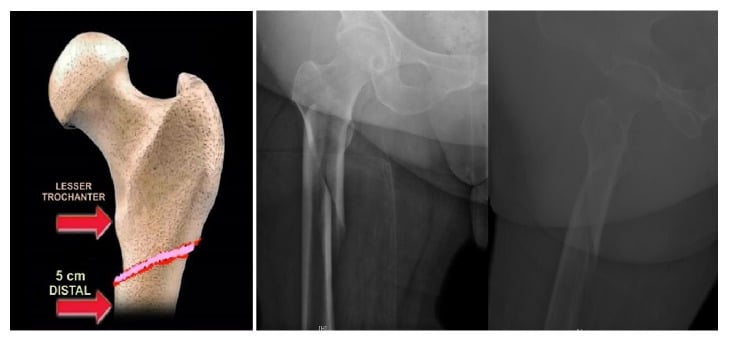
Who. The age distribution is bimodal. Young adults break it in high-energy trauma, with a male predominance; the elderly break it in low-energy falls, through pathological bone or as an atypical fracture, with a female predominance. Subtrochanteric fractures are 10-15% of proximal femoral fractures, and atypical fractures are increasing in incidence (bisphosphonate awareness). Knowing who breaks it, and how, guides suspicion of the underlying cause.
Mechanism. The mechanism helps distinguish the standard traumatic fracture from the atypical one:
- High-energy (young): motor vehicle accidents, motorcycle crashes, falls from height and sporting injuries; associated polytrauma is common
- Low-energy (elderly): a fall from standing height, minimal trauma or a spontaneous fracture, a fracture through a metastasis, or an atypical bisphosphonate-associated fracture
- Atypical: associated with over 5 years of bisphosphonate use, preceded by prodromal thigh pain for weeks to months, and may occur with minimal or no trauma
Risk factors. They guide investigation and treatment planning:
- Standard fractures: high-energy trauma, osteoporosis, metastatic bone disease, primary bone tumours, metabolic bone disease
- Atypical fractures: bisphosphonate use over 5 years, glucocorticoids, proton pump inhibitors, diabetes mellitus, rheumatoid arthritis, and Asian ethnicity (slightly higher risk)
Anatomy and Biomechanics
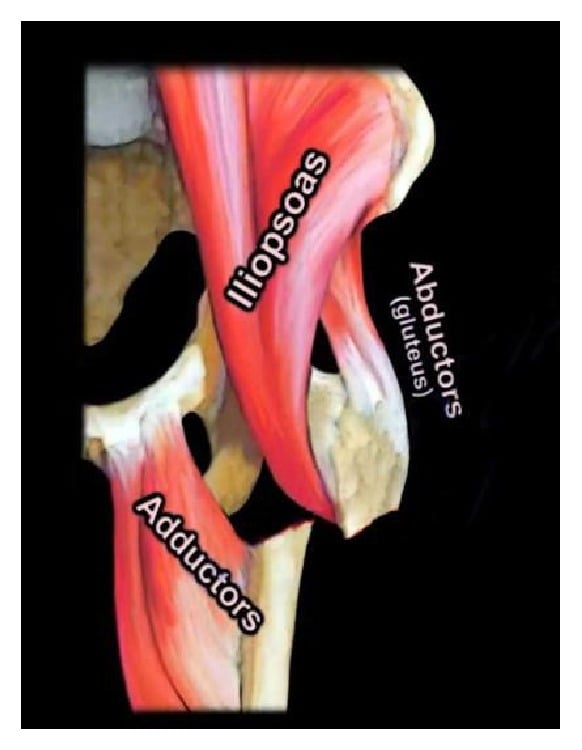
The deforming muscles. Once the fracture has disrupted the lever arm, the proximal fragment is controlled by the gluteal abductors and iliopsoas, and each muscle group pulls a fragment its own way:
- Iliopsoas, on the lesser trochanter, flexes the proximal fragment 30-60 degrees
- The short external rotators, intertrochanteric, externally rotate it
- Gluteus medius and minimus, on the greater trochanter, abduct it
- The adductors, on the linea aspera, adduct the distal fragment
FEAR. The proximal fragment ends up Flexed, Externally rotated and Abducted, and the R is the reduction: match the leg to the proximal fragment by flexing the hip, abducting it and externally rotating slightly.
The blood supply. The periosteal supply comes from perforating branches of the profunda femoris and feeds the outer third of the cortex; it is preserved with minimal soft-tissue stripping. The endosteal supply is the nutrient artery, also from the profunda femoris, which enters the posterior cortex and feeds the inner two-thirds. Reaming disrupts it.
Why it matters. Surgery here balances biology against mechanics. Avoid excessive periosteal stripping, and accept that reaming, although it disrupts the endosteal supply, promotes a healing response.
The mechanics. The medial cortex is loaded in compression and the lateral cortex in tension, so any implant must resist high bending forces. An intramedullary nail does this better than a plate: it is load-sharing, sits on a shorter lever arm to the fracture, resists the bending moment effectively and allows early weight-bearing. A plate is load-bearing and has a higher failure rate, and a short nail creates a stress riser distally. Biomechanics is why the cephalomedullary nail is superior to plating in this region.
Classification Systems
Russell-Taylor decides the nail entry point, Seinsheimer describes the complexity and stability of the pattern, and the ASBMR criteria identify the atypical fracture that needs modified management.
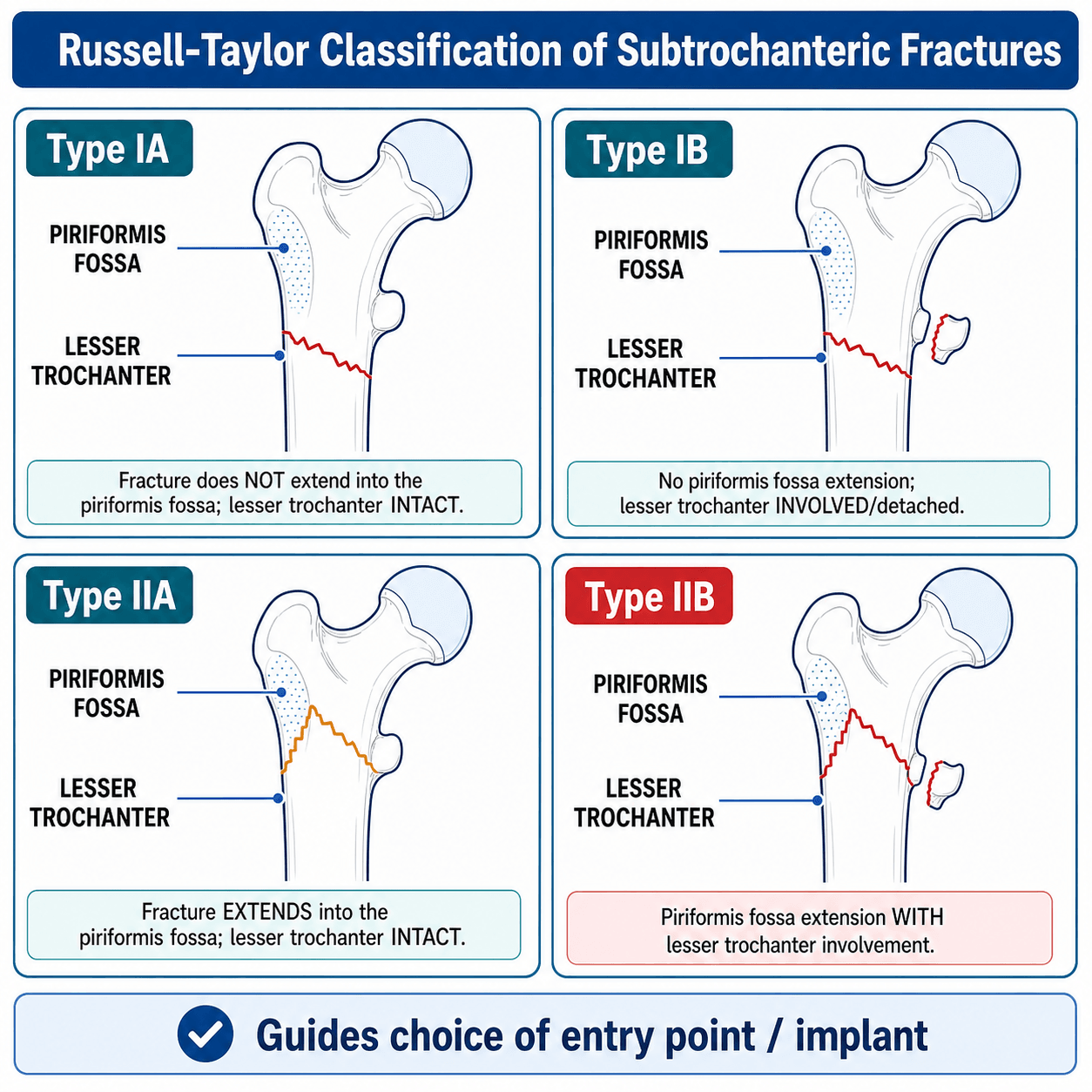
The Russell-Taylor classification determines the nail entry point from how far the fracture extends. Type I leaves the piriformis fossa intact and a piriformis-entry nail can be used; type II involves it and must use a trochanteric-entry nail.
- Piriformis Fossa
- Intact
- Lesser Trochanter
- Intact
- Entry Point
- Piriformis entry possible
- Piriformis Fossa
- Intact
- Lesser Trochanter
- Fractured
- Entry Point
- Piriformis entry possible
- Piriformis Fossa
- Involved
- Lesser Trochanter
- Intact
- Entry Point
- Trochanteric entry required
- Piriformis Fossa
- Involved
- Lesser Trochanter
- Fractured
- Entry Point
- Trochanteric entry required
Why the fossa matters. The piriformis fossa is the entry point for a first-generation piriformis-entry nail. If the fracture line runs through it, reaming and nail insertion through that point drive the proximal fragment into varus and malreduce the fracture. That is the whole reason type II avoids a standard piriformis-entry nail.
Most contemporary nails use a trochanteric entry, which sidesteps the fossa altogether, so the type I/II split is far less decision-critical than when Russell and Taylor devised it. Randomised comparisons (Starr; Lee) found little outcome difference between entry portals, or between a reconstruction nail and a plate. Quoting the rule and knowing why it has softened is what separates a recited answer.
Clinical Presentation and Assessment
History. The history sorts the fracture into traumatic, atypical or pathological, and that decides the workup. After a high-energy injury, associated injuries are common. The questions that matter in the others:
- Atypical: minimal trauma (a fall from standing) or a spontaneous fracture, prodromal thigh pain, glucocorticoid use, and the bisphosphonate history, asking the duration specifically
- Pathological: known malignancy, weight loss, night sweats, previous radiation, and a history of metabolic bone disease
Examination. The limb is shortened and externally rotated, the thigh swollen from significant blood loss, and the patient unable to weight bear; ecchymosis may be delayed. The position of the proximal fragment is difficult to assess clinically, but note any rotational or angular deformity and whether the fracture is open or closed.
Neurovascular status. Record the dorsalis pedis and posterior tibial pulses, sciatic nerve function, and motor and sensory function in the foot, and assess the thigh compartments.
Trauma survey. A high-energy injury gets an ATLS assessment, with a search for ipsilateral injuries (the floating knee), spine clearance, and the chest and abdomen in polytrauma.
- Open fracture requiring urgent debridement
- Vascular injury (rare but devastating)
- Compartment syndrome (thigh compartments)
- Polytrauma requiring damage control
- Significant haemorrhage (can be occult)
Flags that change the treatment. Contralateral thigh pain means checking the other femur. On the radiograph, a transverse pattern with lateral beaking flags an atypical fracture and a lytic lesion flags a pathological one, where biopsy before definitive fixation should be considered.
- Discriminating Features
- Comminution, spiral/oblique pattern, significant trauma, FEAR proximal-fragment deformity
- Key Action
- Long cephalomedullary nail, reduce before reaming
- Discriminating Features
- Transverse pattern, lateral cortex beaking, minimal trauma, prodromal thigh pain, bisphosphonate over 5 years
- Key Action
- Image contralateral femur, stop antiresorptive, bone-health workup
- Discriminating Features
- Lytic lesion, known malignancy, weight loss/night sweats, cortical destruction
- Key Action
- Staging imaging and biopsy before definitive fixation
- Discriminating Features
- Fracture line from distomedial to proximolateral; behaves biomechanically like subtrochanteric
- Key Action
- Intramedullary nail (not sliding hip screw)
- Discriminating Features
- Between greater and lesser trochanter, no shaft extension distal to lesser trochanter
- Key Action
- Sliding hip screw or cephalomedullary nail per pattern
- Discriminating Features
- Proximal to intertrochanteric line, risk of avascular necrosis
- Key Action
- Arthroplasty or fixation depending on age/displacement
Investigations
Radiographs. Three sets of films:
- Full-length femur, AP and lateral, which must show the hip and the knee
- AP pelvis, for comparison and the proximal extent
- Contralateral femur, if an atypical fracture is suspected
Read them for the pattern and comminution, the proximal and distal extent, piriformis fossa involvement (Russell-Taylor), the canal diameter for nail sizing, and atypical features such as lateral beaking.
CT and MRI. CT is for complex patterns, planning in difficult cases, assessing proximal extension and evaluating a pathological fracture. MRI or a bone scan evaluates a stress fracture or an incomplete contralateral fracture, and characterises a pathological lesion if metastatic disease is suspected. The choice follows the clinical suspicion and the needs of surgical planning.
Recognising the atypical fracture. The pattern is transverse or short oblique, starting at the lateral cortex, with beaking or thickening of the lateral cortex, generalised cortical thickening, and little comminution despite the mechanism. The change is often visible on radiographs before the fracture completes.
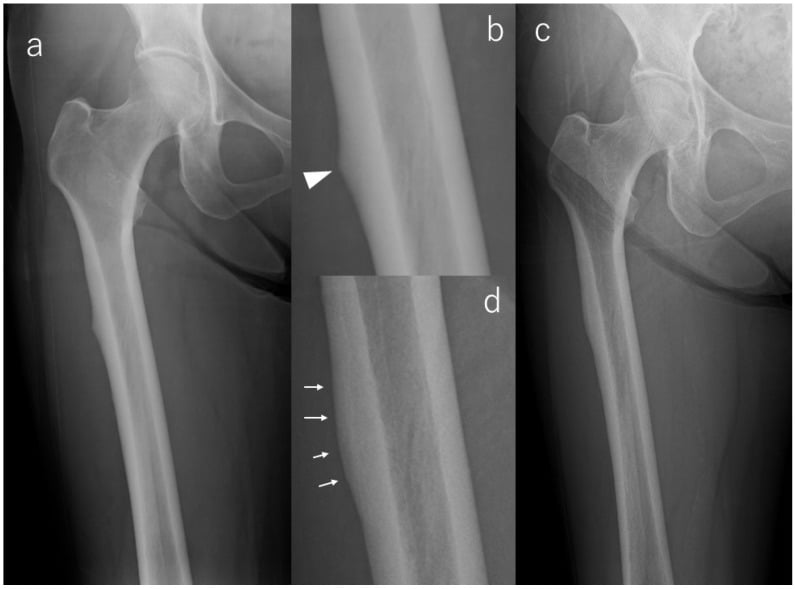
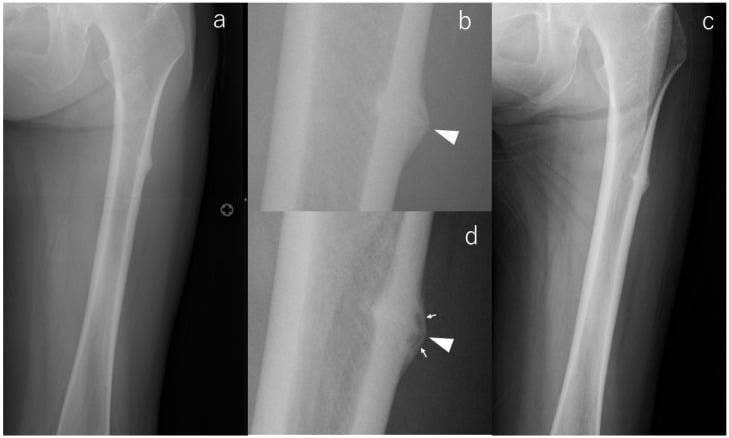
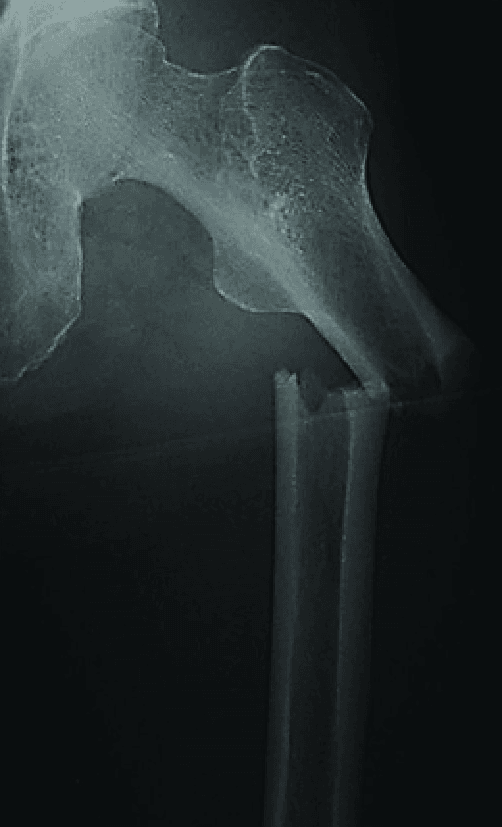
The atypical workup. A radiograph of the contralateral femur is mandatory (bilateral in 28%), with MRI if an incomplete fracture is suspected. The metabolic screen is vitamin D, calcium, PTH, phosphate and bone turnover markers (P1NP, CTX). Endocrinology is involved for bone-health optimisation, alternative osteoporosis treatment and monitoring during healing.
Preoperative planning. Measure the canal diameter at the isthmus for the nail diameter, the femoral length for the nail length, and the neck-shaft angle, and assess the entry point. Review Russell-Taylor for the entry point and Seinsheimer for pattern complexity, then plan the reduction strategy from the pattern. The equipment:
- Long cephalomedullary nail
- Reduction aids: clamps, K-wires, cerclage
- Blocking screw set
- Fracture table or radiolucent table
- Fluoroscopy (C-arm)
Management
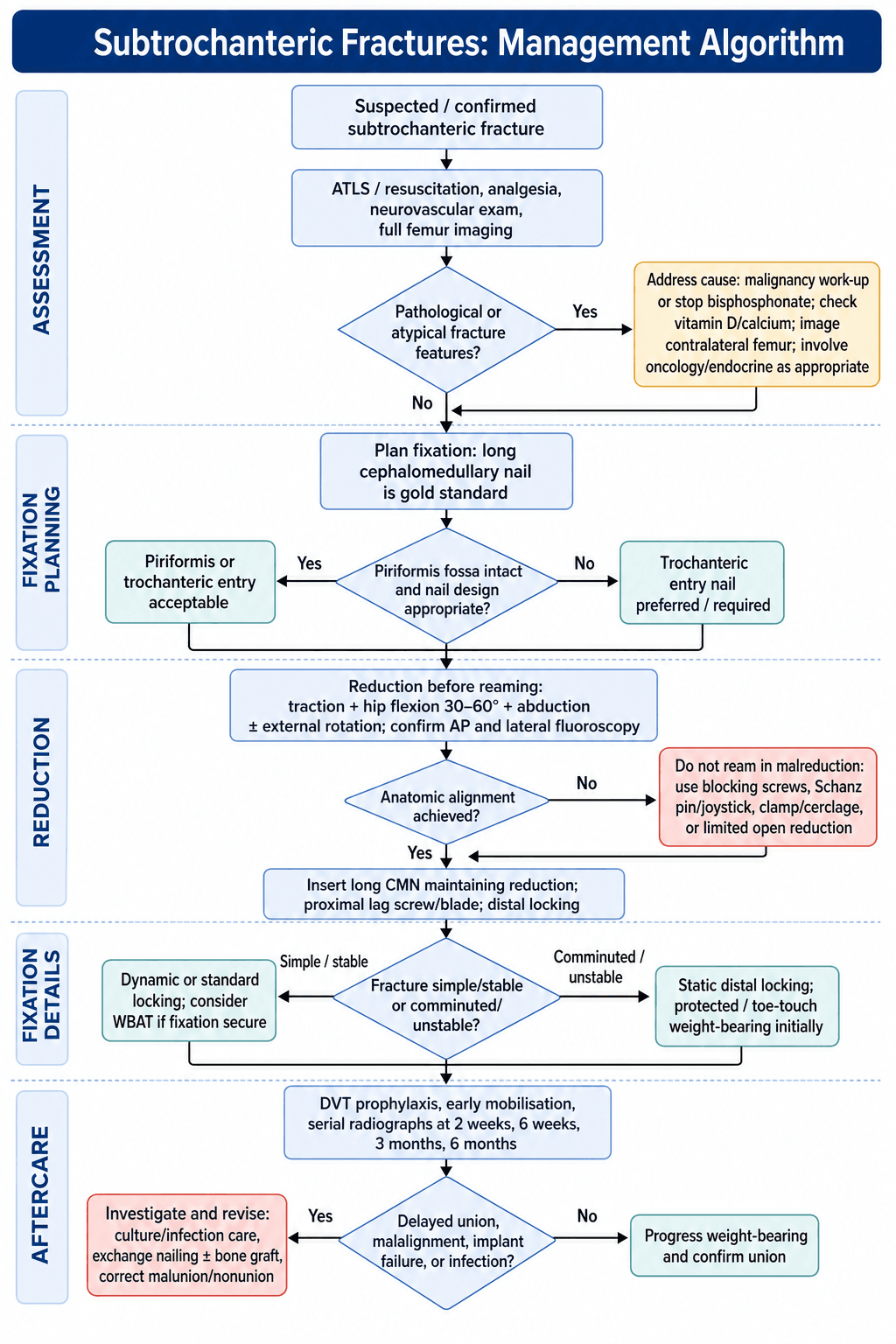
REDUCE BEFORE REAMING
The nail follows the path of the reamer. If you ream in malreduction, the nail will hold that malreduction permanently. Always confirm reduction on AP and lateral fluoroscopy BEFORE reaming.
Goals. Anatomical alignment in length, rotation and axis; stable fixation that allows early mobilisation; biology preserved where possible; and the underlying cause addressed if the fracture is pathological or atypical.
The implant. The cephalomedullary nail is the gold standard, for the mechanical reasons above. A long nail is preferred because it protects the entire femur and prevents a distal stress riser; a short nail is only for the truly isolated subtrochanteric fracture, which is rare. The diameter is chosen for the canal.
The entry point. Piriformis entry is for Russell-Taylor type I only. Trochanteric entry is required for type II and suitable for any type, most modern nails are designed for it, and the entry point is specific to the nail.
Plates. A plate is not first-line. The blade plate or proximal femoral locking plate is reserved for salvage and revision. Plates had higher failure rates historically, and as load-bearing devices they bring more complications. Pooled, the evidence favours the nail, the Kuzyk systematic review finding that intramedullary implants reduce operative time and fixation failure (Evidence Base).
The peritrochanteric/subtrochanteric femur is a common site of metastatic and impending pathological fracture, and the management diverges from a simple trauma nail:
- Suspect pathology with a low-energy mechanism, antecedent pain (a prodrome of activity-related thigh/hip pain), a lytic/destructive lesion, or a known/possible primary; in any such case do NOT just nail it.
- Biopsy/stage before fixation if the primary is unknown - nailing an undiagnosed primary bone sarcoma (or seeding the canal) can convert a curable tumour into an unsalvageable limb. Get the diagnosis (and exclude myeloma/renal/other primaries) first.
- Protect the WHOLE femur with a long cephalomedullary nail - in metastatic disease the bone distal (and proximal) to the lesion is also at risk, so a long load-sharing nail prophylactically spans the femur rather than leaving a stress riser.
- The construct must outlast the patient/bone: pathological bone may never unite, so durable fixation (and often cement augmentation) matters more than waiting for biological healing.
- Give post-operative radiotherapy to the fixed segment to control local tumour, and manage bone health/systemic disease with oncology.
The impending-fracture scoring is covered under metastatic bone disease.
The atypical fracture before and at surgery. Stop the bisphosphonate immediately, image the contralateral femur, optimise vitamin D and calcium, and refer to endocrinology. At operation, open reduction is often required, proximal and distal fixation must both be secure, and bone graft is considered: local, from the iliac crest or with the reamer-irrigator-aspirator (RIA).
After surgery. Expect delayed healing compared with standard subtrochanteric fractures: counsel the patient, protect weight-bearing for longer and extend follow-up for union. Endocrinology stays involved for long-term bone health, with vitamin D and calcium supplementation. Consider teriparatide (a PTH analogue) postoperatively; the evidence that it advances healing is observational and inconsistent (Evidence Base).
The other femur. If it shows a stress fracture, nail it prophylactically before it completes. If there is only a prodrome, protect weight-bearing and monitor closely with serial imaging.
- Key Action
- Long CMN, reduce before reaming
- Implant Choice
- Trochanteric entry CMN, long nail
- Key Action
- Check for atypical, image contralateral
- Implant Choice
- CMN + bone graft, stop bisphosphonates
- Key Action
- Cannot use piriformis entry
- Implant Choice
- Trochanteric entry CMN required
- Key Action
- STOP - do not accept this
- Implant Choice
- Blocking screws, reposition, re-reduce
- Key Action
- Risk of complete fracture
- Implant Choice
- Prophylactic nailing
Surgical Technique
Positioning. The supine fracture table is the most common set-up and the one preferred. The lateral decubitus position gives better reduction control, and a radiolucent table with manual traction is acceptable.
Reduction, then the nail. The leg is matched to the proximal fragment: hip flexion matches the iliopsoas flexion, abduction matches the gluteal abduction, and traction provides length. The sequence:
- Traction for length
- Flex the hip 30-60 degrees to neutralise iliopsoas
- Abduct the leg to align with the proximal fragment
- Externally rotate slightly if needed, and reduce under fluoroscopy, adding blocking screws if the coronal plane is unstable
- Confirm reduction on AP and lateral BEFORE reaming
- Incise over the entry point (trochanteric or piriformis, per nail design) and open the cortex with an awl
- Pass the guidewire across the fracture with the reduction held
- Ream in 2mm increments to 1-1.5mm above the nail diameter
- Insert the nail, maintaining reduction
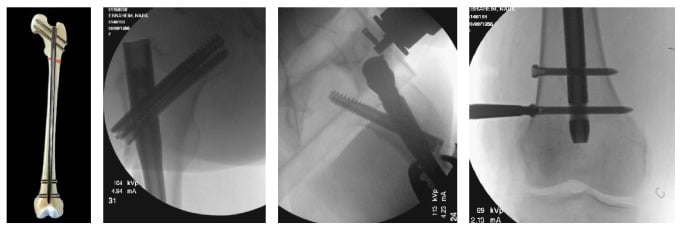
- Lock proximally with a lag screw or blade into the femoral head
- Lock distally: static for comminuted patterns, dynamic if simple
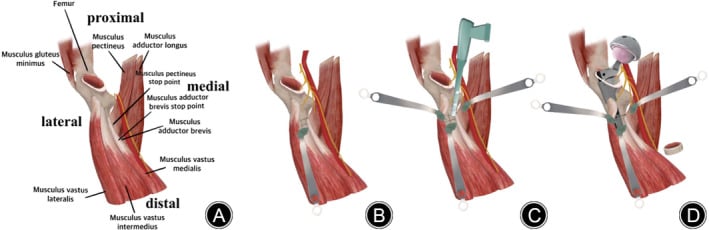
Complications
Intraoperative. Malreduction is the most common complication and the most preventable: varus, procurvatum or rotational malreduction, prevented by reducing before reaming. Iatrogenic fracture occurs at the entry point or distally during nail insertion; adequate reaming and the correct entry point prevent it, and it may need additional fixation. Hardware malposition means a malpositioned lag screw, a short nail creating a stress riser, or inadequate distal locking.
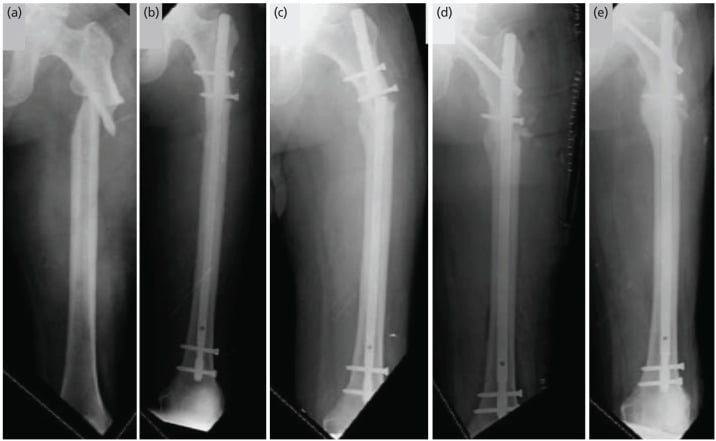
Nonunion. Historically 10-20%, improved with modern cephalomedullary nails. The risk factors are comminution, infection, varus and an atypical fracture, and the treatment is exchange nailing with bone graft.
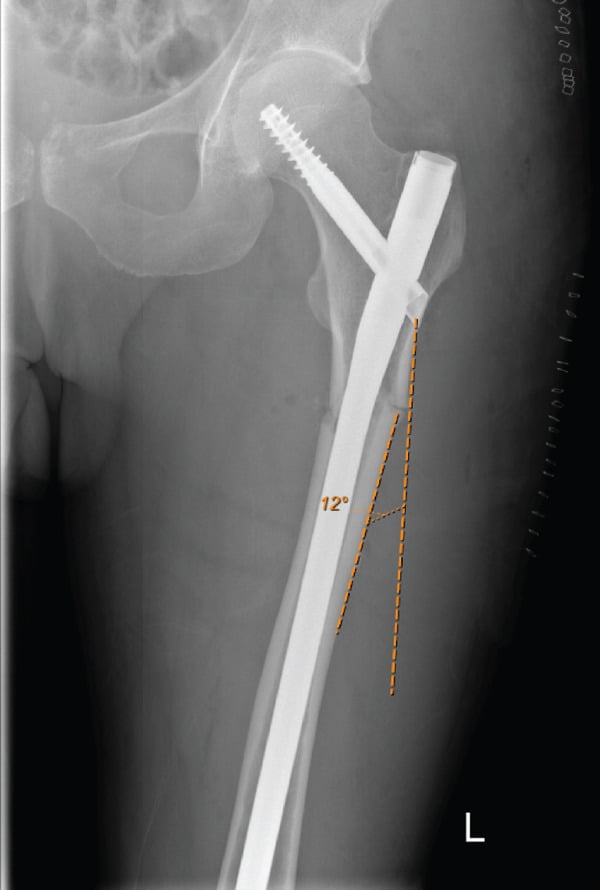
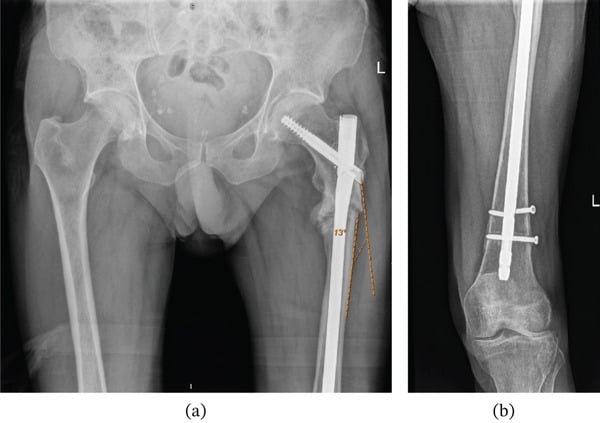
Malunion. Varus is the most common, deviating the mechanical axis, and may require corrective osteotomy.
Implant failure. The nail breaks at the fracture site, or the lag screw cuts out, less commonly than in intertrochanteric fractures. It is usually related to nonunion.
Infection. Under 1% for closed fractures and higher for open ones. Treatment is debridement, antibiotics and possible implant exchange.
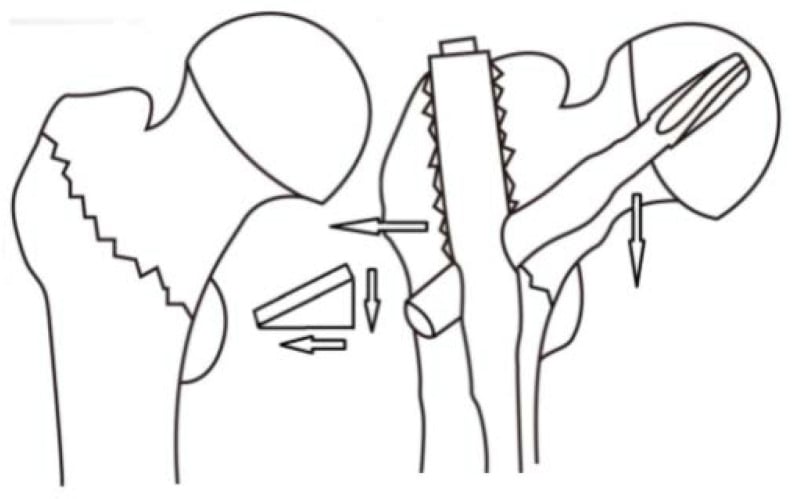
The subtrochanteric region is one of the highest-stress zones in the skeleton, with a long lever arm, so "exchange nail and graft" undersells the salvage. The recurring root cause is varus malreduction with a medial cortical gap, and the salvage must correct the deformity, not just swap metal:
- Correct the varus: re-reduce into neutral/slight valgus (sometimes a valgus-producing osteotomy), and restore medial (calcar) cortical contact - a persisting medial gap will fatigue any implant.
- Add a fixed-angle, often load-sharing-plus construct: options are an exchange reamed cephalomedullary nail (when alignment can be corrected down the canal) or revision to a 95-degree fixed-angle blade plate / proximal femoral locking plate when nail control of the proximal fragment has failed.
- Restore biology: autograft (iliac crest or RIA), exclude infection first, and optimise the host (stop bisphosphonate if atypical, vitamin D/calcium, consider teriparatide).
The general hypertrophic-versus-atrophic nonunion framework is covered at tibial-shaft fractures.
Late. These affect long-term quality of life and may require intervention:
- Chronic pain: thigh pain from the nail, which may require nail removal after union, and heterotopic ossification around the entry point
- Limb length discrepancy: from malreduction or bone loss; a shoe lift if under 2cm, lengthening if severe
- Refracture: after implant removal, through the stress riser at the screw holes
- Functional limitation: hip stiffness, knee stiffness (with an associated injury), and abductor weakness from the approach
Postoperative Care
The first two weeks. Check the wounds at 48 hours and remove drains at 24-48 hours once the output is below 50mL. Physiotherapy starts on day 1; early mobilisation reduces complications and improves outcomes in elderly patients. Analgesia is multimodal, opioids are weaned as tolerated, and regional blocks are considered for enhanced recovery.
Thromboprophylaxis. This is a high-risk injury. Chemical prophylaxis runs for a minimum of 4-6 weeks, LMWH preferred (enoxaparin 40mg daily), with mechanical prophylaxis (TED stockings and intermittent pneumatic compression) and early mobilisation.
Weight-bearing. It depends on the fracture pattern and the stability of fixation. Most cephalomedullary fixation allows touch weight-bearing or weight-bearing as tolerated, and a simple pattern with good fixation can bear weight as tolerated. Comminuted or complex patterns are toe-touch, and comminuted or unstable ones may require protected weight-bearing for 6-8 weeks; progress follows healing.
Follow-up. The reviews and what each is for:
- 2 weeks: wound check, suture removal and radiograph
- 6 weeks: clinical and radiological review; progress weight-bearing
- 12 weeks: radiograph and assessment of union and progression to full weight-bearing
- 6 months: confirm union
The 6- and 12-week radiographs look for callus formation and implant position, and for signs of varus collapse or implant failure.
Rehabilitation. Progressive strengthening, range of motion at the hip and knee, gait training as weight-bearing progresses, and hydrotherapy once the wound has healed.
Warning signs. Watch for:
- Increasing pain, suggesting nonunion or hardware failure
- Wound complications
- Progressive shortening (varus collapse)
- New-onset thigh pain (implant irritation or failure)
Union and return to activity. Union is clinical (full weight-bearing without pain) and radiological (bridging callus on 3 cortices), and takes 4-6 months on average. Light activities resume at 3 months and full unrestricted activity once united, although high-impact activities may be limited long-term. Driving is typically permitted at 6-8 weeks if right-sided and automatic.
The long term. Review annually until implant removal is considered, assessing leg length and watching for late complications. Removal is not routinely recommended; consider it for symptoms such as thigh pain or prominent hardware, delay it a minimum of 18-24 months after union, and warn of refracture through the screw holes.
Outcomes and Prognosis
- Union Rate
- 90-95%
- Complication Rate
- 10-15%
- Notes
- Gold standard, load-sharing
- Union Rate
- 80-85%
- Complication Rate
- 20-25%
- Notes
- Historical data
- Union Rate
- 70-80%
- Complication Rate
- 30-40%
- Notes
- Higher failure, reserved for salvage
Prognostic factors. A simple fracture pattern, an adequate reduction, a long cephalomedullary nail, a young and healthy patient and good bone quality are favourable. Comminution, varus malreduction, an atypical fracture (delayed healing), an open fracture and osteoporosis are unfavourable.
Guidelines, Registries & Global Practice
Global Epidemiology
Subtrochanteric fractures account for approximately 10-15% of proximal femoral fractures, with a bimodal distribution: high-energy injuries in young men and low-energy, osteoporotic or atypical fractures in older women. Atypical femoral fractures are strongly associated with antiresorptive therapy but remain rare in absolute terms.
- Magnitude
- RR 47.3 (95% CI 25.6-87.3)
- Source
- Schilcher, NEJM 2011 (Sweden)
- Magnitude
- 5 per 10,000 patient-years
- Source
- Schilcher, NEJM 2011
- Magnitude
- 3.2-50 per 100,000 person-years
- Source
- ASBMR Task Force 2014
- Magnitude
- Approx 70% per year since last use
- Source
- Schilcher, NEJM 2011
These figures derive from the Swedish nationwide cohort of Schilcher and colleagues (DOI) and the second ASBMR Task Force report (DOI).
Guideline & Society Positions
- Position
- Cephalomedullary (intramedullary) nail is the preferred construct; anatomical reduction before reaming; long nail to avoid distal stress riser
- Basis
- Expert consensus + systematic review (Grade B)
- Position
- Extracapsular fractures with subtrochanteric involvement should be fixed with an intramedullary nail rather than a sliding hip screw
- Basis
- Evidence-based guideline
- Position
- Early surgery, full-length femoral imaging, anatomical reduction and rehabilitation within an orthogeriatric pathway
- Basis
- Standards of care
- Position
- Screen low-energy subtrochanteric fractures for atypical features; stop antiresorptive, image contralateral femur, optimise bone health, consider teriparatide
- Basis
- Consensus / Level IV
Registry & Practice Variation
National hip-fracture registries and arthroplasty/trauma registries (including the AOANJRR in Australia, the National Hip Fracture Database in the UK, and equivalent Scandinavian registries that generated the atypical-fracture risk estimates above) consistently show cephalomedullary nailing as the dominant fixation method for subtrochanteric and reverse-oblique patterns. Practice variation persists in entry point (trochanteric versus piriformis), routine use of cerclage/open reduction adjuncts, and weight-bearing protocols.
MCQ Practice Points
Q: What is the classic proximal fragment deformity in subtrochanteric fractures and why?
A: FEAR - Flexed (iliopsoas on lesser trochanter), Externally rotated (short external rotators), Abducted (gluteus medius/minimus on greater trochanter). The distal fragment is adducted by the adductors.
Q: What is the critical principle regarding reduction and reaming in subtrochanteric fractures?
A: REDUCE BEFORE REAMING. The nail follows the path of the reamer. If you ream a malreduced fracture, the nail locks in that malreduction. Always confirm reduction on AP and lateral fluoroscopy before reaming.
Q: What determines the nail entry point in Russell-Taylor classification?
A: Piriformis fossa involvement. Type I (piriformis intact) = piriformis entry possible. Type II (piriformis involved) = trochanteric entry required.
Q: What are the key features of an atypical bisphosphonate-associated fracture?
A: Transverse or short oblique pattern, lateral cortex beaking/thickening, minimal trauma mechanism, associated with over 5 years bisphosphonate use. Must image contralateral femur (bilateral in 28%).
Q: Where do you place blocking screws to prevent varus malunion?
A: On the medial side of the distal fragment (in the concavity of the deformity). This narrows the canal medially and forces the nail/wire to track more laterally, preventing varus.
Exam Viva Scenarios
Practise clinical reasoning and management decisions out loud
“A 28-year-old male presents after motorcycle accident with isolated subtrochanteric femur fracture. X-rays show comminuted fracture with the proximal fragment appearing flexed and abducted. Neurologically intact.”
“A 72-year-old woman on alendronate for 9 years presents with sudden-onset thigh pain while walking. X-rays show an incomplete lateral cortex fracture with cortical thickening at the subtrochanteric region.”
“You are nailing a subtrochanteric fracture. After reaming, you notice the fracture has displaced into varus. The consultant asks how this happened and what you would do.”
Definition and Location
- Lesser trochanter to 5cm distally
- Highest stress zone of entire femur
- Transition from cancellous to cortical bone
- Bimodal: young trauma vs elderly osteoporotic
Proximal Fragment Deformity (FEAR)
- Flexed 30-60 degrees (iliopsoas)
- Externally rotated (short rotators)
- Abducted (gluteus medius/minimus)
- Match leg position to proximal fragment
Russell-Taylor Classification
- Type I = Piriformis intact = Piriformis entry OK
- Type II = Piriformis involved = Trochanteric entry
- A = Lesser trochanter intact
- B = Lesser trochanter fractured
Key Surgical Principles
- CMN is gold standard (not plate)
- REDUCE BEFORE REAMING
- Long nail preferred (protects entire femur)
- Blocking screws for alignment control
- Accept slight valgus, NEVER varus
Atypical Fractures
- Bisphosphonates over 5 years
- Transverse pattern with lateral beaking
- Minimal or no trauma
- Stop bisphosphonates, check contralateral
- Consider teriparatide, bone graft
Blocking Screw Placement
- Place in short fragment
- Place in concavity of deformity
- Medial for varus tendency
- Anterolateral for procurvatum
Evidence Base
Intramedullary vs Extramedullary Fixation: Systematic Review
- Systematic review of 3 Level I and 9 Level IV studies. Grade B evidence that intramedullary implants reduce operative time and reduce fixation failure compared with extramedullary devices for subtrochanteric fractures.
- Pooled relative risk favoured intramedullary fixation for failure of fixation.
ASBMR Task Force: Atypical Femoral Fractures (Second Report)
- Revised diagnostic case definition: transverse orientation became central, the periosteal/endosteal stress reaction (beaking) was upgraded from a minor to a major feature, and minimal comminution was permitted.
- Absolute risk of atypical femoral fracture in bisphosphonate users is low (3.2 to 50 cases per 100,000 person-years), rising to roughly 100 per 100,000 person-years with long-term use; risk declines after the drug is stopped.
- Inconsistent evidence that teriparatide advances healing.
Bisphosphonate Use and Atypical Femoral Shaft Fractures
- Swedish nationwide study: among women aged 55+ with subtrochanteric/shaft fractures, the age-adjusted relative risk of atypical fracture with bisphosphonate use was 47.3 (95% CI 25.6-87.3), but the increase in absolute risk was only 5 cases per 10,000 patient-years.
- Risk rose with duration of use and fell by approximately 70% per year after withdrawal.
Malreduction and Nonunion Risk
- 102 traumatic subtrochanteric fractures treated with cephalomedullary nails; 57 of 60 followed to union. 19 were fixed in varus, defined as more than 10 degrees of varus angulation at the fracture site.
- The concentration of failure is the finding: implant failure, 9 of the 10 malunions and ALL 3 nonunions occurred in the varus group, against a single malunion among the satisfactorily reduced (p less than 0.0001).
- Overall union rate was 95%.
- Open reduction was used in 24 of 60 and was NOT associated with higher complication rates - 3 malunions and 1 nonunion against 6 and 2 in the closed group (p greater than 0.05), with similar infection and recovery.
Blocking (Poller) Screws for Reduction Control
- Prospective series of 21 proximal/distal metaphyseal tibial fractures: blocking (Poller) screws supplemented small-diameter nail fixation with all fractures uniting and mean varus-valgus alignment within 1 degree.
- Companion biomechanical work (Krettek, J Orthop Trauma 1999;13:550-3, PMID 10714781) demonstrated blocking screws reduce construct deformation by 25% (proximal) to 57% (distal) in short-fragment metaphyseal models.
Teriparatide and Atypical Fracture Healing (Meta-analysis)
- Meta-analysis of 6 studies (214 atypical femoral fractures): teriparatide was associated with lower delayed union (OR 0.24) and nonunion (OR 0.21) and a healing time approximately 1.7 months shorter.
- No significant difference in reoperation rate.