Facet Joint Pathology | Cause of Radiculopathy | Indicator of Instability
- Synovial cysts are a marker of underlying FACET JOINT INSTABILITY.
- They most commonly occur at L4/5 (the most mobile segment).
- Spontaneous resolution is rare but possible (cyst rupture).
- Aspiration/Injection has a high failure rate (~30-40% need a repeat procedure or surgery).
- Surgical excision is curative, but may require FUSION if frank instability (spondylolisthesis) is present.
- “Pain is often postural (worse standing/walking) - mimicking Neurogenic Claudication.
- “Unilateral Radiculopathy is the most common presentation.
- “Look for 'Fluid Sign' on MRI (Hyperintense T2) - confirms fluid content.
- “Calcified cysts (Hypointense T2) are adherent and difficult to resect.
Overview and Epidemiology
A juxtafacet (synovial) cyst is a fluid-filled outpouching from a degenerate lumbar facet (zygapophyseal) joint that herniates into the epidural space and may compress the traversing or exiting nerve root. "Juxtafacet cyst" is the umbrella term (Kao, 1974): it covers both true synovial cysts, which have a synovial lining and communicate with the joint, and ganglion cysts, which have no synovial lining.
Who. A disease of the degenerate spine, peaking in the sixth and seventh decades, with a slight female predominance. It is increasingly diagnosed with the widespread use of MRI.
Where. Overwhelmingly lumbar. L4/5 accounts for roughly 75%, followed by L5/S1 and L3/4; cervical and thoracic cysts are rare, each under 3% (Bydon 2010).
Why it matters. Degenerative spondylolisthesis coexists in up to 40-50% of cases, and the cyst is regarded as a marker of segmental instability. That link drives the central exam debate: decompression alone versus decompression plus fusion.
Pathophysiology and Mechanisms
The facet joint. A synovial joint, heavily innervated by the medial branch nerves. The cyst typically arises from the medial aspect of the joint and occupies the posterolateral epidural space.
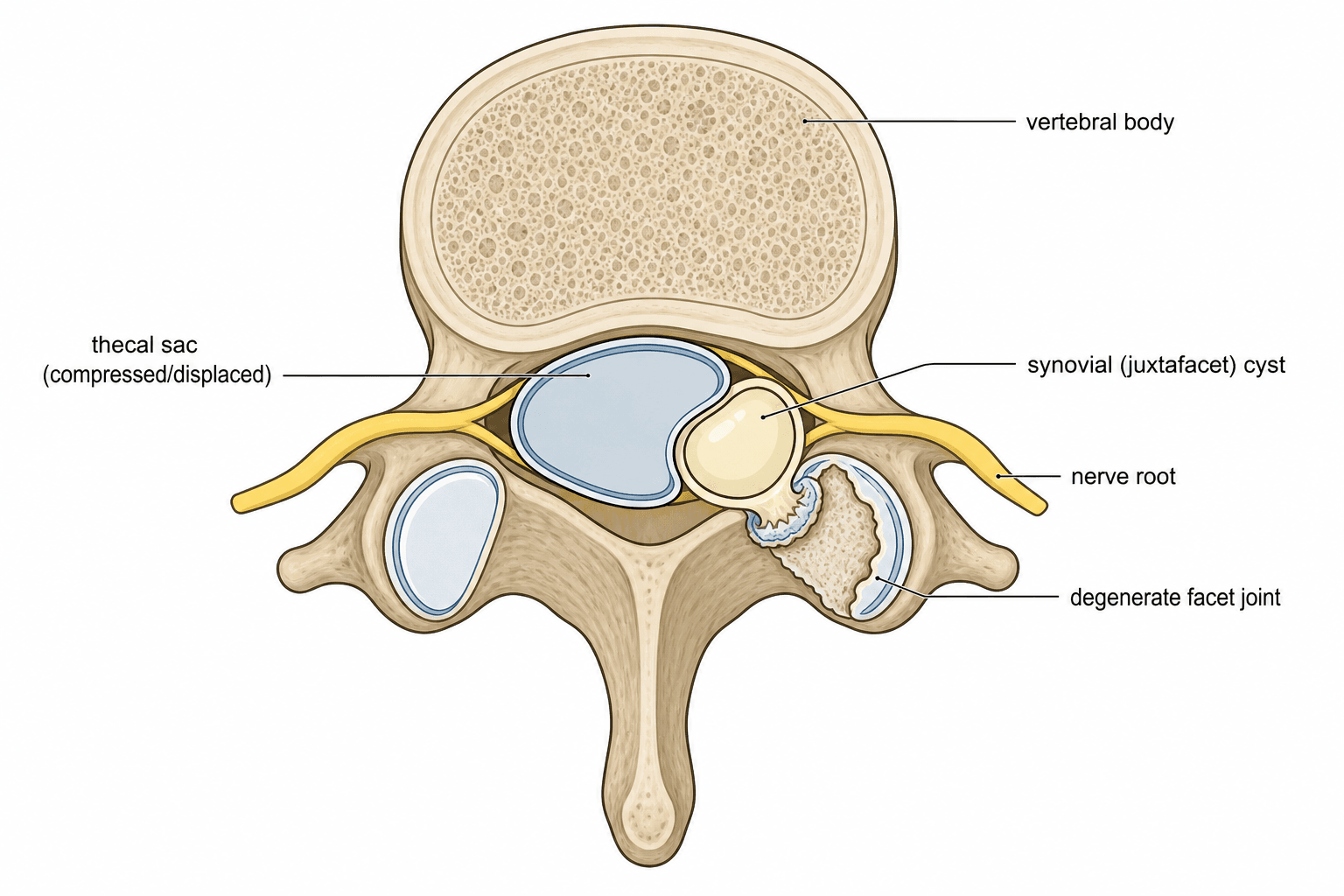
Relationship to the nerve root. The cyst compresses the root from posterior to anterior, the reverse of a disc herniation, which lies anterior to the root and compresses it from anterior to posterior. At surgery the root is therefore superficial, and the risk of injuring it lies mainly in the initial exposure.
The instability link. L4/5 is the most mobile lumbar segment. The cyst is the body's attempt to stabilise the joint, a "hydraulic splint".
Classification Systems
There is no widely used clinical classification (such as AO Spine) specific to synovial cysts. They are described by pathology or by location.
True synovial cyst. Lined by synovium (cuboidal or pseudostratified epithelium) and in clear communication with the joint space. It is often reducible with positioning.
Ganglion or pseudocyst. No synovial lining, but a capsule of fibrous connective tissue, containing mucinous fluid. It often results from myxoid degeneration of the collagen in the joint capsule or ligamentum flavum, and is less likely to reduce.
Location. The cyst is also described by where it sits in relation to the roots:
- Posterolateral - the most common; compresses the traversing root in the lateral recess
- Foraminal - compresses the exiting root
- Far lateral - extraforaminal
Clinical Assessment
History. The complaint is radiculopathy (unilateral leg pain, sciatica) or neurogenic claudication, with pain worse on walking or standing as in stenosis. The pain is often postural and relieved by sitting, because flexion opens the canal. Onset can be acute, from bleeding into the cyst, or subacute to chronic.
Examination. The straight leg raise (Lasègue's sign) may be positive. Look for a motor or sensory deficit corresponding to the level, such as EHL weakness at L5. Extension with rotation (Kemp's test) often exacerbates facet pain.
Imaging and Investigations
Radiographs. AP and lateral films, and flexion-extension views, which are critical to rule out dynamic instability (spondylolisthesis). Look for facet hypertrophy and a vacuum phenomenon.
MRI. The gold standard. The cyst is hyperintense on T2 (fluid) and hypointense on T1, and rim enhancement with gadolinium is typical (inflammation).
CT myelography. The alternative when MRI is contraindicated. The cyst shows as a filling defect in the contrast column, and CT is good for visualising calcification of the cyst wall.
- Synovial Cyst
- Facet Joint
- Disc Herniation
- Intervertebral Disc
- Synovial Cyst
- Bright (Fluid) or Dark (Calcified)
- Disc Herniation
- Dark (Desiccated nucleus)
- Synovial Cyst
- Spondylolisthesis (Instability)
- Disc Herniation
- Degenerative Disc Disease
The Acute Haemorrhagic Synovial Cyst
Haemorrhage into the cyst overturns the usual gradual picture and changes management.
Presentation. Instead of the typical chronic, postural radiculopathy, haemorrhage into the cyst causes sudden, severe radicular pain or a rapidly progressive neurological deficit, and in the lumbar spine occasionally an acute cauda equina syndrome (the acute picture is developed in the cauda equina syndrome topic). It may be spontaneous or precipitated by minor trauma or, importantly, by anticoagulant or antiplatelet therapy.
Imaging. Blood changes the expected signal. The cyst becomes T1-hyperintense (methaemoglobin) rather than the usual T1-hypointense fluid, is often heterogeneous with fluid-fluid levels, shows blooming on gradient-echo or other blood-sensitive sequences, and is typically enlarged and tense.
High T1 signal in a facet cyst may indicate (subacute) haemorrhage. A facet cyst that is bright on T1 should prompt thoughts of haemorrhage, not just proteinaceous fluid.
Management. A haemorrhagic cyst with acute severe pain or a new deficit shifts management away from a conservative or injection trial and towards urgent surgical decompression. Review and correct any anticoagulation or coagulopathy as part of the work-up.
Management Algorithm
Management steps up from conservative care, through an injection, to surgery. The steroid injection is both diagnostic and therapeutic, and the intervention may be aspiration or rupture of the cyst; surgery is decompression with or without fusion.
- 1
Symptomatic Cyst
- 2
Pain Persists
- 3
Recurrence / Failure
Percutaneous Cyst Rupture and Aspiration
Percutaneous treatment is done under fluoroscopic or CT guidance, by two related approaches that are often combined:
- Facet injection with forced distension (indirect rupture). A needle is placed into the affected facet joint. Contrast confirms the intra-articular position and frequently opacifies the cyst, confirming joint communication. Fluid (contrast, local anaesthetic, corticosteroid and/or saline) is then injected under increasing pressure to distend the joint and burst the cyst into the epidural space, decompressing the nerve root and leaving steroid behind for its anti-inflammatory effect.
- Direct cyst puncture and aspiration. The cyst itself is punctured and aspirated, with or without intracystic steroid.
Why it works, and why it often does not last. Over-pressurising the joint ruptures the cyst wall, giving immediate root decompression plus a steroid effect. It does not address the underlying unstable, fluid-pumping facet joint, so the cyst frequently reforms, which is why its durability is limited (see Outcomes and Prognosis).
Candidate selection. Best suited to a small, non-calcified cyst that communicates with the joint, which allows indirect distension rupture, and to poor surgical candidates or patients wishing to defer surgery, with explicit counselling about the proportion who still come to operation. A calcified cyst wall resists rupture and predicts failure. Detailed facet and epidural injection technique sits within interventional spine practice.
Surgical Technique
Micro-decompression and cyst resection. Indicated for a stable joint (no slip) with leg pain dominant, through a midline or tubular approach:
- Laminectomy or medial facetectomy
- Identify the cyst, often purple or blue in colour
- Dissect the plane between dura and cyst, which is often very adherent
- Excise the cyst
The risks of resection. Cysts are often intensely adherent to the dura, so resection carries a higher risk of durotomy than a standard discectomy. Resection also requires removing the medial facet, and if over 50% of the facet is removed, instability may worsen, requiring fusion; that threshold is not precisely defined by high-level evidence. If the joint remains unstable and is not fused, the cyst can recur.
Decompression plus fusion (TLIF or PLIF). Indicated for spondylolisthesis (grade 1 or more), mechanical back pain or a recurrent cyst. Removing the motion segment stops the fluid pumping and prevents recurrence. Its advantage is a definitive cure; its costs are the morbidity of fusion and adjacent segment disease.
Complications
Recurrence is rare after either operation. The 0% after fusion is zero events in 155 fused patients and does not establish a difference from the 1.8% after decompression alone.
- Risk
- High (~8%)
- Note
- Higher than disc herniation due to inflammatory adhesions (MIS series, Garg 2021).
- Risk
- Under 5%
- Note
- 1.8% after decompression alone, 0% after fusion (Bydon 2010).
- Risk
- Variable
- Note
- Post-facetectomy slip progression.
- Risk
- 5%
- Note
- Especially if calcified cyst wall left behind.
Postoperative Rehab
Hospital stay. A decompression is a day case or an overnight (23-hour) stay; after a fusion the stay is 2-3 days.
Restrictions. After decompression, no heavy lifting (over 10kg) for 6 weeks, because of the risk of recurrent herniation or cyst through an annulotomy if one was done. After fusion, a brace is optional (surgeon preference), and there is no bending, twisting or lifting for 6-12 weeks until the fusion mass forms.
Red flags in recovery. Each points to a specific problem:
- Positional headache - potential CSF leak or pseudomeningocele
- Return of radiculopathy - early recurrence or haematoma
- Fever or wound ooze - infection (discitis)
Outcomes and Prognosis
Conservative. Spontaneous regression is documented but rare (Houten 2003).
Percutaneous aspiration or rupture. Cyst resolution is about 58%, against about 90% for surgery (Campbell 2017); about 30-40% need a repeat procedure and roughly one-third proceed to surgery (Lutz 2017). It is useful for temporary control or in poor surgical candidates.
Surgery. Back and leg pain are relieved in about 91-92% (Bydon 2010, Xu 2010), and fusion also reduces recurrent mechanical back pain (Xu 2010).
Guidelines, Registries & Global Practice
Global epidemiology
- A degenerative condition of the ageing spine; incidence is rising with broader MRI access worldwide. L4/5 predominance (~75%) and the 40-50% association with degenerative spondylolisthesis are consistent across international series (Bydon 2010, Campbell 2017).
Guidelines — note the gap
- There is no dedicated society guideline (AAOS, BOA, AO Spine, EFORT, NASS) specific to lumbar synovial cysts; management is extrapolated from degenerative lumbar stenosis and spondylolisthesis pathways.
- NASS / NICE (degenerative stenosis): trial of conservative care first in the neurologically intact patient; surgery for persistent radiculopathy/claudication or progressive deficit.
- AO Spine / spondylolisthesis principles: where a cyst coexists with documented instability (dynamic slip), decompression plus instrumented fusion is favoured — consistent with the cyst literature.
- Common consensus across societies: micro-decompression with cyst excision is the workhorse for the stable spine; add fusion for instability or recurrence.
Registry note
- Synovial cysts are not separately tracked by arthroplasty registries; where fusion is performed, implant and revision data fall within national spine fusion registries rather than a cyst-specific dataset.
High- vs limited-resource practice
- Well-resourced settings: ready MRI, dynamic radiographs, image-guided percutaneous rupture, and MIS tubular/endoscopic resection are all available, supporting individualised escalation.
- Limited-resource settings: reliance on a single MRI and standing radiographs; open micro-decompression remains the mainstay, with percutaneous and endoscopic options less accessible. Definitive surgery is often favoured over repeated injections to avoid multiple visits.
Related pages: Degenerative Spondylolisthesis is the condition that decides this operation - a synovial cyst is a marker of a mobile, degenerate facet, and the presence of a slip is what turns a decompression into a fusion, which is the debate the first two evidence cards above are having on thin data; Facet Arthropathy for the joint the cyst arises from and the degenerative cascade that produces it; Lumbar Spinal Stenosis for the commoner cause of the same claudicant presentation, and for the patient in whom a cyst is an incidental extra finding rather than the problem; Lumbar Disc Herniation is the principal differential on MRI and clinically - both give an acute radiculopathy, but the cyst is posterolateral and continuous with the facet, and this page's comparison table sets out how to tell them apart; Lumbar Radiculopathy for the syndrome itself and its non-compressive mimics; Cauda Equina Syndrome for the presentation an acute haemorrhagic cyst can produce, which is the one situation on this page that is a same-day emergency; Lumbar Fusion Techniques for the TLIF and PLIF constructs used when the facet is resected beyond stability; Degenerative Disc Disease for the segmental degeneration that accompanies the facet changes; and Cervical Facet Arthropathy for the same pathology at the level where these cysts are rare - only 2.6 percent of the 966 patients in the Bydon review were cervical.
Controversies & Areas of Uncertainty
- Fusion versus decompression alone: The central debate. Cyst recurrence is rare after decompression alone (1.8%) and never reported after fusion, and fusion reduces recurrent mechanical back pain (Bydon 2010, Xu 2010). However, no randomised trial exists; systematic reviews explicitly state there is insufficient evidence to define WHEN fusion should be added (Campbell 2017). Most surgeons reserve fusion for an established slip, dynamic instability, or recurrent cyst/back pain.
- Does removing the medial facet cause instability? Resection requires medial facetectomy. The threshold (often quoted as over 50% of the facet, or bilateral facet violation) at which iatrogenic instability mandates fusion is not precisely defined by high-level evidence.
- Role of percutaneous treatment: Clearly less durable than surgery, but the ideal candidate (small cyst, high surgical risk, patient preference) is not well characterised.
- MIS versus open: Tubular microscopic and endoscopic resection give comparable outcomes to open surgery with no microscopic-vs-endoscopic difference (Garg 2021), but comparative trials against open surgery are limited and largely retrospective.
- Calcified cysts: Dense calcification of the cyst wall predicts dense dural adhesion, higher durotomy risk, and incomplete resection — but evidence is observational.
MCQ Practice Points
Q: What MRI finding distinguishes a synovial cyst from a ganglion cyst? A: Communication with the facet joint. (Though clinically managed similarly).
Q: Which spinal level accounts for over 75% of synovial cysts? A: L4/5. It is the level of maximal mobility/instability.
Q: Where are these cysts typically located relative to the thecal sac? A: Posterolateral. Compressing the traversing nerve root in the lateral recess.
Q: How durable is percutaneous aspiration/rupture? A: Poor — roughly 30-40% require a repeat procedure and about one-third ultimately proceed to surgery.
Q: What does the presence of a synovial cyst imply about the facet joint? A: Instability. It is a marker of hypermobility.
Exam Day Cheat Sheet
Key Facts
- L4/5 Most Common
- Marker of Instability
- Adherent to Dura
- High recurrence with aspiration
Imaging
- T2 Hyperintense (Fluid)
- T1 Hypointense
- Posterolateral location
- Facet OA
Treatment
- Conservative (rarely works)
- Injection (Temorizing)
- Decompression (Stable)
- Fusion (Unstable)
Risks
- Dural Tear (High)
- Recurrence (10%)
- Iatrogenic Instability
- Infection (Discitis)
Image Manifest
- [4-magnetic-resonance-imaging-revealed-a-15-cm-intras.png]: Intrasacral Cyst showing compression
- [5-sagittal-t2-weighted-mri-images-showing-sequential.png]: Axial T2 MRI showing lateral recess compression
Clinical Decision Scenarios
Practise clinical reasoning and management decisions out loud
“65M, L4/5 Synovial Cyst causing L5 radiculopathy. Flexion/Extension X-rays show NO slip. What surgery do you offer?”
“During resection of an L4/5 cyst, you encounter a dural tear. The cyst wall was adherent. What is your management algorithm?”
“A 58F with an L4/5 synovial cyst and a 3-month history of L5 radiculopathy asks whether she can avoid surgery with an injection. There is no spondylolisthesis and she is neurologically intact. How do you counsel her?”
Evidence Base
To Fuse or Not — Systematic Review of Outcomes
- 82 studies, 966 patients with spinal synovial cysts.
- L4/5 was the dominant level (75.4%); radicular pain in 69.6%, back pain in 48.3%.
- Back and leg pain resolved in 92.5% and 91.1% after surgery.
- Same-level cyst recurrence 1.8% after decompression ALONE versus 0% after decompression plus fusion.
Recurrence After Resection — Laminectomy vs Instrumented Fusion
- 167 consecutive patients, 195 synovial cysts, single institution over 19 years.
- Back and radicular pain improved in 91.6% and 91.9% after surgery.
- Laminectomy alone carried significantly higher cyst recurrence and recurrent back pain than fusion (log-rank p=0.042 and p=0.018).
- Decompression with instrumented fusion had the lowest incidence of both cyst recurrence and recurrent back pain.
Percutaneous vs Surgical — Comparative Meta-Analysis
- 50 studies, 870 patients with lumbar facet joint cysts.
- Cyst resolution 90% for decompression (with or without fusion) versus 58% for percutaneous procedures.
- Repeat procedures required in 29% after percutaneous treatment versus under 1% after decompression.
- Insufficient data to define when fusion should be added.
Percutaneous Rupture — Prospective Cohort
- 35 patients, fluoroscopy-guided percutaneous cyst rupture, 1-year follow-up.
- Significant improvements in pain and Oswestry Disability Index; satisfaction near 70%.
- 40% (14/35) required repeat rupture.
- 31% (11/35) progressed to surgery.
Minimally Invasive Excision — Systematic Review
- 20 studies, 388 patients, tubular microscopic or endoscopic resection.
- Favourable Macnab outcome in 86%.
- Incidental durotomy 8%, cyst recurrence 4%, reoperation 5%.
- No significant difference between microscopic and endoscopic approaches.
Spontaneous Regression — Case Series
- Three patients with symptomatic lumbar synovial cysts that resolved without surgery.
- Spontaneous regression is documented but rare in the literature.
- Nonoperative management can be appropriate when neurological deficit is absent.
- Supports a trial of conservative care before intervention in selected patients.