Prevention-First | Recognition Patterns | Salvage Techniques
- Sciatic nerve: 80% of nerve injuries, peroneal division affected more than tibial
- Risk factors: developmental dysplasia and previous hip surgery are the most consistently reported; also post-traumatic arthritis and the magnitude of lengthening. Approach is contested - one cited series found the posterior approach significant, another found no difference between approaches
- Clinical signs: immediate foot drop (peroneal), calf pain with ankle plantarflexion (vascular)
- Management: a complete palsy with substantial lengthening is the one combination that argues for urgent revision to shorten the limb - not every post-operative palsy needs the components out
- Prognosis: 70-90% full recovery with neuropraxia, poor recovery with complete nerve division
- “Always check limb length intraoperatively before final component insertion
- “Sciatic nerve most at risk with posterior approach; femoral nerve with anterior approach
- “Vascular injury may present with delayed compartment syndrome (24-48 hours)
- “Early exploration (within 72 hours) improves nerve recovery outcomes
Overview and Epidemiology
Neurovascular injury is among the most feared and devastating complications of total hip arthroplasty. It is relatively uncommon, but it can leave permanent disability, a dissatisfied patient and litigation, and that makes prevention and early recognition paramount.
Nerve injury. The sciatic nerve accounts for 80% of nerve injuries, and its peroneal division is affected more often than the tibial. The femoral nerve accounts for 10-15% and is associated with the anterior approach. The superior gluteal nerve accounts for 5%, and presents as abductor weakness.
Vascular injury. The external iliac artery is the most commonly injured vessel. The common femoral artery is at risk with the anterior approach, and the superior and inferior gluteal vessels with the posterior. Injury shows as immediate bleeding or later as a pseudoaneurysm or arteriovenous fistula, and major vascular injury carries a mortality risk of 5-10%.
Anatomy and Biomechanics
The sciatic nerve. The largest nerve in the body, formed from the L4-S3 roots. It leaves the pelvis through the greater sciatic notch and, at the level of the hip joint, lies 2-3cm posterior to the posterior acetabular rim, protected by the short external rotators (quadratus femoris and the obturators). That distance is critical: excessive posterior wall reaming, retractor placement or cement extrusion can injure the nerve directly.
Its two divisions. The peroneal division lies lateral and posterior to the tibial division, has less connective tissue support, and is the more vulnerable to stretch. The tibial division is medial and better supported. It is less commonly injured, usually as part of a complete sciatic injury, and carries a better prognosis than the peroneal.
The piriformis relationship. This matters for the posterior approach, and it varies:
- 85% - the nerve exits below piriformis (the standard anatomy)
- 12% - the nerve divides at the sciatic notch and the peroneal division passes through piriformis
- 3% - the nerve exits above piriformis
The variant cannot be predicted from external landmarks, so assume the vulnerable anatomy.
The other nerves. The femoral nerve lies anterior to the hip, beneath the inguinal ligament and lateral to the femoral artery. Anterior retractor compression, haematoma and cement extravasation injure it, and the injury is often a neuropraxia. The superior gluteal nerve exits above piriformis and supplies gluteus medius and minimus. Excessive superior dissection or retractor trauma during exposure produces abductor weakness and a Trendelenburg gait, and the injury often goes unrecognised.
The arteries. The external iliac artery runs along the pelvic brim, where medial acetabular screw penetration, intrapelvic cement extravasation and overzealous anterior retractor placement put it at risk. Atherosclerosis increases the risk of vascular injury, especially to this artery. The common femoral artery is vulnerable to direct injury in the anterior approach, to the saw during the femoral neck osteotomy, and to anterior perforation of the femoral canal.
The veins. The external iliac vein has a thinner wall than the artery and is easily torn. It presents with bleeding and haematoma formation, and may cause a delayed DVT if the injury goes unrecognised. The gluteal vessels are at risk with the posterior approach; bleeding is usually controlled with packing, and pseudoaneurysm is rare but reported.
Vascular anomalies. These include a high bifurcation of the common femoral artery (5%), an accessory obturator artery (20-30%) and an aberrant external iliac course. Pre-operative vascular imaging is the mitigation in revision cases and protrusio repair. Both the nerve and the vascular variants are the argument for careful dissection and for adherence to recognised surgical landmarks rather than presumed anatomy.
Classification Systems
Nerve injuries are graded by Seddon (neuropraxia, axonotmesis, neurotmesis), and recovery by grade is set out under Outcomes. The classification that shapes prevention is of risk, which comes from the patient and from the operation.
Patient factors. DDH and revision carry the largest multiples of risk, and each factor has its own preventive answer.
- Mechanism
- High hip centre requires inferior placement, sciatic nerve on stretch
- Risk Increase
- Up to 10 times higher risk
- Prevention Strategy
- Subtrochanteric shortening osteotomy if lengthening over 4cm planned
- Mechanism
- Scarring distorts anatomy, nerve encased in scar tissue
- Risk Increase
- 5-10 times higher risk than primary
- Prevention Strategy
- Careful dissection, consider nerve monitoring, limit lengthening
- Mechanism
- Altered anatomy from previous fracture, retained hardware
- Risk Increase
- 3-5 times higher risk
- Prevention Strategy
- Pre-operative CT imaging to plan approach and identify nerve course
- Mechanism
- Reduced nerve tolerance to stretch, scarring around nerve
- Risk Increase
- Variable, may be permanent deficit
- Prevention Strategy
- EMG/NCS pre-operatively to document baseline, avoid further trauma
In Crowe IV DDH (femoral head above roof level), the sciatic nerve is often significantly shortened due to chronic hip dislocation. Reducing the hip to anatomical centre without femoral shortening can result in over 5-6cm of limb lengthening and near-certain nerve palsy. Always plan for subtrochanteric shortening osteotomy in these cases.
Surgical factors. Each approach puts a different nerve at risk. Lengthening threatens the peroneal division through traction, and protrusio repair threatens the external iliac vessels.
- Nerve at Risk
- Sciatic nerve
- Mechanism
- Retractor placement, excessive external rotation, cement extrusion
- Prevention
- Visualise nerve before retractor, limit retraction time, protect with sponge
- Nerve at Risk
- Femoral nerve, lateral femoral cutaneous nerve
- Mechanism
- Anterior retractor compression against pelvis, haematoma
- Prevention
- Limit retractor force and duration, release intermittently during case
- Nerve at Risk
- Sciatic nerve (peroneal division)
- Mechanism
- Traction injury, nerve stretched beyond elastic limit
- Prevention
- Intraoperative fluoroscopy, compare to contralateral side, consider shortening
- Nerve at Risk
- External iliac vessels
- Mechanism
- Medial wall screw perforation, graft migration
- Prevention
- Pre-operative CT measurement, intraoperative fluoroscopy, limit screw length
Clinical Assessment and Diagnosis
Examine before the patient leaves theatre. The single most important step in diagnosing neurovascular injury is a systematic post-anaesthesia examination before the patient leaves the operating theatre. Failure to perform it is the most common reason for delayed diagnosis of nerve injury: patients emerging from anaesthesia may not recognise or report subtle motor or sensory deficits, and a nerve injury missed in the immediate post-operative period becomes far more difficult to prove causation for and to manage appropriately.
The examination covers:
- Foot dorsiflexion (peroneal division of the sciatic nerve) and plantarflexion (tibial division)
- Toe extension and flexion
- Hip flexion and knee extension (femoral nerve)
- Dorsalis pedis and posterior tibial pulses, and capillary refill in both limbs
Record it within the hour. Motor power on the MRC 0-5 scale, sensation to light touch and pinprick, and vascular status (pulses, temperature, colour) go into the notes, compared with the contralateral limb and with any pre-operative baseline.
When a deficit is found. Inform the supervising consultant immediately. Check the leg-length differential clinically and radiographically, review the intraoperative notes for risk factors, consider urgent imaging if there is a vascular concern, and start the management algorithm.
The patterns. Each nerve leaves its own combination of motor deficit, sensory loss and special signs.
- Motor Deficit
- Foot drop, no ankle movement, toe paralysis
- Sensory Loss
- Entire foot below ankle numb except medial ankle
- Special Signs
- High-stepping gait, foot slap when walking
- Motor Deficit
- Foot drop, weak ankle eversion, toe extension loss
- Sensory Loss
- Dorsum of foot and lateral leg numb
- Special Signs
- Most common pattern, foot drop immediately evident
- Motor Deficit
- Weak plantarflexion, toe flexion loss, ankle inversion weak
- Sensory Loss
- Sole of foot numb, sensory loss calf posteriorly
- Special Signs
- Less common, patient may still walk but with abnormal gait
- Motor Deficit
- Weak hip flexion, unable to extend knee, quadriceps wasting
- Sensory Loss
- Anterior thigh and medial leg numbness
- Special Signs
- Unable to straight leg raise, knee buckles with weight bearing
In the common peroneal-division pattern, tibialis anterior and the peroneal muscles are weak, and the numb dorsum of the foot and lateral leg is the territory of the superficial peroneal nerve. The tibial division is less commonly affected; with it spared, sole sensation is intact and plantarflexion may be preserved.
The differential. Not every post-operative motor or sensory deficit is a direct surgical nerve injury. The following must be actively excluded, because management differs substantially.
- Discriminating Features
- Immediate foot drop, dorsum-of-foot sensory loss, often with lengthening
- Key Investigation
- Clinical exam, leg-length radiograph, EMG/NCS at 3 weeks
- Action if Confirmed
- Assess lengthening; revise if over 4cm with complete palsy
- Discriminating Features
- Absent pulses, cold pale limb, pain out of proportion
- Key Investigation
- ABPI, duplex USS, CT angiography
- Action if Confirmed
- Immediate vascular surgery; theatre within 6h
- Discriminating Features
- Tense compartments, pain on passive stretch, 24-48h onset
- Key Investigation
- Compartment pressures (within 30mmHg of diastolic)
- Action if Confirmed
- Emergency four-compartment fasciotomy
- Discriminating Features
- Progressive (not immediate) deficit, swelling, falling haemoglobin
- Key Investigation
- USS/CT, serial haemoglobin
- Action if Confirmed
- Evacuate if progressive compression
- Discriminating Features
- Bilateral or non-dermatomal pattern, urinary retention, back pain
- Key Investigation
- Neurology review, MRI spine if epidural haematoma suspected
- Action if Confirmed
- Urgent MRI and decompression if epidural haematoma
- Discriminating Features
- Deficit in non-operative pattern or contralateral limb
- Key Investigation
- Clinical pattern recognition, EMG if persists
- Action if Confirmed
- Usually neuropraxia - observe, protect, physiotherapy
Recognising vascular injury. Acute injury shows as absent or diminished distal pulses, a cold, pale limb compared with the other side, an expanding haematoma in the wound or thigh, hypotension if blood loss is significant, and pain out of proportion as compartment syndrome develops. The delayed complications are:
- Pseudoaneurysm - a pulsatile mass with a bruit
- Arteriovenous fistula - a continuous thrill
- Compartment syndrome (see Management)
- DVT from venous injury
- Heterotopic ossification from haematoma
Investigations
At the bedside. Investigation starts with the examination above: systematic motor and sensory testing graded on the MRC scale, a clinical measurement of leg lengths, and a look for signs of compartment syndrome.
Radiographs within 1-2 hours. An AP pelvis and lateral hip show:
- Component position and orientation
- Limb length discrepancy
- Femoral offset restoration
- Cement extruded medially
- Acetabular screws penetrating the medial wall
Nerve studies at 3 weeks. Baseline EMG and nerve conduction studies are done 3 weeks post-injury. Earlier studies are unhelpful because Wallerian degeneration takes 2-3 weeks to develop. At 3 weeks the study distinguishes neuropraxia from axonotmesis, establishes baseline severity for monitoring recovery, localises the level of injury and guides the prognosis discussion. Repeat studies at 3 and 6 months track the recovery trajectory.
Cross-sectional imaging. MRI of the pelvis and hip, if surgical exploration is planned, shows nerve compression from haematoma or cement, assesses nerve continuity and rules out a space-occupying lesion. CT angiography, if vascular injury is suspected, shows active extravasation, pseudoaneurysm or arteriovenous fistula.
Suspected arterial injury. Within the first hour, a bedside duplex ultrasound assesses flow, the ankle-brachial pressure index (ABPI) is compared with the contralateral side, and compartment pressures are measured if there is clinical concern. Within 6 hours, CT angiography, the gold standard, defines the level and extent of injury, with conventional angiography if intervention is planned. The findings decide the pace:
- Hard signs - absent pulses, expanding haematoma, pulsatile bleeding, limb ischaemia - mean immediate theatre for exploration
- ABPI under 0.5 means urgent vascular surgery consultation
- Soft signs mean close observation with serial ABPI and duplex
Suspected venous injury. The clinical features are a large haematoma, limb swelling disproportionate to the surgery, persistent bleeding from the drain, or hypotension without an obvious bleeding source. Duplex ultrasound assesses for DVT, CT venography is used if major vessel injury is suspected, and haemoglobin is measured serially. Small venous injuries are often self-limiting with compression; a large haematoma may require drainage to prevent compression of adjacent structures, and DVT prophylaxis is adjusted to the bleeding risk. Venous injuries are less immediately life-threatening than arterial, but haematoma mass effect and DVT can cause significant morbidity.
Management Algorithm
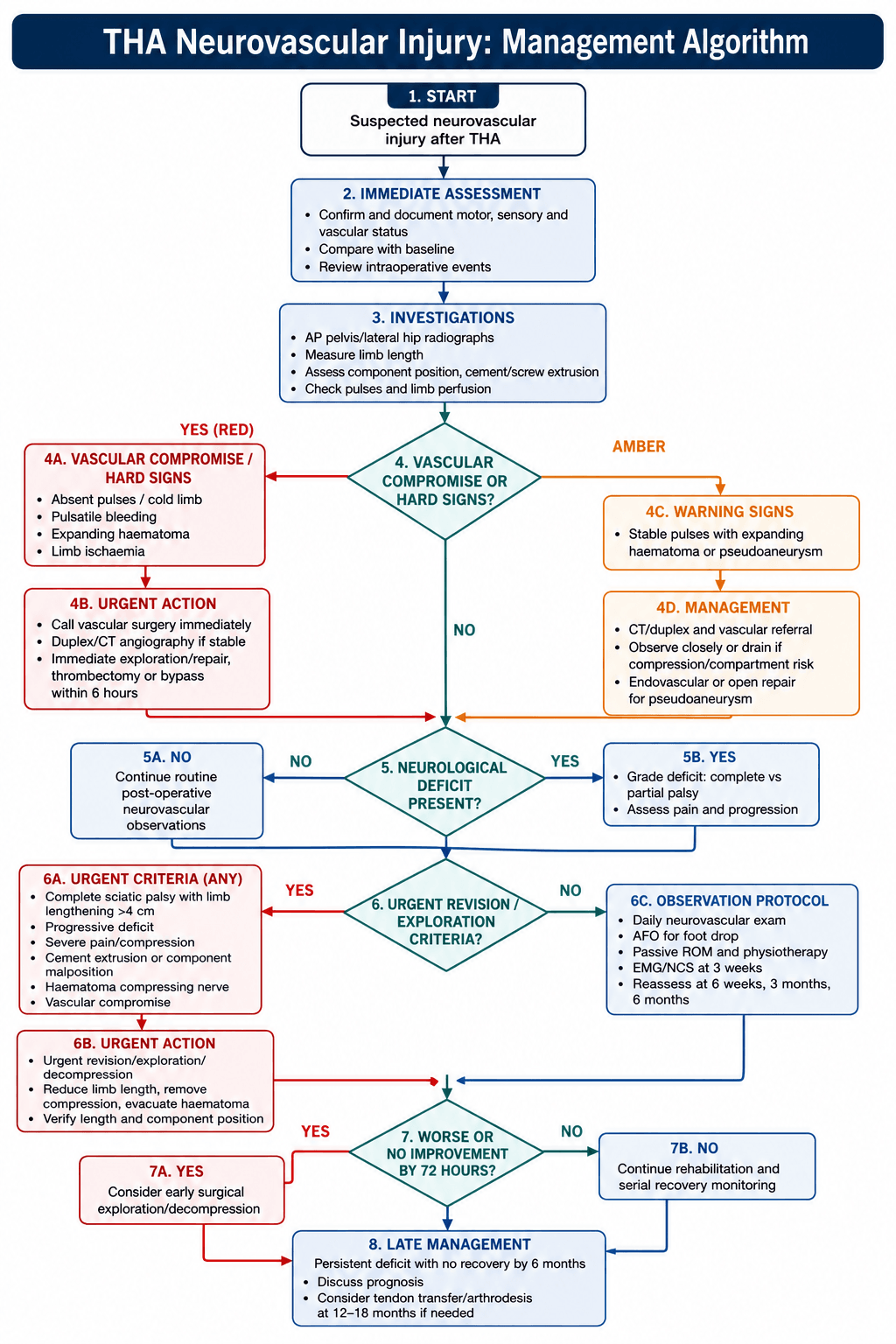
The first hours. Within 0-2 hours, confirm the diagnosis: document the deficit completely (motor and sensory), review the intraoperative events, measure leg length radiographically, and grade the palsy as complete or partial. Between 2 and 6 hours, assess the components. The decision point comes at 6-12 hours.
When to go back urgently. Any of these is an indication for urgent revision, exploration or evacuation:
- Limb lengthening over 4cm with a complete sciatic palsy
- Cement extrusion compressing the nerve or other neurovascular structures
- Component malposition causing direct nerve compression
- A haematoma compressing the nerve - evacuate urgently, and revise if the compression does not resolve with drainage alone
- A progressive deficit: partial becoming complete, or worsening despite initial observation
- Severe pain suggesting nerve compression
- Vascular compromise accompanying the nerve injury
A complete palsy with substantial lengthening is the combination that argues for urgent revision to shorten the limb; not every post-operative palsy needs the components out. A partial deficit without lengthening, where neuropraxia is likely, is observed. The 4cm in the first criterion is the conventional figure discussed under leg length, a planning trigger rather than a validated threshold.
Observation. If observation is chosen, close neurovascular monitoring is essential:
- Daily neurovascular examination
- A foot drop splint (ankle-foot orthosis) to prevent contractures
- Physiotherapy for passive range of motion
- EMG/NCS at 3 weeks
- Re-assessment at 6 weeks, 3 months and 6 months
If nerve injury fails to improve by 72 hours, or worsens, consider surgical exploration. Early nerve decompression (within 72 hours) has been shown to improve recovery rates. Beyond 72 hours, the benefit of exploration diminishes unless there is clear evidence of compressive pathology.
Revising for lengthening. Component exchange aims to bring the limb-length differential to under 4cm:
- Remove the acetabular component and insert a smaller liner
- Reduce femoral offset with a different stem and head combination
- Consider a femoral shortening osteotomy if needed
- Verify leg length with fluoroscopy before closure
Decompressing the nerve. Decompression releases external compression of the nerve:
- Extend the posterior approach proximally
- Identify the sciatic nerve at the sciatic notch
- Trace it distally to the point of compression
- Remove the cement, haematoma or scar tissue
- Do not manipulate the nerve itself, which risks further injury
What going back achieves. 50-60% recover useful function after component revision for lengthening, and nerve decompression for compression brings 40-70% improvement. Outcomes are better if the operation is within 72 hours. A complete nerve transection has a poor prognosis regardless of intervention.
Vascular injury. The presentation sets the investigation and the clock.
- Investigation
- Direct visualisation, vascular surgery consult intraoperatively
- Management
- Immediate vascular repair, potential for graft or bypass
- Timeline
- Do not close wound - call vascular immediately
- Investigation
- ABPI, duplex USS, CT angiography urgent
- Management
- Immediate vascular exploration, thrombectomy or bypass
- Timeline
- Within 6 hours to prevent limb loss
- Investigation
- Serial haemoglobin, CT to assess size and source
- Management
- Observation if stable, drainage if compartment syndrome risk
- Timeline
- Monitor every 2-4 hours for first 24 hours
- Investigation
- Duplex USS, CT angiography, vascular surgery referral
- Management
- Endovascular coiling or open repair depending on anatomy
- Timeline
- Semi-urgent (days to weeks) - risk of rupture
Compartment syndrome. Haematoma from a vascular injury, or reperfusion after ischaemia, can lead to compartment syndrome, typically 24-48 hours post-operatively.
Suspect it with pain out of proportion to examination, pain on passive stretch of the muscles, tense compartments and a progressive motor or sensory deficit. A compartment pressure over 30mmHg, or within 30mmHg of diastolic blood pressure, is diagnostic. Treatment is immediate fasciotomy of all four compartments of the leg; delayed diagnosis leads to permanent sequelae (Volkmann's contracture, amputation).
The decision at a glance. The management above, condensed into four scenarios:
- Diagnosis
- Sciatic nerve injury (peroneal division)
- Immediate Action
- Document deficit, check leg length, consider revision if over 4cm lengthening
- Key Pearl
- Recovery likely if neuropraxia, document baseline EMG at 3 weeks
- Diagnosis
- Probable neurotmesis or vascular compromise
- Immediate Action
- Urgent vascular assessment, MRI/USS, early surgical exploration within 72h
- Key Pearl
- Time to decompression critical for nerve recovery
- Diagnosis
- Vascular injury with ischaemia
- Immediate Action
- Immediate vascular surgery consult, duplex USS, prepare for exploration
- Key Pearl
- Arterial injury may present with delayed compartment syndrome
- Diagnosis
- Femoral nerve injury (anterior approach complication)
- Immediate Action
- Remove anterior retractors, document deficit, observe initially
- Key Pearl
- Usually neuropraxia from retractor pressure, recovers over weeks
Surgical Technique - Prevention Strategies
Prevention is far superior to management. The intraoperative techniques that minimise neurovascular risk concern where the screws go, how the patient lies, how the nerve is protected during exposure, how much the leg is lengthened and how the cement is contained.
The Acetabular Quadrant System - Where Screws May and May Not Go
Why a map is needed. The structures at risk lie on the other side of the bone, and nothing of the intrapelvic anatomy is visible from inside the socket. Screw safety therefore cannot be judged by direct vision the way it can at most other sites. Wasielewski's cadaveric study answered this by fixing the danger to landmarks the surgeon can see from within the acetabulum.
Constructing the quadrants. Two lines are drawn on the acetabulum as it faces you:
- The first runs from the anterior superior iliac spine, through the centre of the acetabulum, to the posterior fovea, dividing the socket into anterior and posterior halves
- The second is drawn perpendicular to the first at the mid-point of the acetabulum, splitting each half into superior and inferior
- Verdict
- Safe - the workhorse
- What lies beyond it
- Best available bone stock; the standard target for transacetabular screws
- Verdict
- Relatively safe
- What lies beyond it
- Acceptable bone; sciatic nerve and the inferior gluteal and pudendal vessels lie further out
- Verdict
- Avoid
- What lies beyond it
- External iliac artery and vein - the highest-consequence structure in the pelvis
- Verdict
- Avoid
- What lies beyond it
- Obturator nerve, artery and vein
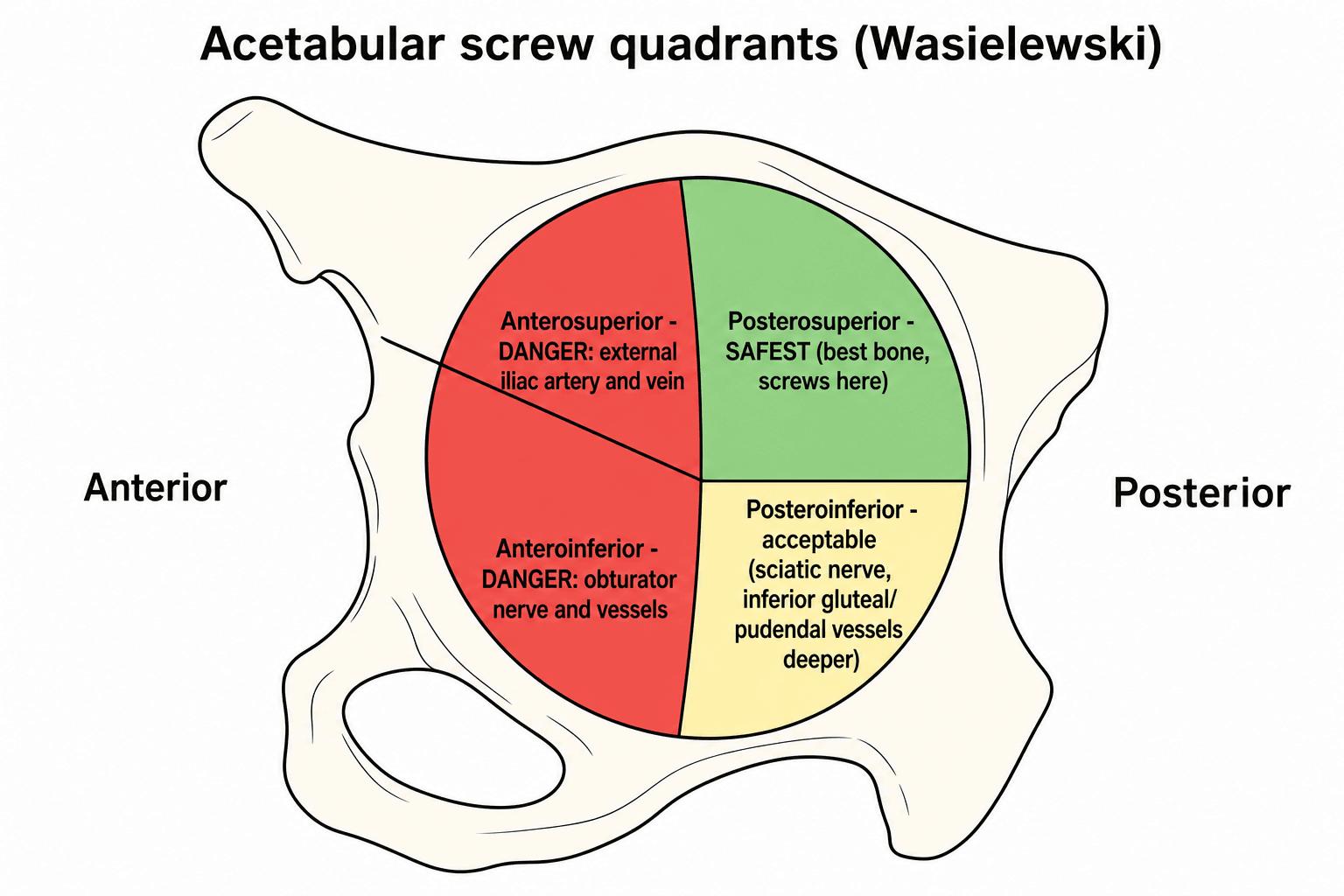
The rule. Screws go posteriorly, and preferably posterosuperiorly. The two anterior quadrants are avoided whenever possible, because a screw that exits there meets vessels which will not tolerate it.
Two cautions for the viva. The quadrant system is a guide to direction, not a licence on length: a correctly aimed posterosuperior screw can still be too long, so measure, and check the trajectory under fluoroscopy when the anatomy is distorted. And the landmarks assume recognisable acetabular anatomy. In revision, dysplasia or protrusio the fovea and rim may be absent or displaced, which is precisely when screws are most needed and the map is least reliable; in that setting pre-operative CT, not the quadrant rule, tells you where the vessels are.
Positioning
Lateral decubitus for the posterior approach. The patient lies with the affected side up, the lower limb flexed at hip and knee for stability, the operative limb free to move through its range, and pelvic posts anterior and posterior to stabilise the pelvis. To protect the sciatic nerve, avoid hip flexion over 90 degrees, which increases its tension, and extreme internal rotation, which stretches it; at rest the operative limb sits in 20-30 degrees of flexion and neutral rotation. Excessive flexion, adduction or rotation during surgery increases nerve stretch.
Supine for the anterior approach. The patient lies on a radiolucent table with the operative leg on an extension attachment and a perineal post for countertraction. Limit hip extension beyond neutral, which stretches the femoral nerve, and avoid excessive lateral translation of the femoral shaft, which compresses it.
Exposure
The posterior approach protects the sciatic nerve in four steps.
- Superficial dissection. Identify the sciatic nerve before placing deep retractors: palpate it posterior to the short external rotators, protect it with a blunt retractor or sponge stick placed posteriorly, and mark its position with a suture if the anatomy is unclear.
- Capsulotomy. Open the capsule along the femoral neck, staying anterior to the nerve's course, under direct vision rather than blindly with scissors. Avoid excessive posterior capsule release, because in revision cases the nerve is adherent to the posterior capsule.
- Retractor placement. The anterior retractor sits on the anterior wall of the acetabulum, which is safe. The posterior retractor goes medially, not posterior to the acetabulum. Use blunt retractors only, since pointed ones can impale the nerve, and release them every 20 minutes to reduce ischaemia.
- Reaming. Use hand-held retraction, have the assistant monitor the retractor position continuously, and do not ream excessively posteriorly, which risks cement extrusion toward the nerve.
The anterior approach protects the femoral nerve. It uses the interval between tensor fascia lata (superior gluteal nerve) and sartorius and rectus femoris (femoral nerve), a true internervous plane. Stay in the muscular interval and avoid excessive medial dissection, where the femoral nerve and vessels lie. The anterior retractor over the femoral neck goes against bone, not soft tissue, is released every 15-20 minutes, and is not levered against the anterior structures. The medial retractor protecting the femoral vessels is hand-held only, not self-retaining, and placed intermittently during femoral preparation. Safe exposure depends on adjusting retractor position frequently rather than on static retraction.
Leg Length
Planning. Template to plan offset and leg length restoration, measure the contralateral limb length as a baseline, and identify the anatomical landmarks (lesser trochanter to centre of rotation).
Measuring in theatre. Fluoroscopy and pin-to-pin measurement give a number; the shuck test does not.
- Method
- Steinmann pins in iliac crest and femoral shaft, measure with ruler
- Accuracy
- Within 5mm in experienced hands
- Limitation
- Requires identical positioning, pelvis must be stable
- Method
- AP pelvis image, measure medial calcar to ischial tuberosity bilaterally
- Accuracy
- Within 3-5mm, objective documentation
- Limitation
- Requires true AP pelvis, adds radiation exposure
- Method
- Assess stability with trial reduction, attempt to distract femoral head
- Accuracy
- Qualitative, not quantitative
- Limitation
- Does not provide actual measurement, can lead to over-lengthening
Lengthening beyond about 4cm is the conventional point at which to change the plan, and that is how to use it: as a trigger, not as a boundary between safe and unsafe. The systematic review cited on this page could not identify any hazardous lengthening value at all, and the risk factors most consistently recognised across studies are developmental dysplasia and previous hip surgery, not a lengthening figure. In the largest single-centre series the strongest statistical association was likewise DDH (p=0.0004), with lengthening significant (p less than 0.01) but alongside post-traumatic arthritis, cementless femoral fixation and approach. So do not say 4cm is "the single strongest predictor", and do not claim the risk rises exponentially beyond it; no cited study demonstrates either. What is defensible is that traction risk rises with the magnitude of lengthening, that a large planned correction should change the operation rather than be accepted, and that 4cm is a sensible number at which to stop and reconsider.
If templating suggests over 4cm of lengthening will be required, consider:
- Subtrochanteric shortening osteotomy (DDH, high dislocation)
- Accepting a lower hip centre (balancing lengthening against biomechanics)
- A staged procedure (soft tissue release first, definitive THA later)
Document the leg length measurement before closing, and record it in the operation note.
Cement
The medial wall. Cement extruding medially through a thin wall or an acetabular defect can compress the external iliac vessels, the femoral nerve or the obturator nerve. It may present as delayed vascular compromise or a progressive nerve palsy, hours to days after the operation. Prevention:
- Bone graft medial wall defects before cementing
- Contain the cement with a restrictor or mesh
- Inject at low pressure
- Watch for medial extrusion with fluoroscopy during injection
The posterior wall. Cement extruding posteriorly can directly contact or compress the sciatic nerve. Do not over-ream posteriorly, check the integrity of the posterior wall by direct vision before cementing, place the posterior retractor to shield the nerve during injection, and remove excess cement immediately, before it polymerises.
The femur. Canal reaming can perforate anteriorly, especially in dysplastic femurs or in revision with a thin anterior cortex. Prevention is hand-feel during reaming, radiographic landmarks, and considering an uncemented stem if the canal is abnormal. Pressurise with a cement gun and canal restrictor, but avoid excessive pressurisation in thin cortices, which risks perforation and cement extrusion.
Intraoperative Neuromonitoring in High-Risk THA
What it offers. Some high-volume centres use intraoperative SSEP or EMG neuromonitoring for Crowe III-IV cases, while routine use is not evidence-supported (see Guidelines). Its value is a real-time warning: the surgeon can release traction, reduce lengthening or reposition a retractor before the injury becomes permanent.
- What It Monitors
- Dorsal-column sensory pathway; near-continuous
- Alert / Limitation
- Alert at an amplitude drop over 50% or a latency increase over 10% from baseline; affected by anaesthesia, temperature and blood pressure (false positives)
- What It Monitors
- Corticospinal motor tracts; more sensitive to motor injury
- Alert / Limitation
- Loss of MEP signals motor compromise; requires total intravenous anaesthesia with no neuromuscular blockade
- What It Monitors
- Real-time mechanical irritation or traction of the nerve
- Alert / Limitation
- Bursts or trains warn of nerve stretch during reduction or retraction, prompting immediate correction
The role of neuromonitoring is in high-risk cases - Crowe III-IV dysplasia with large planned lengthening, complex revision, distorted post-traumatic anatomy. In routine THA it has not been shown to reduce permanent palsy, and it adds cost and false positives.
The Intrapelvic Component: Vascular-Protected Revision
The risk. An acetabular cup, screw or cement mass that has migrated medial to the quadrilateral plate lies against the external iliac and common femoral vessels, and the obturator. It is the highest-stakes vascular scenario in revision THA, and that single radiographic finding changes how the revision is planned and staffed: blind extraction from the hip risks fatal haemorrhage.
Removing it safely. Imaging, vessel control, and a willingness to leave it:
- Image first. CT, ideally CT angiography, defines the relationship of the intrapelvic hardware to the vessels. Involve vascular surgery before the day of surgery.
- Plan vessel control. For hardware intimate with the vessels, plan a retroperitoneal (ilioinguinal or Stoppa) approach to control the iliac vessels first, or keep vascular surgery and an endovascular balloon-occlusion catheter on standby. Do not simply pull it out from the hip.
- Know when to leave it. A well-fixed intrapelvic fragment encasing the vessels may be safer left in situ than risking vascular catastrophe or precipitating uncontrollable haemorrhage. Have cross-matched blood and cell salvage ready.
Complications
Secondary complications. Beyond the primary nerve and vascular injuries, several complications arise from the injury or its management.
- Incidence
- 20-60% of nerve injuries have residual deficit
- Risk Factors
- Complete transection, delayed diagnosis, axonotmesis
- Management
- AFO splint, tendon transfer (tibialis posterior to dorsum), arthrodesis
- Incidence
- 30-40% of patients with nerve injury
- Risk Factors
- Incomplete recovery, neuroma formation
- Management
- Neuropathic pain medications (gabapentin, pregabalin), pain clinic referral
- Incidence
- 5-10% of vascular injuries
- Risk Factors
- Delayed presentation, haematoma, reperfusion injury
- Management
- Immediate fasciotomy all four compartments, may require amputation if delayed
- Incidence
- Under 1% of THAs, more common in revision
- Risk Factors
- Arterial wall injury with contained rupture
- Management
- Endovascular coiling or open repair, risk of rupture if untreated
- Incidence
- Increased with haematoma and revision surgery
- Risk Factors
- Large haematoma, compromised soft tissues, multiple surgeries
- Management
- Irrigation and debridement, antibiotic suppression, may require implant removal
- Incidence
- Up to 20% with large haematoma
- Risk Factors
- Soft tissue trauma, haematoma, re-operation
- Management
- Prophylaxis with indomethacin or radiation, excision if symptomatic at 1 year
The medicolegal position. Nerve injury after THA is a common source of litigation. Defensibility rests on five things: a documented pre-operative baseline neurovascular examination; informed consent that specifically discusses nerve injury risk, especially in high-risk cases; a leg length measurement documented before closing; a post-operative neurovascular examination documented in the recovery room; and timely revision or observation with a clearly documented rationale. Failure in any of these areas significantly weakens the medicolegal position. The full documentation checklist sits under Guidelines.
Postoperative Care and Rehabilitation
The first 48 hours. In recovery, alongside the examination described under Clinical Assessment, the leg lengths are checked radiographically on an AP pelvis, the distal pulses are confirmed and documented, and the pain management protocol is started.
- 2-24 hours. Neurovascular checks every 4 hours for the first 24 hours, watching for compartment syndrome (pain, paraesthesia, pressure) and for excessive drain output, which may indicate vascular injury. Weight bearing follows the protocol, protected if nerve injury is suspected.
- Days 1-2. Physiotherapy assessment of gait and transfers, an AFO fitted if foot drop is present, passive range of motion exercises to prevent contractures, and continued neurovascular observations if there is a deficit.
Neuropraxia, weeks 0-6. The goals are to prevent contractures and maintain joint mobility. The AFO is worn continuously (removable for hygiene), alongside daily passive range of motion exercises, protected weight bearing with a walking aid and weekly physiotherapy review.
Neuropraxia, weeks 6-12. The goals shift to monitoring recovery and strengthening the recovering muscles. The AFO continues while there is no dorsiflexion power, active-assisted exercises begin as motor recovery returns, and a repeat EMG at 12 weeks assesses the trajectory; prognosis is discussed on the basis of the recovery pattern. Electrical stimulation may help, though the evidence is limited.
Axonotmesis. The nerve regenerates at 1mm per day (1 inch per month), and a sciatic injury at the hip is 80-90cm from the foot. The expected time to reach the foot muscles is 24-30 months, functional recovery may take 2-3 years, and many patients recover incompletely.
If no clinical or electrophysiological evidence of recovery by 6 months, complete recovery is unlikely. Consider secondary procedures (tendon transfer, arthrodesis) at 12-18 months if no significant recovery. Do not wait indefinitely - delayed tendon transfers have worse outcomes.
Secondary procedures for persistent foot drop. Indication, expected outcome and timing for each:
- Indication
- All patients with foot drop acutely, long-term if no recovery
- Expected Outcome
- Allows safe ambulation, prevents contractures, cosmetically acceptable
- Timing
- Immediate and ongoing
- Indication
- Persistent foot drop with no recovery, adequate tibialis posterior strength
- Expected Outcome
- Restore active dorsiflexion, eliminate AFO in 70-80%, improved gait
- Timing
- 12-18 months post-injury if no recovery
- Indication
- Complete sciatic palsy, no plantarflexion or dorsiflexion
- Expected Outcome
- Stable ankle, allows weight bearing, requires AFO or shoe modification
- Timing
- 12-24 months post-injury, last resort
Tibialis posterior transfer. The tendon is passed through the interosseous membrane to the dorsum of the foot and attached to the middle cuneiform and the bases of the 2nd-4th metatarsals. The patient must have tibialis posterior strength of MRC grade 4 or greater. The foot is immobilised for 6 weeks, followed by intensive physiotherapy, and functional dorsiflexion is achieved in 70-80% of carefully selected patients.
Outcomes and Prognosis
Recovery by Seddon grade. Timeline, expected outcome and prognostic factors for each grade:
- Recovery Timeline
- Days to weeks, complete by 3 months
- Expected Outcome
- Full recovery in 70-90% of cases
- Prognostic Factors
- Early signs of recovery (within 6 weeks) predict full recovery
- Recovery Timeline
- Months to years, 1mm per day regeneration
- Expected Outcome
- Partial recovery in 40-60%, significant functional deficit common
- Prognostic Factors
- Proximal injuries (at hip) have worse prognosis than distal (below knee)
- Recovery Timeline
- No spontaneous recovery expected
- Expected Outcome
- Poor outcome despite repair, under 10% useful function
- Prognostic Factors
- Surgical repair within 72 hours improves outcomes slightly
Separate the two things called "severity", because only one of them predicts anything. The table above stratifies by Seddon grade - the pathological state of the axon - and that genuinely governs outcome. But Seddon grade is not what you have on the ward round on day one; what you have is whether the palsy is complete or incomplete, and that turns out to be a poor guide.
The evidence on this page proves the point twice over. The systematic review found full recovery in roughly two-thirds of cases irrespective of the extent of initial neural damage. And the Mayo series, without commenting on it, reports the same thing: 10 of 28 complete palsies (36%) recovered full strength, against 7 of 18 incomplete palsies (39%) - effectively identical. A dense-looking deficit on day one is therefore not grounds for a bleak prognosis, and a partial one is not grounds for reassurance.
What does carry prognostic weight is the presence of some motor function immediately after surgery or its return within about two weeks, which is favourable; and femoral palsies recover more predictably than sciatic. Time, not initial density, is the informative variable - which is also the honest answer to the family asking on day two.
Other prognostic factors. A young patient has better regeneration capacity, and an elderly one reduced capacity. No lengthening is favourable, the injury being from transient compression rather than traction, whereas lengthening over 4cm means a traction injury and a poor prognosis. An isolated peroneal-division injury leaves less disability than a complete sciatic nerve injury, which causes severe functional impairment. Traditional lists also put a partial deficit at presentation among the good signs and a complete palsy from the time of surgery (read as suggesting neurotmesis) among the bad; on the evidence above, that distinction is a poor guide.
When counselling patients with nerve injury post-THA:
Initial conversation (first week). "We have identified a nerve injury affecting your foot movement. The majority of these injuries recover over time, though it may take many months. We will monitor closely with nerve studies at 3 weeks and 3 months."
If no recovery by 3 months. "Unfortunately, your nerve injury appears to be more severe than we initially hoped. While some continued recovery is possible over the next 12-18 months, we need to discuss adaptive strategies including ankle braces and the possibility of future tendon transfer surgery if recovery plateaus."
At 12-18 months if no recovery. "Based on the lack of significant improvement, we do not expect further spontaneous recovery. We should discuss secondary procedures such as tendon transfer or ankle fusion to improve your function and quality of life."
Guidelines, Registries & Global Practice
Global Epidemiology (Evidence-Based)
- Reported Figure
- Approximately 1%
- Source
- Schmalzried 1997 (PMID 9372771)
- Note
- Canonical pooled estimate; 80% sciatic/peroneal
- Reported Figure
- 0.17% (47/27,004)
- Source
- Farrell/Morrey 2005 (PMID 16322610)
- Note
- Large single-institution series actively screening for palsy
- Reported Figure
- 0.8% overall, 1.4% in revision
- Source
- Navarro/Schmalzried 1995 (PMID 7730818)
- Note
- Revision and complexity, not approach, drive risk
- Reported Figure
- Over 90%
- Source
- De Fine 2017 systematic review (PMID 29270435)
- Note
- Peroneal division most affected
- Reported Figure
- Approximately two-thirds of cases
- Source
- De Fine 2017 (PMID 29270435); Schmalzried 1997
- Note
- Early residual motor function is the key favourable sign
The widely taught 4cm lengthening threshold is a useful pragmatic limit, but the De Fine 2017 systematic review (PMID 29270435) found no single lengthening value that reliably separates safe from unsafe. Risk reflects a combination of patient factors (DDH, prior surgery, female sex) and intra-operative handling, so it should be assessed individually rather than treated as an absolute cut-off.
Guidance Across Bodies
- Position
- Nerve injury is a recognised THA complication requiring documented informed consent; no level-1 evidence supports routine intra-operative neuromonitoring
- Evidence Level
- Consensus / low-level evidence
- Practical Implication
- Counsel explicitly in high-risk hips; monitoring is selective, not routine
- Position
- Joint replacement guidance and BOA standards (BOAST) emphasise consent, complication recognition and clear post-operative observation pathways
- Evidence Level
- Guideline / standard of care
- Practical Implication
- Documented post-op neurovascular check expected; escalate deficits promptly
- Position
- Teach nerve at risk by approach (posterior - sciatic; anterior/direct anterior - femoral and LFCN) and limb-length control
- Evidence Level
- Educational consensus
- Practical Implication
- Approach-specific protection and intra-operative length checks
- Position
- Informed consent, documented pre- and post-operative neurovascular examination, and incident reporting for nerve injury
- Evidence Level
- Safety/quality standard
- Practical Implication
- Root-cause analysis for permanent deficits
There is genuine international variation: some high-volume DDH centres use intra-operative SSEP/EMG neuromonitoring for Crowe III-IV cases, while most units rely on direct nerve visualisation and limb-length control alone. Evidence that routine neuromonitoring reduces palsy rates is weak (mixed results in older series), so its use remains selective and centre-dependent rather than standard of care.
Key documentation requirements for defensible practice:
-
Pre-operative documentation:
- Baseline neurovascular examination documented in medical record
- Pre-operative leg length measurement or apparent LLD noted
- Specific consent discussion documented if high-risk case (DDH, revision, protrusio)
-
Intraoperative documentation:
- Approach used and any anatomical difficulties encountered
- Leg length measurement technique and result (pin-to-pin, fluoroscopy)
- Final leg length differential documented before closure
- Any intraoperative concerns about nerve or vascular structures
-
Post-operative documentation:
- Neurovascular examination in recovery room before patient leaves theatre
- Motor power graded (0-5 MRC scale) for foot dorsiflexion, plantarflexion, toe movements
- Sensory examination of foot and leg dermatomes
- Vascular status (pulses, capillary refill, temperature)
- Documentation of normal findings is as important as abnormal
-
Management documentation:
- If deficit identified: rationale for revision vs observation clearly stated
- Timing of any intervention and reason for timing
- Patient counselling about injury, prognosis, and treatment plan
- Follow-up plan including EMG timing and specialist referrals
|Common litigation issues:
- Failure to document pre-operative neurological examination
- Excessive limb lengthening (over 4cm) without documented consent discussion
- Delayed recognition of nerve injury (no post-operative examination)
- Failure to revise when indicated (over 4cm lengthening with complete palsy)
- Inadequate informed consent discussion in high-risk cases
Legal precedents in high-income settings emphasise that nerve injury itself is a recognised complication and not necessarily negligent, but failure to recognise, document, or appropriately manage the injury can constitute negligence.
MCQ Practice Points
Q: The sciatic nerve at the level of the hip joint runs approximately how far posterior to the posterior acetabular rim? A: 2-3cm posterior. This distance is critical for safe posterior approach. The nerve exits the pelvis through the greater sciatic notch beneath the piriformis muscle and runs posterior to the acetabulum protected by the short external rotators. Excessive posterior wall reaming, retractor placement directly posterior, or cement extrusion can directly injure the nerve at this level.
Q: What is the single strongest modifiable risk factor for sciatic nerve palsy after THA? A: Limb lengthening. It is the risk factor a surgeon controls: DDH, post-traumatic arthritis and revision status carry at least as much statistical weight but are fixed by the time the patient reaches theatre, whereas lengthening is decided by templating, intraoperative measurement and the option of a femoral shortening osteotomy. Say what the evidence supports and no more. Traction risk rises with the magnitude of lengthening, but the systematic review evidence identifies no threshold value at which risk changes, so avoid claiming an exponential rise beyond 4cm. Treat 4cm as the conventional point to alter the plan - and note that palsies occur below it, so a smaller correction is not a guarantee.
Q: When is the optimal timing for baseline EMG/NCS after suspected nerve injury? A: 3 weeks post-injury. Wallerian degeneration takes 2-3 weeks to develop, so earlier EMG is unhelpful. At 3 weeks, EMG can distinguish neuropraxia (no denervation changes) from axonotmesis (fibrillation potentials, positive sharp waves). Repeat studies at 3 months and 6 months monitor recovery trajectory and guide prognosis.
Q: What is the indication for urgent revision surgery in immediate post-operative sciatic nerve palsy? A: Limb lengthening over 4cm with complete sciatic palsy. This combination indicates traction injury that is unlikely to recover without removing the cause of traction. Component revision to reduce leg length to under 4cm differential should be performed urgently (within 24-72 hours). Partial palsies with less than 4cm lengthening can be observed initially with close monitoring.
Q: What is the expected recovery rate for neuropraxia after THA? A: 70-90% full recovery. Neuropraxia is a temporary conduction block without structural nerve damage. Recovery typically occurs over days to weeks (maximum 3 months). If no recovery by 3 months, the injury was likely more severe than neuropraxia (axonotmesis or neurotmesis), and prognosis worsens significantly. Early signs of recovery within 6 weeks are a positive prognostic indicator.
Q: Which vessel is most commonly injured during THA and what is the typical mechanism? A: External iliac artery, injured by medial acetabular screw penetration or cement extrusion. The external iliac artery runs along the pelvic brim just medial to the acetabulum. In acetabular protrusio repair or revision with medial wall defects, screws or cement can penetrate the thin medial wall and directly injure the vessel. This may present immediately with bleeding or in delayed fashion as pseudoaneurysm. Pre-operative CT to measure medial wall thickness and intraoperative fluoroscopy during screw insertion reduce this risk.
Exam Viva Scenarios
Practise clinical reasoning and management decisions out loud
“You have just completed a primary THA via posterior approach for severe secondary osteoarthritis in a 55-year-old man. The anaesthetist calls you to recovery as the patient is unable to dorsiflex his right foot. What is your assessment and management?”
“You are planning a THA for a 42-year-old woman with Crowe IV developmental dysplasia of the hip. The hip is dislocated 8cm superiorly. Walk me through your approach to minimising nerve injury risk.”
“A 68-year-old man underwent revision THA for aseptic loosening 6 weeks ago. He presents to the emergency department with a painful, pulsatile mass in his groin. Examination reveals a 4cm pulsatile swelling with a bruit. Distal pulses are present. What is your diagnosis and management?”
Key Anatomy
- Sciatic nerve: 2-3cm posterior to acetabular rim, exits below piriformis in 85%
- Peroneal division: lateral and more vulnerable, less connective tissue support
- Femoral nerve: lies lateral to femoral artery beneath inguinal ligament
- External iliac artery: runs along pelvic brim, at risk with medial screws/cement
Injury Classification
- Neuropraxia: conduction block, recovers weeks-months (70-90% full recovery)
- Axonotmesis: axon disruption, 1mm/day regeneration (40-60% partial recovery)
- Neurotmesis: complete transection, poor prognosis (under 10% recovery)
- Distinguish with EMG at 3 weeks (Wallerian degeneration takes 2-3 weeks)
Risk Factors and Prevention
- Lengthening over 4cm: strongest modifiable risk factor (limit with shortening osteotomy)
- DDH: 3-10x higher risk, plan subtrochanteric shortening if Crowe III-IV
- Revision THA: 5-10x higher risk than primary, careful dissection essential
- Posterior approach: visualise nerve, blunt retractors medially, release every 20 min
Recognition and Diagnosis
- Post-anaesthesia exam MANDATORY: test foot dorsiflexion, plantarflexion, toe movements
- Sciatic (peroneal): foot drop, dorsum foot numbness (80% of nerve injuries)
- Femoral nerve: weak quadriceps, anterior thigh numbness (anterior approach)
- EMG/NCS at 3 weeks baseline, repeat at 3 and 6 months to monitor recovery
Management Algorithm
- Lengthening over 4cm + complete palsy = urgent revision within 24-72h
- Lengthening under 4cm + partial palsy = observe with AFO, close monitoring
- Vascular injury (absent pulses, cold limb) = immediate vascular surgery consult
- No recovery by 6 months = consider secondary procedures (tendon transfer at 12-18 months)
Key Evidence and Prognosis
- Schmalzried 1997: overall palsy ~1%, 80% sciatic/peroneal, ~41% full recovery
- Farrell/Morrey 2005 (Mayo): 0.17% motor palsy; DDH, lengthening and posterior approach are risk factors; only 36% of complete palsies fully recover
- De Fine 2017 review: sciatic palsy is over 90% of nerve injuries; no single safe lengthening threshold; ~two-thirds recover
- Recovery timeline: neuropraxia weeks-3 months, axonotmesis 24-36 months maximum
Evidence Base and Key Studies
Motor Nerve Palsy Following Primary Total Hip Arthroplasty (Mayo Clinic series)
- 47 motor nerve palsies among 27,004 primary THAs (0.17%) at a single institution 1970-2000
- Peroneal/sciatic predominated (30 peroneal, 14 sciatic, 3 femoral across complete and incomplete palsies)
- Associated with significantly increased odds: DDH (p=0.0004), post-traumatic arthritis (p=0.01), limb lengthening (p less than 0.01), cementless femoral fixation (p=0.03) and posterior approach (p=0.032) - reported as associations, not as independent multivariable predictors
- Only 36 per cent (10 of 28) of complete palsies recovered full motor strength, taking a mean of 21.1 months
- INCOMPLETE PALSIES DID LITTLE BETTER, which the card must not omit: only 7 of 18 fully recovered their pre-operative strength. The authors' own conclusion is that the majority of deficits, WHETHER COMPLETE OR INCOMPLETE, did not fully resolve
- 21 patients required walking aids, 15 required permanent use of an ankle-foot orthosis, and 5 needed daily medication for chronic neurogenic pain
Acetabular Anatomy and the Transacetabular Fixation of Screws in Total Hip Arthroplasty
- Cadaveric and radiographic study locating intrapelvic structures against landmarks visible from inside the acetabulum
- Quadrants formed by a line from the anterior superior iliac spine through the centre of the acetabulum to the posterior fovea, and a perpendicular at the mid-point
- Posterosuperior and posteroinferior quadrants contain the best bone stock and are relatively safe for transacetabular screws
- Anterosuperior and anteroinferior quadrants should be avoided - screws there may endanger the external iliac artery and vein, and the obturator nerve, artery and vein
Surgical Approach and Nerve Palsy in Total Hip Arthroplasty
- Prospective study of 1,000 consecutive THAs, overall neuropathy prevalence 0.8%
- Posterior approach 0.6% versus lateral transtrochanteric 1.0%; difference not statistically significant
- Revision surgery prevalence 1.4%, higher than primary regardless of approach
- Authors conclude anatomical variation and reconstructive complexity, not approach per se, drive nerve injury